As we have already seen, the Assyrians had long played an important role in spreading trade and promoting urban settlements. But like the other great powers of the ancient world, their civilization had been devastated by the Sea Peoples and the ensuing chaos of famine and migration. For several centuries they struggled for survival. Then, in the ninth century B.C.E., a brilliant but brutal ruler laid the foundations of what historians call the Neo-Assyrian Empire.
Under the leadership of Assurnasirpal II (ah-sur-NAH-sur-PAHL; 883–859 B.C.E.), the Assyrians began to conduct aggressive military campaigns against their neighbors on an annual basis. Those whom they defeated either had to pay tribute or face the full onslaught of the Assyrian war machine, which acquired a deserved reputation for savagery under Assurnasirpal.
Despite their military successes, Assurnasirpal and his son, Shalmeneser III (SHAHL-meh-NEE-zehr; 853–827 B.C.E.), also inspired stiff resistance. The northern kingdom of Israel formed an alliance with other small states to halt Assyrian expansion. This coalition ultimately forced Shalmeneser III to settle for smaller victories against the Armenians to his northwest and the Medes to his northeast, until a great revolt within Assyria itself ended his reign. Thereafter, a usurper named Tiglath-Pileser III seized the Assyrian throne in 744 B.C.E. and immediately demanded tribute from various kingdoms. Those who refused fell victim to his armies.
When Tiglath-Pileser III died in 727 B.C.E., many of these recently conquered states rebelled, but Tiglath-Pileser’s son, Shalmeneser V, energetically crushed them. When he died in battle, he was quickly replaced by one of his military commanders, who took the name Sargon II (722–705 B.C.E.). Sargon claimed to be the direct successor of Sargon of Akkad, the great king of Sumer and the first great king in Mesopotamian history, nearly 1,500 years earlier (see Chapter 1).
Like the Hebrews, Sargon II and his successors skillfully deployed history as a political tool. Eventually, they extended the frontiers of the Neo-Assyrian Empire from western Iran to the shores of the Mediterranean; briefly, they even subjugated parts of Egypt. Sargon himself put an end to the kingdom of Israel in 722 B.C.E., enslaving and deporting most of the population, and he terrified the southern kingdom of Judah into remaining a loyal and quiet vassal. The ancient kingdom of Elam on the Iranian plateau—a civilization almost as old as Sumer—also fell during this period. By the seventh century B.C.E., Assyria was the unrivaled power of the ancient region.
More information
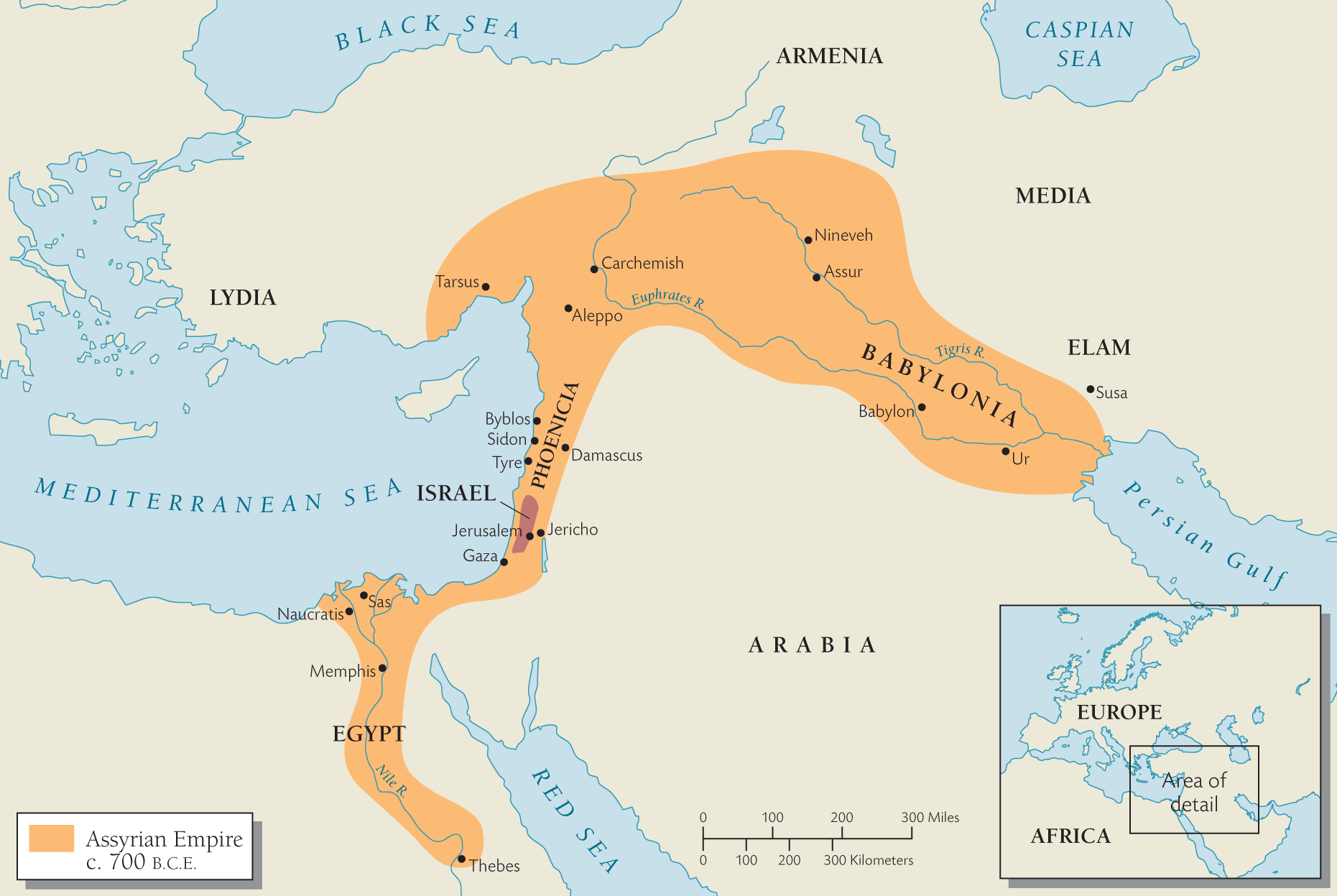
The map defines the territorial boundaries of the empire. The boundaries of the Assyrian Empire range from Thebes in Egypt along the Nile River, to the western coast of Arabia along the Mediterranean Sea, and includes a large region surrounding the Tigris and Euphrates Rivers. Israel is not included in the Assyrian Empire.
THE NEO-ASSYRIAN EMPIRE, C. 700 B.C.E.■ What were the territorial boundaries of the Neo-Assyrian Empire? ■ Why would the Assyrians concentrate their efforts in the river valleys and along the coast, neglecting the Syrian interior? ■ Notice the location of the Neo-Assyrian capitals of Nineveh and Assur; how was their situation in Mesopotamia likely to affect the Assyrians’ sense of their own historical identity? ■ Consider the position of Egypt. Why might the Assyrians find it difficult to subjugate Egypt permanently?
Analyzing Primary Sources
The Men of Israel Demand a King
According to the Book of Samuel in the Hebrew Bible, Samuel was a charismatic and trusted tribal judge of the Hebrews, who was compelled to open a new chapter in the political history of Israel by choosing a king to rule over them. But Samuel’s choice, Saul, was not a successful leader, and Samuel ultimately turned against him, supporting Saul’s rival (and son-in-law), David. The following account describes the ambivalence that Samuel—and, perhaps, the author of the text—felt about having a human king at all: doubts that Saul himself may have shared.
When Samuel became old, he made his sons judges over Israel. The name of his first-born son was Jo’el, and the name of his second, Abi’jah; they were judges in Beer-sheba. Yet his sons did not walk in his ways, but turned aside after gain; they took bribes and perverted justice.
Then all the elders of Israel gathered together and came to Samuel at Ramah, and said to him, “Behold, you are old and your sons do not walk in your ways; now appoint for us a king to govern us like all the nations.” But the thing displeased Samuel when they said, “Give us a king to govern us.” And Samuel prayed to the LORD. And the LORD said to Samuel, “Hearken to the voice of the people in all that they say to you; for they have not rejected you, but they have rejected me from being king over them. According to all the deeds which they have done to me, from the day I brought them up out of Egypt even to this day, forsaking me and serving other gods, so they are also doing to you. Now then, hearken to their voice; only, you shall solemnly warn them, and show them the ways of the king who shall reign over them.”
So Samuel told all the words of the LORD to the people who were asking a king from him. He said, “These will be the ways of the king who will reign over you: he will take your sons and appoint them to his chariots and to be his horsemen, and to run before his chariots; and he will appoint for himself commanders of thousands and commanders of fifties, and some to plow his ground and to reap his harvest, and to make his implements of war and the equipment of his chariots. He will take your daughters to be perfumers and cooks and bakers. He will take the best of your fields and vineyards and olive orchards and give them to his servants. He will take the tenth of your grain and of your vineyards and give it to his officers and to his servants. He will take your menservants and maidservants, and the best of your cattle and your asses, and put them to his work. He will take the tenth of your flocks, and you shall be his slaves. And in that day you will cry out because of your king, whom you have chosen for yourselves, but the Lord will not answer you in that day.”
Israel’s Request for a King Granted
But the people refused to listen to the voice of Samuel; and they said, “No! but we will have a king over us, that we also may be like all the nations, and that our king may govern us and go out before us and fight our battles. And when Samuel had heard all the words of the people, he repeated them in the ears of the LORD. And the LORD said to Samuel, “Hearken to their voice, and make them a king.” Samuel then said to the men of Israel, “Go every man to his city.”
Source: Samuel 8:1–22, Revised Standard Version of the Bible (Division of Christian Education of the National Council of the Churches of Christ in the United States of America: 1971).
Questions for Analysis
What view of kingship emerges in this account? What are the attributes of a king? What is the relationship among the king, his god, and his people? What is the role of the people in his selection?
Given what we have learned about the Hebrew tribes’ precarious position during the early Iron Age, what would you imagine to be the reasons that compelled the men of Israel to demand a king?
Given that this passage describes Samuel’s doubts about kingship and his reluctance to appoint a king, why do you think that it was preserved in the Book of Samuel?
Neo-Assyrian Government and Administration
The Neo-Assyrian Empire was a military dictatorship, built on the ability of its army to spread terror and oppress both enemies and subjects alike. At its head was a hereditary monarch regarded as the earthly representative of the Assyrians’ patron god, Assur. When his army was not in the field, the king’s time was taken up with elaborate sacrifices and rituals to appease the “great god.” Divination and the consultation of oracles were central features of this religion, because the Neo-Assyrian king—as chief priest—had to be able to discern the will of Assur through the portents of nature.
Supporting the empire’s centralized authority was an extensive bureaucracy of governors, high priests, and military commanders—professions by no means mutually exclusive. These administrators formed the highest class in Neo-Assyrian society and exercised local authority on behalf of the king. They maintained lines of transport and communication, which were the engines of imperial hegemony, and supervised the construction of an extensive network of roads that served these needs for centuries. The Neo-Assyrian state also deployed a system of spies and messengers to report to the royal court on the activities of subjects and provincial governors.
Provincial governors collected tribute, recruited for the army, and administered the king’s law. It is not surprising that the Assyrians, so mindful of historical precedent, modeled their laws on the Code of Hammurabi, though many of their penalties were much more severe. The harshest punishments were reserved for practices deemed detrimental to human reproduction; the penalties for same-sex relations and abortion were particularly severe. Neo-Assyrian law was also rigidly patriarchal. This entailed substantial revision of Hammurabi’s code, which had granted women many rights. Now, only husbands had the power of divorce, and they were legally permitted to inflict a variety of penalties on their wives, ranging from corporal punishment to mutilation and death.
The Assyrian Military-Religious Ethos
The Assyrians’ new religious, political, and military ideology had taken shape during the long centuries when they fought for survival, and it then became the foundational ethos for their empire’s relentless conquests. Its two fundamental tenets were the waging of holy war and the exaction of tribute through terror.
The Neo-Assyrians were convinced that their god demanded the constant expansion of his worship through military conquest. Essentially, their army belonged to Assur, and all who did not accept Assur’s supremacy were, by that fact alone, enemies of Assur’s people. Ritual humiliation of a defeated city’s gods was therefore a regular feature of conquest. Statues of conquered gods would be carried off to the Neo-Assyrian capital, where they would remain as hostages at the court of Assur. Meanwhile, an image of Assur himself—usually represented as a sun disk with the head and shoulders of an archer—would be installed in the defeated city, and the conquered people would be required to worship him. Although conquered peoples did not have to abandon their previous gods altogether, they were made to feel their gods’ inferiority. The Assyrians were therefore strict henotheists, meaning that they acknowledged the existence of other gods but believed that one god should be the supreme deity of all peoples.
For the Neo-Assyrians, “receiving tribute” meant the taking of plunder. Rather than defeating their foes once and imposing formal obligations, the Assyrians raided even their vanquished foes each year. This strategy kept the Neo-Assyrian military machine primed for battle, but it did little to inspire loyalty among subject peoples, who often felt that they had nothing to lose through rebellion. Moreover, annual invasions toughened the forces of the Neo-Assyrians’ subjects. To counter them, imperial battle tactics became notoriously savage—even by the standards of ancient warfare, which regarded the mutilation of prisoners, systematic rape, and mass deportations as commonplace. Neo-Assyrian artwork and inscriptions often celebrate the butchering and torture of their enemies. Smiling archers are shown shooting fleeing enemies in the back while remorseless soldiers impale captives on stakes.
The Neo-Assyrian army was not a seasonal army of part-time warriors or peasant conscripts, but rather a massive standing force of more than 100,000 soldiers. Because the Assyrians had mastered iron-smelting techniques on a large scale, they could equip their fighting men with high-quality iron weapons that overwhelmed opponents still reliant on bronze. The organization of this army also contributed to its success. At its core were heavily armed and armored shock troops, equipped with a variety of thrusting weapons and bearing tall shields for protection. They were the main force for crushing enemy infantry in the field and for routing the inhabitants of an enemy city once inside. To harass enemy infantry and break up their formations, the Assyrians deployed light skirmishers with slings and javelins, and they combined archery and chariotry as never before. They also developed the first true cavalry force in the West, with individual warriors mounted on armored steeds, wielding bows and arrows or heavy lances. They even trained a highly skilled corps of combat engineers to undermine city walls and to build catapults, siege engines, battering rams, and battle towers.
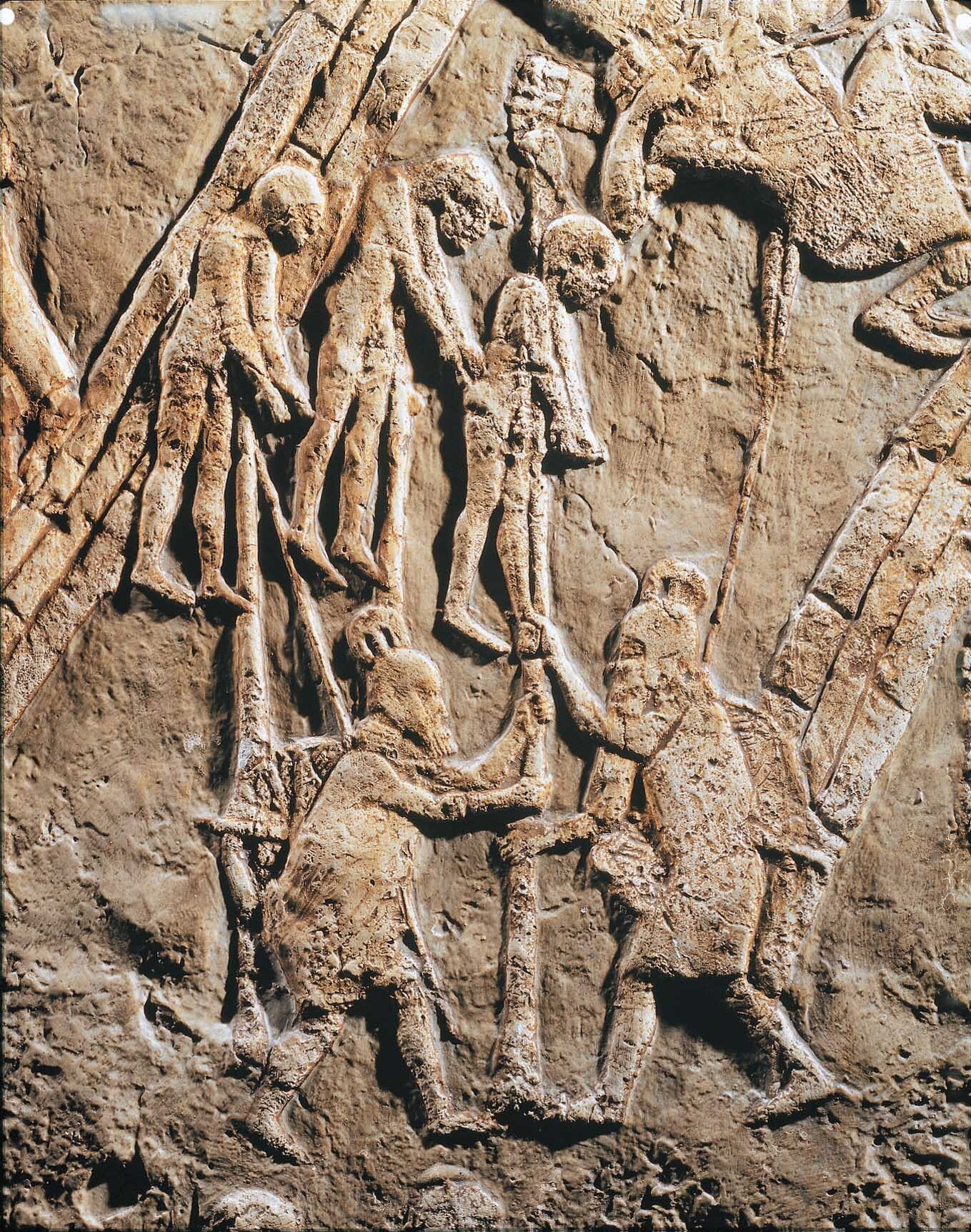
NEO-ASSYRIAN ATROCITIES. Judean captives whose city had fallen to the Neo-Assyrian king Sennacherib (704–681 B.C.E.) are shown being impaled on stakes. This triumphal carving comes from the walls of Sennacherib’s palace at Nineveh. ■ What was the purpose of advertising these captives’ fates?
The Legacy of Neo-Assyrian Power
The successors of Sargon II continued these military policies while devoting great energy to promoting an Assyrian cultural legacy. Sargon’s immediate successor, Sennacherib (sen-AH-sher-ib; 704–681 B.C.E.), rebuilt the ancient Assyrian city of Nineveh, fortifying it with a double wall for a circuit of nine miles. He constructed an enormous palace there, raised on a giant platform decorated with marble, ivory, and exotic woods; and he ordered the construction of a massive irrigation system, including an aqueduct that carried fresh water to the city from thirty miles away. His son rebuilt the conquered city of Babylon along similar lines and was also a patron of the arts and sciences. His grandson Assurbanipal (ah-sur-BAHN-ih-pahl; r. 669–627 B.C.E.) was perhaps the greatest of all the Neo-Assyrian kings. For a time, he ruled the entire delta region of northern Egypt and also enacted a series of internal reforms, seeking ways to govern his empire more peacefully.
By Neo-Assyrian standards, Assurbanipal was an enlightened ruler, and one to whom we owe a tremendous debt. Like Sargon II before him, he had a strong sense of the rich traditions of Mesopotamian history and laid claim to them. But he did this much more systematically: he ordered the construction of a magnificent library at the great capital of Nineveh, where all the cultural monuments of Mesopotamian literature were to be copied and preserved. This library also was an archive for the correspondence and official acts of the king. Fortunately, this trove of documentation has survived. Our knowledge of history, not to mention all modern editions of the Epic of Gilgamesh, ultimately derive from the library at Nineveh.
Climate Change and Civilizational Collapse
When Assurbanipal died in 627 B.C.E., the Neo-Assyrian Empire appeared to be at its zenith. Its borders were secure, the realm was largely at peace with its neighbors, its kings had adorned their capitals with magnificent artwork, and the hanging gardens of Babylon were already famous: these were artificial slopes whose cascading flowers and trees were fed by irrigation systems that pumped water uphill, an amazing marriage of engineering and horticulture.
The collapse of this empire is therefore all the more dramatic for its suddenness. Within fifteen years of Assurbanipal’s reign, Nineveh lay in ruins and the other cities of the empire were abandoned. Moreover—adding to the mystery—archeologists have determined that most of these cities were never resettled. What had caused this precipitous decline?
More information
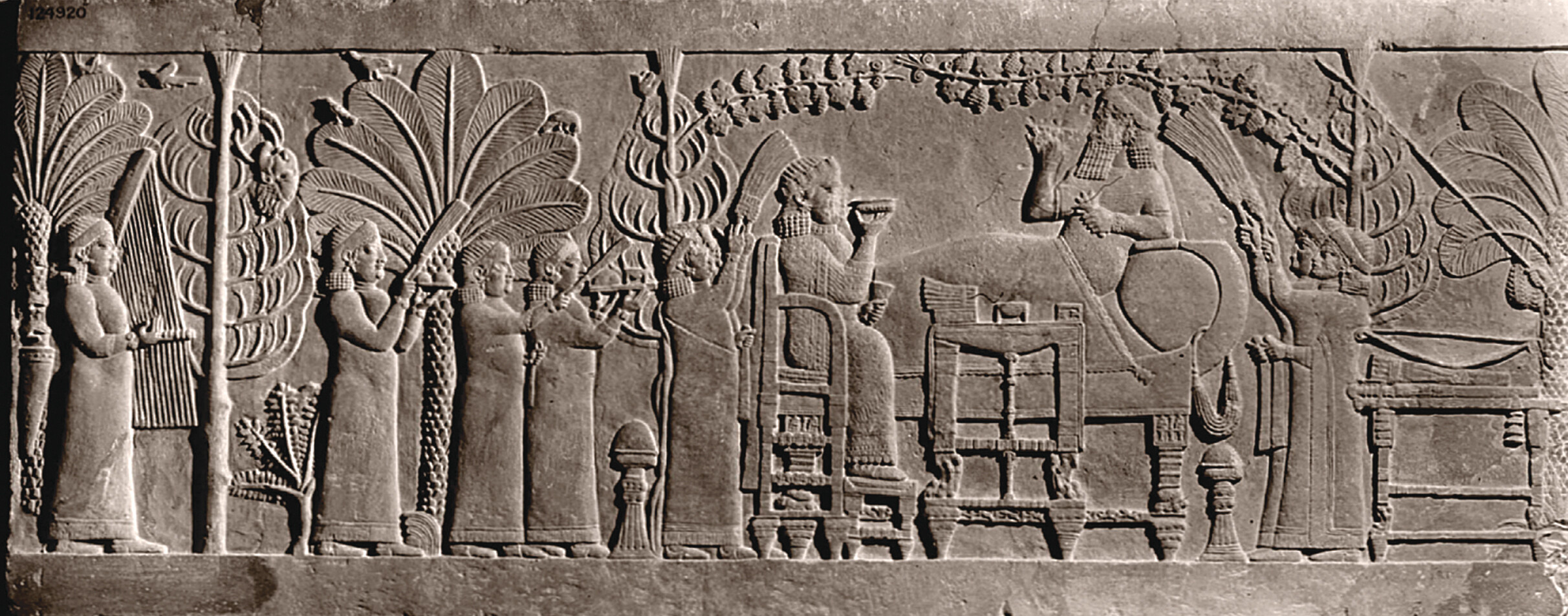
In the carving, the queen and king are sipping a drink. The queen sits on a chair while the king leans on a bed with his legs stretched. There are four servants playing music and one fanning the queen. Another servant fans the king. Next to one of the servants, who plays music, is a severed head hanging from a pine tree.
ASSURBANIPAL FEASTING WITH HIS WIFE IN A HANGING GARDEN. Even in this peaceful, domestic scene, the severed head of the king’s recently defeated enemy, the king of Elam, can be seen hanging from the pine tree on the left.
Until very recently, historians explained the fall of the Neo-Assyrian Empire by pointing to an alliance that had formed between the Medes of Iran and the Chaldeans, a Semitic people who controlled the southern half of Babylonia. But while it is evident that the Chaldeans eventually occupied Babylon and controlled the upper Euphrates, their successes were largely coincidental. The true cause of Neo-Assyrian decline was a decades-long drought induced by climate change and worsened by environmental degradation due to overfarming of cereal crops (as discussed in Chapter 1). The Neo-Assyrian power-bases were therefore emptied of inhabitants, who either died of famine or became climate refugees.
Meanwhile, the Chaldeans became the predominant imperial power in Mesopotamia and the Levant. In 586 B.C.E., they captured Jerusalem and destroyed the Temple, deporting the population of Judah to Babylon. Meanwhile, the Medes retired to the Iranian plateau to extend their suzerainty there.
(883–859 B.C.E. to 612–605 B.C.E.) Assurnasirpal II laid the foundations of the Neo-Assyrian Empire through military campaigns against neighboring peoples. Eventually, the empire stretched from the Mediterranean Sea to western Iran. A military dictatorship governed the empire through its army, which it used to frighten and oppress both its subjects and its enemies. The empire’s ideology was based on waging holy war in the name of its principal god, Assur, and the exaction of tribute through terror.