 The Impact of Persian and Peloponnesian Wars and Their Different Outcomes
THE CHALLENGE OF THE PERSIAN WARS
The profound significance of Greek experiments with new forms of governance and new ideas about the world can be seen with particular clarity if we compare the Greek poleis with the empires and kingdoms of the Bronze Age, in which the typical political regime, as we have seen, was a monarchy supported by a powerful priesthood. In this context, cultural achievements were mainly instruments to enhance the prestige of rulers, and economic life was controlled by palaces and temples. By contrast, the core values of the Greeks were the primacy of the human male and the principles of competition, individual achievement, and human freedom and responsibility. In his history, Herodotus records a conversation between a Greek (in this case a Spartan) and a Persian, who expresses surprise that the Greeks should raise spears against the supposedly benign rule of his emperor. The Spartan retorts, “You understand how to be a slave, but you know nothing of freedom. Had you tasted it, you would advise us to fight not only with spears but with axes.” How the Greeks came to turn those spears on each other within a few generations of their united victory is a story worthy of one of their own tragedies.
The two major wars fought between the uneasily unified Greeks and the vast empire of the Persians, known as the Persian Wars, were understood as defining events by those who witnessed and looked back on them. From the first, the contest was unequal. Persia was the largest and most efficient state the world had ever seen, capable of mustering more than a million armed men. The Greeks, by contrast, remained a collection of disparate communities, fiercely competitive and suspicious of one another. An exceptionally large polis, such as Athens or Sparta, might put 10,000 hoplites in the field; but the vast majority of Greek states could only provide a few hundred each. So the threat of Persian conquest loomed large on the Greek horizon, and the experience of warfare on a global scale changed the Greek world immeasurably.
More information
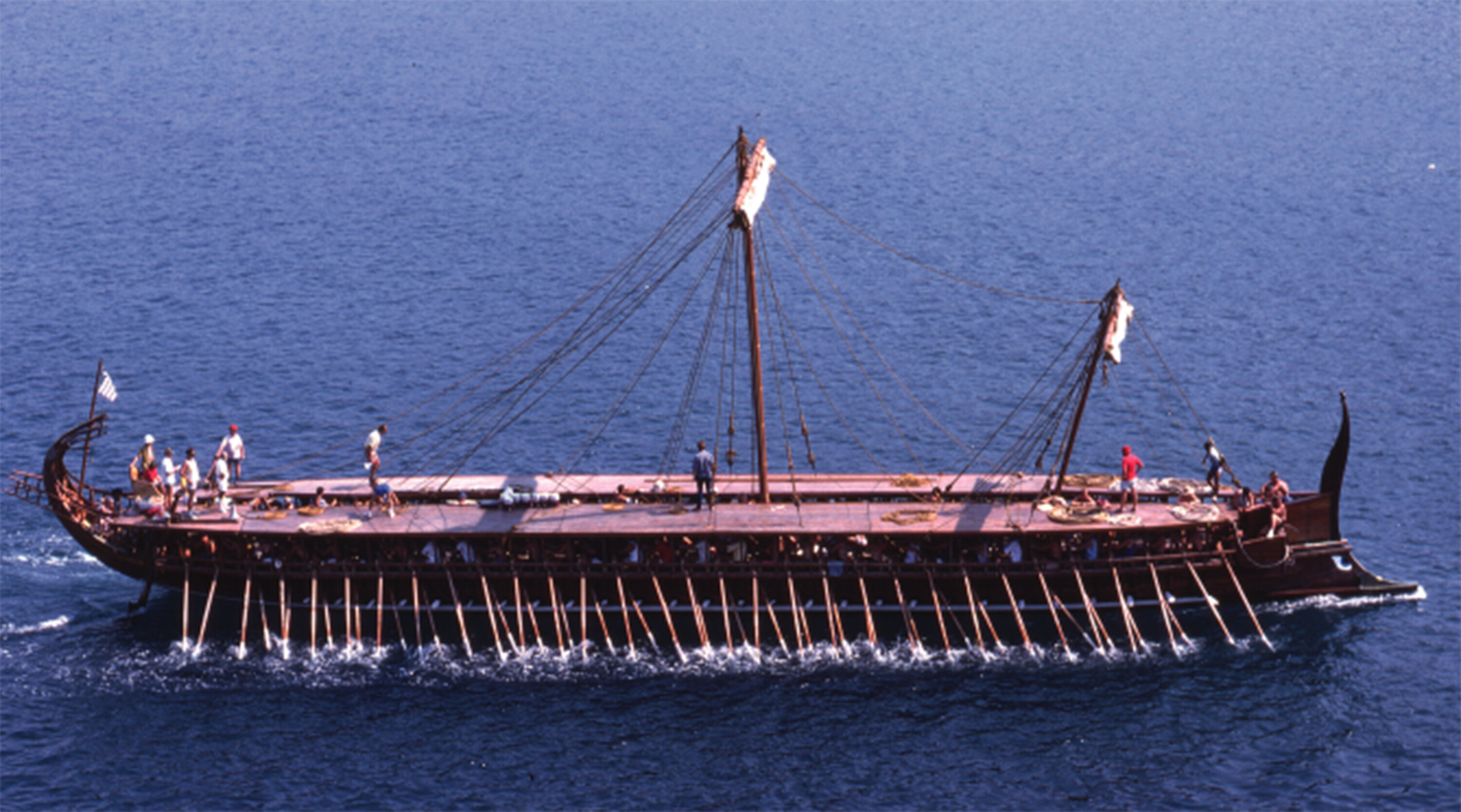
The ship is long and has a very flat surface. Many oars reach from the sides of the ship into the water.
The Ionian Revolt (499–494 B.C.E.)
For the first time in the history of Western civilizations, we can follow the unfolding of events of the wars through the narrative of a contemporary historian, Herodotus, the first person who self-consciously set out to write an account of his own times in careful, unambiguous prose—rather than in the form of heroic poetry or the boastful language of victorious inscriptions. And lucky for us, Herodotus was uniquely qualified to probe the long-term and more immediate causes of the Persian Wars. Raised in the Ionian polis of Halicarnassus, he was a product of the hybrid culture discussed previously. He was also a keen observer of human nature and human diversity. He regarded both the Greeks and the Persians as great peoples. Yet as a Greek himself—albeit one born within the Persian dominion—he was not impartial. Indeed, his surviving account reflects many of the intellectual currents of mid-fifth-century Athens, where he spent the better part of his career, as well as many Athenian prejudices. This is something that must be borne in mind when reading his work.
Herodotus wanted to show that the war between the Persians and Greeks had ancient roots and could be traced back to long-standing differences (as mentioned earlier). But his narrative also shows that the catalyst was not cultural; it was a political conflict in Miletus. In 501 B.C.E., the city was governed by Aristagoras (EHR-is-STAG-or-uhs), a tyrant who owed his power to the backing of the Persian emperor, Darius (Chapter 2). But Aristagoras apparently came to believe that his days as the emperor’s favorite were numbered. So he turned abruptly from puppet to patriot, rousing the Milesians and the rest of Ionia to revolt against Persian rule. As a safeguard, he also sought military support from the sympathetic poleis on the Greek mainland.
The Spartans refused to send their army abroad, but Athens and Eretria (er-eh-TREE-uh), on the island of Euboea (you-BOY-ah), agreed to send twenty-five ships and crews. This small force managed to capture the old Lydian capital of Sardis (by then a Persian administrative center) and burn it to the ground. Then the Athenians and Eretrians went home, leaving the Ionians to their own devices. In 494 B.C.E., the rebellious poleis were finally overwhelmed by the vastly superior might of Persia.
Darius realized, however, that so long as his Greek subjects in Ionia could cast a hopeful eye to their neighbors across the Aegean, they would forge alliances with them. He therefore decided to launch a preemptive strike against Athens and Eretria, to teach these upstart poleis a lesson. In the summer of 490 B.C.E., a punitive expedition of 20,000 soldiers, under two of Persia’s finest generals, crossed the Aegean and landed on the coast of Euboea. Their forces sacked and burned Eretria to the ground, sending its population into captivity in Persia. They then crossed the narrow strait to Attica, landing on the plain of Marathon, approximately twenty-six miles from Athens.
Marathon and Its Aftermath
When the Persians landed in Attica, the Athenians quickly called on the only polis that could conceivably help them: Sparta. But the Spartans responded that they were unable to assist—they were celebrating a religious festival. Only the small, nearby polis of Plataea offered the Athenians aid. The Athenian and Plataean hoplites would have to engage the mighty Persians on their own.
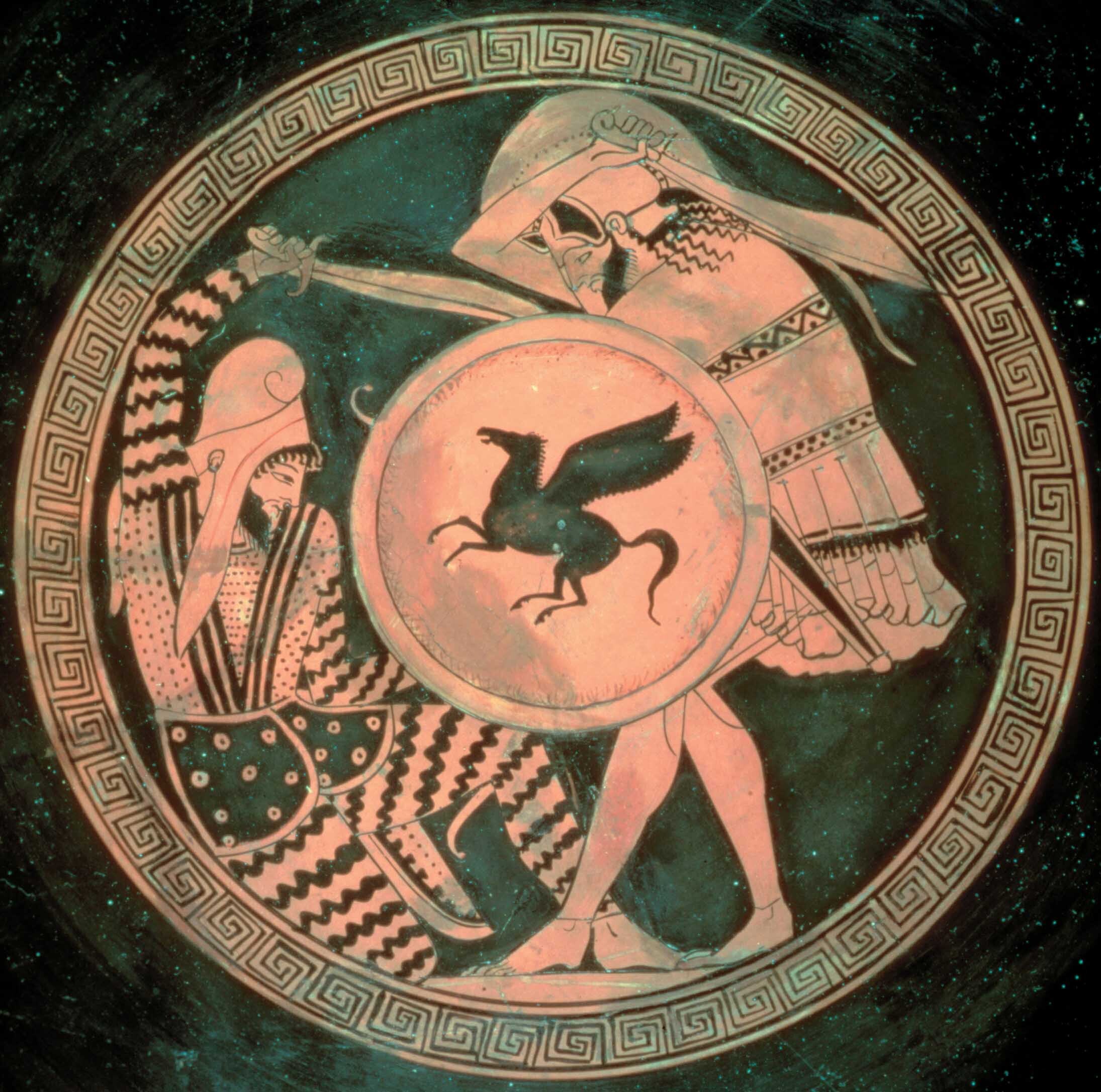
Heavily outnumbered and without effective cavalry to counter that of the Persians, the Athenian phalanx took a position between two hills blocking the main road to the polis. After a standoff of several days, the Athenian general Miltiades (mil-TIE-uh-dees) received word that the Persians were watering their horses and that the Persian infantry was vulnerable to attack. So Miltiades led a charge that smashed the Persian force, resulting in crippling losses. In an almost unbelievable victory, the Athenians had defeated the world’s major imperial power, and they had done it without Spartan help. It was a vindication of hoplite tactics and a tremendous boost to Athenian confidence.
Yet the Athenian politician Themistocles (the-MIS-toh-klees) warned that the Persians would not suffer such humiliation quietly and would retaliate with an even larger force. So when the Athenians discovered a rich vein of silver ore in the Attic countryside a few years later, Themistocles persuaded them not to divide the windfall among themselves (the customary practice) but to finance a fleet of 200 triremes, state-of-the-art warships. Athens thereby transformed itself into the preeminent naval power of the Greek world, just in time to confront a new Persian onslaught.
More information
The soldier on the left lowers to the ground and wears chainmail and trousers. The soldier on the right wears a tunic and carries a shield that has an image of a horse with wings on it.
Xerxes’ Invasion
Darius the Great died in 486 B.C.E. and was succeeded by his son Xerxes (ZERK-sees), who almost immediately began preparing a massive overland invasion of Greece designed to conquer the entire territory, thus eradicating any future threats to Persian imperial expansion while avenging his father’s shame. Supported by a huge fleet of 600 ships, this grand army (which numbered at least 150,000 men and may have been as large as 300,000) set out from Sardis in 480 B.C.E., crossing the Hellespont, the narrow strait separating Europe from Asia. Unlike his father, who had dispatched talented generals against Athens, Xerxes led this campaign himself.
More information
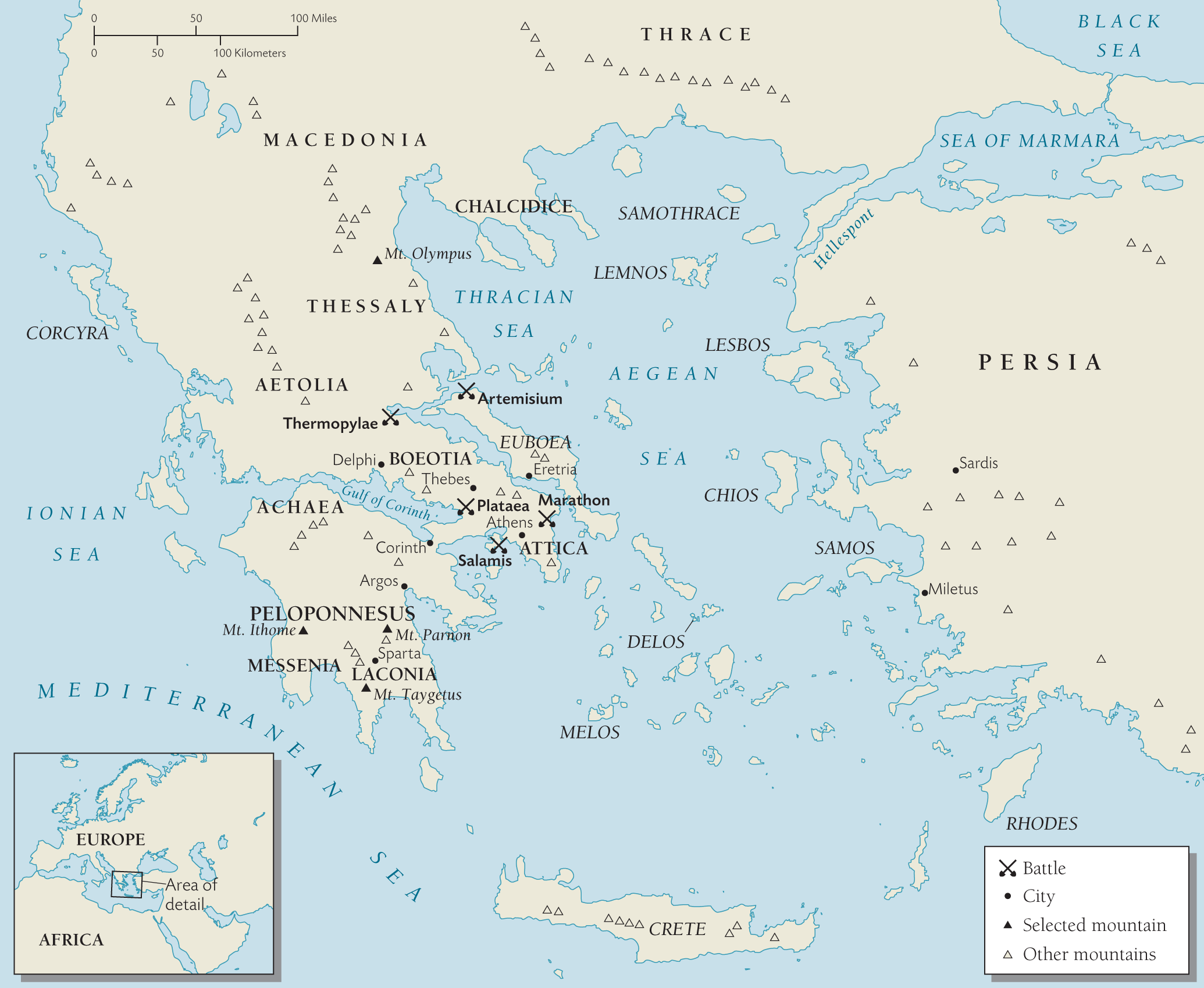
A smaller inset map shows that the area of detail is part of southern Europe that reaches into the Mediterranean Sea. Major battles labeled on this map include Artemisium, Thermopylae, Plataea, Marathon, and Salamis. Major cities that are plotted include Delphi, Thebes, Eretria, Athens, Corinth, Argos, Sparta, Sardis, and Miletus. Selected mountains that are plotted include Mount Olympus, Mount Ithome, Mount Parnon, and Mount Taygetus.
Many Greek poleis capitulated immediately. But Athens, Sparta, Corinth, and some thirty others refused to surrender. Instead, they hastily formed the Hellenic League, an unprecedented alliance forged in the face of an unprecedented external threat. In August of 480 B.C.E., a major Persian offensive was held at bay when the outnumbered Greek allies, under the military leadership of Sparta, confronted Xerxes at the mountain pass of Thermopylae (ther-MO-puh-lie). For three days, they valiantly held off the Persian multitude, whose way through the narrow pass was effectively blocked. Meanwhile, a Greek fleet led by Athens and guided by Themistocles engaged a Persian flotilla off the Attic coast. The Spartans’ defense of Thermopylae ultimately failed, but their sacrifice allowed the new Athenian warships to inflict heavy losses on the Persians.
However, these engagements left Athens without any men to defend the city. Themistocles therefore persuaded the entire population to abandon Athens for the island of Salamis. From there, the Athenians watched the Persians torch their city. Time, however, was on their side. Xerxes’ massive army depended on his damaged fleet for supplies, and the Persians’ military tactics—which included a heavy reliance on cavalry and chariots—were not adapted for the rocky terrain of Greece. Bad weather also made sailing the Aegean in autumn a risky business; the Persians were now desperate to force a decisive battle and return home before the season turned against them.
In late September, the vastly superior Persian fleet sailed into the straits of Salamis, believing that the Athenians were preparing to flee the island. The report turned out to be false, but so confident was Xerxes that he had a throne placed on the headland above the bay, where he would have a good view of his victory. Instead, he watched as the battle-ready Athenian triremes demolished the Persian fleet. This was the turning point of the war. Xerxes retreated with the majority of his army to Persia, while an elite force stayed behind. But when the allied Greek army met the Persians on favorable terrain the next spring—an open plain near Plataea, which had been razed the year before—the Greeks prevailed. Against all odds, the small, fractious poleis had defeated the mightiest army of the known world.
Glossary
- Persian Wars
- (490–479 B.C.E.) In 501 B.C.E., a political conflict between the Greek ruler of Miletus, Aristagoras, and the Persian emperor, Darius, sparked the first of the Persian Wars when Darius sent an army to punish Athens for its intervention on the side of the Greeks. Despite being heavily outnumbered, Athenian hoplites defeated the Persian army at the plain of Marathon. In 480 B.C.E., Darius’s son Xerxes invaded Greece but was defeated at sea and on land by combined Greek forces under the leadership of Athens and Sparta.
- Darius
- (521–486 B.C.E.) The Persian emperor whose conflict with Aristagoras, the Greek ruler of Miletus, ignited the Persian Wars. In 490 B.C.E., Darius sent a large army to punish the Athenians for their intervention in Persian imperial affairs, but this force was defeated by Athenian hoplites on the plain of Marathon.
- Xerxes
- (519?–465 B.C.E.) Xerxes succeeded his father, Darius, as Great King of Persia. Seeking to avenge his father’s shame and eradicate any future threats to Persian hegemony, he launched his own invasion of Greece in 480 B.C.E. An allied Greek army defeated his forces in 479 B.C.E.