2
Peoples, Gods, and Empires, 1700–500 B.C.E.
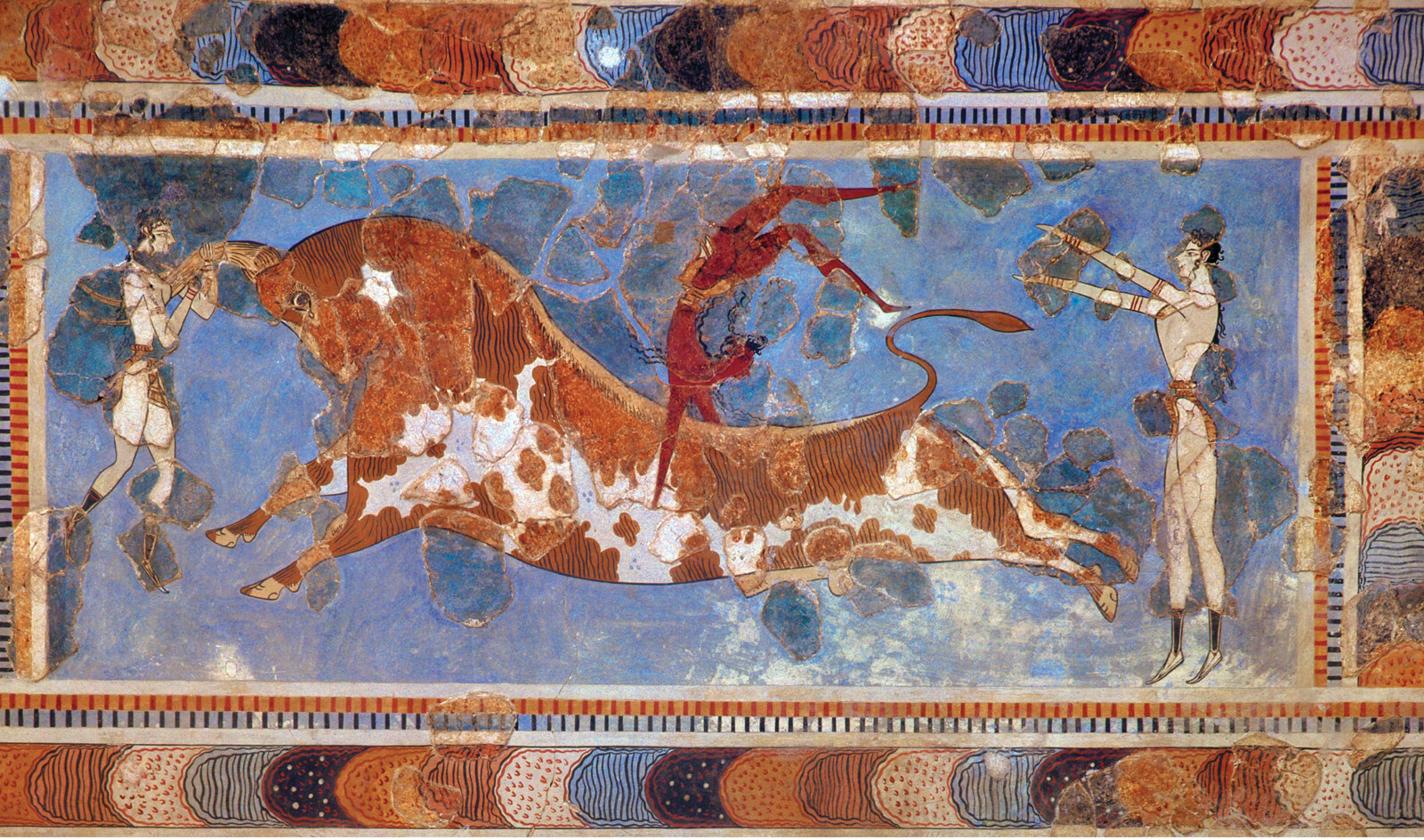
More information
The first man directly faces the bull grabbing the bull by its horns. The second man is upside down with his front facing the bull’s head on top of the bull. The third man faces the back of the bull and has his arms extended in front of him.

BEFORE YOU READ THIS CHAPTER |
 |
STORY LINES
- During the second millennium B.C.E., new peoples migrated into Eurasia, introducing a related set of Indo-European languages that are the ancestors of several modern language groups.
- In Egypt, the rise of the Eighteenth Dynasty fostered imperial expansion beyond the Nile Valley for the first time.
- During the Late Bronze Age, an interconnected network of alliances bound societies together in new ways. But these civilizations were eventually destroyed or weakened by the raids of mysterious Sea Peoples.
- In the wake of these events, both oppressive new empires and smaller-scale states emerged.
- In the Iron Age, the worship of Yahweh among the Hebrews, and of Ahura-Mazda among the Persians, fostered a new view of the world: one in which a single creator god ruled over all peoples.
CORE OBJECTIVES
- DESCRIBE the impact of new migrations and settlements on ancient civilizations.
- DEFINE the differences between Egypt’s New Kingdom and the previous Old and Middle Kingdoms.
- EXPLAIN the workings of commercial and cultural networks during the Late Bronze Age.
- IDENTIFY the new empires and kingdoms that emerged during the Iron Age.
- UNDERSTAND the historical importance of monotheism.
ACCORDING TO HESIOD, a Greek poet who flourished during the eighth century B.C.E., all of human history falls into five ages. The dawn of time was a golden age, when men lived like gods. Everything was good then, food was plentiful, and work was easy. The next age was silver, when men took gods for granted, killed one another, and lived in dishonor. So the gods destroyed them, sending a mighty flood that spared only the family of Deucalion, the son of wily Prometheus, who built an ark. Then came the age of bronze, when everything was made of bronze—houses and armor and weapons and tools. Giants fought incessantly from huge strongholds, causing destruction so great that no man’s name survives. The time following was short but bright, a heroic age, the time of men who traveled with Theseus and fought with Achilles and sailed with Odysseus, men whose names will live forever. But Hesiod’s own age was iron: a dull age, a time of tedium and strife and petty feuds.
Hesiod’s periodization captures an understanding of history that reflects actual developments. The stories he knew told of a time before cities and the need for agriculture. They recalled a time when the human race was saved by one legendary hero: the Sumerian Utnapishtim, the Hebrew Noah, or the Greek Deucalion. They chronicled the wars of an age we still call Bronze, when enormous palaces (abandoned by Hesiod’s day) had been built. And they remembered the race of warriors whose glory was measured by their abiding fame. Thanks to new archaeological finds, linguistic discoveries, and efforts at decoding the historical record, we can both confirm and correct Hesiod’s perspective on the past.
In the second millennium B.C.E., Western civilizations were transformed by the arrival of new peoples and the emergence of extensive land-based empires built up through systematic military conquest. These migrations and conquests caused enormous upheaval, but they also led to intensified cultural contact and economic integration in a network that not only encompassed the Mediterranean but extended from Scandinavia to China.
Yet this extraordinary system proved more fragile than its participants could have imagined. Around 1200 B.C.E., a wave of mysterious invasions led to the destruction of nearly every established Mediterranean civilization. As a result, around the turn of the first millennium B.C.E., we enter a world organized along profoundly different lines. In this Iron Age, iron would slowly replace bronze as the primary component of tools and weapons. New and more brutal empires would come to power, while new ideas about the divine and its relationship to humanity would emerge. Two of the Western world’s most enduring religious traditions—Judaism and Zoroastrianism—were born, fundamentally altering conceptions of ethics, politics, and the natural world.