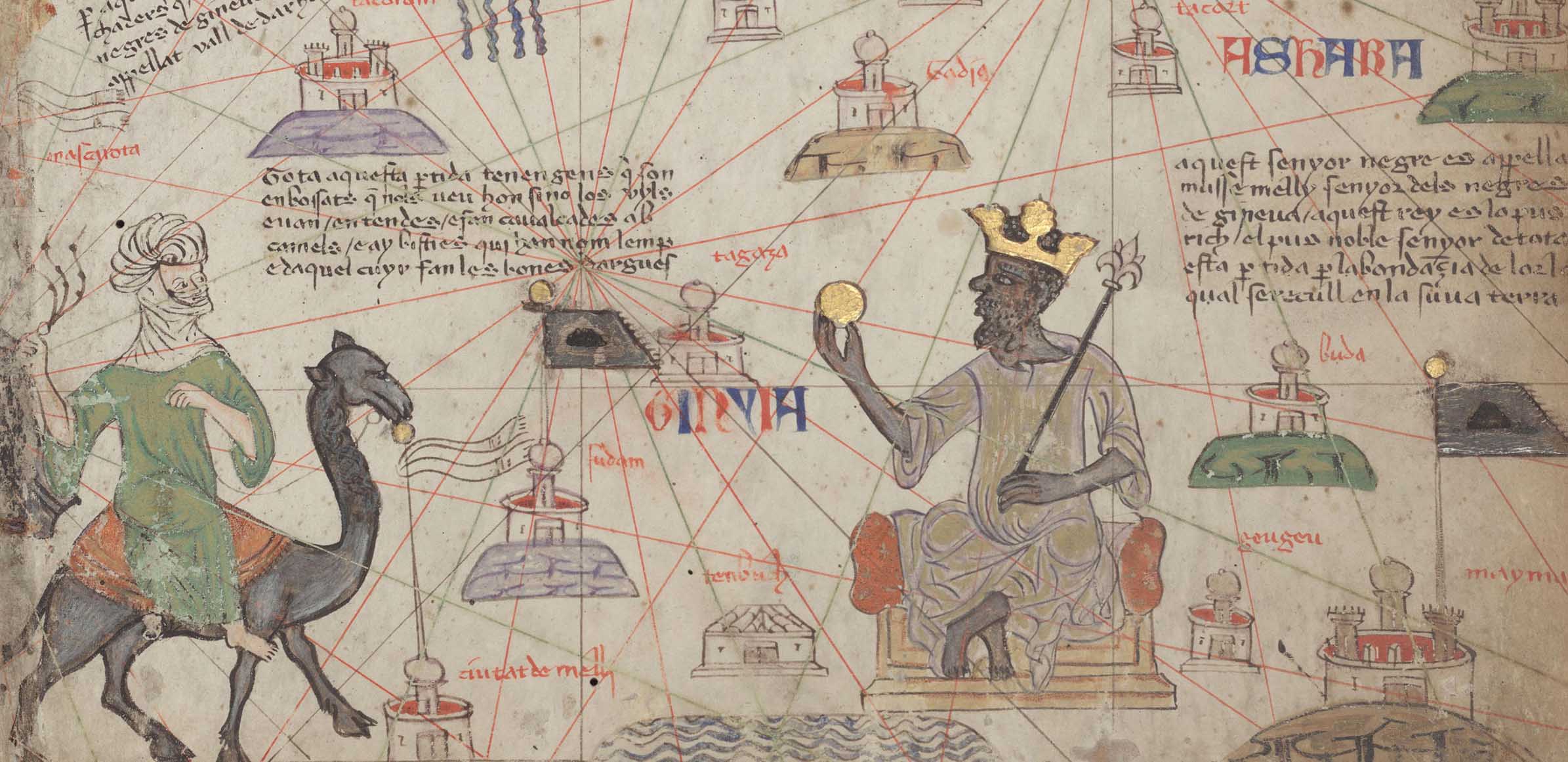
The Mongol Empire widened channels of communication, commerce, and cultural exchange between Europe and the Far East. At the same time, Europeans were extending their reach into the Atlantic Ocean.
Western civilizations’ integration with this wider medieval world led to new ways of mapping, measuring, and describing that world.
Despite these broadening horizons, most Europeans’ lives were bounded by their communities and focused on the parish church.
Meanwhile, the growing strength of the kings of France and England drew them into territorial disputes that led to the Hundred Years’ War.
As global climate change affected the ecosystems of Europe and caused years of famine, the integrated networks of the medieval world facilitated the rapid transmission of the Black Death.
CHRONOLOGY
1206–1279Rapid expansion of the Mongol Empire under Genghis Khan and his heirs
1240The territory of Rus’ is dominated by the Mongols; Mongol Khanate of the Golden Horde established
1260–1294Reign of Kublai Khan, Great Khan, and emperor of China
1271–1295Travels of Marco Polo
1309“Babylonian Captivity” of the papacy in Avignon begins
1315–1322The Great Famine in Europe
1320The Declaration of Arbroath proclaims Scotland’s independence from England
1326–1354The travels of Ibn Battuta
1337Beginning of the Hundred Years’ War
1347–1353Spread of the Black Death in Europe
1350Circulation of Mandeville’s Book of Marvels
CORE OBJECTIVES
DESCRIBE the effects of the Mongol conquests.
IDENTIFY the key characteristics of the medieval world system.
UNDERSTAND the reasons for the papacy’s loss of prestige and the rise of strong secular monarchs.
DEFINE the concept of sovereignty and its importance.
EXPLAIN the rapid spread of the Black Death in this historical context.
When Christopher Columbus set out to find a new trade route to the East, he carried with him two influential travel narratives written centuries before his voyage. One was The Book of Marvels, composed around 1350 and attributed to John de Mandeville, an English adventurer (writing in French) who claimed to have reached the far horizons of the globe. The other was Marco Polo’s Description of the World, an account of that Venetian merchant’s journey through the vast Eurasian realm of the Mongol Empire to the court of the Great Khan in China. He had dictated it to an author of popular romances around 1298, when both men (Marco Polo and his ghostwriter) were in prison—coincidentally, in Columbus’s own city of Genoa. Both books were the product of an extraordinary era of unprecedented interactions among the peoples of Europe, Asia, and the interconnected Mediterranean world. And both became highly influential, inspiring generations of mercantile adventurers, ambitious pilgrims, and armchair travelers. Eventually, they would fuel the imaginations of those future mariners who launched a further age of discovery (see Chapter 3).
In many ways, these narratives were as fantastical as they were factual, making them problematic sources for historians. But they are representative of an era that seemed wide open to every sort of influence. This was a time when ease of communication and commercial exchange made Western civilizations part of an interlocking network that had the potential to span the globe. Although this network would prove fragile in the face of a large-scale demographic crisis, the Black Death, it created a lasting impression of infinite possibilities. Indeed, it was only because of this network’s connective channels that the Black Death wreaked such devastation, beginning—as recent research shows—in Asia at least a century before its arrival in Europe around 1347. Looking back, we can see the century leading up to this near-worldwide crisis as the beginning of a new global age.
Europeans’ integration with this widening world not only put them into contact with unfamiliar cultures and commodities but it also opened up new ways of looking at the world they already knew. Novel artistic and intellectual responses are discernible in this era, as are a host of new inventions and technologies. At the same time, involvement in this wider world placed new pressures on long-term developments within Europe, notably the growing tensions among large territorial monarchies, and between these secular powers and the authority of the papacy. By the early fourteenth century, the papal court was literally held hostage by the king of France. A few decades later, the king of England openly declared his own claim to the French throne. The ensuing struggles for sovereignty would have a profound impact on the balance of power in Europe, and further complicate Europeans’ relationships with one another and with their far-flung neighbors.