Citizenship: Participation, Knowledge, and Efficacy
Describe the rights and responsibilities that citizens have in a democracy
In a democracy, citizenship can be defined as membership in a political community that provides legal rights and carries participation responsibilities.7 Civil liberties and rights such as freedom of speech, freedom of worship, and trial by jury are identified in the Constitution—particularly in the Bill of Rights (see Chapters 2 and 4). Citizens also have responsibilities, such as upholding the Constitution; obeying federal, state, and local laws; paying taxes; and serving on juries when called. Because political participation is the hallmark of democratic government and the source of its legitimacy, citizens also have a responsibility to be informed about issues and to take part in the democratic process.8
One key ingredient for political participation is political knowledge. Democracy functions best when citizens have the knowledge needed to engage in political debate. Having political knowledge means more than having a few opinions to post on social media or to guide your decisions in a voting booth. It is also important to know the rules and processes that govern political institutions and the principles they rest on, and to know them in ways that relate to your own interests. If your street is blocked by snow, for example, you need to know that snow removal is a city or county responsibility and to be able to identify the agency that deals with the problem. Americans are fond of complaining that government isn’t responsive to their needs, but in some cases they simply lack the information needed to present their problems to the appropriate officials.
FOR CRITICAL ANALYSIS
Many studies seem to show that most Americans know very little about government and politics. Can we have democratic government without knowledgeable and well-informed citizens? Why or why not?
Likewise, without political knowledge, citizens cannot be aware of their stakes in political disputes. For example, during the 2017 debate about whether to repeal the health care reform enacted in 2010, one-third of Americans did not know that “Obamacare” and the “Affordable Care Act” are the same thing.9 Therefore, some people who had enrolled in “Obamacare” didn’t realize their access to health insurance would be affected if the ACA were repealed. Citizens need knowledge in order to assess their interests and know when to act on them.
Surveys show that large majorities of Americans get political information online, although inequalities in internet access by income, education, geographic region, race, and age remain. Despite the internet making it easier than ever to learn about politics, actual political knowledge in the United States remains spotty. Disinformation—false information shared intentionally to reach a political goal—complicates the process of acquiring valid political information (see also Chapter 7).10 Even with greater access to information, most Americans know little about current issues or debates, or even the basics of how government works. For example, in 2021 only 56 percent of those surveyed could identify all three branches of the federal government, and only 35 percent knew the term of office for a senator is six years. Just 55 percent correctly identified the party that controlled the House and 61 percent the Senate. However, 83 percent of respondents knew that the Supreme Court has ruled that citizens have a constitutional right to own a handgun (see Table 1.3).
TABLE 1.3What Americans Know about Government
PERCENTAGE OF RESPONDENTS WHO . . .
Could identify all three branches of government
56%
Knew that the First Amendment’s protection of freedom of speech does not mean that Facebook must permit all Americans to freely express themselves on Facebook pages
39
Knew the size of the majority needed in Congress to override a presidential veto (two-thirds)
53
Knew the Supreme Court ruled that citizens have a constitutional right to own a handgun
83
Knew that a 5–4 Supreme Court ruling means the decision is law and needs to be followed
61
Knew that those in the country without authorization have some rights under the U.S. Constitution
55
SOURCES: 2021 and 2019 Annenberg Constitution Day Civics Survey, https://cdn.annenbergpublicpolicycenter.org/wp-content/uploads/2019/09/Annenberg_civics_2019_Appendix.pdf (accessed 1/19/20); www.annenbergpublicpolicycenter.org/2021-annenberg-constitution-day-civics-survey (accessed 3/18/22).
Another ingredient in participation is political efficacy, the belief that ordinary citizens can affect what government does. The feeling that you can’t affect government decisions can lead to apathy, declining political participation, and withdrawal from political life. Americans’ sense of political efficacy has declined over time. In 1960 only 25 percent felt shut out of government. In 2019, 71 percent of survey respondents said that elected officials don’t care what ordinary people think.11 Moreover, 52 percent disagreed with the idea that the “government is really run for the benefit of all the people.”12
WHO PARTICIPATES
Can Young People Make a Difference in Politics?
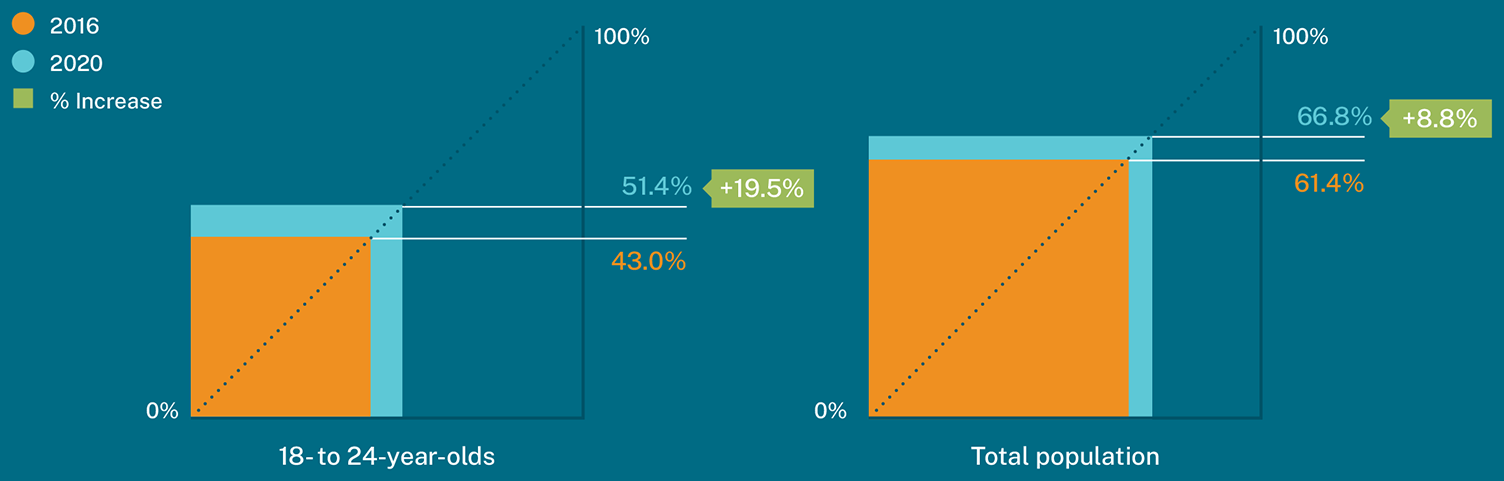
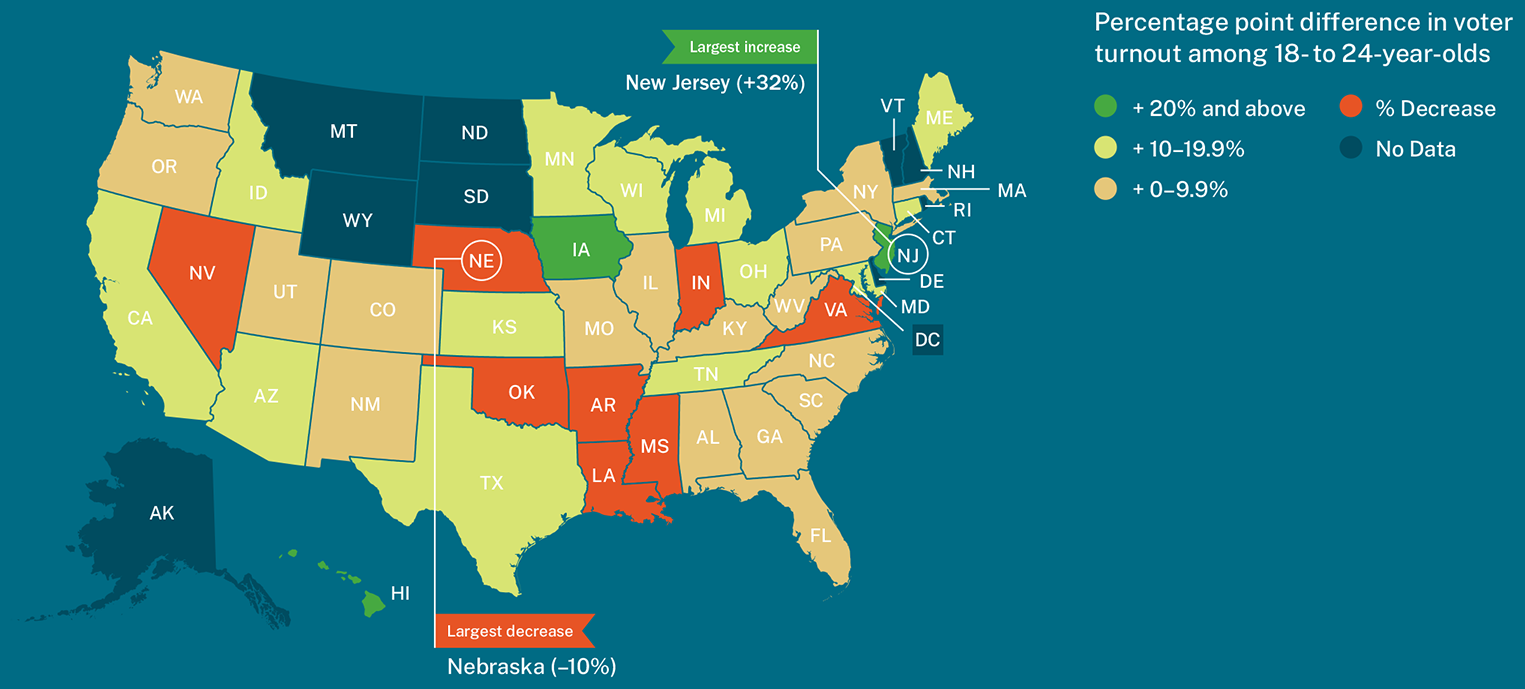
Young people are less likely to participate in politics than older people. Only 43 percent of young people (age 18–24) voted in the 2016 presidential election, compared to 71 percent of those over age 65. The 2020 election was historic, with the highest voter turnout in 120 years, and youth voter turnout broke records in many states. Generation Z is a sizable age cohort in the United States, and they made their voices heard in 2020.
Change in Voter Turnout, 2016–20
More information
A data graphic about voting patterns in 2016 and 2020. It shows that 51.4% of 18 to 24 year olds voted in 2020, versus just 43.0% in 2016. That was a 19.5% increase. For comparison, 66.8% of the total population voted in 202, versus 61.4% in 2016. That was an 8.8% increase.
Change in Voter Turnout among Younger People, by State, 2016–20
More information
A map shows changes in voter turnout among 18 to 24 year olds, state by state, from 2016 to 2020. The changes range from a 10% drop in Nebraska to a 32% increase in New Jersey. Iowa and Hawaii also saw increases above 20%. A few other states saw decreases, namely Nevada, Oklahoma, Arkansas, Louisiana, Mississippi, Indiana, and Virginia. The remaining states saw increases in the 0 to 20 percent range.
SOURCES: Data for 2016: www.census.gov/data/tables/time-series/demo/voting-and-registration/p20-580.html;
Data for 2020: www.census.gov/data/tables/time-series/demo/voting-and-registration/p20-585.html.
FOR CRITICAL ANALYSIS
Which five states had the largest increase in youth voting in 2020? Which states saw youth turnout decline?
What factors do you think led to increased youth participation in 2020? Characteristics of the candidates running? The importance of key issues to young people? Something else?
More information
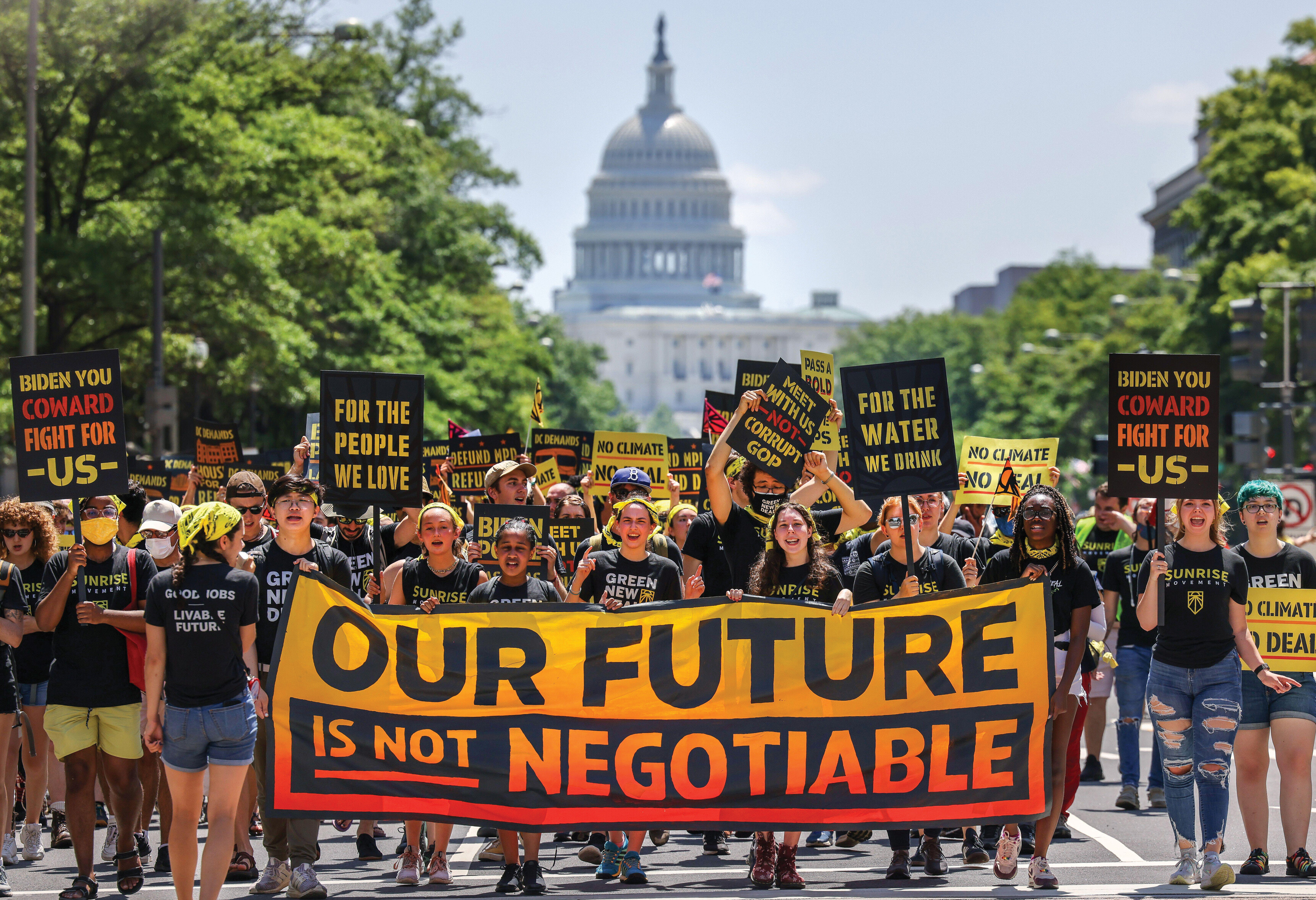
Marchers carry signs down Pennsylvania Avenue in Washington, D C. The signs, in black, yellow, and orange, bear various slogans related to climate change. A large banner the front row of marchers is carrying reads, Our Future Is Not Negotiable.
More information
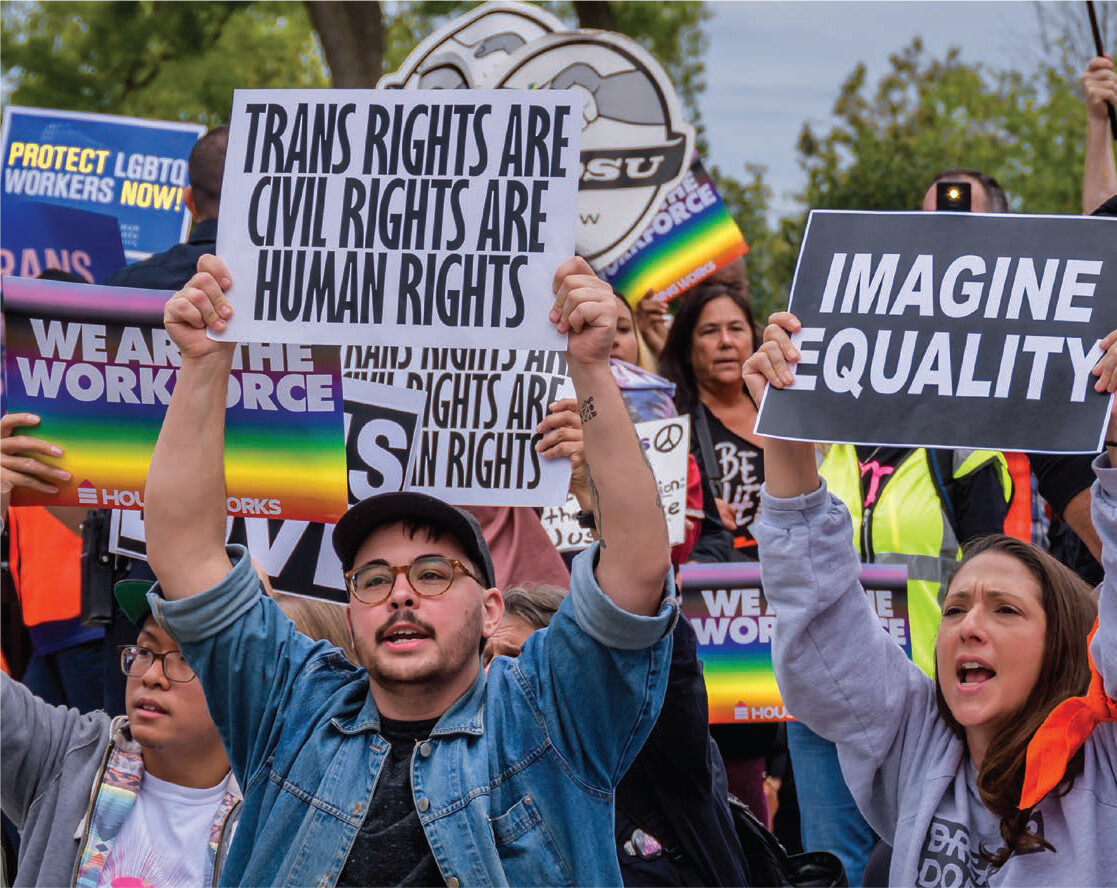
Marchers carry signs related to transgender rights. An individual in front holds up a sign that reads, Trans Rights Are Civil Rights Are Human Rights.
More information
An overhead view of marchers on behalf of the rights of immigrants. They are displaying a large, round, horizontal banner that reads, Immigrants Are Essential. Citizenship For All. In the center of the banner are three workers who represent an organization named Voces De La Frontera.
More information
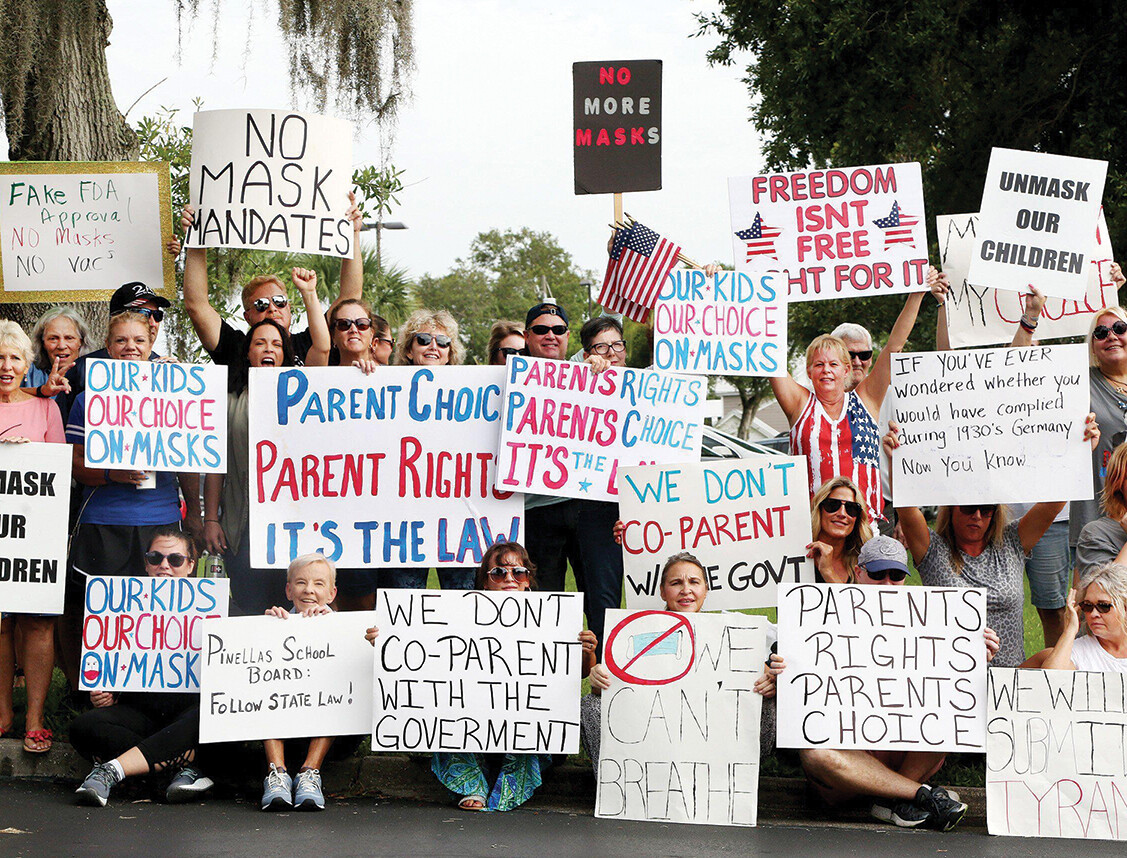
A view of marchers protesting against mask mandates. They hold up numerous signs with slogans like “We Don’t Co-Parent With The Government,” “Parents Rights, Parents Choice,” and “Our Kids, Our Choice On Masks.”
Politics sometimes involves direct action. People often hold public rallies or protests to draw attention to issues. These concerns can range from government inaction on climate change, the legal rights of transgender individuals, immigration policies including border walls, and government-imposed mask mandates.
This widely felt loss of political efficacy does not bode well for American democracy. Of course, not every effort by ordinary citizens to influence government will succeed, but without trust that such efforts can be effective, government decisions will be made by an increasingly smaller circle of powerful people. Fortunately, given the importance to American political ideals that all citizens be informed and able to act, individuals can build their own sense of political efficacy. Research shows that efficacy and participation are related: a feeling that one can make a difference leads to participation, and joining in can increase one’s efficacy.13
the belief that one can influence government and politics
Endnotes
Thomas H. Marshall, Citizenship and Social Class, vol. 11 (New York: Cambridge University Press, 1950).Return to reference 7
U.S. Citizenship and Immigration Services, “Citizenship Rights and Responsibilities,” https://my.uscis.gov/citizenship/information (accessed 4/10/22).Return to reference 8
Kyle Dropp and Brendan Nyhan, “One-Third Don’t Know Obamacare and Affordable Care Act Are the Same,” New York Times, The Upshot, February 7, 2017, www.nytimes.com/2017/02/07/upshot/one-third-dont-know-obamacare-and-affordable-care-act-are-the-same.html?_r=0 (accessed 12/28/17).Return to reference 9
Joan Donovan, “Deconstructing Disinformation’s Threat to Democracy,” The Fletcher Forum of World Affairs 44, no. 1 (Winter 2020); Joe Heim, “‘Disinformation Can Be a Very Lucrative Business, Especially if You’re Good at It,’ Media Scholar Says,” Washington Post, January 19, 2021, www.washingtonpost.com/lifestyle/magazine/disinformation-can-be-a-very-lucrative-business-especially-if-youre-good-at-it-media-scholar-says/2021/01/19/4c842f06-4a04-11eb-a9d9-1e3ec4a928b9_story.html (accessed 10/20/21); The Media Manipulation Casebook, https://mediamanipulation.org/ (accessed 10/20/21).Return to reference 10
Pew Research Center, Global Attitudes & Trends, “Attitudes toward Elected Officials, Voting, and the State,” February 26, 2020, www.pewresearch.org/global/2020/02/27/attitudes-toward-elected-officials-voting-and-the-state/pg_2020-02-27_global-democracy_02-1/ (accessed 3/21/20).Return to reference 11
Pew Research Center, “Attitudes toward Elected Officials, Voting, and the State.”Return to reference 12
Sydney Verba and Norman H. Nie, Participation in America (New York: Harper & Row, 1972).Return to reference 13