Describe how foundational values of liberty, equality, and justice influence the U.S. system of government
The essential documents of the American Founding—the Declaration of Independence and the Constitution—proclaimed a set of principles about the purposes of the new Republic: liberty, equality, and justice. (You can read these documents in the appendix at the back of this book.) Americans embraced these principles and made them central to the national identity. The practice of democracy—or the participation of ordinary people, as was just discussed in the previous section—is essential to how these values (liberty, equality, justice) are debated and made manifest. Most citizens still affirm these values, which form our political culture, even though they may disagree over their meaning and how these principles are balanced against one another.
American values are based on the liberal democratic political tradition, which draws its inspiration from the European Enlightenment (see Chapter 2). The democratic political tradition stresses the importance of a representative democracy and protection for individual liberties by the rule of law. While liberty, equality, and justice anchor the American political system, these core values have not been equally applied over time. Despite the influence of the liberal democratic political tradition on the practice of government, certain undemocratic traditions—nativism, racism, and sexism—have also been influential. Political scientist Rogers Smith points out that American political culture comprises many, often conflictual, values, which he calls “multiple traditions.”43 Examining the impact of these traditions on American political culture allows a deeper understanding of how far this nation has come and the challenges that still lie ahead.
Liberty
Liberty is one of America’s central political values. The Declaration of Independence identified three “unalienable” rights: “Life, Liberty and the pursuit of Happiness.” The Constitution likewise identified the need “to secure the Blessings of Liberty.” For Americans, liberty means both personal freedom and economic freedom. Both are closely linked to the idea of limited government.
More information
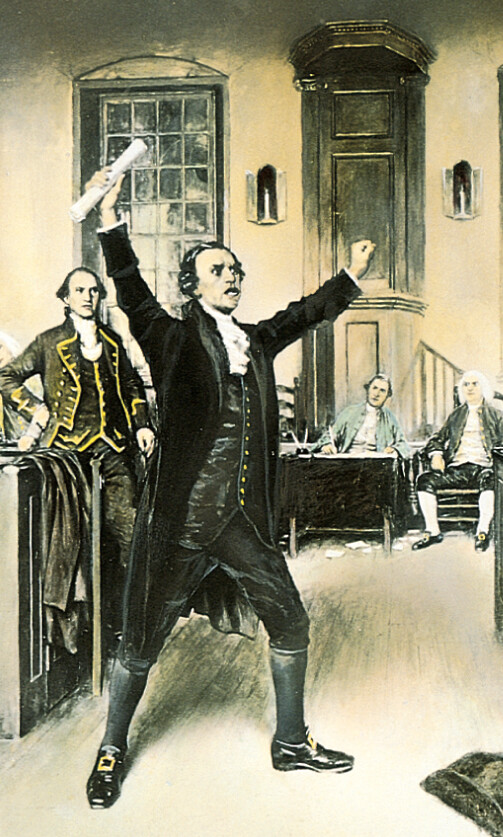
An illustration of Patrick Henry giving a speech. He stands with both fists raised, the right one clutching a rolled document.
Patrick Henry’s famous “Give Me Liberty or Give Me Death” speech demanded freedom at any cost and has resonated with Americans throughout the nation’s history.
The Constitution’s first 10 amendments, known collectively as the Bill of Rights, delineate individual personal liberties and rights. In fact, the word liberty has come to mean many of the freedoms guaranteed in the Bill of Rights: freedom of speech and the press, the right to assemble freely, and the right to practice religious beliefs without interference from the government.
Throughout American history, the scope of personal liberties has expanded as laws have become more tolerant and individuals have successfully used the courts to challenge restrictions on their personal freedoms. Far fewer restrictions exist today on the press, political speech, and individual behavior than in the nation’s early years. Even so, conflicts emerge when personal liberties violate a community’s accepted standards of behavior. For example, a number of cities have passed “sit-lie” ordinances, which limit the freedom of individuals to sit or lie down on sidewalks. Designed to limit the presence of people who are homeless and to make city streets more attractive to pedestrians, the ordinances have also been denounced as restrictions on individual liberties.
HOW TO
DEBATE RESPECTFULLY
More information
A headshot of April Lawson. She has shoulder-length brown hair and is smiling at the viewer.
April Lawson, the director of debates for Better Angels
Government by the people functions best when individuals discuss ideas, share their preferences, and talk about what government is doing. But political discussion and debate can be uncomfortable, particularly among people who disagree or when politics is polarized, as it is in the current era. In order to have a productive discussion, it is important that people are respectful of others from different backgrounds, who might hold different political views.
To learn how to engage others and to debate respectfully, we spoke with April Lawson, the director of debates for Better Angels, a national organization that works with individuals from across the political spectrum to “combat polarization and restore civil dialogue across America.” She offers these tips for successful and civil political conversations:
1
The most important thing is the presumption of good faith. If someone says something you can’t stand, know that the other person is trying, just like you are, to address hard questions. Assume that the other person is smart and that they are moral.
2
Say what you actually believe. Genuineness and sincerity are crucial. You could debate either by making a case no one could disagree with or by sharing what you really feel about the issue. The latter will make for a more productive exchange of ideas.
3
How can you launch such a conversation and set the tone? A good technique is to start with a question of genuine curiosity for the other person, which reassures them that you want to know what they believe. Another tip is to paraphrase what they have said before you respond, to make sure the other person feels heard.
4
When you respond, it helps if you express some doubt or nuance in your own argument, or mention that you agree with some aspect of the other person’s position. You do not need to agree with everything they have said, but you can pick something reasonable the other person said and affirm, “You said X, which makes sense because of Y.”
5
Know that you may need to be the bigger person in the conversation. In order to be an ambassador of civility, you may need the patience to ask several genuine questions of curiosity before the other person believes that you are actually interested in what they have to say. And you need to control your own emotions and triggers, to manage your activation, because you know these rules for civil engagement, and they may not.
6
Finally, realize that you have agency. Prepare yourself for these tough conversations by telling yourself, “I will probably have feelings about this. But I can be patient and manage them.” Remember, you’re not trapped. You can take a break. You can change topics. Or you may want to have a conversational exit in mind. If you’re speaking with your combative uncle, you might pivot to the football game.
Debating respectfully requires coming to the table with a posture of openness and helping the other person feel heard. In America, at the talking-point level, which is a surface level, we don’t agree at all. But if you can go down even one level to political values, or even one more level to moral values, then there’s a lot of common ground. With these conversations, we’re not trying to change how you see the issue; we’re trying to change how you see the other person.
Liberty also extends into the realm of economics. The American concept of economic freedom supports capitalism, free markets (including open competition and unrestricted movement of goods), and the protection of private property.44 During the nation’s first century, support for capitalism often meant support for the principle of laissez-faire (French for “allow to do”). Laissez-faire capitalism allowed the national government very little power to regulate commerce or restrict the use of private property. Today, however, federal and state governments impose many regulations to protect the public. For example, government regulations to slow the spread of the coronavirus included school closures, stay-at-home orders, and cancellations of entertainment and sporting events.
Not surprisingly, fierce disagreements often erupt over what should be the proper scope of government regulation. For example, one provision of the Affordable Care Act (“Obamacare”) required that insurers pay for access to contraceptive care. Supporters argued that this provision ensured women’s access to basic health care. Some businesses, however, denounced it as a violation of their fundamental liberty to run their businesses and use their property as they see fit. In 2014 the Hobby Lobby company successfully challenged the provision, with the Supreme Court ruling that family-owned companies or businesses could be exempted from it on the basis of religious objections.45
FOR CRITICAL ANALYSIS
Throughout the Covid-19 pandemic there has been much debate about the proper role of government in mandating the wearing of masks. When did you feel a mandate was appropriate? Were there times you felt it infringed on your liberty?
Concerns about liberty have also arisen in relation to the government’s efforts to combat terrorism and other national security threats. These concerns escalated in 2013 when Edward Snowden, a former National Security Agency (NSA) contractor, leaked top-secret documents from the NSA to the press. The NSA is the agency charged with monitoring electronic data flows—including radio, email, and cell phone calls—for foreign threats. The leaked documents revealed that the U.S. government was listening in on the private communications of foreign governments, including many allies. In addition, the NSA had access to Americans’ Facebook, Google, Apple, and Yahoo! accounts, among many other electronic data sources, and for three years had been using these metadata to track connections among people, searching for suspicious ties.
This revelation set off a storm of controversy, since the NSA is not supposed to monitor American citizens. The controversy reinforced the tech companies’ commitment to guard their users’ privacy from government. In 2016, Apple refused an FBI order to unlock the iPhone used by a man suspected of terrorism who had killed 14 people in San Bernardino, California. Although the FBI dropped the case after opening the phone without Apple’s help, a new court order to Apple related to an iPhone used in a drug conspiracy case made it clear that the tension between privacy and security will continue.46
Can we find the proper balance between liberty and security? Between one person’s liberty and another’s?
Equality
The Declaration of Independence declares as its first “self-evident” truth that “all men are created equal.” However, equality has been an even less well-defined ideal than liberty, because people interpret it in such different ways. Few Americans have wholeheartedly embraced the ideal of full equality of results (that everyone deserves equal wealth and power), but most share the ideal of equality of opportunity (that all people deserve a fair chance to go as far as their talents will allow). Yet it’s hard to agree on what constitutes equality of opportunity. Furthermore, in contrast to liberty, which requires limits on the role of government, equality implies an obligation of the government to the people.47 But how far does this obligation extend? Must a group’s past inequalities be redressed to ensure equal opportunity in the present? Should legal, political, and economic inequalities all be given the same weight?
More information
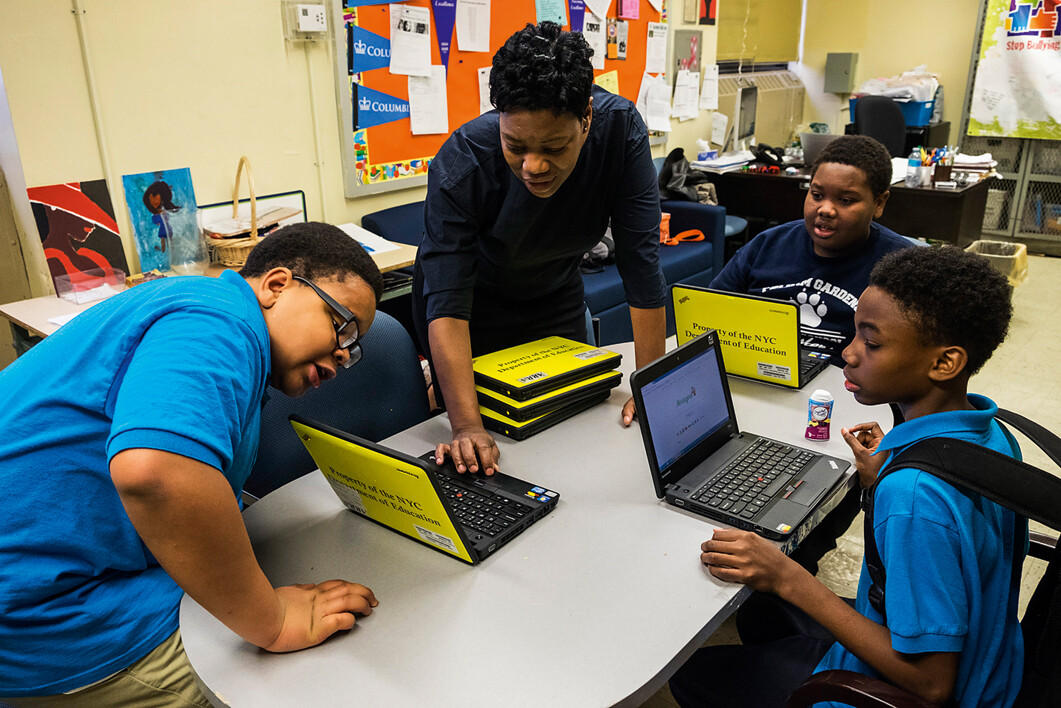
Three boys and their teacher working on school-issued laptops in a classroom.
More information
Children eating lunch in a classroom. The boy in the foreground is looking up and writing something down.
Americans struggle to define how equality of opportunity can be provided at the same time as individual liberty. One area of debate is in education. Does the fact that New York (left) spends on average $23,091 per student each year while Utah (right) spends on average $7,179 per student mean that there is not an equality of opportunity for schoolchildren?(Data from www.census.gov.)
Americans do make clear distinctions between social or economic equality and political equality, the right of a community’s members to participate in politics on equal terms. Though America started with a very restricted definition of political community, which included only White men who owned a certain amount of property, the nation has moved much closer to an ideal of political equality that can be summed up as “one person, one vote.” Although considerable conflict remains over whether the political system makes it harder for some people to participate than others, most Americans agree that all citizens should have an equal right to participate and that government should enforce that right.
Many Americans see economic inequality as largely the result of individual choices, so they tend to be more skeptical of government action to reduce it (compared to government action to reduce political inequality). Even when severe economic hardships, like the Great Depression of the 1930s, have affected many people, a large number of Americans have supported only a limited response by government.
Three kinds of controversies have arisen about government’s role in addressing inequality. The first involves determining what constitutes equality of access to public facilities, including those operated by government and those operated privately but open to the public. In 1896 the Supreme Court ruled in Plessy v. Ferguson that providing “separate but equal” facilities for Black people and White people was constitutional.48 But after grassroots organizing shifted public opinion and applied pressure on the political branches, the Court overturned the principle of separate but equal in the area of education through its ruling in Brown v. Board of Education (1954),49 and Congress prohibited discrimination and mandated equal access to facilities through the Civil Rights Act of 1964 (see Chapter 5). Today, new questions have been raised about what constitutes equal access to public facilities. Some argue, for example, that unequal financing of public schools in different districts within a state violates the constitutional guarantee of “equal protection of the laws.” To date, federal courts have rejected such claims that the unequal economic effects of state and local government policies are a constitutional matter.50
More information
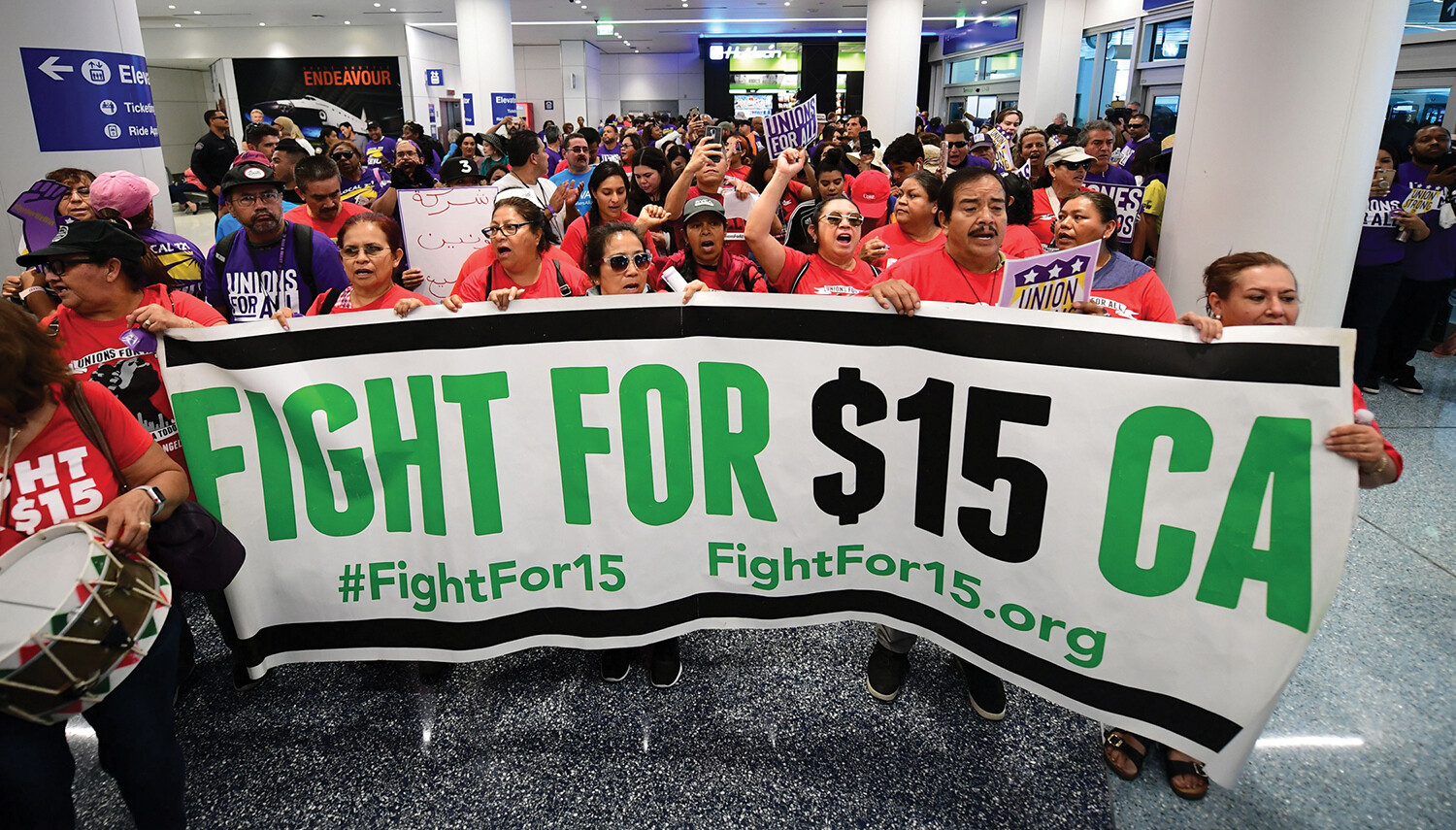
Demonstrators rallying for the 15 dollar minimum wage. They hold a banner that reads, Fight for $15 California, hashtag Fight For 15, website Fight For 15 dot org.
The Fight for $15—a nationwide effort to increase the minimum wage to $15 an hour—first gained traction in 2013, increasing public awareness of income inequality in the United States. By 2022 many states had increased their minimum wage above the federal minimum wage, but few had reached the $15 threshold that workers had protested for.
A second debate concerns government’s role in ensuring equality of opportunity in private life, such as college admissions and corporate employment. Although Americans generally agree that discrimination in such areas should not be tolerated, they disagree over how to ensure equality of opportunity in those areas (see Table 1.4).51 Supporters of affirmative action programs, for example, claim they are a necessary part of a larger effort to address past discrimination in order to establish true equality of opportunity today. Opponents maintain that they amount to reverse discrimination and that a truly equal society should not acknowledge gender or racial differences. Some particularly pointed questions about public responsibility for private inequalities involve gender. The traditional view, still held by many today, takes for granted that women bear special responsibilities in the family and that the resulting challenges they face in the labor force aren’t matters for government to address. In the past 40 years especially, this view has come under fire as advocates for women have argued that these inequalities are indeed a topic of public concern.52
FOR CRITICAL ANALYSIS
Economic inequality among Americans has been widening since at least the 1970s. Many politicians and news commentators say that inequality is threatening the middle class. Is there any evidence that the American public is worried about the growth in inequality? Explain your response.
A third debate concerns differences in income and wealth. As noted earlier, income inequality has seldom led to widespread political controversy in the United States, which currently has the largest gaps in income and wealth between rich and poor citizens of any developed nation. This tolerance for inequality is reflected in America’s tax code, which is more advantageous to wealthy taxpayers than that of almost any other Western nation.
Income inequality rose on the political agenda during the coronavirus pandemic of 2020 and 2021, however. The economic slowdown most affected lower-income workers without employee benefits, including those in the restaurant, retail, and gig economy sectors. As Congress deliberated economic stimulus measures and policy changes, debates about the role of government reemerged. Should greater resources be directed at helping workers or employers? Would increased unemployment benefits lead to better jobs for workers or disincentivize returning to work? Such debates appear even under the toughest economic circumstances.53
TABLE 1.4Equality and Public Opinion
Americans believe in some forms of equality more than others. How do these survey results reflect disagreement about what equality means in practice?
STATEMENT
PERCENTAGE WHO AGREE
It is very important that women have the same rights as men in our country.
97
It is very important that everyone has an equal opportunity to succeed.
82
It should be illegal for employers to fire people or refuse to hire people for being lesbian, gay, or bisexual.
90
It should be legal for gay and lesbian couples to get married.
61
There is too much economic inequality in the country these days.
61
Some amount of inequality is acceptable (among those who said there is too much economic inequality).
70
Our country has not gone far enough when it comes to giving Black people equal rights with White people (according to White people).
37
Our country has not gone far enough when it comes to giving Black people equal rights with White people (according to Black people).
78
The country hasn’t gone far enough when it comes to gender equality (according to women).
64
The country hasn’t gone far enough when it comes to gender equality (according to men).
49
SOURCE: Pew Research Center, www.pewresearch.org; Kaiser Family Foundation, kff.org.
Justice
Justice is the first of five political objectives highlighted in the Constitution: “We the People of the United States, in Order to form a more perfect Union, establish Justice, insure domestic Tranquility, provide for the common defence, promote the general Welfare, and secure the Blessings of Liberty . . .” The theme also appears in Federalist 51 (see appendix), where James Madison writes, “Justice is the end of government. It is the end of civil society.” For Madison, justice is the ultimate goal of good government. However, like the values of liberty and equality, what constitutes justice is contested. Americans believe in justice, but what justice means and how it has been applied has been debated over time.
The pursuit of justice contributed to the early colonists’ decision to declare independence from Britain. Since they were taxed with no representation in Parliament, many colonists viewed their relationship with Britain as unfair, and they ultimately revolted in order to establish a more just form of government (see Chapter 2 for more on the American Revolution). Yet, while the Founders valued the concept of justice, the practice of justice was more complicated. Numerous aspects of the Founding period were unjust, such as the taking of land from Native nations, the enslavement of Black people, and the absence of voting rights for women and other groups.
More information
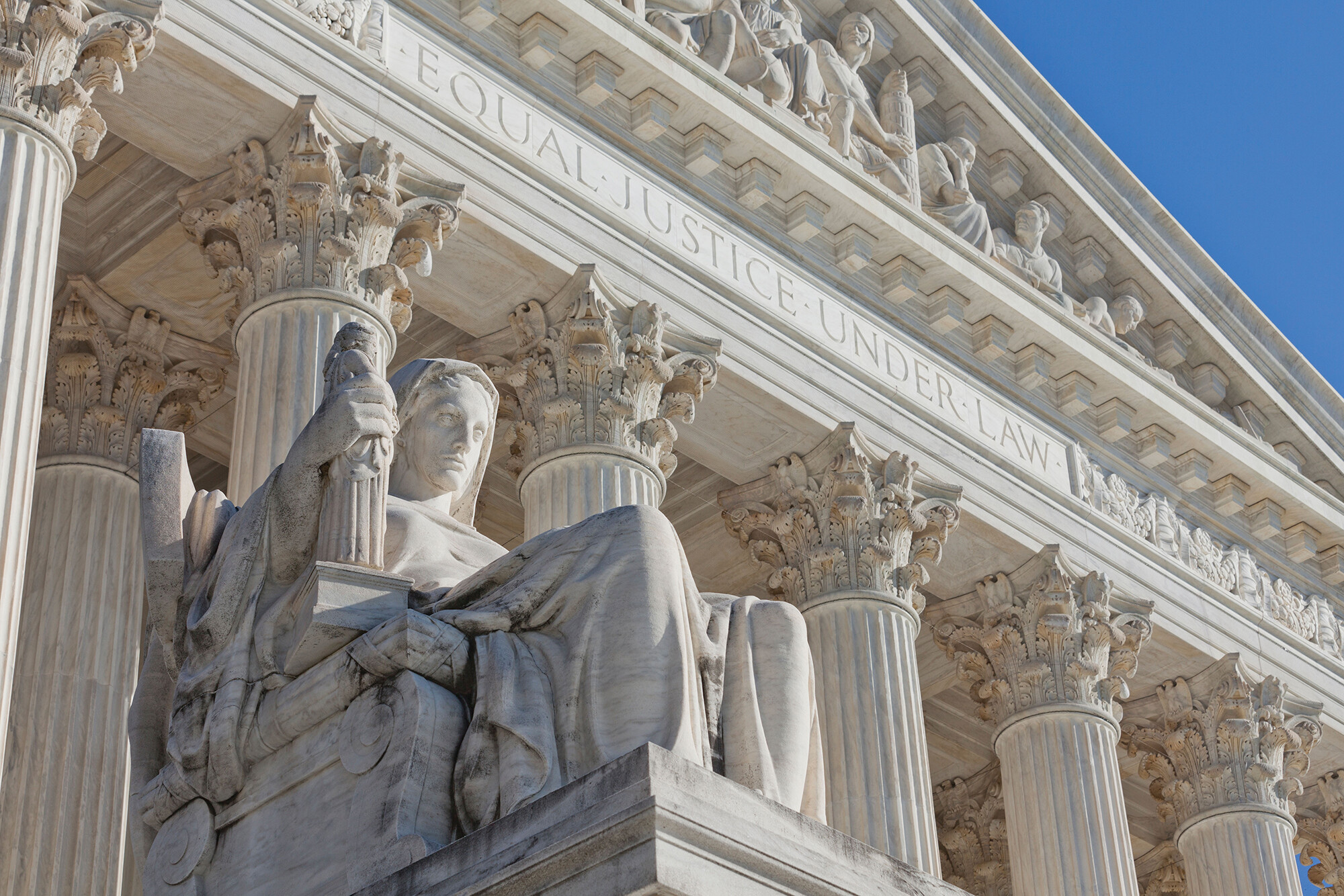
The front of the U S Supreme Court building. A statue of the justice personified as a goddess sits enthroned beneath a frieze that features the slogan Equal Justice Under The Law.
Justice is one of America’s most important political values. In fact, justice is so central to the mission of the Supreme Court of the United States that engraved in marble on its building is the famous phrase “Equal Justice Under Law.”
Some of the most intense battles over the meaning of justice have occurred through the judicial branch. As articulated in Federalist 78 by Alexander Hamilton: “The complete independence of the courts of justice is peculiarly essential in a limited Constitution.” In the Founders’ view, the judicial branch would have the responsibility of ensuring that justice is carried out. Justice was, and is, closely linked to the principle of fairness.54 Ensuring a fair process is key to how we get to a just outcome. In order for the judicial branch to do its job, courts must apply the law fairly. Today, many disputes over the meaning of justice are decided in the Supreme Court. For example, in the landmark case Obergefell v. Hodges (2015), gay and lesbian couples argued that state laws preventing same-sex marriage were unjust and asked the Court for the ability to marry. In its majority opinion, the Court ruled that banning same-sex marriage represented a grave injustice and that fairness required its legalization.55
But justice is not exclusively determined by judges, nor does it always necessitate a change in laws. Conceptions of justice arise from the people, and efforts to realize those visions can take many different forms. Over time, organized groups of Americans have used the language of justice—especially social justice—to advocate for change.56 Examples include the disability justice movement, the environmental justice movement, and the criminal justice reform movement. Sometimes the change being sought is about present challenges, and other times it is focused on redressing past wrongs. The movement for racial justice inspired over 20 million people to take to the streets during spring 2020 to draw attention to persistent racism directed at Black people.57 Protesters sought the transformation of policing, housing, and the economic system. In response, in many cases police reforms were instituted, cities provided help to families that needed housing, and corporations pledged resources to help improve race relations.58 And as with other protests advocating for change, those who disagreed with the calls for racial justice held counter demonstrations.
Another recent example of a social justice movement is the landback movement led by Native nations.59 Landback leaders point to centuries of land dispossession by the U.S. government and assert that justice will be achieved when government and private land are returned to the stewardship of Native Americans. However, because some of the land is now privately owned or part of national parks, detractors argue that the movement’s goal is unfair to current landowners and to the public.
An Unfinished Project
These examples show that despite Americans’ reverence for justice, its meaning and practice are often deeply contested.60 Some people understand it as closely related to liberty and requiring limitations from government intrusion. For others, it overlaps more closely with equality and requires government to intercede on behalf of citizens to address deep-seated inequalities. Just as we can say that the concept of justice is not static, we can consider all of American politics to be an unfinished project: the Founders established lofty guiding principles such as liberty, equality, and justice, but it has been the responsibility of successive generations of Americans to realize these ideals more fully.
broadly shared values, beliefs, and attitudes about how the government should function; American political culture emphasizes the values of liberty, equality, and justice
an economic system in which the means of production and distribution are privately owned and operated for profit with minimal or no government interference
the just allocation of wealth, opportunities, and privileges within a society
Endnotes
Rogers M. Smith, “Beyond Tocqueville, Myrdal, and Hartz: The Multiple Traditions in America,” American Political Science Review 87, no. 3 (1993): 549–66.Return to reference 43
Herbert McClosky and John Zaller, The American Ethos: Public Attitudes toward Capitalism and Democracy (Cambridge, MA: Harvard University Press, 1984), 19.Return to reference 44
Kevin McCoy and Kevin Johnson, “U.S. Demands Apple Unlock Phone in Drug Case,” USA Today, April 10, 2016, www.usatoday.com/story/news/2016/04/08/justice-moving-forward-separate-apple-case/82788824 (accessed 4/10/16).Return to reference 46
J. R. Pole, The Pursuit of Equality in American History (Berkeley: University of California Press, 1978), 3.Return to reference 47
See San Antonio Independent School District v. Rodriguez, 411 U.S. 1 (1972); Rogers M. Smith, Liberalism and American Constitutional Law (Cambridge, MA: Harvard University Press, 1985), chap. 6; Morath v. Taxpayer & Student Fairness Coal., 490 S.W.3d 826 (Tex. 2016).Return to reference 50
Pew Research Center, “Deep Divisions in American’s Views of Nation’s Racial History—and How to Address It,” Report, August 12, 2021, www.pewresearch.org/politics/2021/08/12/deep-divisions-in-americans-views-of-nations-racial-history-and-how-to-address-it/ (accessed 9/22/21); Megan Brenan, “Ratings of Black-White Relations at New Low,” Gallup News, July 21, 2021, https://news.gallup.com/poll/352457/ratings-black-white-relations-new-low.aspx (accessed 9/22/21); Caitlyn Oprysko, “Poll: Majority of Voters Say U.S. Government Should Do More to Address Gender Pay Gap,” Politico, September 27, 2019, /www.politico.com/news/2019/09/27/poll-gender-pay-gap-006066 (accessed 9/22/21); Justin McCarthy, “Mixed Views among Americans on Transgender Issues,” Gallup, May 26, 2021, https://news.gallup.com/poll/350174/mixed-views-among-americans-transgender-issues.aspx (accessed 9/22/21).Return to reference 51
See the discussion in Eileen McDonagh, “Gender Political Change,” in New Perspectives on American Politics, ed. Lawrence C. Dodd and Calvin C. Jillson (Washington, DC: CQ Press, 1994), 58–73. The argument for moving women’s issues into the public sphere is made by Jean Bethke Elshtain, Public Man, Private Woman (Princeton, NJ: Princeton University Press, 1981).Return to reference 52
Dan Murphy, “Economic Impact Payments,” The Brookings Institution, February 2021, www.brookings.edu/research/economic-impact-payments-uses-payment-methods-and-costs-to-recipients/ (accessed 10/5/21); Kevin Hassett and Matthew Jensen, “Here’s How Much the COVID-19 Stimulus Will Cost You,” National Review, March 18, 2021, www.nationalreview.com/2021/03/heres-how-much-covid-19-stimulus-cost-you/ (accessed 10/5/21); Allison Prang and Veronica Dagher, “Debate Over Paid Family Leave Is Louder than Ever,” Wall Street Journal, October 30, 2021, www.wsj.com/articles/debate-over-paid-family-leave-is-louder-than-ever-11635564747 (accessed 10/5/21).Return to reference 53
John Rawls, “Justice as Fairness: Political Not Metaphysical,” Equality and Liberty (London: Palgrave Macmillan, 1991), 145–73; Rawls, A Theory of Justice (Cambridge, MA: Belknap Press of Harvard University Press, 1971).Return to reference 54
Martha Craven Nussbaum, Frontiers of Justice: Disability, Nationality, Species Membership (Cambridge, MA: Belknap Press, 2006).Return to reference 56
L. Buchanan, Q. Bui, and J. K. Patel, “Black Lives Matter May Be the Largest Movement in U.S. History,” New York Times, July 3, 2020, www.nytimes.com/interactive/2020/07/03/us/george-floyd-protests-crowd-size.html (accessed 10/7/21).Return to reference 57
Barbara Ransby, Making All Black Lives Matter: Reimagining Freedom in the Twenty-First Century (Oakland: University of California Press, 2018); Deva Woodley, Reckoning: Black Lives Matter and the Democratic Necessity of Social Movements (Oxford, UK: Oxford University Press, 2021); Amna Akbar, “The Left Is Remaking the World,” New York Times, July 11, 2020, www.nytimes.com/2020/07/11/opinion/sunday/defund-police-cancel-rent.html (accessed 10/5/21).Return to reference 58
Harmeet Kaur, “Indigenous People across the US Want Their Land Back—and the Movement Is Gaining Momentum,” CNN, November 26, 2020, www.cnn.com/2020/11/25/us/indigenous-people-reclaiming-their-lands-trnd/index.html (accessed 10/7/21); Claire Elise Thompson, “Returning the Land,” Grist, November 25, 2020, https://grist.org/fix/indigenous-landback-movement-can-it-help-climate/ (accessed 10/7/21).Return to reference 59
Rawls, A Theory of Justice; Michael J. Sandel and T. Anne, Liberalism and the Limits of Justice (New York: Cambridge University Press, 1998); Iris Marion Young, Justice and the Politics of Difference (Princeton, NJ: Princeton University Press, 2011).Return to reference 60