Differentiate between the Federalists’ and Antifederalists’ stances on the ratification of the Constitution
The first hurdle faced by the proposed Constitution was ratification by state conventions of delegates elected by voters. This struggle for ratification included 13 separate campaigns, each influenced by local as well as national considerations.
FOR CRITICAL ANALYSIS
The Antifederalists worried that the size and diversity of the United States made democratic government impossible. In what ways might a large heterogeneous population limit democracy? How might it enhance democracy?
Two sides faced off in all the states, calling themselves Federalists and Antifederalists (see Table 2.3). The Federalists (who more accurately could have called themselves “Nationalists”) supported the Constitution and preferred a strong national government. The Antifederalists opposed the Constitution and preferred a more decentralized federal system; they took their name by default, in reaction to their better-organized opponents. The Federalists were united in their support of the Constitution, whereas the Antifederalists were divided over possible alternatives.
Federalists versus Antifederalists
Thousands of essays, speeches, pamphlets, and letters were presented for and against ratification of the proposed Constitution. The best-known pieces in support were the 85 articles published in New York City newspapers by Alexander Hamilton, James Madison, and John Jay. These Federalist Papers, as they are collectively known, defended the principles of the Constitution and sought to dispel fears of a strong national government. Meanwhile, the Antifederalists, including Patrick Henry and Richard Henry Lee, argued in their speeches and writings that the new Constitution betrayed the Revolution and was a step toward monarchy.
TABLE 2.3Federalists versus Antifederalists
FEDERALISTS
ANTIFEDERALISTS
Who were they?
Property owners, creditors, merchants
Small farmers, frontiersmen, debtors, shopkeepers, some state government officials
What did they believe?
Believed that elites were most fit to govern; feared “excessive democracy”
Believed that government should be closer to the people; feared concentration of power in hands of the elites
What system of government did they favor?
Favored strong national government; believed in “filtration” so that only elites would obtain governmental power
Favored retention of power by state governments and protection of individual rights
Who were their leaders?
Alexander Hamilton, James Madison, George Washington
Patrick Henry, George Mason, Elbridge Gerry, George Clinton
More information
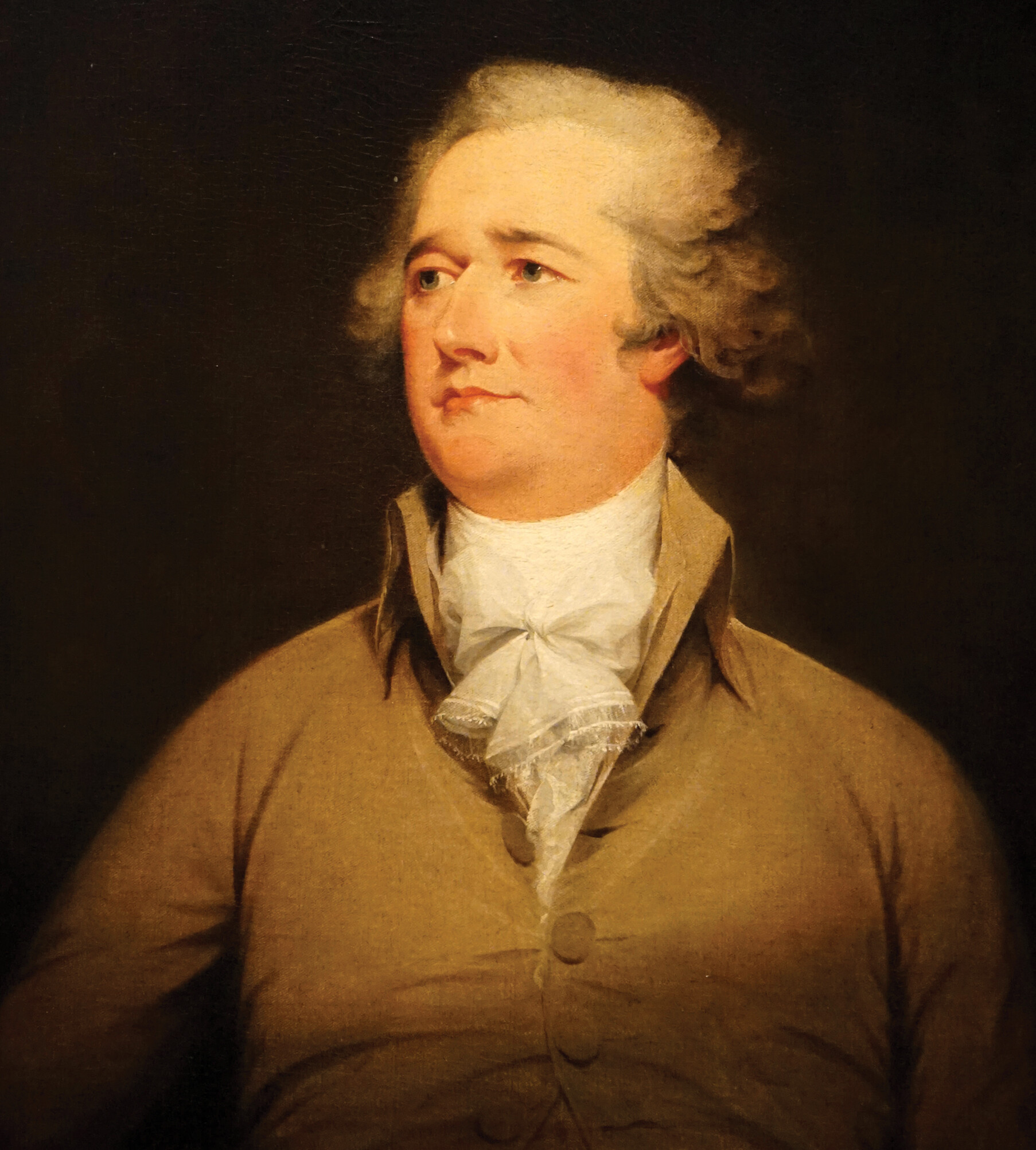
An oil portrait of Alexander Hamilton. He is viewed slightly from below. He wears a tan frock coat over a formal white shirt and cravat.
Alexander Hamilton (1757–1804) supported the ratification of the Constitution. He wrote the majority of the Federalist Papers (51 out of 85), which were widely read and greatly influenced voters’ belief in the need for ratification.
Representation
One major area of contention between the two sides was the nature of political representation. The Antifederalists asserted that representatives must be “a true picture of the people . . . [possessing] the knowledge of their circumstances and their wants.” 28 This could be achieved, they argued, only in small republics such as each of the existing states, whose people were relatively similar to one another. In their view, the size and diverse population of the entire nation made a truly representative form of government impossible.
Federalists, for their part, saw no reason that representatives should be exactly like those they represented. In their view, one of the great advantages of representative government over direct democracy was precisely the possibility that the people would choose individuals with experience and talent greater than their own to represent them. In Madison’s words, rather than mirroring society, representatives must be “[those] who possess [the] most wisdom to discern, and [the] most virtue to pursue, the common good of the society.”29
Tyranny
A second issue dividing Federalists and Antifederalists was the threat of tyranny—unjust rule by the group in power. The two sides, however, had different views of the most likely source of tyranny, and thus different ideas about how to keep it from emerging.
For the Antifederalists, the great danger was the tendency of republican governments to become gradually more “aristocratic,” with members of the small group in authority using their positions to gain more and more power over other citizens. In essence, Antifederalists feared the few would tyrannize the many. For this reason, they sharply criticized those features of the Constitution that created governmental institutions without direct responsibility to the people—such as the Senate, the presidency, and particularly the federal judiciary, with its lifetime appointments.
The Federalists, in contrast, viewed the danger particularly associated with republican governments not as aristocracy but as tyranny over the few by the many. They feared that a popular majority, “united and actuated by some common impulse of passion, or of interest, adverse to the rights of other citizens,” would “trample on the rules of justice.”30 From their perspective, those features of the Constitution that the Antifederalists attacked as potential sources of tyranny actually offered the best hope of preventing it. They saw the nation’s size and diversity as further protection because these characteristics would make it harder to unite a tyrannical majority.
Governmental Power
A third divisive issue concerned the fundamentally important question of how to place limits on governmental action. Antifederalists favored limited government and proposed limiting and spelling out the powers granted to the national government in relation both to the states and to the people at large. To them, its powers ought to be “confined to certain defined national objects”31 so that it did not “swallow up all the power of the state governments.”32 Antifederalists bitterly attacked the supremacy and elastic clauses of the Constitution as dangerous surrenders of power to the national government.33 They also demanded that a bill of rights be added to the Constitution to limit the government’s power over the people.
AMERICA |SIDE BY SIDE
Democratic Systems
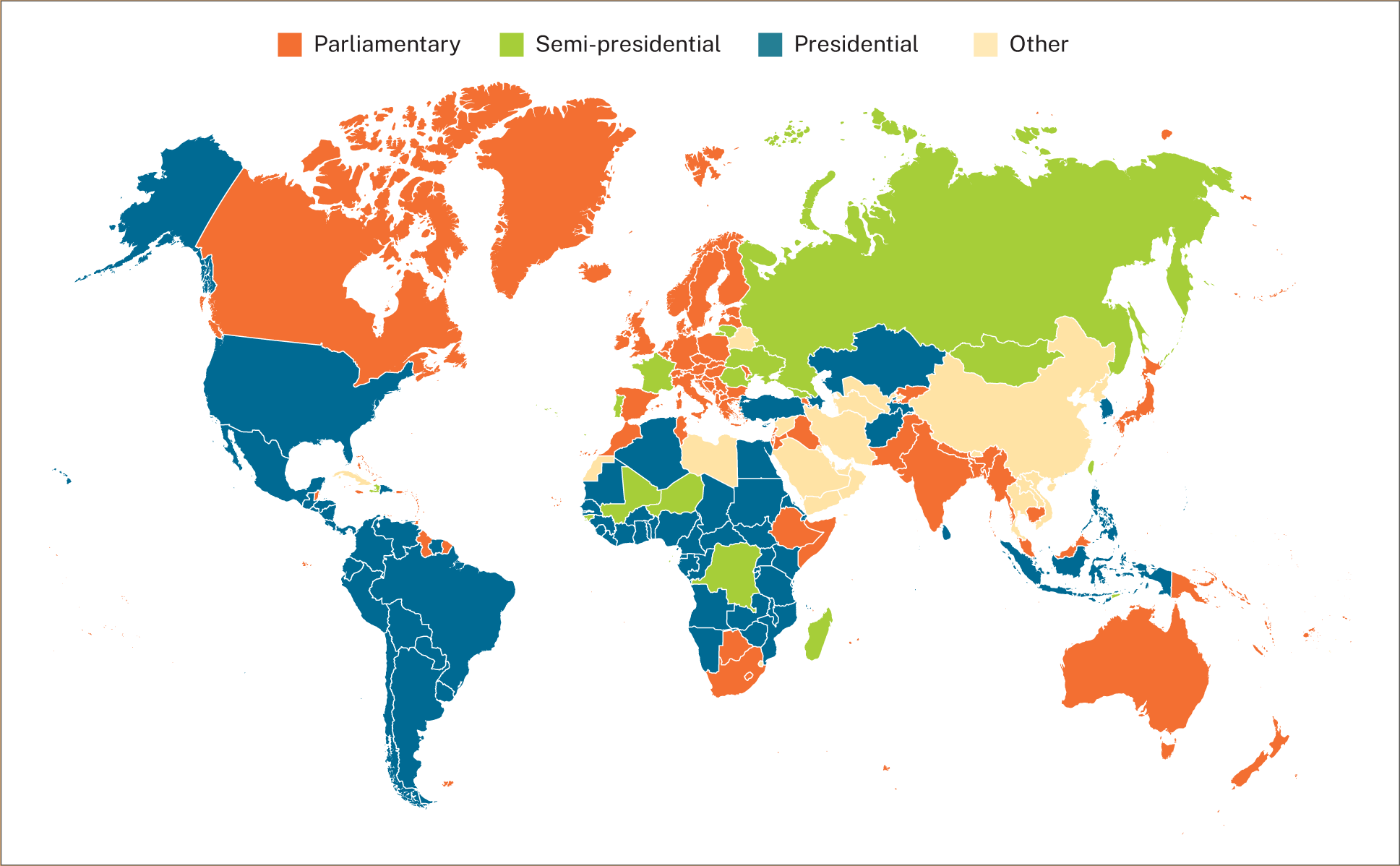
Executive authority is vested in different positions in different countries. In parliamentary systems the prime minister is both the chief executive and the head of the legislature. In presidential systems, such as in the United States, the executive and legislative branches are separate. Some countries use a semi-presidential system in which there is a president who heads the executive branch and has limited authority, and a prime minister who heads the legislative branch. Parliamentary systems can be more efficient, as the prime minister can wield a lot of authority, but only if his or her party has a sizable and stable majority in Parliament. Presidential and semi-presidential systems can lead to more gridlock, as there are multiple seats of power.
Does one system seem to be more common than another? Why might one country have a parliamentary system while its neighbor has a presidential system?
What do you think would be the advantages to having executive and legislative authority vested in the same individual? What are the advantages to a system such as that of the United States, where powers are separated in independent branches? Do you think the advantages of one system over another are different today than they were 250 years ago at the Founding of the United States?
More information
A color-coded world map shows government types of various countries. The countries are categorized as Parliamentary, Semi-presidential, presidential and Other. The most prominent countries on the map, having presidential governments are as follows. The U S A, Mexico, Brazil, Argentina, Afghanistan, Kazakhstan, Turkey, Indonesia, the Philippines, and most countries in the African continent. Major countries having semi-presidential governments are as follows. Spain, Ukraine, Romania, Madagascar, Mongolia, and Russia. Major countries having parliamentary governments are as follows. Canada, Guyana, French Guiana, South Africa, Ethiopia, Somalia, Morocco, India, Pakistan, Nepal, Cambodia, Japan, Papua New Guinea, Australia, and most of the countries in Europe. Major countries having other types of governments are as follows. Cuba, Libya, Saudi Arabia, Yemen, Oman, U A E, Iran, Turkmenistan, Uzbekistan, China, Thailand, Laos, and Vietnam.
SOURCE: CIA World Factbook, www.cia.gov/the-world-factbook/field/government-type (accessed 10/17/21).
More information
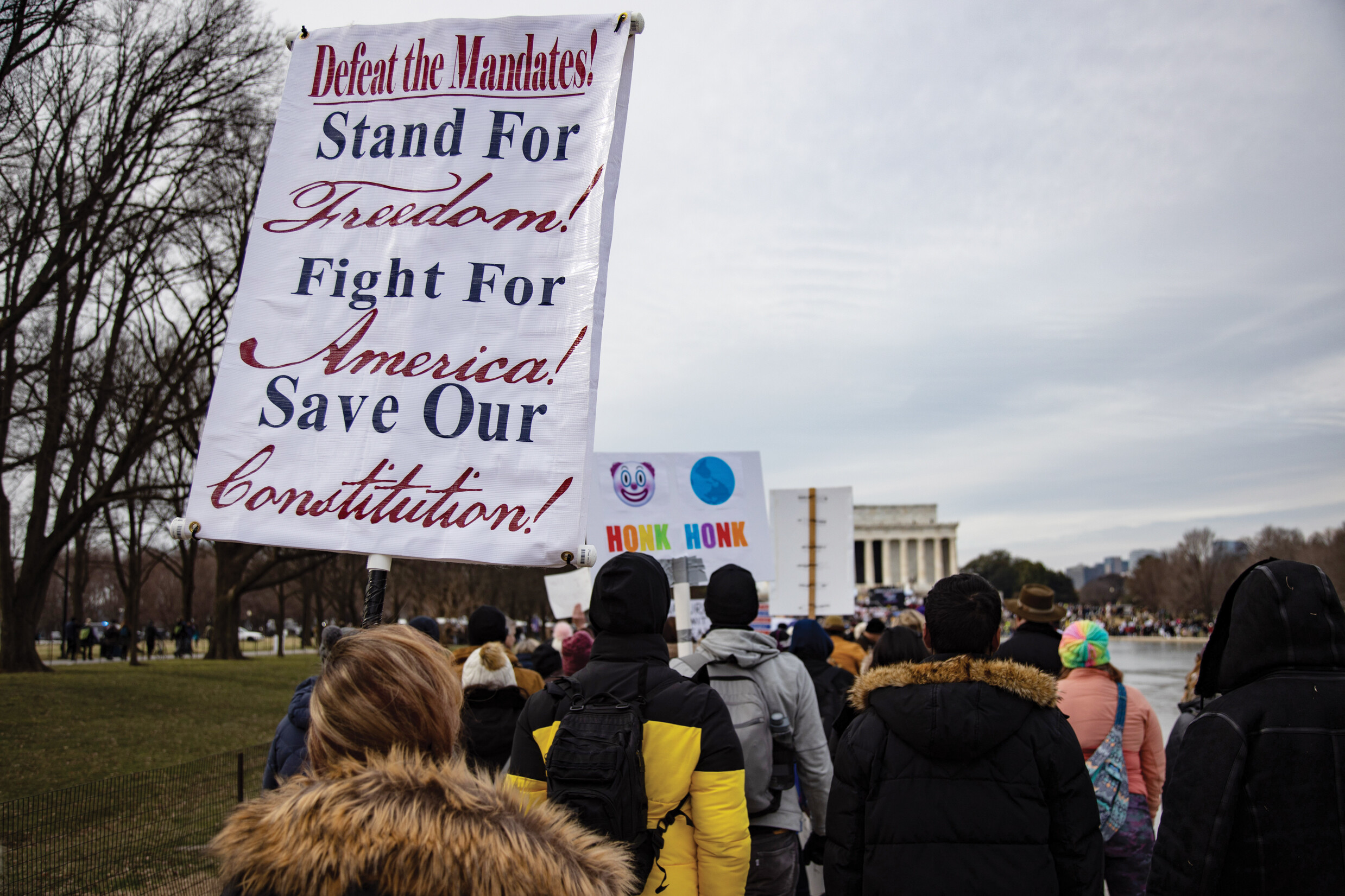
Protesters gather in the Washington Mall to oppose government anti-Covid measures. They have brought a banner that reads, Defeat the Madness. Stand For Freedom! Fight For America! Save Our Constitution!
Debates over the meaning of the Constitution continue to this day. Some critics of mask mandates instituted during the coronavirus pandemic pointed to the Constitution’s protections of individual liberty as reason to protest the mandates.
In reply, Federalists such as Hamilton acknowledged the possibility that every power could be abused. They argued, however, that the risk was worth taking in order to give the government the powers needed to achieve essential national goals. In addition, the various checks and controls on power incorporated into the Constitution would minimize the risks of abuse. As Madison put it, “the power surrendered by the people is first divided between two distinct governments (state and national), and then the portion allotted to each subdivided among distinct and separate departments. Hence, a double security arises to the rights of the people. The different governments will control each other, at the same time that each will be controlled by itself.”34 The Federalists’ concern with avoiding unwarranted limits on governmental power led them to oppose a bill of rights as unnecessary.
“The very idea of power included a possibility of doing harm,” said the Federalist John Rutledge during the South Carolina ratification debates. “If the gentleman would show the power that could do no harm,” Rutledge continued, “he would at once discover it to be a power that could do no good.”35 This aspect of the debate between Federalists and Antifederalists, perhaps more than any other, continues to reverberate through American politics. Should the nation limit the federal government’s power to tax and spend? Should Congress limit federal agencies’ authority to issue new regulations? Should the government establish new rights for people from racial and ethnic groups, people with disabilities, and other marginalized groups? Though the details have changed, these questions have been debated since the Founding.
Compromise
FOR CRITICAL ANALYSIS
Do you agree with John Rutledge that a power that can do no harm can also do no good? Why or why not? How can a system of government maximize the ability of government to do good while minimizing the possibility of harm?
While the Federalists ultimately prevailed, the Antifederalists did have a lasting impact on the Constitution by making a persuasive case for the inclusion of a bill of rights. During the first Congress, in June 1789, Madison introduced a proposed bill of rights. Three months later, Congress sent a final list of amendments to the states, and in December 1791 the states ratified the Bill of Rights—the first 10 amendments to the Constitution. Intended to protect individual rights and liberties from government overreach, these include the freedom of speech, the right to bear arms, protection from unreasonable searches, and the right to a fair trial. Initially, the amendments applied only to the federal government; not until passage of the Fourteenth Amendment in 1868 were many of the protections extended to states. (We’ll say more about the Bill of Rights in Chapter 4.) At the end of the ratification fight, the Federalists did secure passage of the Constitution, and the compromise around a bill of rights made for a stronger governing document—one that has endured to the present.
WHAT DO YOU THINK?
THE CONSTITUTION
More information
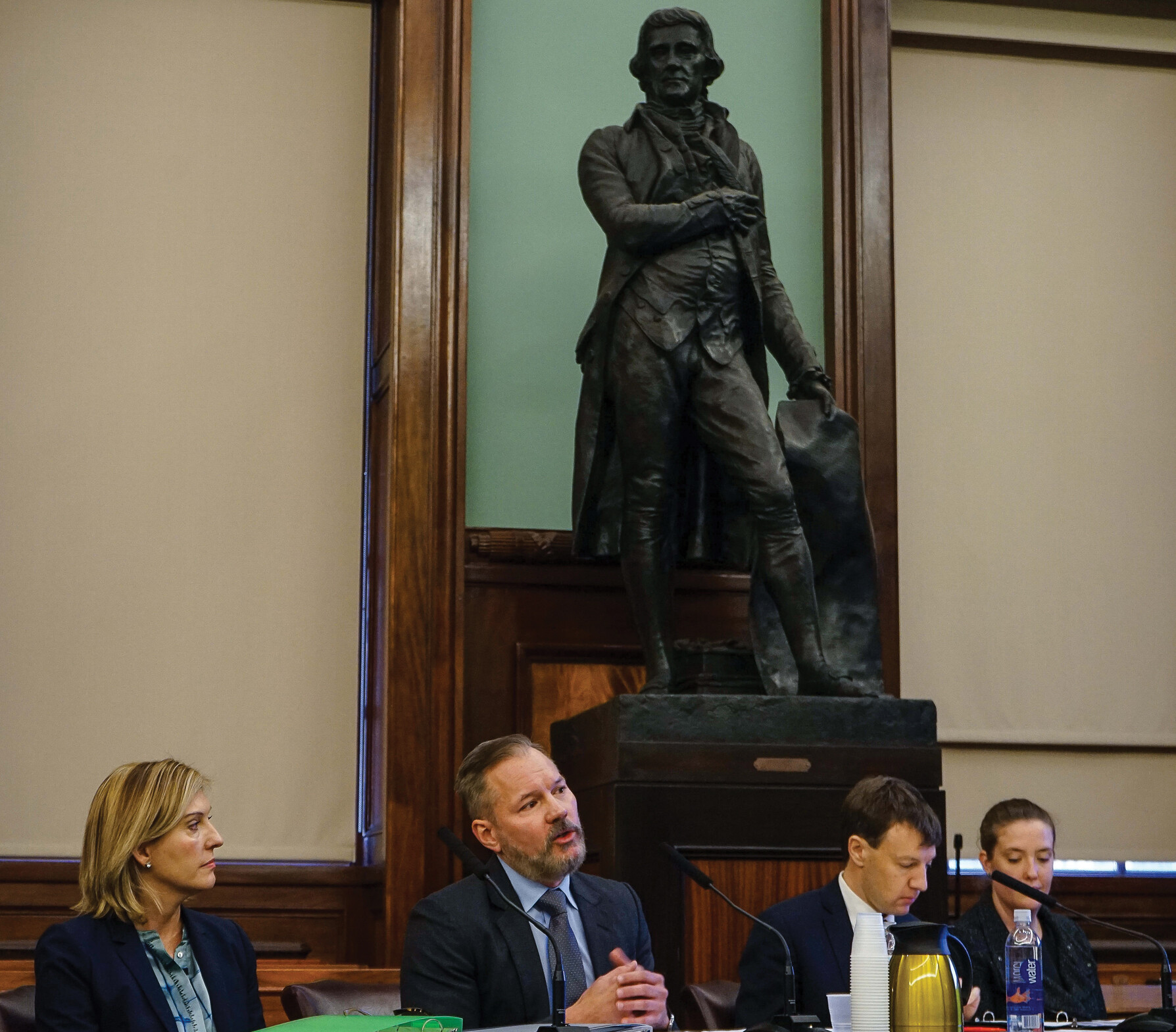
City council members sit in session as a statue of Thomas Jefferson looks on. The figure is in an active pose, as if striding forward.
Many Americans cherish the nation’s founding documents as symbols of the great American “experiment for promoting human happiness,”36 as George Washington termed it. But the system of government that emerged was the subject of intense debate and of compromise between competing factions with differing interests along regional, economic, and philosophical lines. The meaning of the values encapsulated in the institutions of American government as set out in the Constitution were the subject of debate as well—and continue to be contested to this day.
The Founders placed individual liberty ahead of all other political values. They feared that too much democracy could degenerate into tyranny of the majority. They feared that economic or social equality would inspire the have-nots to interfere with the liberty of the haves. As a result, they designed many of the Constitution’s key provisions, such as separated powers, internal checks and balances, and federalism, to safeguard liberty, and they designed others, such as indirect election of senators and the president and the appointment of judges for life, to limit democracy and the threat of majority tyranny. These features continue to influence the nature of representation in the United States.
By championing liberty, however, the framers virtually guaranteed that the fight for justice and equality would mark the history of the United States. The degree to which different groups of Americans have enjoyed liberty, equality, and justice has varied across time and place. But because liberty promotes political activity and participation, it encourages people and groups to fight for their rights and interests and for justice. In so doing, they may achieve greater equality.
What do you think about the values of liberty, equality, and justice? Which is most important to you? Which do you think is most important to New York City council member Inez Barron, Professor Hasan Kwame Jeffries, or Professor Sean Wilentz? How might your life be different if you lived in a country with different commitments to these values?
Advocates arguing for a particular policy position often invoke cherished values such as liberty, equality, and justice to support their positions. What kinds of arguments could both supporters and opponents of removing statues of the nation’s Founders make using these three values?
Are there policy areas where you are frustrated by the slow policy-making process created by the separation of powers and the system of checks and balances? Or policy areas where you are relieved that changes you opposed were slowed or halted? What are your views on the pros and cons of the nation’s constitutional structure?
those who favored strong state governments and a weak national government and who were opponents of the Constitution proposed at the American Constitutional Convention of 1787
a series of essays written by Alexander Hamilton, James Madison, and John Jay supporting ratification of the Constitution
Endnotes
Melancton Smith, quoted in Herbert J. Storing, What the Anti-Federalists Were For (Chicago: University of Chicago Press, 1981), 17.Return to reference 28