Explain how the relationship between the federal and state governments has evolved over time
The most fundamental impact of federalism on the way the United States is governed comes not from any particular provision of the Constitution but from the framework itself. The federal framework is not static; it changes over time as competing forces seek to make use of different levels of government to pursue their interests. Yet the federal framework does create both restraints and opportunities for political action and helps to determine how the country evolves.
At the time of the Founding, the states far surpassed the federal government in their power to influence the lives of ordinary Americans. In the system of shared powers, they played a much more active role in economic and social regulation than the federal government, which tended toward a hands-off approach. Although Supreme Court decisions gradually expanded its authority in this area, not until the New Deal response to the Great Depression in the 1930s did the national government gain vast new powers. Since then, even as this trend toward centralization has continued, the states have asserted themselves at certain times and in certain policy areas, sometimes aided by the courts. But at other moments a crisis shifts power toward the national government again, as during the September 11, 2001, terror attacks and the fiscal crisis that began in 2008. During the coronavirus pandemic, the federal government issued policies on travel from abroad and awarded contracts to pharmaceutical firms developing treatments and vaccines, while state and local governments were responsible for shutdown orders and mask mandates. Federalism creates a complex, flexible form of government whose workings shift over time.
Restraining National Power with Dual Federalism
Historically, the dual federalism fundamental to the American system of government has meant that states have done most of the fundamental governing. We call this state-centered federalism the “traditional system” because it prevailed for much of American history. Under this system, the national government was quite small and very narrowly specialized in the functions it performed. For evidence, look at Table 3.2, which lists the major types of public policies by which Americans were governed for the first century and a half under the Constitution.
What do the functions of the national government reveal? First, virtually all of them were aimed at assisting commerce, such as building roads or protecting domestic industries with tariffs on imported goods. Second, virtually none of them directly coerced citizens. The emphasis was on promotion and encouragement—providing land or capital needed for economic development.
TABLE 3.2Governmental Functions in the Traditional Federal System, 1789–1937
NATIONAL GOVERNMENT POLICIES (DOMESTIC)
STATE GOVERNMENT POLICIES
LOCAL GOVERNMENT POLICIES
Internal improvements
Subsidies
Tariffs
Public land disposal
Patents
Currency
Property, estate, and inheritance laws
Commerce and banking laws
Corporate, occupations and professions, and insurance laws
Family, morality, public health, and education laws
Penal and criminal laws
Eminent domain, construction, land use, water, and mineral laws
Local government, election, and civil service laws
Adaptation of state laws to local conditions
Public works
Contracts for public works
Licensing of public accommodation
Zoning and other land-use regulation
Basic public services
FOR CRITICAL ANALYSIS
Which level of government had the most influence over citizens’ lives when the country was founded? Why did this allocation of responsibilities make sense at the time?
State legislatures were also actively involved in economic regulation during the nineteenth century. American capitalism took its form from state property and trespass laws and from state laws and court decisions regarding contracts, markets, credit, banking, incorporation, and insurance. Until the Thirteenth Amendment abolished slavery, property law extended to slavery, with the fugitive slave clause of the Constitution (Article IV, Section 2) requiring even “free states” without slavery to return freedom-seeking enslaved people to the states from which they had escaped.
By allowing states to do most of the governing, the Constitution saved the national government from many policy decisions that might have proved too divisive for a large and very young country. And the state and regional variation in policy allowed by the federal framework continues to facilitate governance in this vast and diverse nation.
How the Supreme Court Responded to Demands for a Larger Federal Role
As the nation grew, disputes arose about the powers of the federal government versus the powers of the states. In the first several decades after the Founding, the Supreme Court decided several critical cases that expanded federal powers, removed barriers to trade across the states, and laid the groundwork for a national economy. These early decisions to expand federal power rested on a pro-national interpretation of Article I, Section 8, of the Constitution. That article enumerates the powers of Congress, including the power to tax, raise an army, declare war, establish post offices, and “regulate commerce with foreign nations, and among the several States and with the Indian tribes.” Though its scope initially was unclear, this commerce clause would later form the basis for expanding federal government control over the economy.
HOW TO
MAKE YOUR VOICE HEARD AT A LOCAL MEETING
More information
A headshot of Domingo Morel. He smiles at the camera. He has dark hair and wears a jacket over an open-collared shirt.
Domingo Morel, cofounder of the Rhode Island Latino Policy Institute and assistant professor at Rutgers University–Newark
How can you change policy in your community? There are over 90,000 local governments in the United States, including school boards, city councils, county boards, and special districts for public transportation, utilities, libraries, parks, police, fire, water, and more. Domingo shared his advice for making your voice heard in local government:
1
Figure out which governmental entity has jurisdiction over your issue and get on its agenda. Most school boards, city councils, and other local government entities have an online sign-up to speak at their meetings.
2
Do research on your issue. Local governments often do not have staffs to do research. Many local officeholders have day jobs. You can be an effective advocate and partner by supplying the research they can’t do. Young people would be surprised to learn how far that can get them.
3
Prepare your statement. Your time will be limited, so lay out your issue concern and suggested solution succinctly. The most effective statements don’t just articulate an argument but also attach a personal narrative about why this issue is important and convey that to the people who are in power.
4
Follow up. Email the members of the board or council. Broadcast your issue concern and proposals on social media. Monitor the agenda and attend subsequent meetings. Build relationships with local officials.
5
Consider that collective action may be even more powerful. I recall a mother who attended Newark school board meetings for four months, urging, without success, that Muslim holidays be added to the school calendar. In the fifth month she said, “Today I brought my community. Can all of the Muslims in attendance please stand up?” Seeing an auditorium full, the school board changed the policy. I advise bringing friends, finding out what groups may already work on your concerns, or creating your own group if needed (see How to Start an Advocacy Group on p. 415).
6
Work across the generations. Seek the advice of elders and community leaders who worked on such issues in the past. In turn, recruit younger people to keep the effort going, giving them information so they don’t have to start over. It’s not easy getting engaged, it’s not easy to go out there and be an activist on the individual or collective level, but once you get to that place, it’s important to ensure you’re recruiting others.
7
Work the federal system. Many issues are addressed at multiple levels of government. Strategize about the best level for addressing your particular concern. And if you make no headway at one level, target another. Federalism brings its challenges but also has its advantages.
More information
A woman stands and speaks into the mic of a podium in an auditorium. A group of people, seated behind her and to her left, listen attentively.
The Court’s early decisions began to define national power by favoring federal control over the economy when there was a conflict between the states and the federal government. The first and most important such case was McCulloch v. Maryland (1819), which involved the question of whether Congress could charter a national bank—an explicit grant of power nowhere to be found in Article I, Section 8.11 Chief Justice John Marshall answered that this power could be “implied” from other powers expressly delegated to Congress, such as the power to regulate commerce. His decision rested on the necessary and proper clause of Article I, Section 8, which gave Congress the power to enact laws “necessary and proper” for carrying out its delegated powers.
Marshall also concluded in McCulloch that any state law conflicting with a federal law is invalid because the Constitution states that “the Laws of the United States . . . shall be the supreme Law of the Land.” Both aspects of his ruling thus created the potential for an unprecedented increase in national government power, yet Congress did not immediately pursue such an expansion.
Another major case, Gibbons v. Ogden (1824), reinforced this nationalistic interpretation of the Constitution. The issue was whether New York State could grant a monopoly to Robert Fulton’s steamboat company to operate an exclusive service between New York and New Jersey. In arguing that the state lacked the power to do so, Chief Justice Marshall had to define what Article I, Section 8, meant by “commerce among the several states.” He insisted that the definition was “comprehensive,” extending to “every species of commercial intercourse.” However, this comprehensiveness was limited “to that commerce which concerns more states than one.”
Gibbons is important because it established the supremacy of the national government in all matters affecting what later came to be called “interstate commerce.”12 But the precise meaning of that term would remain uncertain over the next few decades. Backed by the implied-powers decision in McCulloch and by the broad definition of “interstate commerce” in Gibbons, Article I, Section 8, was a source of power for the national government as long as Congress aimed to encourage commerce through subsidies, services, and land grants.
Later in the nineteenth century, though, any effort of the national government to regulate commerce in such areas as fraud, product quality, child labor, or working conditions or hours was declared unconstitutional by the Supreme Court. The Court said that with such legislation the federal government was entering workplaces—local areas—and attempting to regulate goods that had not yet passed into interstate commerce. To enter local workplaces was to exercise police power—a power reserved to the states.
More information
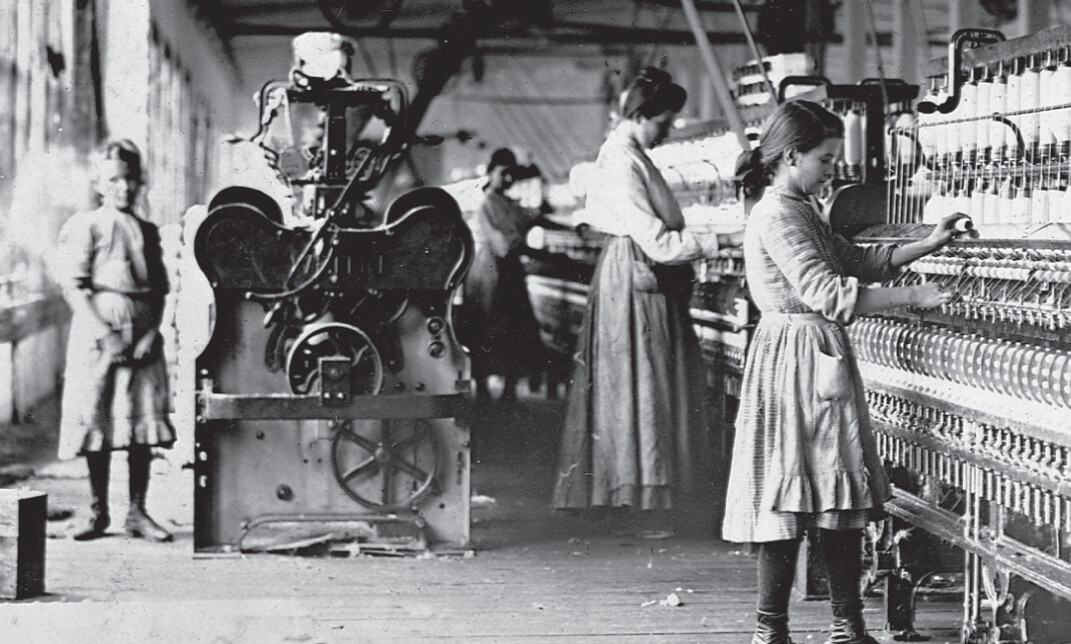
In a black and white photo, a child and several young women work at a large machine inside a mill building.
In 1916 the national government passed the Keating-Owen Child Labor Act, which excluded from interstate commerce all goods manufactured by children under age 14. The act was ruled unconstitutional by the Supreme Court, and the regulation of child labor remained in the hands of state governments until the 1930s.
No one questioned the power of the national government to regulate businesses that by their nature crossed state lines, such as railroads, gas pipelines, and waterway transportation. But well into the twentieth century the Supreme Court used the concept of interstate commerce as a barrier against most efforts by Congress to regulate local conditions. Thus, federalism, as interpreted by the Supreme Court for 70 years after the Civil War, enabled business to enjoy the benefits of national policies promoting commerce while being shielded by the courts from policies regulating commerce by protecting consumers and workers.13
This barrier fell after 1937, however, when the Supreme Court issued a series of decisions that laid the groundwork for a much stronger federal government. Most significant was the Court’s dramatic expansion of the commerce clause. By throwing out the old distinction between interstate and intrastate commerce, the Court converted the clause from a source of limitations to a source of power for the national government. The Court upheld acts of Congress that protected the rights of employees to organize and engage in collective bargaining, regulated the amount of farmland in cultivation, extended low-interest credit to small businesses and farmers, and restricted the activities of corporations dealing in the stock market.14
The Court also upheld many other laws that contributed to the construction of the modern safety net of social programs created in response to the Great Depression. With these rulings, the Court decisively signaled that the era of dual federalism was over. In the future, Congress would have very broad powers to regulate activity in the states.
The New Deal: New Roles for Government
The economic crisis of the Great Depression and the nature of the government response signaled a new era of federalism in the United States. Before this national economic catastrophe, it was states and localities that took responsibility for assisting people in poverty, usually channeling aid through private charity. But the extent of the depression quickly exhausted their capacities. By 1932, 25 percent of the workforce was unemployed, and many people had lost their homes and settled into camps called “Hoovervilles,” after President Herbert Hoover. Elected in 1928, the year before the depression hit, Hoover steadfastly maintained that the federal government could do little to alleviate the misery caused by the depression. It was a matter for state and local governments, he said.
More information
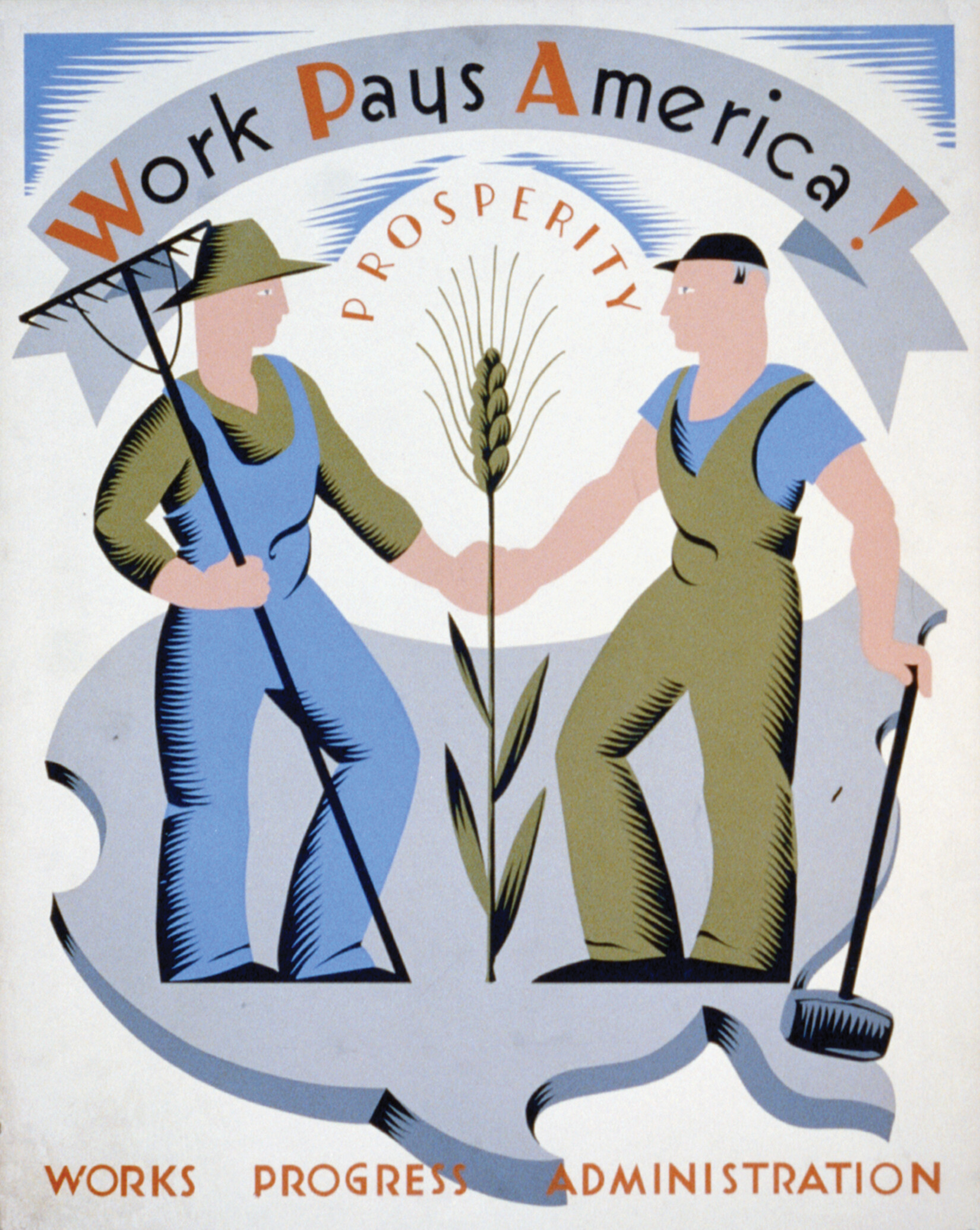
An illustrated poster reads, “Work pays America!” at the top and “Works Progress Administration” at the bottom. The illustration between the two phrases comprises two men in overalls, shaking hands across a stalk of corn, while standing atop a map of the United States.
The New Deal expanded the scope of the federal government. One of the largest and most effective New Deal programs, the Works Progress Administration (WPA) employed millions of Americans in projects such as constructing highways, bridges, and public parks.
Yet demands mounted for the federal government to take action. In Congress, some Democrats proposed that the federal government finance public works to aid the economy and put people back to work. Other members of Congress introduced legislation to provide federal grants to the states to assist them in their relief efforts. Most of these measures failed to win congressional approval or were vetoed by President Hoover.
When Franklin Delano Roosevelt took office in 1933, he energetically threw the federal government into the fight against the depression through a number of proposals known collectively as the New Deal. He proposed a variety of temporary relief and work programs, most of them to be financed by the federal government but administered by the states. In addition to these temporary measures, Roosevelt presided over the creation of several important federal programs designed to provide future economic security for Americans. The New Deal signaled the rise of a more active national government.
Cooperative Federalism and the Use of Categorical Grants
For the most part, the new national programs that the Roosevelt administration developed did not directly take power away from the states. Instead, the national government typically offered states grants-in-aid, money provided on the condition that it be spent for a particular purpose defined by Congress. The New Deal expanded the range of grants-in-aid into social programs, providing grants to the states for financial assistance to poor children. Congress added more grant programs after World War II to help states fund activities such as providing school lunches and building highways. Sometimes state or local governments were required to match the national contribution dollar for dollar, but in programs such as the development of the interstate highway system, the congressional grants provided 90 percent of the cost.
These types of federal grants-in-aid are called categorical grants because the national government determines the purposes, or categories, for which the money can be used. For the most part, the categorical grants created before the 1960s simply helped the states perform their traditional functions.15 During that decade, however, the number of categorical grants increased dramatically,16 and new ones announced national purposes much more strongly than had earlier grants. One of the most important—and expensive—was the federal Medicaid program, which provides grants to pay for medical care for people in poverty, disabled people, and many nursing home residents. Over time the value of categorical grants has risen dramatically, increasing from $54.8 billion in 1960 to an estimated $1,111 billion in 2022 (see Figure 3.1).
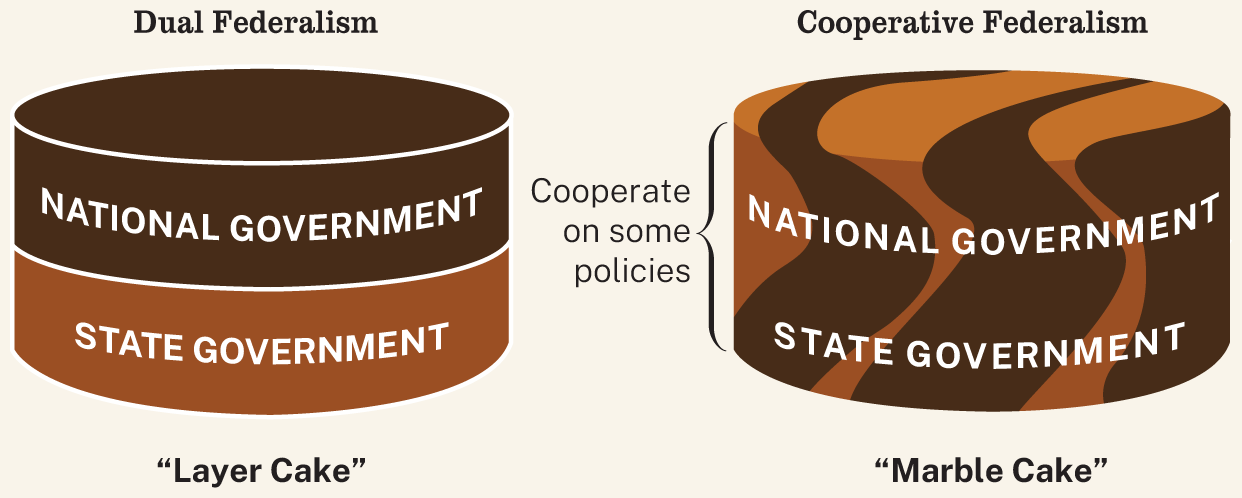
The growth of categorical grants created a new kind of federalism. If the traditional system of two authorities—the federal government and the states—performing highly different functions could be called dual federalism, historians of federalism suggest that the system since the New Deal could be called cooperative federalism. The political scientist Morton Grodzins characterized this as a move from “layer cake federalism” to “marble cake federalism,”17 in which intergovernmental cooperation and sharing have blurred a once-clear distinguishing line, making it difficult to say where the national government ends and the state and local governments begin (see Figure 3.2).
As important as the states were in this new system of grants, some new federal grants, particularly during the War on Poverty of the 1960s, bypassed the states and instead sent money directly to local governments and even to local nonprofit organizations. One of the reasons for this shift was the way African Americans were treated in the South. As the civil rights movement gained momentum, the southern defense of segregation on the grounds of states’ rights helped create the impression in Washington that the states could not be trusted to carry out national purposes.
Yet other new programs of the 1960s, such as Medicaid, relied on state governments for their implementation. In addition, as the national government expanded existing state-run programs, states had to take on more responsibilities, which gave them a critical role in the federal system.
FIGURE 3.1Federal Grants-in-Aid,* 1960–2021
Federal spending on grants to state and local governments has grown dramatically since 1980. Today, most state and local governments are heavily dependent upon such grants to implement their policy goals. How might such dependence affect the autonomy of state governments and the character of American federalism?
*Excludes outlays for national defense, international affairs, and net interest. Data in constant (fiscal year 2012) dollars.
**Estimate.
SOURCE: Office of Management and Budget, U.S. Budget for Fiscal Year 2020, “Historical Tables: Table 12.1,” www.whitehouse.gov/omb/historical-tables/ (accessed 1/21/20); White House, “Aid to State and Local Governments,” www.whitehouse.gov/wp-content/uploads/2021/05/ap_11_state_and_local_fy22.pdf.
Regulated Federalism and the Rise of National Standards
Giving policy responsibilities to states raises questions about to what extent and in what areas it is acceptable for states to differ from one another. Supreme Court decisions have provided important answers to many of these questions, typically pushing for greater uniformity across the states. But in other policy areas, national government has created greater uniformity by offering incentives or imposing rules.
Federal grants, as we have seen, are one such tool: Congress provides an incentive by giving money to state and local governments if they agree to spend it for the purposes Congress specifies. But as Congress in the 1970s began to enact legislation in new areas, such as environmental policy, it resorted to another tool: regulations on states and localities. In what some political scientists call regulated federalism,18 the national government began to set standards of conduct or to require the states to set standards that met national guidelines. As a result, state and local policies in environmental protection, social services, and education are more uniform from coast to coast than are other nationally funded policies.
FIGURE 3.2Dual versus Cooperative Federalism
In layer-cake (dual) federalism, the responsibilities of the national government and state governments are clearly separated. In marble-cake (cooperative) federalism, national policies, state policies, and local policies overlap in many areas.
More information
Figure 3.2 is a diagram titled, Dual versus Cooperative Federalism. The diagram uses two cakes to explain the differences between the two types of federalism. The first cake, called “layer cake,” represents dual federalism and shows national government stacked on top of state government. The second cake, called “marble cake,” shows cooperative federalism between the national government and state government. It is mixed together to show that they cooperate on some policies.
Sometimes the federal government takes over areas of regulation from state or local governments when their standards are less strict or otherwise inconsistent with federal ones. In the 1970s, such preemption required the states to abide by tougher federal rules in areas including air and water pollution, occupational health and safety, and access for disabled people. The regulated industries often opposed preemptions because they increased the cost of doing business. After 1994, however, when Republicans took control of Congress, the federal government used its preemption power to limit the ability of states to tax and regulate industry. For example, the Internet Tax Freedom Act, first enacted by Congress in 1998 and subsequently renewed, prohibits states and localities from taxing internet access services.
FOR CRITICAL ANALYSIS
When is federal preemption of local laws desirable? Is preemption justified for some issues more than for others?
State and local governments as well as individuals often challenge federal preemptions. For example, in 2001, Attorney General John Ashcroft declared that Oregon’s law permitting doctor-assisted suicide was illegal under federal drug regulations. Ashcroft’s rule was challenged by the state, a physician, a pharmacist, and several terminally ill state residents, and in 2006 the Supreme Court ruled that the attorney general did not have the authority to prohibit the Oregon law.19
The Trump administration took actions much like the congressional Republicans of 1994. California has long had more stringent vehicle emissions and mileage targets than the federal government, but the administration moved to prohibit any state from setting standards different from federal ones. In 2019, California and 22 other states sued to keep their ability to set stricter regulations in place.20 The suit was unsuccessful. In 2022, however, the Biden administration restored the rights of states to set their own emission standards even if these were more strict than federal standards.
the system of government that prevailed in the United States from 1789 to 1937 in which most fundamental governmental powers were shared between the federal and state governments
Article I, Section 8, of the Constitution, which delegates to Congress the power “to regulate commerce with foreign nations, and among the several States and with the Indian tribes”; this clause was interpreted by the Supreme Court in favor of national power over the economy
programs through which Congress provides money to state and local governments on the condition that the funds be employed for purposes defined by the federal government
a type of federalism existing since the New Deal era in which grants-in-aid have been used strategically to encourage states and localities (without commanding them) to pursue nationally defined goals; also known as intergovernmental cooperation
the principle that allows the national government to override state or local actions in certain policy areas; in foreign policy, the willingness to strike first in order to prevent an enemy attack
The Sherman Antitrust Act, adopted in 1890, for example, was enacted not to restrict commerce but rather to protect it from monopolies, or trusts, in order to prevent unfair trade practices and to enable the market again to become self-regulating. Moreover, the Supreme Court sought to uphold liberty of contract to protect businesses. For example, in Lochner v. New York, 198 U.S. 45 (1905), the Court invalidated a New York law regulating the sanitary conditions and hours of labor of bakers on the grounds that the law interfered with liberty of contract.Return to reference 13
The key case in this process of expanding the power of the national government is generally considered to be NLRB v. Jones & Laughlin Steel Corporation, 301 U.S. 1 (1937), in which the Supreme Court approved federal regulation of the workplace and thereby virtually eliminated interstate commerce as a limit on the national government’s power.Return to reference 14
Kenneth T. Palmer, “The Evolution of Grant Policies,” in The Changing Politics of Federal Grants, ed. Lawrence D. Brown, James W. Fossett, and Kenneth T. Palmer (Washington, DC: Brookings Institution Press, 1984), 15.Return to reference 15
Brady Dennis and Juliet Eilperin, “California and Nearly Two Dozen Other States Sue Trump Administration for the Right to Set Fuel-Efficiency Standards,” Washington Post, November 15, 2019, www.washingtonpost.com/climate-environment/2019/11/15/california-nearly-two-dozen-other-states-sue-trump-administration-right-require-more-fuel-efficient-cars/ (accessed 1/21/20).Return to reference 20