Since the United States was established as a nation, Americans have been reluctant to grant government too much power, and they have often been suspicious of politicians. But they have also turned to government for assistance in times of need and have strongly supported it in periods of war. In 1933 the government’s power began to expand to meet the crises created by the stock market crash of 1929, the massive business failures and unemployment of the Great Depression, and the threatened failure of the banking system. Congress passed legislation that brought government into the businesses of home mortgages, farm mortgages, credit, and relief of personal financial distress. More recently, when the economy suffered a deep recession in 2008 and 2009, the federal government took action to stabilize the financial system, oversee the restructuring of failing auto manufacturers, and provide hundreds of billions of dollars in economic stimulus. From 2020 to 2022, federal funds helped fight the coronavirus pandemic, providing funds to businesses, to state and local governments, and direct payments to many Americans.
More information
A screen capture displays the Federal Student Aid homepage. Five side-view portrait shots form the backgrounds for five questions: How Do I Prepared For College? What Types Of Aid Can I Get? Do I Qualify For Aid? How Do I Apply For Aid? And How Do I Manage My Loans?
The federal government maintains a large number of websites that provide useful information to citizens on such topics as loans for education, civil service job applications, the inflation rate, and how the weather will affect farming. These sites are just one way in which the government serves its citizens.
Today the national government is enormous, with programs and policies reaching into every corner of American life. It oversees the nation’s economy, it is the nation’s largest employer, it controls the world’s most formidable military, and it regulates a wide range of social and commercial activities. Americans use government services, benefits, and infrastructure every day, although they are simultaneously skeptical about the role of government in society.
Partisan Differences over the Size of Government
The Constitution lays out a system of limited government. Yet over the years, in response to citizen demands and economic downturns, the power and size of government have increased. Today, Americans are almost evenly divided in their opinions about the overall size of government: 47 percent would prefer smaller government with fewer services, and 47 percent would prefer bigger government with increased services.61 Despite these differing opinions, a clear majority support increased federal spending in education (72 percent), veterans benefits (72 percent), and rebuilding highway infrastructure (62 percent).62 Thus, while a sizeable portion of Americans prefer small government in the abstract, many still very much like what government does in particular areas.63
What explains the different levels of support in the size of government? Partisanship (being a strong supporter of a political party) is one factor. Democrats have often advocated for enlarging the size of government, while Republicans have argued for restraining it. A recent poll found that compared with Republicans (22 percent), significant majorities of Democrats (83 percent) and Independents (56 percent) favored increasing the role of government to solve more problems.64 The partisan divide was especially pronounced over support for President Biden’s American Rescue Plan stimulus package in 2021, with 94 percent of Democrats and only 26 percent of Republicans in support.65
Trust in Government
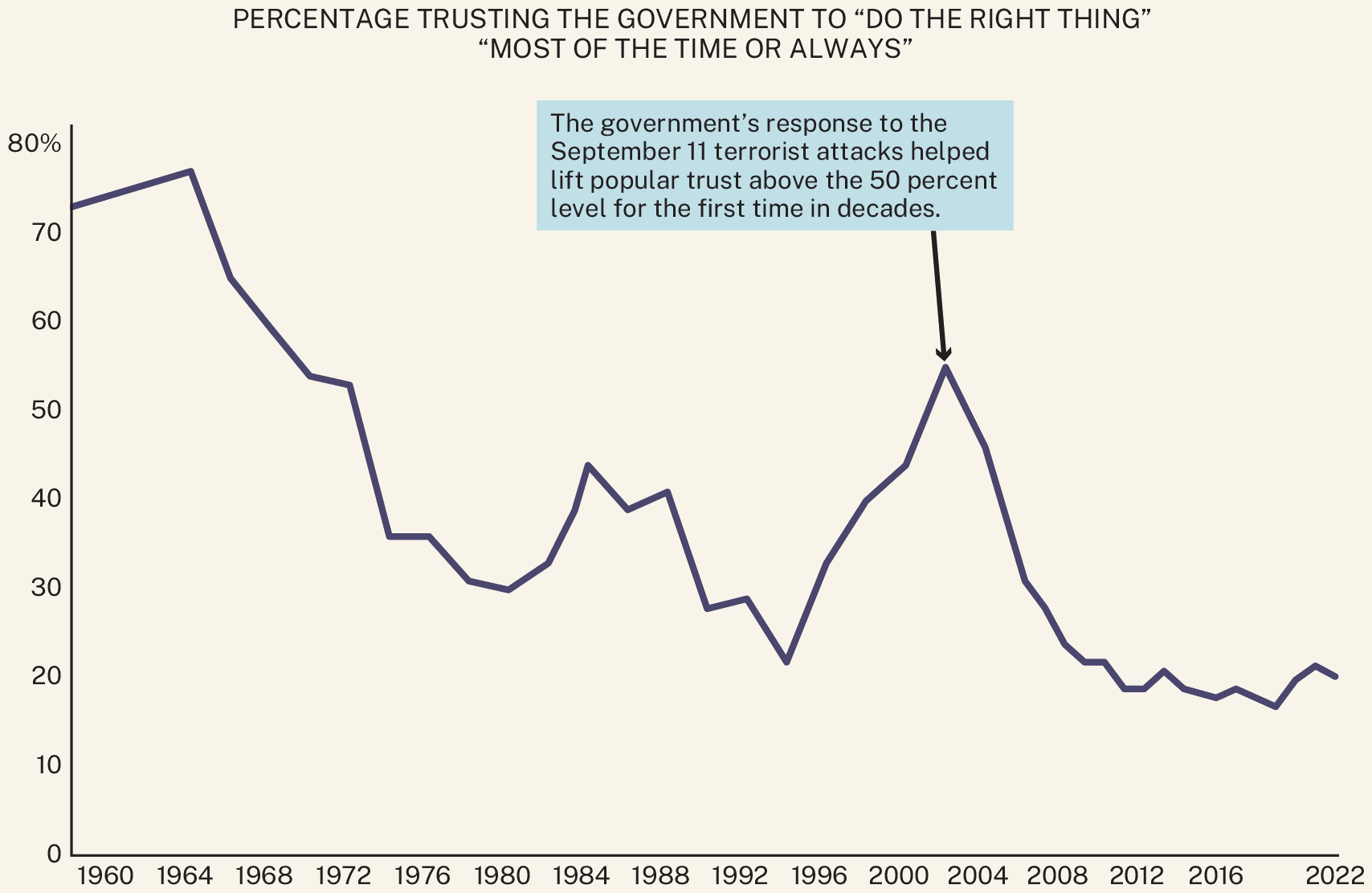
A key characteristic of contemporary political culture is low trust in government. In the early 1960s three-quarters of Americans said they trusted government “most of the time or always.” By 2021 only 24 percent said they did.66 (See Figure 1.3.)
FIGURE 1.3Public Trust in Government, 1958–2022
Since the 1960s, general levels of public trust in government have declined. What factors might help to account for changes in the public’s trust in government? Why has confidence in government dropped again since September 11, 2001?
More information
A line graph titled Public Trust in Government, 1958 to 2022 shows the declining percentage of Americans TRUSTING THE GOVERNMENT TO “DO THE RIGHT THING” “MOST OF THE TIME OR ALWAYS”. The percentage is above 70% in the early 1960s but begins to drop rapidly in the late 1960s. It hits 30% in 1980, briefly recovers to about 40% in the late 1980s but in the mid-1990s hits a new low of around 20%. At that point, the percentage rises steadily and rapidly, peaking above 50% in 2003. At that point, the percentage starts dropping steeply again, and from 2010 onward stabilizes at about 20%.
SOURCE: The American National Election Studies, 1958–2004; Pew Research Center, www.people-press.org/2019/04/11/public-trust-in-government-1958-2019 (accessed 1/19/20); Pew Research Center, “Public Trust in Government: 1958–2022,” June 6, 2022, www.pewresearch.org/politics/2022/06/06/public-trust-in-government-1958-2022/ (accessed 7/7/22).
Trust rose after the September 11, 2001, terrorist attacks, but fell to pre-attack levels within three years, and the trend has continued downward. Distrust of government greatly influenced the presidential primary elections in 2016, when a number of “outsider” candidates critical of government attracted wide support, including Donald Trump. Importantly, trust in government has been found to increase among members of the party that controls the presidency. For example, Republicans exhibited higher levels of trust when Trump was president (36 percent), while Democrats’ trust fell (12 percent). In contrast, Democrats’ trust in government increased to 36 percent during the Biden administration while Republicans’ plummeted to 9 percent.67
FOR CRITICAL ANALYSIS
Is your level of trust in government high or low? What is your feeling based on? If you have low trust in government, what changes in society or politics might increase that trust?
While Americans’ trust in the federal government has fallen over recent decades, trust in local and state governments has stayed relatively high. Even during the pandemic, with people objecting to policies from their state and local governments, confidence continued to be higher than in the federal government. One poll found that clear majorities of respondents expressed trust in their state governments (57 percent) and in their local governments (66 percent). In contrast, only 39 percent of Americans expressed trust in the federal government.68 The differing levels in trust are likely related to the fact that state and local governments are smaller than the federal government, which means that citizens can exert greater influence on local and state politics.
Level of trust also differs across groups: Black people and Latinos express more confidence in the federal government than do White people. And there is a generational difference in levels of trust: Baby Boomers (those born between 1946 and 1964) express greater confidence in the federal government than those from Generation Z (born after 1996).69
Does it matter if Americans trust their government? Yes. As we’ve seen, most Americans rely on government—federal, state, and local—for a wide range of services and protections. Long-term distrust in government can result in opposition to the taxes necessary to support such programs and can also make it difficult to attract talented workers to public service.70 In addition, it may ultimately weaken the nation in defending its interests in the world economy and may jeopardize its national security. Likewise, a weakened government can do little to help citizens weather periods of tumultuous economic or technological change. Public confidence in government is vital for the health of a democracy.
WHAT DO YOU THINK?
AMERICANS AND THEIR POLITICAL VALUES
More information
Hayat Muse stands in front of her high school. She wears a hijab and a warm jacket.
This chapter has examined various components of American ideals, traditions, and values. Many citizens support the political values of liberty, equality, and justice, but how we put them into practice sparks many of the debates that shape American political life. In addition, the makeup of the population deeply influences the nation’s politics. Race, gender, and class divisions foster disagreement and debate and, as we will see throughout this book, influence how government and politics function.
At the start of this chapter, we introduced Hayat Muse and Cole Stevens, workers who supported their families but who were denied unemployment benefits when they were laid off during the coronavirus pandemic because they were high school students. Given what you learned in this chapter about Americans and their political values, take a closer look at the account of the students’ activism on pp. 2–4:
Given your political values—your beliefs about liberty, equality, and justice—what do you think of the unemployment benefit case? If you were to contact an elected official about this issue, which American values would you emphasize? What values do you think Hayat and Cole underlined?
In what ways does the diversity of the American people represent a strength for American democracy? In what ways is it a challenge?
How important do you think participation, knowledge, and efficacy are for the functioning of American democracy? What would make you more engaged in government? How do you imagine Hayat and Cole would answer these questions? Are your friends, family, or fellow students engaged in politics? Why, or why not?
Endnotes
“Little Public Support for Reductions in Federal Spending,” Pew Research Center, April 11, 2019, www.pewresearch.org/politics/2019/04/11/little-public-support-for-reductions-in-federal-spending/ (accessed 9/5/21).Return to reference 61
Benjamin I. Page and Lawrence R. Jacobs, Class War? What Americans Really Think about Economic Inequality (Chicago: University of Chicago Press, 2009).Return to reference 63
Megan Brenan, “New High 54% Want Government to Solve More Problems in U.S.,” Gallup, September 28, 2020, https://news.gallup.com/poll/321041/new-high-government-solve-problems.aspx (accessed 10/12/21).Return to reference 64
Frank Newport, “A New Era of Big Government?” Gallup, March 12, 2021, https://news.gallup.com/opinion/polling-matters/337406/new-era-big-government.aspx (accessed 10/12/21).Return to reference 65
“Americans See Broad Responsibilities for Government; Little Change Since 2019,” Pew Research Center, May 21, 2021, www.pewresearch.org/politics/2021/05/17/americans-see-broad-responsibilities-for-government-little-change-since-2019/ (accessed 3/19/22).Return to reference 66
Pew Research Center, “Public Trust in Government: 1958–2021,” May 17, 2021, www.pewresearch.org/politics/2021/05/17/public-trust-in-government-1958-2021/ (accessed 10/12/21).Return to reference 67
Megan Brenan, “Americans’ Trust in Government Remains Low,” Gallup, September 30, 2021, https://news.gallup.com/poll/355124/americans-trust-government-remains-low.aspx (accessed 1/26/22).Return to reference 68
Joseph S. Nye, Jr., “Introduction: The Decline of Confidence in Government,” in Why People Don’t Trust Government, ed. Joseph S. Nye, Jr., Philip D. Zelikow, and David C. King (Cambridge, MA: Harvard University Press, 1997), 4.Return to reference 70