2 The Founding & the Constitution
More information
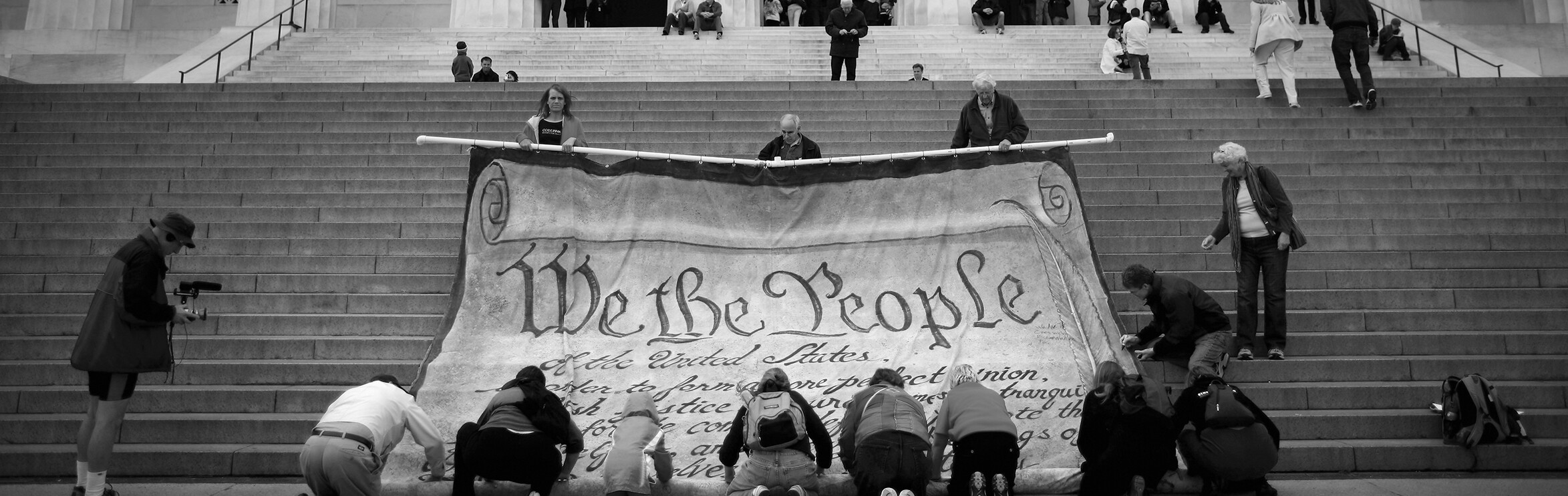
On the steps of Washington’s Lincoln Memorial, a team of people furls a giant copy of the preamble to the U S Constitution. A person off to the side films the event.
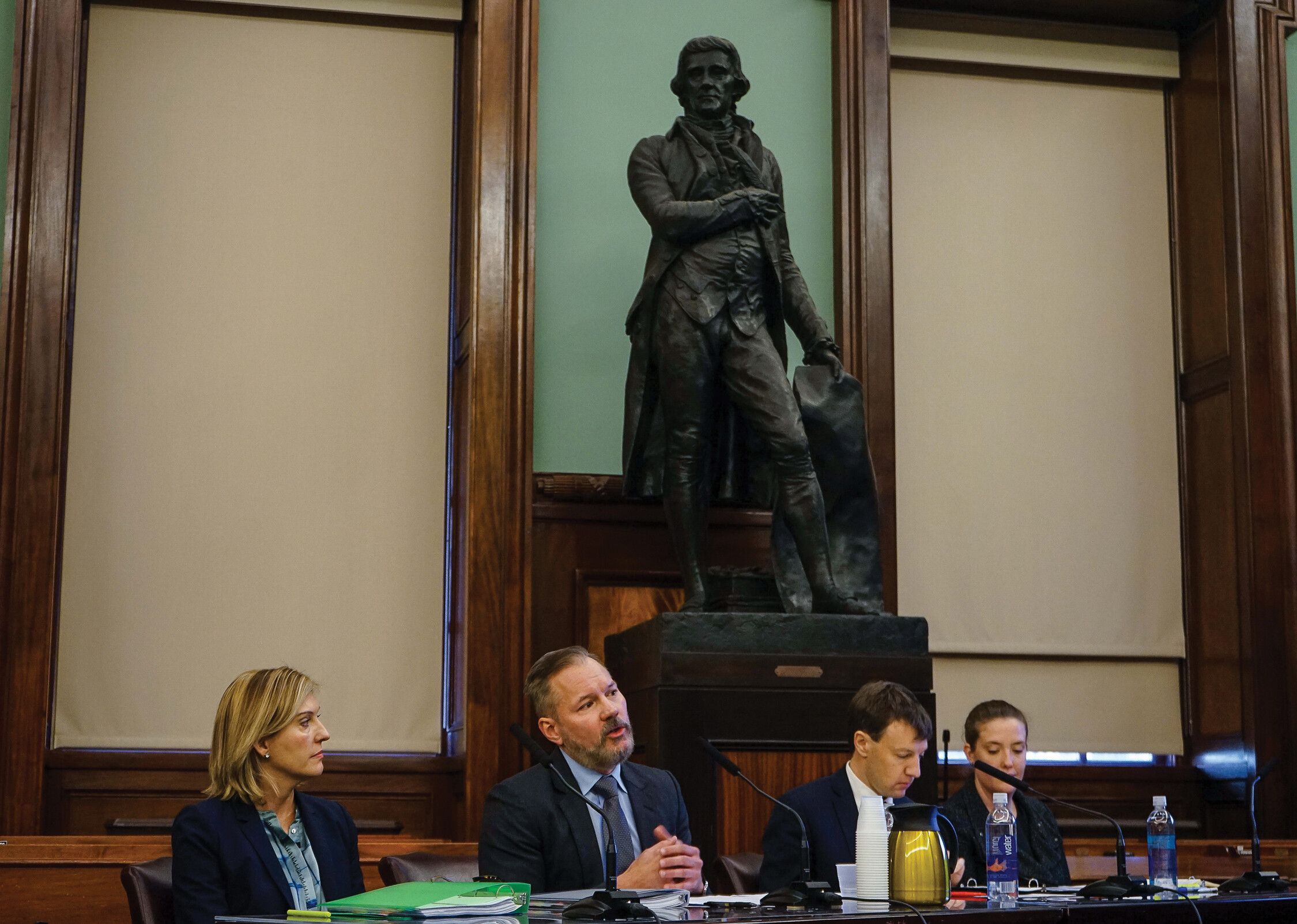
WHAT GOVERNMENT DOES AND WHY IT MATTERS For nearly 200 years—since 1834—a statue of Thomas Jefferson has stood in New York City Hall, residing in the city’s Council Chambers since 1915. A debate has been simmering for two decades about removing the statue. Many of the Founders, including Jefferson, owned enslaved people even as they were formulating the nation’s founding documents such as the Declaration of Independence and the U.S. Constitution, which uphold the ideas of liberty, justice, equality, and the pursuit of happiness. On one side of the debate are members of the city council’s Black, Latino, and Asian caucus, who described the statue as “oppressive” and “racist,” and who, in a letter to the mayor, argued that it serves as “a constant reminder of the injustices that have plagued communities of color since the inception of our country.”1 Council member Inez Barron said that Jefferson “felt that Blacks were inferior to Whites—in his own words,” and that he had removed Native peoples from their ancestral lands.2 Those urging that the statue remain in city hall had a different view. In a letter to the city’s Public Design Commission, Princeton historian Sean Wilentz argued that “the statue honors Jefferson for his greatest contribution to America, indeed, to humankind: the basic idea, radical then, radical now, that all men are created equal.”3 Raymond Lavertue, a historian from the University of Oxford, testified that “removal is a very simple solution that will erase the debate” and that although Jefferson was “massively flawed,” his ideas on equality should “be grappled with daily.”4
In October 2021, the city’s Public Design Commission decided to remove the statue. It will be moved to the New-York Historical Society, whose president and chief executive, Louise Mirrer, planned to create an exhibition examining “the relationship between the founding ideals of freedom and equality set down by Jefferson and their lived experience, which included supporting slavery and owning enslaved people.” “There are very, very difficult questions that need to be raised around the disconnect between our stated American ideals and the way in which they were not respected when it came to certain people,” she said. “I think those are topics that should not be shied away from.”5
The Declaration of Independence explained the American colonists’ right to revolt against England. Abraham Lincoln called it a “rebuke . . . to tyranny and oppression.” The U.S. Constitution lays out the purposes of government: to promote justice, to maintain peace at home, to defend the nation from foreign foes, to provide for the “general welfare” of Americans, and, above all, to secure the “blessings of liberty” for them. It also spells out a plan for achieving these objectives, including institutions to exercise legislative, executive, and judicial powers and a division of powers among the federal government’s branches and between the national and state governments.
More information
City council members sit in session as a statue of Thomas Jefferson looks on. The figure is in an active pose, as if striding forward.
These documents are revered. But as we will see in this chapter, they are also complicated. The Constitution was the product of conflict and intense bargaining among competing interests. The values of liberty, equality, and justice encapsulated in it and in the Declaration were contested then, and they are contested now. The debate over removing statues and monuments to Founders also reminds us that these documents were written by men whose legacy is complex. Historian Hasan Kwame Jeffries recounts that James Madison, the nation’s fourth president, formulated the Bill of Rights in the library of his home at Montpelier, built with bricks made by enslaved children, whose handprints can still be traced in the building’s foundation. Reckoning with these contradictions is “hard history,” Jeffries says, which is uncomfortable to discuss.6
Although many Americans believe strongly in the values of liberty, equality, and justice, the ways those values are defined and implemented by the institutions that the Constitution created have generated much controversy. As this chapter will show, the Constitution reflects high principles as well as political self-interest. How those principles have been realized over time—and which groups have benefited and which groups have suffered—is an enduring theme of American governance.
CHAPTER GOALS
Endnotes
- Jeffery C. Mays and Zachary Small, “Jefferson Statue Will Be Removed from N.Y.C. Council Chambers,” New York Times, October 19, 2021, www.nytimes.com/2021/10/18/nyregion/thomas-jefferson-statue-ny-city-council.html (accessed 1/26/22).Return to reference 1
- Bill Chappell, “New York City Will Exile Thomas Jefferson’s Statue from a Prominent Spot in City Hall,” NPR, October 19, 2021, www.npr.org/2021/10/19/1047258467/thomas-jefferson-statue-removal-new-york-city-council-chamber (accessed 10/20/21).Return to reference 2
- Joseph Guzman, “Thomas Jefferson Statue to Be Removed from New York City Council Chambers,” The Hill, October 19, 2021, https://thehill.com/changing-america/respect/577446-thomas-jefferson-statue-to-be-removed-from-new-york-city-council (accessed 10/20/21).Return to reference 3
- Mays and Small, “Jefferson Statue Will Be Removed.”Return to reference 4
- James Barron, “Removing a Statue of Thomas Jefferson from City Hall,” New York Times, October 18, 2021, www.nytimes.com/2021/10/18/nyregion/removing-a-statue-of-thomas-jefferson-from-city-hall.html (accessed 10/21/21).Return to reference 5
- Hasan Kwame Jeffries, “Why We Must Confront the Painful Parts of US History,” TEDxOhioStateUniversity, February 2020, www.ted.com/talks/hasan_kwame_jeffries_why_we_must_confront_the_painful_parts_of_us_history#t-784414 (accessed 10/20/21).Return to reference 6