Describe how the Constitution structures the relationships among the national, state, and local governments
Federalism is a system of government in which power is divided between a central government and regional governments. In addition to the United States, other nations with federal systems include Switzerland, Australia, and Germany. As we saw in Chapter 2, federalism was a central element of America’s Constitution of 1787, which assigned specific powers to the national government and left others to the states.
Federalism stands in contrast to a unitary system, in which lower levels of government have little independent power and primarily just implement decisions made by the central government. In France, for example, the central government was once so involved in the smallest details of local government that the minister of education boasted that by looking at his watch he could tell what all French schoolchildren were learning at that moment, because the central government set the school curriculum. (See America Side by Side for an overview of federalism and unitary systems worldwide.)
The United States was the first nation to adopt federalism as its governing framework. By granting a number of “expressed powers” to the national government and reserving all the rest to the states, the original Constitution recognized two authorities: state governments and the federal government.
While federalism was adopted to solve some practical governing problems that arose under the Articles of Confederation, as Chapter 2 noted, it has its own important implications for government and politics, some positive and some more problematic. Compared to unitary systems, with a single governing authority, federal systems with their multiple levels of government offer a number of possible advantages. Federalism offers the possibility of national unity for diverse countries. The nations most likely to have federal arrangements are those with diverse ethnic, language, or regional groupings, such as India, Switzerland, and Canada and certainly the United States.
At the time of America’s Founding, the new nation consisted of diverse economic and political interests. Federalism was a way of assuring these interests, particularly southern plantation owners, most if not all of whom owned enslaved Black people, that their views would not be submerged in the new nation. Today, the multiple governments at the national, state, and local levels present many opportunities for citizens to express their preferences, offering to maximize democratic participation. Because states and even localities have their own taxing, spending, and policy-making powers (especially in the United States), policy experimentation, innovation, and the tailoring of policy to local preferences are all possibilities. And competition among states and localities to attract individuals and businesses may maximize the efficiency of government services.3 But federalism can produce problems as well. Slavery and segregation hid behind the banner of federalism. During the pandemic, opponents of measures that might mitigate the effects of Covid-19 seized upon the rhetoric of local control and states’ rights.
AMERICA |SIDE BY SIDE
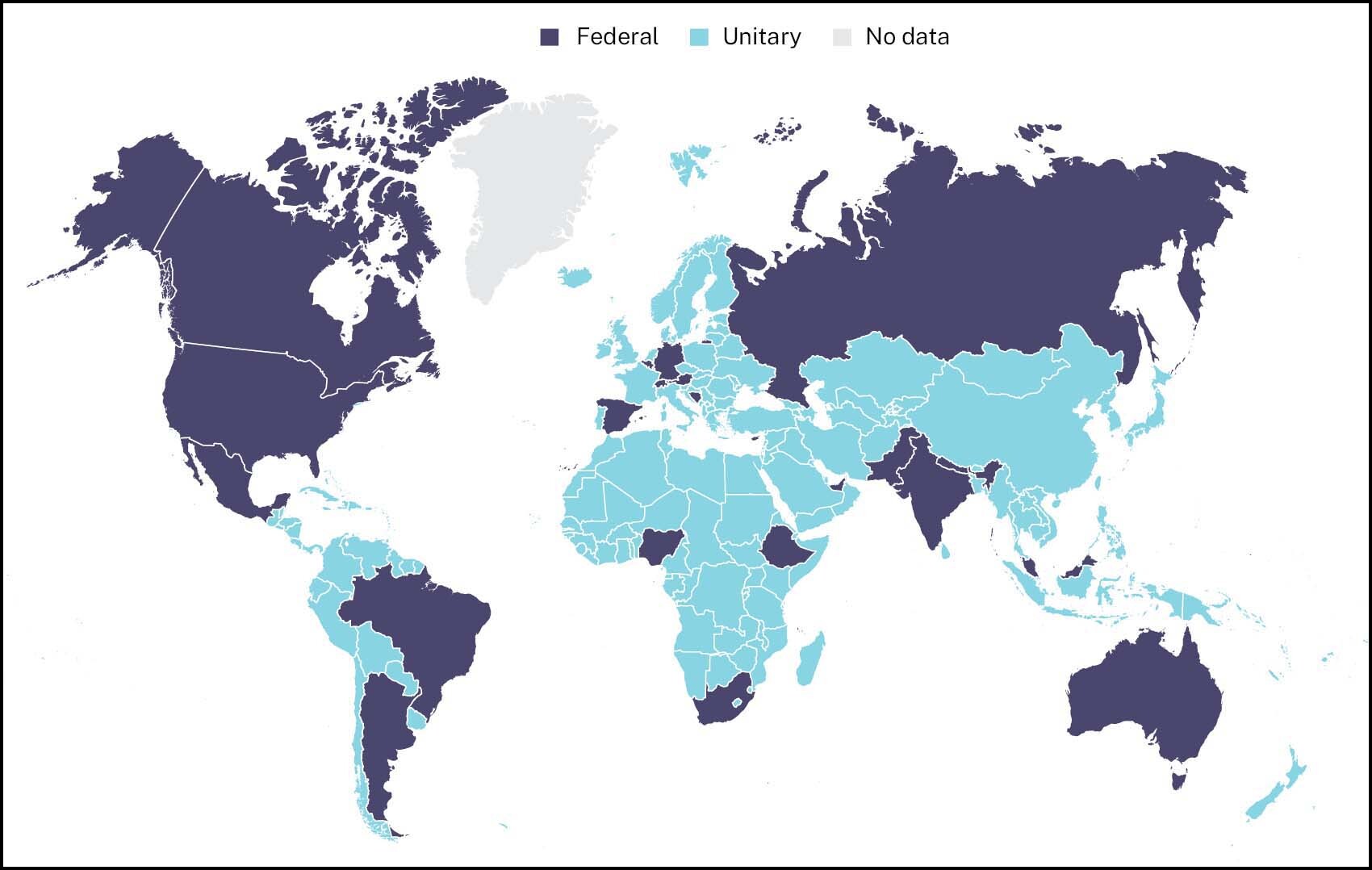
Federal and Unitary Countries
Worldwide, unitary systems of government are much more common than federal systems. Geographically they may appear to be roughly even on this map, but that is because larger countries such as the United States and Russia often use federal systems. In fact, fewer than 15 percent of the world’s countries use federal systems. Each type of system brings its own strengths and drawbacks: unitary systems can be more efficient, but federal systems can allow for more regional autonomy and policy innovation.
What explains why a country might use a federal or a unitary system? Why would a country with a large amount of territory to govern, such as Canada or Brazil, prefer a federal arrangement? Are there any geographic or regional patterns that you see? What might lead to countries on a continent being more likely to have similar government arrangements?
What are some of the other advantages to having a unitary system? In what ways might a federal system be more responsive? If you were designing your own country, which would you prefer and why?
More information
A world map shows the countries with federal and unitary systems of government. The countries are categorized as Federal, Unitary, and No Data Available. The most prominent countries on the map, having a Federal system of government are as follows. The U S A, Canada, and Mexico in North America. Brazil and Argentina in South America. Nigeria, Ethiopia, and South Africa in Africa. The U A E in the Middle East. Belgium, Germany, Switzerland, Austria and Spain in Europe. Russia. Pakistan, India, Nepal, and Malaysia in Asia. Australia. The rest of the countries of the world, except for Greenland with no data available, have a unitary system of government.
SOURCE: A. Griffiths, R. Chattopadhyay, J. Light, and C. Stieren, “The Forum of Federations Handbook of Federal Countries 2020,” Wikipedia, https://en.wikipedia.org.
No two federal systems are exactly the same—they vary greatly in how power is shared—but in the American version of federalism state and local governments have even more policy-making responsibilities than in most federal systems. The result is particularly wide variation in policies and a centuries-long tug-of-war between the national and state governments, and between state and local governments. The federal structure’s division of labor across the levels of government makes intergovernmental relations—the processes by which those levels of government negotiate and compromise over policy responsibility—one of the most characteristic aspects of American government.
It is important to understand that federalism is not simply a contest for power between competing levels of government. It is also a contest for power between the different groups—social, economic, and political—that are influential at each level of government. Often in our history, groups influential in particular states sought to use those state governments to thwart national policies. In 1860, for example, after Republicans opposed to slavery won control of the national government, Democrats favoring slavery who controlled southern state governments seceded from the Union. During the Trump administration, Democrats used their control of several states to thwart the national government’s immigration policies, while during the Biden presidency, Republicans used their own control over several state governments to undermine federal efforts on energy and environmental policy.
Political Ramifications of Federalism
American federalism not only affects political power; it has significant implications for policy outcomes as well. Because of the policy variation made possible by the authority of state and local governments, where you live determines how old you have to be to get a license to drive or get married, how much you pay for public college tuition, what you have to do to get a license to work as a barber or accountant or athletic trainer, and whether you would get unemployment benefits if you were out of work and, if so, how much. But federalism has important effects on American politics as well.
First, political preferences arising from federalism are not set in stone. Although conservatives typically support a smaller federal government or a return of power to the states, once in power at the federal level they find at times they need a strong federal government to respond to public demands. Also, federal power can be used to advance conservative policy goals.
For President George W. Bush, for example, the importance of a strong federal government became apparent after the terrorist attacks in 2001. Aware that the American public was looking to Washington for protection, Bush worked with Congress to pass the USA PATRIOT Act, which greatly increased the surveillance powers of the federal government. A year later, he created the enormous new federal Department of Homeland Security. Bush also increased federal control and spending in policy areas far removed from security. The 2001 No Child Left Behind Act (NCLB) introduced unprecedented federal intervention in public education, traditionally a state and local responsibility, through detailed new requirements for states’ testing of students and treatment of failing schools.
Democratic presidents, too, have sometimes made decisions about national–state responsibilities that defy the usual ideological expectations. As president, Barack Obama released the states from the federal NCLB mandates, and in 2015 he sponsored a new law called Every Student Succeeds that returned power to the states to evaluate schools—a move that might have been expected more from a conservative president. Thus the preferences of conservatives and liberals, Republicans and Democrats, about federal versus state versus local policy making are more fluid and situational than we might expect, and vary by issue area, policy goal, and party control of different levels of government.
FOR CRITICAL ANALYSIS
Are politicians consistent in their beliefs in either a stronger role for states or a stronger role for the federal government in policy making? How does allegiance to political parties shape what people think of state versus federal power?
A second important political implication of federalism concerns individuals’ democratic participation and the accountability of government to the people. The multiple layers of government provide many opportunities for ordinary citizens to vote, contact elected officials, and engage in “venue shopping”—seeking policy change at a different level of government if stymied at first. But federalism can also discourage individuals’ political participation. The overlapping policy responsibilities created by federalism make it difficult for individuals to figure out which government is responsible for the problem that concerns them, and they may give up. Federalism can also complicate accountability—it is difficult for individuals to demand answers from government if they can’t determine which government is in charge.4
The Powers of the National Government
As we saw in Chapter 2, the expressed powers granted to the national government are found in Article I, Section 8, of the Constitution. These 17 powers include the power to collect taxes, declare war, and regulate commerce. Article I, Section 8, also contains another important source of power for the national government: the implied powers that enable Congress “to make all Laws which shall be necessary and proper for carrying into Execution the foregoing Powers.” Not until several decades after the Founding did the Supreme Court allow Congress to exercise the power implied in this Necessary and Proper Clause. But as we shall see later in this chapter, this power allowed the national government to expand considerably—if slowly—the scope of its authority. In addition to these expressed and implied powers, the Constitution affirmed the power of the national government in the Supremacy Clause (Article VI), which made all national laws and treaties “the supreme Law of the Land.”
The Powers of State Government
One way in which the framers preserved a strong role for the states in the federal system was through the Tenth Amendment to the Constitution, which says that the powers the Constitution does not delegate to the national government or prohibit to the states are “reserved to the States respectively, or to the people.” The Antifederalists, who feared that a strong central government would encroach on individual liberty, repeatedly pressed for such a “reserved powers amendment.” Federalists agreed to it because they did not think it would do much harm.
States also retain and share with the national government concurrent powers to regulate commerce and the economy—for example, they can charter (authorize and regulate) banks, grant or deny charters for corporations, grant or deny licenses to engage in a business or practice a trade, regulate the quality of products or the conditions of labor, and levy taxes. Wherever there is a direct conflict of laws between the federal and state levels, the issue will most likely be resolved in favor of national supremacy.
WHO PARTICIPATES?
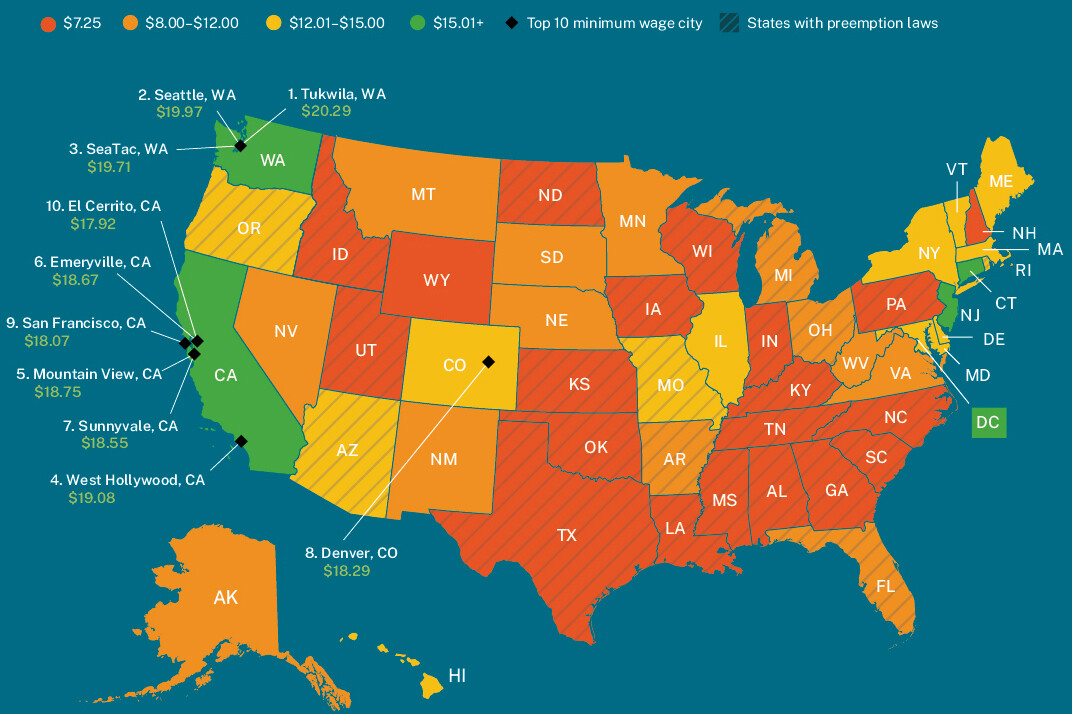
Who Works Under a Federal, State, or Local Minimum Wage?
SOURCE: U.S. Department of Labor, “State Minimum Wage Laws,” www.dol.gov; NerdWallet, “These 10 Cities Have the Highest Minimum Wage in the U.S.,” www.nerdwallet.com; and Economic Policy Institute, “Workers’ Rights Preemption in the U.S.,” www.epi.org.
SHOW OVERVIEWHIDE OVERVIEW
State Minimum Wages, 2024
More information
“A page titled “Who Participates? Who Works Under a Federal, State, or Local Minimum Wage?” A color-coded map of the United States shows state minimum wages. They range from the federal minimum of $7.25 across most of the South and a number of other states, ranging from Idaho and Wyoming in the West to Pennsylvania and New Hampshire in the Northeast. Florida, Virginia, Alaska, and 10 inland states ranging from Nevada and Montana in the west to Ohio and West Virginia in the east, have minimum wages in the 8 to 12 dollar range. A few states, including Hawaii, Oregon, Arizona, Colorado, Missouri and Illinois, plus Maryland, Delaware, and most of the New England states, have minimum wages above 12 dollars and up to 15 dollars. California, Washington, New Jersey, and Connecticut are joined by the District of Columbia in having minimum wages above 15 dollars. Individual cities on the West Coast mandate especially high minimum wages, ranging from $17.92 in El Cerrito in California’s Bay Area to $19.08 in West Hollywood, and all the way up to $20.29 in Tukwila, Washington, a suburb of Seattle. Denver also stands out, with a minimum wage of $18.29. Text below the map reads “Congress created the federal minimum wage in the 1938 Fair Labor Standards Act under its authority in Article I, Section 8, of the Constitution to ‘regulate commerce . . . among the several states.’ States can also set higher minimum wages. The federal minimum wage of $7.25 was last raised in 2009. As of 2024, 30 states and the District of Columbia adopted a higher minimum wage. In addition, nearly five dozen cities and counties have adopted minimum wages above their state minimum wage. However, such policy making is prohibited in 26 states that have passed preemption laws (shaded on the map), which prohibit localities from raising local minimum wages.
Congress created the federal minimum wage in the 1938 Fair Labor Standards Act under its authority in Article I, Section 8, of the Constitution to “regulate commerce . . . among the several states.” States can also set higher minimum wages. The federal minimum wage of $7.25 was last raised in 2009. As of 2024, 30 states and the District of Columbia adopted a higher minimum wage. In addition, nearly five dozen cities and counties have adopted minimum wages above their state minimum wage. However, such policy making is prohibited in 26 states that have passed preemption laws (shaded on the map), which prohibit localities from raising local minimum wages.
FOR CRITICAL ANALYSIS
Which states or regions have the highest minimum wages? Which have the lowest? Why might minimum wages be higher or lower in some regions than others?
Should the minimum wage vary from state to state? Should the minimum wage vary within states?
More information
A photo shows a man behind a bakery counter speaking to a police officer. A sign near the officer lists the bakery’s “Reopen Defence Funds Specials” and includes a “Bill of Rights Bagel Sandwich” for $100 and a “Constitutional Cappuccino” for $50.
As businesses like this bakery in Arizona pushed the limits of stay-at-home orders during the coronavirus pandemic, police officers stepped in to enforce the state’s authority to regulate the public health and safety of citizens.
A very important power of the states is control of voting rights and the process of elections. States, for example, draw congressional district boundaries, establish voter registration requirements, decide whether absentee voting is allowed, and organize the casting and counting of ballots. The struggle over voting rights, to be discussed in Chapter 5, has been an effort to loosen restrictive state requirements that tend to reduce participation on the part of poor people and people from racial and ethnic minority groups. Today, Republicans control a majority of state governments. Accordingly, congressional Democrats support legislation that would reduce the states’ power over voting rules while congressional Republicans support the status quo.
The Police Power
America’s federal system leaves a great deal of power in the hands of the individual states. Each year, the states collectively adopt nearly 20,000 new laws, an average of 400 per state, while the U.S. Congress in recent years has on average enacted hardly more than 150 new statutes. States are especially important in the realms of education, health care, environmental policy, and transportation. In all these areas, states do share power with the federal government but still possess considerable discretionary authority.
The most fundamental power exercised by states, however, is that of coercion—the power to develop and enforce criminal codes, administer health and safety rules, and regulate the family via marriage and divorce laws. States also have the power to regulate individuals’ livelihoods: physicians, attorneys, plumbers, hairdressers, and those wishing to practice a host of other occupations must obtain licenses from their state. Even more fundamental, states have the power to define private property. Private property exists because state laws against trespass and theft define who is and who is not entitled to use a piece of property. Ownership of a house or piece of land, for example, means that the state will enforce the owner’s possession by prohibiting others from occupying the property without the consent of its owner. At the same time, under its power of eminent domain (see Chapter 4), the state may seize private property for anything it deems to be a public purpose. If the state, however, does seize such property, it is required by its own constitution and the federal constitution to compensate the owners for their loss. The decision to take the property, though, is well within the states’ recognized powers.
A state’s authority to regulate these fundamental matters, commonly referred to as the police power, encompasses its power to regulate the health, safety, welfare, and morals of its citizens. Policing is what states do: they coerce individuals in the name of the community in order to maintain public order. When an individual is issued a traffic ticket, or taken into custody for most other crimes, the state is exercising its police power, often through the agency of a county or city police officer. (Counties and cities are effectively agencies of their states.)
States’ Obligations to One Another
The Constitution also creates obligations among the states, spelled out in Article IV. By requiring states to recognize or uphold governmental actions and decisions in other states, the framers aimed to make the states less like independent countries and more like components of a unified nation. Article IV, Section 1, calls for “Full Faith and Credit” among states, meaning that each state is normally expected to honor the “Public Acts, Records, and Judicial Proceedings” that take place in any other state. So, for example, if a restraining order is placed on a stalker in one state, other states are required to enforce that order as if they had issued it.
Nevertheless, some courts have found exceptions to the Full Faith and Credit Clause: if one state’s law is against the “strong public policy” of another state, that state may not be obligated to recognize it.5 The history of interracial marriage policy shows how much leeway states once had about recognizing marriages performed in other states. In 1952, 30 states prohibited interracial marriage, and many of these also refused to recognize such marriages performed in other states.6 For example, in the 1967 Supreme Court case of Loving v. Virginia, which successfully challenged state bans on interracial marriage, Mildred and Richard Loving, a Black woman and a White man, were married in the District of Columbia. However, when they returned to their home state of Virginia, it refused to recognize them as a married couple.7
Until recently, same-sex marriage was in a similar position to interracial marriage half a century ago. Thirty-five states had passed “Defense of Marriage” acts, defining marriage as a union between one man and one woman, or had adopted constitutional amendments to this effect. In 1996, Congress passed a federal Defense of Marriage Act, which declared that states were not required to recognize a same-sex marriage from another state and that the federal government did not recognize same-sex marriage even if it was legal under state law.
In 2015, however, the Supreme Court ruled that the Fourteenth Amendment guaranteed a fundamental right to same-sex marriage. The case, Obergefell v. Hodges, combined four lawsuits by same-sex couples challenging their home states’ refusals to grant same-sex marriage licenses or recognize same-sex marriages performed out of state.8 The Court’s decision meant that all states must now offer marriage licenses to two people of the same sex and recognize same-sex marriages licensed by other states. In one stroke, same-sex marriage turned from a state-level policy choice to a nationally recognized right.
Article IV, Section 2, known as the Comity Clause, also seeks to promote national unity, by providing that citizens enjoying the “privileges and immunities” of one state should be entitled to similar treatment in other states. What this has come to mean is that a state cannot discriminate against someone from another state or give special privileges to its own residents. For example, in the 1970s, the Supreme Court struck down as unconstitutional an Alaska law that gave Alaska residents preference over nonresidents for jobs on the state’s oil and gas pipelines.9 The Comity Clause also regulates criminal justice among the states by requiring states to return fugitives to the states from which they have fled. Thus, in 1952, when an escaped prisoner sued to avoid being returned to Alabama on the grounds that he was being subjected to “cruel and unusual punishment” there, the Supreme Court ruled that he must be returned according to Article IV, Section 2.10
Local Government and the Constitution
Local government occupies a peculiar but very important place in the American system (see Table 3.1). It has no status in the U.S. Constitution. Instead, state constitutions define local government structures and responsibilities. Thus, local governments are subject to ultimate control by the states.
TABLE 3.1Governments in the United States
TYPE
NUMBER
National
1
State
50
County
3,031
Municipal
19,491
Townships
16,214
School districts
12,546
Other special districts
39,555
SOURCE: U.S. Census Bureau, 2023 Census of Governments, Table 2, www.census.gov.
This imbalance of power means that state governments could legally dissolve local governments or force multiple local governments to consolidate into one. Most states have amended their constitutions to give their larger cities home rule—a guarantee of noninterference in various areas of local affairs.11 In recent years, however, as discussed below, some local governments have passed laws making policy on matters from minimum wage to public broadband, only to have state legislatures preempt, or remove, that authority.
Endnotes
Pietro S. Nivola, “Why Federalism Matters,” Brookings Institution Policy Brief #146, October 2005, 2016, www.brookings.edu.Return to reference 03
Lisa L. Miller, “The Representational Biases of Federalism: Scope and Bias in the Political Process, Revisited,” Perspectives on Politics 50, no. 2 (June 2007): 305–21.Return to reference 04
The public policy exception stems from developments in case law tracing back to the 1930s. In Section 283 of the Restatement (Second) of Conflict of Laws (1971), a group of judges and academics codified existing case law related to marriage: “A marriage which satisfies the requirements of the state where the marriage was contracted will everywhere be recognized as valid unless it violates the strong public policy of another state which had the most significant relationship to the spouses and the marriage at the time of the marriage.” However, in Baker v. General Motors Corp., 522 U.S. 222 (1998), the Supreme Court explicitly stated that its decision “creates no general exception to the full faith and credit command.”Return to reference 05
Adam Liptak, “Bans on Interracial Unions Offer Perspective on Gay Ones,” New York Times, March 17, 2004, www.nytimes.com.Return to reference 06
Loving v. Virginia, 388 U.S. 1 (1967). The Lovings were charged with violating Virginia’s miscegenation laws and sentenced to one year in jail, which would be suspended if they left the state for 25 years. Five years later, with the assistance of the American Civil Liberties Union, the Lovings filed a motion to vacate their conviction. The Supreme Court heard the case and overturned the Lovings’ conviction, finding Virginia’s miscegenation law unconstitutional under the Due Process Clause and Equal Protection Clause of the Fourteenth Amendment.Return to reference 07
A good discussion of the constitutional position of local governments is in Richard Briffault, “Our Localism: Part I, the Structure of Local Government Law,” Columbia Law Review 90, no. 1 (January 1990): 1–115. For more on the structure and theory of federalism, see Larry N. Gerston, American Federalism: A Concise Introduction (Armonk, NY: M. E. Sharpe, 2007), and Martha Derthick, “Up-to-Date in Kansas City: Reflections on American Federalism” (1992 John Gaus Lecture), PS: Political Science and Politics 25 (December 1992): 671–75.Return to reference 11
powers derived from the Necessary and Proper Clause of Article I, Section 8, of the Constitution; such powers are not specifically expressed but are implied through the expansive interpretation of delegated powers
Article I, Section 8, of the Constitution, which provides Congress with the authority to make all laws “necessary and proper” to carry out its expressed powers
provision from Article IV, Section 1, of the Constitution requiring that the states normally honor the public acts and judicial decisions that take place in another state
provision, from Article IV, Section 2, of the Constitution, that a state cannot discriminate against someone from another state or give its own residents special privileges