THE BIG PICTURE
Identify the earliest river-basin societies. What are their shared characteristics?
THE BIG PICTURE
Identify the earliest river-basin societies. What are their shared characteristics?
 The First Cities
Around 3500 BCE, cultural changes, population growth, and technological innovations gave rise to complex societies. Clustered in cities, these larger communities developed new institutions, and individuals took on a wide range of social roles and occupations, resulting in new hierarchies based on wealth and gender. At the same time, the number of small villages and pastoralist communities grew.
Water was the key to settlement, since predictable flows of water determined where humans settled. Reliable water supplies allowed communities to sow crops adequate to feed large populations. Abundant rainfall allowed the world’s first villages to emerge, but the breakthroughs into big cities occurred in drier zones where large rivers formed beds of rich soils deposited by flooding rivers. With irrigation innovations, soils became arable. Equally important, a worldwide warming cycle expanded growing seasons. The river basins—with their fertile soil, irrigation, and available domesticated plants and animals—made possible the agricultural surpluses needed to support city dwellers.
The Earliest Civilizations
The material and social advances of the early cities occurred in a remarkably short period—from 3500 to 2000 BCE—in three locations: the basin of the Tigris and Euphrates Rivers in central Southwest Asia; the northern parts of the Nile River flowing toward the Mediterranean Sea; and the Indus River basin in northwestern South Asia. About a millennium later, a similar process began along the Yellow River and the Yangzi River in China. (See Map 2.1.) In these regions humans farmed and fed themselves by relying on intensive irrigation agriculture. Gathering in cities inhabited by rulers, administrators, priests, and craftworkers, they changed their methods of organizing communities by worshipping new gods in new ways and by obeying divinely inspired monarchs and elaborate bureaucracies. New technologies appeared, ranging from the wheel for pottery production to metalworking and stoneworking for the creation of both luxury objects and utilitarian tools. The technology of writing used the storage of words and meanings to extend human communication and memory.
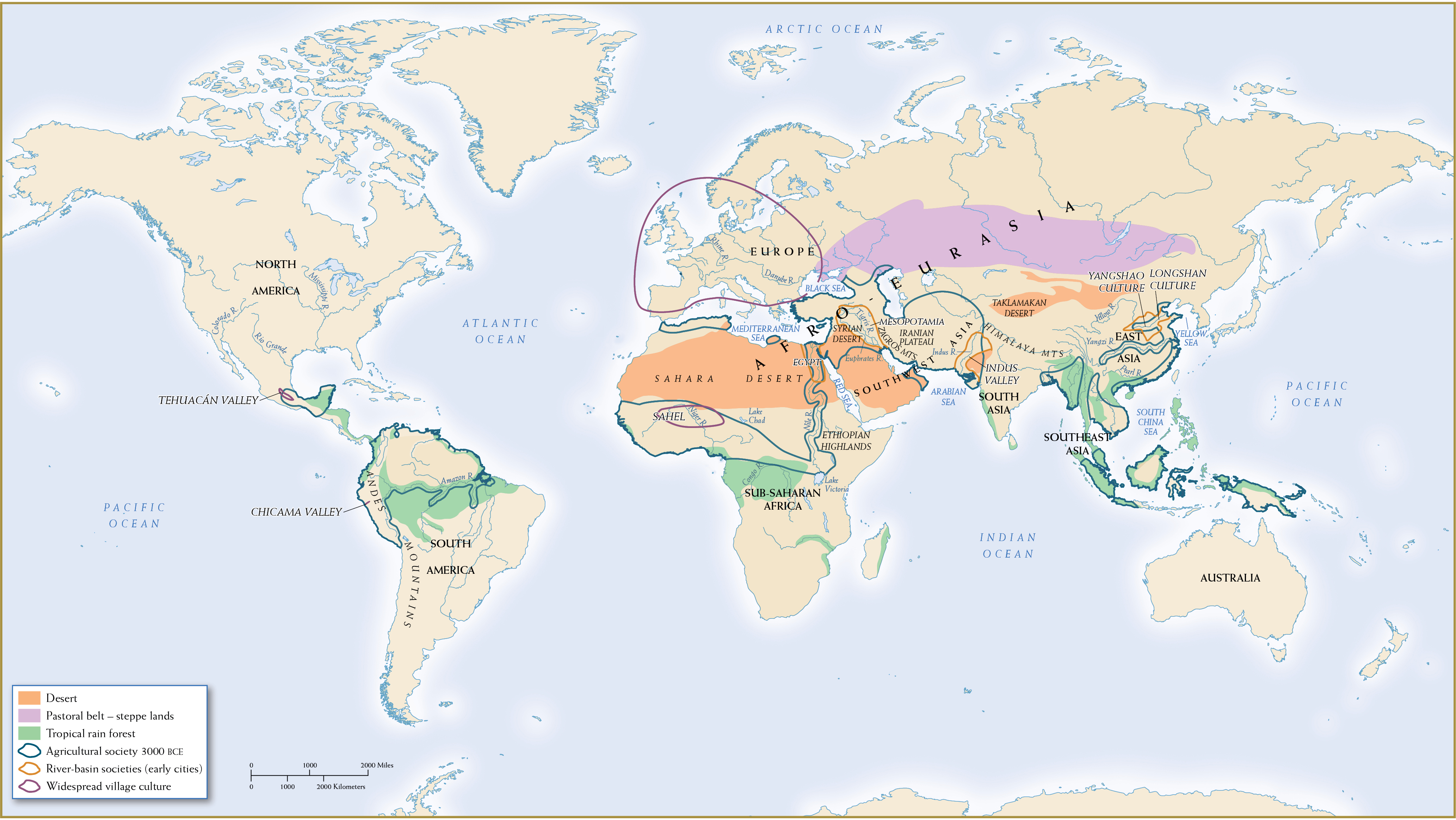
Human societies became increasingly diversified as agricultural, urban, and pastoralist communities expanded. While urban communities began to develop in several major river basins in the Eastern Hemisphere, not every river basin produced cities in the third millennium BCE. Pastoralism, village life, agricultural communities, and continued hunting and gathering were by far the norm for most of the peoples of the earth.
With cities and new technologies came greater divisions of labor. Dense urban settlement enabled people to specialize in making goods for the consumption of others: weavers made textiles, potters made ceramics, and jewelers made precious ornaments. Soon these goods were traded with outlying areas. As trade expanded over longer distances, raw materials such as wool, metal, timber, and precious stones arrived in the cities and could be fashioned into new, manufactured goods. (See Map 2.2.) One of the most coveted metals was copper: easily smelted and shaped (not to mention shiny and alluring), it became the metal of choice for charms, sculptures, and valued commodities. When combined with arsenic or tin, copper hardens and becomes bronze, which is useful for tools and weapons. Consequently, this period marks the beginning of the Bronze Age, even though the use of this alloy extended into and flourished during the second millennium BCE (see Chapter 3).
The dawn of cities and city-states had drawbacks for those who had been hunters and gatherers or had lived in towns. As rulers, scribes, bureaucrats, priests, artisans, and wealthy farmers rose, so did social stratification. Men made gains at the expense of women, for men dominated the prestigious positions and societies became highly patriarchal. All those who lived close to cities had to fashion their own city-states to protect themselves lest they be exploited, or even enslaved.
The emergence of cities as population centers created one of history’s most durable worldwide distinctions: the urban-rural divide. Where cities appeared alongside rivers, people adopted lifestyles based on specialized labor and the mass production of goods. In contrast, most people continued to live in the countryside, where they remained on their lands, cultivating the land or tending livestock, though they exchanged their grains and animal products for goods from the urban centers. The two ways of life were interdependent and both worlds remained linked through family ties, trade, politics, and religion.
The transhumant herder communities that had appeared in Southwest Asia around 5500 BCE (see Chapter 1) continued to be small and their settlements impermanent. They lacked substantial public buildings or infrastructure, but their seasonal moves followed a consistent pattern. Across the vast expanse of Afro-Eurasia’s great mountains and its desert barriers, and from its steppe lands ranging across inner and central Eurasia to the Pacific Ocean, these transhumant herders lived alongside settled agrarian people, especially when occupying their lowland pastures. They traded animal products such as meat, hides, and milk for grains, pottery, and tools produced in the agrarian communities.
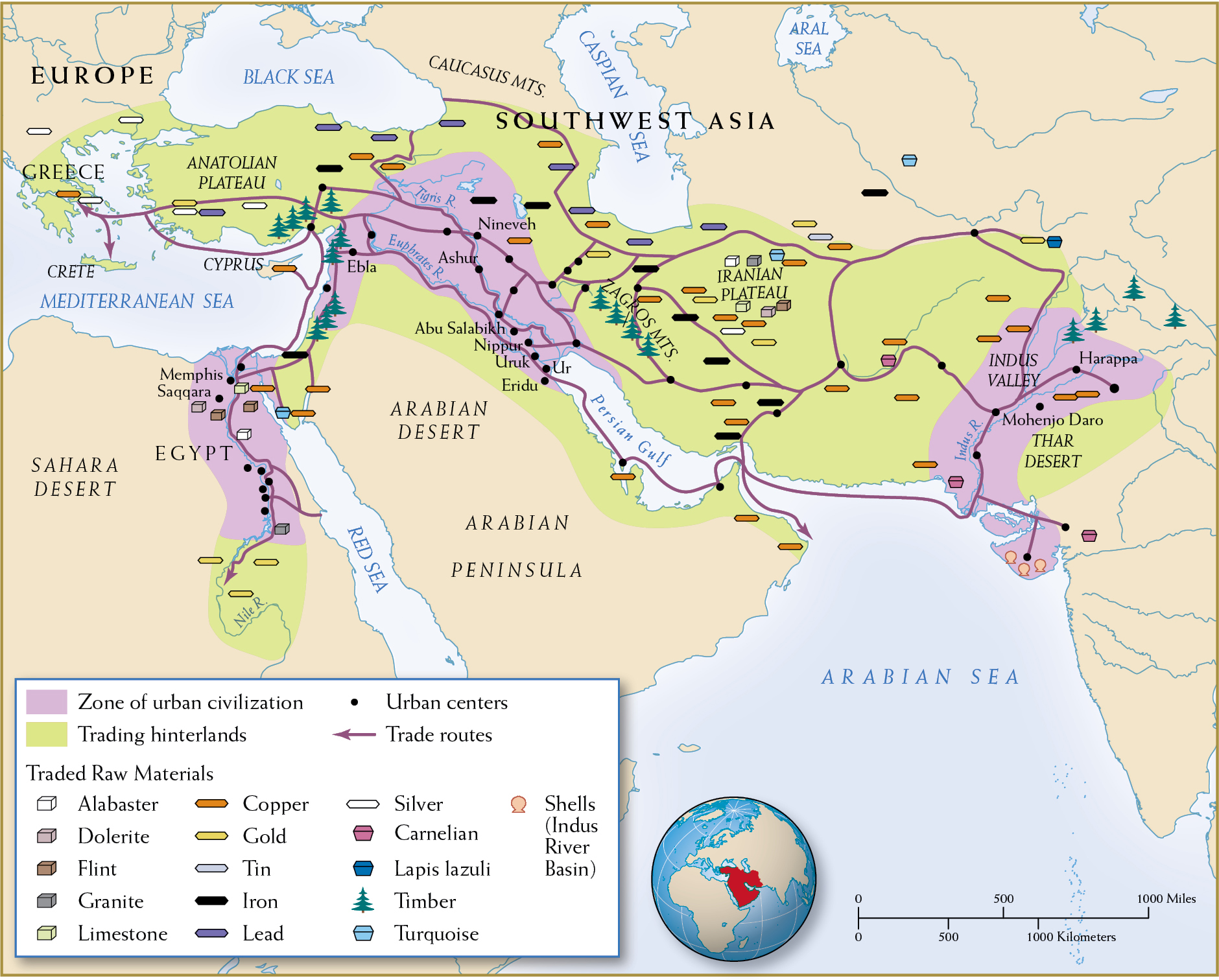
Extensive commercial networks linked the urban cores of Southwest Asia.
In the arid environments of Inner Mongolia and central Asia, transhumant herding and agrarian communities initially followed the same combination of herding animals and cultivating crops that had proved so successful in Southwest Asia. However, it was in this steppe environment, unable to support large-scale farming, that some communities began to concentrate exclusively on animal breeding and herding. Though some continued to fish, hunt, and farm small plots in their winter pastures, by the middle of the second millennium BCE many societies had become full-scale pastoral communities.
These pastoralists dominated steppe life. The area that these pastoral societies occupied lay between 40 degrees and 55 degrees north and extended the entire length of Eurasia from the Great Hungarian Plain to Manchuria, a distance of 5,600 miles. The steppe itself divided into two zones, an eastern one and a western one, the separation point being the Altai Mountains in Central and East Asia where the modern states of Russia, China, Mongolia, and Kazakhstan come together. Frost-tolerant and drought-resistant plant life predominated in the region. Over time, pastoralist groups—both transhumant herders and pastoral nomads (more on this distinction in Chapter 3)—played a vital role by interacting with cities, connecting more urbanized areas, and spreading ideas throughout Afro-Eurasia.