Political, economic, and social changes also stimulated new thinking in the Mediterranean world. The violent upheavals that tore through the borderland areas of the northern Levant, the coastal lands of Anatolia, the islands of the Aegean and Mediterranean Seas, and mainland Greece in the few centuries after 1000 BCE freed the people in these regions from the domination of the Neo-Assyrians and Persians (see Chapter 4). These borderland communities encircling the Mediterranean basin also created second-generation societies that developed new social and political methods of organization and explored new Axial Age ideas. Phoenicians, Greeks, Cretans, Cypriots, Lydians, Etruscans, and many others exchanged not only trade goods but also ideas about the virtues of self-sufficient cities whose inhabitants shared power more widely than before. (See Map 5.4.)
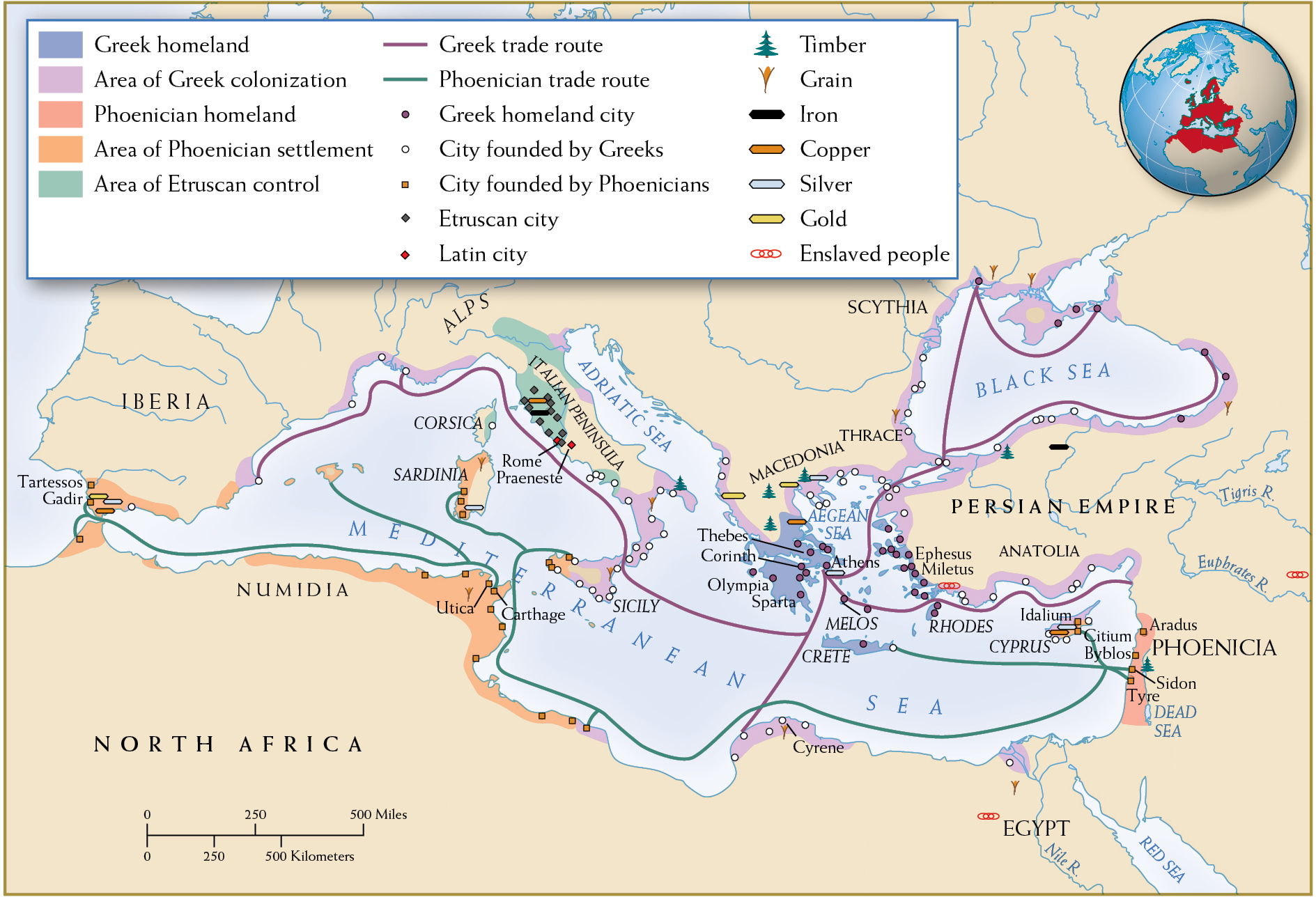
Map 5.4The Mediterranean World, 1000–350 BCE
Phoenician and Greek city-states, as well as the colonies they founded, dotted the coastline of both the Mediterranean and Black Seas.
What were the main goods traded in the Mediterranean world in this period? Where were they located?
To what extent might the concentration of goods in certain regions have driven colonization and fostered trade?
What areas did the Greeks and Phoenicians control with their homeland cities and their colonies? What was their main settlement pattern?
FORMATION OF NEW CITY-STATES
Core Objectives
EXPLAIN the relationship between Axial Age thinkers across Afro-Eurasia and the political and social situations to which they were responding.
In the ninth and eighth centuries BCE, as order returned to the eastern Mediterranean and the population rebounded, peoples who were clustered in more concentrated settlements formed city-states. Unlike the city-states of earlier Mesopotamia, which were governed by semidivine monarchs, or the great urban centers of Southwest Asian empires, which were run by elite scribes, high priests, and monarchs, the Mediterranean city-states were governed by their citizens. These self-governing city-states were a new political form that profoundly influenced the Mediterranean region. This new urban entity—known first by the Phoenicians as a qart, then by the Greeks as a polis, and the Romans as a civitas—multiplied throughout the Mediterranean by the sixth century BCE.
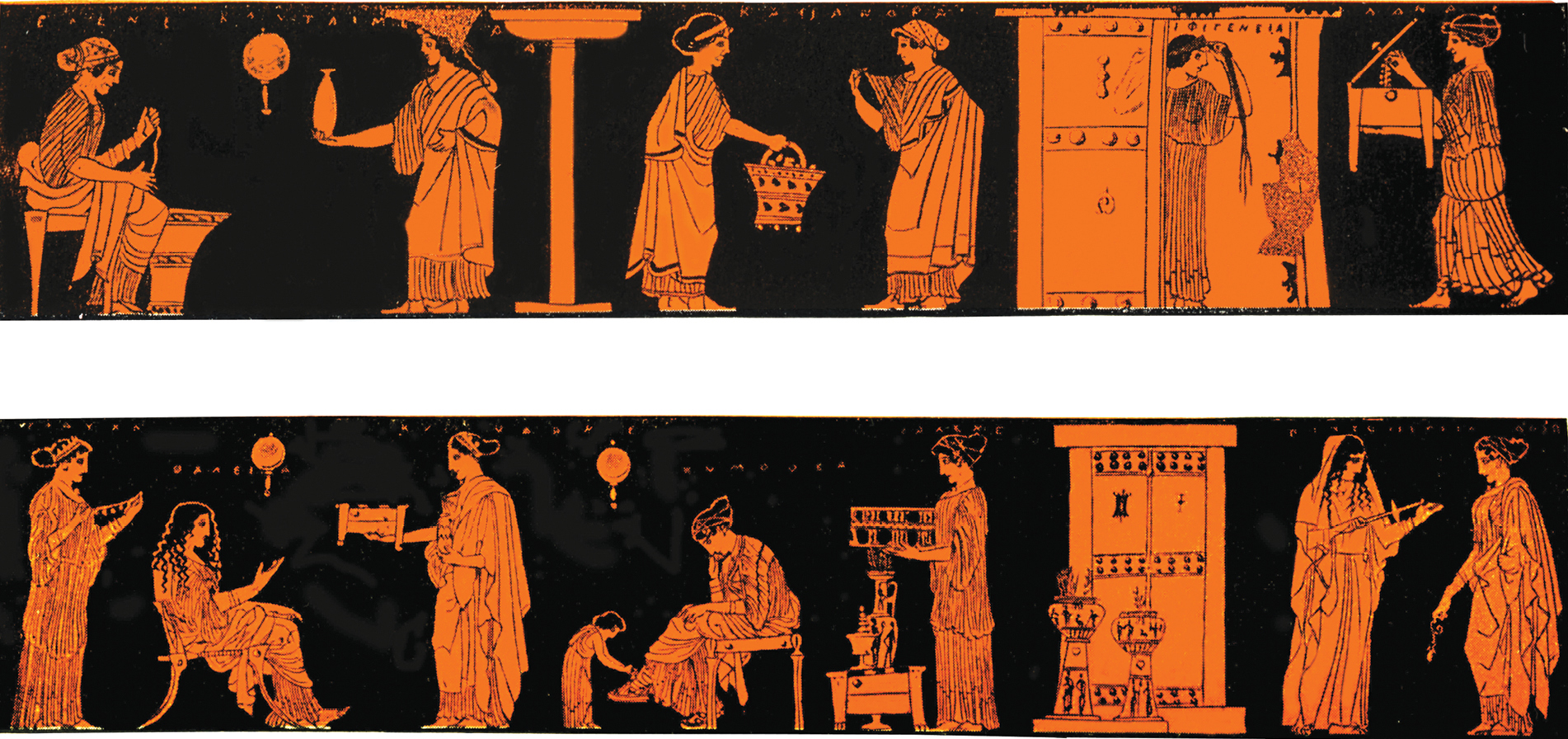
Glimpsing Women’s Lives These panels are from two cosmetic containers from fifth-century BCE Greece. While they depict mythological women (Clytemnestra, Cassandra, and Iphigenia in the top scene and the daughters of Nereus in the bottom scene), these women are engaged in activities—such as spinning (top left) and marriage preparation (bottom)—that would have been meaningful to the women who used these containers to hold their cosmetics and jewelry. The woman on the far right of the marriage scene (bottom) uses a device called an iunx to cast a love spell.
The new principles of rulership were revolutionary. Ordinary residents, or “citizens,” of these cities—such as Carthage and Gadir (modern-day Cádiz in Spain) among the western Phoenicians; Athens, Thebes, Sparta, and Corinth among the Greeks; and Rome and Praeneste among the early Latins—governed themselves and selected their leaders. Their self-government took various forms, including tyranny (rule by a popularly approved individual), oligarchy (rule by the few), and democracy (rule by all free adult males).
The new cities of the Mediterranean basin included adult male citizens, other free persons (including women, who could not vote or hold office), foreign immigrants, and large numbers of unfree persons (including enslaved people and people tied to the land who could not vote or fight for the polis). The small family unit, or household, was the most important social unit of the city-state, and the city-state was seen as a natural outgrowth of the household. Thus, the free adult male was fully entitled to engage in the city’s public affairs. Those enjoying full citizenship rights—the adult freeborn males—in each community decided what tasks, from warfare to public works, the city-state would undertake and what kind of government and laws it would adopt. In contrast, adult women of free birth remained enclosed within the private world of the family and had no standing to debate policy in public, vote, or hold office, although they did go out in public for religious festivals of which there were many. Upper-class women who did carry on intelligent conversations with men in public about public matters were criticized. Families of the lower classes could not afford the luxury of secluding women in such a way, however, when they might be needed to work as agricultural laborers or market vendors or just to do the chores outside the house that wealthy families could employ someone else to do. Spartan women were a partial exception, and their unusual behavior—such as exercising in the nude in public (as did men) or holding property in their own right—evoked humor and hostility from men in the other Greek city-states.
Athens developed into one of the most dynamic of these city-states. The Athenian city-state was tiny by the standards of the ancient empires. It covered less than 2,000 square miles, barely big enough to be a Persian satrapy, and its population of roughly 300,000, not counting 60,000 “chattel slaves,” was significantly smaller than the population of 35 million who lived under Persian rule. Nonetheless, city-states were competitive places. Their histories relate rivalries between individuals, social classes, and other groups. Competition for honor and prestige was a value that shaped behavior in the city-states. This extreme competitive ethic found an outlet in organized sporting events. Almost from the moment that Greek city-states emerged, athletic contests sprang up. The greatest of these competitions were the Olympic Games, which began in 776 BCE at Olympia in southern Greece.
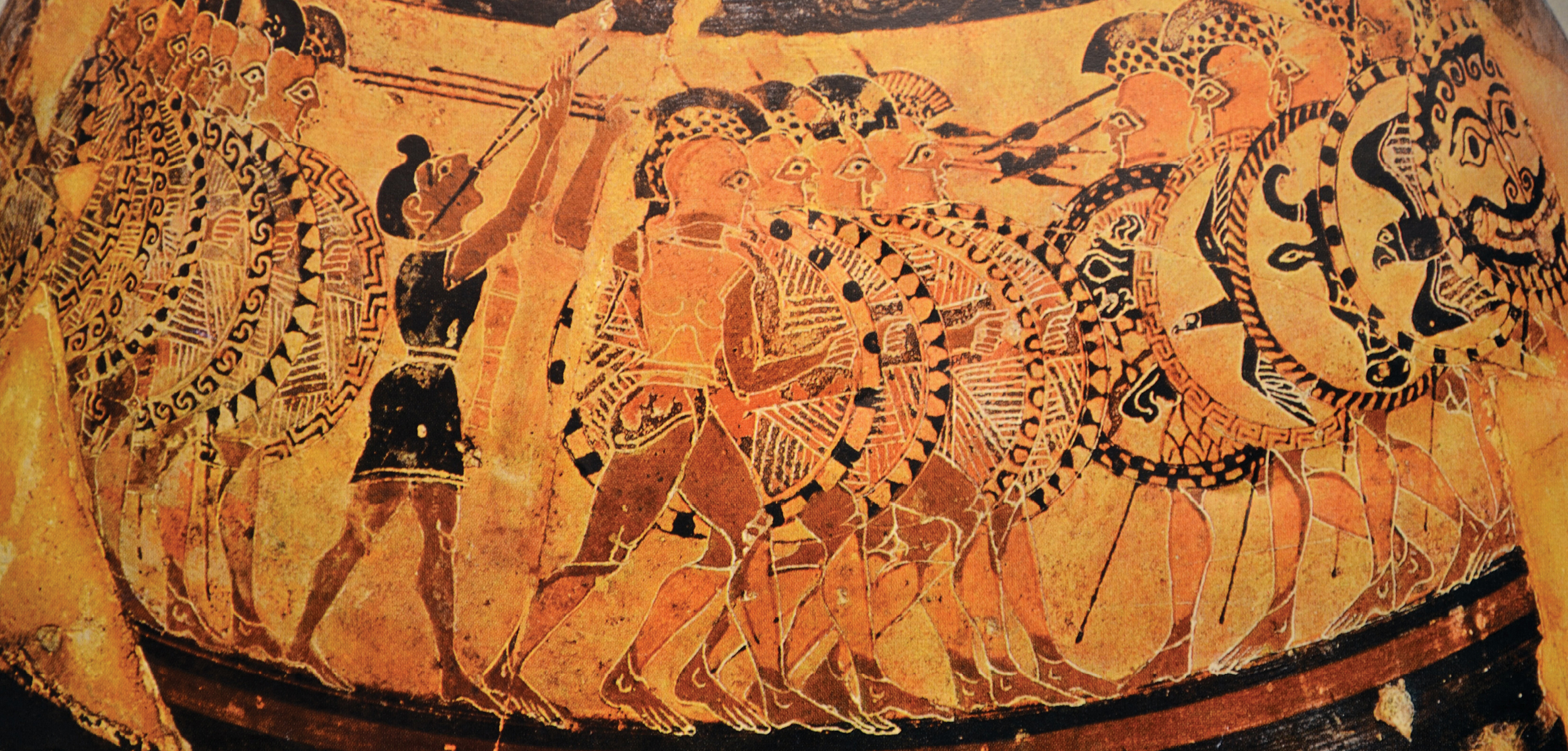
Hoplite Warfare Two lines of helmeted hoplites advance on each other in lockstep, marching shield to shield with spears raised. A pipe player’s tune sounds out the pace and maneuvers. The troops in the center offer a view of the inside of the hoplon (shield) and how it was grasped by the hoplite, while on the right we see the range of menacing heraldry emblazoned on the shield faces. The scene comes from the Chigi vase, which dates to the seventh century BCE and was found in a tomb in Greek-influenced Etruscan territories on the Italian Peninsula.
The competitive spirit among communities also took the destructive form of armed conflicts over borderlands, trade, valuable resources, religious shrines, and prestige. The incessant battles among city-states fueled new developments in military equipment, such as the heavy armor that gave its name to the hoplites, or infantrymen, and in tactics, such as the standard blocklike configuration (which the Greeks called a phalanx) in which the regular rank and file fought. These wars were so destructive that they threatened to destabilize the city-states’ world. The most famous conflicts were the Peloponnesian War (431–404 BCE) between Athens and Sparta and their respective allies, and the ongoing rivalry between the city-states of Rome and Phoenician Carthage (from c. 500 BCE onward) that led to the Punic Wars. Despite the destabilizing effects of warfare, city-states prospered, and economic innovations facilitated trade and exchange throughout the Mediterranean.
ECONOMIC INNOVATIONS
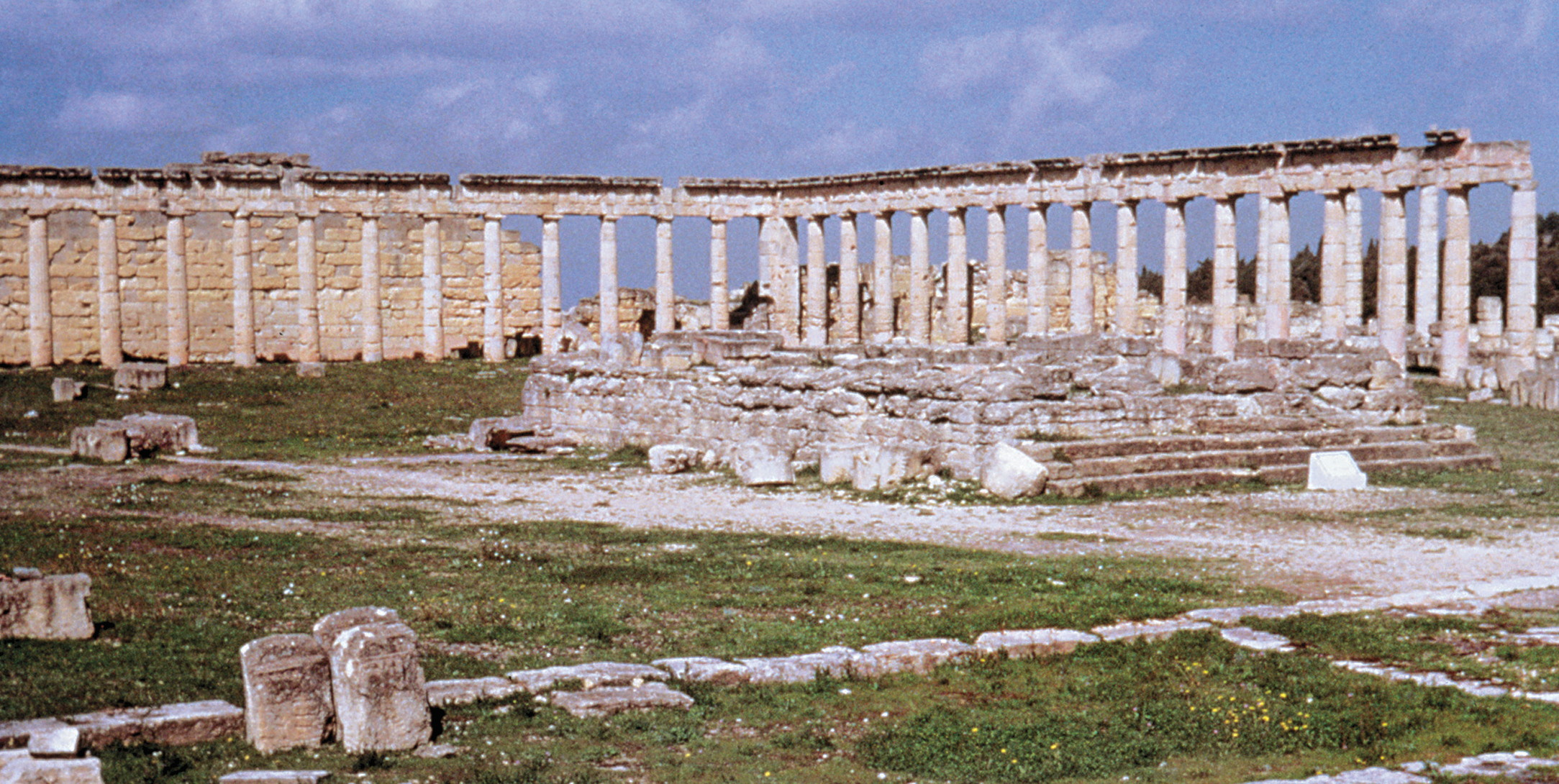
Without an elaborate top-down bureaucratic and administrative structure, residents of the new cities devised other ways to run their commercial affairs. They developed open trading markets and a system of money that enabled buyers and sellers to know the precise value of commodities so that exchanges were efficient. At their center, the new city-states had a marketplace (agora or forum), a large open area where individuals bought and sold commodities. These increasingly complex transactions required money, rather than barter or gift exchange. Like the states in Eastern Zhou China and Vedic South Asia, the Greek city-states were issuing a striking variety of coins by the end of the fifth century BCE, and other peoples such as the Phoenicians, Etruscans, and Persians were using them. Each Greek city-state minted coins with distinct features, making them recognizable at a glance. For example, Athens stamped its coins with the image of an owl, Corinth with a Pegasus, Aegina with a turtle, Knossos with a maze, and Akragas with a crab. Coins bought services as well, perhaps at first the services of mercenary soldiers. In the absence of large bureaucracies, Mediterranean cities relied on money to connect the producers and buyers of goods and services, especially as city-states became more far-flung.
The Agora The agora, or central open marketplace, was one of the core defining features of Mediterranean city-states. At its center, each city had one of these open-air plazas, the heart of its commercial, religious, social, and political life. When a new city was founded, the agora was one of the first places that the colonists measured out. The large, rectangular, open area in this picture is the agora of the Greek colonial city of Cyrene (in modern-day Libya).
Indeed, the search for silver, iron, copper, and tin drove traders westward across the Mediterranean. By about 500 BCE, the Phoenicians, Greeks, and others from the eastern Mediterranean had planted new city-states around the shores of the western Mediterranean and the Black Sea. Once established, these colonial communities became completely independent and might even found other colonies. For instance, Corinth founded Syracuse (in Sicily) and then Syracuse went on to settle several Sicilian colonies of its own. Sparta founded Thera (a city-state on the modern island of Santorini in the Aegean), which then went on to found Cyrene (in North Africa). At Cyrene, a foundation inscription hints at the tricky citizenship and property issues involved in creating a new colony, as well as the potential dangers of colonization. One man from each Theran family was required to join the expedition and the expedition had to make a go of it for five years before being allowed to return home. The oath the colonists swore as they set out included burning wax images fashioned in the shape of the would-be colonists and proclaiming that just as these wax images melted away so would the fortunes and lives of the settlers and their descendants should they break their oath to found the Theran colony at Cyrene.
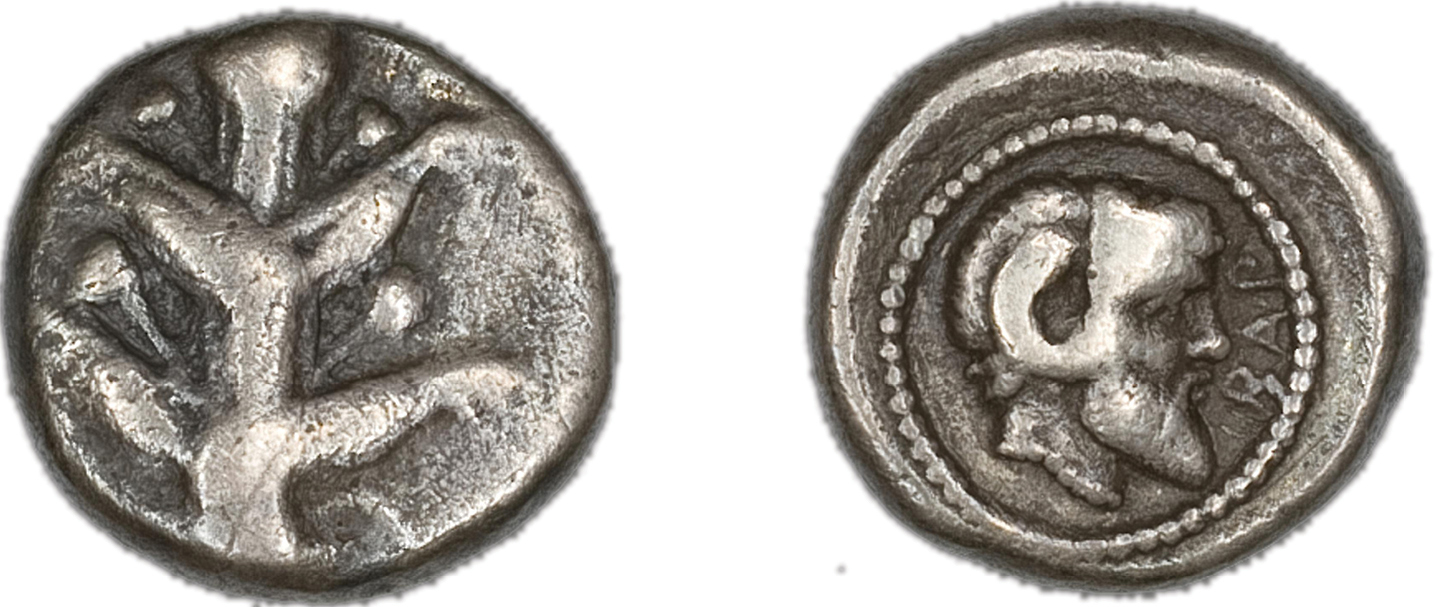
Coinage and Commodities From the sixth century BCE onward, the use of metal coins minted by individual city-states began spreading throughout the Mediterranean. This coin from Barce, a Greek town in North Africa, depicts a precious regional commodity, silphium, on one side and the image of Zeus Ammon on the other. Silphium was a plant that when ingested orally (eaten or brewed as a tea) served as an effective contraceptive.
Whether driven by internal competition, population pressures, or economic possibilities, the far-flung colonies of the Greeks and Phoenicians transformed the coastal world. City-based life was common from southern Spain and western Italy to the Crimea on the Black Sea. With amazing speed, seaborne communications spread a Mediterranean-wide urban culture that bolstered the region’s wealthy and powerful elites. Among the local elites of Tartessos in southern Spain, the Gallic chiefs in southern France, and the Etruscan and Roman nobles of central Italy, a new aristocratic culture featured similar public displays of wealth: richly decorated chariots, elaborate armor and weapons, fine dining ware, elaborate houses, and public burials. From the western end of the Mediterranean to the Black Sea, the city-state communities developed a culture founded on market-based economies and private property.
In contrast to the privilege enjoyed by these elites was the traffic in human flesh: slavery. Treating men, women, and children as objects of commerce, to be bought and sold in markets, created a new form of commercial slavery called chattel slavery. Slavery—the forced, unfree labor of war captives or of those who sold themselves to pay debt—had existed since the third millennium BCE, but what was new in this Mediterranean context was the commodification of bodies and the scale of the exchange. When dangerous and exhausting tasks such as mining and farming required extra labor, freeborn citizens purchased enslaved laborers. The primary source of enslaved laborers was still mainly war captives. In some city-states, enslaved people may have constituted up to a quarter of the population. In every one of the new city-states, the enslaved provided manual and technical labor of all kinds and produced the agricultural surpluses that supported the urban population.
Encounters with Frontier Communities The forces that transformed the Mediterranean region’s mosaic of urban communities and surrounding rural areas also affected those in northern and central Europe. Whether they wished it or not, diverse tribes and ethnic groups—such as the Celts and Germans in western Europe and the Scythians to the north of the Black Sea—who were living in nomadic bands, isolated settlements, and small villages became integrated into the expanding cities’ networks of violence, conquest, and trade.
Increasingly drawn to the city-states’ manufactured goods—money, wine, ornate clothing, weapons—these tribal peoples became an armed threat to the region’s core societies. Seeking to acquire the desired commodities through force rather than trade, frontier peoples convulsed the settled urban societies in wavelike incursions between 2200 and 2000 BCE, 1200 and 1000 BCE, and 400 and 200 BCE. Called “barbarians” (the Greeks’ mocking name for foreigners unable to speak their language), the invaders actually were not much different from the Phoenicians or Greeks—who themselves had sought new homes and a better future by migrating. In colonizing the Mediterranean, they, too, had dispossessed the original inhabitants. The Celts, Gauls, Germans, Scythians, and other northerners came to the Mediterranean first as conquerors. Later, when Mediterranean empires grew more powerful and could keep them at bay, they were imported as enslaved laborers. Regarding these outsiders as uncivilized, the Greeks and western Phoenicians seized and colonized their lands—and sold the captives as commodities in their marketplaces.
NEW IDEAS
New ways of thinking about the world emerged from the competitive atmosphere that the Greek city-states fostered. In the absence of monarchical or priestly rule, ideas were free to arise, circulate, and clash. Individuals argued publicly about the nature of the gods, the best state, what is good, and whether to wage war. There was no final authority to give any particular idea a final stamp of approval and force its acceptance. New ideas emerged in science and the arts, and Greek philosophers proposed theories on human society and many other topics.
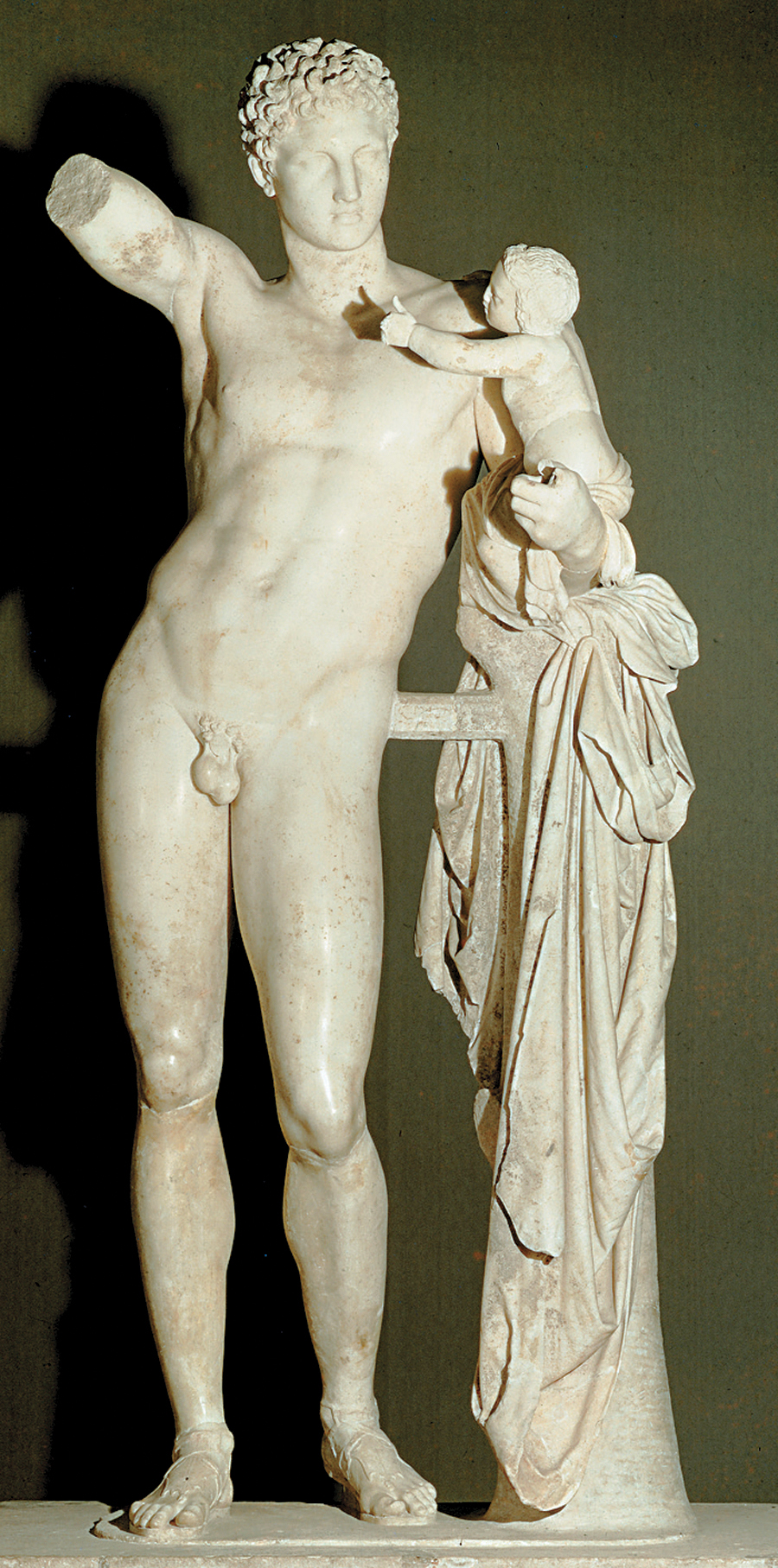
Naturalistic Science and Realistic Art In this competitive marketplace of ideas, some daring thinkers developed novel ways of perceiving the cosmos and representing the environment. Rather than seeing everything as the handiwork of all-powerful deities, they took a naturalistic view of humans and their place in the universe. This new thinking was evident in their art, which idealized the natural world. Artists increasingly represented humans, objects, and landscapes not in abstract, idealized, or formal ways but in “natural” ways, as they appeared to the human eye. Even their portrayals of gods became more human-like. Later, these objective and natural views of humans and nature became the new ideals, the highest of which was the unadorned human figure: the nude became the centerpiece of Greek art. Individual artists and writers—such as the vase painter Exekias, the sculptor Praxiteles, and the poet Sappho—began to sign their works in a clear manifestation of the new sense of the individual being freed from the restraints of an autocratic state or a controlling religious system.
The Human Form The human body as it appeared naturally, without any adornment, became the ideal set by Greek art. Even gods were portrayed in this nude human form. This statue by Praxiteles is of the god Hermes with the infant Dionysus. Such bold nude portraits of humans and gods were sometimes shocking to other peoples.
New Thinking and Greek Philosophers Axial Age thinkers in city-states such as Miletus and Ephesus in western Anatolia did not accept traditional explanations of how and why the universe worked. Each thinker competed to outdo his peers in offering persuasive and comprehensive explanations of the cosmos, and their theories became ever more radical. For instance, Thales (c. 636–546 BCE) believed that water was the primal substance from which all other things were created. Xenophanes (c. 570–480 BCE) doubted the very existence of gods as they had been portrayed, asserting instead that only one general divine aura suffused all creation but that ethnic groups produced images of gods in their own likeness. Pythagoras (c. 570–495 BCE), who devoted himself to the study of numbers, held that a wide range of physical phenomena, like musical sounds, were in fact based in numbers. Democritus (c. 460–370 BCE) claimed that everything was composed of small and ultimately indivisible particles, which he called atoma (“uncuttables”). This rich competition among ideas led to a more aggressive mode of public thinking, which the Greeks called philosophia (“love of wisdom”).
In the fifth century BCE, Greek philosophers (“wisdom lovers”) were focusing on humans and their place in society. Some of these professional thinkers tried to describe an ideal state, characterized by harmonious relationships and free from corruption and political decline. One such thinker was Socrates (469–399 BCE), a philosopher who frequented the agora at Athens and encouraged people to reflect on ethics and morality, even as the Peloponnesian War raged on. He stressed the importance of honor and integrity as opposed to wealth and power (just as Confucius had done in Eastern Zhou China and the Buddha had done in Vedic South Asia). Plato (427–347 BCE), a student of Socrates, presented Socrates’s philosophy in a series of dialogues (much as Confucius’s students had written down his thoughts). In The Republic, Plato envisioned a perfect city that philosopher-kings would rule. He thought that if fallible humans could imitate this model city more closely, their states would be less susceptible to the decline that was affecting the Greek city-states of his own day.
Plato’s most famous pupil answered the same questions about nature and the acquisition of knowledge differently. Deeply interested in the natural world, Aristotle (384–322 BCE) believed that by collecting and studying all the facts one could about a given thing, one could achieve a better understanding. His main idea was that the interested inquirer can find out more about the world by collecting as much evidence as possible about a given thing and then making deductions from these data about general patterns. This evidence-based inquiry stood in stark contrast to Plato’s claim that everything a person observes is in fact only a flawed copy of the “real” thing that exists in a thought-world of abstract patterns accessible only by pure mental meditation—completely the opposite of Aristotle’s method.
This competition of ideas raged on for centuries, with the new thinking of these Mediterranean Axial Age philosophers at times fueling the aspirations of the city-states and at other times challenging them.
“Wisdom lovers” of the ancient Greek city-states, including Socrates, Plato, Aristotle, and others, who pondered such issues as self-knowledge, political engagement and withdrawal, and evidence-based inquiry to understand the order of the cosmos.