 Sub-Saharan Africa and the Americas
Common Cultures in the Americas and Sub-Saharan Africa
Core Objectives
COMPARE the political, cultural, and social developments across Afro-Eurasia with those occurring in the Americas and sub-Saharan Africa.
During what we have termed the Axial Age in Eurasia and North Africa, peoples living in the Americas and most of sub-Saharan Africa built complex, urban-based societies for the first time. These regions did not have the large number of immense cities, the presence of increasingly complex empires, the proliferation of elaborate written texts, the wide variety of load-bearing domesticated animals, and the other ingredients that underlay the radical new ideas of this era in the narrow band above the equator in the Eastern Hemisphere. Nonetheless, among the Chavín of the Andes, the Olmecs of Mesoamerica, the peoples of Nubia, and the West African Nok, exciting new developments were taking place in the first millennium BCE. Since the written record from these communities is limited, however, knowledge of their societies and beliefs is based largely on archaeological remains.
THE CHAVÍN IN THE ANDES
Around 1400 BCE, as the Chavín peoples began to share a common belief system, they also began to organize their societies vertically along the steep mountainsides and deep fertile valleys of the Andes. (See Map 5.1.) Valley floors yielded tropical and subtropical produce; the mountains supported maize and other crops; and in the highlands, potatoes became a staple and llamas produced wool and dung (used as fertilizer and fuel) and, eventually, served as beasts of burden. Llamas could not transport humans, however, so the Chavín migratory and political reach remained limited. While most necessities were available nearby thanks to the ecological diversity of the region, the Chavín did undertake some long-distance trade—mainly in dyes and precious stones, such as obsidian. By 900 BCE, the Chavín were erecting elaborate stone carvings, using advanced techniques to weave fine cotton textiles, and making gold, silver, and copper metal goods. Scholars have found evidence that by 400 BCE trade in painted textiles, ceramics, and gold objects spanned the Pacific coast, the Andean highlands, and the watershed eastward to the tropical rain forests of the Amazon basin.
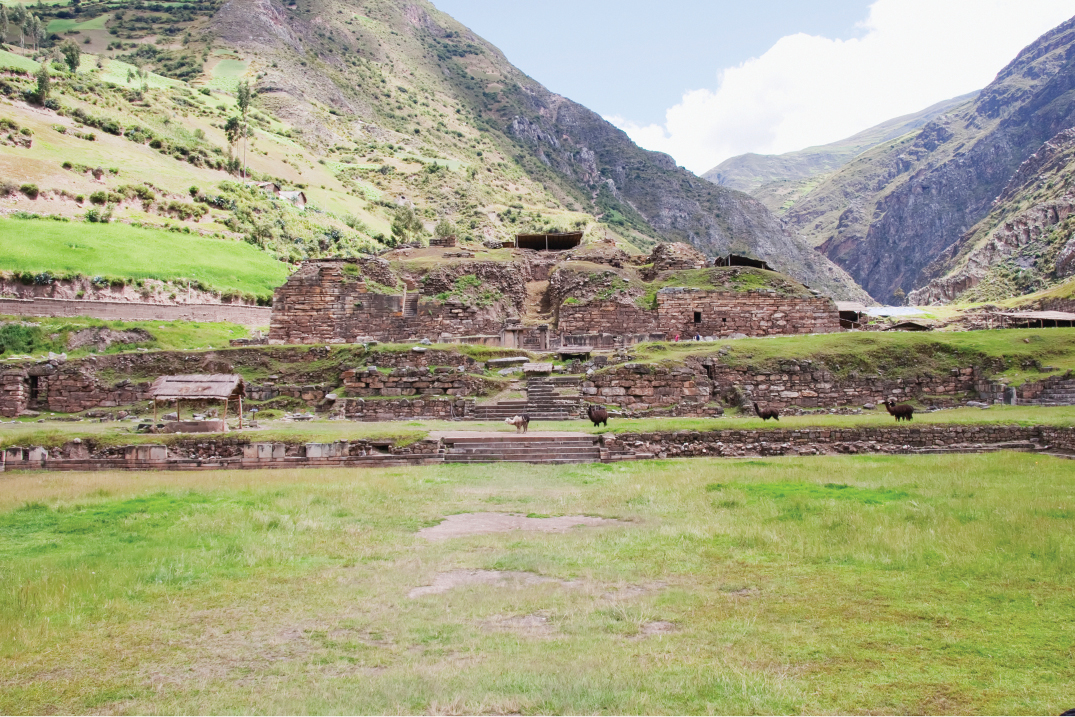
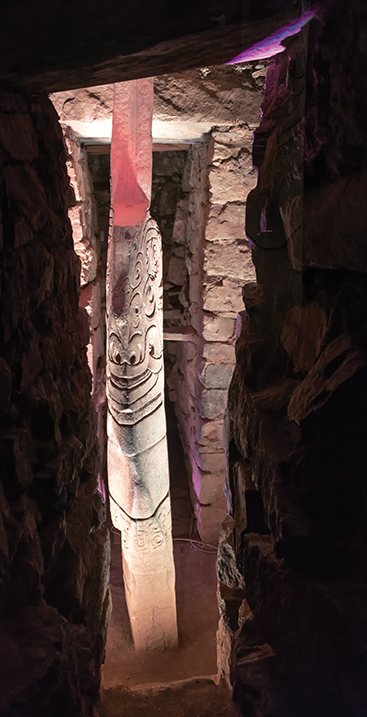
What unified the fragmented Chavín communities was a shared artistic tradition manifested in their devotion to powerful deities. Their spiritual capital was the central temple complex of Chavín de Huántar, in modern Peru’s northeastern highlands. The temple boasted a U-shaped platform whose opening to the east surrounded a sunken, circular plaza. From its passageways and underground galleries, priests—whom the Chavín believed were transformed into jaguars through their consumption of hallucinogenic drugs—could make dramatic entrances during ceremonies. Pilgrims brought tribute to Chavín de Huántar, where they worshipped and feasted together. The Chavín drew on influences from as far away as the Amazon and the Pacific coast as they created devotional cults that revered wild animals as representatives of spiritual forces. Carved stone jaguars, serpents, and hawks, baring their large fangs and claws to remind believers of nature’s powers, dominated the spiritual landscape. The Chavín cult gave way around 400 BCE to local cultural heirs, but some elements of it survived in successor religions adopted by stronger states to the south.
THE OLMECS IN MESOAMERICA
Farther to the north, the first complex society in Mesoamerica emerged about 1500 BCE between the highland plateaus of central Mexico and the Gulf Coast around modern-day Veracruz. (See Map 5.5.) The Olmecs are an example of a first-generation community that created new political and economic institutions while contemplating profound questions about the nature of humanity and the world beyond. The culture of the Olmecs—a name meaning “inhabitants in the land of rubber,” one of their staples—sprang up from local village roots. The region’s peoples formed a loose confederation of villages scattered from the coast to the highlands, mainly nestling in river valleys and along the shores of swampy lakes. Their residents traded with one another, shared a common language, and worshipped the same gods. Around 1500 BCE, the residents of hundreds of hamlets began to develop a single culture and to spread their beliefs, artistic achievements, and social structure far beyond their heartland.
At the core of Olmec culture were its decentralized villages, which housed hundreds—possibly thousands—of households apiece. In these settlements productive subsistence farmers cultivated most of the foodstuffs their communities needed (especially maize, beans, squash, and cacao), while shipping lightweight products including ceramics and precious goods (such as jade, obsidian, or quetzal feathers, used to create masks and ritual figurines) to other villages. Most of the precious objects were for religious purposes rather than everyday consumption. Despite their dispersed social landscape, the Olmec peoples created shared belief systems, a single language, and a priestly class who ensured that villagers and residents of the new urban centers followed highly ritualized practices.
Cities as Sacred Centers The primary Olmec cities, including San Lorenzo, La Venta, and Tres Zapotes, were small compared with the urban centers of Afro-Eurasia, but they served as devotional and secular hubs. The cities featured specialized structures that included massive earthen mounds, platforms, palaces, capacious plazas, and large stone monuments (colossal heads, jaguar sculptures, and basalt thrones). Beneath the mounds of the devotional centers, archaeologists have found axes, knives of sharpened obsidian, other tools, and jade figurines, buried as tokens for those who dwelled in the supernatural world. Olmec devotional art depicted natural and supernatural entities—not just snakes, jaguars, and crocodiles, but also certain humans called shamans, whom the Olmecs believed could commune with the supernatural and transform themselves wholly or partly into beasts. A common figurine is the “were-jaguar,” a being that was part man, part animal. Shamans representing jaguars invoked the Olmec rain god, a jaguar-like being, to bring rainfall and secure the land’s fertility.
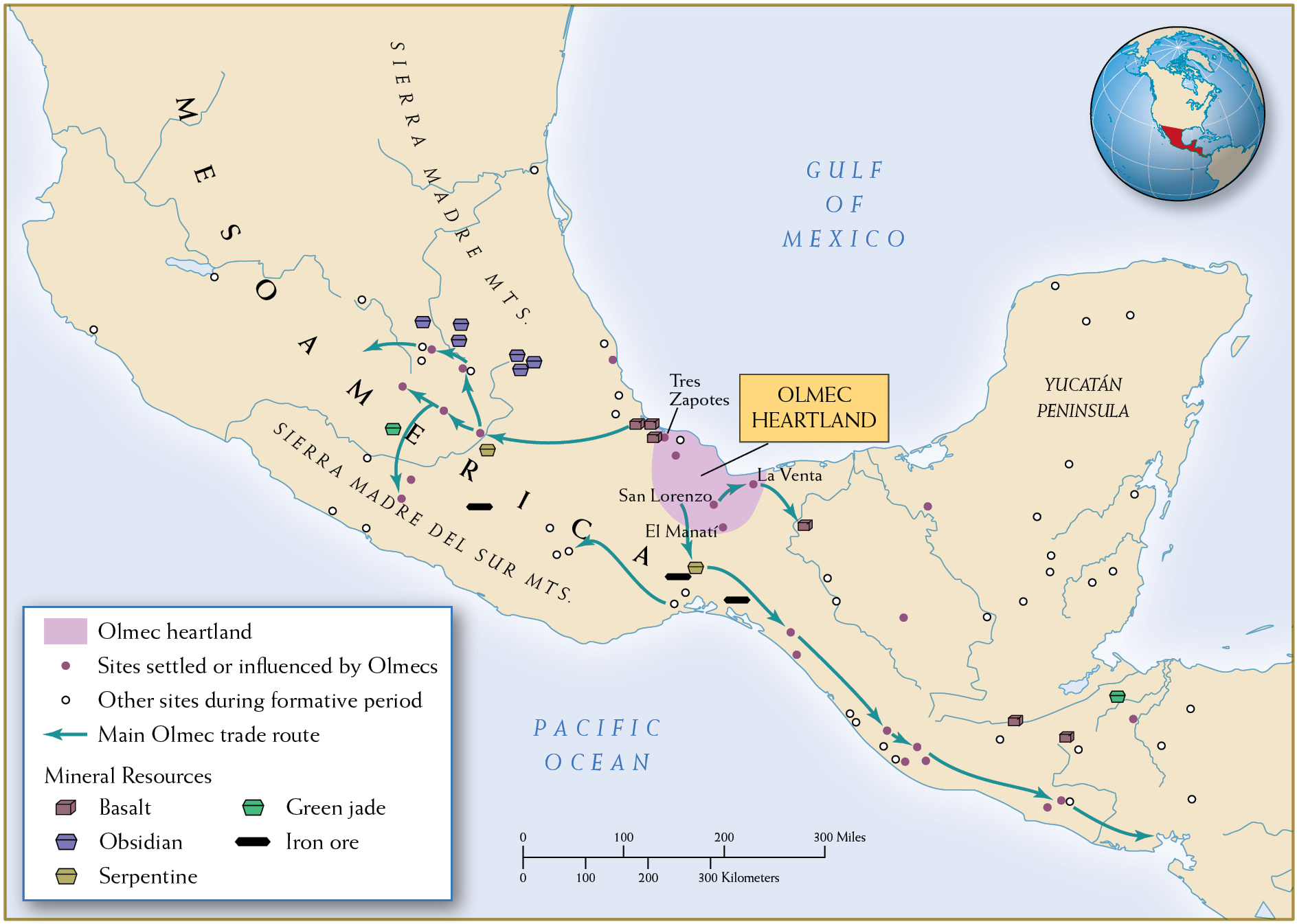
Map 5.5The Olmec World, 1500–350 BCE
The Olmecs had a strong impact on Mesoamerica’s early cultural integration.
- According to this map, how did the Olmecs influence people living beyond the Olmec heartland?
- What geographical factors limited the extent of Olmec influence?
- What is the relationship between resources, trade routes, and Olmec settlements?
A range of agriculture-linked devotional activity thrived in the Olmecs’ major cities. Noble players competed in a complex ball game to honor the rain god, as fans cheered them on. Olmec archaeological sites are filled with the remains of game equipment and trophies, some of which were entombed with dead rulers so they could play ball with the gods in the otherworld. It is likely that athletics and human sacrifice were blended in the same rituals. Many monuments depict a victorious and costumed ballplayer (sporting a jaguar headdress or a feathered serpent helmet) atop a defeated, bound human, though scholars are not sure whether the losers were literally executed. Nevertheless, rainmaking rites did include human sacrifice, which involved executing and dismembering captives. The Olmecs believed that the gods defined calendric passages, and thus controlled the seasons and crucial rainfall patterns. Priests, charting celestial movements, devised a complex calendar that marked the passage of seasons and generations. Indeed, the Olmecs’ ceremonial life—from ball games to human sacrifice to calendars—was focused on agricultural and rainfall cycles.
Social Distinctions Unlike many decentralized agrarian cultures that were simple and egalitarian, the Olmecs developed an elaborate cultural system marked by many tiers of social rankings. Daily labor kept village-focused Olmecs busy. The vast majority worked the fertile lands as part of household units, with children and parents toiling in the fields with wooden tools, fishing in streams with nets, and hunting turtles and other small animals. Most Olmecs juggled the needs of their immediate families, those of their village neighbors, and the taxes imposed by rulers.
The priestly class, raised and trained in the palaces at La Venta, San Lorenzo, and Tres Zapotes, directed the exchanges of sacred ritual objects among farming communities. Alongside the priestly elite emerged a secular elite composed of chieftains who supervised agrarian transactions, oversaw artisans, and accepted villagers’ tribute. The highest-ranking chieftains commanded villages scattered over a large territory. The chieftains set up workshops, managed by foremen, where craftworkers created pots, painted, sculpted, and wove. Some of their work featured stones and gems imported from surrounding villages.
It is likely that a merchant class also developed to facilitate trade throughout Olmec territories and beyond. As the Olmecs’ arts expanded, so did their demand for imported obsidian and jade, seashells, plumes, and other precious goods. The Olmecs exported rubber, cacao, pottery, ceramics, figurines, jaguar pelts, and crocodile skins throughout Mesoamerica. They also conveyed their belief system to neighbors—if not to convert them, at least to influence them and reinforce a sense of superiority.
The Loss of Centers The breakdown of the Olmec culture around the middle of the first millennium is shrouded in mystery. The decline was abrupt in some centers and drawn out in others. At La Venta, the altars and massive basalt heads were defaced and buried, indicating a dramatic shift. Yet there is little evidence of a spasm of war, a peasant uprising, a population shift, or conflict within the ruling classes. Indeed, in many parts of the heartland, the religious centers that had been the hubs of the Olmec world were abandoned but not destroyed. As the bonds between rulers and subjects weakened, so did the exchange of ritual objects that had enlivened the Olmec centers and made them magnets for obedience and piety. Although Olmec hierarchies collapsed, much of the Olmec hinterland remained heavily populated and highly productive. While it lasted, the Olmec combination of an integrated culture, a complex hierarchical social structure, and urban-centered devotional practice offered a degree of cohesion unprecedented in the Americas.
COMMON CULTURES IN SUB-SAHARAN AFRICA
In Africa, too, widespread common cultures emerged in a number of favorable locations. Africa’s most significant climate-related historical development in the first millennium BCE was the continued drying up of the northern and central landmass and the sprawl of the great Sahara Desert. (See Map 5.6.) Large areas that had once supported abundant plant and animal life, including human settlements, now became sparsely populated. As a result, the African peoples began to coalesce in a few locations. Most important was the Nile Valley, which may have held more than half of the entire population of Africa at this time.
Climatic change divided Africa from the equator northward to the Sahara Desert into four zones. The first zone was the Sahara itself, which never completely emptied out despite its extreme heat and aridity. Its oases supported pastoral peoples, who raised livestock and promoted contacts between the northern and western parts of the landmass. South of the Sahara was the Sahel, literally the “coast” (Arabic sahil) of the great ocean of sand, which saw no city of great size in this period. The next zone was the Sudanic savanna, an area of high grasslands stretching from present-day Senegal along the Atlantic Ocean in the west to the Nile River and the Red Sea in the east. Many of West Africa’s kingdoms later emerged there because the area was free of the tsetse fly, which was as lethal to animals as to humans, killing off cattle, horses, and goats. The fourth zone comprised the western and central African rain forests, a sparsely populated region characterized by small-scale societies.
Although there was contact across the Sahara by means of trans-Saharan trade routes traversed by camel and via the Nile Valley, Africa below the Sahara differed markedly from North Africa and Eurasia. It did not develop plow agriculture; instead, its farmers depended on hoes. Also, except in densely populated regions, land was held communally and never carried as much value as labor, which was in short supply. African peoples could always move into new locations. They had more difficulty finding workers to turn the soil. In the savanna, millet and sorghum were the primary food crops; in the rain forests, yams and other root crops predominated. Relatively large populations inhabited the Sudanic savanna, the sole area for which substantial historical records exist. Here, in fact, a way of life that historians call Sudanic began to crystallize.
These Sudanic peoples were not completely dependent on their feet to get around (in contrast to their llama-reliant counterparts in the Americas). They had domesticated several animals, including cattle and goats, and even possessed small horses. Although their communities were scattered widely across this region of Africa, they had much in common. For example, they all possessed religious beliefs dominated by a high god, polities led by sacred kings, and burial customs of interring servants alongside dead rulers to serve them in the afterlife. Sudanic peoples were skilled cultivators and weavers of cotton, which they had domesticated. Archaeologists and historians used to believe that the Sudanic peoples borrowed their institutions, notably their sacred kingships, from their Egyptian neighbors, but linguistic evidence and their burial customs indicate that the Sudanic communities developed these practices independently.
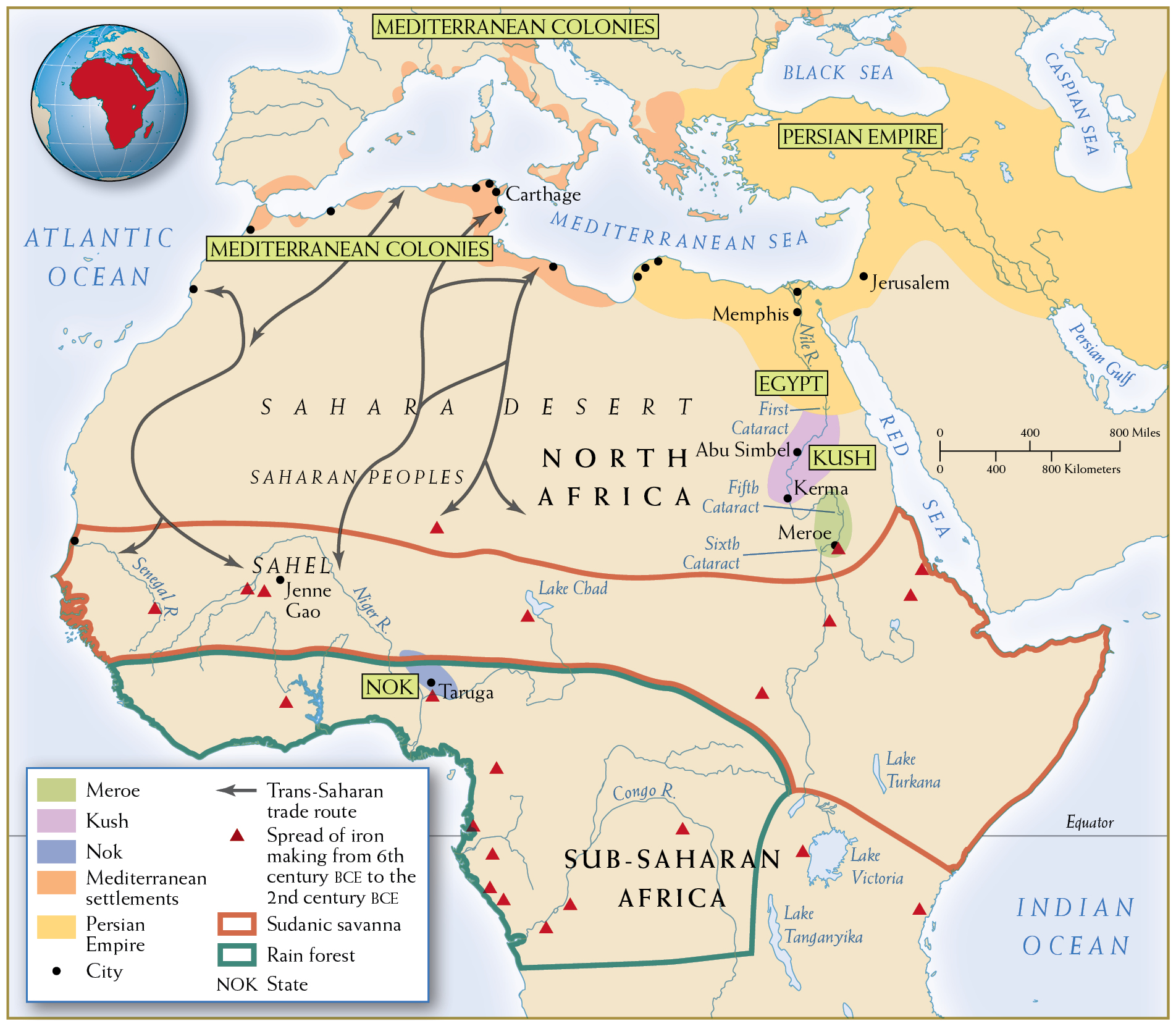
Map 5.6 Africa, 500 BCE
The first millennium BCE was a period of cultural, economic, and political integration for North and sub-Saharan Africa.
- According to this map, what effect did the Mediterranean colonies have on Africa?
- What main geographic feature integrated Kush and Egypt? What impact might cataracts have had on integration?
- Where does the map indicate there was a spread of ironworking? What features on the map may have influenced where ironworking spread?
Nubia: Kush and Meroe One of the most highly developed locations of common culture in sub-Saharan Africa was Nubia, a region lying between the first Nile cataract (a large waterfall) and the sixth, just north of where the Blue and White Niles come together. From at least the fourth millennium BCE onward, peoples in this region had contact with both the northern and southern parts of the African landmass. It was one of the few parts of sub-Saharan Africa known to the Eurasian world during this period.
In the second and first millennia BCE, complex societies formed and developed into states in Nubia. The first of the important Nubian states was Kush. A thriving contemporary of Middle Kingdom Egypt, it flourished between 1700 and 1500 BCE between the first and third cataracts and had its capital at Kerma. Because of its proximity to Egypt, it adopted many Egyptian cultural and political practices, even as it was under constant pressure from the northern powerhouse. Its successor states had to move farther south, up the Nile, to keep free from the powerful Egyptians; the kingdom’s capitals were repeatedly uprooted and relocated upriver.
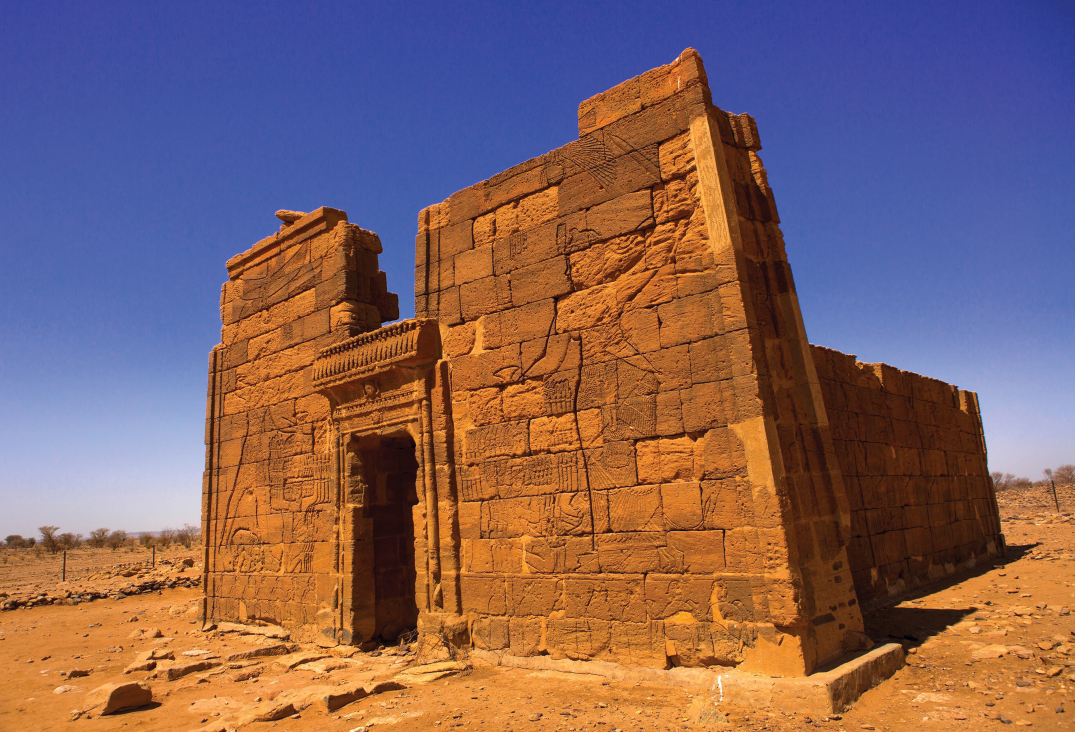
Nubia was Egypt’s corridor to sub-Saharan Africa; a source of ivory, gold, and enslaved men and women; and an area that Egyptian monarchs wanted to dominate. To the Egyptians, the land of Kush and its people were there to be exploited, not conquered, as Egyptians had no desire to live there. Ramses II left his mark with his magnificent monuments at the Nubian site Abu Simbel around 1250 BCE.
CURRENT TRENDS IN WORLD HISTORY
What Makes an “Axial Age”?
In the mid-twentieth century, the German philosopher Karl Jaspers invented the term “Axial Age” to describe the importance of ideas that originated in the first millennium BCE. These thinkers and their ideas are characterized as “axial” because (1) they were a pivot point, or axis, that seemed to turn the world in a new direction, (2) they occurred along an east-west axis stretching from the Mediterranean to East Asia, and (3) they are central to ethical thought even down to the present day. These Axial Age philosophers were both the product of, and a challenge to, the societies from which they came. Each was responding to a context of economic growth and political infighting. Although the specific socioeconomic and political contexts that spurred them to develop their new ideas were unique—the stratifications of varna in South Asia for the Buddha, the warfare of the late Spring and Autumn period in China for Confucius, and the civil war among Greek city-states for Socrates—across the board these new thinkers critiqued and offered alternatives to the status quo.
Ideas about the Axial Age have come a long way since Jaspers. World historians today have a better understanding of how connectedness may have affected the development of these ideas. Where Jaspers saw a relatively disconnected world and marveled at the similarities among the independently proposed ideas, scholars today recognize that exchange between the Mediterranean, Southwest Asia, and South Asia predated these thinkers by almost 2,000 years and may have even had an impact on these developments. Scholars have refined the definition of what makes a tradition axial. For instance, Shmuel Eisenstadt has remarked that the axial philosophers were a sort of intellectual elite who, in a self-examining way, helped negotiate between what he refers to as an “otherworldly” and “worldly” order. David Christian, the historian known for his work with “Big History,” has noted the relationship between large, connected empires and these universal philosophical ideas, with their “universal truths and . . . all-powerful gods”; he has even interpreted the spread of these similar ideas as evidence of the connections across Afro-Eurasia. Others have also begun to reflect more critically on the limitations of Axial Age thought as an organizing concept. For instance, although the tenets of Axial Age philosophers were accessible and applicable to urban-living elite men, historians such as Karen Armstrong raise the question of whether they also applied to women, nonelites, and those living in rural contexts. Other scholars, of whom Iain Provan is the most recent and vocal, raise concerns about generalizing across very different cultures and not giving enough attention to the unique political situation of each region. Some have challenged outright the concept of the Axial Age, arguing that it is merely a modern, oversimplifying construct that is in no way useful for interpreting the complex philosophical developments of the first millennium BCE.
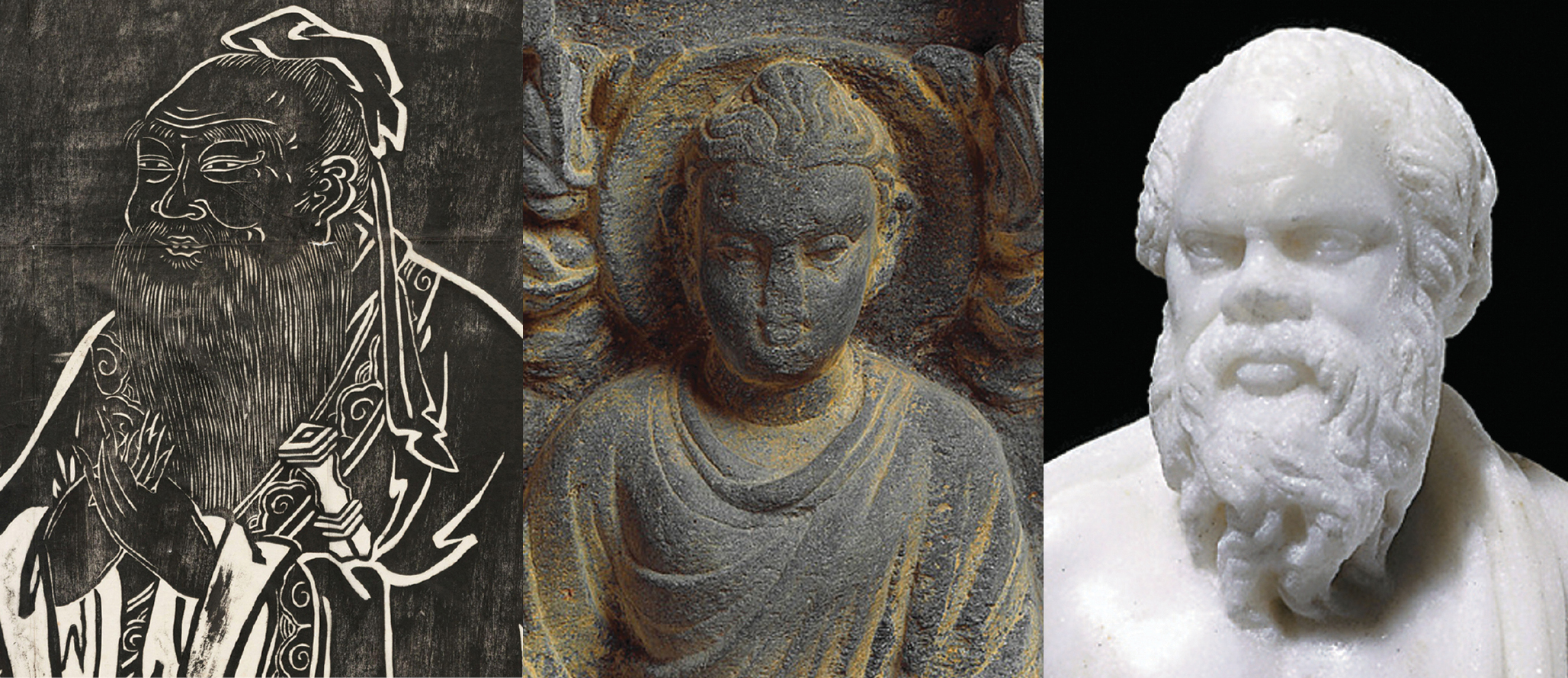
Even with the modern tweaks and strong critiques of his theory, it is hard to disagree with Jaspers that these mid-first-millennium BCE thinkers, such as Confucius, the Buddha, and Socrates, offered transformational ideas that are still with us today. The axial traditions offer surprisingly similar moral codes that address issues such as the nature of wisdom and divine justice, the need for kindness, and the value of following the “Golden Rule.”
Questions for Analysis
- Based on your reading of this chapter, what connections, if any, can be made between the geopolitical situation of a society and the Axial Age philosophy that sprang from that region? In what ways did each philosopher support or challenge the status quo?
- Karl Jaspers was particularly impressed that societies he understood as being disconnected from one another could develop philosophical ideas that were so similar. How might connections with other regions, or the lack thereof, have affected the development of these ideas? What might account for similarities and differences in these Axial Age philosophies?
- How useful, or not, do you find the concept of the Axial Age for thinking about global developments in the first millennium BCE? What are some arguments for and against using such a term/concept?
Explore Further
- Armstrong, Karen, The Great Transformation: The Beginning of Our Religious Traditions (2006).
- Bellah, Robert N., “What Is Axial about the Axial Age?” European Journal of Sociology 46, no. 1 (2005): 69–89.
- Eisenstadt, S. N., (ed.), The Origins and Diversity of the Axial Age (1986).
- Jaspers, Karl, The Origin and Goal of History, translated by Michael Bullock (1953).
- Provan, Iain, Convenient Myths: The Axial Age, Dark Green Religion, and the World That Never Was (2013).
Sources: Karen Armstrong, The Great Transformation: The Beginning of Our Religious Traditions (New York: Knopf, 2006), pp. xxi–xxii; Robert N. Bellah, “What Is Axial about the Axial Age?” European Journal of Sociology 46, no. 1 (2005): 69–89; David Christian, Maps of Time: An Introduction to Big History (Berkeley: University of California Press, 2004), p. 319; S. N. Eisenstadt (ed.), The Origins and Diversity of the Axial Age (Albany: State University of New York Press, 1986); Karl Jaspers, The Origin and Goal of History, translated by Michael Bullock (New Haven, CT: Yale University Press, 1953); Iain Provan, Convenient Myths: The Axial Age, Dark Green Religion, and the World That Never Was (Waco, TX: Baylor University Press, 2013).
Building on the foundations of earlier kings who had ruled the region of Nubia, the Meroitic kingdom arose in the fourth century BCE and flourished until 300 CE. This kingdom was centered in the city of Meroe farther south along the Nile, close to its sixth cataract, in the region today known as Sudan. The Meroitic kingdom’s rulers were influenced by pharaonic culture, adapting hieroglyphs, erecting pyramids in which to bury their rulers, viewing their kings as divine, and worshipping the Egyptian god Amun. Meroe became a thriving center of production and commerce. Its residents were especially skilled in iron smelting and the manufacture of textiles, and their products circulated widely throughout Africa. However, Meroe was equally a part of the Sudanic savanna way of life—as evidenced by the distinctiveness of its language and the determination of its inhabitants to retain political autonomy, including, if necessary, moving farther south, out of the orbit of Egypt and more into the orbit of Sudanic polities. Although they called their kings pharaohs, the influential leaders of Meroe selected them from among the many members of the royal family, attempting to ensure that their rulers were men of proven talents. In addition, the Nubian states had close commercial contacts with other merchants and commercial hubs in Sudanic Africa.
West African Kingdoms Complex societies also thrived in West Africa. The most spectacular West African culture of the first millennium BCE was the Nok culture, which arose in the sixth century BCE in an area that is today the geographical center of Nigeria. Though slightly south of the savanna lands of West Africa, the area was (and still is) in regular contact with that region. At Taruga, near the present-day village of Nok, early iron smelting occurred in 600 BCE. Taruga may well have been the first place in western Africa where iron ores were smelted. Ironworking was significant for the Nok peoples, who moved from using stone materials directly to iron, bypassing the bronze working that had been a transitional stage in the technology characteristic of other advanced metallurgists in Afro-Eurasia (as in second-millennium BCE Shang China and the Mediterranean). The Nok made iron axes and hoes, iron knives and spears, and luxury items for trade. However, they achieved historical fame not for their iron-smelting prowess but for their magnificent terra-cotta figurines, discovered in the 1940s in the tin-mining region of central Nigeria. These naturalistic figures date to at least 500 BCE. They were likely altarpieces for a cult associated with the land’s fertility. Placed next to new lands that were coming into cultivation, they were believed to bless the soil and enhance its productivity.
The Nok were not the only culture developing in this region. Peoples living in the Senegal River basin and Mande peoples around the western branch of the Niger River also began to establish large settlements, in which artisans smelted iron ore and wove textiles and merchants engaged in long-distance trade. West Africa was also home to the Bantu-speaking peoples destined to play a major role in the history of the landmass. Around 300 BCE, small Bantu groups began to migrate southward into the equatorial rain forests, where they cleared land for farming; from there, some moved on to southern Africa. (See Chapter 8 for a discussion of the Bantu peoples.) As impressive as the ironworking, figurines, and trade of West Africa were, these cultures were not yet producing—or at least there is no record of—the type of Axial Age developments that were happening in much of Eurasia.
Glossary
- Chavín
- Agrarian people living from 1400 to 200 BCE in complex societies in what is now Peru. They manufactured goods (ceramics, textiles, and precious metals), conducted limited long-distance trade, and shared an artistic and religious tradition, most notably at Chavín de Huántar.
- Olmecs
- Mesoamerican people, emerging around 1500 BCE, whose name means “inhabitants in the land of rubber,” one of their major trade goods. Living in decentralized agrarian villages, this complex, stratified society shared language and religious ideas that were practiced at sacred ritual centers.
- Meroitic kingdom
- Thriving kingdom from the fourth century BCE to 300 CE. A successor to Kush, it was influenced by both Egyptian and Sudanic cultures.