The Slave Trade and Africa
CORE OBJECTIVES
ANALYZE the consequences of the Atlantic slave trade across the Atlantic world.
The Slave Trade and Africa
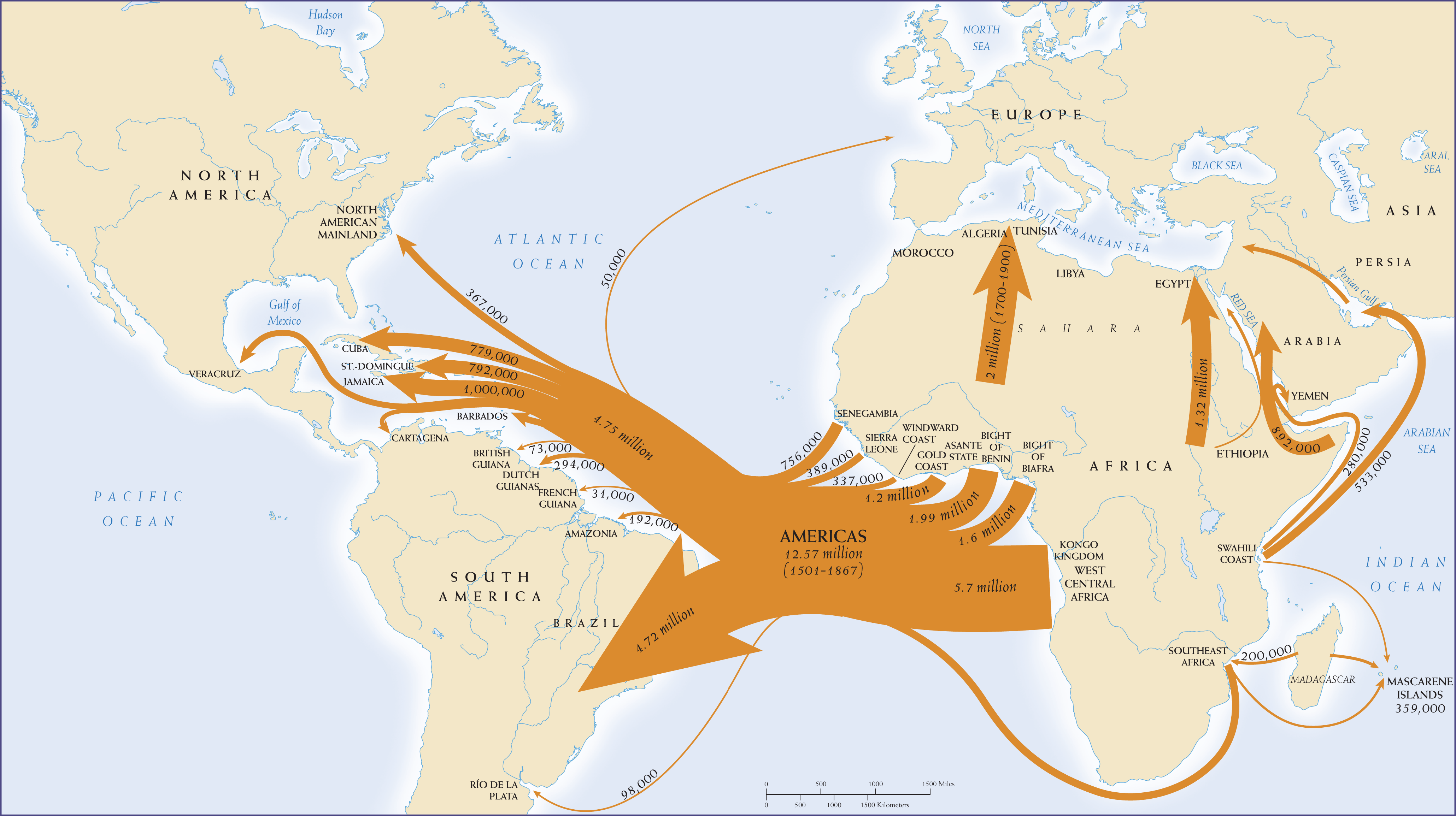
Wiping out Indigenous populations, or pushing them farther afield, cleared the way for European occupation in the Americas. But there was a problem: Who was going to work the land? Where Indigenous labor could not be recruited or forced, Europeans turned to indentured workers and increasingly to importing enslaved African laborers. Although the Atlantic slave trade began in the mid-fifteenth century, only in the seventeenth and eighteenth centuries did the numbers of human exports from Africa begin to soar. (See Map 13.4.) By 1820, four enslaved Africans had crossed the Atlantic for every free European. Those numbers were essential to the prosperity of Europe’s American colonies. At the same time, the departure of so many inhabitants depopulated and destabilized many parts of Africa.
Capturing and Shipping Enslaved Peoples
Merchants in Europe and the New World prospered as the slave trade grew, but their fortunes depended on trading and political networks in Africa. In fact, before the nineteenth-century discovery of quinine, European enslavers could not survive in the African interior. Instead, they took advantage of African rivalries. Using firearms supplied by Europeans, African elites controlled the capturing of human cargo; their networks linked moneylenders and traders on the coast with allies in the interior.
Before the Europeans’ arrival, Africa had long-standing enslavement networks, mainly flowing across the Sahara to North Africa and Egypt and eastward to the Red Sea and the Swahili coast of East Africa. From the Red Sea and Swahili coast destinations, Muslim and Hindu merchants shipped enslaved peoples to ports around the Indian Ocean. However, their numbers could not match the volume destined for the Americas once plantation agriculture began to spread. Indeed, 12.5 million Africans survived forcible enslavement and shipment to Atlantic ports from 1525 (the date of the first direct voyage from Africa to the Americas) until 1867 (when the last voyage took place).
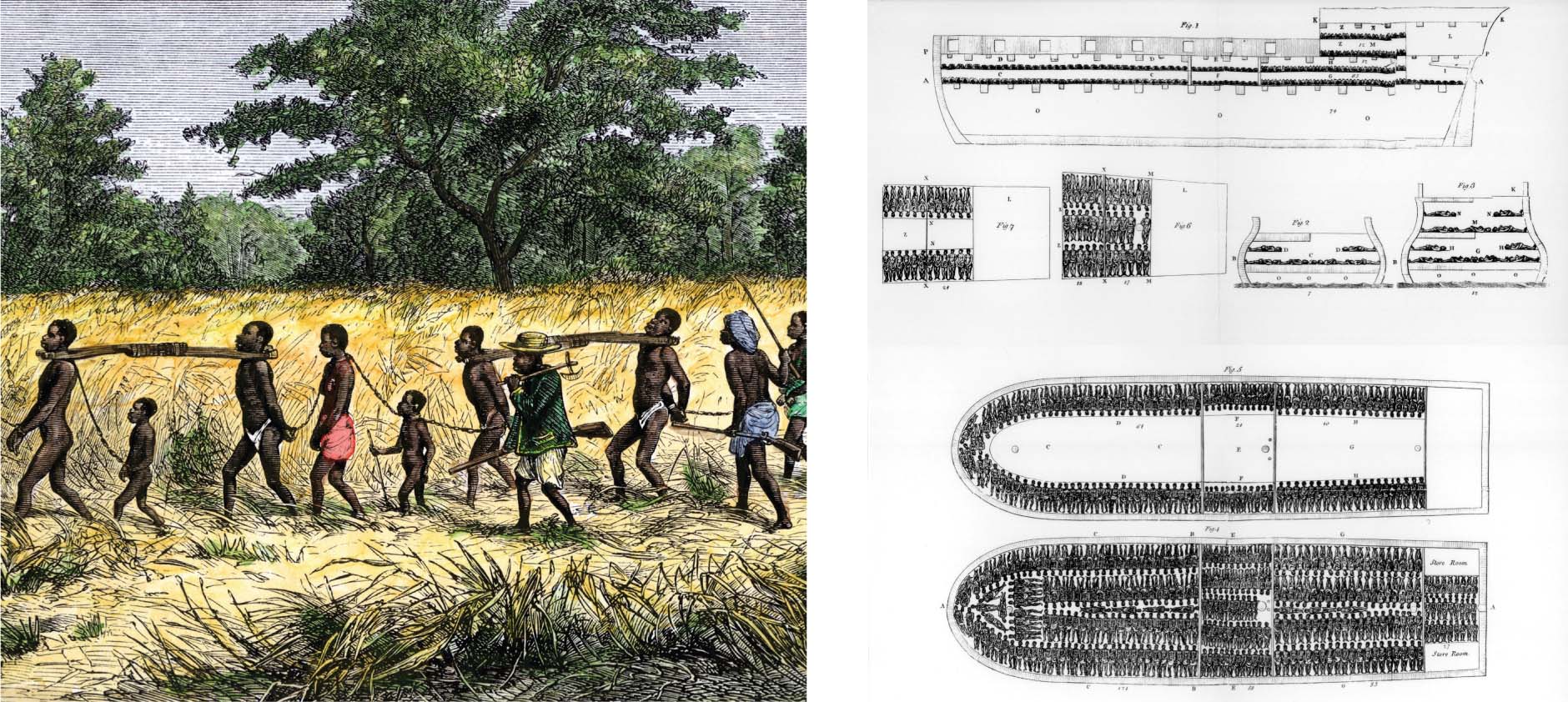
The slave ports along the African coast became gruesome holding pens. Many of the enslaved who perished did so before losing sight of Africa. Stuck in vast camps where disease and hunger were rampant, the enslaved were then forced aboard vessels in cramped and wretched conditions. These ships waited for weeks to fill their holds while their human cargoes wasted away below deck. Crew members tossed dead Africans overboard as they loaded on other Africans from the shore. When the hold was full, the ships set sail. In their wake, crews continued to dump bodies. Most died of dehydration brought on by gastrointestinal diseases and a lack of fresh water. Smallpox and dysentery were also scourges. Either way, death was slow and agonizing.
Slavery’s Gender Imbalance
In moving so many people from Africa to the Americas, the slave trade wreaked havoc on the ratios of men to women in both places. Most of the people shipped to the Americas were adult men, which made it difficult for them to form families and have children in the Americas. Planters and slave traders then returned to Africa to procure more human beings to force into bondage—especially for the Caribbean islands, where death rates were astronomical.
More information
A drawing of captured Africans marching through a field. The prisoners are tied to each other by ropes, and some are attached by the neck with wooden apparatuses. Several of the prisoners are children and two others carry baskets on their heads. Soldiers with muskets and spears watch the line of prisoners. There are many trees in the background.
A schematic of a slave trade ship. The slave trade ship shows how the captured prisoners are laid side by side, crowded close together, throughout the interior of the ship. The schematic shows the ship on several levels and from several perspectives.
Men outnumbered women in the New World slave communities, but in the regions of Africa where captives were seized, women outnumbered men. Enslaved women were especially prized in Africa because of their traditional role in the production of grains, leathers, and cotton. Moreover, the slave trade reinforced the traditional practice of polygamy—allowing relatively scarce men to take several wives, which helped minimize the loss of population.
Africa’s New Slave-Supplying States
Africans did not passively let captives fall into the arms of European buyers; instead, local political leaders and merchants actively supplied them. This promoted the growth of centralized political structures, particularly in West African rain forest areas. The trade also shifted control of wealth away from households owning large herds or lands in the interior to those who profited from the capture and exchange of enslaved people—urban merchants and warrior elites.
In some parts of Africa, the booming slave trade created chaos as local leaders feuded over control of the traffic. In the Kongo kingdom, for example, civil wars raged for over a century after 1665, and captured warriors were sold into slavery. As members of the royal family clashed, entire provinces saw their populations vanish. Europeans fueled these conflicts and provided weapons to their African allies. Moreover, kidnapping became so prevalent that farmers worked their fields bearing weapons, leaving their children behind in guarded stockades.
More information
Map 13.4 is titled, The African Slave Trade, 1440-1867. The map displays voyages from Africa to Europe, South America, Central America, and North America. The shipment of slaves is represented by arrows, along with the number of slaves transported in millions. The large majority of the slave trade went to the Americas, which was 12.57 million from 1501 to 1867. 5.7 million came from the Kongo and West Central Africa, 1.6 million came from the Bight of Biafra, 1.99 million came from Bight of Benin Oyo, 1.2 million came from Gold Coast Asante, 337,000 came from Windward Coast, 389,000 came from Sierra Leone, and 756,000 came from Senegambia. Of those 12.57 million slaves, 98,000 went to Rio de la Plata, 4.72 million went to Brazil, 192,000 went to Amazonia, 31,000 went to French Guiana, 294,000 went to Dutch Guianas, 73,000 went to British Guiana, 1,000,000 went to Jamaica, 792,000 went to Saint Domingue, 779,000 went to Cuba, 367,000 went to the North American Mainland, and 50,000 went to Europe. From 1700 to 1900 2 million slaves were transported from central Africa to Algeria and Tunisia. 1.32 million slaves were transported from central Africa to Egypt. 892,000 slaves were transported from Ethiopia to Arabia and up the Red Sea. 280,000 slaves were transported from the Swahili Coast to Yemen, another 533,000 to the Persian Gulf and the Middle East, and some were transported to the Mascarene Islands. 200,000 slaves were transported from Madagascar to Southeast Africa, and 359,000 from Madagascar and Africa to the Mascarene Islands.
MAP 13.4 | The African Slave Trade, 1440–1867
The Atlantic slave trade flourished in the seventeenth, eighteenth, and nineteenth centuries, linking many parts of Africa with the Americas.
- What were the main areas in Africa from which people were taken and enslaved?
- What were the main areas that they were taken to in the Americas?
- Based on your reading, how and where did the slave trade reshape African societies?
More information
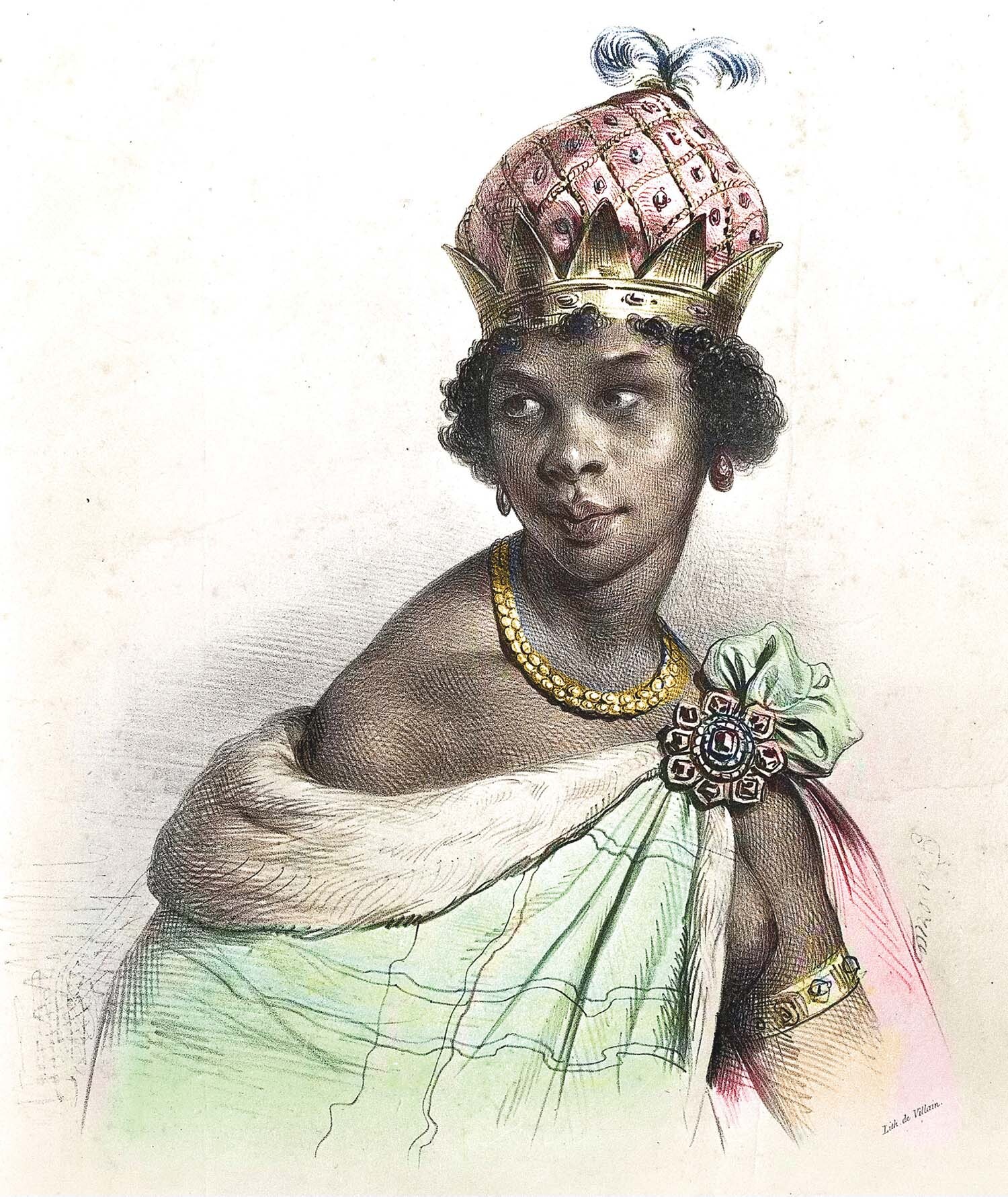
Portrait of Queen Nzinga wearing a crown and looking to her right. She has short curly hair and wears a piece of fabric pinned on one shoulder with a brooch, a golden necklace, and a golden arm band.
Some leaders of the Kongo kingdom fought back. Queen Nzinga (1583–1663), for example, was a masterful diplomat and a shrewd military planner. Having converted to Christianity, she managed to keep Portuguese enslavers at bay during her long reign. Even after Portuguese forces defeated her troops in battle, she conducted effective guerrilla warfare into her sixties.
Consider also the Christian visionary Dona Beatriz Kimpa Vita. Born in Kongo in 1684 and baptized as a Christian, she claimed at age twenty to have received visions from Saint Anthony of Padua. She believed that she died every Friday and was transported to heaven to converse with God, returning to earth on Monday to broadcast God’s commands to believers. Her message aimed to end the Kongo civil wars and re-create a unified kingdom. Although she gained a large following, she failed to win the support of leading political figures. In 1706, she was captured and burned at the stake.
As some African merchants and warlords sold other Africans, their commercial success enabled them to consolidate political power and grow wealthy. Their wealth financed additional weapons, with which they subdued neighbors and extended political control. Among the most durable new polities was the Asante state, which arose in the West African tropical rain forest in 1701 and expanded through 1750. This state benefited from its access to gold, which it used to acquire firearms from European traders to raid nearby communities for captives to be sold into slavery in the Americas. From its capital city at Kumasi, the state eventually encompassed almost all of present-day Ghana. Main roads spread out from the capital like spokes of a wheel, each approximately twenty days’ travel from the center. Through the Asante trading networks African traders bought, bartered, and sold captives, who wound up in the hands of European merchants waiting in ports with vessels carrying manufactures and weaponry.
Slavery and the emergence of new states enriched and empowered some Africans, but they cost Africa dearly. The Atlantic system tilted wealth toward port cities and away from rural dwellers and village elders. Across Africa, the slave trade thinned the population. Africa was spared the demographic catastrophe endured by Indigenous peoples. The introduction of American food crops—notably maize and cassava, which produced many more calories per acre than the old staples of millet and sorghum—blunted the trade’s depopulating aspects. Yet some areas suffered grievously from three centuries of heavy involvement in the slave trade. The Atlantic trade enhanced the warrior class, which carried out raids for captives. The dislocations, internal power struggles, and economic hardships that followed precipitated the rise of militaristic West African kingdoms.
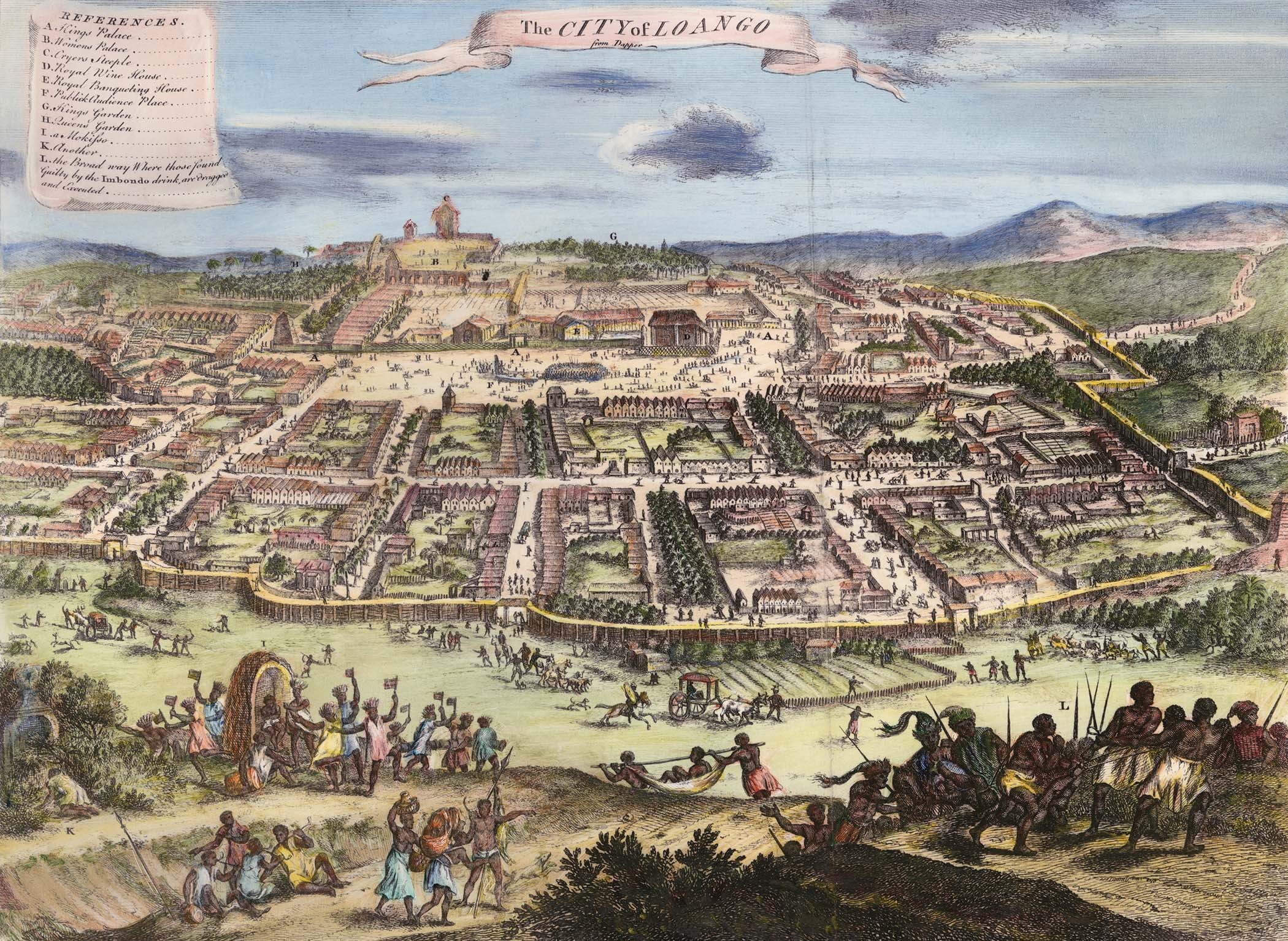
More information
A birds’ eye view illustration of the port of Loango. The large port city is neatly constructed and is surrounded by a wall. Numerous enslaved people are working in the outskirts of the city, carrying their enslavers, cultivating land, or capturing other prisoners. The references are listed in the top left corner and a scroll that reads The City of Congo is at the center of the top.