 Connecting the World
DEVELOPMENT OF MARITIME TRADE
By the tenth century CE, sea routes were becoming more important than land networks for long-distance trade. Improved navigational aids, better mapmaking, refinements in shipbuilding, and new political support for shipping made seaborne trade easier and slashed its cost. These developments also fostered the growth of maritime commercial hubs (called anchorages), which further facilitated the expansion of maritime trade.
Innovations at Sea
A new navigational instrument spurred this maritime boom: the needle compass. This Chinese invention initially identified promising locations for houses and tombs, but eleventh-century sailors from Guangzhou (Canton) used it to find their way on the high seas. The use of this device among navigators spread rapidly. The compass not only allowed sailing under cloudy skies but also improved mapmaking.
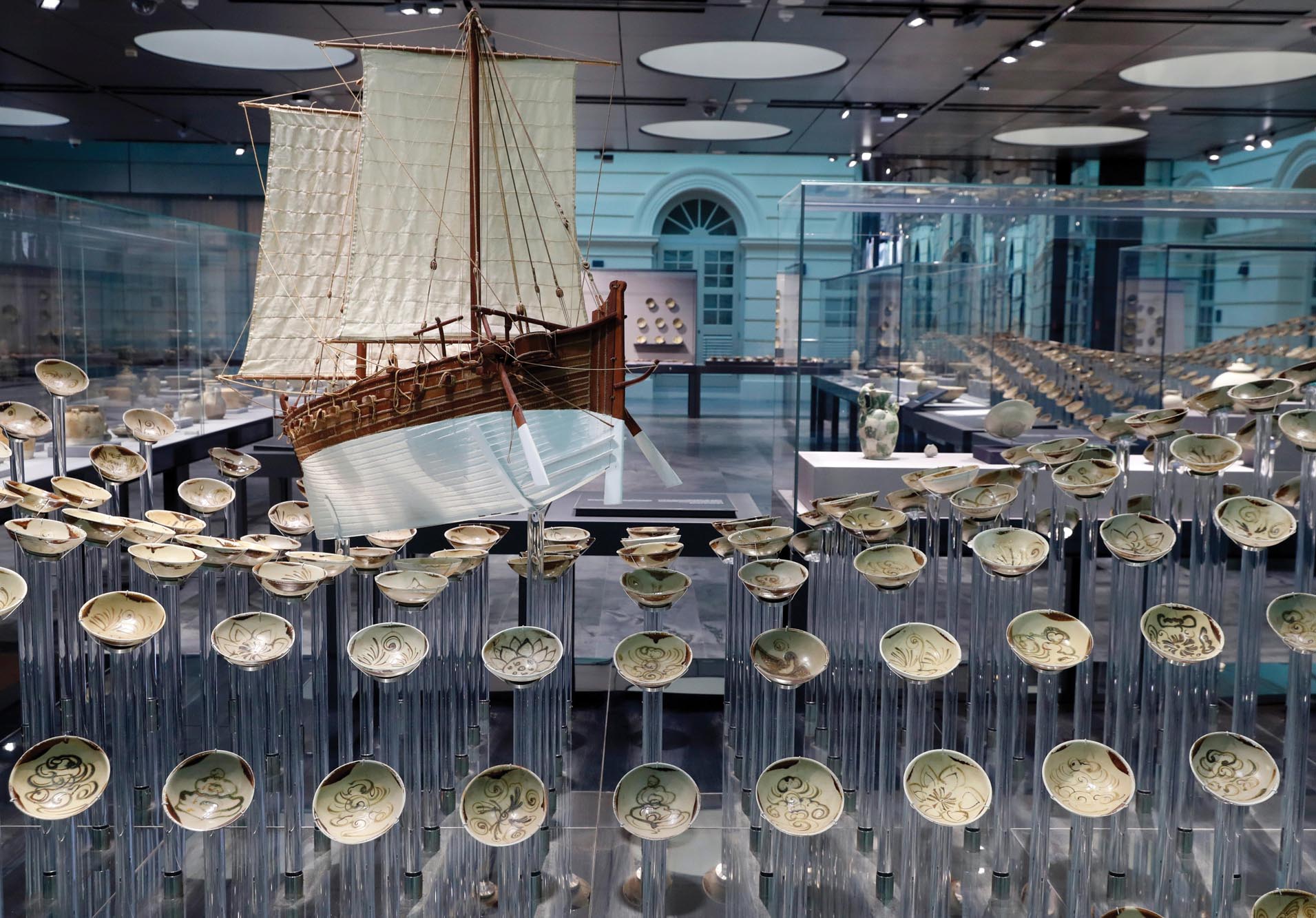
An array of new ship types—dhows, junks, and cogs—allowed for more impressive mastery of the seas. Dhows, which were ships with triangular sails called lateens, maximized the power of the monsoon trade winds on the Arabian Sea and the wider Indian Ocean. Sailing the South China Sea were junks, large, flat-bottomed ships with internal sealed bulkheads, stern-mounted rudders, as many as four decks, six masts with a dozen sails, and the space to carry as many as 500 men. And, in the Atlantic, cogs, with their single mast and square sail, linked Genoa to locations as distant as the Azores and Iceland. The numbers testify to the power of the maritime revolution: while a porter on land could carry about 10 pounds over long distances, and animal-drawn wagons could move 100 pounds of goods over small distances, the Arab dhows could transport up to 5 tons of cargo, Atlantic cogs as much as 200 tons, and Chinese junks more than 500 tons.
One particularly fascinating recent archaeological discovery that demonstrates the connectivity brought by these ships is the Belitung dhow. Shipwrecked in the Java Sea off the coast of the Indonesian island of Belitung in the early ninth century CE, this 50-foot ship likely hailed from the southern coast of the Arabian Peninsula (modern-day Oman or Yemen), based on analysis of the wood out of which it was constructed. The ship was filled with more than 60,000 artifacts from Tang dynasty China. Packed with tens of thousands of Changsha bowls (a kind of ceramic from Hunan Province), jars of star anise (a spice from East and Southeast Asia, valued for its medicinal properties), twenty-nine Chinese bronze mirrors, Chinese coins, and many other items, the ship had clearly been loaded up in China (probably Guangzhou). Based on some cargo that would have appealed to an Abbasid market, scholars think the Belitung dhow may have been sailing to Basra, in modern-day Iraq. Although the shipwreck dates to a bit earlier than the time frame emphasized in this chapter (to c. 830 CE, based on the writing on a pot and the date of the coins in the wreckage), it offers evidence for the kind of direct, long-distance maritime trade between China and the Abbasid world that was bringing the world closer together by 1000 CE. The parallels between this Belitung shipwreck and the Uluburun shipwreck that occurred more than 2,000 years earlier (c. 1325 BCE) off the coast of modern-day Turkey (see Chapter 3) are striking: both boats were filled to the brim with long-distance trade items.

Global Commercial Hubs
Although it may seem ironic to assert after invoking a shipwreck as evidence, the business of shipping, on the whole, became less dangerous in the period from 1000 to 1300 CE thanks not only to these innovations in shipbuilding but also to local political support. Maritime traders enjoyed the protection of political authorities such as the Song rulers in China, who maintained a standing navy that protected traders and lighthouses that guided trading fleets in and out of harbors. The Fatimid caliphate in Egypt profited from maritime trade and defended merchant fleets from pirates, using armed convoys of ships to escort commercial fleets and regulate the ocean traffic. This system of protection soon spread to North Africa and southern Spain.
In these regions with supportive political structures, long-distance trade spawned the growth of commercial cities. (See Map 10.1.) These cosmopolitan entrepôts served as transshipment centers located on land between borders or in ports where ships could drop anchor. In these cities, traders exchanged commodities and replenished supplies. Beginning in the late tenth century CE, several regional centers became major anchorages of the maritime trade: in the west, the Egyptian port city of Alexandria on the Mediterranean (and Cairo, just up the Nile); near the tip of the Indian subcontinent, the port of Quilon (now Kollam); in the Malaysian Archipelago, the city of Melaka; and in the east, the Chinese city of Quanzhou. These hubs thrived under the political stability of powerful rulers who recognized that trade would generate wealth for their regimes.
Cairo and Alexandria were the Mediterranean’s main maritime commercial centers. Cairo was home to numerous Muslim and Jewish trading firms, and Alexandria was their lookout post on the Mediterranean. It was through Alexandria that Europeans acquired silks from China, especially the coveted zaytuni (satin) fabric from Quanzhou. But many more goods passed through the Egyptian anchorage: from the Mediterranean olive oil, glassware, flax, corals, and metals; from India, gemstones and aromatic perfumes; and from elsewhere, minerals and chemicals for dyeing or tanning and raw materials such as timber and bamboo. Paper and books (including hand-copied Bibles, Talmuds, and Qurans) traveled along this network as well.
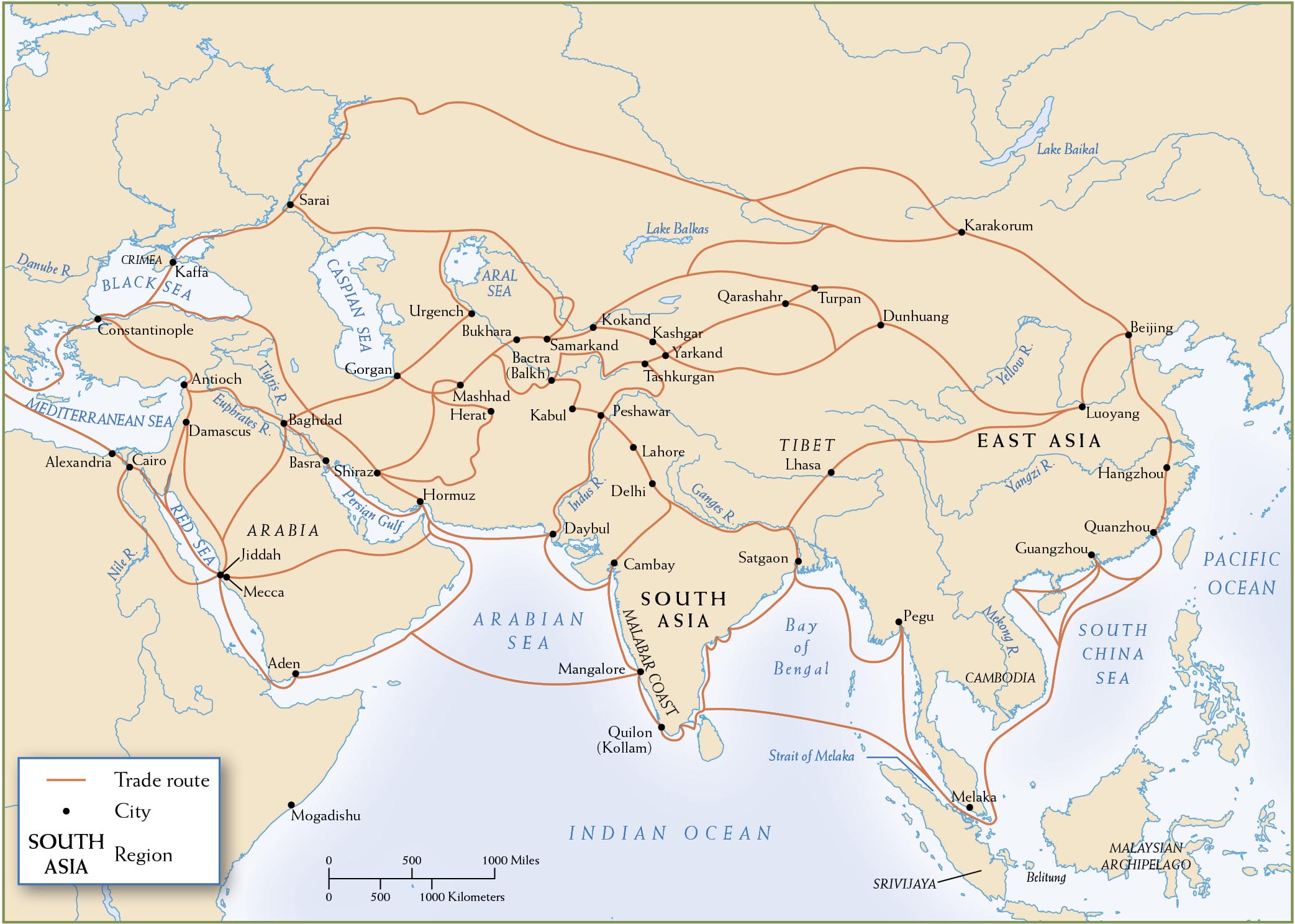
Map 10.1 | Afro-Eurasian Trade, 1000–1300 CE
During the early second millennium, Afro-Eurasian merchants increasingly turned to the Indian Ocean to transport their goods. Locate the global hubs of Quilon, Alexandria, Cairo, Melaka, and Quanzhou on this map.
- What regions do each of these global hubs represent?
- Based on the map, why would sea travel have been preferable to overland travel?
- According to the text, what revolutions in maritime travel facilitated this development?
The Islamic legal system prevalent in Egypt promoted a favorable business environment. Legal specialists got around the rule that might have brought commerce to a halt—the sharia’s (see Chapter 9) prohibition against earning interest on loans. With the clerics’ blessing, Muslim traders formed partnerships between those who had capital to lend and those who needed money to expand their businesses: owners of capital entrusted their money or commodities to agents who, after completing their work, returned the investment and a share of the profits to the owners—and kept the rest as their reward. The English word risk derives from the Arabic rizq, the extra allowance paid to merchants in lieu of interest. As we saw with the Belitung shipwreck possibly bound for Basra (a Persian Gulf port city of the Islamic Abbasid caliphate), shipping was indeed a risky business.
The Cairo Geniza—a cache of documents dating from around 800 CE through the nineteenth century that was preserved by the Jewish community because the documents had the name of God written on them—contains a series of correspondence among a system of Jewish traders from Egypt, the southern Arabian Peninsula, and the west coast of India. For example, Joseph Ben Abraham, a Jewish merchant living in Aden, wrote multiple letters to Abraham Ben Yiju, who lived on the southwest coast of India around 1130. Joseph’s letters to Abraham mention shipwrecks and cargo loss, giving insight into the risks of Indian Ocean trade, goods (like betel nuts and spices) received for trading, raw materials sent for manufacturing, and gift packages to be distributed by Abraham to Joseph’s connections in India. Abraham, Joseph’s Indian point of contact, was a Jewish merchant who had moved from North Africa (Tunisia) to Mangalore on the southwest coast of India and married a local maidservant named Ashu, whom he freed and had children with, and through whom he established local connections. The correspondence between Joseph and Abraham and others in their network demonstrate the personal connections that undergirded Indian Ocean trading in the early twelfth century.
About two centuries before Abraham Ben Yiju was operating out of Mangalore, the Chola dynasty in South India during the tenth century CE began supporting the port of Quilon, which was the nerve center of maritime trade between China and the Red Sea and the Mediterranean. Trade through Quilon continued to flourish long after the Chola golden age passed away. Personal relationships were key to trade at Quilon, like elsewhere, as we saw with Abraham Ben Yiju. When striking a deal with a local merchant, a Chinese trader might mention his Indian neighbor in Quanzhou and that family’s residence in Quilon. Dhows arrived in Quilon laden not only with goods from the Red Sea and Africa, but also with traders, sojourners, and fugitives. Chinese junks unloaded silks and porcelain, and picked up passengers and commodities for East Asian markets. Muslims, the largest foreign community in Quilon, lived in their own neighborhoods and shipped horses from Arab countries to India and its southeastern islands, where kings viewed them as symbols of royalty. There was even trade through Quilon in elephants and cattle from tropical countries, though the most common goods were spices, perfumes, and textiles.
East of Quilon, across the Bay of Bengal, Melaka became a key cosmopolitan entrepôt because of its strategic location and proximity to Malayan tropical produce. Indian, Javanese, and Chinese merchants and sailors spent months in such ports selling their goods, purchasing return cargo, and waiting for the winds to change direction so they could reach their next destination. During peak season, Southeast Asian ports were crowded with colorfully dressed foreign sailors, local Javanese artisans who produced finely textured batik handicrafts, and traders eager for profit. The traders converged from all over Asia to flood the markets with their merchandise and to search for pungent herbs, aromatic spices, and agrarian staples such as quick-ripening strains of rice to ship out.

In China, the Song government set up offices of seafaring affairs in its three major ports: Quanzhou, Guangzhou (Canton), and a third near present-day Shanghai. In return for a portion of the taxes on the goods passing through these entrepôts, these offices registered cargoes, sailors, and traders, while guards kept a keen eye on the traffic. All foreign traders in Song China were guests of the governor, who doubled as the chief of seafaring affairs. Every year, the governor conducted a wind-calling ritual. Traders of every origin—Arabs, Persians, Jews, Indians, and Chinese—witnessed the ceremony, then joined together for a sumptuous banquet. Although most foreign merchants did not reside apart from the rest of the city, they did maintain buildings for religious worship according to their faiths. A mosque from this period still stands on a busy street in Quanzhou. Hindu traders living in Quanzhou worshipped in a Buddhist shrine where statues of Hindu deities stood alongside those of Buddhist gods. Each of these bustling ports teemed with a cosmopolitan mix of peoples, goods, and ideas that flowed through growing maritime networks thanks to improved ships and better navigational tools.
Glossary
- entrepôts
- Multiethnic trading stations, often supported and protected by regional leaders, where traders exchanged commodities and replenished supplies in order to facilitate long-distance trade.