CONCLUSION
Despite the intermixing of peoples, ideas, and goods across Afro-Eurasia, new political and cultural boundaries were developing that would split this landmass in ways previously unimaginable. The most important dividing force was religion, as Islam challenged and slowed the spread of Christianity and as Buddhism challenged the ruling elite of Tang China. As a consequence, Afro-Eurasia’s major cultural zones began to compete in terms of religious and cultural doctrines. The Islamic Abbasid Empire pushed back the borders of the Tang Empire. But the conflict grew particularly intense between the Islamic and Christian worlds, where the clash involved faith as well as frontiers.
The Tang Empire revived Confucianism, insisting on its political and moral primacy as the foundation of a new imperial order, and it embraced the classical written language as another unifying element. By doing so, the Tang counteracted universalizing foreign religions—notably Buddhism but also Islam—spreading into the Chinese state. The same adaptive strategies influenced new systems on the Korean Peninsula and in Japan.
In some circumstances, faith followed empire and relied on rulers’ support or tolerance to spread the word. This was the case especially in East Asia. At the opposite extreme, empire followed faith—as in the case of Islam, whose believers endeavored to spread their empire in every direction. The Islamic empire and its successors represented a new force: expanding political power backed by one God whose instructions were to spread his message. In the worlds of Christianity, a common faith absorbed elements of a common culture (shared books, a language for the learned classes). But in the west, political rulers never overcame inhabitants’ intense allegiance to local authority.
While universalizing religions expanded and common cultures grew, debate raged within each religion over foundational principles. In spite of the diffusion of basic texts in “official” languages, regional variations of Christianity, Islam, and Buddhism proliferated as each belief system spread. The period from 600 to 1000 CE demonstrated that religion, reinforced by prosperity and imperial resources, could bring peoples together in unprecedented ways. But it could also, as the next chapter will illustrate, drive them apart in bloody confrontations.
After You Read This Chapter
 Go to IJK to see what you’ve learned—and learn what you’ve missed—with personalized feedback along the way.
TRACING THE GLOBAL STORYLINE
FOCUS ON: Religion and Empires: Islam, the Tang Dynasty, Christendom, and Common Cultures
The Islamic Empire
- Warriors from the Arabian Peninsula defeat Byzantine and Sasanian armies and establish an Islamic empire stretching from Morocco to South Asia.
- The Abbasid state takes over from the Umayyads, crystallizes the main Islamic institutions of the caliphate and Islamic law, and promotes cultural achievements in religion, philosophy, and science.
- Disputes over Muhammad’s succession lead to a deep and enduring split between Sunnis and Shiites.
Tang China
- The Tang dynasty dominates East Asia and exerts a strong influence on Korea and Japan.
- Tang rulers balance Confucian and Daoist ideals with Buddhist thought and practice.
- A common written language and shared philosophy, rather than a single universalizing religion, integrate the Chinese state.
Christian Europe
- Charlemagne establishes an empire in part of western Europe, while the Vikings raid and trade from their homeland in Scandinavia westward to North America, southward to the Mediterranean, and eastward to the Caspian Sea.
- Monks, nuns, and Rome-based popes spread Christianity throughout western Europe.
- Constantinople-based Greek Orthodoxy survives the spread of Islam.
KEY TERMS
THINKING ABOUT GLOBAL CONNECTIONS
- Thinking about Crossing Borders and Faith & Empire As Islam spread outside its initial Arabian context, the faith underwent a range of developments. As Christianity and Buddhism continued to spread, these traditions underwent changes as well. Compare the shifts that took place within Islam as it expanded (600–1000 CE) with those within Buddhism and Christianity, not only in their earlier periods (see Chapter 8) but also during the period from 600 to 1000 CE.
- Thinking about Changing Power Relationships and Faith & Empire As each of the empires discussed in this chapter matured, divisions developed within the faiths that initially had helped to bring unity to their respective regions. In the Abbasid world, a split developed between Sunni and Shiite Muslims. In Tang China, Buddhism and Confucianism vied for political influence. Christendom divided into the Roman Catholic west and the Greek Orthodox east. What was the exact nature of each religious disagreement? How do these divisions compare in terms of the root of the internal rifts and their impact in the political realm?
- Thinking about Worlds Together, Worlds Apart The empires described in this chapter reached across wide swaths of territory and interacted with vibrant societies on their margins. The peoples of Europe struggled with the onslaught of the fierce Vikings. The peoples of Tang China interacted with neighboring Korea and Japan. How does the interaction of Europe and the Vikings compare with the relations of the Tang and the external influences that they experienced? To what extent did the Abbasids contend with similar exchanges?
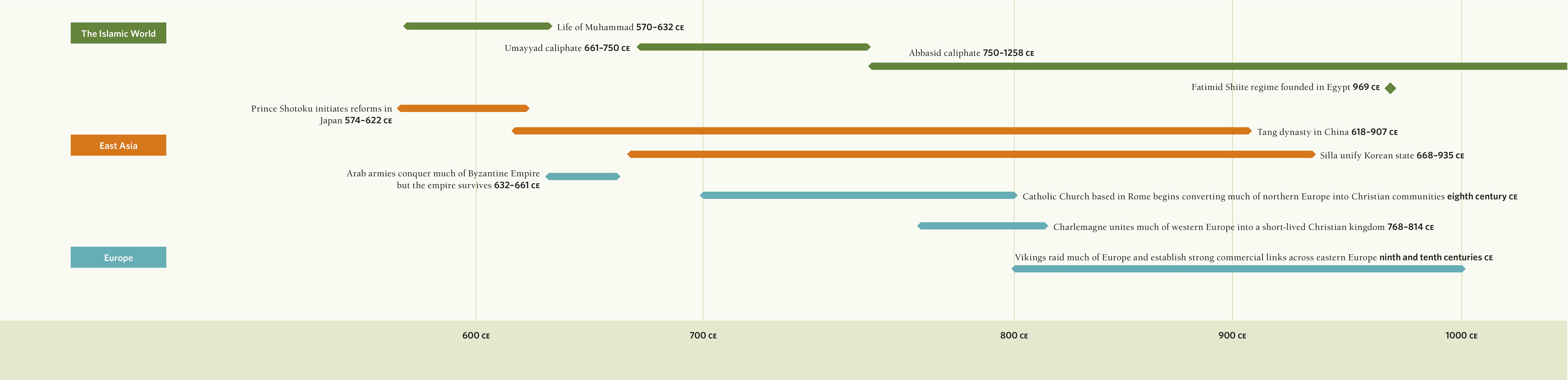
CHRONOLOGY
Glossary
- five pillars of Islam
- Five practices that unite all Muslims: (1) proclaiming that “there is no God but God and Muhammad is His Prophet”; (2) praying five times a day; (3) fasting during the daylight hours of the holy month of Ramadan; (4) traveling on pilgrimage to Mecca; and (5) paying alms to support the poor.
- caliphate
- Islamic state, headed by a caliph—chosen either by election from the community (Sunni) or from the lineage of Muhammad (Shiite)—with political authority over the Muslim community.
- sharia
- Sunnis
- Majority sect within modern Islam that follows a line of political succession from Muhammad, through the first four caliphs (Abu Bakr, Umar, Uthman, and Ali), to the Umayyads and beyond, with caliphs chosen by election from the umma (not from Muhammad’s direct lineage).
- Shiites
- Minority tradition within modern Islam that traces political succession through the lineage of Muhammad and breaks with Sunni understandings of succession at the death of Ali (cousin and son-in-law of Muhammad and fourth caliph) in 661 CE.
- civil service examinations
- Set of challenging exams instituted by the Tang to help assess potential bureaucrats’ literary skill and knowledge of the Confucian classics.
- eunuchs
- Surgically castrated men who rose to high levels of military, political, and personal power in several empires (for instance, the Tang and the Ming Empires in China; the Abbasid and Ottoman Empires; and the Byzantine Empire).
- monasticism
- From the Greek word monos (meaning “alone”), the practice of living without the ties of marriage or family, forsaking earthly luxuries for a life of prayer and study. While Christian monasticism originated in Egypt, a variant of ascetic life had long been practiced in Buddhism.
- Vikings
- Warrior group from Scandinavia that used its fighting skills and sophisticated ships to raid and trade deep into eastern Europe, southward into the Mediterranean, and westward to Iceland, Greenland, and North America.
- Greek Orthodoxy
- Branch of eastern Christianity, originally centered in Constantinople, that emphasizes the role of Jesus in helping humans achieve union with God.
- Roman Catholicism
- Western European Christianity, centered on the papacy in Rome, that emphasizes the atoning power of Jesus’s death and aims to expand as far as possible.