The Black Death
Collapse and Consolidation
Although the Mongol invasions overturned the political systems that they encountered, the plague devastated society itself. The pandemic killed millions, disrupted economies, and threw communities into chaos. Rulers could explain to their people the assaults of “barbarians,” but it was much harder to make sense of an invisible enemy. Many concluded that mass death was God’s wish and humankind’s punishment. However, the upheaval gave surviving rulers and their regimes the opportunity to consolidate power by making dynastic matches through marriage, establishing new armies and taxes, and creating new systems to administer their states.
The Black Death
The spread of the Black Death was the fourteenth century’s most significant historical development. (See Map 11.1.) Originating in Inner Asia, the disease combined bubonic, pneumonic, and septicemic plague strains, and it caused a staggering loss of life. Death rates ranged from 25 to 65 percent among infected populations.
How did the Black Death spread so far? One explanation may lie in climate changes. A cooler climate—what scholars refer to as a “Little Ice Age”—may have weakened populations and left them vulnerable to disease. In Europe, for instance, beginning around 1310, harsh winters and rainy summers shortened the growing season and ruined harvests. Exhausted soils could no longer supply the crops that expanding urban and rural populations required; at the same time, nobles squeezed the peasantry in an effort to maintain their luxurious lifestyles. The ensuing European famine lasted from 1315 to 1322, during which time millions died, either of starvation or from diseases against which the malnourished population had little resistance. Climate change and famine had thus crippled populations on the eve of the Black Death. Climate change also spread drought across central Asia, where bubonic plague had lurked for centuries. So when steppe peoples migrated in search of new pastures and herds, they carried the germs with them and into more densely populated agricultural communities. Rats also joined the exodus from the arid lands and transmitted fleas to other rodents, which carried the disease to humans.
The main conduit for the spread of pathogens across Eurasia was its vast trading network. The first outbreak in a heavily populated region occurred in southwestern China during the 1320s. From there, the disease spread through China and then took its death march westward along the major trade routes. The main path of transmission was across central Asia to the Crimea and the Black Sea and from there by ship to the Mediterranean Sea and the Italian city-states. Secondary routes were also by sea: one from China to the Red Sea, and another across the Indian Ocean, through the Persian Gulf, and into the Fertile Crescent and what is now Iraq. All routes terminated at the Italian port cities, where ships with dead and dying men aboard arrived in 1347. From there, what Europeans called the Pestilence or the Great Mortality engulfed the western end of the landmass.
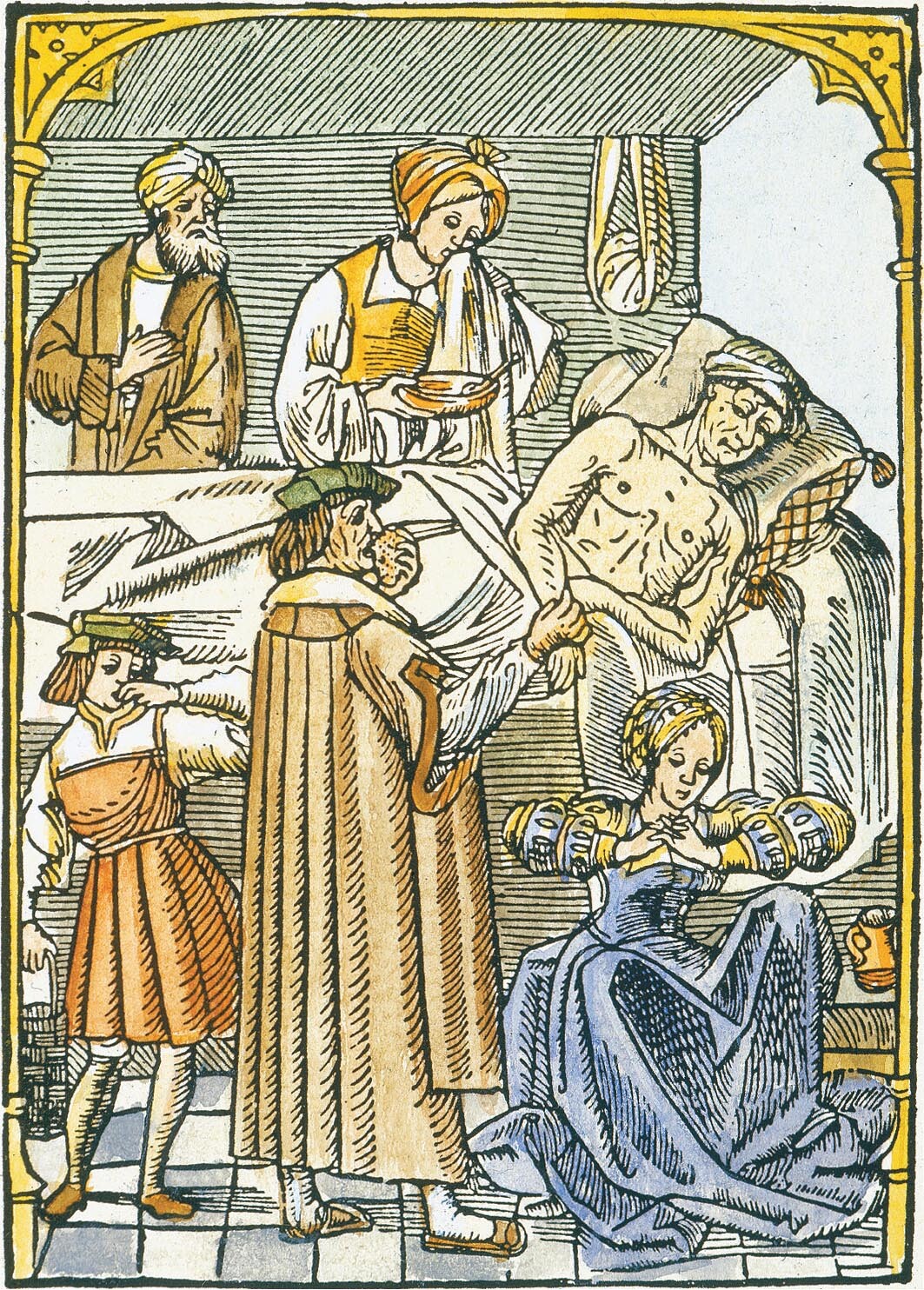
More information
A painting of a person with the plague in bed. There are several people around him holding their noses. The patient is shirtless and looks gaunt. A physician wearing long robes holds an object up to his nose with one hand and holds the wrist of the patient with the other. A child wearing a dress, holding a bucket, and covering her nose stands to his left. A woman wearing a dress and interlacing her fingers in front of her sits to his left. On the other side of the bed a woman holds a cloth to her nose with one hand and holds a bowl in the other. A bearded man wearing a turban stands to her left. A loop of fabric hangs from the ceiling above the patient.
The Black Death struck heavily populated and highly integrated societies that were vulnerable to this virulent disease because their members had no immunity to it. Rodents, mainly rats, carried the plague bacilli that caused the disease. Fleas transmitted the bacilli from rodent to rodent, as well as to humans. The epidemic was terrifying, simply because its causes were unknown. Infected victims died quickly—sometimes overnight—and in great agony, coughing up blood and oozing pus and blood from ugly black sores the size of eggs. Some European sages attributed the ravaging of their societies to an unusual alignment of Saturn, Jupiter, and Mars. Many believed that God was angry with humanity. One Florentine historian compared the plague to the biblical flood and believed that the end of humankind was imminent. Everywhere across Eurasia where there was plague, people of all classes had no explanation for the death and disease; in fact, they often acted in ways that would have been considered reprehensible or outrageous in more normal times.
PLAGUE IN CHINA China was ripe for the pandemic. Its population had significantly increased under the Song dynasty (960–1279) and subsequent Mongol rule. But by 1300, hunger and scarcity spread as needed resources stretched thin. This weakened population was especially vulnerable to disease. For seventy years, the Black Death ravaged China, shattering the Mongol rulers’ claim to a mandate from heaven. In 1331, plague may have killed 90 percent of the population in Bei Zhili (modern Hebei) Province. From there it spread through other provinces, reaching Fujian and the coast at Shandong. By the 1350s, most of China’s large cities had already suffered through severe outbreaks.
The reign of the last Yuan Mongol rulers was thus a time of utter chaos. Even as the Black Death was engulfing large parts of China, bandit groups and dissident religious sects undercut the state’s power. As in other areas devastated by the plague, popular religious movements foretold impending doom. Most prominent was the Red Turban movement, which took its name from its soldiers’ red headbands. This movement blended China’s diverse cultural and religious traditions, including Buddhism, Daoism, and other faiths. Its leaders emphasized strict dietary restrictions, penance, and ceremonial rituals in which the sexes freely mixed, while making proclamations that the world was drawing to its end.
PLAGUE IN NORTH AFRICA AND THE EASTERN MEDITERRANEAN The plague also devastated parts of the Muslim world, including places in North Africa. The Black Death reached Baghdad by 1347. By the next year, plague had overtaken Egypt, Syria, and Cyprus; one report from Tunis recorded the death of more than 1,000 people a day in that North African city. (See Global Themes and Sources: Primary Sources 11.1, 11.3, and 11.4.) Animals, too, were afflicted. One Egyptian writer commented: “The country was not far from being ruined. . . . One found in the desert the bodies of savage animals with the bubos under their arms. It was the same with horses, camels, asses, and all the beasts in general, including birds, even the ostriches” (Dols, p. 156). In the eastern Mediterranean, plague left many polities close to political and economic collapse. The great Arab historian Ibn Khaldûn (1332–1406), who lost his mother and father and a number of his teachers to the Black Death in Tunis, underscored the sense of desolation. “Cities and buildings were laid waste, roads and way signs were obliterated, settlements and mansions became empty, dynasties and tribes grew weak,” he wrote. “The entire world changed” (Dols, p. 67).
The Global View
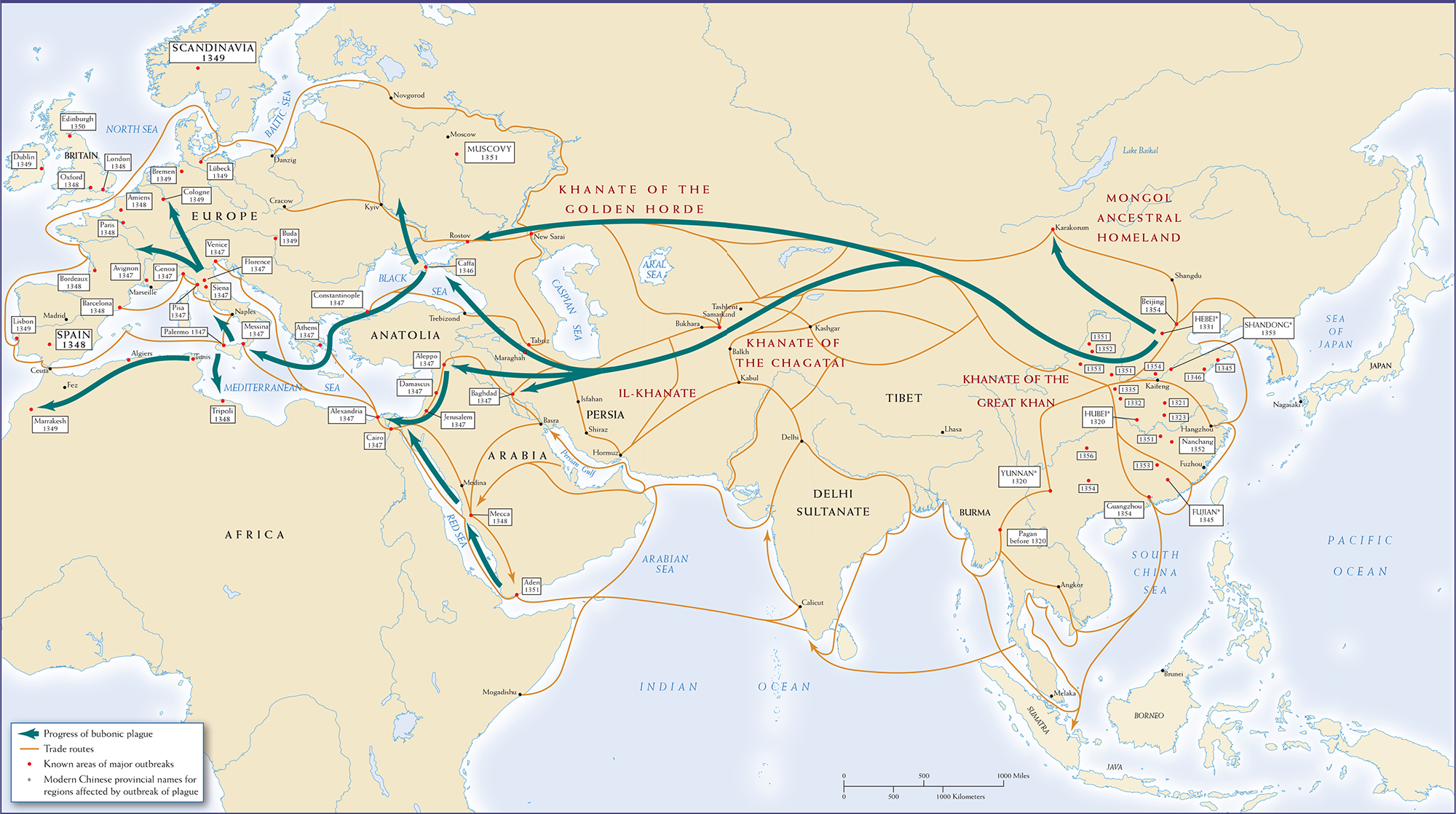
More information
Map 11.1 is titled The Spread of the Black Death. The map shows trade routes, progress of the bubonic plague, known areas of major outbreaks, and modern Chinese provincial names for regions affected by outbreak of plague. Trade routes run in many directions through the Khanate of the Great Khan, Delhi Sultanate, Il-Khanate, Khanate of the Golden Horde, Arabia, and Europe, and the plague followed many of these same routes. The plague started in Pagan before 1320. From there it spread to Yunnan in 1320, Hubei in 1320, Hebei in 1331, Fuhan in 1345 and through most of the Khanate of Great Khan from 1320 to 1350. It then spread north to the Mongol ancestral homeland and the city Karakorum. It also spread west via the Silk Road to the Khanate of Chatagai. It then went north through the Khanate of the Golden Horde to New Sarai and Rostov. It also went south from the Golden Horde through Samarkand to Baghdad in 1347, as well as north to Tabriz and Caffa on the Black Sea in 1346. It also went to Aleppo, Damascus, Jerusalem, Cairo, and Alexandria in 1347. It also reached Mecca in 1348 and Aden in 1351. From Caffa, the plague moved north towards Muscovy in 1351. It also went south to Constantinople, Athens, and then Messina in Italy in 1347. From there it went south to Tripoli in 1348 and Tunis, Algiers, and Marrakesh in 1349. The plague also moved north to Siena, Florence, Pisa, Genoa, Venice, and Avignon in 1347. Bordeaux, Paris, Amiens, London, Oxford, and Barcelona had outbreaks in 1348. Lisbon, Dublin, Cologne, Bremen, Lubeck, Buda, and Scandinavia had outbreaks in 1349.
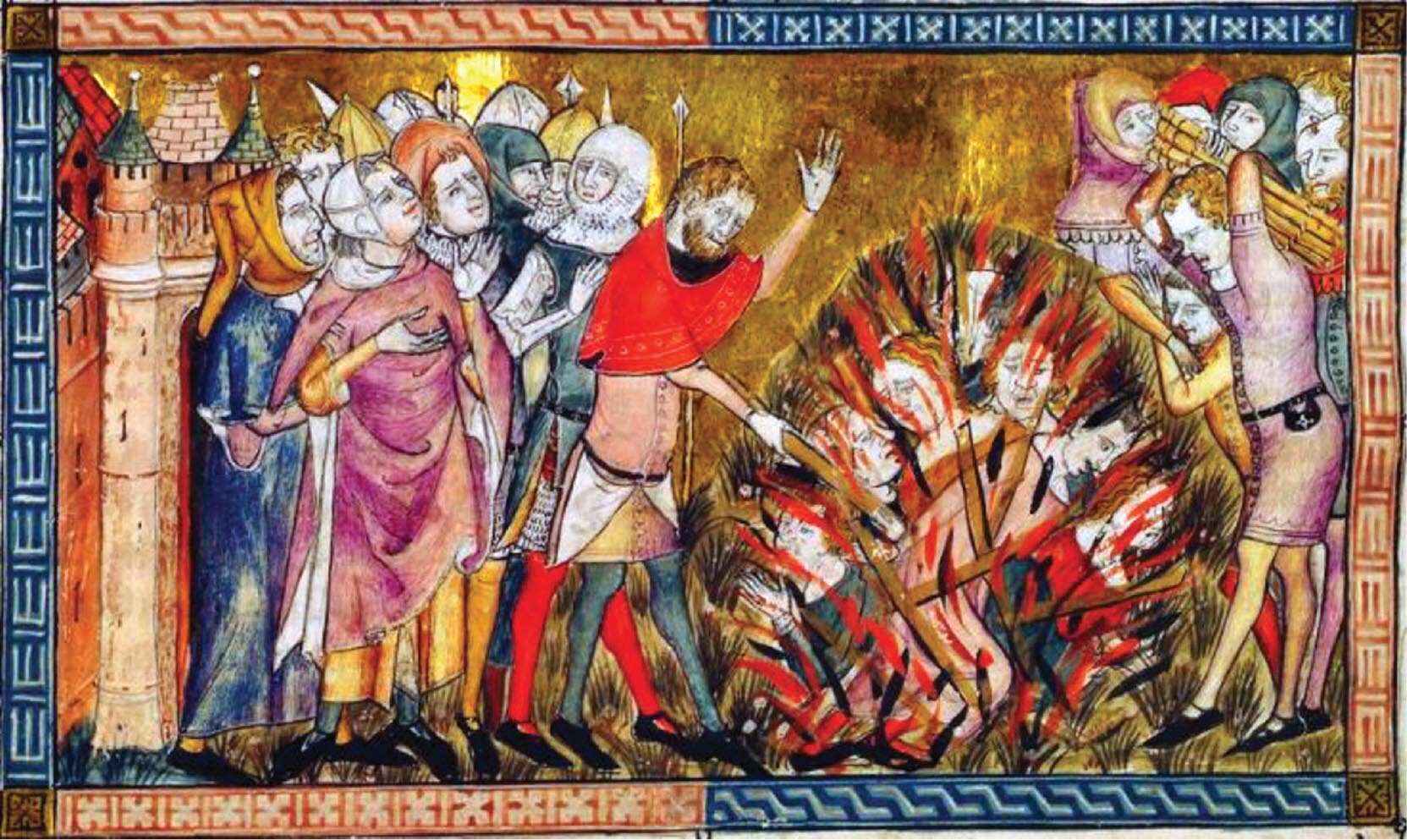
More information
A painting on a manuscript page shows a group of people watching a pile of burning dead bodies. Some of them hold spears. One person holds a flaming torch to the pile and another holds a bundle of wood above their head. Part of a castle is visible behind the group of people on the left side of the painting. There is a decorative border around the painting.
PLAGUE IN EUROPE In Europe, the Black Death made landfall on the Italian Peninsula; then it seized France, the Low Countries (present-day Netherlands, Belgium, and Luxembourg), the Holy Roman Empire, and Britain. The overcrowded and unsanitary cities were particularly vulnerable. Bremen lost at least 8,000 souls, perhaps two-thirds of its population; Hamburg, another port city, at least as many. Most at risk were the poor who slept in crowded quarters. But master bakers, bankers, and aristocrats died too, unless they were able to flee to the relatively safer countryside in time to escape infection. No one had seen dying on such a scale. (See Global Themes and Sources: Primary Source 11.2.) Nearly two-thirds of Europe’s total population perished between 1346 and 1353.
After 1353, the epidemic subsided, having killed those with no natural immunity and most of the original carriers of the disease, the European black rat. But the plague would return every seven years or so for the rest of the century, as well as sporadically through the entire fifteenth century, killing the young and those who had managed to escape exposure in the first epidemic. The European population continued its decline, until by 1450 many areas had only one-quarter the number of people that they did a century earlier. It took three centuries for the population to return to levels that existed before the Black Death arrived.
Disaster on this scale had enduring psychological, social, economic, and political effects. Many individuals turned to pleasure, even debauchery, determined to enjoy themselves before it became their turn to die. Some incorrectly blamed Jews for unleashing the plague, even though Jews died in numbers equal to those of Christians. Others, believing the church had lost God’s favor, sought consolation in more individualized forms of piety, such as extreme fasting or worshipping in private chapels. The Flagellants were so sure that humanity had incurred God’s wrath that they whipped themselves to atone for human sin. They also bullied communities that they visited, demanding to be housed, clothed, and fed. A new intensity of private Christian piety, exhibited by figures such as Catherine of Siena, who was widely admired for punishing her body to purify her soul, characterized the period.
The Black Death wrought devastation throughout Afro-Eurasia. The Chinese population plunged from 115 million in 1200 to 75 million or less in 1400, the result of the Mongol invasions of the thirteenth century and the disease and disorder of the fourteenth. (See Analyzing Global Developments: Population Changes in Fourteenth-Century Eurasia.) Over the course of the fourteenth century, Europe’s population shrank by more than 50 percent. In the most densely settled Islamic territory—Egypt, located on the African continent—a population that had totaled around 6 million in 1400 was reduced by half.
When farmers fell ill with the plague or died from it, food production collapsed. Famines resulted, which starved survivors to death. Worst afflicted were the coastal cities, especially their ports. Refugees from urban areas fled their homes, seeking security and food in the countryside. Moreover, the shortages of food led to rapidly rising prices, hoarding, work stoppages, and unrest. Political leaders added to their unpopularity by repressing demands for change. Regimes collapsed everywhere. The Mongol Empire, which had held so much of Eurasia together commercially and politically, collapsed under the weight. As a result, the region was ready for experiments in state building, religious beliefs, and cultural achievements.
Analyzing Global Developments 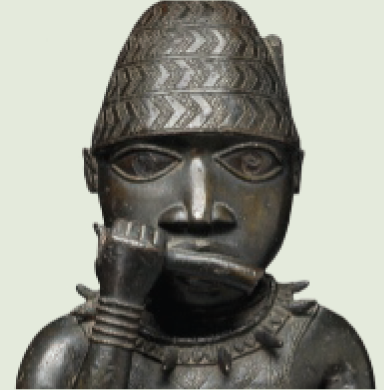
More information
A statue of a person playing a pipe with one hand. Only the head and upper torso are visible. The person wears a patterned headdress and shirt or tunic with a spiked collar.
Population Changes in Fourteenth-Century Eurasia
Famine, warfare, and disease led to vast population declines all across fourteenth-century Eurasia. The Mongols were instrumental players in spreading disease across the landmass, starting in China and moving westward along land- and sea-based trading routes toward the Mediterranean World and ultimately into northern Europe. (See Map 11.1.) While the effects of these destructive forces were felt across the Eurasian landmass, some states and regions were less affected than others. The population data in the table come from the best historical studies of the last forty years and are based on painstaking archival research. They serve as one of the best ways for us to gain historical insight into this tumultuous century.
|
Location |
Earlier Population Figures |
Later Population Figures |
Percent Change |
|
By Region |
|||
|
Europe |
80 ma in 1346 |
30 m in 1353 |
−60% |
|
Asia |
230 m in 1300 |
235 m in 1400 |
+2% |
|
By Country |
|||
|
Spain |
6 m in 1346 |
2.5 m in 1353 |
−60% |
|
Italy |
10 m in 1346 |
4.5 m in 1363 |
−55% |
|
France |
18 m in 1346 |
7.2 m in 1353 |
−60% |
|
England |
6 m in 1346 |
2.25 m in 1353 |
−62.5% |
|
China |
115 m in 1200 |
75 m in 1400 |
−35% |
|
Japan |
9.75 m in 1300 |
12.5 m in 1400 |
+28% |
|
Korea |
3 m in 1300 |
3.5 m in 1400 |
+17% |
|
India |
91 m in 1300 |
97 m in 1400 |
+6.5% |
|
By City |
|||
|
London |
100,000 in 1346 |
37,000 in 1353 |
−62.5% |
|
Florence |
92,000 in 1346 |
37,250 in 1353 |
−59.5% |
|
Siena |
50,000 in 1346 |
20,000 in 1353 |
−60% |
|
Bologna |
50,000 in 1346 |
27,500 in 1353 |
−45% |
|
Cairo |
400,000 in 1300 |
350,000 in 1350 |
−12.5% |
|
Damascus |
80,000 in 1300 |
50,000 in 1400 |
−37% |
|
Constantinople |
150,000 in 1300 |
80,000 in 1350 |
−47% |
QUESTIONS FOR ANALYSIS
- In what regions or cities does population loss seem to have been lower? Higher? What might account for those variations in the death rate?
- How do the losses in urban areas compare with the losses in the region where those urban areas are located? What might that comparison suggest about the impact of fourteenth-century disasters on urban versus other populations?
- Why do you think the population decline was more severe and widespread in Europe than in Asia?
- In what ways was the great loss of population in Europe and China a turning point in their histories?
Sources: Ole J. Benedictow, The Black Death, 1346–1353: The Complete History (Woodbridge, England: Boydell Press, 2004); Michael Walter Dols, The Black Death in the Middle East (Princeton, NJ: Princeton University Press, 1977); Colin McEvedy and Richard E. Jones, Atlas of World Population History (Hammondsworth, England: Penguin, 1978); Ping-ti Ho, Studies on the Population of China, 1368–1953 (Cambridge, MA: Harvard University Press, 1959).
Rebuilding States
“Good Laws and Good Arms”
Starting in the late fourteenth century, residents of connected societies in Afro-Eurasia began the task of reconstructing both their political orders and their trading networks. (By then the plague had subsided, though it continued to afflict humans for centuries.) The rebuilding of military and civil administrations—no easy task—also required political legitimacy. Rulers needed to revive confidence in themselves and their political systems, which they did by fostering beliefs and rituals that confirmed their rights to rule, while increasing their control over their subjects.
The form that power took in most places was a political institution well known for centuries: the dynasty, a ruling family that passed control from one generation to the next. Like those of the past, new dynasties sought to establish their legitimacy in three ways. First, ruling families insisted that their power derived from a divine calling: Ming emperors in China claimed for themselves what previous dynasts had asserted—the “mandate of heaven”—while European monarchs claimed to rule by “divine right.” From their base in Anatolia, Ottoman warrior-princes asserted that they now carried the banner of Islam. In these ways, ruling households affirmed that God or the heavens intended for them to hold power. The new Safavid regime on the Iranian plateau embraced a Shiite form of governance. Second, leaders squelched squabbling among potential heirs by establishing clear rules about succession to the throne. Many European states tried to standardize succession by passing titles to the eldest male heir, but in practice there were countless complications and quarrels. In Islamic states, successors could be designated by the incumbent or elected by the community; here, too, struggles over succession were frequent. Third, ruling families elevated their power through conquest or alliance—by ordering armies to forcibly extend their domains or by marrying their royal offspring to rulers of other states or members of other elite households. Once it established legitimacy, the typical royal family would consolidate power by enacting coercive laws and punishments and sending emissaries to govern far-flung territories. It would also establish standing armies and new administrative structures to collect taxes and to oversee building projects that proclaimed royal power.
As we will see in the remainder of this chapter, the innovative state building that followed the plague’s devastating wake would not have been as successful had it not drawn on older traditions. In Europe, a cultural flourishing based largely on ancient Greek and Roman models gave rise to thinkers who proposed novel views of governance. The peoples of the Islamic world held fiercely to their religion as two successor states—the Ottoman Empire and the Safavid state—absorbed numerous Turkish-speaking groups. A third Islamic state—the Mughal Empire—drew on local traditions of religious and cultural tolerance as its rulers built a new regime in the Indian cultural area on top of the foundations of the weakened Delhi Sultanate (see Chapter 10). The Ming, having failed in their attempts to control northern Vietnam and Korea, renounced the expansionist Mongol legacy and emphasized a return to Han rulership, consolidating control of Chinese lands and concentrating on internal markets rather than overseas trade. Many of these regimes lasted for centuries, long enough to set deep roots for political institutions and cultural values that molded societies long after the Black Death.
Glossary
- Black Death
- Plague pandemic that ravaged Europe, East Asia, and North Africa in the fourteenth century, killing large numbers of people, including perhaps as much as two-thirds of the European population.
- Red Turban movement
- Diverse religious movement in China during the fourteenth century that spread the belief that the world was drawing to an end as Mongol rule was collapsing.
- dynasty
- Hereditary ruling family that passed control from one generation to the next.
Endnotes
- m = millions.Return to reference a