The Ottoman Empire
The Islamic World
The devastation of the Black Death followed hard on the heels of the Mongol destruction of Islam’s most important city, Baghdad (see Chapter 10). The double shock of conquest and disease shattered whatever was left of Islamic unity and cleared the way for new Islamic states to emerge. Contrast this fractured recovery with Chinese integrated recovery. Although the Arabic-speaking peoples remained vital in Islam’s geographic heartland, they now had to cede authority to Persian and Turkish political leaders as Islamic influences spread outwards. Persians and Turks had embraced Islam and had made their cultural, intellectual, and military influence felt well before the Mongol invasions and the Black Death. The implosion of the Abbasid caliphate in Baghdad made way for powerful, more militarized, expansionist successors capable of extending Islam’s reach into Christian heartlands in the west and the Indian cultural area to the east.
The recovery from conquest and disease was slow. Eventually, the Ottomans, the Safavids, and the Mughals would emerge as the dominant states in the Islamic world in the early sixteenth century. They exploited the rich agrarian resources of the Indian Ocean regions and the Mediterranean Sea basin, and they benefited from brisk seaborne and overland trades. By the mid-sixteenth century, the Mughals controlled the northern Indus River valley; the Safavids occupied Persia; and the Ottomans ruled Anatolia, the Arab world, and much of southern and eastern Europe.
Despite sharing core religious beliefs, each empire had unique political features. The most powerful, the Ottoman Empire, occupied the pivotal area between Europe and Asia. The Ottomans embraced a Sunni view of Islam, while absorbing and adapting traditional Byzantine ways of governance. One of the signatures of the Ottomans’ success was their hybrid approach to ruling diverse peoples and incorporating sprawling territories. By contrast, the Safavids, adherents of the Shiite vision of Islam, were ardently devoted to the pre-Islamic traditions of Persia (present-day Iran). But unlike the Ottoman rulers, the Safavid rulers were less effective at expanding beyond their Persian base. The Mughals ruled over the wealthy but divided realm that is much of today’s Indian subcontinent; here they carried even further the region’s religious and political traditions of assimilating Islamic and pre-Islamic Indian ways. Their wealth and their domain’s lack of centralization made the Mughals constant targets for internal dissent and eventually for external aggression.
The Ottoman Empire
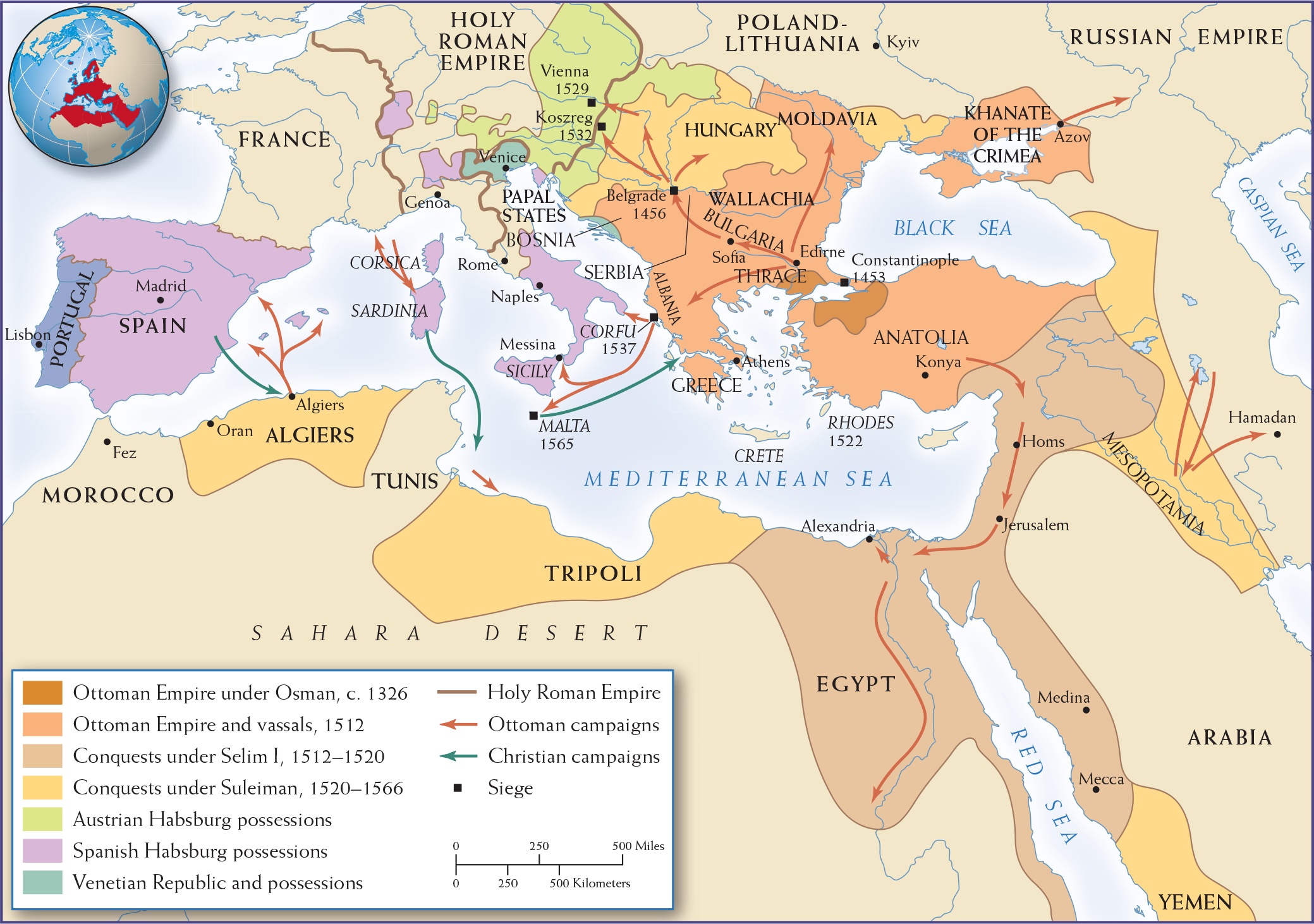
The rise of the Ottoman Empire owed as much to innovative administrative techniques and religious tolerance as it did to military strength. Although the Mongols considered Anatolia to be a borderland region of little economic importance, their military forays against the Anatolian Seljuk Turkish state in the late thirteenth century brought political turmoil, bordering on chaos, but opened up the region to new political forces. The ultimate victors here were the Ottoman Turks. They transformed themselves from warrior bands, roaming the borderlands between Islamic states to the east and Christian worlds to the west, into rulers of a settled state and, eventually, into sovereigns of a far-flung, highly bureaucratic empire. (See Map 11.2.)
Many modern western-trained historians have portrayed the early Ottoman state as a plundering regime, engaged in rape and slaughter and carrying out campaigns of massive devastation by galvanizing its zealous warriors to terrorize local populations. The Ottomans did indeed have stern and disciplined warriors, known as ghazis, whose commitment to Islam and its leaders was boundless. Even so, what enabled the Ottoman leaders to triumph in a region of widespread disorder was their ability to form alliances with previously hostile—and divergent—ethnic and religious communities. Their first chief, Osman (r. 1299–1326), and his son Orhan (r. 1326–1362) were Sunni Muslims. But they were adept at working with those who held different religious beliefs, such as Byzantine leaders, Kurds, Sufi dervish orders, and Shiites. By constructing eclectic political institutions possessing enormous elasticity, they succeeded not only in offering toleration to religiously and culturally diverse populations but also in providing opportunities for those populations to exercise power and gain wealth. The Ottomans created a hybrid state, which welcomed Christian supporters as fervently as it did Muslims. Hence, the Ottomans prevailed over other Turkic competitors and transformed what was a small principality in northwestern Anatolia during the fourteenth century into the hub of a preeminent state in Anatolia. The principal characteristics of the early Ottoman state were inclusivity, resilience, and syncretism. The Ottomans also took advantage of existing divisions among rivals. As Byzantine leaders feuded, Ottoman forces besieged the city of Bursa, capturing it in 1326. The Ottomans thus achieved a victory that marked their ascendancy in Anatolia. They now threatened the existence of the once powerful, now hobbled Byzantine Empire. Other Turkic warrior bands, which like the Ottomans lived off the land and fought for booty under charismatic military leaders, ultimately failed in their quest for power because they had little regard for other groups such as artisans, merchants, bureaucrats, and clerics, whose support was essential in the Ottoman rise.
More information
Map 11.2 is titled The Ottoman Empire, 1300-1566. The map shows the Ottoman Empire under Osman circa 1326, as well as its spread under subsequent rulers, the Holy Roman Empire, Austrian Hapsburg possessions, Spanish Hapsburg possessions, the Venetian Republic and possessions, Ottoman campaigns, Christian campaigns, battles, and sieges. Other countries labeled on the map include the Russian Empire, Poland-Lithuania, France, Spain, Portugal, Morocco, Tunis, Egypt, and Arabia. The Ottoman Empire under Osman around 1326 includes Thrace, Gallipoli, and Bursa where there was a battle in 1326. The Ottoman Empire and vassals in 1512 include Khanate of the Crimea Moldavia, Wallachia, Bulgaria, Albania, Greece, and Anatolia. Cities and battles in this area include Azov, Caffa with a battle in 1475, Argesh with a battle, Nicopolis with a battle, Sofia, Belgrade with a battle, Kosovo with a battle in 1389, Edirne, Istanbul which had a siege and battle in 1453, Athens, Konya, and Ankara with a battle in 1402. There are Ottoman campaigns from Edirne up to Moldavia, down through Albania, and to Sofia and Belgrade. Conquests under Selim I from 1512 to 1520 include a siege that follows Aleppo in 1516, Homs, Damascus in 1516, Jerusalem, Cairo in 1517, Alexandria, and most of Egypt. The area also includes Medina and Mecca. Conquests under Suleiman from 1520 to 1566 include Hungary with battles in Mohacas and Buda. There is an Ottoman campaign that goes through Hungary and into Vienna in 1529 and Koszerg in 1532. These conquests also include Mesopotamia with a battle in Baghdad 1534 and Basra. There is a siege to Tabriz, and Hamadan from Baghdad. They also include Tripoli with a battle in 1551 and the city of Djebar with a battle in 1560 and Algiers with the city of Oran and Algiers. There was an Ottoman campaign from Algiers to Spain and a Christian campaign from Spain to Algiers, as well as from Malta to Greece and Sardinia to Tunis. The Austrian Hapsburgs possessions include part of the Holy Roman Empire and the cities of Vienna and Koszreg. The Spanish Hapsburg possessions include Spain, Sardinia, Corsica, Sicily, southern Italy, and parts of the Holy Roman Empire. This includes the cities Madrid and Naples. The Venetian Republic and possessions include Venice and some land in Bosnia.
MAP 11.2 | The Ottoman Empire, 1300–1566
This map charts the expansion of the Ottoman state from the time of its founder, Osman, through the reign of Suleiman, the empire’s most illustrious ruler.
- Where did the Ottoman Empire originate under Osman? Into what regions did the Ottomans expand between the years 1326 and 1566?
- What were the geographic limits of the Ottoman Empire?
- What governments were able to resist Ottoman expansion?
THE CONQUEST OF CONSTANTINOPLE The Ottoman Empire’s spectacular territorial expansion into Europe and eventually the Arab world was at heart a military affair. To recruit followers, the Ottomans promised wealth and glory to their new subjects. This was an expensive undertaking, but territorial expansion generated financial and administrative rewards. Moreover, by spreading lucrative administrative positions and the spoils of conquest, rulers bought off potentially discontented subordinates who might challenge them. Still, without great military strength, the Ottomans would not have enjoyed the successes associated with the brilliant reigns of Murad II (r. 1421–1451) and his aptly named successor, Mehmed the Conqueror (r. 1451–1481).
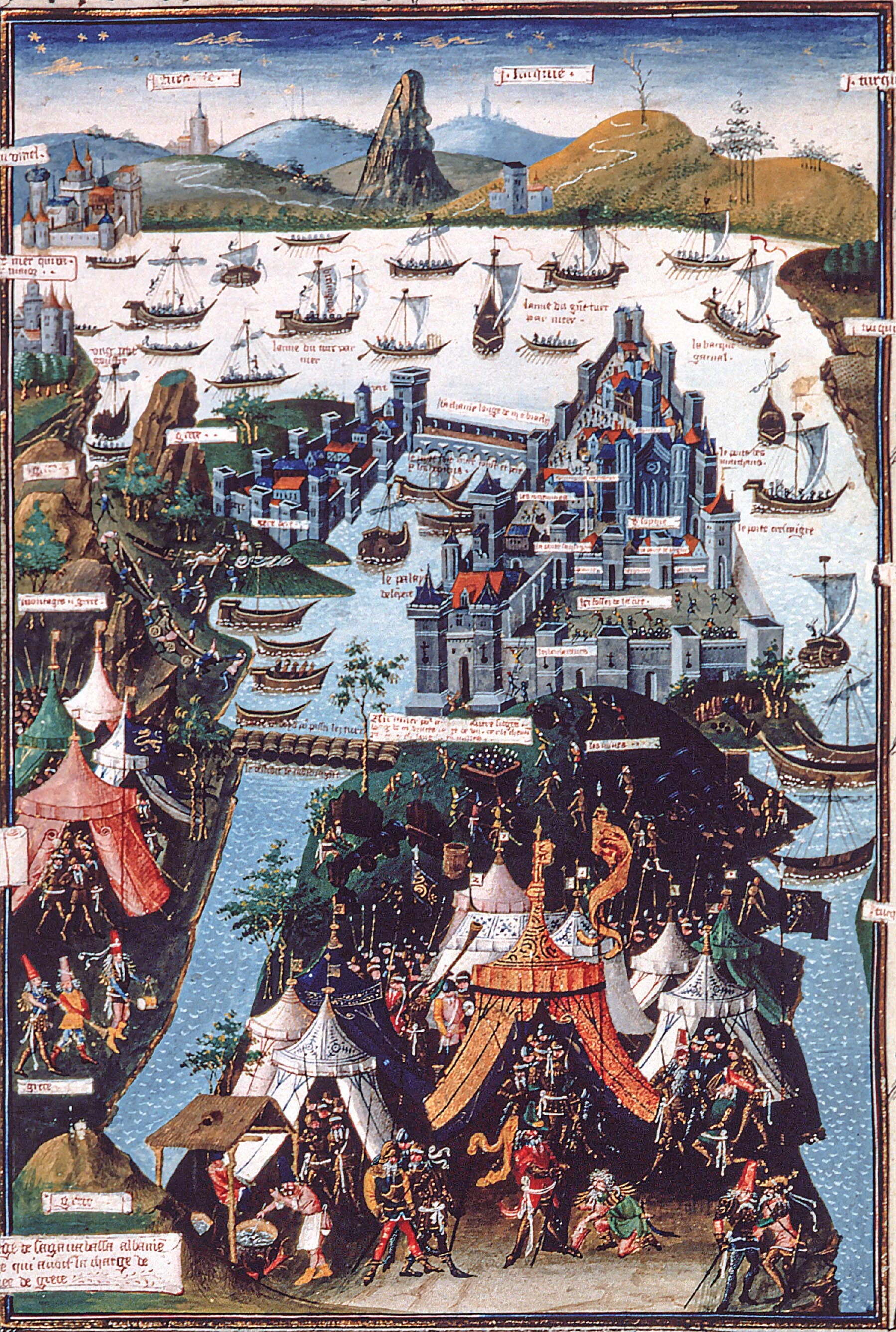
Mehmed’s most stunning triumph was the conquest of Constantinople, an ambition for Muslim rulers ever since the birth of Islam. Mehmed left no doubt that this was his primary goal. Indeed, shortly after his coronation, he vowed to capture the capital of the Byzantine Empire, a city of immense strategic and commercial importance. He exclaimed early in his reign that Constantinople was “an island in the midst of an Ottoman ocean.” His desire to take the city “never left his tongue” (Faroqhi, p. 23). Mehmed knew this feat required a large and well-armed fighting force; the heavily fortified city had kept Muslim attacks at bay for almost a century. First, he built a fortress of his own, on the European bank of the Bosporus Strait, at its narrowest point, to prevent European vessels from reaching the capital. Then, by promising his soldiers free access to booty and portraying the city’s conquest as a holy cause, he amassed a huge army that outnumbered the defending force of 7,000 by more than tenfold. For fifty-three days his troops bombarded Constantinople’s massive walls with artillery that included enormous cannons built by Hungarian and Italian engineers. On May 29, 1453, Ottoman troops overwhelmed the surviving soldiers and took the ancient Roman and Christian capital of Byzantium—which Mehmed promptly renamed Istanbul.
Although Christians generally portrayed the “fall” of Constantinople as a calamity, in fact the Muslim conquest brought benefits to western Europe. Many Christian survivors fled to ports in the west, bringing with them classical and Arabic manuscripts previously unknown in Europe. The well-educated, Greek-speaking émigrés generally became teachers and translators, thereby helping to revive Europeans’ interest in antiquity and spreading knowledge of ancient Greek (which had virtually died out in the Middle Ages). These manuscripts and teachers would play a vital role in Europe’s Renaissance. Once the Ottomans consolidated their place in the eastern Mediterranean, sea trading, especially with the Italian city-states, also bounced back.
THE TOOLS OF EMPIRE BUILDING Mehmed made Istanbul the Ottoman capital, adopting Byzantine administrative practices to unify his enlarged state and incorporating many of Byzantium’s powerful families into it. From Istanbul, Mehmed and his successors would continue their westward expansion, eventually seizing all of Greece and the Balkan region. As a result, Ottoman navies increasingly controlled sea-lanes in the eastern Mediterranean, curtailing European access to the rich ports that handled the lucrative caravan trade. By the late fifteenth century, Ottoman forces menaced another of Christendom’s great capitals, Vienna, and European merchants feared that never again would they obtain the riches of Asia via the traditional overland route, now under Ottoman control. Ottoman expansion would continue apace, even into the sixteenth century, which is most associated with the Empire’s growth.
Having penetrated the heartland of Christian Byzantium, the Ottomans, under Selim (r. 1512–1520) and Suleiman (r. 1520–1566), turned their expansionist designs to the Arab world. Under Suleiman, the Ottomans reached the height of their territorial expansion. He personally led thirteen major military campaigns and many minor engagements. An exceptional commander, Suleiman was an equally gifted administrator. His subjects called him “the Lawgiver.” In the western part of the realm, he was known as “the Magnificent” in recognition of his attention to civil bureaucratic efficiency and justice for his people. His fame spread to Europe, where he was known as “the Great Turk.” The courts of Europe sent envoys and diplomats seeking alliances. The rebel German theologian Martin Luther saw Muslims as kindred in the fight against icons. Though he saw the “Turk” penetration into the heart of Europe as a threat, Luther also recognized that the Ottomans could cripple Habsburg and Catholic power and upend the papacy in Rome. Indeed, by dragging Catholic armies and navies into a protracted and costly war from Vienna to the Mediterranean, Suleiman later gave Protestant insurgents in Germany some breathing room. For a time, Istanbul was one of the globe’s powerhouse capitals. Under Suleiman’s administration, the Ottoman state ruled over 20 to 30 million people. By the time Suleiman died, the Ottoman Empire bridged Europe and the Arab world.
More information
A painting depicts the Turkish siege of Constantinople. An army with many tents is camped outside the gates of the city. The city is surrounded by walls and is shaped like a tall triangle with a smaller section on the left connected by a bridge. A harbor with many boats surrounds the sides and back of the city. There are hills in the background beyond the harbor and text scattered throughout the painting.
Ottoman dynastic power was not only military; it also rested on a firm religious foundation. The sultans combined a warrior ethos with an unwavering devotion to Islam. Describing themselves as the “shadow of God” on earth, they claimed to be caretakers for the welfare of the Islamic faith and assumed the role of protectors of the holy cities on the Arabian Peninsula and in Jerusalem after the conquests in the Arab world. They devoted substantial resources to the construction of elaborate mosques and the support of Islamic schools throughout the empire, and to the extension of the borders of Islam. Thus, the Islamic faith helped unite a diverse and sprawling imperial populace, with the sultan’s power fusing the sacred and the secular.
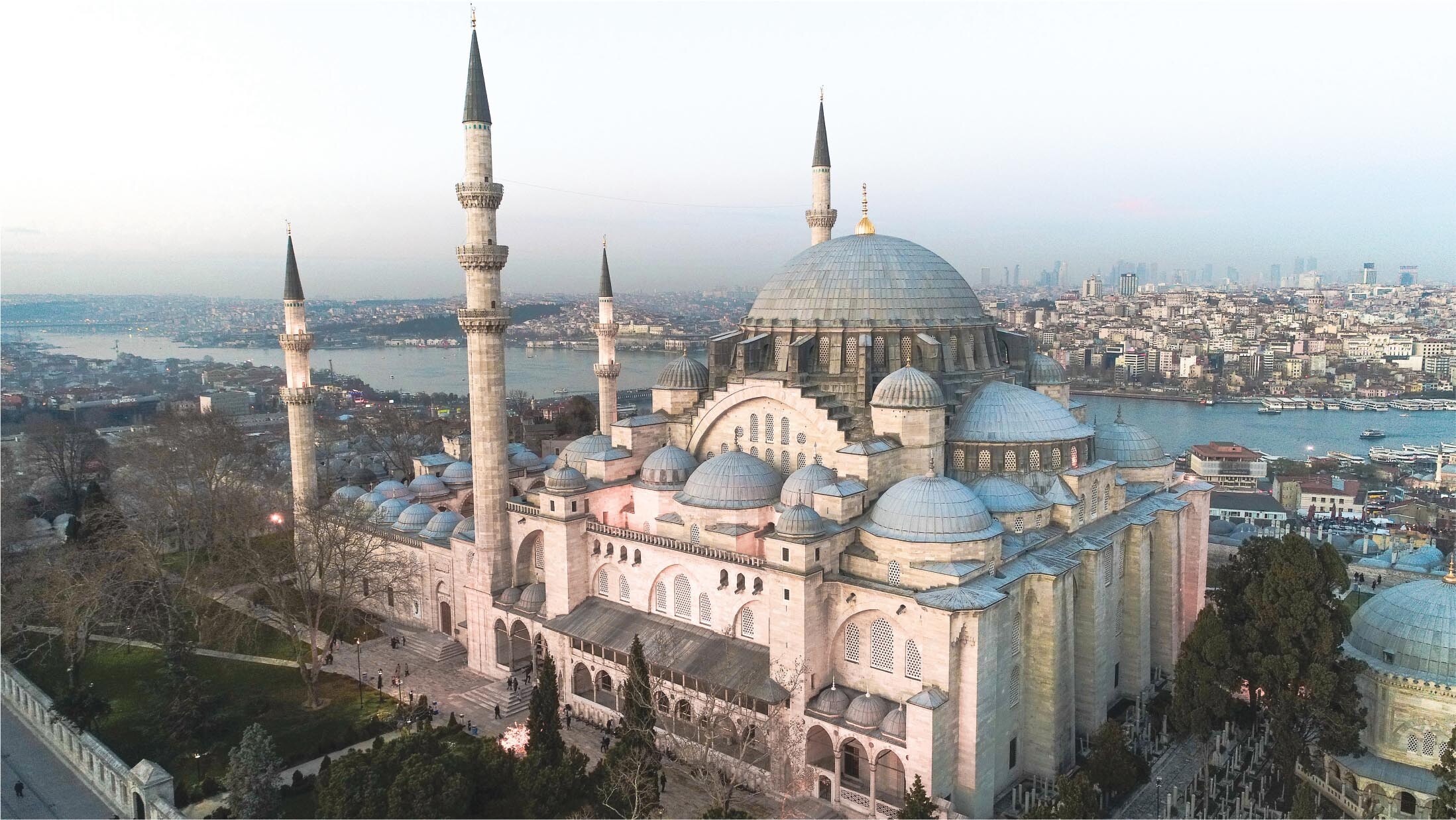
ISTANBUL AND THE TOPKAPI PALACE Istanbul reflected the splendor of this awesome empire. After the Ottoman conquest, the sultans’ engineers rebuilt the city’s crumbling walls, while their architects redesigned homes, public buildings, baths, inns, and marketplaces to display the majesty of Islam’s new imperial center. To crown his achievements, Suleiman ordered the construction of the Süleymaniye Mosque, which sat opposite Hagia Sophia. The latter, a domed Byzantine cathedral, was formerly the most sacred of Christian cathedrals, the largest house of worship in all of Christendom, but Suleiman had it turned into a mosque. Moreover, the Ottoman dynasts welcomed (indeed, forcibly transported) thousands of Muslims and non-Muslims to the city and revived Istanbul as a major trading center. Within twenty-five years of its conquest, its population more than tripled; by the end of the sixteenth century, 400,000 people regularly swarmed through its streets and knelt in its mosques, making it the world’s largest city outside China.
More information
An aerial view of Suleymaniye Mosque. It has one large central dome on top surrounded by many smaller domes. Four tall minarets tower over the mosque. A body of water and city can be seen in the background.
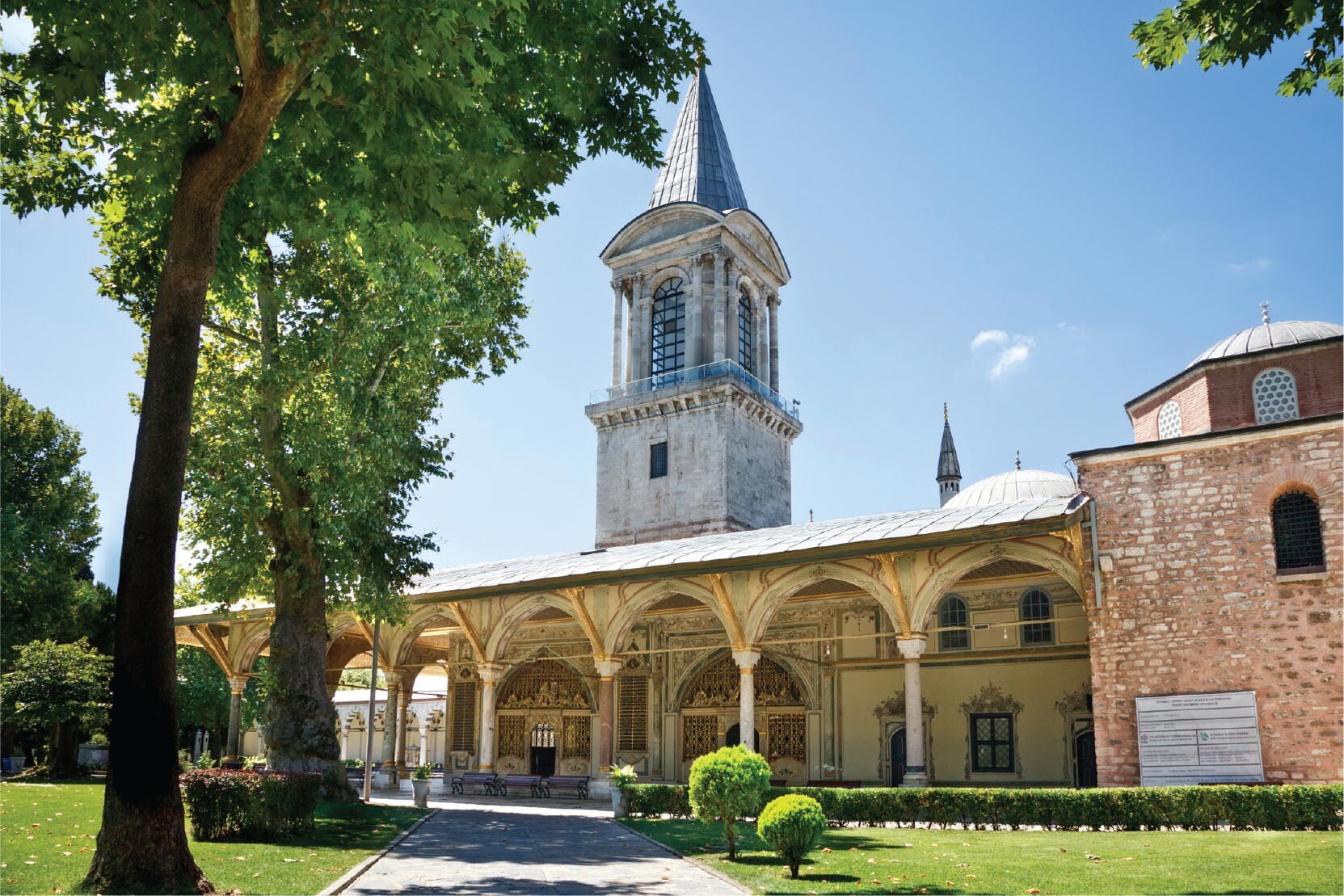
Istanbul’s Topkapi Palace reflected the Ottomans’ view of governance, the sultans’ emphasis on religion, and the continuing influence of Ottoman familial traditions—even in the administration of a far-flung empire. Laid out by Mehmed II, the palace complex reflected a vision of Istanbul as the center of the world. As a way to exalt the sultan’s magnificent power, architects designed the complex so that the buildings containing the imperial household nestled behind layers of outer courtyards in a mosaic of mosques, courts, and special dwellings for the sultan’s harem.
More information
A photo of the Topkapi palace. One tower rises up above a shorter building with large arches at the front. A portion of the building to the right side is made of brick and has part of a dome visible on top. There is a path leading up to the palace surrounded by grass, bushes, and trees.
The growing importance of Topkapi Palace as the command post of the empire represented a crucial transition in the history of Ottoman rulers. Not only was the palace the place where future bureaucrats received their training; it was also the place where the chief bureaucrat, the grand vizier, carried out the day-to-day running of the empire. Whereas the early sultans had led their soldiers into battle personally and had met face-to-face with their kinsmen, the later rulers withdrew into the sanctity of the palace, venturing out only occasionally for grand ceremonies. Still, every Friday, subjects queued up outside the palace to introduce their petitions, ask for favors, and seek justice. If they were lucky, the sultans would be there to greet them—but they did so behind grated glass, issuing their decisions by tapping on the window. The palace thus projected a sense of majesty, distant wonder, a home fit for commanders of the faithful.
Topkapi became a home for the increasingly sedentary sultan and his harem. Among his most cherished quarters were those set aside for women. At first, women’s influence in the Ottoman polity was slight. But as the realm consolidated, women became a powerful political force. The harem, like the rest of Ottoman society, had its own hierarchy of rank and prestige. At the bottom were enslaved women; at the top were the sultan’s mother and his favorite consorts. As many as 10,000 to 12,000 women inhabited the palace, often in cramped quarters. Those who had the ruler’s ear conspired to have him favor their own children, which made for widespread intrigue. When a sultan died, the entire retinue of women would be sent to a distant palace poignantly called the Palace of Tears, because the women who occupied it wept at the loss of the sultan and their own banishment from power.
DIVERSITY AND CONTROL The Ottoman Empire’s endurance into the twentieth century owed much to the ruling elite’s ability to gain the support and employ the talents of exceedingly diverse populations. After all, neither conquest nor conversion eliminated cultural differences in the empire’s distant provinces. Thus, for example, the Ottomans’ language policy was one of flexibility and tolerance. Although Ottoman Turkish was the official language of administration, Arabic was the primary language of the Arab provinces, the common tongue of street life. Within the empire’s European corner, the sounds and cadences of various languages continued to prevail. From the fifteenth century onward, the Ottoman Empire was more multilingual than any of its rivals.
In politics, as in language, the Ottomans showed flexibility and tolerance. The imperial bureaucracy permitted extensive regional and religious autonomy. In fact, Ottoman military cadres perfected a technique for absorbing newly conquered territories into the empire by parceling them out as revenue-producing units among loyal followers and kin. Regional appointees could collect local taxes, part of which they earmarked for Istanbul and part of which they pocketed for themselves. (This was a common administrative device for many world dynasties that controlled extensive domains.)
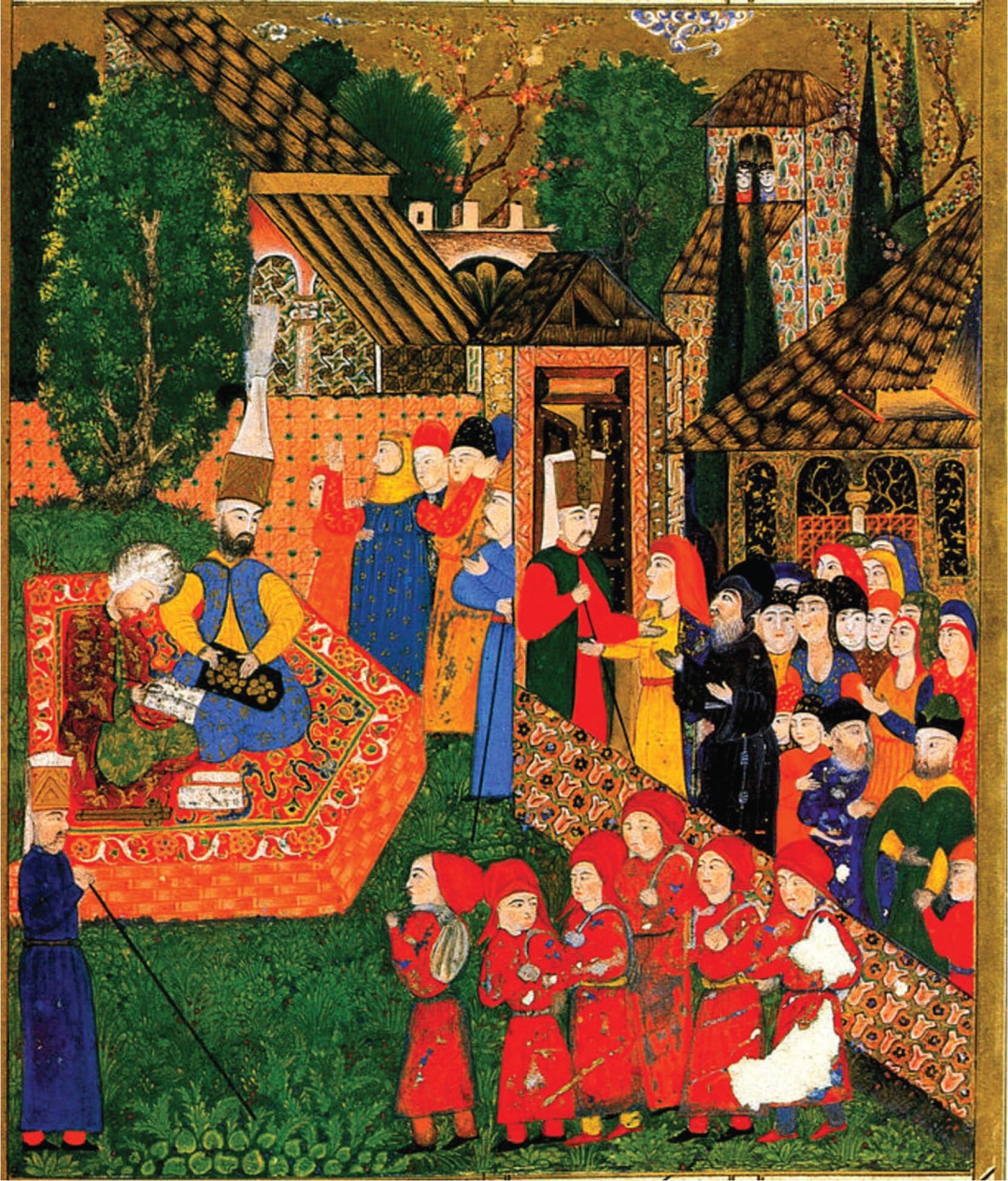
More information
A painting of a group of people in a city. There is a group of children separated from the adults. There is a man standing facing the group of children and holding a long stick in front of him. There are two men sitting to the side holding objects in their laps. Trees and intricately patterned buildings rise in the background.
Like other empires, the Ottoman state was always in danger of losing control over its provincial rulers. Local rulers—the group that the imperial center allowed to be (and remain) in charge—found that great distances enabled them to operate independently from central authority. These local authorities kept larger amounts of tax revenues than Istanbul deemed proper. So, to clip local autonomy, the Ottomans established a corps of infantry soldiers and bureaucrats called janissaries who owed the Sultan direct allegiance. The system at its high point involved a conscription of Christian youths from the empire’s European lands. This conscription, called the devshirme, required each village to hand over a certain number of males between the ages of eight and eighteen. Uprooted from their families and villages, these young men—chosen for their fine physiques and good looks—were converted to Islam and sent to farms to build up their bodies and learn Turkish. A select few were moved to Topkapi Palace, where they learned Ottoman military, religious, and administrative techniques. Some of these men—such as the architect Sinan, who designed the Süleymaniye Mosque—later enjoyed exceptional careers. Recipients of the best education available in the Islamic world, trained in Ottoman ways, instructed in the use of modern weaponry, and shorn of all family connections, the devshirme recruits were prepared to serve the sultan (and the empire as a whole) rather than the interests of any locality or ethnic group.
The Ottomans thus established their legitimacy via military skills, religious backing, and a loyal bureaucracy. They artfully balanced the decentralizing tendencies of the outlying regions with the centralizing forces of the imperial capital. Relying on a careful mixture of faith, patronage, and tolerance, the sultans curried loyalty and secured political stability. Indeed, so strong and stable was the political system that the Ottoman Empire dominated the coveted and highly contested crossroads between Europe and Asia for many centuries.
The Safavid Empire in Iran
The Ottoman dynasts were not the only rulers of Islamic regimes to spring from the rubble of conquest and disease. In Persia, too, a new empire arose in the aftermath of the Mongols’ decline. The legitimacy of the Safavid Empire, like that of the Ottoman Empire, rested on an Islamic foundation. But the Shiism espoused by Safavid rulers was quite different from the Sunni faith of the Ottomans, and these contrasting religious visions shaped distinct political systems.
In the western part of central Asia, the Khanate of the Chagatai, one of four governments created by the Mongols (see again Map 11.1), slipped into decline at the end of the thirteenth century. With no power dominating the area, the region fell into disorder, with warrior chieftains squabbling for preeminence. Adding to the volatility were various populist Islamic movements, some of which urged followers to withdraw from society or to parade around without clothing. Among the more prominent movements was a Sufi brotherhood led by Safi al-Din (1252–1334), which gained the backing of religious adherents and Turkish-speaking warrior bands. His successors, known as Safaviyeh or Safavids, embraced Shiism.
A RELIGIOUS SHIITE STATE The Safavids emerged from Turkic Sufi groups in eastern Anatolia and Azerbaijan. The Ottoman claims over most of Anatolia turned these regions into conflict zones with the Safavids and ultimately pushed Sufis into the Iranian plateau. As so often happens when migrant communities relocate, they had to reckon with the indigenous peoples of the area where they moved. In this case, they merged with tribal groups in devastated parts of Persia. In return for offering good governance, the newcomers were welcome. But as Turkic groups became Persianate, they also gave up some of their Sufi ways and steeped themselves in the sacred traditions of Shiism. As a result, the Safavid state became not just devout but devoted to persecuting those who did not follow its Shiite form of Islam. Of the three successor empires to the old caliphate, the Safavids were the least pluralist and religiously diverse. The most dynamic of Safi al-Din’s successors, Ismail (r. 1501–1524), required that the call to prayer announce that there is no God but Allah, that Muhammad is his prophet, and that Ali is the successor of Muhammad. Rejecting his advisers’ counsel to tolerate the Sunni creed of the majority of the city’s population, Ismail made Shiism the official state religion. He offered the people a choice between conversion to Shiism or death, exclaiming at the moment of conquest that “with God’s help, if the people utter one word of protest, I will draw the sword and leave not one of them alive” (Savory, p. 29). In 1502, Ismail proclaimed himself the first shah of the Safavid Empire. (Shah is the Persian word for “king” or “leader,” a title that many other cultures adopted as well.) Under Ismail and his successors, the Safavid shahs restored Persian sovereignty over the entire region traditionally regarded as the homeland of Persian speakers.
In the hands of the Safavids, Islam assumed an extreme and often militant form. The Safavids revived the traditional Persian idea that rulers were ordained by God, and believed the shahs to be divinely chosen. Some Shiites even went so far as to affirm that there was no God but the shah. Moreover, Persian Shiism fostered an activist clergy who (in contrast to Sunni clerics) saw themselves as political and religious enforcers against any heretical authority. They compelled Safavid leaders to rule with a sacred purpose. Because the Safavids, unlike the Ottomans, did not tolerate diversity, they never had as expansive an empire. Whatever territories they conquered, the Safavids ruled much more directly, based on central—and theocratic—authority. They also succeeded in transforming Iran, once a Sunni area, into a Shiite stronghold, a change that has endured to the present.
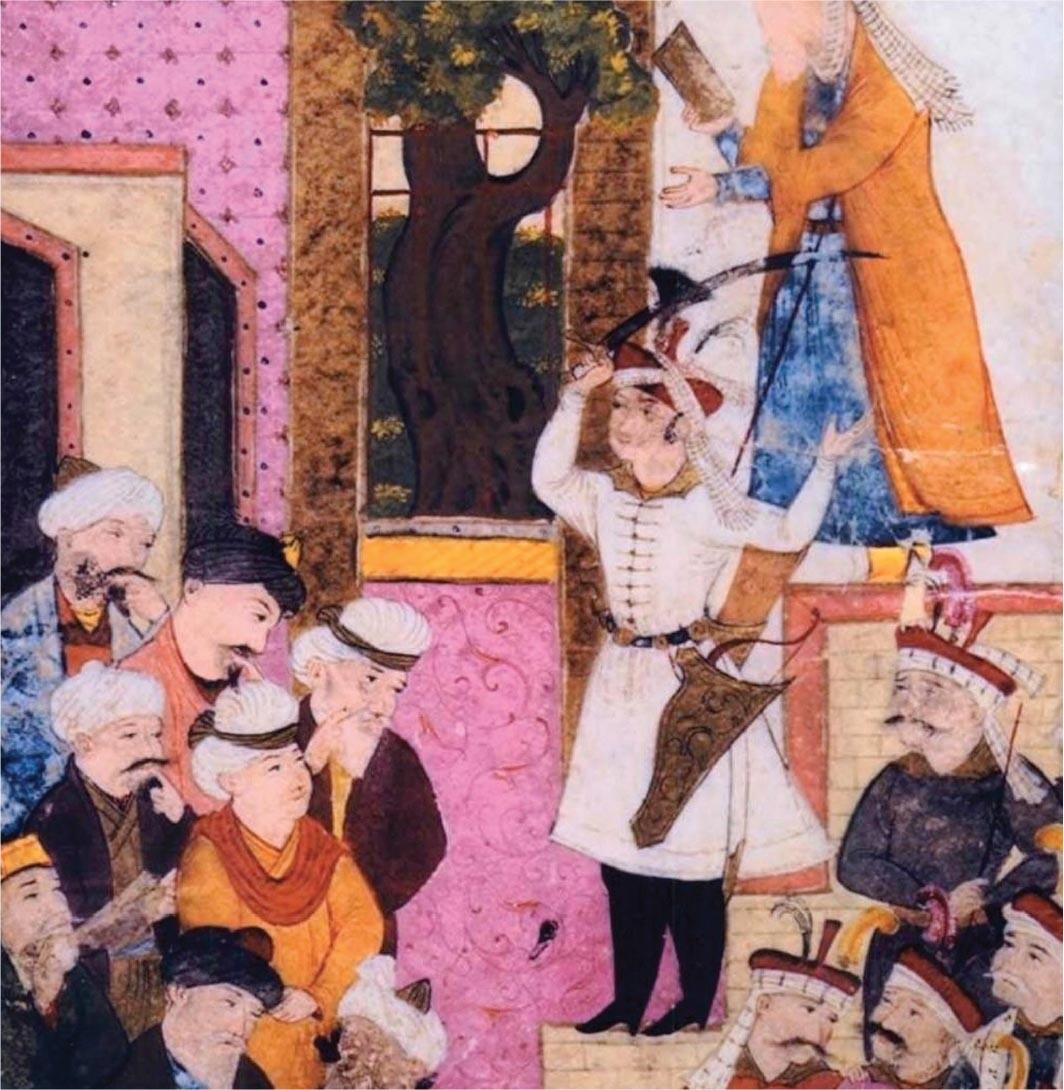
More information
A painting depicts Shah Ismail holding his sword up high and addressing a group of people. He wears a bow holstered at his side. A person with an obscured face reads from a book behind him. There is a tree in front of a window or entryway in the background.
The Delhi Sultanate and the Early Mughal Empire
A quarter century after the Safavids seized power in Persia, another Islamic dynasty, the Mughals, emerged in South Asia. Like the Ottomans and Safavids, the Mughals created a regime destined to last for many centuries and leave an enduring imprint. But unlike those other empires, the Mughal Empire did not replace a Mongol regime. Instead, the Mughals erected their state on the foundations of the old Delhi Sultanate, in the Indian cultural area (described in the last chapter) which had come into existence in 1206. The peoples of India, although spared the devastating direct effects of the Mongols and the Black Death, nonetheless had to deal with an invading nomadic force that was directly affected by these earlier dislocations: the warriors of Timur, or Tamerlane. Every bit as disruptive as the Mongols’ attacks, Timur’s invasions crushed the Delhi Sultanate and opened the way for a new, even more powerful regime.
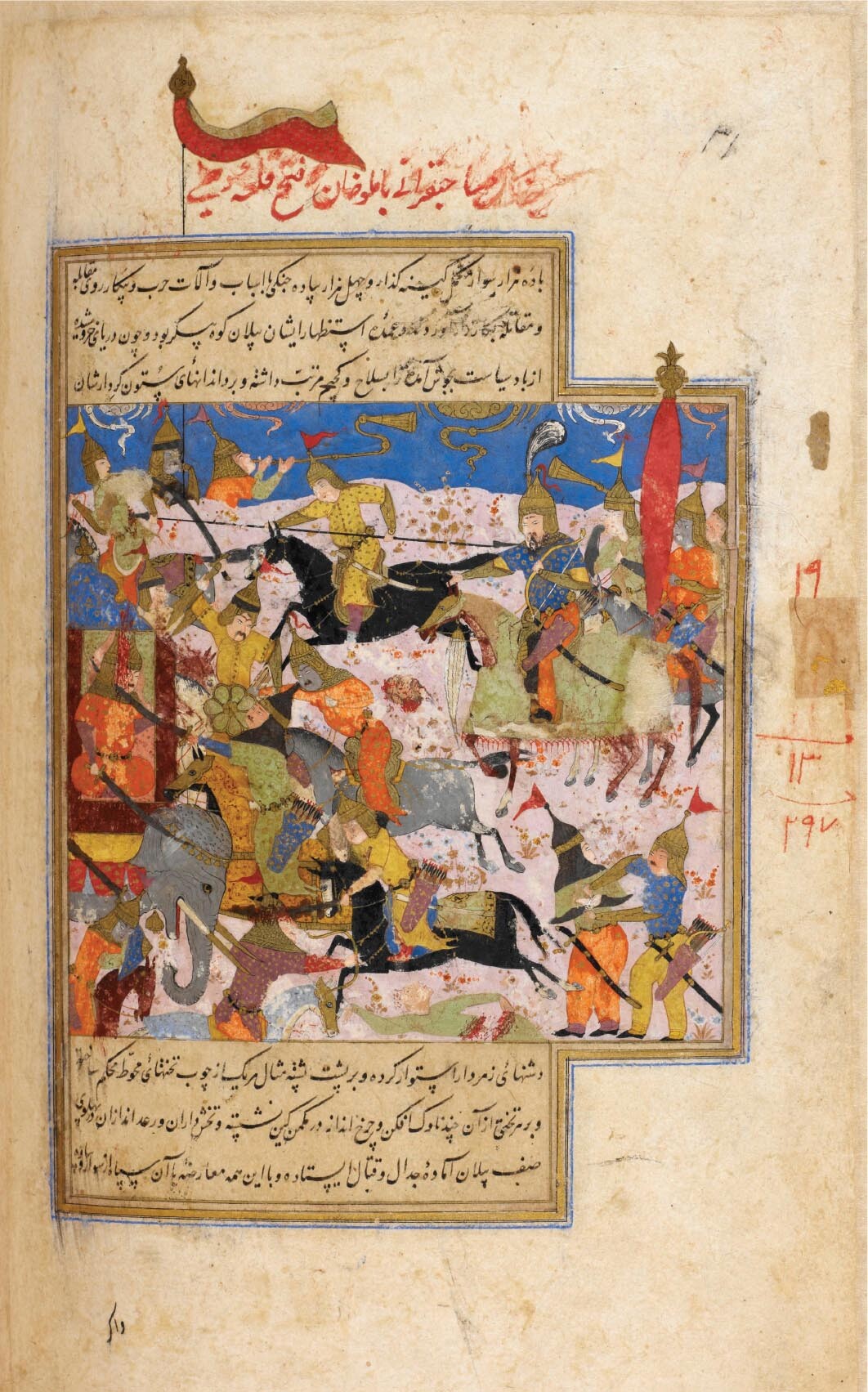
More information
A painting shows Timur’s cavalry charging towards the ranks of chain-mail-clad elephants. Many of the horsemen wield bows and arrows. Several people are slumped over the neck of their horses. One person blows a long horn in the top left corner. Two warriors stand in the bottom right corner. One body lies in two pieces on the ground. There are blood splatters on the snow covered ground. Arabic text is displayed above and below the painting.
RIVALRIES, RELIGIOUS REVIVAL, AND THE FIRST MUGHAL EMPEROR As head of the Barlas tribe from Central Asia, Timur was an indirect heir of Chinggis Khan’s rule. Timur waged wars that sprawled from the Caspian Sea to India. By the time he reached Delhi, Timur commanded a pillaging war machine. Timur’s campaigns were so widespread, relentless, and furious that some historians have estimated that up to 17 million people, 5 percent of the world population, may have perished in the warring and sickness his armies brought. But of all his conquests, Delhi was the prize. Though crippled by infighting, Delhi was rich and enormous, but was also no match for a cunning invader. While the sultan’s forces included elephant cavalries wearing chain mail and wielding poisoned tusks, Timur quickly learned that these animals were hard to defeat but easy to panic. He ordered his soldiers to tie flaming bunches of hay to the tails of his camels and drive them into the elephant formations, driving all the animals into hysterics and trampling the paralyzed foot soldiers. Routed, the sultan fled with his remnant forces, leaving Delhi to be sacked and almost demolished.
The Delhi Sultanate lost much of its power after Timur’s conquests. Soon, a wave of religious revivals occurred. Bengal broke away from Delhi and soon embraced Sufism, a mystical form of Islam that emphasized personal union with God. Here, too, a special form of Hinduism, called Bhakti Hinduism, put down deep roots. Its devotees preached the doctrine of divine love. In the Punjab, previously a core area of the Delhi Sultanate, a new religion known as Sikhism came into being. Sikhism largely followed the teachings of Nanak (1469–1539). Although born a Hindu, he was inspired by Islamic ideals and called on his followers to renounce the caste system and to treat all believers as equal before God.
Following Timur’s victory, rival kingdoms and sultanates asserted their independence. The Delhi Sultanate became a mere shadow of its former self, just one of several competing powers in northern India. Out of this political chaos emerged a Turkish prince, Babur (the “Tiger”), invited in 1526 by the governor of the Punjab to restore order. A great-grandson of Timur, Babur traced his lineage to both the Turks and the Mongols (he was said to be a descendant of Chinggis Khan). For years, Babur had longed to conquer India. Massing an army of Turks and Afghans armed with matchlock cannons, he easily breached the wall of elephants put together by the sultan’s defenders. Delhi fell, and with it the Delhi Sultanate also came to an end. Babur proclaimed himself emperor and spent the next few years snuffing out the remaining resistance to his rule. He thus laid the foundation of the Mughal Empire, the third great Islamic dynasty (discussed in detail in Chapter 12).
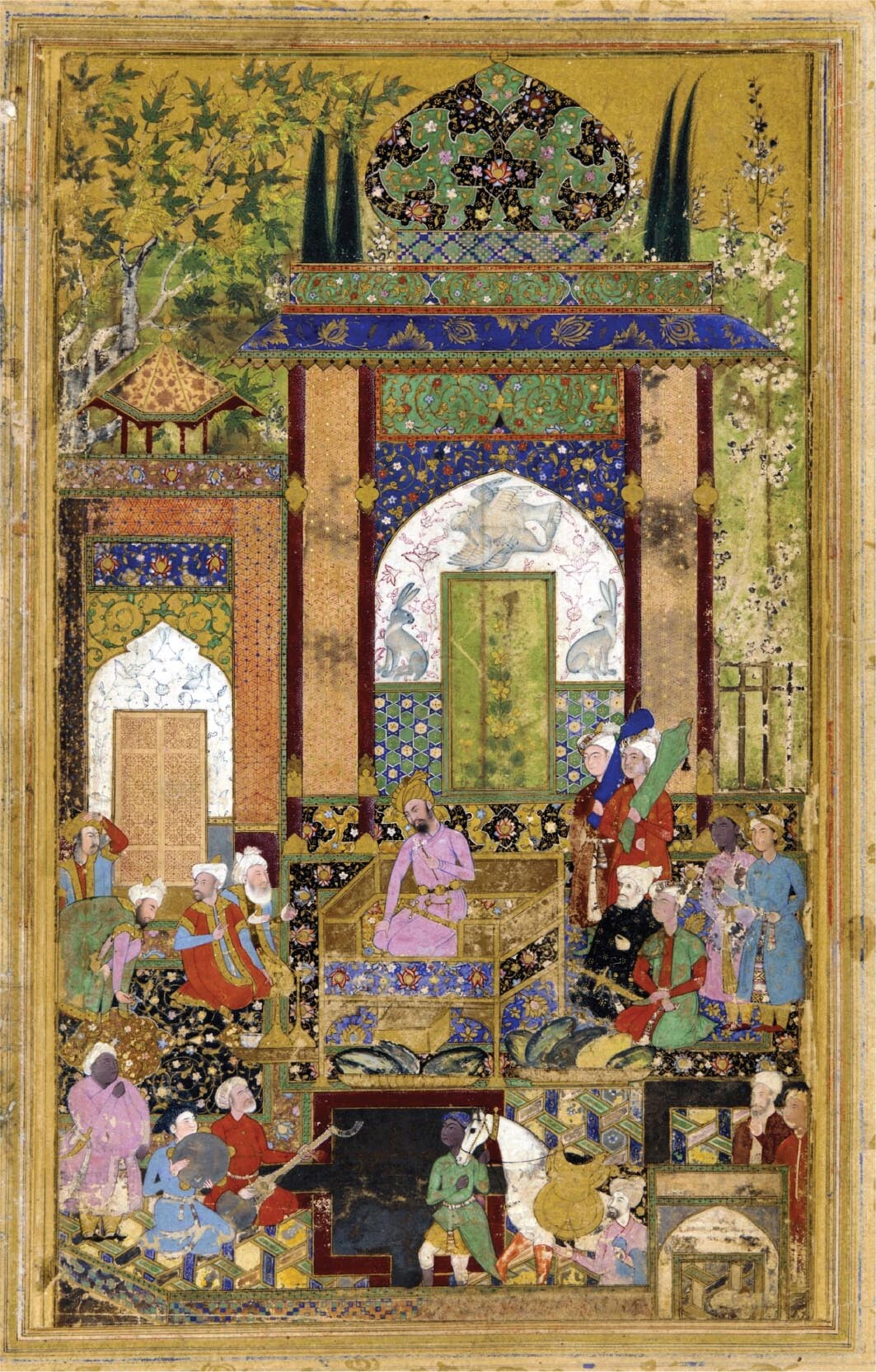
More information
A painting of Babur holding court. He is seated in an elevated position at the center of the court room. Members of the court are scattered throughout the room. Many sit, several stand, several play instruments, and one holds the reins of a horse. Intricate patterns cover the walls and floor. The wall behind Babur has paintings of rabbits incorporated into part of the patterns and a large dome with a pointed top above it. Trees and a patterned gazebo are visible in the background beyond the wall.
By the sixteenth century, three new Islamic empires had emerged across the Asian continent. Their differences were obvious, especially regarding religion. The Ottomans were Sunni Islam’s most fervent champions, determined to eradicate the Shiite heresy on their border, where an equally determined Persian Safavid dynasty sought to expand the reach of Shiism. In contrast to these dynasties’ sectarian religious commitments, the Mughals, drawing on well-established Indian traditions of religious and cultural tolerance, were open-minded toward non-Muslim believers and sectarian groups within the Muslim community. Yet the political similarities of these imperial dynasties were equally clear-cut. Although these states did not hesitate to go to war against one another, they shared similar styles of rule. All established their legitimacy via military prowess, religious backing, and a loyal bureaucracy. This combination of spiritual and military weaponry enabled emperors, espousing the Prophet Muhammad’s teaching, to claim vast domains. Moreover, their religious differences did not prevent the movement of goods, ideas, merchants, and scholars across political and religious boundaries—even across the most divisive boundary of all, that between Sunni Iraq and Shiite Persia.
Glossary
- Ottoman Empire
- A Turkish warrior band that transformed itself into a vast, multicultural, bureaucratic empire that lasted from the early fourteenth century through the early twentieth century and encompassed Anatolia, the Arab world, and large swaths of southern and eastern Europe.
- Topkapi Palace
- Palace complex located in Istanbul that served as both the residence of the sultan, along with his harem and larger household, and the political headquarters of the Ottoman Empire.
- devshirme
- The Ottoman system of taking non-Muslim children in place of taxes in order to educate them in Muslim ways and prepare them for service in the sultan’s bureaucracy.
- Sikhism
- Islamic-inspired religion that calls on its followers to renounce the varna (caste) system and to treat all believers as equal before God.