Ming China
Like Europeans, the Chinese saw their stable worldview and political order crumble under the cataclysms of human and bacterial invasions. Moreover, like Europeans, people in China had long regarded outsiders as “barbarians.” Together, the Mongols and the Black Death upended the political and intellectual foundations of what had appeared to be the world’s most integrated society. The Mongols brought the Yuan dynasty to power; then the plague devastated China and prepared the way for the emergence of the Ming dynasty.
Ruled by ethnically Han Chinese, the Ming dynasty defined itself against its foreign predecessors. Ming emperors sought to reinforce everything Chinese. In particular, they supported China’s vast internal agricultural markets in an attempt to minimize dependence on merchants and foreign trade.
Restoring Order
In the chaotic fourteenth century, as plague and famine ravaged China and as the Mongol Yuan dynasty collapsed, only a strong military movement capable of overpowering other groups could restore order. That intervention began at the hands of a poor young man who had trained in the Red Turban movement: Zhu Yuanzhang. He was an orphan from a peasant household in an area devastated by disease and famine and a former novice at a Buddhist monastery. At age twenty-four, Zhu joined the Red Turbans, after which he rose quickly to become a distinguished commander. Eventually, his forces defeated the Yuan and drove the Mongols from China.
It soon became clear that Zhu had a much grander design for all of China than the ambitions of most warlords. When he took the important city of Nanjing in 1356, he renamed it Yingtian (“In Response to Heaven”). Buoyed by subsequent successful military campaigns, Zhu (r. 1368–1398) proclaimed the founding of the Ming (“brilliant”) dynasty twelve years later. Soon thereafter, his troops met little resistance when they seized the Yuan capital of Beijing, causing the Mongol emperor to flee to his homeland in the steppe. It would, however, take Zhu almost another twenty years to reunify the entire country.
More information
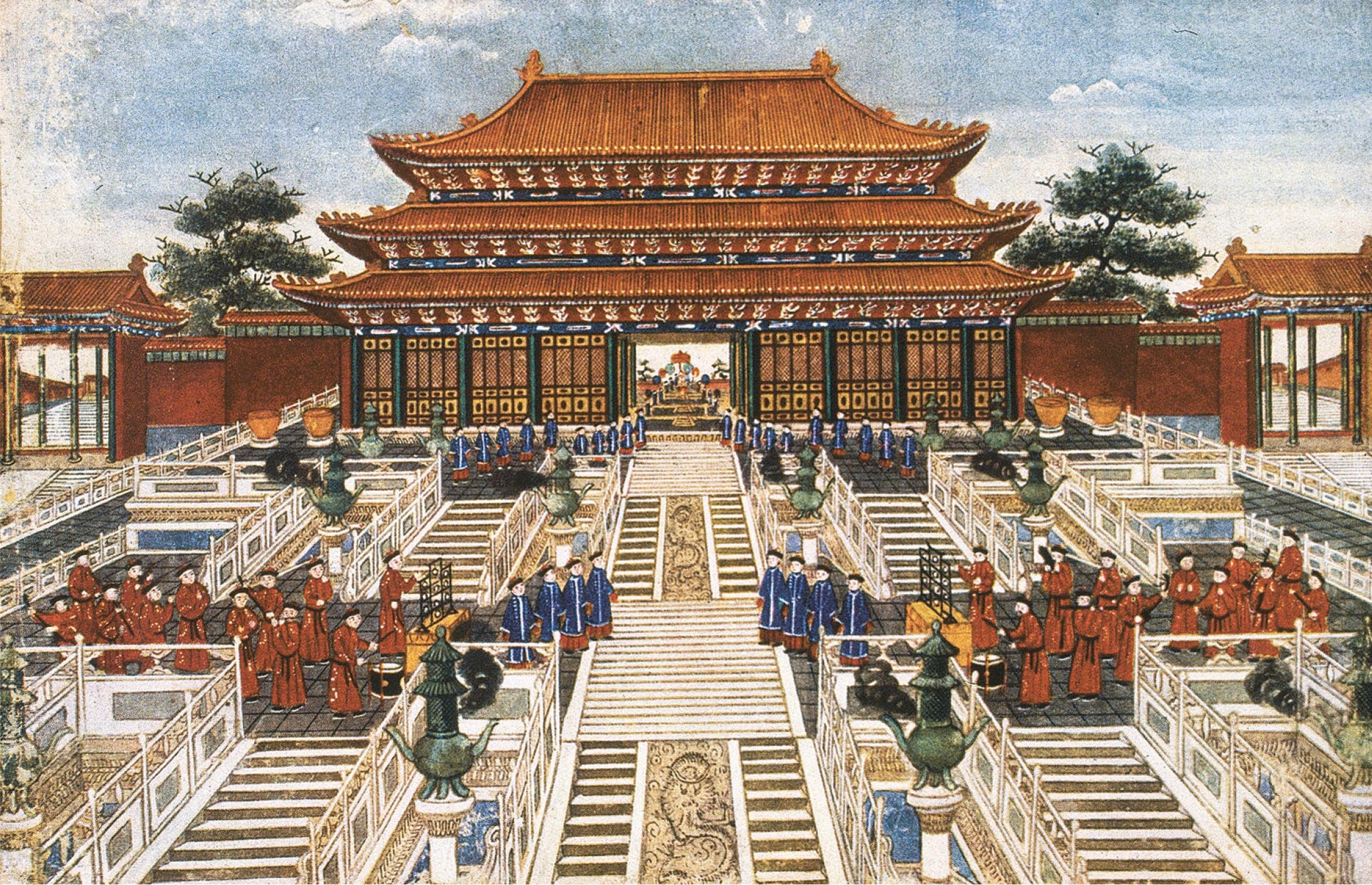
A painting of the Forbidden City. There are groups of people playing instruments and lines of people going into the city. The palace has a three tiered roof with corners that flare upwards. There are patterns under each tier and rectangular panels on the front of the palace. There are many steps leading into the entryway of the palace and several vessels with two handles and a tower-like structure on top throughout the outdoor area in front of the palace.
Centralization under the Ming
Zhu and successive Ming emperors had to rebuild a devastated society from the ground up. Although China in the past had experienced natural catastrophes, wars, and social dislocation, the plague’s legacy was devastation on an unprecedented scale. It left the new rulers with the formidable challenge of rebuilding the great cities, restoring respect for ruling elites, and reconstructing the weakened bureaucracy.
IMPERIAL GRANDEUR AND KINSHIP The rebuilding began under Zhu, the Hongwu (“expansive and martial”) Emperor, whose extravagant capital at Nanjing reflected imperial grandeur. When the dynasty’s third emperor, the Yongle (“perpetual happiness”) Emperor, relocated the capital to Beijing, he flaunted an even more grandiose style. Construction here mobilized around 100,000 artisans and a million laborers. The city had three separate walled enclosures. Inside the outer city walls sprawled the imperial city; within its walls lay the palace city, the Forbidden City. Traffic within the walled sections navigated through boulevards leading to the different gates, above which imposing towers soared. The palace compound, where the imperial family resided, had more than 9,000 rooms. Anyone standing in the front courts, which measured more than 400 yards (366 meters) on a side and boasted marble terraces and carved railings, would gasp at the sense of awesome power. That was precisely the effect the Ming emperors wanted (just as the Ottoman sultans did in building Topkapi Palace).
Marriage and kinship buttressed the power of the Ming imperial household. The dynasty’s founder married the adopted daughter of a leading Red Turban rebel (her father, according to legend, was a convicted murderer), thereby consolidating his power and eliminating a threat. Empress Ma, as she was known, became the Hongwu Emperor’s principal wife and was praised for her compassion. Emerging as the kinder face of the regime, she tempered the harsh and sometimes cruel disposition of her spouse. He had numerous other consorts as well, including Korean and Mongol women, who bore him twenty-six sons and sixteen daughters. (His household was similar to, although on a smaller scale than, the sultan’s harem at Topkapi Palace.)
More information
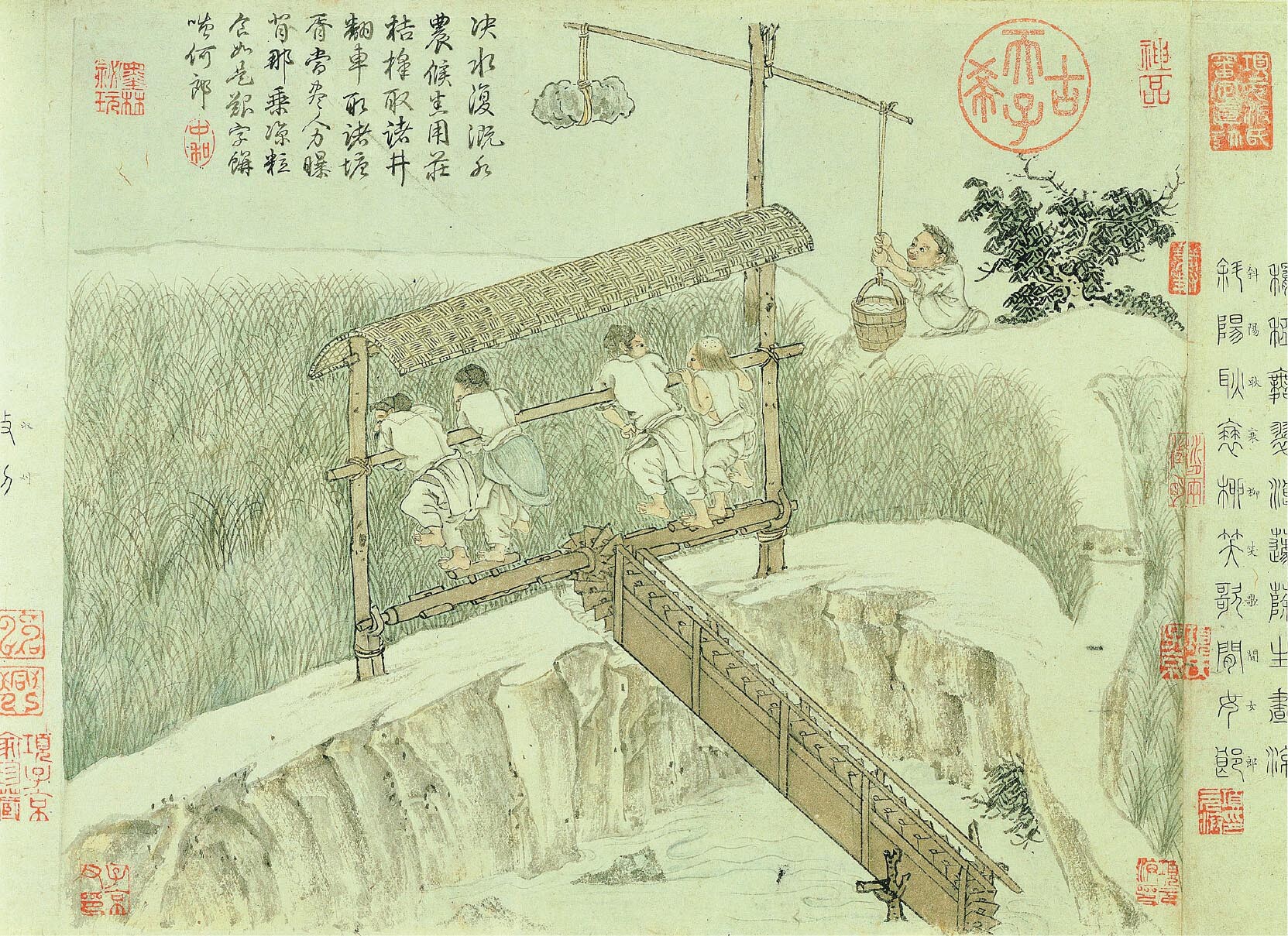
An illustration shows four farmers pumping water to a field using a water conveyor. The farmers are rotating a wooden log using their legs. The log is connected to the top of the conveyor. The bottom of the conveyor sits in a water reservoir. A rice paddy extends into the distance behind the conveyor. There is Chinese text at the top and on the sides of the illustration.
BUILDING A BUREAUCRACY Faced with the challenge of reestablishing order out of turmoil, the Hongwu Emperor initially sought to rule through his many kinsmen by giving imperial princes generous stipends, command of large garrisons, and significant autonomy in running their domains. However, when the princes’ power began to threaten the court, the emperor slashed their stipends, reduced their privileges, and took control of their garrisons. No longer dependent on these men, he established an imperial bureaucracy beholden only to him and to his successors. These officials won appointments through their outstanding performance on a reinstated civil service examination.
In addition, the Hongwu Emperor took other steps to install a centralized system of rule. He assigned bureaucrats to oversee the manufacture of porcelain, cotton, and silk products as well as to collect taxes. He reestablished the Confucian school system as a means of selecting a cadre of loyal officials (not unlike the Ottoman janissaries and administrators). He also set up local networks of villages to rebuild irrigation systems and to supervise reforestation projects to prevent flooding—with the astonishing result that the amount of reclaimed land nearly tripled within eight years. Historians estimate that the Hongwu Emperor’s reign oversaw the planting of about a billion trees, including 50 million sterculia, palm, and varnish trees around Nanjing. Their timber served in building a maritime expedition fleet in the early fifteenth century. For water control, 40,987 reservoirs underwent repairs or new construction.
Now the imperial palace not only projected the image of a power center; it was the center of power. Every official received his appointment from the emperor through the Ministry of Personnel. The Hongwu Emperor also eliminated the post of prime minister (he executed the man who held the post) and then ruled directly. Ming bureaucrats literally lost their seats and had to kneel before the emperor. In one eight-day period, the Hongwu Emperor reputedly reviewed over 1,600 petitions dealing with 3,392 separate matters. The drawback, of course, was that he had to keep tabs on this immense system, and his bureaucrats were not always up to the task, leading to inconsistent results. Indeed, the Hongwu Emperor constantly juggled personal and impersonal forms of authority, sometimes fortifying the administration, sometimes undermining it lest it become too autonomous. In due course, he nurtured a bureaucracy that was far more extensive than those of the Islamic empires. The Ming thus established the most highly centralized system of government of all the monarchies of this period.
More information
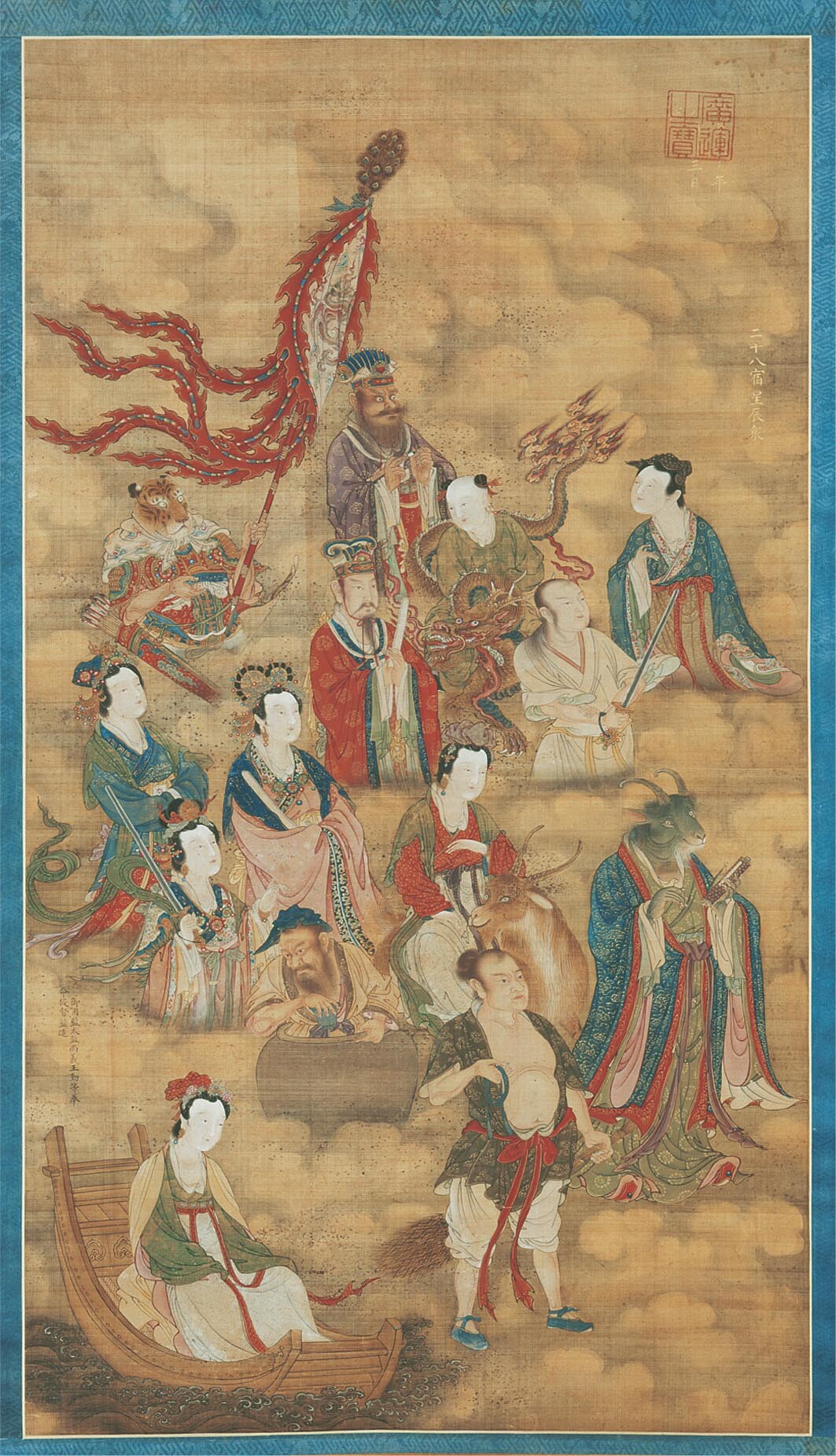
An illustration of a collection of deities surrounded by clouds. A woman sits in a boat in the bottom left corner. A man with open robes stands next to her. A goat-headed figure holding a scroll stands nearby. A woman riding an antlered animal stands near a man sitting behind a large pot. Several women sit nearby. A group of men sit and stand near a small dragon. One of the men holds a scroll and another holds a sword. A lion-headed figure holding a banner sits in the top left corner. A large block of Chinese characters floats in the top right corner and several small lines of Chinese characters are scattered throughout the illustration.
Religion under the Ming
Just as the Ottoman sultans projected themselves as Muslim rulers, calling themselves the shadow of God, and European monarchs claimed to rule by divine right, so the Ming emperors enhanced their legitimacy by drawing on ancient Chinese religious traditions. Citing the mandate of heaven, the emperor revised and strengthened the elaborate protocol of rites and ceremonies that had undergirded dynastic power for centuries. As well as underscoring the emperor’s centrality, official rituals (such as those related to the gods of soil and grain) reinforced political and social hierarchies.
Under the guise of “community” gatherings, rites and sacrifices solidified the Ming order by portraying the rulers as the moral and spiritual benefactors of their subjects. On at least ninety occasions each year, the emperor engaged in sacrificial rites, providing symbolic communion between the human and the spiritual worlds. These lavish festivities reinforced the ruler’s image as mediator between otherworldly affairs of the gods and worldly concerns of the empire’s subjects. The message was clear: the gods were on the side of the Ming household.
Because religious rituals supported hierarchies, the emperor sanctioned elaborate official cults. Organized into civil or military domains; tiered into great, middle, or minor rites; and categorized as celestial, terrestrial, or human, official cults were meant to reflect the emperor’s glory and reinforce Ming rule. But official cults often conflicted with local faiths. In this regard, they revealed the limits of Ming centralism. Consider Dongyang, a hilly interior region. As was common in Ming China, the people of Dongyang supported Buddhist institutions. Guan Yu, a legendary martial hero killed centuries earlier, was enshrined in a local Buddhist monastery there. But he was also worshipped as part of a state cult. Herein lay the problem: the state cult and the Buddhist monastery were separate entities, and imperial law held that the demands of the state cult prevailed over those of the local monastery. So the state-appointed magistrates in Dongyang kept a watchful eye on local religious leaders, although the magistrates refrained from directly tampering with the monastery’s affairs. Although the imperial government insisted that people make payments to the state, Dongyang’s residents delivered most of their funds to the Buddhist monks. So strong were local sentiments that even the officials siphoned revenues to the monastery.
Ming Rulership
If conquest established the Ming Empire, bureaucracy kept it functioning. The empire’s large scale (see Map 11.4) required a remarkably complex administration. To many outsiders (especially Europeans, whose region was in a state of constant war), Ming stability and centralization appeared to be political wizardry.
Ming rulers worried in particular about maintaining the support of ordinary people in the countryside. The emperor wished to be seen as the special guardian of his subjects. He wanted their allegiance as well as their taxes and labor. But during hard times, poor farmers were reluctant to provide resources—taxes or services—to distant officials. For these reasons alone, the Hongwu Emperor preferred to entrust management of the rural world to local leaders, whom he appointed as village chiefs, village elders, or tax captains. (In fact, a popular Chinese proverb was “The mountain is high and the emperor is far away.”) Within these communities, the dynasty created a social hierarchy based on age, sex, and kinship. While women’s labor remained critical for the village economy, the government reinforced a gender hierarchy by promoting women’s chastity and constructing commemorative arches for widows who refrained from remarrying. The Ming thus produced a more elaborate system for classifying and controlling its subjects than did the other Eurasian dynasties. But individuals also sought to define themselves by dressing in ways that expressed their own view of their place in the social order. (See Current Trends in World History: Ming Fashion.)
More information
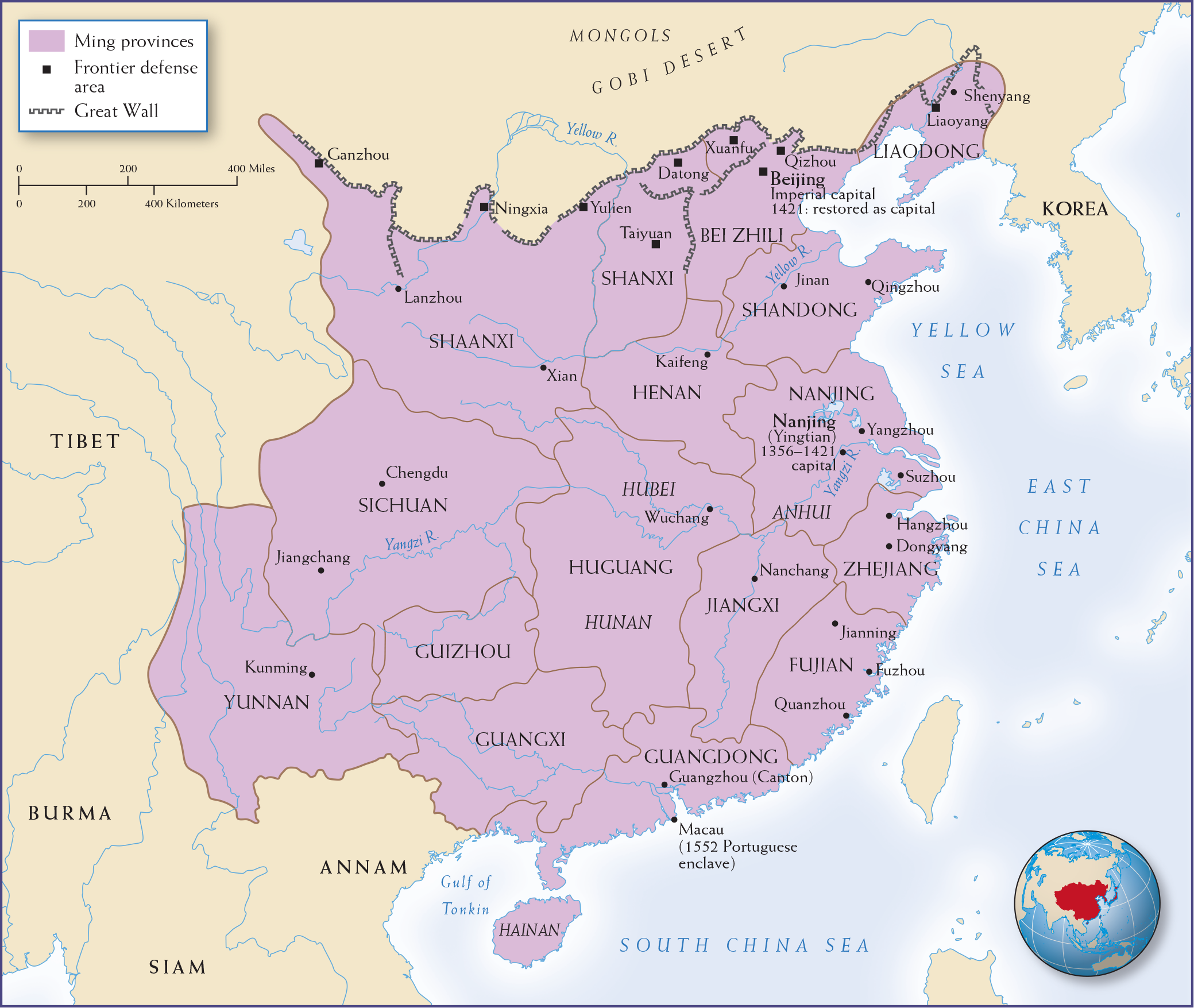
Map 11.4 is titled Ming China, 1500s. The map shows Ming provinces, frontier defense areas, and the Great Wall. Nanjing was the capital from 1356 to 1421, and Beijing was restored as the imperial capital in 1421. The Ming Empire is made up of provinces: Yunnan province with the city Kunming; Sichuan province with the cities Jiangchang and Chengdu; Shaanxi province with the cities Lanzhou and Xian and the defense areas Ganzhou, Ningxia, and Yulien; Shanxi province with the defense areas Taiyuan, Datong, and Xuantu; Bei Zhili province with defense areas Beijing and Qizhuo; Shandong province with cities Jinan and Qingzhou; Henan province with the city Kaifeng; Nanjing province with cities Nanjinh (Yingtian), Yangzhou, Suzhou, and the region of Anhui; Liaodong province with the city Shenyang and frontier defense Liaoyang; Zhejiang province with cities Dongyang and Hangzhou; Jiangxi province with the city Nanchang; Fujian province with cities Quanzhou, Fuzhou, and Jianning; Huguang province with regions Hubei and Hunan and the city Wuchang; Guizhou; Guangxi; Hainan; and Guangdong province with the cities Guangzhou (Canton) and Macao (1552 Portuguese enclave). The Great Wall runs along the northern border of the provinces of Shaanxi, Shanxi, Bei Zhili, and Liaodong. Bordering the Ming provinces are Mongols, Korea, Tibet, Burma, Siam, and Annam.
MAP 11.4 | Ming China, 1500s
The Ming state was one of the largest empires at this time—and the most populous. Using the scale, determine the length of its coastline and its internal borders.
- What were the two Ming capitals and the three main seaport trading cities? How far are they from one another?
- According to the map, where did the Ming rulers expect the greatest threat to their security?
- How many provinces are outlined on the map? How far is Beijing from some of the more distant provinces? What sorts of challenges did that create for the centralized style of Ming rule, and how does the chapter suggest those challenges were resolved?
The Ming Empire, like states in Europe and the Islamic world, faced periodic unrest and rebellion. Rebels often proclaimed their own brand of religious beliefs, just as local elites resented central authority. Outright terror helped stymie threats to central authority. In a massive wave of carnage, the Hongwu Emperor slaughtered anyone who posed a threat to his authority, from the highest of ministers to the lowliest of scribes. From 1376 to 1393, four of his purges condemned close to 100,000 subjects to execution.
Yet, despite the emperor’s immense power, the Ming Empire was insufficiently governed. Indeed, as the population multiplied, there were too few loyal officials to handle local affairs. By the sixteenth and early seventeenth centuries, for example, some 10,000 to 15,000 officials shouldered the responsibility of managing a population exceeding 200 million people. Nonetheless, the Hongwu Emperor bequeathed to his descendants a set of tools for ruling that drew on subjects’ direct loyalty to the emperor and on the intricate workings of an extensive bureaucracy. His legacy enabled his successors to balance local sources of power with the needs of centralized dynastic rulership.
More information
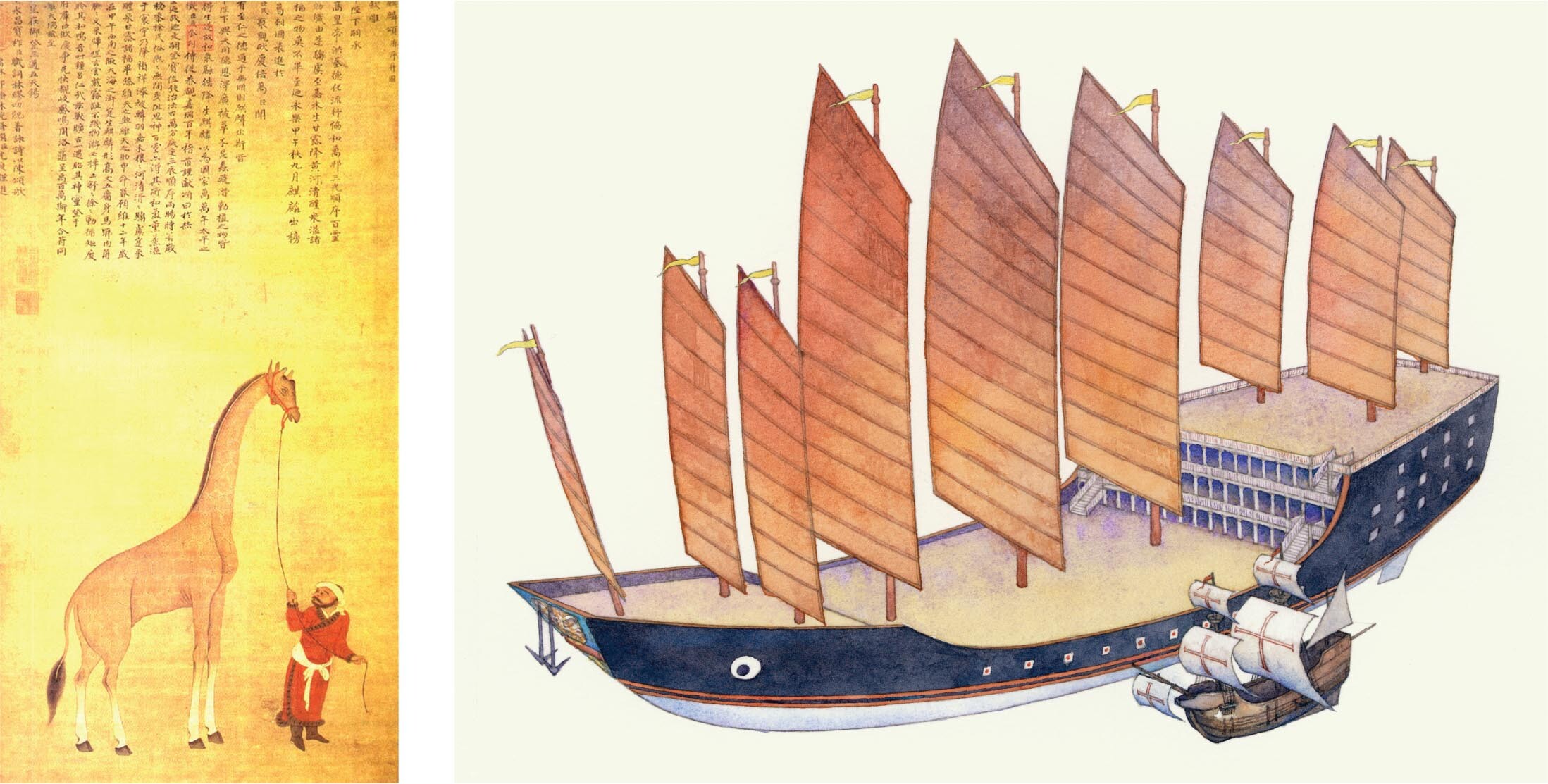
A drawing of a giraffe on a leash being held by a man. Chinese characters cover the drawing’s top third.
A drawing of a large boat with nine masts topped by pendants and nine roughly rectangular sails. A much smaller boat with six sails, five of which have crosses on them, is presented for contrast.
Trade and Exploration
Gradually, consolidation under the Ming allowed for the revival of trade. The new dynasty’s merchants reestablished China’s preeminence in long-distance commercial exchange. Chinese silk and cotton textiles, as well as fine porcelains, ranked among the world’s most coveted luxuries. Wealthy families from across Eurasia loved to wash their hands in delicate Chinese bowls and to flaunt fine wardrobes made from bolts of Chinese dyed linens and smoothly spun silk. When a Chinese merchant ship sailed into port, trading partners and onlookers crowded the docks to watch the unloading of precious cargoes. Although Ming rulers’ support for overseas ventures wavered and eventually declined, this period saw important developments in Chinese trade and exploration.
During the Ming period, Chinese traders based in ports such as Hangzhou, Quanzhou, and Guangzhou (Canton) were as energetic as their Muslim counterparts on the Indian Ocean. These ports were home to prosperous merchants and the point of convergence for vast sea-lanes. Leaving the mainland ports, Chinese vessels carried precious wares to offshore islands, the Pescadores, and Taiwan. From there they sailed on to the ports of Kyūshū, the Ryūkyūs, Luzon, and maritime Southeast Asia. As entrepôts for global goods, East Asian ports flourished. Former fishing villages developed into major urban centers.
Current Trends in World History
Ming Fashion
Ming rulers liked to represent themselves as custodians of the “civilized” Han traditions, in contrast to the “barbarian” ways of the previous Mongol Yuan dynasty. However, from governmental practices to clothing fashions, there were visible signs everywhere that the Ming, despite their rhetoric, followed in the Yuan’s footsteps and became increasingly linked to an ever-growing, interconnected world. As trade with neighboring and faraway lands continued unabated and merchants and travelers kept moving, it proved to be impossible for the Ming to keep outside influences at arm’s length. At the same time, the rhetoric of a return to the Han traditions did generate moves to invoke antiquity in the realm of fashion. Status-conscious elites with newfound wealth eagerly purchased clothes in what they believed to be the ancient Han style, hoping to set themselves apart from the common people. Their flirtation with antiquity, however, often ended up being more reinvention to satisfy the surging demands of the market than a genuine return to earlier conventions.
Founder Zhu Yuanzhang set the tone of the Ming by trying to rid the country of the close-fitting tunics worn by the Mongols. He advocated instead the wearing of the reputedly Tang-style garment of earlier times. While this measure did meet with some success, the vibrant clothing sector was hardly free of its fascination with the “exotic,” such as horsehair skirts from Korea for men. These skirts were a rare commodity when they first arrived, probably via trade missions. But by the late fifteenth century, local weavers had become so skilled in making them, and consumers so eager to obtain them, that craftworkers were caught stealing the tails of horses to satisfy the soaring demand for the raw materials. Indeed, undoubtedly to the chagrin of the first Ming emperor and his descendants, much of the Yuan style and even terminology in both male and female clothing persisted during the Ming era.
The retro movement in fashion had more to do with the demands of a changing Ming society than with the official advocacy for restorationism. Nowhere was this more apparent than in the myriad styles of hats for men—a convenient yet highly visible way to make a statement in social standing. Invoking the names of earlier dynasties, styles included the Han cap, the Jin cap, the Tang cap, and so on. The most interesting, however, was the Chunyang hat, which allegedly drew upon both Han and Tang styles in its design but had actually become a symbol of the so-called new and strange fashion that so often attracted commentary in Ming writings. In fact, it was favored by the young, who had nothing but disdain for ancient styles!
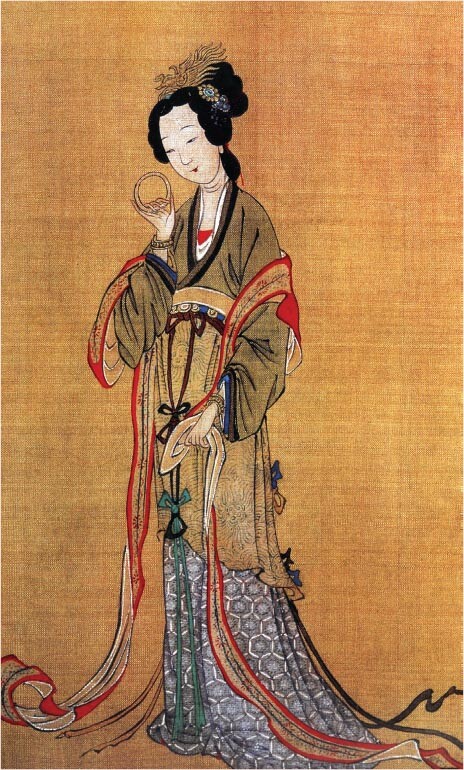
Nor was the rage for fashion reserved for only men or even for just the privileged. One Ming writer lamented, perhaps with a hint of exaggeration, “Nowadays the very servant girls dress in silk gauze, and the singsong girls look down on brocaded silks and embroidered gowns.” Respectable women, we are told, looked to the clothing and style of the courtesans of the prosperous southern region of the country for ideas and inspiration for fashion. Indeed, much of our visual knowledge of Ming women’s clothing comes from paintings that likely depicted highly trained courtesans or the female “entertainers” ubiquitous in Ming urban centers. These paintings reveal the different and consistently evolving styles of clothing for Ming women, including the “paddy-field gowns”—which might have owed their origins to Buddhist robes—that were the focus of much criticism from those who frowned on the growing penchant for the exotic, the strange, the outrageous, and the irreverent in the realm of fashion. If nothing else, this debate about clothing certainly tells us that despite the often conservative stance and policies of the Ming regime, the everyday life of many Ming subjects was a constant exercise in negotiating the multiple impacts of both the old and the new, as well as the familiar and the foreign, in different arenas of their rapidly changing society.
More information
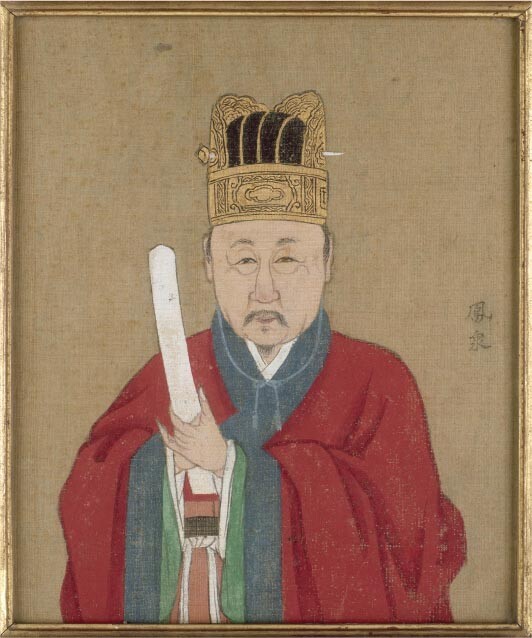
A painting of a man wearing a robe and a crown. The crown is made up of gold and has three beams attached to it. The man holds a scroll.
More information
A painting of a woman wearing an elaborate gown. She hold an object shaped like a large ring in one hand and a piece of fabric in the other.
QUESTIONS FOR ANALYSIS
- Why did the Ming elite cultivate an “ancient” Han style?
- Can you think of retro styles popular today? What do such styles say about the people who cultivate them?
- How do we know about changes in women’s fashion in the Ming era? Are there any dangers in using these sources to understand the dress of all Ming women?
EXPLORE FURTHER
Finnane, Antonia, Changing Clothes in China: Fashion, History, Nation (2008).
The Ming dynasty viewed overseas expansion with suspicion, however. The Hongwu Emperor feared that too much contact with the outside world would cause instability and undermine his rule. In fact, he banned private maritime commerce in 1371. But enforcement was lax, and by the late fifteenth century maritime trade once again surged. Because much of the thriving business took place in defiance of official edicts, constant friction occurred between government officials and maritime traders. Although the Ming government ultimately agreed to issue licenses for overseas trade in the mid-sixteenth century, its policies continued to vacillate. To Ming officials, the sea represented problems of order and control rather than opportunities.
THE EXPEDITIONS OF ZHENG HE One spectacular exception to the Ming’s attitude toward maritime trade was a series of officially sponsored expeditions in the early fifteenth century. The ambitious Yongle Emperor took the initiative. One of his loyal followers was a Muslim whom the Ming army had captured as a boy. The youth was castrated and sent to serve at the court (as a eunuch, he could not continue his family line and so theoretically owed sole allegiance to the emperor). Given the name Zheng He (1371–1433), he grew up to be an important military leader. The emperor entrusted him with venturing out to trade, collect tribute, and display China’s power to the world.
From 1405 to 1433, Zheng He commanded the world’s greatest armada and led seven naval expeditions. His larger ships stretched 400 feet in length (Columbus’s Santa Maria was 85 feet), carried hundreds of sailors on four tiers of decks, and maneuvered with sophisticated rudders, nine masts, and watertight compartments. The first expedition set sail with a flotilla of 62 large ships and over 200 lesser ones. All 28,000 men aboard pledged to promote Ming glory.
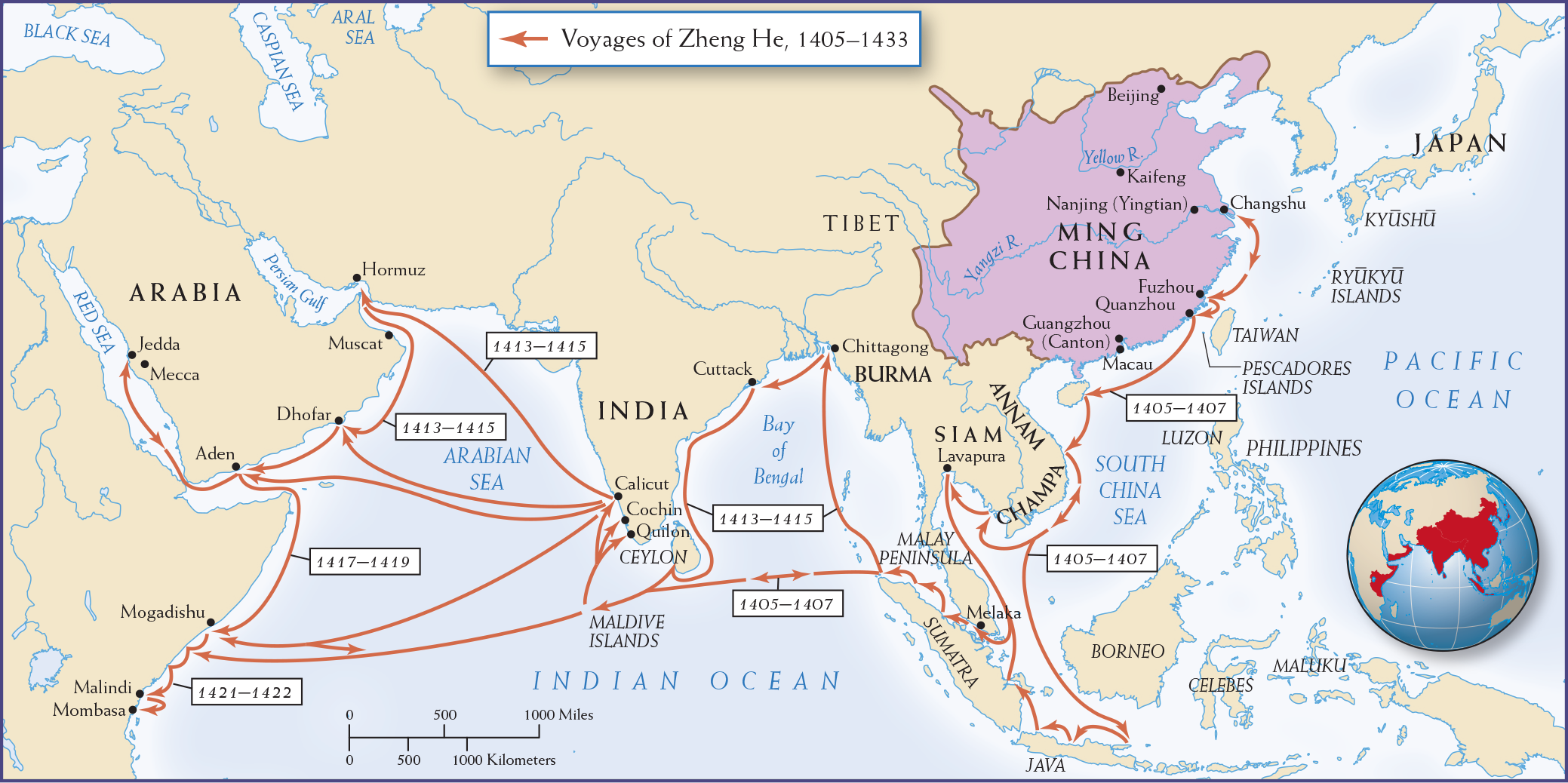
Zheng He and his entourage aimed to establish tributary relations with far-flung territories—from Southeast Asia to the Indian Ocean ports, to the Persian Gulf, and to the east coast of Africa. (See Map 11.5.) These expeditions did not seek territorial expansion but rather expanded control of trade and tribute. Zheng traded for ivory, spices, ointments, exotic woods, and even some wildlife, including giraffes, zebras, and ostriches. He also used his considerable force to intervene in local affairs, exhibiting China’s might in the process. If a community refused to pay tribute, Zheng’s fleet would attack it. He encouraged rulers or envoys from Southeast Asia, India, Southwest Asia, and Africa to visit his homeland. When local rulers were uncooperative, Zheng might seize them and drag them all the way to China to face the emperor, as he did to the rulers of Sumatra and Ceylon.
More information
Map. 11.5 is titled Voyages of Zheng He, 1405-1433 and shows the routes followed by the famous Ming naval commander. The first voyage (1405-1407) starts in Changshu and goes to Fuzhou, and Quanzhou in Ming China. Then the route goes to Lavapura in Siam, Melaka on the Malay Peninsula, and places on the islands of Java and Sumatra before crossing the Indian Ocean to Ceylon (and then returning the same way). The second voyage (1413-1415) goes north from Sumatra to Chittagong in Burma, Cuttack, Quilon, Cochin, and Calicut in India. The second voyage also goes to Hormuz, Dhofar, Aden, Jedda, and Mecca in Arabia. Zheng He’s third voyage (1417-1419) goes between Aden and Mogadishu. From 1421-1422, the voyage travels from Mogadishu to Malindi and Mombasa. The countries and areas named on the map include Ming China, Japan, Philippines, Borneo, Celebes, Maluku, Java, Sumatra, Siam Burma, Annam, Champa, Malay Peninsula, Burma, India, and Arabia.
MAP 11.5 | Voyages of Zheng He, 1405–1433
Zheng He’s voyages are some of the most famous in world history. Many have speculated about how history might be different if the Chinese emperors had allowed the voyages to continue.
- What routes did Zheng He’s armada follow?
- Referring to other maps in this chapter and earlier chapters, with what peoples did Zheng He’s armada come into contact?
- Using the scale on the map, estimate how far Zheng He’s armada sailed. How does this distance compare with the distances covered by other world travelers you’ve encountered in this text?
As spectacular as they were, Zheng’s accomplishments could not survive the changing tides of events at home. Although many items gathered on his voyages delighted the court, most were not suitable for everyday commerce. The expeditions were glamorous but expensive, and in 1424, when the Yongle Emperor died, they lost their most enthusiastic patron. Moreover, by the mid-fifteenth century there was a revival of military threats from the north. At that time, the Ming court was shocked to discover that during a tour of the frontiers, the emperor had been captured and held hostage by the Mongols. Recalling how the maritime-oriented Song dynasty had been overrun by invaders from the north (see Chapter 10), Ming officials withdrew imperial support for seagoing ventures and instead devoted their energies to overland ventures and defense. Thus, Zheng’s expeditions came to a complete halt in 1433. Never again did the Ming undertake such large-scale maritime ventures, although individual merchants returned to their profitable coastal trade routes.
The Chinese decision to forgo overseas ventures after 1433 was momentous. Although China remained the wealthiest, most densely settled region of the world with the most fully developed state structure and thriving market, the empire’s wariness of overseas projects deprived merchants and would-be explorers of vital support just at the time that others were beginning to look outward and across the oceans.
Glossary
- Ming dynasty
- Successor to the Mongol Yuan dynasty that reinstituted and reinforced Han Chinese ceremonies and ideals, including rule by an ethnically Han bureaucracy.
- Zheng He
- Ming naval commander who, from 1405 to 1433, led seven massive naval expeditions to impress other peoples with Ming might and to establish tributary relations with Southeast Asia, Indian Ocean ports, the Persian Gulf, and the east coast of Africa.