Mercantilism
Global Commerce and Climate Change
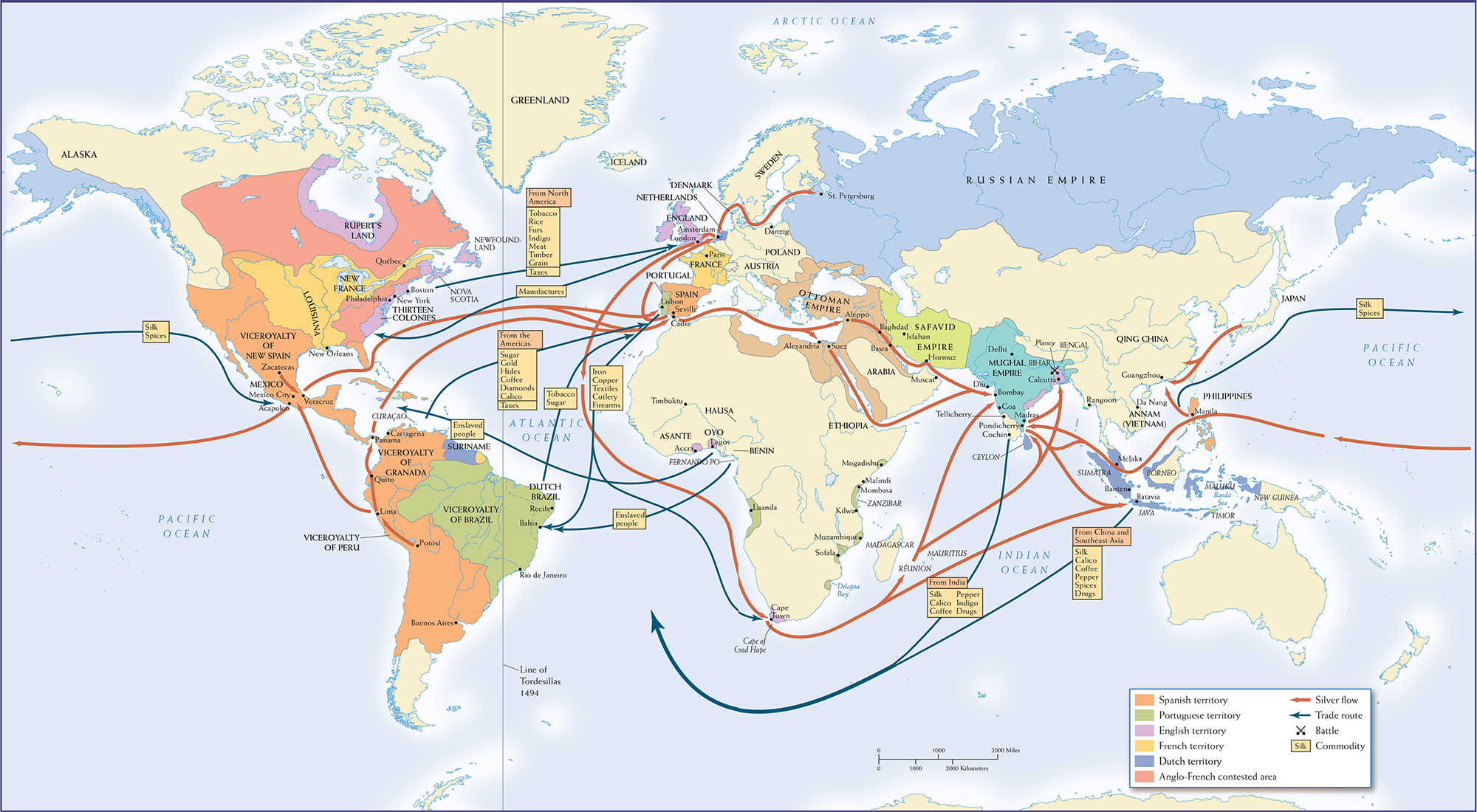
In spite of the worldwide trauma brought on by the plunge in temperatures, global trade flourished during this period. Sugar and silver, along with enslaved human beings, were considered the primary items, promoted equally by merchant groups and the rulers and commoners of sponsoring nations. Increasing economic ties brought new products into world markets: furs from French North America, sugar from the Caribbean, tobacco from British colonies on the American mainland, coffee from Southeast and Southwest Asia, and enslaved people from West and central Africa. (See Current Trends in World History: Stimulants, Sociability, and Coffeehouses; see also Map 13.1.)
Closer economic contact bolstered some states and destabilized others. It buoyed the legitimacy of England and France, and it prompted strong local support of new rulers in Japan and parts of sub-Saharan Africa. With rising powers and scrambles to get into the commodities business came competition, friction, and warfare. Governments had to squeeze more resources from trade and agriculture, which spurred protest and open rebellions during the Little Ice Age. Civil wars and social unrest swept through much of the world. England, France, and Japan faced mass peasant uprisings. In the Ottoman state, rebellions almost brought the empire to its knees; the Safavid regime foundered and then collapsed; the Ming dynasty imploded and gave way to the Qing. In India, rivalries among princes and merchants eroded the Mughals’ authority, compounding the instability caused by peasant uprisings.
Another result of the plunge in temperatures was a flight from marginal agricultural lands into the cities. The world had never experienced such massive urbanization: 2.5 million Japanese lived in cities, roughly 10 percent of the population, and in Holland over 200,000 lived in ten cities close to Amsterdam. But city officials were ill equipped to deal with the influx. Disease swept through overcrowded houses, and fire ravaged whole districts. London had an excess of 228,000 deaths over births, yet continued to grow through in-migration. Hardly an escape from rural poverty, cities had inordinately high mortality rates, what one scholar has called “the graveyard effect” (Parker, Global Crisis, p. 58).
Transformations in global relations began in the Atlantic, where the extraction and shipment of gold and silver siphoned wealth from the Americas to Afro-Eurasia. Mined mainly by coerced Indigenous people and delivered into the hands of merchants and monarchs, silver from the Andes and Mesoamerica boosted the world’s supply of money and injected liquidity into the global trading networks. Increasing dependence on silver flows posed risks around the world; during the boom years of the sixteenth century, liquidity poured into the world economy and inflated prices. But there could also be sharp contractions, especially after 1620, which deflated prices and led to shortages. Then, a new boom began after 1690: new silver veins opened in Mexico and a gold rush made Brazil the world’s largest producer of that gilded ore. For societies that depended on precious metals for money supply, the ups and downs of mining output, resulting in inflation and deflation, created an economic roller coaster.
But overall, rising money supply and new institutions like stock markets and lending houses spurred global commercial activity. American mining exports were so lucrative for Spain and Portugal that other European powers wanted a share of the bounty, so they, too, launched colonizing ventures and conquests. Although these latecomers found few precious minerals, they devised other ways to extract wealth, for the Americas had fertile lands on which to cultivate sugarcane, cotton, tobacco, indigo, and rice. The Americas also had fur-bearing wildlife, whose pelts were prized in Europe.
If silver quickened the pace of global trade, sugar transformed diets. First domesticated in Polynesia, sugar was not central to European diets before American plantations started exporting it. Previously, Europeans had used honey for sweetener, but they soon became insatiable consumers of sugar. Between 1690 and 1790, Europe imported 12 million tons of sugar—approximately 1 ton for every African enslaved in the Americas. Public tooth pulling became a popular entertainment (for spectators!) in cities like Paris, and tooth decay became a leading cause of death for Europeans.
Extracting wealth from colonies gave rise to a new economic model to govern long-distance relations between societies. No matter what products they supplied, colonies were supposed to provide wealth for their “mother countries”—according to exponents of mercantilism, the economic theory that drove European empire builders. Hitherto, conquests aimed to plunder the defeated or to claim tribute. But the economic integration of the Americas—the peoples and lands—gave rise to policies and concepts that aimed to keep wealth flowing from one society to another in large sums year after year, generation after generation. Mercantilism saw the world’s wealth as fixed: any one country’s wealth came at the expense of other countries. The theory further assumed that overseas possessions existed solely to enrich European motherlands because it measured imperial power according to the hoard of treasure in the crown’s coffers. To bulk up the treasury, motherlands were supposed to export more goods than they imported and thereby sustain trade surpluses. Lucrative colonies were like magnets for competitors who wanted in on the action. Empires were therefore in a constant struggle to shut out rivals and interlopers, lest foreign traders drain precious resources from an empire’s exclusive domain. The result was a vicious cycle: extraction allowed European states to grow rich while the feud to protect extraction rackets generated unceasing wars between rivals. Ultimately, mercantilists believed, as did the English philosopher Thomas Hobbes (1588–1679), that “wealth is power and power is wealth.”
The mercantilist system required an alliance between the state and its merchants. Mercantilists understood economics and politics as interdependent, with the merchant needing the monarch to protect his interests and the monarch relying on the merchant’s trade to enrich the state’s treasury. Chartered companies, such as the Virginia Company (English) and the East India Companies (Dutch and English), were visible examples of the collaboration between the state and the merchant classes. European monarchs awarded these firms monopoly trading rights over vast areas. These policies and institutions of mercantilism augmented the competition among European empires for markets, colonies, and spoils, and this escalated the penetration into colonial interiors and wars between empires. As competition and extraction intensified, this cycle coincided with a global environmental shock. The combination of global war and global climate change was explosive.
The Little Ice Age
While commerce laced the world together, the global climate entered what is known as the Little Ice Age, which shocked the planet’s survival systems with plunging temperatures and drought. It also happened to coincide with a downturn in New World mining output. The combination was toxic. In some places, the effect of falling temperatures, shorter growing seasons, and irregular precipitation patterns was felt as early as the fourteenth century. But the impact of the Little Ice Age reached farther and deeper in the seventeenth century. What caused this climate change is a matter of debate. Unlike climate change today, it was not caused by human energy needs. Some experts claim that a combination of low sunspot activity and volcanic eruptions choked the atmospherechanged ocean currents. Others have argued the reverse—that changing currents altered the pressure on continental shelves, which set off earthquakes and volcanoes. Whatever the explanation, the results ravaged an interconnected world. What’s more, recent research has revealed that the great dying of Indigenous peoples in the sixteenth and seventeenth centuries, as described in the previous chapter, was a major factor producing the Little Ice Age. The collapse in Indigenous populations cleared the way for a return of trees and bushes to what was once densely tilled land. This created what scientists call a “carbon sink.” The return of forests gave the planet the means to pull vast quantities of carbon dioxide from the atmosphere; this meant that the earth trapped less of the sun’s heat—which in turn cooled and dried the air. In a sense, this was the reverse of the trend we see today, in which deforestation reduces the planet’s capacity to absorb carbon dioxide, leading to warming.
Current Trends in World History
Stimulants, Sociability, and Coffeehouses
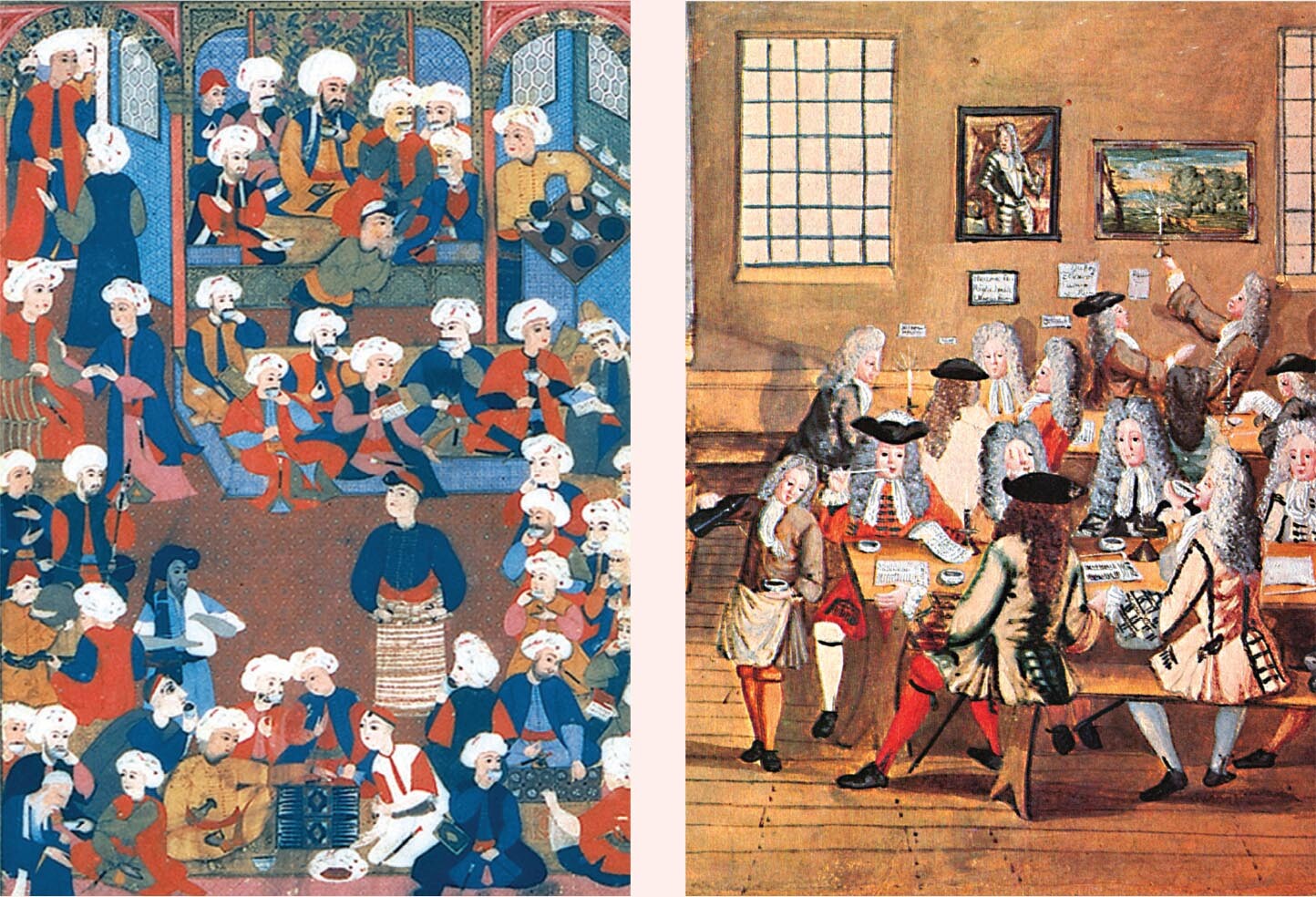
While armies, travelers, and missionaries were breaching the world’s main political and cultural barriers, it was commodities that had unsung effects on everyday lives. The rise of world commodities transformed production and consumption. Ruling elites struggled to control and to curtail the desire of their populations to dress themselves in fine garments, to possess jewelry, and to consume satisfying food and drink no matter where these products came from. The history of commodities is a central concern for world historical research: to make products for other peoples’ consumption meant crossing cultural barriers and connecting peoples over long distances. As the world’s trading networks thrived in the seventeenth and eighteenth centuries, merchants in Europe, Asia, Africa, and the Americas served as the brokers of new commodity exchange—at a scale that would have made the Silk Road traders green with envy. By far the most popular commodities were a group of stimulants: coffee, cocoa, sugar, tobacco, and tea. These were not just stimulating—they were addicting. And they were not just addicting—they reinforced the demand for each other. People added sugar to ease the bitterness of coffee and consumed tea while puffing on tobacco; these items functioned like a narcotic cocktail. Previously, many of these products had been grown in isolated parts of the world: the coffee bean in Yemen, tobacco and cocoa in the New World, and sugar in Bengal. Yet, by the seventeenth century, in nearly every corner of the world, the well-to-do began to congregate in coffeehouses, consuming these new products and engaging in sociable activities. While new consumption habits laced the world together, globalized commodity frontiers expanded commercial production across the tropics.
More information
Many people gathered together in a banquet hall while kneeling and standing around with coffee. About forty men, almost all wearing white turbans, are seated in several rows while servers bring them coffee. There are several arches with patterns on the tops in the back of the hall.
An illustration shows coffee drinkers sitting at two tables in an English coffeehouse. In the illustration, almost all wear long wigs, while half have black hats. Some sit, others stand, one drinks, another pours, and a third raises his cup in a toast. A portrait and a landscape painting are hung on the wall behind the tables.
Coffeehouses everywhere served as locations for social exchange, political discussions, and business activities. Yet they also varied from cultural area to cultural area, reflecting the values of the societies in which they arose.
The coffeehouse first appeared in Islamic lands late in the fifteenth century. As coffee consumption caught on among the wealthy and leisured classes in the Arabian Peninsula and the Ottoman Empire, local growers protected their advantage by monopolizing its cultivation and sale and refusing to allow any seeds or cuttings from the coffee tree to be taken abroad.
Despite some religious opposition, coffee spread into Egypt and throughout the Ottoman Empire in the sixteenth century. Ottoman bureaucrats, merchants, and artists assembled in coffeehouses to trade stories, read, listen to poetry, and play chess and backgammon. Indeed, so deeply connected were coffeehouses with literary and artistic pursuits that people referred to them as schools of knowledge.
From the Ottoman territories, the culture of coffee drinking spread to western Europe. The first coffeehouse in London opened in 1652, and within sixty years the city claimed no fewer than 500 such establishments. In fact, the Fleet Street area of London had so many that the English essayist Charles Lamb commented, “The man must have a rare recipe for melancholy who can be dull in Fleet Street.” Although coffeehouses attracted people from all levels of society, they especially appealed to the new merchant and professional classes as locations where stimulating beverages like coffee, cocoa, and tea promoted lively conversation without the inebriating effects of alcohol—and spared patrons the reputational toll of bawdy taverns. However, some opponents claimed that excessive coffee drinking destabilized the thinking processes; the narcotic effects of caffeine, it was said, might even promote conversions to Islam. But consumer demand won out: the pleasures of coffee, tea, and cocoa prevailed. These bitter beverages in turn required liberal doses of the sweetener sugar. A smoke of tobacco topped off the experience. In this environment of pleasure, patrons of the coffeehouses indulged their addictions, engaged in gossip, conducted business, and talked politics.
QUESTIONS FOR ANALYSIS
- What factors drove the consumption of stimulants like coffee on a global scale?
- What other commodities from earlier in world history played a similar role? Were there differences in the underlying factors, such as scale of consumption, between the different periods?
EXPLORE FURTHER
Hattox, Ralph S., Coffee and Coffeehouses: The Origins of a Social Beverage in the Medieval Near East (1985).
Pendergrast, Mark, Uncommon Grounds: The History of Coffee and How It Transformed Our World (2010).
While the seventeenth century was especially severe, the cold lasted well into the next century and in parts of North America into the nineteenth. One night in 1709, it is said, the king of France’s beard froze solid while he slept. The Thames River and Dutch canals iced over, inspiring artists to create now-famous paintings of people skating on Dutch ponds and lakes. So did the waters separating Sweden from Denmark, which allowed Swedish armies to march right across to Copenhagen. In West Africa, colder and drier conditions saw an advance of the Sahara Desert, leading to repeated famines in the Senegambia region. In addition, Timbuktu and the region around the Niger bend suffered their greatest famines in the seventeenth century. It was still so cold in the early nineteenth century that the English novelist Mary Shelley and her husband spent their summer vacation indoors in Switzerland telling each other horror stories, which inspired Shelley to write Frankenstein. Climate change brought mass suffering because harvests failed. In China, the orange groves of Jiangxi Province had to be abandoned after constant and widespread freezing; rice fields, which need a wet spring, went dry. Famine spread across Afro-Eurasia.
The Global View
More information
Map 13.1 is titled, Trade in Silver and other Commodities, 1650-1750. The map shows Spanish, Portuguese, English, French, and Dutch territories, as well as Anglo-French contested areas, commodities, silver flow, trade route, and battles. Spanish territories include the Viceroyalty of New Spain and Mexico in North America and the Viceroyalties of Granada and Peru in South America, as well as the Philippines. Portuguese territories include the Viceroyalty of Brazil in South America the area around Luanda in West Africa, and enclaves from Mogadishu to Sofala along the coast of East Africa. English territory includes Rupert’s Land, the Thirteen Colonies, Nova Scotia, and Newfoundland in North America, as well as small enclaves around Accra, Lagos, and Cape Town in Africa and near Calcutta in India. French territories include Louisiana and New France in North America, as well as a sliver of Surinam. Dutch territory includes the rest of Surinam, Sumatra, Java, Borneo, Timor, and part of New Guinea. Silver flows out of Peru and Mexico and across the world, traveling to Europe, Southwest Asia, Africa, and eventually East Asia. Trade routes travel to Europe from India, China, and Southeast Asia, between Europe and North America and the Caribbean, and between Africa and South America. Other commodities traded globally included silk and spices (from China); silk, pepper, calico, coffee, and drugs (from India, China, and Southeast Asia); indigo from India; slaves from Africa; tobacco and sugar from Brazil; tobacco, rice, furs, meat, timber, grain indigo and Texas from North America; sugar, gold, diamonds, calico, coffee, and taxes from South America; and iron, copper, textiles, cutlery, firearms and manufactures from Europe. The battle of Plassey occurred in Bengal.
More information
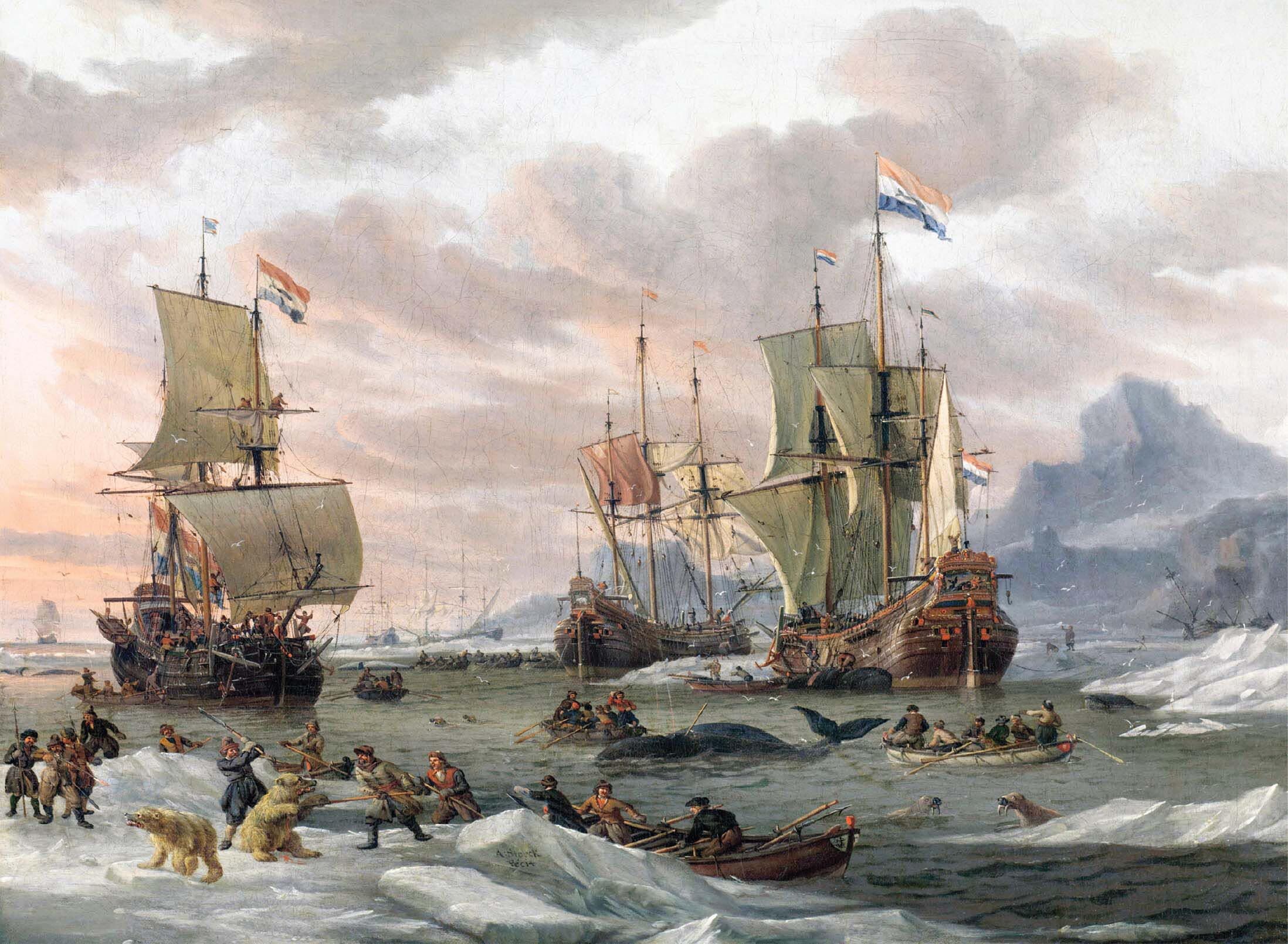
Three large Dutch whaling ships sail in the ocean near many row boats full of people. There are people with long poles on a stretch of icy land in the foreground and two polar bears, one of whom is fighting with one of the people. There are several whales and walruses in the water. There are large icebergs and several more whaling ships in the distance.
There were also political consequences. As droughts, freezing, and famine spread across Afro-Eurasia, herding societies invaded settled societies. Starving peasants lashed out against their lords and rulers. Political divides opened up. On the continent of Europe, the Thirty Years’ War raged out of control, stoked by farmers’ anger (see later in this chapter). Although religious and national strife fueled the violence, it owed much to the decline of food production. In the Americas, centuries of plagues had already ripped through Indigenous populations. But the long cold snap brought more suffering. Severe cold and drought afflicted the Rio Grande basin in northern Mexico, culminating in a deep freeze in 1680. The Puebloans rose up en masse against Spanish rulers in a desperate bid for survival. Tensions between Iroquois and Huron rose in the Great Lakes region of North America. Civil war between Portugal and Spain in Europe wreaked havoc in Iberian colonies and led to invasion and panic. According to the bishop of Puebla, in Mexico, “The whole monarchy trembled and shook, since Portugal, Catalonia, the East Indies, the Azores and Brazil had rebelled.” In the viceregal capital of New Spain, “apprehension and panic” seized the city. The Ottomans faced a crippling revolt, while in China the powerful Ming regime could not deal with the climate shock. It was invaded, as was so often the case when pastures turned to dust, by Manchurian peoples from beyond the Great Wall. They installed a new regime, the Qing dynasty. Indeed, Thomas Hobbes, England’s notable political philosopher and author of a classic work of political theory, Leviathan, summed up the age: “Man’s natural state, before they came together into society, was war; and not simply war, but the war of every man against every other man.” He went on to add famously that “the life of man [is] solitary, poor, nasty, brutish, and short.”
More information
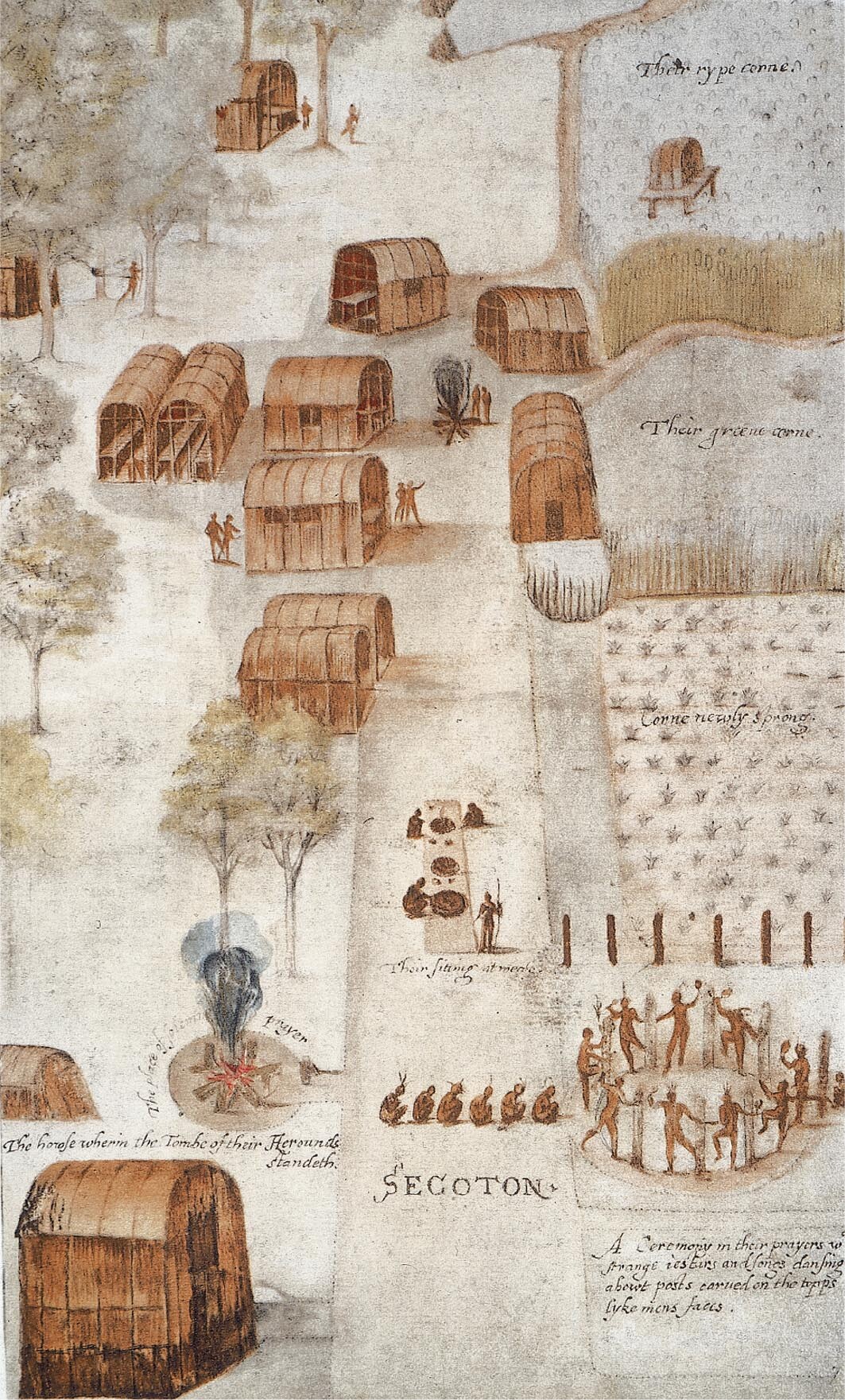
A bird’s-eye view of an Indigenous North American village of thirteen houses. A path at the top leads to the main group of houses where it widens through the settlement. In the center of the main group of houses, a spoke-shaped fire attended by two people is burning, and below, further down the path, are shown mats spread out on which are three large circular eating vessels and six small objects of indefinite form. One squatting and two sitting figures are seen eating and one man armed with a bow stands by. To the right of the path and street are three cornfields each at a different stage of growth. The top field contains a small hut, open at one side, which may shelter a seated figure and is mounted on a platform with four legs. The houses to the left of the road are set among birch-like trees. Among the trees to the left are two houses with three figures nearby. Four other figures are seen among the main group of houses, which are shown with open ends. At the bottom right, a path separates the lowest cornfield from the ceremonial area and is bordered by a row of seven posts. Below this is a circle of seven posts and on a path around it nine people are dancing. Six people squat or sit in line on the roadway to the left. A further path is indicated at the bottom right, below the dancers. To the left of the roadway, a spoke-shaped log fire is burning. To the left of the fire is a but with the end covered and below, at the bottom left, is a house taller than the rest which may have openings in the end wall. A short path leads from it to the road. There is text scattered throughout the illustration.
The Little Ice Age had a devastating impact on populations. It is hard, however, to separate the victims of starvation from the victims of war, since warfare aggravated starvation and famine contributed to war. But in continental Europe, the Thirty Years’ War carried off an estimated two-thirds of the total population, on par with the impact of the Black Death (see Chapter 11). Elsewhere, estimates were closer to one-third. Not until the twentieth century did the world again witness such extensive warfare. For some Afro-Eurasian regimes, the global crisis led to collapse and decline; for others, it became an opportunity for renewal and reinvention.
Glossary
- mercantilism
- Economic theory that drove European empire builders. In this economic system, the world had a fixed amount of wealth, which meant one country’s wealth came at the expense of another’s. Mercantilism assumed that colonies existed for the sole purpose of enriching the country that controlled the colony.
- chartered companies
- Private firms that were awarded monopoly trading rights over vast areas by European monarchs (for example, the Virginia Company and the Dutch East India Company).
- Little Ice Age
- A period of global cooling—not a true ice age—that extended roughly from the sixteenth to the nineteenth century. The dates, especially for the start of the period, remain the subject of scientific controversy.