Other Parts of Asia in the Seventeenth and Eighteenth Centuries
The other regions in Asia also grappled with the Little Ice Age. All faced droughts, high winds, hailstorms, and earthquakes. But some weathered the troubles better than others. The most successful was Japan. The Tokugawa regime, installed early in the sixteenth century, overcame the Little Ice Age adversities. In fact, it experienced a century of increased agricultural productivity, rapid population growth, and impressive urbanization, mostly owing to the shrewd provincial administrators appointed by Tokugawa rulers. At the other end of the spectrum was the Safavid regime in Iran, which crumbled in the seventeenth century, as ethnic diversity and ineffective rulers drained its legitimacy. In the middle was Mughal India, which faced upheavals but endured. In India, four monsoons and a plethora of rebellions led Shah Aurangzeb (r. 1658–1707) to carry out savage persecutions of non-Muslim groups. Nevertheless, Mughal monarchs, even Aurangzeb, dealt promptly and reasonably effectively with the famines, even the most severe one that ravaged the Gujarati region between 1630 and 1632.
Global trading networks boomed in Asia, even as some of the regimes wavered or cracked up. For the most part, however, they kept commercial newcomers to the edges of their prosperous systems. In contrast to the conquests in the Atlantic region, Europeans skirted around the fringes of Asia and had to content themselves as commercial intermediaries in Asia’s brisk long-distance trade. They penetrated Asian markets with American silver largely because the Asians, especially the Chinese, scorned European trade goods. Nor could they conquer Asian empires or colonize vast portions of the region or enslave Asian peoples as they had Africans. Still, chipping away at the edges had cumulative effects that became visible by the end of the eighteenth century.
The Dutch in Southeast Asia
In Southeast Asia, the Dutch already enjoyed a dominant position by the seventeenth century. Although the Portuguese had seized the vibrant port city of Melaka in 1511 and the Spaniards had taken Manila in 1571, neither was able to monopolize the lucrative spice trade. To challenge them, the Dutch government persuaded its merchants to charter the Dutch East India Company (abbreviated as VOC) in 1602. Benefiting from Amsterdam’s position as the world’s most efficient money market, the VOC raised enough capital to build a vast corporate navy. At its peak the company had 257 ships and employed 12,000 persons. Throughout two centuries it sent ships manned by a total of 1 million men to Asia.
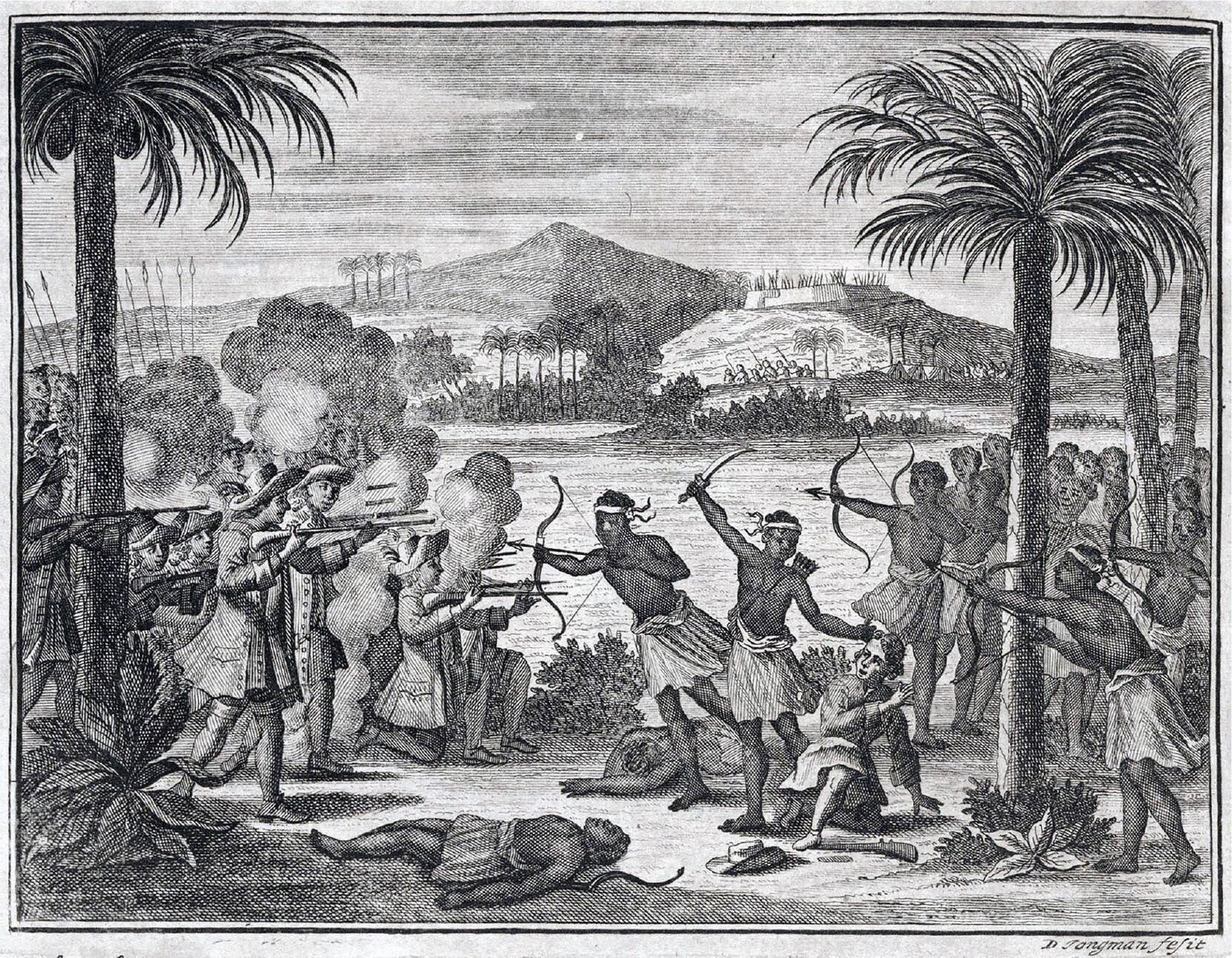
More information
A black and white print of Dutch invaders with muskets fighting Maluku warriors with bows and arrows. The bodies of several fallen warriors lay on the ground. Smoke drifts upwards from the muskets of the invaders. There are several trees in the foreground and more trees and a mountain in the background.
The commercial-military drive created a conquering machine in Southeast Asia to develop extractive economies, akin to the labor-plantation camps in the Atlantic. Spices, coffee, tea, and teakwood became key exports. (See again Map 13.1.) The company’s objective was to secure a trade monopoly wherever it could, fix prices, and subdue local populations, enslaving them where they could, and where they could not, to import workers from the rest of the region. In 1619, under the leadership of Jan Pieterszoon Coen (who once said that trade could not be conducted without war and war could not be conducted without trade), the Dutch swept into the Javanese port of Jakarta (renamed Batavia by the Dutch) and created a fortress. Two years later, Coen’s forces seized a cluster of nutmeg-producing islands known as Banda. Traditional chiefs were killed. Villagers were enslaved. The vibrant local coastal trading systems based on long dugout canoes called prahus were forced to accept Dutch monopolies. Salt, indigo, Japanese copper, timber, opium, and anything else that was tradable had to be controlled by Dutch masters. And to buy these goods, islanders had to work on Dutch plantations for miserable wages. To clear the land for commercial spice production and to build fortresses and ships, the Dutch ordered forests to be razed.
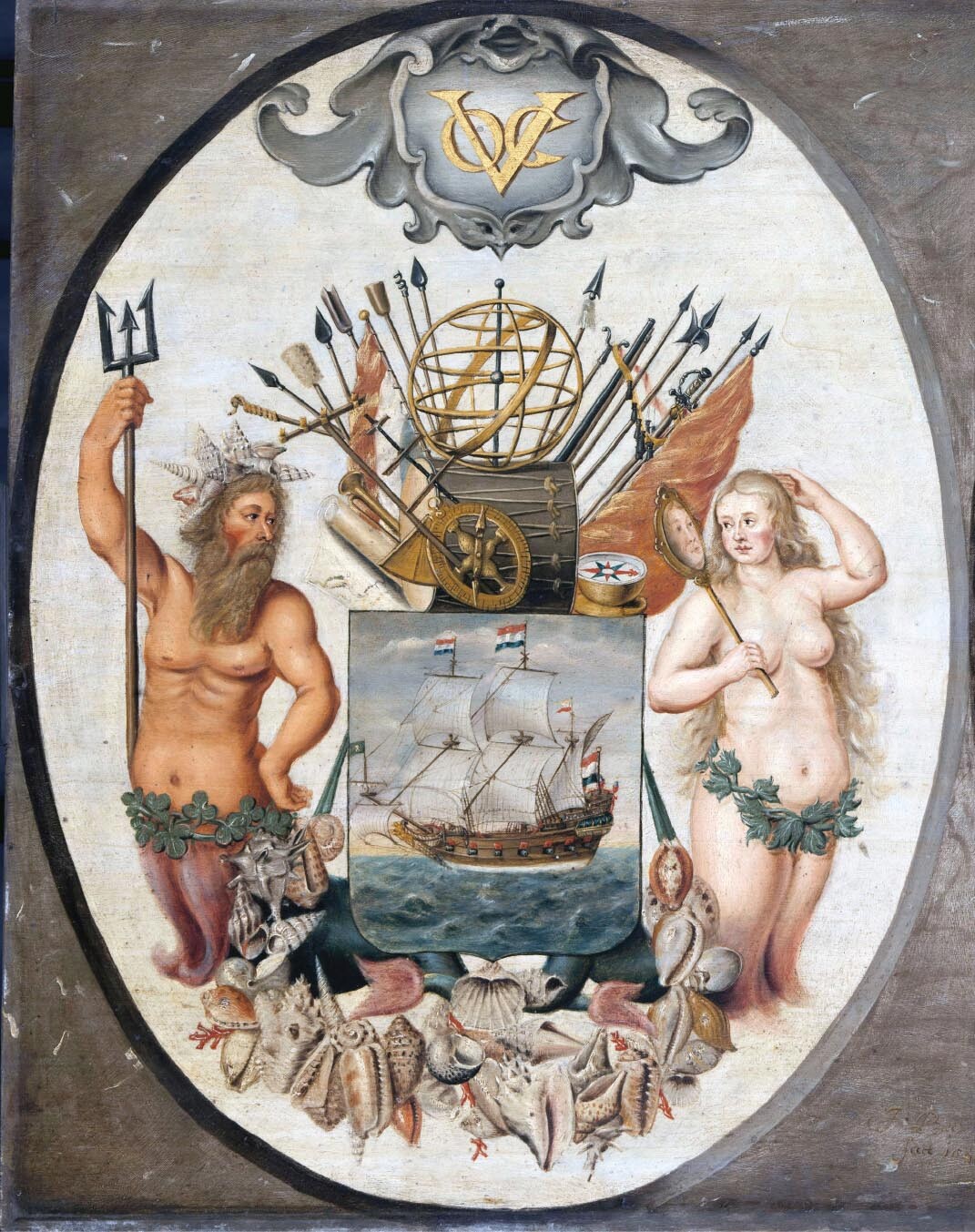
More information
The V O C coat of arms depicts a painting of a Dutch man-of-war ship with Neptune and Providentia on either side. Above the painting there is pile with nautical instruments, arrows, and a golden globe. There is a pile of various seashells below the painting. Neptune holds a trident, wears a crown of shells, and has a long beard. Providentia holds a mirror and has long flowing hair. Above the illustration there is a crest with the letters V O C.
Islanders rose up wherever possible, sometimes with the support of Dutch rivals, the English. The people of the Maluku Strait, for instance, objected to the Dutch commercial restrictions and monopoly extraction. One chief, Majira, from the island of Seram, wanted to sell his villagers’ cloves directly to Asian merchants and rallied his people to drive the Dutch from their lands. In 1651, he went to war, but his arrows and spears were no match for Dutch muskets.
The islands, once rich with dense forests and ecologically complex, became monocrop (single-crop) plantations. With their monopoly of nutmeg secured, the Dutch went after the market in cloves. Their strategy was to control production in one region and then destroy competitors, which entailed, once again, wars against producers and traders in other areas. Portuguese Melaka soon fell to the Dutch and became a VOC outpost. Although this aggressive expansion met widespread resistance, by 1670 the Dutch controlled all the lucrative spice trade from the Maluku islands.
As a result of the Dutch enterprise, European outposts such as Dutch Batavia and Spanish Manila soon rivaled and in some cases eclipsed old Asian entrepôts and their private merchant networks. Indeed, as Europeans, buoyed by their chartered monopolies, competed for supremacy in the borderlands of Southeast Asia, they made local societies serve their own ambitions and began replacing traditional networks with trade routes that primarily served European interests. The Dutch used Europe’s traditional appetite for Southeast Asian spices like nutmeg, pepper, and cloves, to which they added coffee, tea, and teakwood, to integrate the islands of the Dutch East Indies into the global economy.
Transformations in the Islamic Heartland
By the early seventeenth century, the three major Muslim empires of Afro-Eurasia, stretching from the Balkans and North Africa to South Asia, had a combined population of between 130 and 150 million. Yet, compared with Southeast Asia, they did not feel such direct effects of European intrusion. Here, trade was not as crucial as in East Asia. True, the importation of silver was significant and destabilizing. But Islamic regimes were not as dependent on silver as China was. The Islamic heartland did, however, face internal difficulties. While the Ottoman and Mughal Empires muddled along, the Safavid Empire fell into chaos.
THE SAFAVID EMPIRE The Safavid Empire had always required a powerful, religiously inspired ruler to enforce Shiite religious orthodoxy and to hold together the realm’s tribal, pastoral, mercantile, and agricultural factions. During its rise, charismatic political leadership and religious messianism had overcome the innate tendencies of the peoples living on the Iranian plateau to resist the authority of state power. The Iranian plateau consisted of vast semidesert and wooded areas surrounded by mountains and was inhabited by diverse, often-hostile ethnic, linguistic, and religious communities. Moreover, a substantial percentage of the Safavid population of 8.5 million comprised nomadic peoples who bristled when confronted with centralized power. Abbas I (r. 1588–1629), the fifth Safavid shah, used the strength of his personality, his commitment to Shiism, and his talent for playing off one group against another to enhance the state’s power (see Chapter 14). His successors were weaker and less charismatic, and the state foundered as eunuchs and harem women asserted their authority over that of the shahs and as tribal groups slipped away from control from the center.
By 1722, the state was under assault from within and without, and it collapsed abruptly at the hands of clans from the Afghan borderlands who overran its inept and divided armies and besieged the capital at Isfahan. (See again Map 13.1.) As the city’s inhabitants perished from hunger and disease, some desperate survivors ate the corpses of the deceased. After the shah abdicated, the invaders executed thousands of officials and members of the royal household. The empire limped along until 1773, when a revolt toppled the last ruler from the throne.
Even so, the Safavid period left an immense imprint on the peoples of the Iranian plateau. Most importantly, they continued their commitment to Shiism in a predominantly Sunni world and harkened back in admiration to their Persian historical traditions. (For a discussion of Safavid culture at its height, see Chapter 14.)
THE MUGHAL EMPIRE In contrast to the Ottomans’ setbacks, the Mughal Empire reached its height in the seventeenth century. The period saw Mughal rulers extend their domain over almost all of India and enjoy increased domestic and international trade. But they eventually had problems governing dispersed and resistant provinces, where many villages retained traditional religions and cultures.
Before the Mughals, India had never had a single political authority. Akbar and his successors had conquered territory in the north (see Chapter 12, Map 12.5), so now the Mughals turned to the south and gained control over most of that region by 1689. As the new provinces provided additional resources, local lords, and warriors, the Mughal bureaucracy grew better at extracting services and taxes. What it did not do was create a degree of centralized authority like the Ming or Qing in China. This made the Mughal Empire less brittle and more adaptive, but vulnerable to decentralizing pressures.
The Mughal Empire did resemble China in one basic aspect: it was an overland, not overseas, power and relied on agrarian rents, not trade, to fund its war-making machinery. Although the Mughals profited from seaborne trade, they never embarked on overseas expansion. The main source of their wealth was land rents, boosted via incentives to bring new land into cultivation. Here peasants planted, in part, New World crops like maize and tobacco. But the imperial economy also benefited from Europeans’ increased demand for Indian goods and services—such as a sixfold rise in the English East India Company’s textile purchases.
LOCAL AUTONOMY IN MUGHAL INDIA It is important to underscore the differences between European-style conquests, which aimed to dominate and even exterminate the conquered, and Mughal conquests, which aimed to subdue, but not wipe out, local kingdoms. In contrast to European expansion, which was based on the destruction of much Indigenous sovereignty in the Americas or the creation of new states in West Africa to mesh with the new transatlantic slave trade, Mughal expansion relied on confederacies and alliances with neighbors. The result was enormous wealth and resilience, but gradual dissolution. Eventually, Mughals were victims of their own success. More than a century of imperial expansion, commercial prosperity, and agricultural development placed substantial resources in the hands of local and regional authorities. As a result, local warrior elites became more autonomous. By the late seventeenth century, many regional leaders were well positioned to resist Mughal authority.
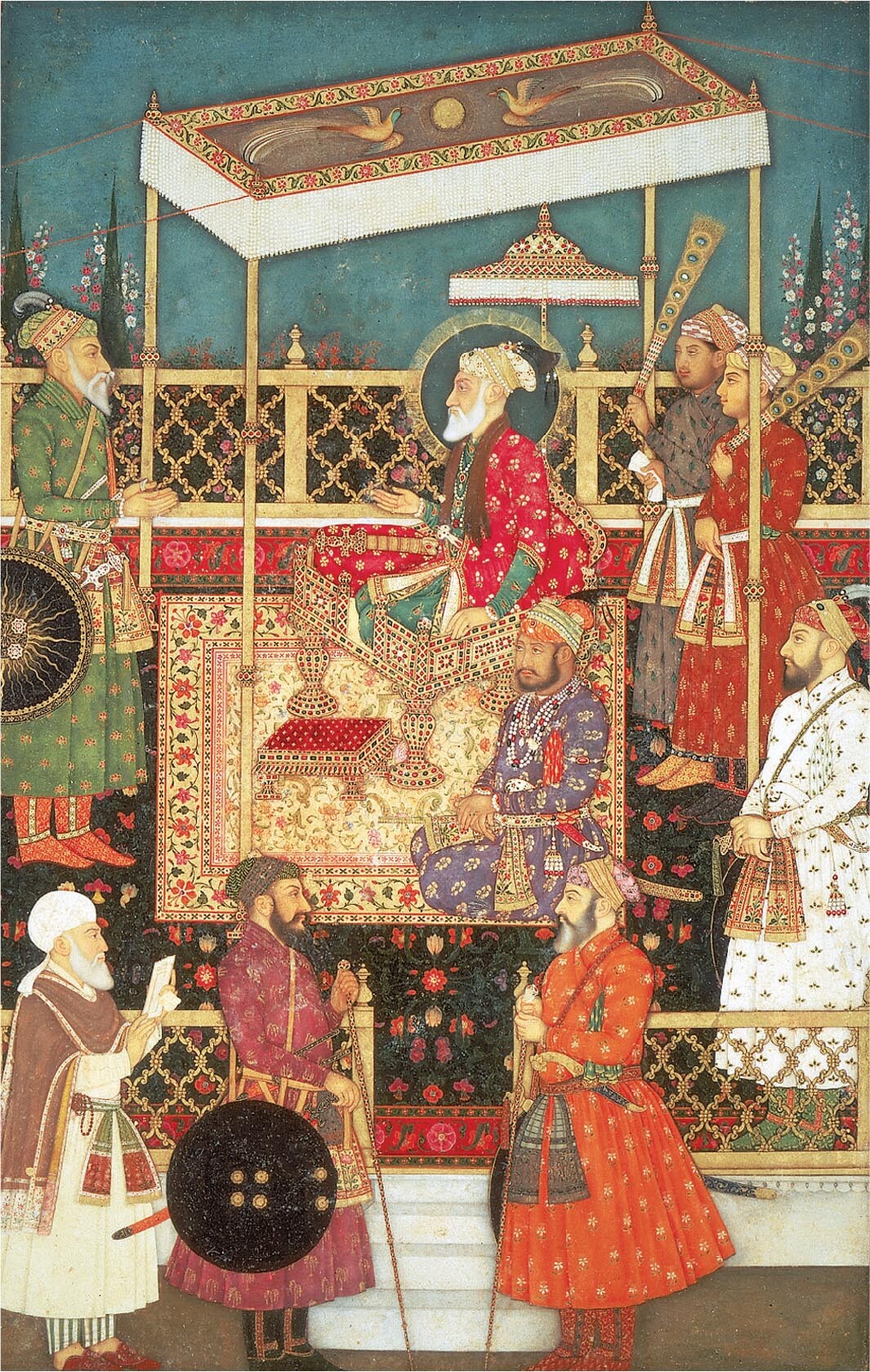
More information
Aurangazeb sits on a throne in a balcony, beneath a canopy adorned with birds of paradise. An old bearded man stands facing him while another man kneels to his side. Six other men surround him.
Thus, increased prosperity enabled distant provinces to challenge central rulers. When, under Aurangzeb (r. 1658–1707), the Mughals pushed deep into southern India, they encountered fierce opposition from the Marathas in the northwestern Deccan plateau. (See again Map 13.1.) To finance this expansion, Aurangzeb raised taxes on the peasants. As resentment spread, even the elite grew restive at the drain on imperial finances. Seeking support from the ulama, the monarch abandoned the toleration of heterodoxy and of non-Muslims that his predecessors had allowed. All this turmoil set the stage for successful peasant revolts.
Now the Indian peasants (like their counterparts in Ming China, Safavid Persia, and the Ottoman Empire) capitalized on weakening central authority to assert their independence. They, too, were feeling the effects of the Little Ice Age on their lands’ productivity. Many rose in rebellions; others resorted to banditry. At this point the Mughal emperors had to accept diminished power over a loose unity of provincial “successor states.” (For a discussion of Mughal culture at its height, see Chapter 14.) Most of these areas accepted Mughal control in name only; local rulers administered semiautonomous regimes and kept a grip on local resources to prevent Delhi centralization. Yet India still flourished, and landed elites brought new territories into agrarian production. Cotton, for instance, supported a thriving textile industry as peasant households focused on weaving and cloth production. Much of their production was destined for export as the region deepened its integration into world trading systems.
PRIVATE COMMERCIAL ENTERPRISE The Mughals paid scant attention to commercial matters. Local rulers, however, welcomed Europeans into Indian ports, striking deals with merchants from Portugal, England, and Holland. Some Indian merchants formed trading companies of their own to control the sale of regional produce to competing Europeans; others established intricate trading networks that reached as far north as Russia.
One of these companies built a trading and banking empire that demonstrated how local prosperity could undercut imperial power. This was the House of Jagat Seth, which at first specialized in shipping Bengal cloth through Asian and European merchants. Increasingly, however, most of its business in the provinces of Bengal and Bihar was tax farming, whereby it collected taxes for the imperial coffers. (See again Map 13.1.) The Jagat Seths maintained their own retinue of agents to gather levies from farmers while pocketing substantial profits for themselves. In this way, they and other mercantile houses grew richer and gained greater political influence over financially strapped emperors. Thus, even as global commercial entanglements enriched some in India, the effects undercut the Mughal dynasty.
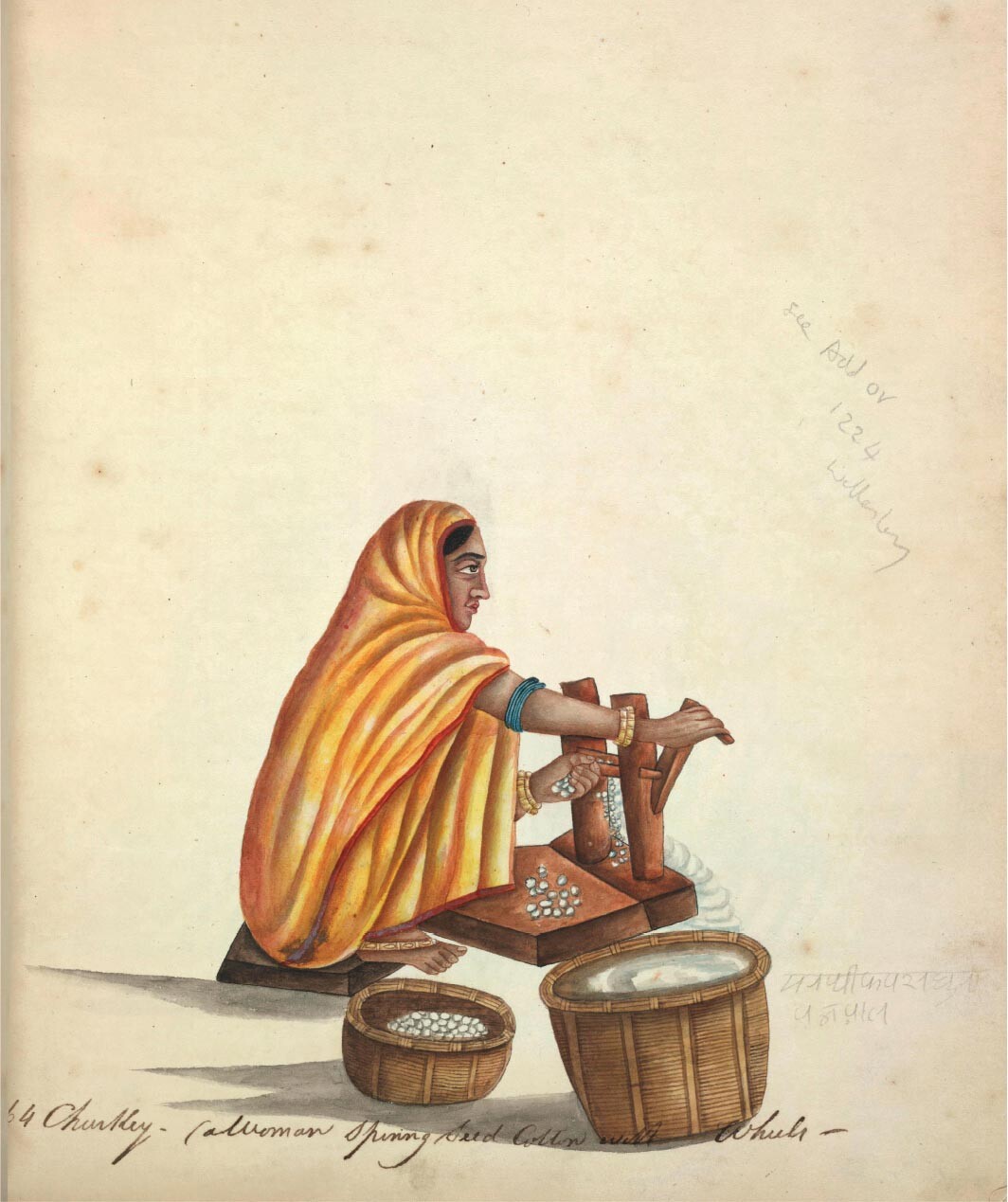
More information
A woman sits sideways and removes seeds from cotton using an old traditional cotton ginning tool. The woman is traditionally dressed with her head covered by a saree. Two baskets are placed near her. There is text at the bottom of the illustration.
Tokugawa Japan
Integration with the Asian trading system exposed Japan to new external pressures, even as the islands grappled with internal turmoil. But the Japanese dealt with these pressures more successfully than the mainland Asian empires (Ottoman, Safavid, Mughal, and Ming), which saw political fragmentation and even the overthrow of ruling dynasties. In Japan, a single ruling family emerged. This dynastic state, the Tokugawa shogunate, accomplished something that most of the world’s other regimes did not: it regulated foreign intrusion. While Japan played a modest role in the expanding global trade, it remained free of outside exploitation.
UNIFICATION OF JAPAN During the sixteenth century, Japan had endured political instability as banditry and civil strife disrupted the countryside. Regional ruling families, called daimyos, had commanded private armies of warriors known as samurai. The daimyos sometimes brought order to their domains, but no one family could establish preeminence over the others. Although Japan had an emperor, his authority did not extend beyond the court in Kyoto.
Ultimately, several military leaders attempted to unify Japan. One general, who became the supreme minister, arranged marriages among the children of local authorities to solidify political bonds. Also, to coax cooperation from the daimyos, he ordered that their wives and children be kept as semihostages in the residences they were required to maintain in Edo. After the general died, one of the daimyos, Tokugawa Ieyasu, seized power. This was a decisive moment. In 1603, Ieyasu assumed the title of shogun (military ruler), retaining the emperor in name only while taking the reins of power himself. He also solved the problem of succession, declaring that rulership would be hereditary and that his family would be the ruling household. This hereditary Tokugawa shogunate lasted until 1867.
Now administrative authority shifted from Kyoto to the site of Ieyasu’s domain headquarters: the castle town called Edo, later renamed Tokyo. (See Map 13.6.) The Tokugawa built Edo out of a small earthen fortification clinging to a coastal bluff. Behind Edo lay a village in a swampy plain. In a monumental work of engineering, the rulers ordered the swamp drained, the forest cleared, many of the hills leveled, canals dredged, bridges built, the seashore extended by landfill, and a new stone castle completed. By the time Ieyasu died, Edo had a population of 150,000.
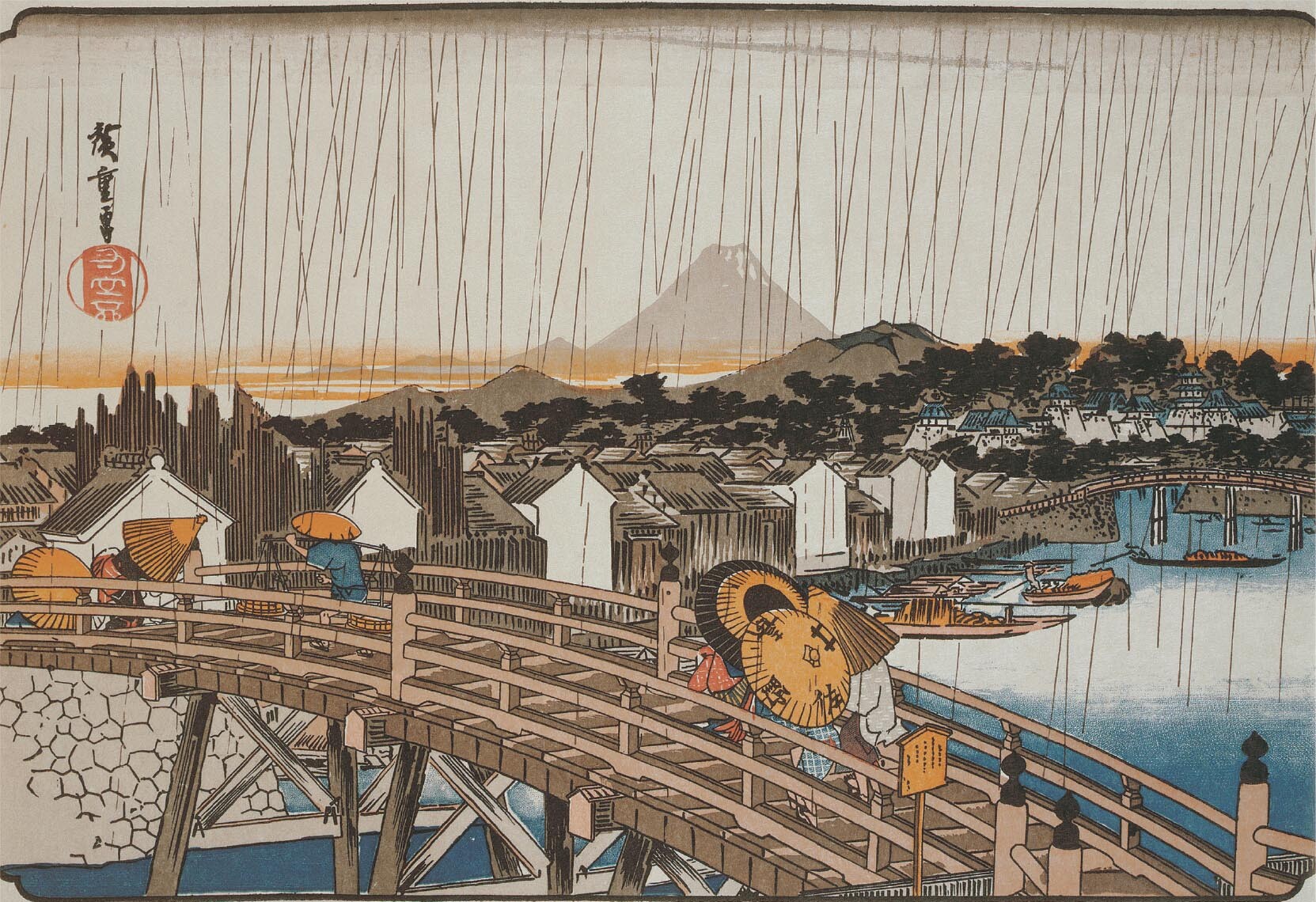
More information
A painting of the city of Edo shows a small part of the curved wooden bridge over a river. Few people are shown crossing the bridge sheltering under straw capes from rain. Several buildings, trees, and mountains line the shore. A mountainous volcano is in the background.
The Tokugawa shoguns ensured a flow of resources from the working population to the rulers and from the provinces to the capital. Villages paid taxes to the daimyos, who transferred resources to the seat of shogunate authority. No longer engaged in constant warfare, the samurai became administrators. Peace brought prosperity. Agriculture thrived. Improved farming techniques and land reclamation projects enabled the country’s population to triple between 1550 and 1700.
FOREIGN AFFAIRS AND FOREIGNERS Internal peace and prosperity did not insulate Japan from external challenges, especially the intrusion of Christian missionaries and European traders. Initially, Japanese officials welcomed these foreigners out of an eagerness to acquire muskets, gunpowder, and other new technology. But once the ranks of Christian converts swelled, Japanese authorities realized that Christians were intolerant of other faiths, believed Christ to be superior to any authority, and fought among themselves. Trying to stem the tide, the shoguns prohibited conversion to Christianity and attempted to ban its practice. After a rebellion by converted peasants protesting high rents and taxes, the government suppressed Christianity and drove European missionaries from the country.
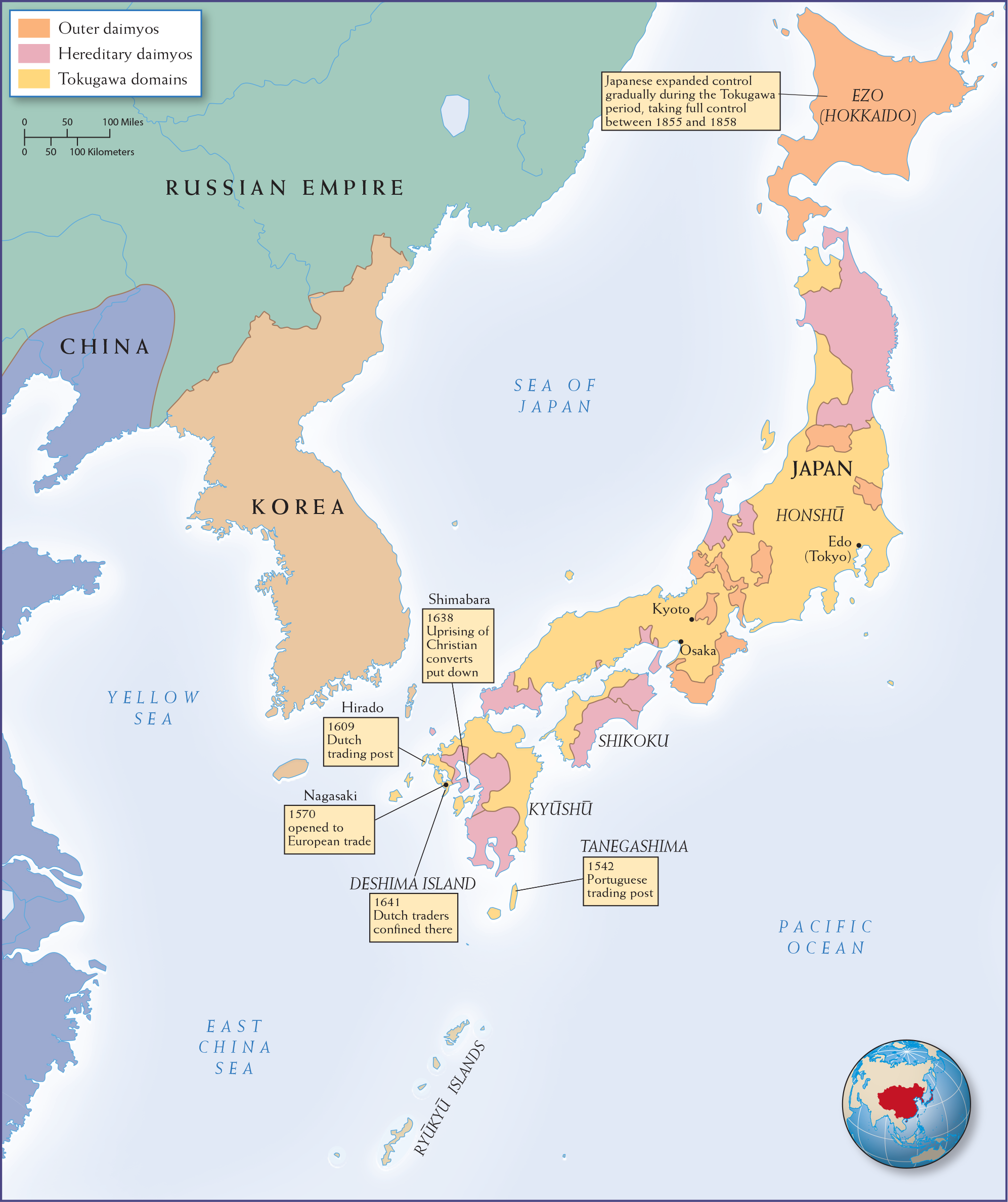
Even more troublesome was the lure of trade with Europeans. The Tokugawa knew that trading at various Japanese ports would pull the commercial regions in various directions, away from the capital. When it became clear that European traders preferred the ports of Kyūshū (the southernmost island), the shogunate restricted Europeans to trading only in ports under Edo’s direct rule in Honshū. Then Japanese authorities expelled all European competitors. Only the Protestant (and nonmissionizing) Dutch won permission to remain in Japan, confined to an island near Nagasaki. The Dutch were allowed to unload just one ship each year, under strict supervision by Japanese authorities.
More information
Map 13.6 is titled, Tokugawa Japan, 1603-1867. The map displays regions of hereditary daimyos, Tokugawa domains, and outer daimyos. Most of Japan is under Tokugawa domains. Hereditary daimyos control small pockets of land scattered across the country, particularly in Kyushu, Shikoku, and the northern part of Honshu. In the north, outer daimyos control the island of Ezo (Hokkaido). The map also shows that there was a Portuguese trading post on the island of Tanegashima in 1542. In 1570, Nagasaki opened to European trade. Dutch traders were confined to Deshima Island in 1641. There was a Dutch trading post in Hirado in 1609. An uprising of Christian converts was put down on Shimabara in 1638.
MAP 13.6 | Tokugawa Japan, 1603–1867
The Tokugawa shoguns created a strong central state in Japan at this time.
- According to this map, how extensive was their control?
- Based on your reading, what foreign states were interested in trade with Japan?
- How, according to the chapter, did Tokugawa leaders attempt to control relations with foreign states and other entities?
These measures did not close Tokugawa Japan to the outside world, however. Trade with China and Korea flourished, and the shogun received missions from Korea and the Ryūkyū Islands. Edo also gathered information about the outside world from the resident Dutch and Chinese (who included monks, physicians, and painters). A few Japanese were permitted to learn Dutch and to study European technology, shipbuilding, and medicine (see Chapter 14). By limiting such encounters, the authorities ensured that foreigners would not threaten Japan’s security.
New World silver and climate change challenged the major Asian states. Mughal rulers dealt with famines and rebellions while guiding South Asia to its greatest power and influence. China’s dynastic change from the Ming to the Qing did not diminish its wealth and power, although irregular supplies of silver (glut followed by scarcity) produced inflation and altered relations between the state and outlying regions. The Ottomans expanded into the Arab world and challenged the Portuguese in the Indian Ocean, but suffered significant military and territorial losses in Europe. The Europeans established commercial footholds in South and East Asia and thrust themselves into the already brisk Indian Ocean trade, while the Dutch created an export-oriented colony in Southeast Asia.
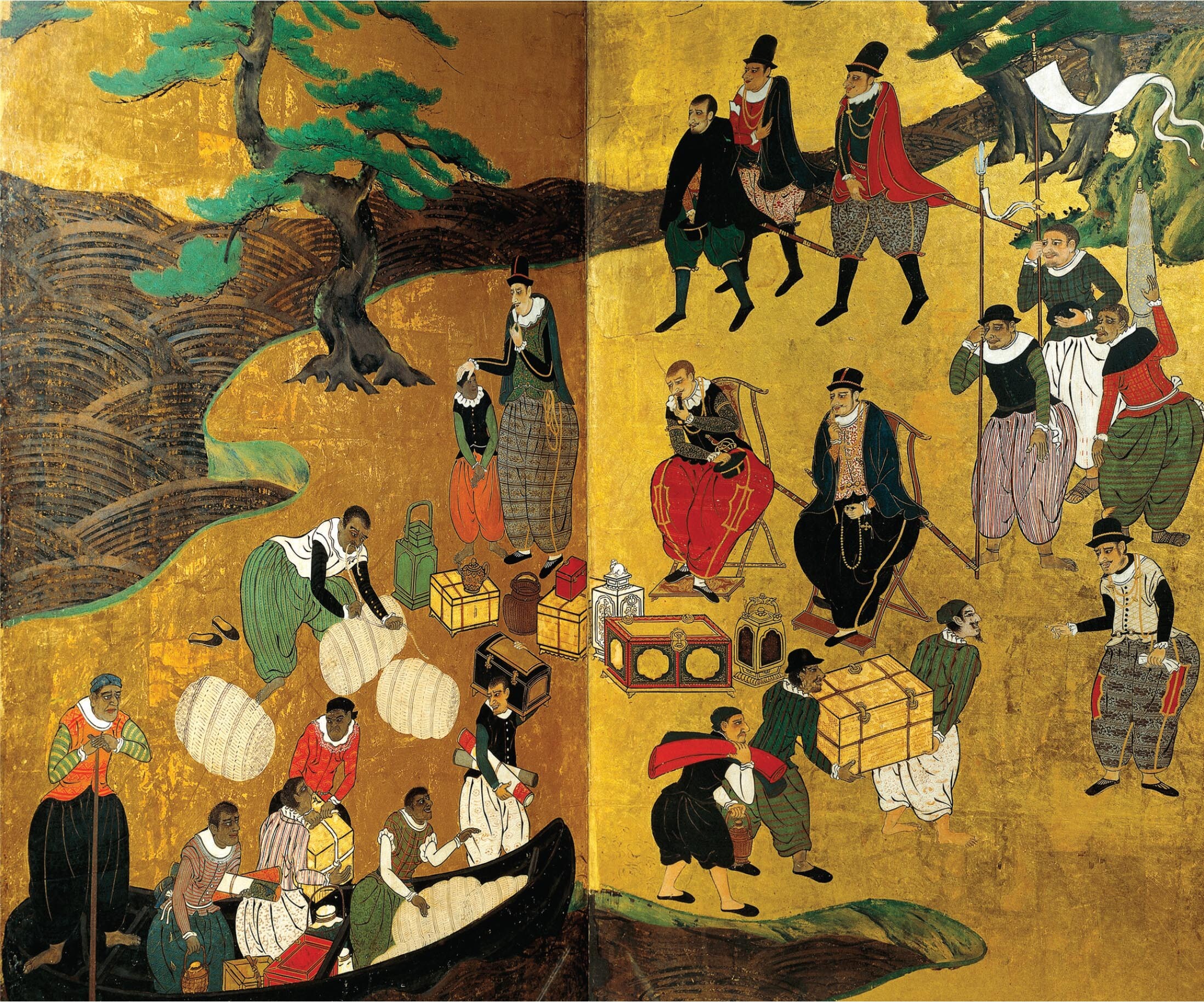
More information
A painting of Portuguese traders with goods on the coast of Japan. Several traders watch a Japanese man unwrap goods on the ground in front of them. A group in the background watches the ocean while another group to the side holds spears and watches the goods being unwrapped. Two men in the bottom right corner face each other in conversation. There is a tree right on the edge of the coast and several in the background on the right side.
Glossary
- Tokugawa shogunate
- Hereditary military administration founded in 1603 that ruled Japan while keeping the emperor as a figurehead; it was toppled in 1868 by reformers who felt that Japan should adopt, not reject, western influences.