Transformations in Europe
Between 1600 and 1750, religious conflict and the consolidation of dynastic power, spurred on by climate change and long-distance trade, transformed Europe. Commercial centers shifted northward, and Spain and Portugal lost ground to England and France. Farther to the north, the state of Muscovy expanded dramatically to become the sprawling Russian Empire.
Expansion and Dynastic Change in Russia
During this period, the Russian Empire became the world’s largest-ever state. It gained positions on the Baltic Sea and the Pacific Ocean, and it established political borders with both the Qing Empire and Japan. These momentous shifts involved the elimination of steppe nomads as an independent force. Culturally, Europeans as well as Russians debated whether Russia belonged more to Europe or to Asia. The answer was both.
MUSCOVY BECOMES THE RUSSIAN EMPIRE The principality of Moscow, or Muscovy, like Japan and China, used territorial expansion and commercial networks to consolidate a powerful state. Originally a mixture of Slavs, Finnish tribes, Turkic speakers, and many others, Muscovy expanded to become a huge empire that spanned parts of Europe, much of northern Asia, numerous North Pacific islands, and even—for a time—a corner of North America (Alaska).
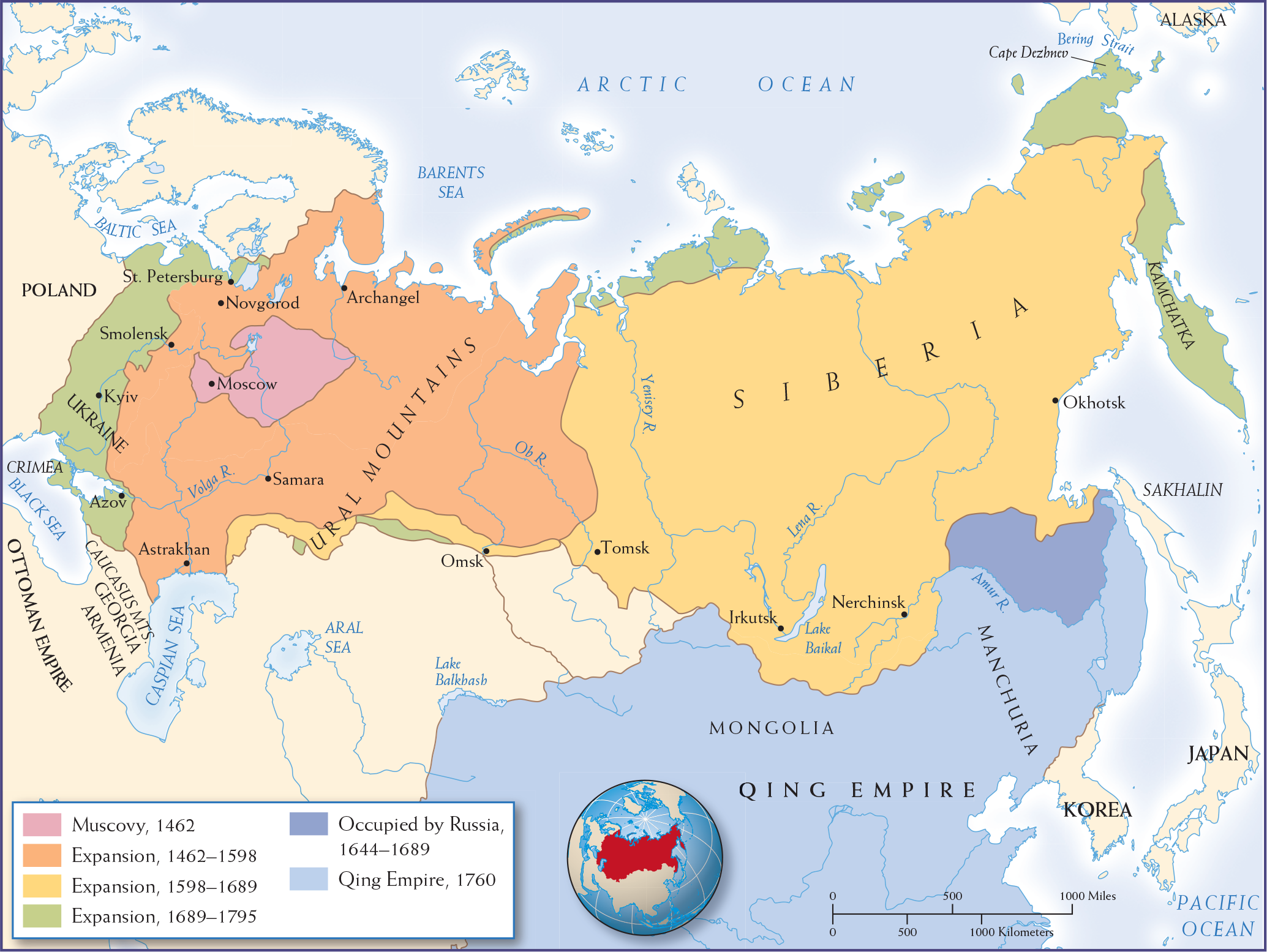
Like Japan, Russia emerged out of turmoil. Three factors inspired the regime to seize territory: security concerns, the ambitions of private individuals, and religious conviction. Security concerns were foremost, as expansion was inseparable from security. Because the steppe, stretching deep into Asia, remained a highway for nomadic peoples (especially descendants of the powerful Mongols), Muscovy sought to dominate the areas south and east of Moscow. Beginning in the 1590s, Russian authorities built forts and trading posts along Siberian rivers at the same time that privateers, enticed by the fur trade, pushed even farther east. By 1639, the state’s borders had reached the Pacific. Now Muscovy claimed an empire straddling Eurasia and incorporating peoples of many languages and religions. (See Map 13.7.)
Much of this expansion occurred during the colorful and violent reign of Ivan IV, known as Ivan the Terrible, a name that could also be translated as “awesome” (r. 1547–1584). A Muscovite grand prince, he restyled himself “tsar of all of the Russias,” ruling in the northern reaches of a European-Asian crossroads that lacked natural borders. The many invasions and counterinvasions that had taken place in the past persuaded Ivan that the only way to achieve security against hostile neighbors was to conquer them first and then rule in an autocratic fashion. Ivan’s great military victory in 1552 over the powerful Tatar khanate, centered on the Volga River city of Kazan, began a transformation of his largely Orthodox-Christian, Russian-speaking realm through the incorporation of large Muslim, Turkic-speaking populations. Ivan also sponsored expeditions that led to the conquest of even vaster territories in the east, which came to be known as Siberia.
Ivan’s paradoxical reign, full of both dynamism and destruction, set Moscow on an expansionist course toward a transcontinental empire, a state of many religions, and a zealous commitment to strongly authoritarian rule. Like the Ottoman and Qing dynasts, the new Romanov tsars who followed Ivan IV and their aristocratic supporters would retain power into the twentieth century.
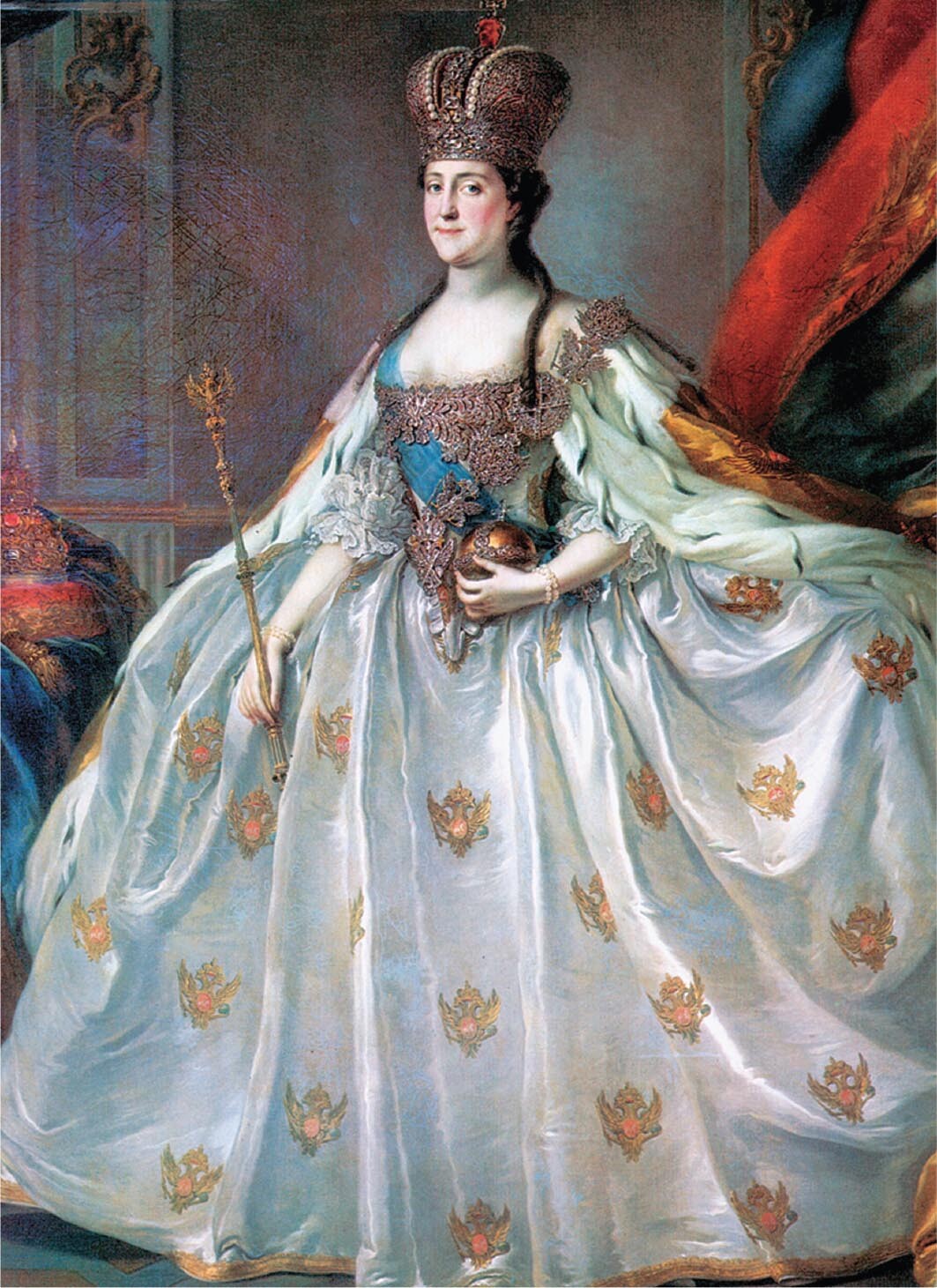
The next great leap came under Peter the Great (r. 1682–1725), who doubled down on expansion and modernized the Russian state. He founded a new capital at St. Petersburg, revamped agrarian taxes, adopted military reforms to create a more modern army, equipped with artillery and trained for war against other empires, like Sweden’s empire. This allowed Peter’s successors, including the hard-nosed Catherine the Great, to add even more territory. Catherine carved up the medieval state of Poland. Russia also annexed Ukraine, the grain-growing breadbasket of eastern Europe. By the late eighteenth century, Russia’s grasp extended from the Baltic Sea through the heart of Europe, Ukraine, and Crimea on the Black Sea and into the ancient lands of Armenia and Georgia in the Caucasus Mountains.
Expansion brushed this new empire up with older Ottoman (to the south) and Chinese (to the east) empires. By the end of the seventeenth century, Eurasia was being filled in with giant empires—often at the expense of borderland, nomadic communities. It would be a matter of time before the big dynasts turned from warring against borderlanders to fighting with each other over the balance of power in Eurasia.
ABSOLUTIST GOVERNMENT AND SERFDOM In the seventeenth and eighteenth centuries, the Romanovs created an absolutist system of government. Only the tsar had the right to make war, tax, judge, and coin money. The Romanovs also made the nobles serve as state officials. Now Russia became a despotic state that had no political assemblies for nobles or other groups, other than mere consultative bodies like the imperial senate. Indeed, away from Moscow, local aristocrats enjoyed nearly unlimited authority in exchange for loyalty and tribute to the tsar.
During this period, Russia’s peasantry bore the burden of maintaining the wealth of the small nobility and the monarchy. Most peasant families gathered into communes, isolated rural worlds where people helped one another deal with plummeting Little Ice Age temperatures, severe landlords, and occasional poor harvests. Communes functioned like extended kin networks in that members reciprocated favors and chores. The typical peasant hut was a single chamber heated by a wood-burning stove with no chimney. Livestock and humans often shared the same quarters. In 1649, peasants were legally bound as serfs to the nobles and the tsar, meaning they had to perform obligatory services and deliver part of their produce to their lords. The lords essentially controlled all aspects of their serfs’ lives.
More information
Map 13.7 is titled, Russian Expansion, 1462-1795. The map displays regions of Muscovy in 1462, expansions of Russia from 1462-1598, 1598-1689, and 1689-1795, as well as area occupied by Russia from 1644 to 1689, and the Qing Empire in 1760. In 1462, the state of Muscovy was a small area around and east of Moscow. By 1598, Russia has expanded past the Ural Mountains south and east almost to Omsk, as well as west to Smolensk and north past Archangel to the Barents Sea. Russia has expanded into all of Siberia by 1689. By 1795, Russia has expanded west to the Polish border, south to Ukraine and Crimea, and further east to Kamchatka. Russia occupies an area north of the Amur River from 1644-1689. The Qing empire covers Manchuria, Mongolia, and those areas further south that are part of present-day China.
MAP 13.7 | Russian Expansion, 1462–1795
The state of Muscovy incorporated vast territories through overland expansion as it grew and became the Russian Empire.
- Using the map key, identify the different expansions the Russian Empire underwent between 1462 and 1795 and the directions it generally expanded in.
- With what countries and cultures did the Russian Empire come into contact?
- According to the text, what drove such dramatic expansion?
Economic and Political Fluctuations in Western Europe
During this period, western Europe was a study in contrasts. Its economies adapted to climate change and colonialism with ingenuity and innovation. But it was a political and devotional hodgepodge, feuding over spiritual and dynastic loyalties. The result was the birth of modern capitalism, powered by contending middle-scaled imperial regimes—bigger than the city-states of the Renaissance but puny next to the lumbering agrarian and territorial powerhouses of Asia and now Russia. It was this delicate balance of carnage and competition that set Europe apart. It also explains Europe’s outward aggression; once the cycle of war, fueled by the effects of climate change, crested in the middle of the seventeenth century, European rivals set aside their feuding within Europe and turned their eyes, their companies, and their gunships overseas.
More information
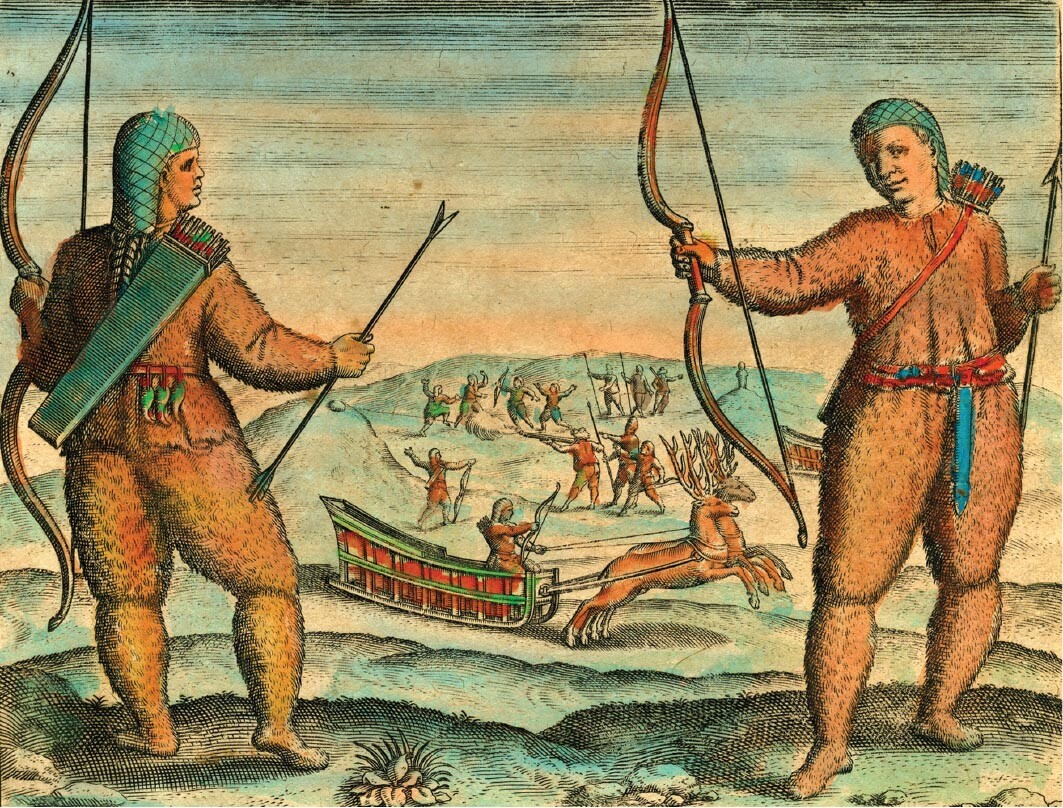
An engraving of Nenets hunters. Two Nenets hunters in animal skin attire stand opposite to each other and hold their bow and arrow. A reindeer cart with a hunter’s sleigh runs through the snowfield behind them. Several hunters are fighting in the background.
Would this tilt have happened without the Little Ice age? It’s impossible to say for sure. But what we do know is that freezing temperatures shortened agricultural growing seasons by one to two months. The result was escalating prices for essential grain products, famine, death, and widespread peasant unrest that fueled political discord. The cooling had a few benefits, however, among which were the magnificent violins, still prized today, crafted by Antonio Stradivari (1644–1737) from the denser wood that freezing temperatures produced.
THE THIRTY YEARS’ WAR For a century after Martin Luther broke with the Catholic Church (see Chapter 12), religious warfare raged in Europe. So did contests over territory, power, and trade. The Thirty Years’ War (1618–1648)—a war between Protestant princes and the Catholic emperor for religious predominance in central Europe—reflected all of these. At its heart was a civil war within Hapsburg lands, which sucked in Catholic and Protestant neighboring states.
The civil war between Protestants and Catholics within the Habsburg Empire soon became a war for preeminence in Europe. It took the lives of civilians as well as soldiers. In total, fighting, disease, and famine wiped out a third of the German states’ urban population and two-fifths of their rural population. The war also depopulated Sweden and Poland. Ultimately, the Treaty of Westphalia (1648) stated, in essence, that as there was a rough balance of power between Protestant and Catholic states, they would simply have to put up with each other. The Dutch won their independence from Spain. But the war’s enormous costs provoked severe discontent in Spain, France, and England. Central Europe did not recover in economic or demographic terms for more than a century.
More information
A full-length portrait of Catherine the Great in her coronation gown. Catherine wears a crown and holds a scepter in one hand and an ornately decorated spherical object in the other.
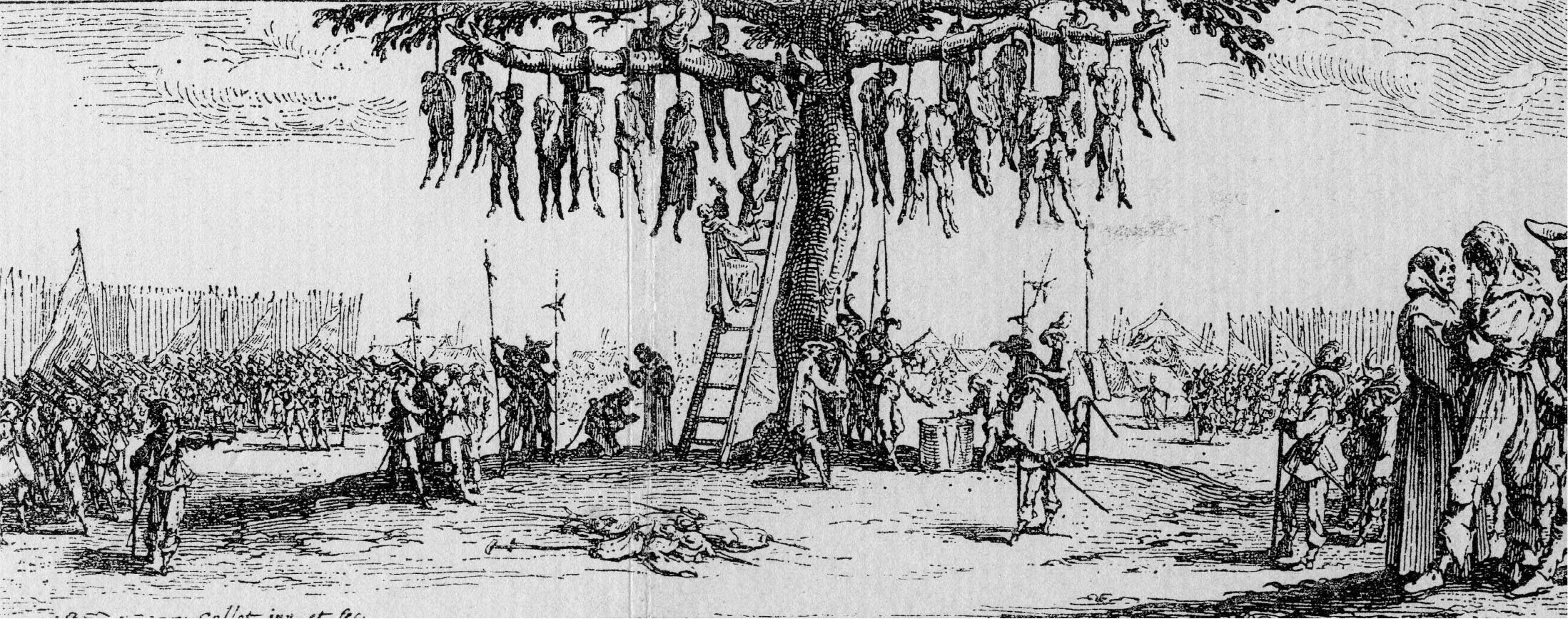
The Thirty Years’ War transformed war making. Whereas most medieval struggles had been sieges between nobles leading small armies, centralized states fielding standing armies now waged grand-scale campaigns. The war also changed the ranks of soldiers: as the conflict ground on, local enlisted men defending their king, country, and faith gave way to hired mercenaries or criminals doing forced service. Even officers, who had previously obtained their stripes by purchase or royal decree, now had to earn them. Gunpowder, cannons, and handguns became standardized. By the eighteenth century, Europe’s wars featured huge standing armies boasting a professional officer corps, deadly artillery, and long supply lines bringing food and ammunition to the front. The costs—material and human—of war began to soar and put added pressure on empires to expand and compete for overseas spoils.
More information
An illustration of numerous soldiers hanging from a tree while a large crowd of soldiers watches. Several people stand on a ladder propped against the tree. Several people watching hold flags and many hold spears. Several townspeople stand talking in the right side of the foreground.
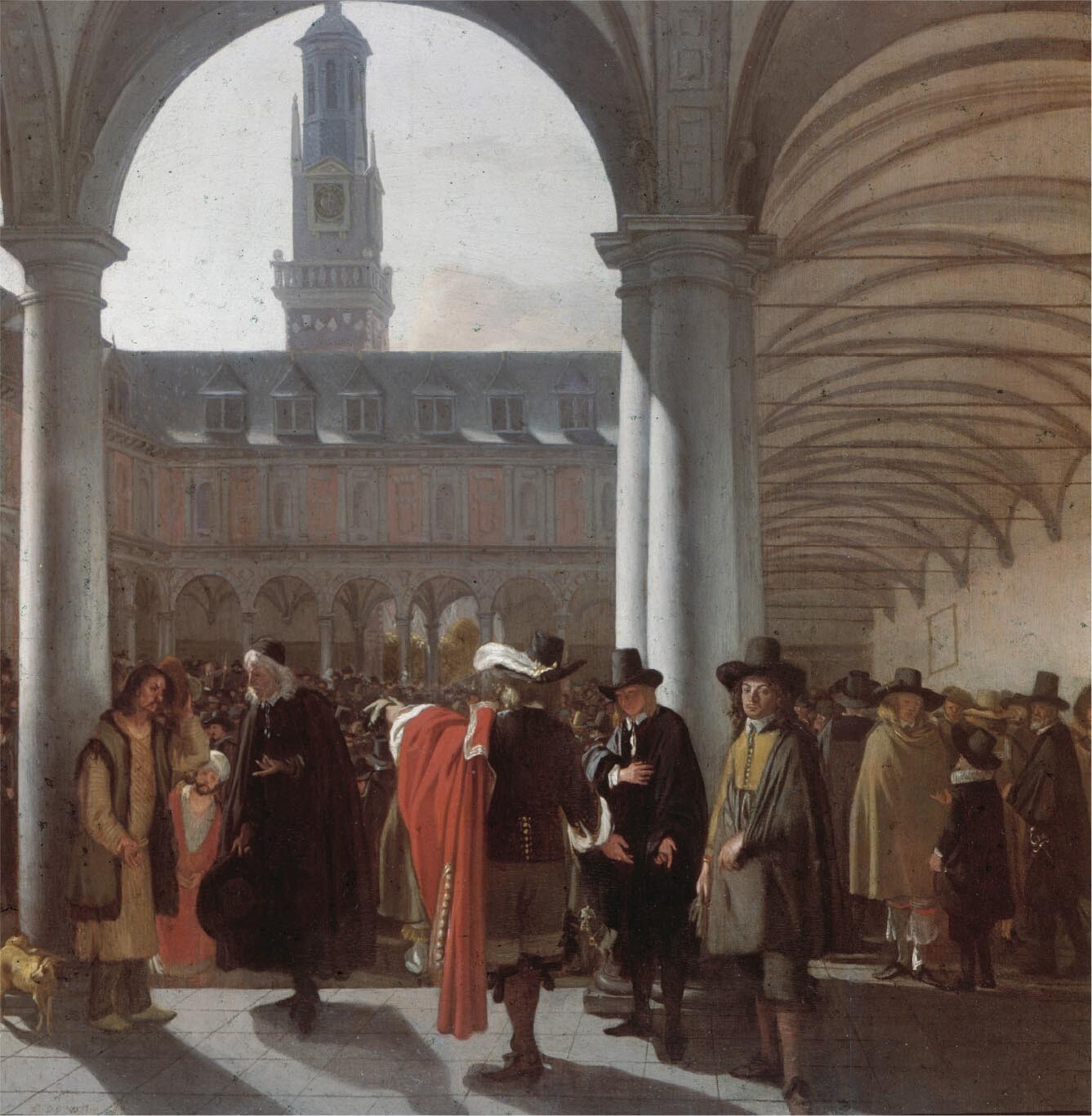
WESTERN EUROPEAN ECONOMIES In spite of warfare’s human toll, it spurred European states’ commercial expansion. But not all European states grew equally. Warfare favored the rising powers, like the Netherlands, England (later, Britain), and France, at the expense of Spain and Portugal. As European commercial dynamism shifted northward, the Dutch led the way with innovative commercial practices and a new mercantile elite. They specialized in shipping and in financing regional and long-distance trade. Their famous fluitschips carried heavy, bulky cargoes (like Baltic wood) with relatively small crews. Dutch ships transported their own and other countries’ goods. Amsterdam’s merchants founded an exchange bank, established a rudimentary stock exchange, and pioneered systems of underwriting and insuring cargoes.
More information
A painting of many men gathered in the courtyard of the Amsterdam Stock Exchange. A dog stands near a man’s feet in the foreground. The courtyard is surrounded by arched walkways held up by columns and there is a tower in the distance.
England and France also became commercial powerhouses, establishing aggressive policies to promote national business and drive out competitors. Consider the English Navigation Act of 1651. By stipulating that only English ships could carry goods between the mother country and its colonies, it protected English shippers and merchants—especially from the Dutch. The English subsequently launched several effective trade wars against Holland. The French, too, followed aggressive mercantilist policies and ultimately joined forces with England to invade Holland.
Economic development was not limited to port towns: the countryside, too, enjoyed breakthroughs in production. In northwestern Europe, investments in water drainage, larger livestock herds, and improved cultivation practices generated much greater yields. Also, a four-field crop rotation involving wheat, clover, barley, and turnips kept nutrients in the soil and provided year-round fodder for livestock. As a result (and as we have seen many times throughout history), increased output supported a growing urban population. By contrast, in Spain and Italy, agricultural change and population growth came more slowly.
Production rose most where the organization of rural property changed. In England, for example, in a movement known as enclosure, landowners took control of lands that traditionally had been common property serving local needs. Claiming exclusive rights to these lands, the landowners planted new crops or pastured sheep with the aim of selling the products in distant markets. The largest landowners put their farms in the hands of tenants, who hired wage laborers to till, plant, and harvest. Thus, in England, peasant agriculture gave way to farms run by wealthy families who exploited the marketplace to buy what they needed (including labor) and to sell what they produced. In this regard, England led the way in a Europe-wide process of commercializing the countryside.
DYNASTIC MONARCHIES: FRANCE AND ENGLAND If Asian powers wrestled with the balance of centralizing versus decentralizing authority, so did European monarchs. In France, Louis XIII (r. 1610–1643) and especially his chief minister, Cardinal Richelieu, concentrated power in the hands of the king. After 1614, kings refused to convene the Estates-General, a medieval advisory body. Composed of representatives of three groups—the clergy (the First Estate, those who pray), the nobility (the Second Estate, those who fight), and the unprivileged remainder of the population (the Third Estate, those who work)—the Estates-General was an obstacle to the king’s full empowerment. Instead of sharing power, the king and his counselors wanted to rule without constraints, to create—in the words of the age—an absolute monarchy. The ruler’s authority was to be complete and his state free of bloody disorders. His rule would be lawful, but he, not his jurists, would dictate the last legal word. If the king made a mistake, only God could call him to account. Thus, the French, like most Europeans, believed in the “divine right of kings,” a political belief akin to that of imperial China, where the emperor was thought to rule with the mandate of heaven.
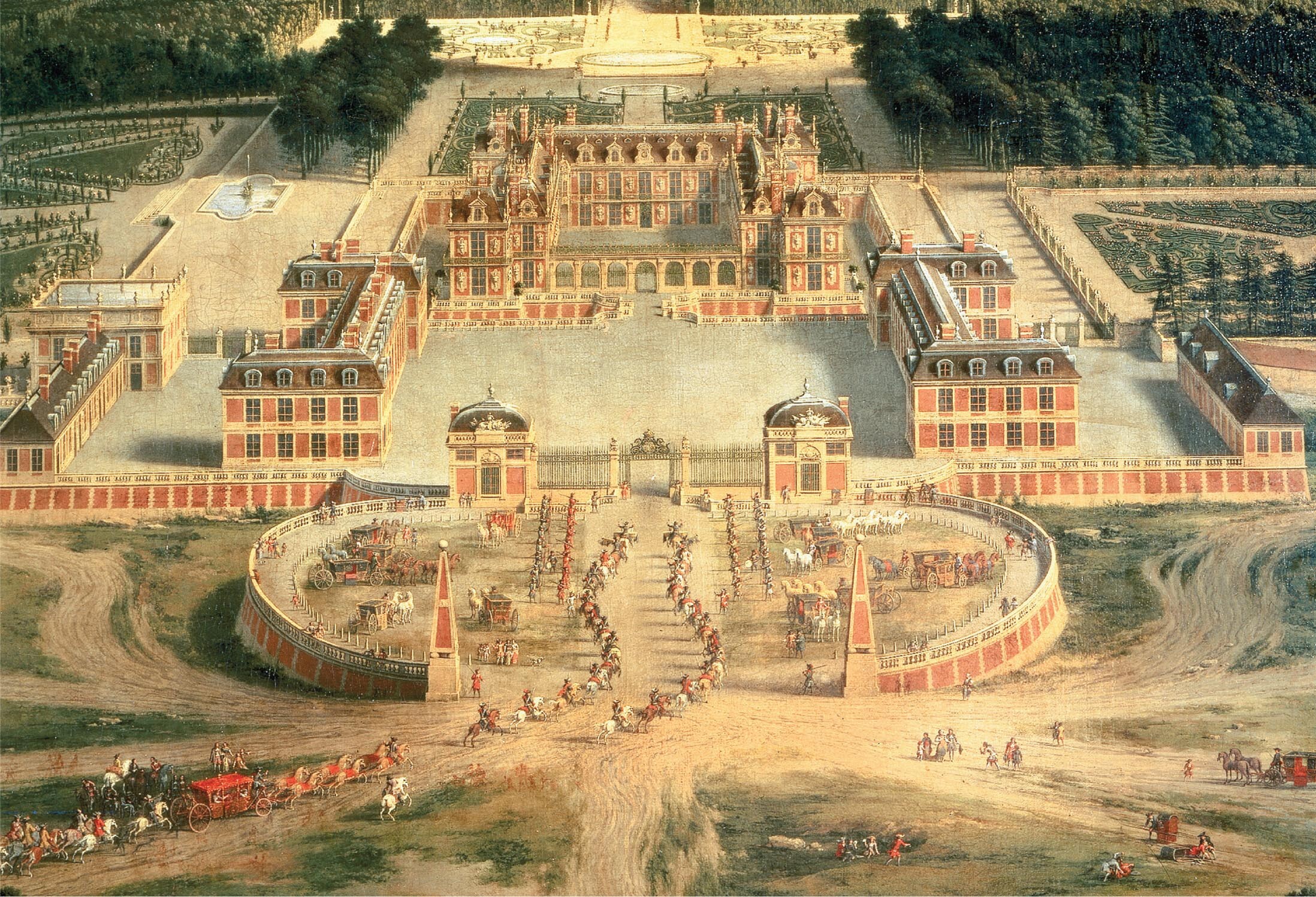
In absolutist France, privileges and state offices flowed from the king’s grace. All patronage networks ultimately linked to the king. The great palace Louis XIV built at Versailles teemed with nobles from all over France seeking favor, dressing according to the king’s lavish (and expensive) fashion code, and attending the latest tragedies, comedies, and concerts. Just as the Japanese shogun monitored the daimyos by keeping their families in Edo, Louis XIV kept a watchful eye on the French nobility at Versailles.
In practice, French absolutist government was not as absolute as the king and his ministers wished. Pockets of stalwart Protestants practiced their religion secretly. Peasant disturbances continued. Criticism of court life, wars, and religious policies filled anonymous pamphlets, jurists’ notebooks, and courtiers’ private journals. Members of the nobility also grumbled about their political misfortunes, but since the king would not call the Estates-General, they had no formal way to express their concerns.
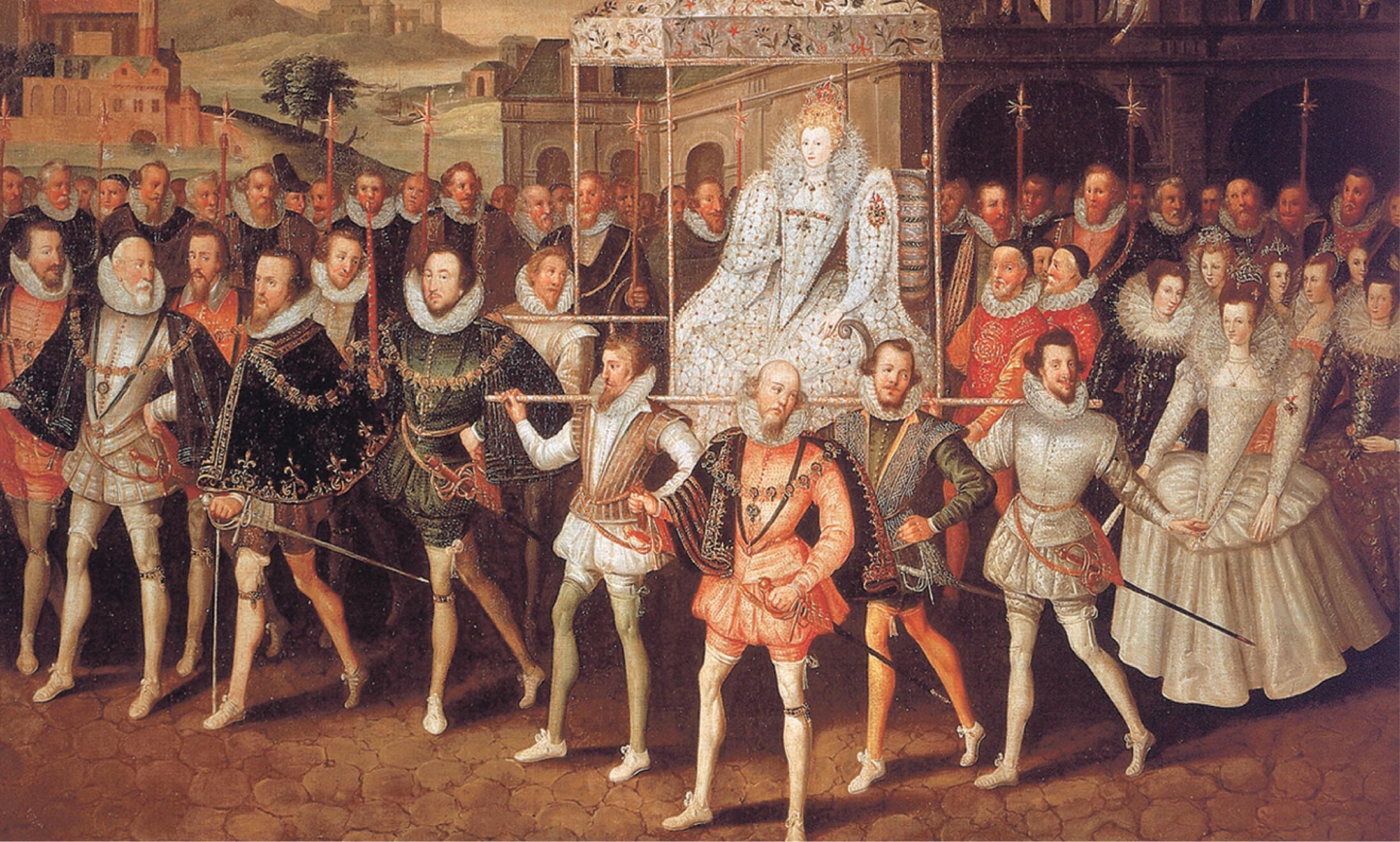
England might also have evolved into an absolutist regime, but there were important differences between England and France. While French Catholic royals consolidated power, England’s feud between Catholics and Protestants plunged the country into civil war. Queen Elizabeth (r. 1558–1603) and her successors used many policies similar to those of the French monarchy, such as control of patronage (to grant privileges) and elaborate court festivities. The “Virgin Queen” never married and exerted sole control over the church, military, and aristocracy. However, the English Parliament remained an important force. Whereas the French kings did not need the consent of the Estates-General to enact taxes, the English monarchs had to convene Parliament to raise money.
Under Elizabeth’s successors, fierce quarrels broke out over taxation, religion, and royal efforts to rule without parliamentary consent. Tensions ran high between Puritans (who preferred a simpler form of worship and more egalitarian church government) and Anglicans (who supported the state-sponsored, hierarchically organized Church of England headed by the king). Social and economic grievances led to civil war in the 1640s and an ultimate victory for the parliamentary army (largely Puritan)—and the beheading of King Charles I. Twelve years followed of government as a kingless commonwealth, primarily under the leadership of Puritan Oliver Cromwell.
In 1660, the monarchy was restored, but without resolving issues of religious tolerance and the king’s relation to Parliament. Charles II and his successor, James II, aroused opposition due to their autocracy and secret efforts to bring England back into the Catholic fold. The conflict between an aspiring absolutist monarch and Parliament’s insistence on shared sovereignty and Protestant succession culminated in the Glorious Revolution of 1688–1689. In a bloodless upheaval, James II fled to France and Parliament offered the crown to William of Orange and his wife, Mary (a Protestant). The conflict’s outcome established the principle that English monarchs must rule in conjunction with Parliament. Although the Church of England was reaffirmed as the official state church, Presbyterians and Jews were allowed to practice their religions. Catholic worship, still officially forbidden, was tolerated as long as the Catholics kept quiet. By 1700, then, England’s nobility and merchant classes had a guaranteed say in public affairs and assurance that state activity would privilege the propertied classes as well as the ruler.
More information
A painting of an aerial view of the Palace of Versailles. The huge estate sprawls over acres of land. The buildings surround several courtyards. To the sides and behind the palace there are several gardens and fountains. A procession enters through the front entrance.
Events in France and England stimulated much political writing. In England, Thomas Hobbes published Leviathan (1651), a defense of the state’s absolute power over all competing forces. John Locke published Two Treatises of Civil Government (1689), which argued not only for the natural rights to liberty and property but also for the rights of peoples to form a government and then to disband and re-form it when it did not live up to its contract. French theorists also proposed new ways of conducting politics and making law and debated the extent to which elites could check the king. As the eighteenth century unfolded, the question of where sovereignty lay grew more pressing.
MERCANTILIST WARS The rise of new powers in Europe intensified rivalries for control of the Atlantic system. As conflicts over colonies and sea-lanes replaced earlier religious and territorial struggles, commercial struggles became worldwide wars. Across the globe, European empires constantly skirmished over control of trade and territory. English and Dutch trading companies took aim at Portuguese outposts in Asia and the Americas and then at each other. Ports in India suffered repeated assaults and counterassaults. In response, European powers built huge navies to protect their colonies and trade routes and to attack their rivals. After 1715, mercantilist wars raged mainly outside Europe, as empires feuded over colonial possessions. Each round of warfare ratcheted up the scale and cost of fighting.
More information
A procession of Queen Elizabeth and her court through the town. The Queen sits in a canopy chair in the center, carried by men. Several knights, distinguished by their collars, walk before the Queen, her ladies following behind. One of the knights carries the Sword of State before her. A crowd watched from the side.
The Seven Years’ War (known as the French and Indian War in the United States) marked the culmination of this rivalry. Fought from 1756 to 1763, it saw Indigenous peoples, African slaves, Bengali princes, Filipino militiamen, and European foot soldiers dragged into a contest over imperial possessions and control of the seas. Some fleets, like the French at the Battle of Quiberon Bay, were dispatched to the bottom of the ocean. Some fortresses, like Spain’s Havana and France’s Québec City, fell to invaders. What sparked the war was a skirmish of British colonial troops (featuring a lieutenant colonel named George Washington) allied with Seneca warriors against French soldiers in the Ohio Valley. (See Map 13.2 for North American references.) In India, the war had a decisive outcome, for here the East India Company trader Robert Clive rallied 850 European officers and 2,100 Indian recruits to defeat the French (there were but 40 French artillerymen) and their 50,000 Maratha allies at Plassey. The British seized the upper hand—over everyone—in India. Not only did the British drive off the French from the rich Bengali interior, but they also crippled Indian rulers’ resistance against European intruders. (See Map 12.5 for India references.)
The Seven Years’ War changed the balance of power around the world. Britain emerged as a foremost colonial empire. Its rivals took a pounding: France lost its North American colonies, and Spain lost Florida (though it gained the Louisiana Territory west of the Mississippi in a secret deal with France). In India, as well, the French were losers and had to acknowledge British supremacy in the wealthy provinces of Bihar and Bengal. But overwhelmingly, the biggest losers were Indigenous peoples everywhere. With the rise of one empire over all others, it was harder for Indigenous peoples to play the Europeans off against each other. Maratha princes faced the same problem. Clearly, as worlds became more entangled, the gaps between winners and losers grew more pronounced.
Wealth from long-distant trade and intense warfare led to the rise of militarily powerful, monarchical states in Europe. In the long run, beginning in the eighteenth century and coming to fulfillment in the nineteenth, the most dynamic of these states, notably Britain and France, ultimately joined by a newly unified Germany, were able to dominate the great states of Afro-Eurasia economically and militarily.
Glossary
- Muscovy
- The principality of Moscow. Originally a mixture of Slavs, Finnish tribes, Turkic speakers, and many others, Muscovy used territorial expansion and commercial networks to consolidate a powerful state and expanded to become the Russian Empire, a huge realm that spanned parts of Europe, much of northern Asia, numerous North Pacific islands, and even—for a time—a corner of North America (Alaska).
- Thirty Years’ War (1618–1648)
- Conflict begun between Protestants and Catholics in Germany that escalated into a general European war fought against the unity and power of the Holy Roman Empire.
- enclosure
- A movement in which landowners took control of lands that traditionally had been common property serving local needs.
- absolute monarchy
- Form of government in which one body, usually the monarch, controls the right to tax, judge, make war, and coin money. The term enlightened absolutist was often used to refer to state monarchies in seventeenth- and eighteenth-century Europe.
- Seven Years’ War (1756–1763)
- Also known as the French and Indian War; worldwide war that ended when Prussia defeated Austria, establishing itself as a European power, and when Britain gained control of India and many of France’s colonies through the Treaty of Paris.