AP® Skills & Processes
CONTINUITY AND CHANGE Assess the role the Silk Roads played in the transmission of religious and cultural ideas across Afro-Eurasia.
Although exchange along the Silk Roads had been taking place for centuries, the sharing of knowledge between the Mediterranean world and China began in earnest during this period. Wending their way across the difficult terrains of central Asia, a steady parade of merchants, scholars, ambassadors, missionaries, and other travelers transmitted commodities, technologies, and ideas between the Mediterranean worlds and China, and across the Himalayas into northern India, exploiting the commercial routes of the Silk Roads. Ideas, including the beliefs of the universalizing religions described in this chapter, traveled along with goods on these exchange routes. Christianity spread through the Mediterranean and beyond, and as we shall see later in this chapter, Buddhism and the Vedic religion (Brahmanism) also continued to spread.
CONTINUITY AND CHANGE Assess the role the Silk Roads played in the transmission of religious and cultural ideas across Afro-Eurasia.
The great oasis cities of central Asia played a crucial role in the effective functioning of the Silk Roads. While the Sasanians controlled the city of Merv in the west, nomadic rulers became the overlords of Sogdiana and Tukharistan and extracted tribute from the cities of Samarkand and Panjikent in the east. The tribal confederacies in this region maintained the links between west and east by patrolling the Silk Road between Iran and China. They also joined north to south as they passed through the mountains of Afghanistan into the plains of northern India. As a result, central Asia between 300 and 600 CE was the hub of a vibrant system of religious and cultural contacts covering the whole of Afro-Eurasia. (See Map 1.4.)
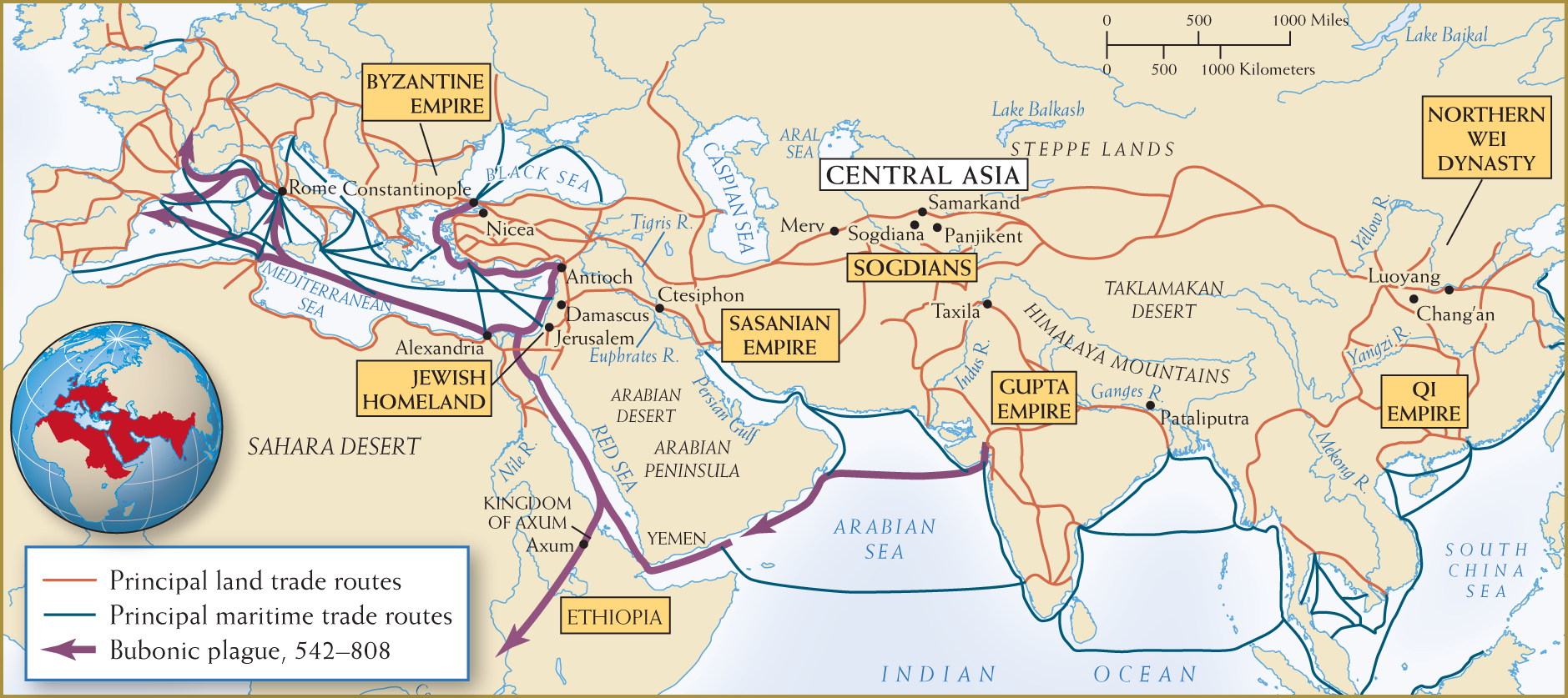
Map 1.4 Exchanges across Afro-Eurasia, 300–600 CE
Southwest Asia remained the crossroads of Afro-Eurasia in a variety of ways. Trade goods flowing between west and east passed through this region, as did universalizing religions.
Beginning at the Euphrates River and stretching for eighty days of slow travel across the modern territories of Iraq, Iran, Afghanistan, and much of central Asia, the Sasanian Empire of Persia encompassed all the land routes of western Asia that connected the Mediterranean world with East Asia. In the early third century CE, the Sasanians had replaced the Parthians as rulers of the Iranian plateau and Mesopotamia. The Sasanian ruler called himself the “King of Kings of Iranian and non-Iranian lands,” a title suggestive of the Sasanians’ aspirations to universalism. The ancient, irrigated fields of what is modern Iraq became the economic heart of this empire. Its capital, Ctesiphon, arose where the Tigris and the Euphrates rivers come close to one another, only twenty miles south of modern Baghdad.
Symbolizing the king’s presence at Ctesiphon was the 110-foot-high vaulted Great Arch of Khusro, named after Justinian’s rival, Khusro I Anoshirwan (Khusro of the Righteous Soul). As his name implied, Khusro Anoshirwan (r. 531–579 CE) exemplified the model ruler: strong and just. His image in the east as an ideal monarch was as glorious as that of Justinian in the west as an ideal Christian Roman emperor. For both Persians and Arab Muslims of later ages, the Arch of Khusro was as awe-inspiring as Justinian’s Hagia Sophia was to Christians.
The Sasanian Empire controlled the trade crossroads of Afro-Eurasia and posed a military threat to Byzantium. Its Iranian armored cavalry was a fighting machine adapted from years of competition with the nomads of central Asia. These fearless horsemen fought covered from head to foot in flexible armor (small plates of iron sewn onto leather) and chain mail, riding “blood-sweating horses” draped in thickly padded cloth. Their lethal swords were light and flexible owing to steel-making techniques imported from northern India. With such cavalry, Khusro in 540 CE sacked Antioch, a city of great significance to early Christianity. The campaign was a warning, at the height of Justinian’s glory, that Mesopotamia could reach out once again to conquer the eastern Mediterranean shoreline. Under Khusro II the confrontation between Persia and Rome escalated into the greatest war that had been seen for centuries. Between 604 and 628 CE, Persian forces under Khusro II conquered Egypt and Syria and even reached Constantinople before being defeated in northern Mesopotamia.
COMPARISON Explain the ways in which those with different religious beliefs interacted with each other along the Silk Roads.
Politically united by Sasanian control, Southwest Asia also possessed a cultural unity. Syriac was the dominant language. While the Sasanians themselves were devout Zoroastrians, Christianity and Judaism enjoyed tolerance in Mesopotamia. Nestorian Christians—so named by their opponents for their acceptance of a hotly contested understanding of Jesus’s divine and human nature, promoted by a former bishop of Constantinople named Nestorius—exploited Sasanian trade and diplomacy to spread their faith as far as Chang’an in China and the western coast of southern India. Protected by the Sasanian King of Kings, the Jewish rabbis of Mesopotamia compiled the monumental Babylonian Talmud at a time when their westernpeers, in Roman Palestine, were feeling cramped under the Christian state. The Sasanian court also embraced offerings from northern India, including the Panchatantra stories (moral tales played out in a legendary kingdom of the animals), polo, and the game of chess. In this regard Khusro’s was truly an empire of crossroads, where the cultures of central Asia and India met those of the eastern Mediterranean.
The Sogdians, who controlled the oasis cities of Samarkand and Panjikent, served as human links between the two ends of Afro-Eurasia. Their religion was a blend of Zoroastrian and Mesopotamian beliefs, touched with Brahmanic influences. Their language was the common tongue of the early Silk Roads, and their shaggy camels bore the commodities that passed through their entrepôts (transshipment centers). Moreover, their splendid mansions such as those excavated at Panjikent show strong influences from the warrior aristocracy culture of Iran. The palace walls display gripping frescoes of armored riders, reflecting the revolutionary change to cavalry warfare from Rome to China. The Sogdians were known as merchants as far away as China.
Through the Sogdians, products from Southwest Asia and North Africa found their way to the eastern end of the landmass. Carefully packed for the long trek on jostling camel caravans, Persian and Roman goods rode side by side. Along with Sasanian silver coins and gold pieces minted in Constantinople, these exotic products found eager buyers as far east as China and Japan.
South of the Hindu Kush Mountains, in northern India, nomadic groups made the roads into central Asia safe to travel, enabling Buddhism to spread northward and eastward via the mountainous corridor of Afghanistan into China. Buddhist monks were the primary missionary agents, the bearers of a universal message who traveled across the roads of central Asia, carrying holy books, offering salvation to commoners, and establishing themselves more securely in host communities than did armies, diplomats, or merchants.
CONTEXTUALIZATION Describe the ways in which Buddhist missionaries promoted the spread of their religion along the Silk Roads.
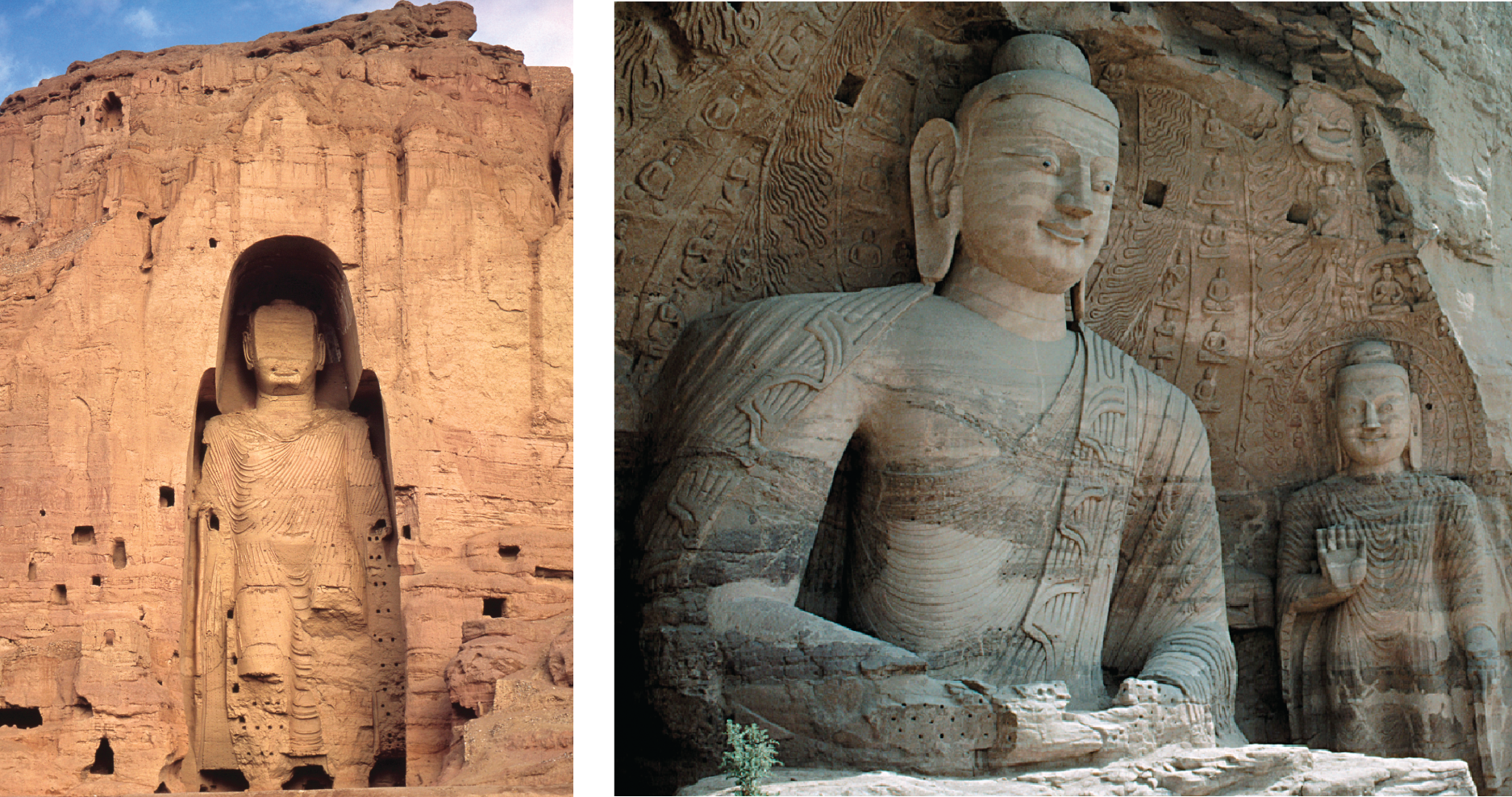
At Bamiyan, a valley of the Hindu Kush—two gigantic statues of the Buddha, 121 and 180 feet in height, were carved from a cliffside during the fourth and fifth centuries CE (and stood there for 1,500 years until dynamited by the Taliban in 2001). Travelers found welcoming cave monasteries here and at oases all along the way from the Taklamakan Desert to northern China, where—2,500 miles from Bamiyan—travelers also encountered five huge Buddhas carved from cliffs in Yungang, China. While those at Bamiyan stood tall with royal majesty, the Buddhas of Yungang sat in postures of meditation. In the cliff face and clustered around the feet of the Bamiyan Buddhas various elaborately carved cave chapels housed intricate paintings with Buddhist imagery. Surrounding the Yungang Buddhas, over fifty caves sheltered more than 50,000 statues representing Buddhist deities and patrons. The Yungang Buddhas, seated just inside the Great Wall, welcomed travelers to the market in China and marked the eastern end of the central Asian Silk Road. (See Map 1.5.) The Bamiyan and Yungang Buddhas are a reminder that by the fourth century CE religious ideas were creating world empires of the mind, transcending kingdoms of this world and bringing a universal message contained in their holy scriptures.

Map 1.5 Buddhist Landscapes, 300–600 CE
Buddhism spread from its heartland in northern India to central and East Asia at this time. Trade routes, along with the merchants and pilgrims who traveled along them, fostered that spread.