Core Objectives
ANALYZE the relationship between empires and universalizing religions in South Asia and China.
ANALYZE the relationship between empires and universalizing religions in South Asia and China.
South Asia, especially the area of modern India, enjoyed a surge of religious enthusiasm during the Gupta dynasty, the largest political entity in South Asia from the early fourth to the mid-sixth century CE. Its kings facilitated commercial and cultural exchange, much as the Roman Empire had done in the west. Chandragupta, calling himself “King of Kings, Great King,” together with his son, expanded Gupta territory to the entire northern Indian plain and made a long expedition to southern India. The development of Hinduism out of the varna-bound Vedic Brahmanic religion and the continued spread of Buddhism helped unify a diverse region and the diverse peoples who lived there.
During this period, the ancient Brahmanic Vedic religion spread widely in South Asia. Because Buddhism and Jainism had many devotees in cities and commercial communities, conservative Brahmans turned their attention to rural India and brought their religion into accord with rural life and agrarian values. This refashioned Brahmanic religion emerged as the dominant faith in Indian society in the form of what we today call Hinduism.
In the religion’s new, more accessible form, believers became vegetarians, abandoning the animal sacrifices that had been important to their earlier rituals. Their new rituals were linked to self-sacrifice—denying themselves meat rather than offering up slaughtered animals to the gods, as they had done previously. Three major deities—Brahma, Vishnu, and Shiva—formed a trinity representing the three phases of the universe—birth, existence, and destruction, respectively—and the three expressions of the eternal self, or atma. Vishnu was the most popular of the three and was thought by believers to reveal himself through various avatars (or incarnations).
CONTINUITY AND CHANGE Describe how Hinduism effectively evolved from the earlier Brahmanic religion.
Poets during the reign of Chandragupta, a generous patron of the arts, expressed the religious sentiments of the age. Working with the motifs and episodes from two early epics, the Mahabharata and the Ramayana, these poets addressed new problems and praised new virtues. What had once been lyric dramas and narrative poems written to provide entertainment now served as collective memories of the past and underscored Brahmanic religious beliefs about ideal behavior. The heroes and deeds that the poets praised in classical Sanskrit served as models for kings and their subjects.
A central part of the Mahabharata revolves around the final battle between two warring confederations of Vedic tribes. The hero Arjuna, the best warrior of one of these confederations, is unwilling to fight against his enemies because many of them are his cousins. At a crucial moment on the battlefield, Krishna—an avatar of Vishnu, who was Arjuna’s charioteer and religious teacher—intervenes, commanding Arjuna to slay his foes, even those related to him. Krishna reminds Arjuna that he belongs to the Kshatriya varna, the warriors put on earth to govern and to fight against the community’s enemies. The Bhagavad Gita, which preserves this tale of Krishna and Arjuna, became part of the authoritative literature of Hindu spirituality. It prescribed religious and ethical teachings and behaviors, called dharma in Hinduism, for people at every level of society.
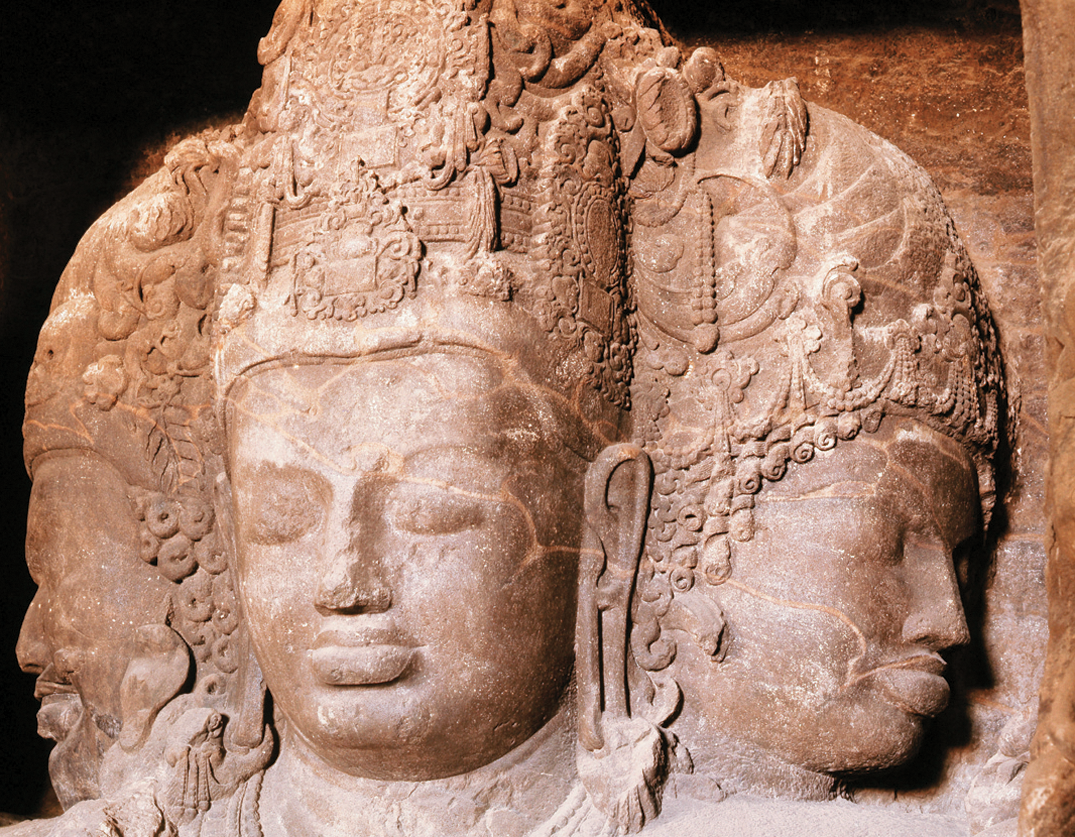
Hindus also adopted the deities of other religions, even regarding the Buddha as an avatar of Vishnu. Thus, the Hindu world of gods became larger and more accessible than the earlier Vedic one, enabling more believers to share a single faith. Hindus did not wish to approach the gods only through the sacrificial rituals at which Brahmans alone could officiate. Individuals, therefore, also developed an active relationship with particular gods through personal devotion, in a practice called bhakti. This individualized, personal bhakti devotion attracted Hindus of all social strata, while the mythological literature wove the deities into a heavenly order presided over by the trinity of Brahma, Vishnu, and Shiva as universal gods. During this period Hinduism lived side by side with Buddhism, competing for followers by building ornate temples and sculptures of gods and by holding elaborate rituals and festivals.
While the stories of human-divine interaction, the larger number of gods, and the development of bhakti devotion made Hinduism more personal than the old Vedic Brahmanism had been, Hinduism was still very much rooted in the hierarchical varna system. While Hinduism was more accessible to a wider audience than Brahmanism had been, there were limits to how universalizing this tradition could be since the varna system, with which it was closely intertwined, did not extend outside South Asia.
CONTEXTUALIZATION Explain how Buddhism came to be seen as a universalizing religion.
During the Gupta period, the two main schools of Buddhism—the Mahayana (Greater Vehicle) school and the Hinayana (Lesser Vehicle) school—acquired universalizing features that were different from what the Buddha had preached centuries earlier. The historical Buddha was a sage who was believed to enter nirvana, ending the pain of consciousness. In the earliest Buddhist doctrine, god and supernatural powers were not a factor. But by 200 CE a crucial transformation had occurred: his followers started to view the Buddha as a god. Mahayana Buddhism not onlyrecognized the Buddha as a god but extended worship to the many bodhisattvas who bridged the gulf between the Buddha’s perfection and the world’s sadly imperfect peoples. It was especially in the Mahayana school that Buddhism became a universalizing religion, whose adherents worshipped divinities, namely the Buddha and the bodhisattvas, rather than recognizing them merely as great men.
Some Buddhists fully accepted the Buddha as god but could not accept the divinity of bodhisattvas; these adherents belonged to the more monkish school of old-fashioned Hinayana Buddhism, later called Theraveda in Sri Lanka and Southeast Asia. Rejecting Sanskrit authoritative scripture on the supernatural power of bodhisattvas, they remained loyal to the early Buddhist texts, which were probably based on the words of the Buddha himself. Hinayana temples barred all colorful idols of the bodhisattvas and other heavenly beings; they contained images of only the Buddha. Buddhism, with its vibrant competing Mahayana and Hinayana schools, spread along the Silk Roads far beyond its South Asian point of origin.
Unlike China and Rome, India did not have a centralized empire that could establish a code of laws and an overarching administration. Instead, what emerged to unify South Asia was a distinctive form of cultural synthesis—called by scholars the Sanskrit cosmopolis—based on Hindu spiritual beliefs and articulated in the Sanskrit language.
Spearheading this development from 300 to 1300 CE were priests and intellectuals well versed in the Sanskrit language and literary and religious texts. As Sanskrit spread, it stepped beyond religious scriptures and became the public language of politics, although local languages retained their prominence in day-to-day administration and everyday life. Kings and emperors used Sanskrit to express the ideals of royal power and responsibility. Rulers issued inscriptions in it, recording their genealogies and their prestigious acts. Poets celebrated ruling dynasties and recorded important moments in the language.
COMPARISON Compare the unification process in South Asia to that of the Roman and Chinese Empires.
The emergence of Sanskrit as the common language of the elites in South and Southeast Asian societies also facilitated the spread of Brahmanism. Possessing an unparalleled knowledge of the language, Brahmans circulated their ideals on morality and society in Sanskrit texts, the most influential of which was the Code of Manu. This document records a discourse given by the sage, Manu, to a gathering of wise men seeking answers on how to organize their communities after the destruction wrought by a series of floods. The text lays out a set of laws designed to address the problems of assimilating strangers into expanding towns and refining the hierarchical Brahmanic order as the agricultural frontier expanded. Above all, the Code of Manu offered guidance for living within the varna and jati system, including whom to marry, which profession to follow, and even what to eat. The Code of Manu provided mechanisms for absorbing new groups into the system of varnas and jatis, thus propelling Hinduism into every aspect of life, far beyond the boundaries of imperial control.
During this period, settlers from northern India pushed southward into lands formerly outside the domain of the Brahmans. In these territories Brahmans encountered Buddhists and competed with them to win followers. The mixing of these two groups and the intertwining of their ideas and institutions ultimately created a common “Indic” culture organized around a shared vocabulary addressing concepts such as the nature of the universe and the cyclical pattern of life and death. Much of this mixing of ideas took place in schools, universities, and monasteries. The Buddhists already possessed large monasteries, such as Nalanda in northeast India, where 10,000 residential faculty and students assembled, and more than 100 smaller establishments in southeast India housing at least 10,000 monks. In these settings Buddhist teachers debated theology, cosmology, mathematics, logic, and botany. Brahmans also established schools where similar intellectual topics were discussed and where Buddhist and Brahmanic Hindu ideas were fused.
The resulting Indic cultural unity covered around 1 million square miles (an area as great as the extent of the Roman Empire) and a highly diverse population. Although India did not have a single governing entity like China and did not adhere to one religious system as in the Christian Roman Empire, it was developing a distinctive culture based on the intertwining of two shared, accessible, and—to varying degrees—universalizing religious traditions.