Continuity and the “Fall”
Religious Change and Empire in Western Afro-Eurasia
By the fourth century CE in western Afro-Eurasia, the Roman Empire was hardly the political and military juggernaut it had been 300 years earlier. Surrounded by peoples who coveted its wealth while resisting its power, Rome was fragmenting. So-called barbarians eventually overran the western part of the empire, but in many ways those areas still felt “Roman.” Rome’s weakening was a boon to the new religious activity that thrived in the turmoil of the immigrations and contracting political authority of the empire. Romans and so-called barbarians alike looked to the new faith of Christianity to maintain continuity with the past, eventually founding a central church in Rome to rule the remnants of empire.
The Appeal of Christianity
The spread of new religious ideas, including Christianity, in the Roman Empire changed the way people viewed their existence. Believing implied that an important otherworld loomed beyond the world of physical matter. Feeling contact with that other world gave worshippers a sense of worth; it guided them in this life, and they anticipated someday meeting their guides and spiritual friends there. No longer were the gods understood by believers as local powers to be placated by archaic rituals in sacred places. Many gods became omnipresent figures whom mortals could touch through loving attachment. As ordinary mortals now could hope to meet these divine beings in another, happier world, the sense of an afterlife glowed more brightly.
More information
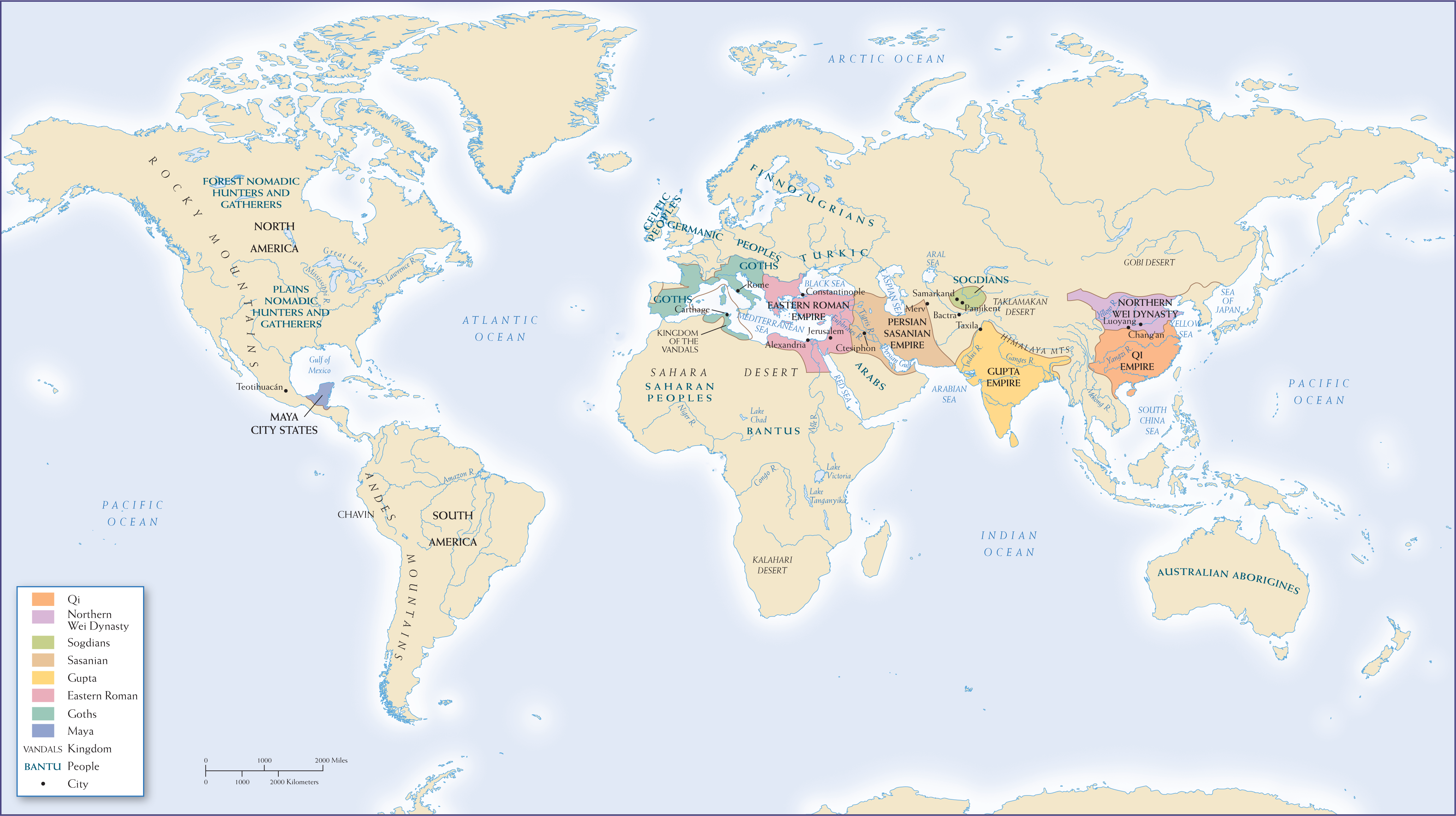
A world map highlights major empires and cultural regions between 300 and 600 CE. Colored areas identify states such as the Eastern Roman (Byzantine) Empire in the eastern Mediterranean, the Sasanian Empire in Persia, the Gupta Empire in India, and Chinese dynasties in East Asia. Other groups shown include the Goths, Vandals, and Frankish Kingdom in Europe. In the Americas, regions such as Maya city-states are marked, while parts of Africa show groups like the Bantu peoples. The map places these empires within a global geographic context, labeling continents, oceans, and major regions to illustrate the distribution of major political powers during this period.
MAP 1.1 | Empires and Universalizing Religions, 300–600 CE
The period from 300 to 600 CE was a time of tumultuous political change accompanied by the spread of adaptable and accessible universalizing faiths.
- Where on the map are the world’s empires located? Why might that be the case?
- Looking at Map 1.2, what seems to be the relationship between these empires and religions or philosophies such as Christianity, Buddhism, Judaism, Hinduism, and Confucianism?
Christians’ emphasis on obedience to their Lord God, rather than to a human ruler, sparked a Mediterranean-wide debate on the nature of religion as well as texts that explored these issues. Christians read and followed divinely inspired scriptures that told them what to believe and do, even when those actions went against the empire’s laws. Christians spoke of their scriptures as “a divine codex.” Bound in a compact volume or set of volumes, which reflected the revolutionary change from scrolls to books for knowledge transmission, this was the definitive guide to proper belief and behavior. By the late fourth century CE, Christians had largely settled on a combination of Jewish scriptures and newly authoritative Christian texts—including history, laws, prophecy, biography, poetry, letters, and ideas about the end of days—that would come to be known as the Bible.
AP® Skills & Processes
Another central feature of early Christianity was the figure of the martyr. Martyrs were women and men whom the Roman authorities executed for persisting in their Christian beliefs instead of submitting to emperor worship, as we saw in this chapter’s opening story of the twelve Scillitan martyrs, so-called for the town in North Africa from which they came. While other religions, including Judaism and, later, Islam, honored martyrs who died for their faith, Christianity claimed to be based directly—in the words of the North African Christian theologian Tertullian (writing around 200 CE)—on “the blood of martyrs,” including Jesus.
The story of Vibia Perpetua, a well-to-do mother in her early twenties, offers a striking example of martyrdom. Perpetua and Felicitas, her maidservant (the Latin word conserva is perhaps more accurately translated as “slave,” as scholars have recently suggested), refused to sacrifice to the Roman gods. Along with their companions, they were condemned in 203 CE to face wild beasts in the amphitheater of Carthage, a venue small enough that the condemned and the spectators would have had eye contact with one another throughout the fatal encounter. The prison diary that Perpetua dictated before her death offered to Christians and potential converts a powerful religious message that balanced heavenly visions and rewards with her duties to her father, brother, and infant son. As the Christian church became more formally institutionalized, it became more dominated by men. The remembered heroism of women martyrs like Perpetua and Felicitas serves as powerful examples of the more influential role that women played in the early Christian church.
CONSTANTINE: FROM CONVERSION TO CREED
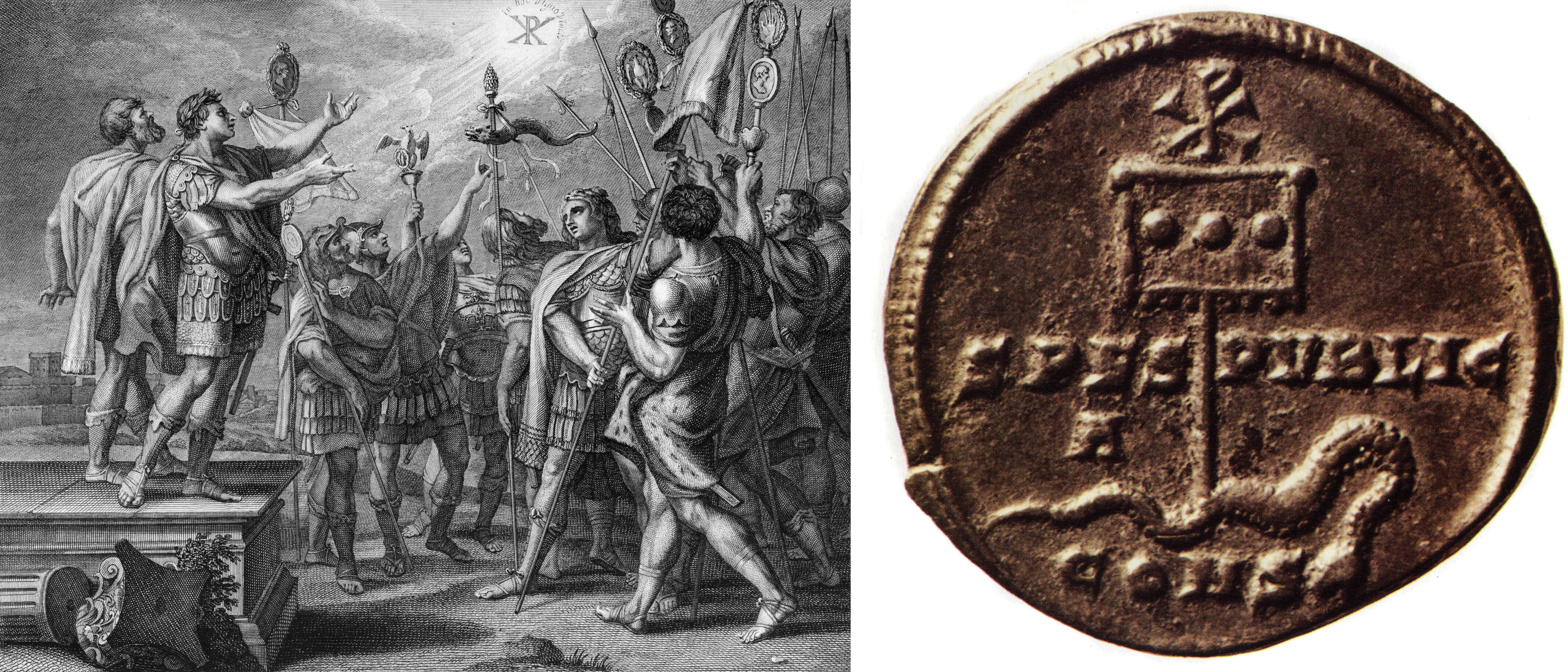
Crucial in spurring Christianity’s spread was the transformative experience of the Roman emperor Constantine (c. 280–337 CE). Born near the banks of the Danube River in what is today Serbia, he belonged to a class of professional soldiers whose careers took them far from the Mediterranean. Constantine’s troops proclaimed him emperor after the death of his father, the emperor Constantius. In the civil war that followed, Constantine looked for signs from the gods. Before the decisive battle for Rome, which took place at a strategic bridge in 312 CE, he supposedly had a dream in which he saw an emblem bearing the words “In this sign you will conquer.” The “sign,” which he then placed on his soldiers’ shields, was the first two letters of the Greek christos, a title for Jesus meaning “anointed one.” Constantine’s troops won the ensuing battle and, thereafter, Constantine’s visionary sign became known all over the Roman world. Constantine showered imperial favor on this once-persecuted faith, not only legalizing Christianity (in 313 CE) but also praising the work of Christian bishops and granting them significant tax exemptions.
The Global View
More information
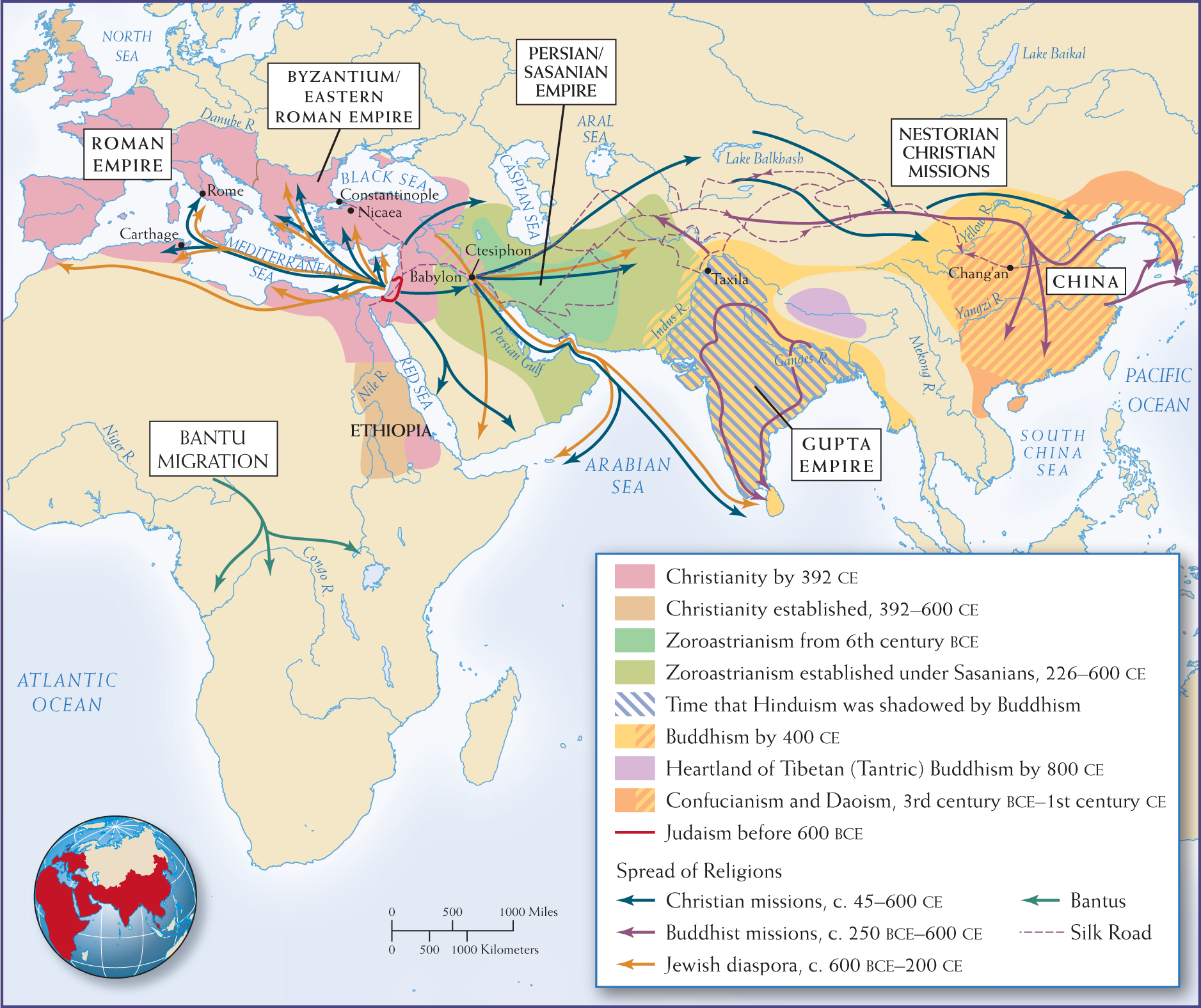
A world map illustrates the spread of major religions and cultural movements across Europe, North Africa, and Asia during the early centuries CE. Colored regions indicate where religions such as Christianity, Judaism, Zoroastrianism, Buddhism, Hindu traditions, Confucianism, and Daoism were established. Arrows show the movement of religious ideas through missionary activity, migration, and trade routes such as the Silk Road. Major states and regions, including the Roman and Byzantine Empires, the Persian Sasanian Empire, the Gupta Empire in India, and China, are labeled. The map also marks movements like the Bantu migration in Africa and Christian and Buddhist missionary routes across Eurasia.
MAP 1.2 | The Spread of Religions and Common Cultures in Afro-Eurasia, 300–600 CE
The spread of religions and common cultures was closely linked to the shifting political landscape.
- Where did Hinduism, Buddhism, and Christianity emerge? Where did Zoroastrianism and Confucianism thrive? Which traditions coexisted, and where did they coexist?
- Along what routes did each religion expand? What comparisons can you draw about the directional spread and extent of these religions’ expansion?
- What differences do you see between the spread of universalist and non-universalist religions?
- What other features besides universalism appear to foster the diffusion of religion and cultural traditions? What features appear to limit their expansion?
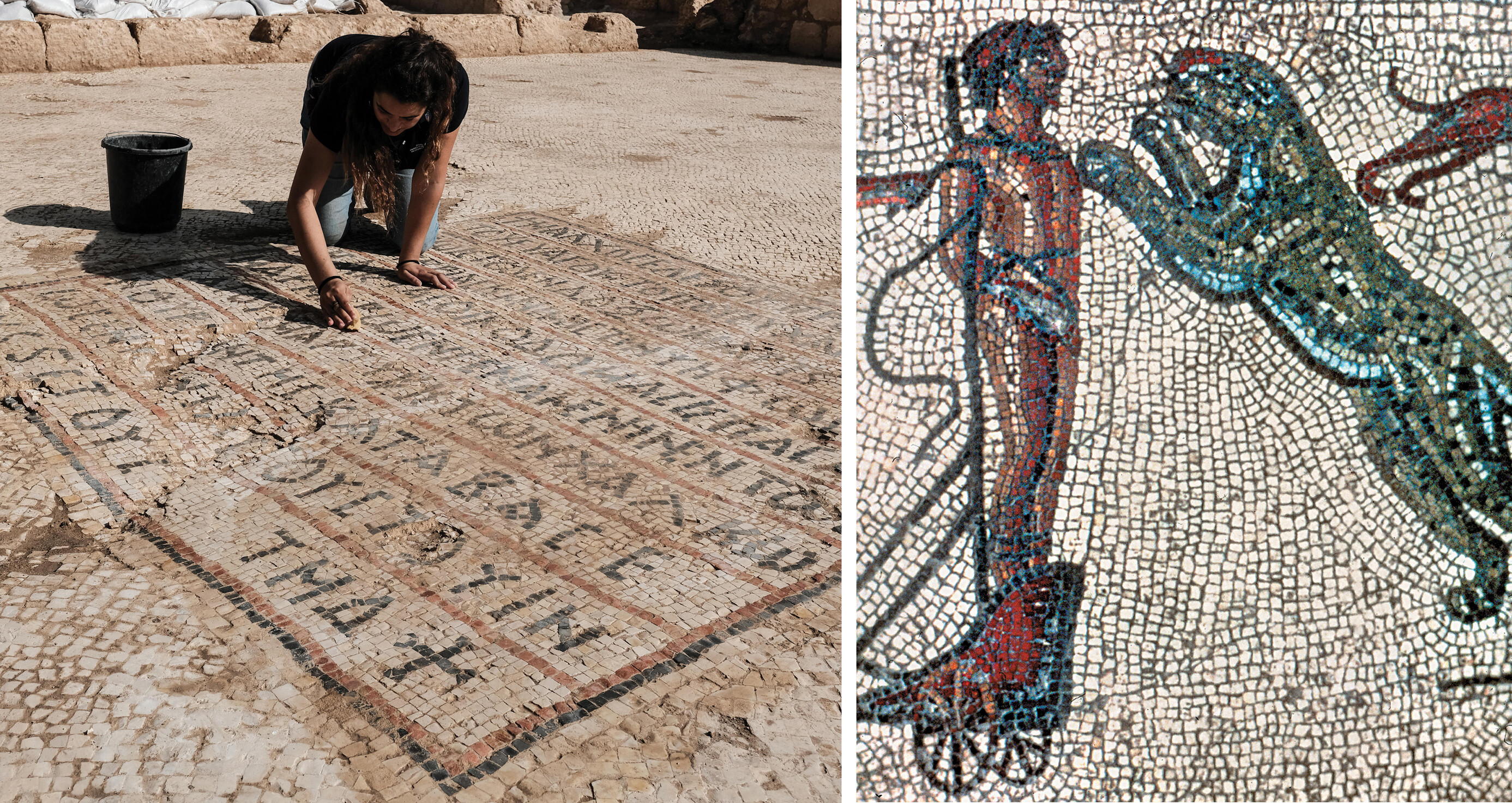
By the time that Constantine embraced Christianity, it had already made considerable progress within the Roman Empire. It had prevailed in the face of stiff competition and periodically intense persecution from the imperial authorities. Apart from the new imperial endorsement, Christianity’s success could be attributed to the sacred aura surrounding its authoritative texts, the charisma of its holy women and men, the consistency between its doctrines and popular preexisting religious beliefs and practices, and its broad, universalizing appeal to rich and poor, city dwellers and peasants, enslaved and free people, young and old, and women and men.
In 325 CE, hoping to bring unity to the diversity of belief within Christian communities, Constantine summoned all bishops to Nicaea (modern Iznik in western Turkey) for a council to develop a statement of belief, or creed (from the Latin credo, “I believe”). The resulting Nicene Creed balanced three separate divine entities—God “the father,” Jesus “the son,” and “the holy spirit”—as facets of one supreme being. Also at Nicaea the bishops agreed to observe Easter, the day on which Christians celebrate Christ’s resurrection, on the same day in every church of the Christian world. Constantine’s legacy to the Christian church was monumental. His conversion had happened in such a way that Christianity became the religion of the Roman Empire itself. Writing near the end of Constantine’s reign, an elderly bishop in Palestine named Eusebius noted that the Roman Empire of his day would have surprised the martyrs of Carthage, who had willingly died rather than recognize any “empire of this world.”
AP® Skills & Processes
AP® Skills & Processes
CHRISTIANITY IN THE CITIES AND BEYOND
After 312 CE, the large churches built in every major city, many with imperial funding, signaled Christianity’s growing strength. These gigantic meeting halls were called basilicas, from the Greek word basileus, meaning “king.” They were modeled on Roman law-court buildings and could accommodate over a thousand worshippers. Inside a basilica’s vast space, oil lamps shimmered on marble and brought mosaics to life. Rich silk hangings, swaying between rows of columns, increased the sense of mystery and directed the eye to the far end of the building—a splendidly furnished semicircular apse. Under the dome of the apse, which represented the dome of heaven, and surrounded by priests, the bishop sat and preached from his special throne, or cathedra. Worshippers entering the basilica had come into a different world. This was heaven on earth.
These basilicas became the new urban public forums, ringed with spacious courtyards where the city’s poor would gather. In return for the tax exemptions that Constantine had granted them, bishops cared for the metropolitan poor. Bishops also became judges, as Constantine turned their arbitration process for disputes between Christians into a kind of small claims court. Offering the poor shelter, quick justice, and moments of unearthly splendor in grand basilicas, Christian bishops perpetuated “Rome” for centuries after the empire had disappeared.
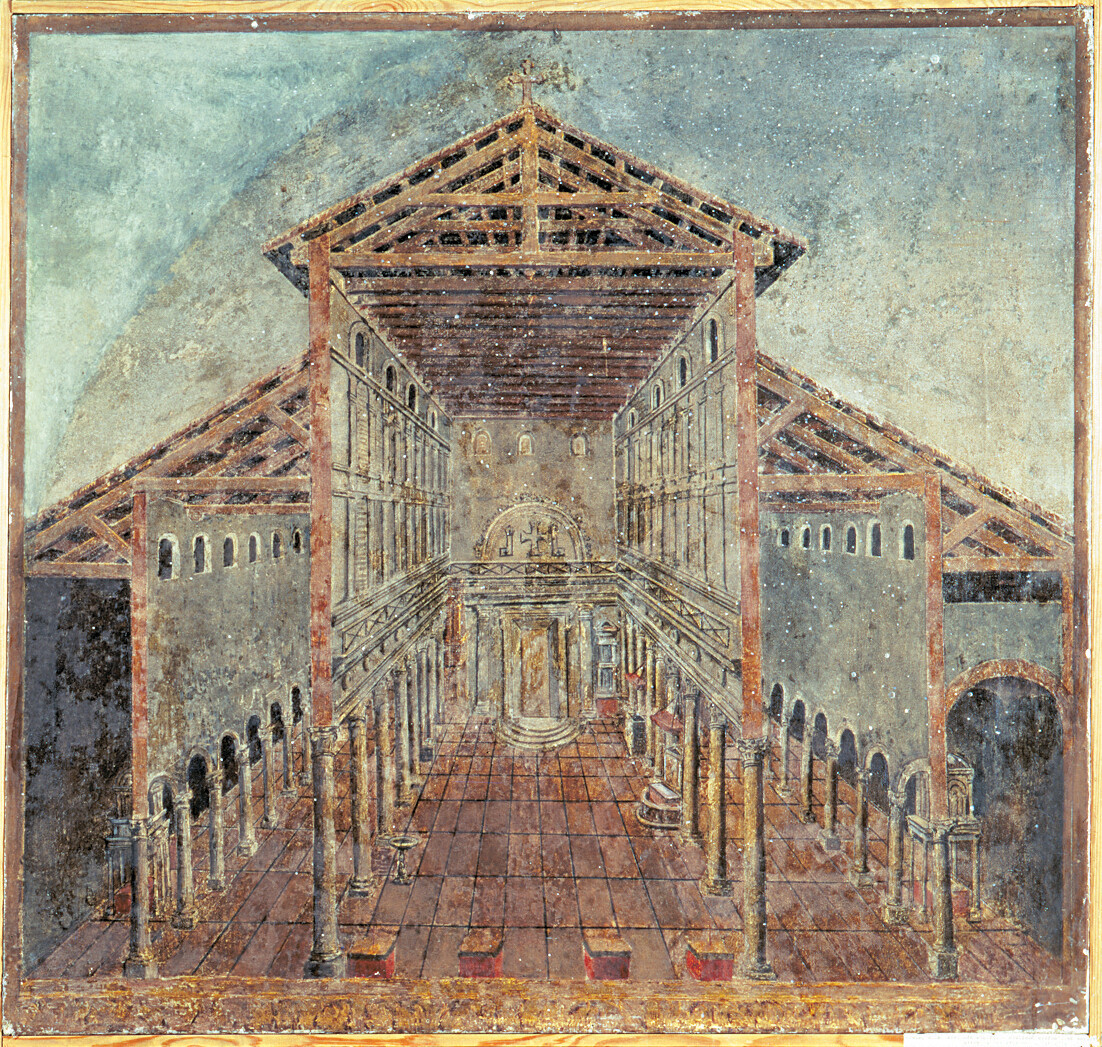
The spread of Christianity outside the cities and into the hinterlands of Africa and Southwest Asia required the breaking of language barriers. In Egypt, Christian clergy replaced hieroglyphs with Coptic, a more accessible script based on Greek letters, in an effort to bridge the linguistic and cultural gap between town and countryside in Egypt. In the busy corridor that joined Antioch to Mesopotamia, Syriac, an offshoot of the Semitic language Aramaic, became a major Christian language. As Christianity spread farther north, to Georgia in the Caucasus and to Armenia, Christian clergy created written languages that are still used in those regions.
The “Fall” of Rome in the West
By the third and fourth centuries CE, the political and economic fabric of the old Roman world was unraveling. (See Map 1.3.) The so-called barbarian invasions of the late fourth and fifth centuries CE further contributed to that demise. These “invasions” were not so much an assault as a violent and chaotic immigration of young fighting men from the frontiers of the empire. Today the term barbarian implies uncultivated or savage, but its meaning in antiquity was “foreigner” (with overtones of inferiority). Romans used the same word to describe the indigenous populations they encountered in North Africa, from which we derive the contemporary (and somewhat derogatory) term “Berber.” Inhabitants of the empire’s western provinces had become accustomed to non-Roman soldiers from across the frontiers, and for them barbarian was synonymous with “soldier.” The popular image of bloodthirsty barbarian hordes streaming into the empire bears little resemblance to reality.
THE GOTHS
It was the Romans’ need for soldiers that drew the barbarians in. The process reached a crisis point when tribes of Goths petitioned the emperor Valens (r. 364–378 CE) to let them immigrate into the empire. These Goths were no strangers to Roman influence: in fact, many had been evangelized into an anti-Nicene version of Christianity by the Gothic bishop Ulfilas, who had even translated the Bible into the Gothic language using an alphabet he developed for that purpose.
Desperate for manpower, Valens encouraged the Goths to enter Roman territory but mistreated these new immigrants. A lethal combination of famine and anger at the breakdown of supplies—not innate bloodlust—turned the Goths against Valens. When he marched against them at Adrianople in the hot August of 378 CE, Valens was not seeking to halt a barbarian invasion but rather intending to teach a lesson in obedience to his new recruits. The Gothic cavalry, however, proved too much for Valens’s imperial army, and the Romans were trampled to death by the men and horses they had hoped to hire. As the pattern of disgruntled “barbarian” immigrants, civil war, and overextension continued, the Roman Empire in western Europe crumbled.
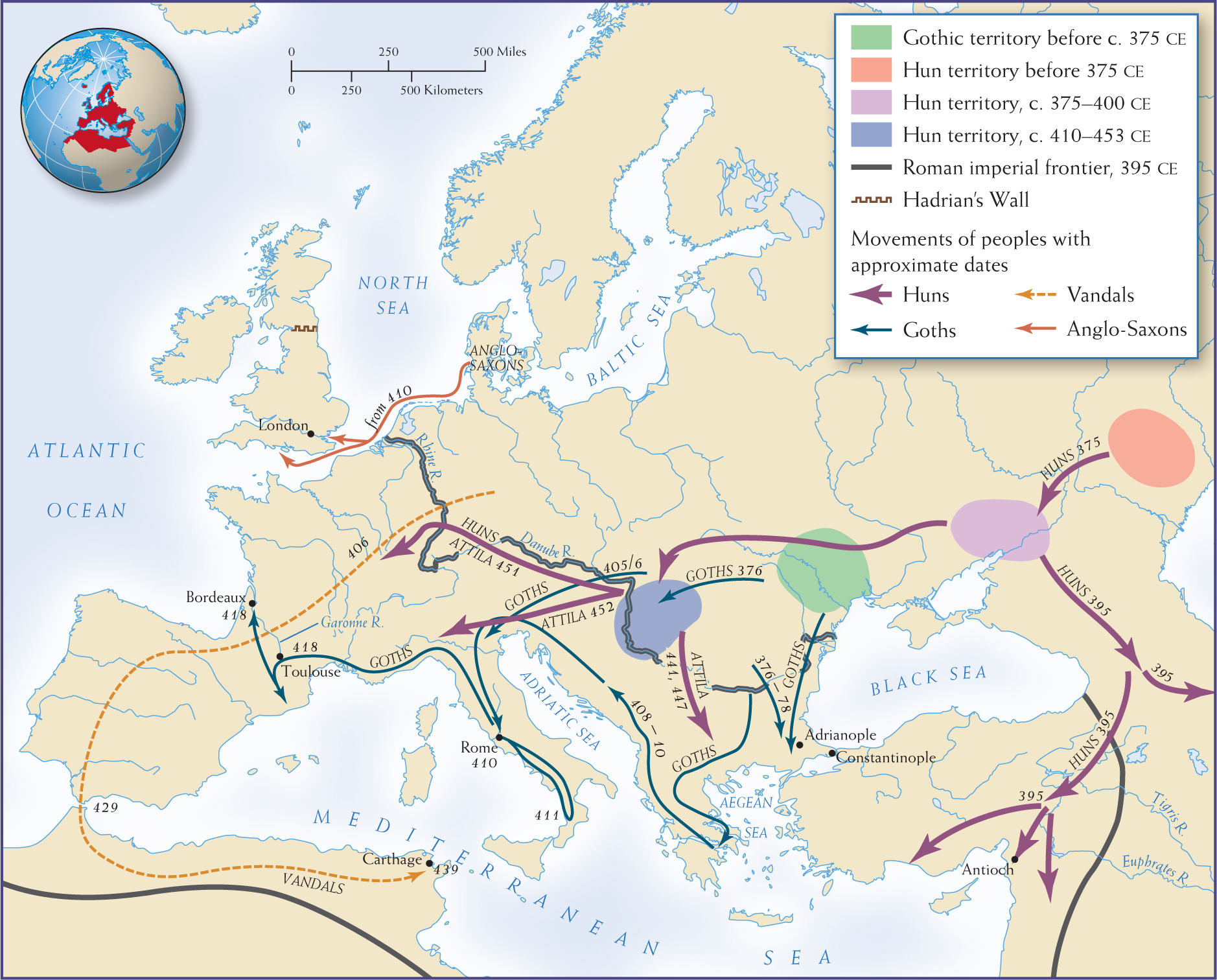
More information
Map of Europe and western Asia shows migrations and conflicts during the late Roman Empire between about 375 and 450 CE. Arrows trace the movements of groups such as the Huns, Goths, Vandals, and Anglo-Saxons as they moved across the Roman world. Colored areas indicate territories controlled by the Huns at different times, earlier Gothic territories, and the Roman Empire around 395 CE. The map also marks key cities and regions such as Rome, Constantinople, Gaul, and the Black Sea area, as well as Hadrian’s Wall in Britain.
MAP 1.3 | Western Afro-Eurasia: War, Immigration, and Settlement in the Roman World, 375–450 CE
Invasions and migrations brought about the reconstitution of the population of the Roman Empire at this time.
- Using the map, identify the people who migrated to or invaded the Roman Empire. Where were they from, and where did they go?
- How did these migrations and invasions reshape the political landscape of western Afro-Eurasia?
- Considering the impact of these population movements, to what extent was the Roman depiction of these groups as “barbarians” a fair assessment?
Rome’s maintenance of its northern borders required constant efforts and high taxes. But after 400 CE the western emperors could no longer raise enough taxes to maintain control of the provinces. In 418 CE, the Goths settled in southwest Gaul as a kind of local militia to fill the absence left by the contracting Roman authority. Ruled by their own king, who kept his military in order, the Goths suppressed alarmingly frequent peasant revolts. Roman landowners of Gaul and elsewhere anxiously allied themselves with the new military leaders rather than face social revolution and the raids of even more dangerous armies. Although they practiced a different, “heretical” version of Christianity, the Goths came as Christian allies of the aristocracy, not as godless enemies of Rome.

THE HUNS
Romans and non-Romans also drew together to face a common enemy: the Huns. Led by their king Attila (r. 434–453 CE) for twenty years, the Huns threatened both Romans and Germanic peoples (like the Goths). While the Romans could hide behind their walls, the Hunnish cavalry regularly plundered the scattered villages and open fields in the plains north of the Danube River.
Attila intended to be a “real” emperor of a warrior aristocracy. Having adopted (perhaps from the Chinese empire) the notion of a “mandate of heaven”—in his case, a divine right to rule the tribes of the north—he fashioned the first opposing empire that Rome ever had to face in northern Europe. Rather than selling his people’s services to Rome, Attila extracted thousands of pounds of gold coins in tribute from the Roman emperors who hoped to stave off assaults by his brutal forces. Drained both militarily and economically by this Hunnish threat, the Roman Empire in the west disintegrated only twenty years after Attila’s death.
AP® Skills & Processes
In the last analysis, barbarians did not destroy the empire. They were only the last straw. The “fall” of the empire in western Europe was the result of a long process of overextension. Rome could never be as strong along its frontiers as it was around the Mediterranean, because those frontiers were too far away. Despite the famous Roman roads, travel time between the Rhine border and Rome was more than thirty days. Lacking the vast network of canals that enabled Chinese emperors to move goods and soldiers by water, Roman power could survive in the north only at the cost of constant effort and high taxes. But after 400 CE, the western emperors could no longer raise enough taxes to maintain control of the northern provinces, and invaders simply moved into the vacuum. In 476 CE, the last Roman emperor of the west, a young boy named Romulus Augustulus (namesake of both Rome’s legendary founder and its first emperor), resigned to make way for a so-called barbarian king in Italy. (See Current Trends in World History: Fall of the Roman and Han Empires: A Comparative Perspective.)
The political unity of the Roman Empire in the west now gave way to a sense of unity through the church. The Catholic Church (Catholic meaning “universal,” centered in the bishops’ authority) became the one institution to which all Christians in western Europe, Romans and non-Romans alike, felt that they belonged. The bishop of Rome became the symbolic head of the western churches. Rome became a spiritual capital instead of an imperial one. By 700 CE, the great Roman landowning families of the Republic and early empire had vanished, replaced by religious leaders with vast moral authority.
Continuity of Rome in the East: Byzantium
Elsewhere during this period the Roman Empire was alive and well. From the borders of Greece to the borders of modern Iraq, and from the Danube River to Egypt and the borders of today’s Saudi Arabia, the empire survived undamaged. The new Roman Empire of the east—to which historians gave the name Byzantium—built its own imperial capital, Constantinople, in every way a rival to Rome. Founded in 324 CE by its namesake, Constantine, on the Bosporus straits separating Europe from Asia, this strategically located city was well situated to receive taxes in gold and to control the sea-lanes of the eastern Mediterranean.
AP® Skills & Processes
Constantinople was one of the most spectacularly successful cities in Afro-Eurasia, soon boasting 4,000 palaces and a population of over half a million. Every year, more than 20,000 tons of grain arrived from Egypt, unloaded on a dockside over a mile long. A gigantic hippodrome echoing Rome’s Circus Maximus straddled the city’s central ridge, flanking an imperial palace whose opulent enclosed spaces stretched down to the busy shore. As they had for centuries before in Rome, emperors would sit in the imperial box, witnessing chariot races as rival teams careened around the stadium. The hippodrome also featured displays of eastern imperial might, as ambassadors came from as far away as central Asia, northern India, and Nubia.
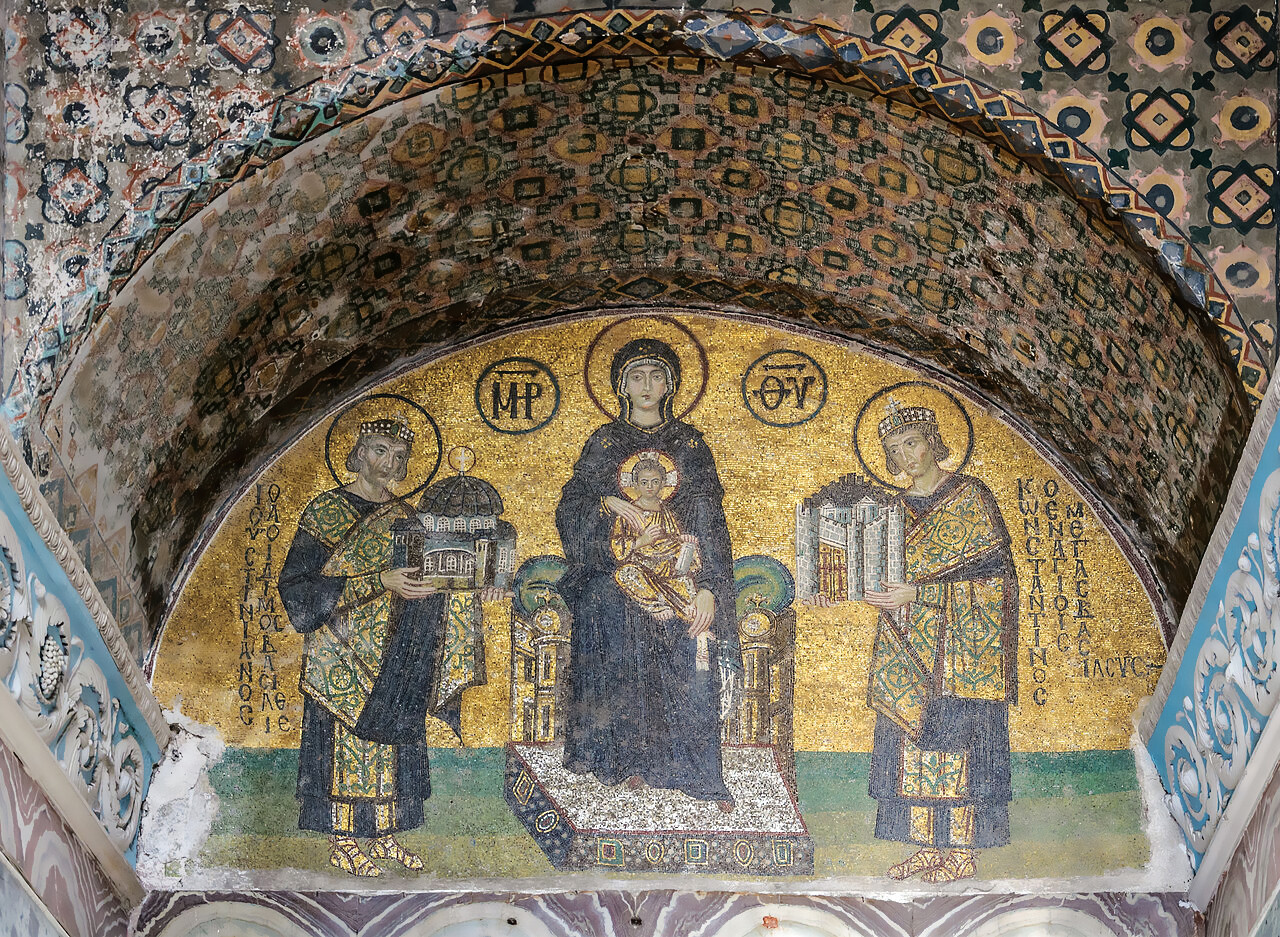
Similarly, the future emperor Justinian came to Constantinople as a young man from an obscure Balkan village, to seek his fortune. When he became emperor in 527 CE, he considered himself the successor of a long line of forceful Roman emperors—and he was determined to outdo them. Most important, Justinian reformed Roman laws. Within six years a commission of lawyers had created the Digest, a massive condensation and organization of the preexisting body of Roman law. Its companion volume was the Institutes, a teacher’s manual for schools of Roman law. These works were the foundation of what later ages came to know as “Roman law,” followed in both eastern and western Europe for more than a millennium.
Reflecting the marriage of Christianity with empire was Hagia Sophia, a church grandly rebuilt by Justinian on the site of two earlier basilicas. The basilica of Saint Peter in Rome, the largest church built by Constantine two centuries earlier, would have reached only as high as the lower galleries of Hagia Sophia. Walls of multicolored marble, gigantic columns of green and purple granite, audaciously curved semicircular niches placed at every corner, and a spectacular dome lined with gleaming gold mosaics inspired awe in those who entered its doors. Hagia Sophia represented the flowing together of Christianity and imperial culture that for another 1,000 years would mark the Eastern Roman Empire centered in Constantinople.
Current Trends in World History
Fall of the Roman and Han Empires: A Comparative Perspective
The Roman Empire and the Han Empire shared an extraordinary number of similarities. Initially, they knew little about each other. With 5,000 miles of steppes, mountains, and deserts separating the empires, their knowledge of each other was based on traded commodities. Although they arose at slightly different times (the Han Empire at the end of the third century BCE and the Roman Empire at the end of the first century BCE), they both lasted approximately 400 years and had the same population size (around 60 million, together more than half the world’s population at the time). The rulers of both empires resided in capital cities that had the largest populations in the world. Both rulers were thought to have godlike powers, aspired to domination of their known world, and commanded huge militaries. Moreover, both empires were so powerful and long-lasting that subsequent Chinese and western European rulers sought to revive them. In China the imperial system, in spite of periods of considerable turmoil and fragmentation (especially from 300 to 600 CE), lasted more than 2,000 years, from the establishment of the Qin dynasty in 221 BCE to the abdication of the last Qing emperor on February 12, 1912, when the Chinese republic came into existence. In contrast, in western Europe, while political leaders sought to revive the fallen Roman Empire and claimed to have done so first under Charlemagne and later under the Habsburgs as the Holy Roman Empire, these states were never true empires.
A variety of reasons exist for the endurance of China’s imperial system and the failure of western European leaders to revive anything that resembled the Roman Empire. Three reasons stand out. First, China and Rome emerged as empires in markedly different ways. Second, during their four centuries of existence, their ruling elites created different political institutions and were guided by different ideologies. Third, their collapses were notably different.
THE ROAD TO EMPIRE
The short-lived Qin Empire (221–207 BCE) cleared the way for the Han Empire and created the institutional foundations and solidified the ideological bases for the Han and subsequent dynasties. The Qin arose after the Shang and Zhou dynasties, which were important states but far from being true empires. Although the rulers of the Zhou dynasty, founded in 1045 BCE, remained on the throne until the third century BCE, the Zhou ceased to be a dynamic and powerful state in the eighth century BCE, giving way to the Spring and Autumn period (722–481 BCE) and the Warring States period (403–221 BCE). The Warring States period was crucial in establishing the ideological foundations for China’s imperial history. During this long period China experienced constant warfare, in which the size of armies and the number of casualties skyrocketed. According to China scholar Yuri Pines, the carnage of warfare led all the major Chinese intellectuals and scholar-officials, including Confucius, Mencius, Laozi, Mo Di, and the Legalists, to “endorse the idea that a single savior-like person would bring about unity and peace.” These Axial Age philosophers in China created the ideological foundations for empire—foundations that compelled China’s ruling elites to return over and over again to imperial rule through an emperor.
In contrast, the Roman state emerged as the dominant city-state in the Italian Peninsula beginning in the fifth century BCE. Rome warred continuously with other city-states on the peninsula right down to the first century CE (against Etruscans, Samnites, Greeks in southern Italy, and Italian allies). Additionally, Rome warred against other groups in the Mediterranean, from the Carthaginians in North Africa and Spain to the Hellenistic successor kingdoms to the east. Nonetheless, Rome’s experience with warfare did not produce foundational philosophies. Moreover, its political ideology, drawn to some extent from the Greek city-states of the Axial Age, was based on republicanism. The Roman Empire emerged only at the end of the first century BCE.
DIFFERENT IMPERIAL POLITICAL INSTITUTIONS AND IDEOLOGIES
Geography was an important difference between Rome and Han China. The Roman Empire was not easy to govern territorially. Its ruler’s authority had to extend over both sides of the Mediterranean Sea. In addition, Italy was a peninsula, Iberia was separated from northern Europe by the Pyrenees, and the British Isles were divided from mainland Europe by the English Channel. China had geographical barriers also. It was crisscrossed by rivers, mountains, and deserts that created diverse regional cultures. Thus, like the rulers of the Roman Empire, China’s ruling elites had to impose their will on disparate ethnic and linguistic groups. Ideology, handed down from the Warring States period, proved crucial in solidifying this unity. Equally important, however, was the role of the scholar-gentry class, who insisted that a detailed knowledge of the classics was the only way to enter the ruling class. Moreover, China was more closely governed than its Roman counterpart. The central and local governments were staffed by around 130,000 individuals, of whom 20,500 worked for the central administration. The far-flung Chinese bureaucracy made the Roman Empire seem undergoverned. Rome was much more of a patchwork empire, governed in cooperation with local elites and nowhere as dependent on direct administration or a complex bureaucracy. Rome maintained its authority through its immense army and military coercion rather than ideological preeminence. Even considering Rome’s late third-century CE system of more than 100 provinces managed as twelve dioceses, Rome never developed the kinds of administrative institutions that existed in the Han Empire.
THE DECLINE AND FALL OF THE ROMAN AND HAN EMPIRES
While both the Roman and Han Empires lasted four centuries, their falls were decidedly different. Both succumbed to nomadic pastoral peoples—the Goths overwhelming the Roman state and the northern steppe peoples bringing the Han to their knees. European nomads entered the Roman Empire and destroyed Rome’s power to rule in the west, while Christianity offered a degree of continuity. In the east, steppe peoples who invaded China did not destroy the Han imperial system but instead emulated it, even while maintaining their traditional political, social, and ideological practices in their homelands. Ultimately, western Europe and China diverged dramatically after the fall of the Roman and Han Empires. Europe ended up with many fledgling states and vernacular languages, but one God, one papacy, and one dominant religion. In contrast, China had many minor gods, but one emperor, one dominant language, and a long-lasting Confucian bureaucracy.
QUESTIONS FOR ANALYSIS
- What are some of the similarities and differences in the processes through which the Roman and Han Empires formed, were maintained, and fell?
- What might account for the differing outcomes in the aftermaths of the fall of the Han Empire and the fall of the Roman Empire in the west?
EXPLORE FURTHER
Pines, Yuri, Envisioning Eternal Empire: Chinese Political Thought of the Warring States Era (2009).
Pines, Yuri, The Everlasting Empire: The Political Culture of Ancient China and Its Imperial Legacy (2012).
Rosenthal, Jean-Laurent, and R. Bin Wong, Before and Beyond Divergence: The Politics of Economic Change in China and Europe (2011).
Scheidel, Walter (ed.), Rome and China: Comparative Perspectives on Ancient World Empires (2009).
Source: Yuri Pines, Envisioning Eternal Empire: Chinese Political Thought of the Warring States Era (Honolulu: University of Hawaii Press, 2009), p. 26.
Among other challenges, internal discord intensified during Justinian’s reign. Justinian quelled riots at the heart of Byzantium, like the weeklong Nika riots in 532 CE in which thousands died when a group of senators used the unrest and high emotions of the chariot races as a cover for revolt. Externally, Justinian initiated battles to reclaim parts of the western Mediterranean and to hold off the threat from Sasanian Persia in the east (see next section).
Perhaps the grisliest reminder of this increased connectivity was a sudden onslaught in 541–542 CE of the bubonic plague. One-third of the population of Constantinople died within weeks. Justinian himself survived, but thereafter he ruled an empire whose heartland was decimated. Nonetheless, Justinian’s contributions—to Roman law, to Christianity, to the maintenance of imperial order—helped Byzantium last almost a millennium after Rome in the west had fallen away.
Glossary
- martyr
- Literally meaning “witness,” a person executed by Roman authorities for maintaining his or her Christian beliefs rather than worshipping the emperor.
- creed
- From the Latin credo, meaning “I believe,” an authoritative statement of belief. The Nicene Creed, formulated by Christian bishops at the Council of Nicaea in 325 CE, is an example of one such formal belief statement.
- Byzantium
- Modern term for the Eastern Roman Empire (which would last until 1453), centered at its “New Rome,” Constantinople, which was founded in 324 CE by Constantine on the site of the Greek city Byzantium.