In 1933 George Pullen Jackson, a New England–born professor of German at Vanderbilt University in Nashville, Tennessee, published a book—White Spirituals in the Southern Uplands—about a remarkable tradition he had encountered among “plain folk” in the region. Gathering on weekends, groups of southerners staged all-day “singings” of sacred music, and they brought their own books: oblong volumes of psalm and hymn tunes, fuging tunes, and anthems set mostly for four-part chorus with the melody in the tenor voice. They seated themselves according to voice part—treble (soprano), counter (alto), tenor, and bass—in a rectangle with open space in the middle. Into that space stepped a succession of singers from the ranks, each leading the group in two or three pieces. Typically, before adding the words to a piece, the group would sing the notes on four syllables: fa, sol, la, and mi (a form of solmization, as described in the box on p. 63). Jackson, who found the singers’ note-reading ability astounding, learned that most had attended singing schools. They tended to vocalize at full blast, paying little heed to voice quality and making no attempt to blend—but with no audience in sight, such things didn’t seem to matter.
While the singing promoted by the New England reformers always included a human audience, which it tried to please and edify, singers in Jackson’s southern tradition made music to glorify God; theirs was an attitude of praise. According to their understanding, the power of the music and the absorbed concentration they brought to their singing made it worthy of the recipient, no matter how it sounded. Neither self-awareness nor an audience played any role, for when human judgments of musical quality began to be made, Jackson warned, “at that moment, this singing of, for, and by the people loses its chief characteristic.”
Conversations at the singings he attended helped Jackson understand what these gatherings meant to the singers. “Every time I go to one of these singings,” one veteran confided, “I feel that I am attending a memorial to my mother”; when one of her favorite pieces was sung, it was “as if heaven itself hovers over the place.” Pleasure in making music was also part of the attraction. But in the end, the spiritual environment seems to have left the deepest impression. Many of the people imagined heaven as “a place where they will meet again those beloved singers who have gone before, and sing again with them, endlessly.”
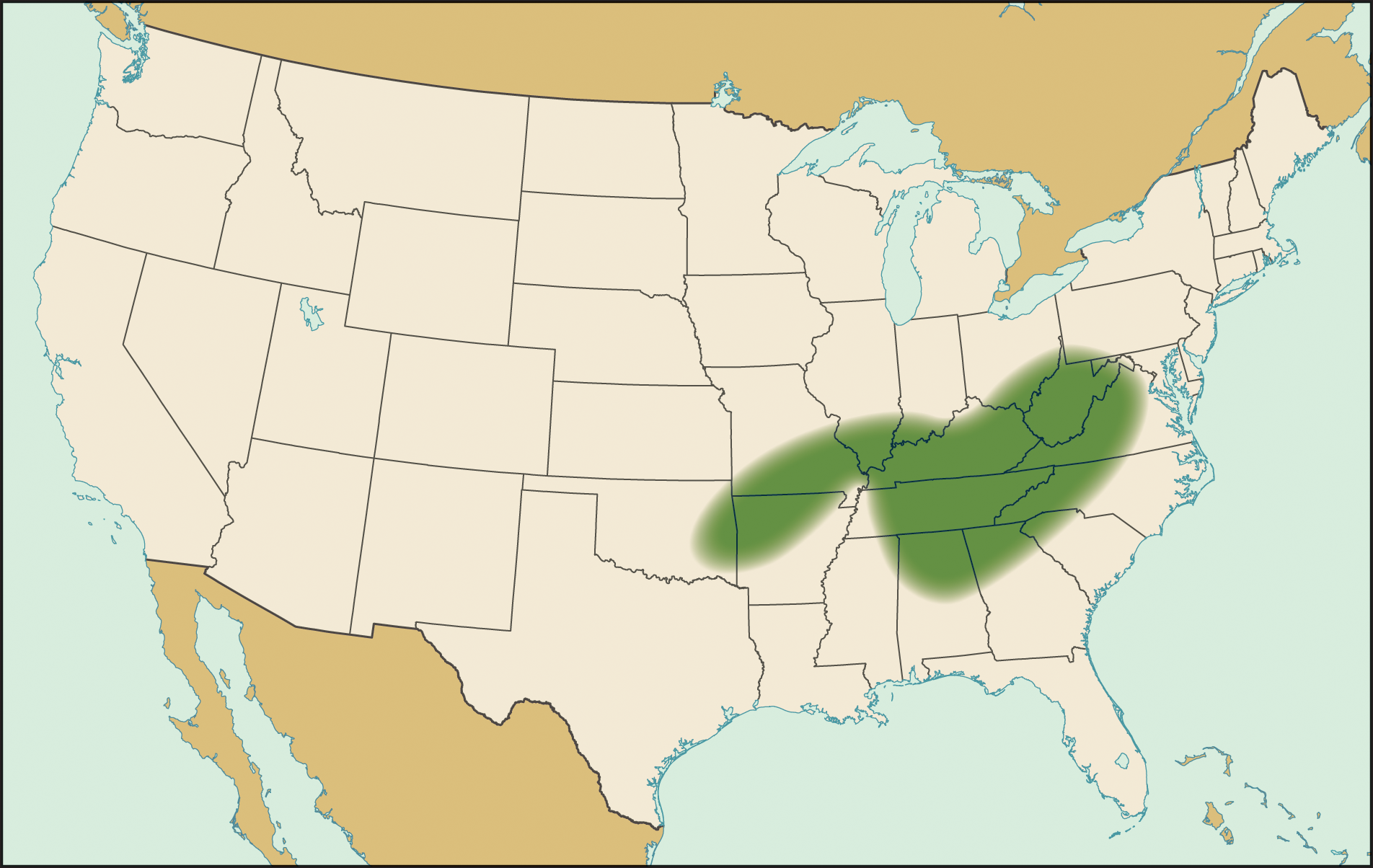
The Upland South embraces the higher elevations of several states and is defined by culture and history as much as by geographical features.
Jackson’s research revealed these singings to be the tip of a historical iceberg. Rather than keeping pace with religious and musical change, people in the Upland South—which includes the Shenandoah Valley and parts of Maryland, Virginia, West Virginia, Kentucky, Tennessee, North and South Carolina, and Georgia, but not the coastal areas—had preserved a singing-school tradition dating back to colonial New England.
But the southern practice was more a transformation than a simple survival of the northern practice. Psalmody had been sung in New England by rural people, city dwellers, college students, and Calvinist churchgoers of all ages, singing in the name of art as well as praise. In the Southern Uplands, however, hymnody—in effect, the psalmody of the nineteenth century, when hymn singing had eclipsed psalm singing—took root among rural plain folk with stern views of religion and generally old-fashioned ways. And perhaps nothing marks southern hymnody as a countrified tradition more clearly than the musical notation in which it circulated.
Many southern tunebooks used a notation, introduced in William Little and William Smith’s Easy Instructor (Philadelphia, 1801), in which the shapes of the notes, in addition to their position on the staff, indicated the pitches to be sung. Shape notes, although they originated in the Northeast, were used there for only a short time, instead taking root in the southern singing traditions, where for two centuries they have helped countless singers learn to sing accurately at sight from printed music books.
A CLOSER LOOK
Fasola
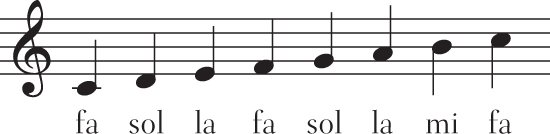
Since the Middle Ages, the technique of solmization, or solfège, which assigns a particular syllable to each pitch in a scale, has been used to teach singers how to sing from notation. In the most common modern form of solmization, a major scale is sung on seven syllables: do, re, mi, fa, sol, la, and ti (repeating do at the octave). In contrast, early American singing masters taught note reading according to a four-syllable system of solmization called fasola, in which a major scale was sung fa, sol, la, fa, sol, la, mi (repeating fa at the octave):
Once singers knew their major and minor scales, could find the tonic fa and the mi just below it, and had the intervals between syllables ingrained in their vocal and aural memories, they were ready to read music.
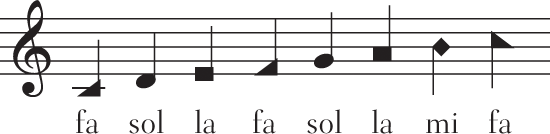
Shape notes simplified the reading process by assigning a different-shaped notehead to each of the four singing syllables:
Singers who could coordinate shapes with syllables were spared having to figure out which note to sing.
Thanks to a mixture of regional, class, and religious prejudices, musical reformers soon branded shape notes a crutch needed only by ignorant rural singers. That attitude did not stop their spread, however, especially in regions where the reformers’ message did not reach, such as New York State, New Jersey, Pennsylvania, and the Ohio River Valley. After 1810, as the frontier pushed westward, new shape-note collections began to appear in cities and towns farther and farther from Boston and Philadelphia. And while favorites from New England at first dominated the shape-note repertory, new tunes by local composers were also welcomed. The new pieces tended to emphasize the very features of New England psalmody that the reformers strove to eliminate: stark “open” sonorities, alternating with the harmonic collisions that could arise when each voice goes its own separate way. Ananias Davisson, the Virginia-born composer and compiler of Kentucky Harmony (Harrisonburg, Virginia, 1816), the first shape-note tunebook printed in the South, argued that such dissonances “answer a similar purpose to acid, which being tasted immediately before sweet [i.e., the open sonorities], give the latter a more pleasing relish.”
Idumea (LG 3.2), first printed in Davisson’s Kentucky Harmony, was a favorite, reprinted in twenty-eight southern tunebooks. Davisson, to whom the minor-mode tune is credited, may have borrowed his melody from a now-forgotten folk song; the pentatonic melody—using only five of the seven notes of the diatonic scale and thus avoiding the half steps—is characteristic of folk tunes from the British Isles. The short-meter text by Charles Wesley, an eighteenth-century English Methodist and prolific writer of hymns, paints a terrifying picture of death, from which sinners will be awakened only to face a stern judgment. (The later stanzas of Wesley’s text offer a more consoling note of redemption, but those stanzas were not included in most tunebooks.) In Davisson’s setting, each of the thirteen measures begins with a long note, all but one harmonized with a stark-sounding “open” sonority; many of the quicker notes that fill out each measure produce the fleeting dissonances that Ananias Davisson relished. In the first half, spanning the first two lines of text, the tenor melody climbs upward, reaching the apex on the fourth bar, mirroring the questioning tone that opens most of Wesley’s stanzas. The second half returns to the apex, then winds downward, as if resigned to the bleak prospect of death.
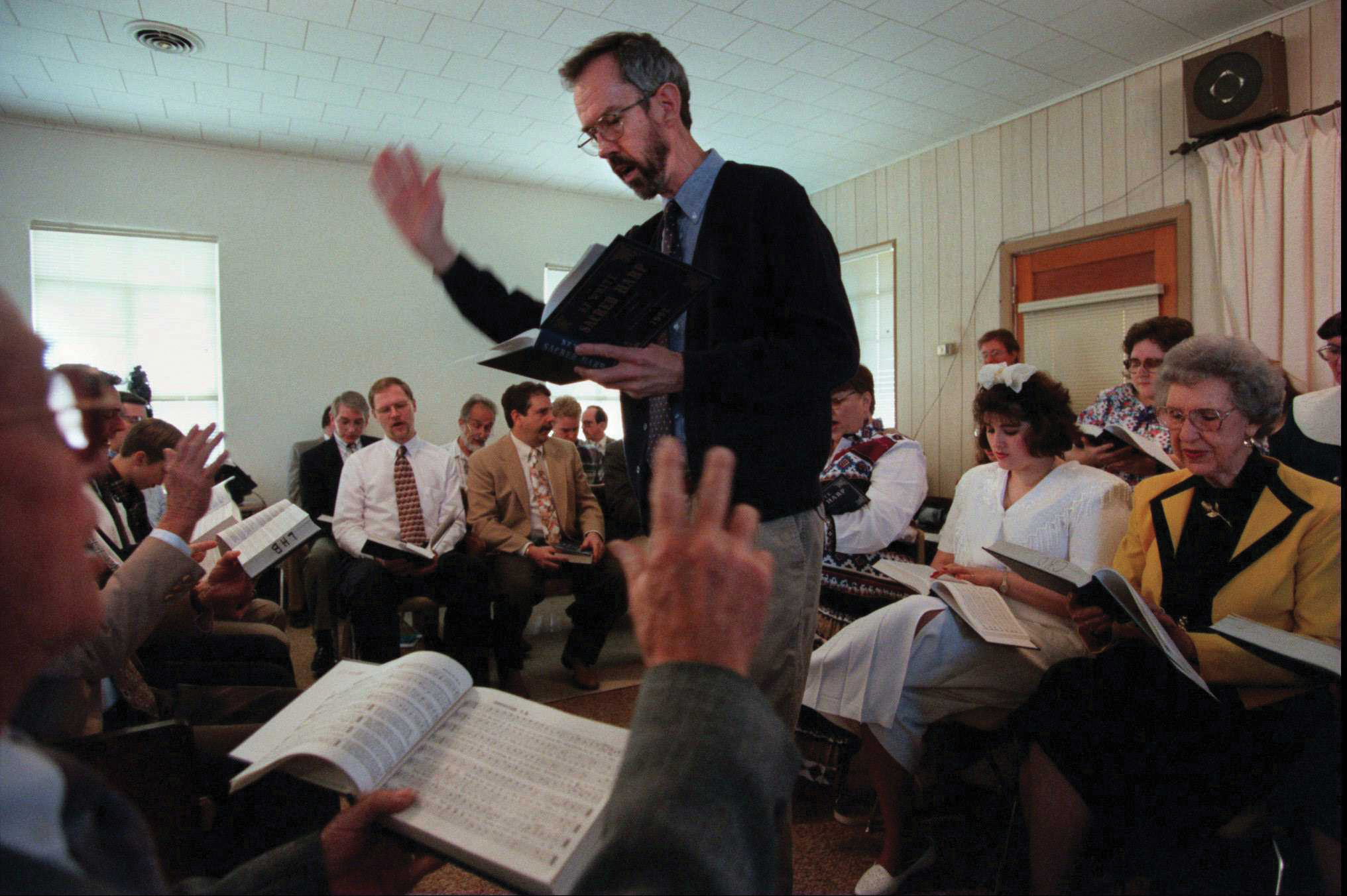
The practice of shape-note singing remains strong today. Here, a participant leads singers arranged in the traditional square at a Sacred Harp convention in McMahan, Texas, in 1998.
The impact is heightened by the full-throttle sound of the voices, as heard in the accompanying recording. The vocal production—at maximum volume, with no apparent attempt to blend the voices into a more conventional choral sound—is characteristic of the southern shape-note singing tradition.
Idumea endures as a part of a singing tradition that distilled the attitude of religious praise into an untutored, heartfelt utterance.
Southern hymnodists were not the only composers to add to the sacred repertory. In 1805, Vermont composer and compiler Jeremiah Ingalls published The Christian Harmony (Exeter, New Hampshire). Inspired by the musical practices developed in the camp meetings of the Second Awakening, Ingalls filled his tunebook with folk hymns, in which religious words—many from the Baptist and Methodist preachers who led the wave of revivalism—were set to secular tunes. But Ingalls’s book failed in the marketplace, perhaps because it appeared in New England at the very time the ancient-music reform was taking hold, a movement whose spirit could hardly have differed more from the democratic energy of folk hymnody.
Listening Guide 3.2
Idumea — Ananias Davisson
Date: 1816
Performers: singers at Liberty Baptist Church, Sand Mountain, Henagar, Alabama, 2003
Genre: Southern shape-note folk hymn
Meter: triple
Form: strophic
What to Listen for
block-chord texture
rugged sound of “open” sonorities
Minor mode and pentatonic melody
timing
section
text
comments
0:00
A leader sets a pitch, and the other singers join in, finding the starting pitches for all four voice parts.
0:07
The group, reading from printed tunebooks, sings through the music once using fasola syllables instead of words. The tenor melody, in the middle of the texture, may be hard to discern at first.
0:42
stanza 1
And am I born to die?
To lay this body down?
The tenor melody reaches its apex (highest pitch) at the midpoint of the stanza, then begins its descent.
0:58
And must my trembling spirit fly
Into a world unknown?
The tenor melody returns to the apex, then descends.
1:16
stanza 2
A land of deepest shade,
Unpierced by human thought!
The dreary regions of the dead,
Where all things are forgot!
The music repeats with new words.
1:49
stanza 3
Soon as from earth I go,
What will become of me?
Eternal happiness or woe
Must then my portion be!
The music repeats with new words.
2:23
stanza 4
Wak’d by the trumpet’s sound,
I from my grave shall rise
And see the Judge, with glory crown’d,
And see the flaming skies!
The music repeats with new words.
2:54
And see the Judge, with glory crown’d,
And see the flaming skies!
The singers repeat the second half of the final stanza, a common practice in shape-note singing.
Listen & Reflect
Compare and contrast the vocal quality of these singers with the other examples of Protestant sacred music in this chapter and in chapter 1. How can you account for the differences, and what do they suggest about the singers’ attitudes toward the performance of this music?
Likewise, a performance intended to please listeners would probably make sure that the melody stood out clearly from the softer accompanying voices. Yet here the other voices are at least as loud as the tenor. What does that imply about the participant’s purposes in singing this music?
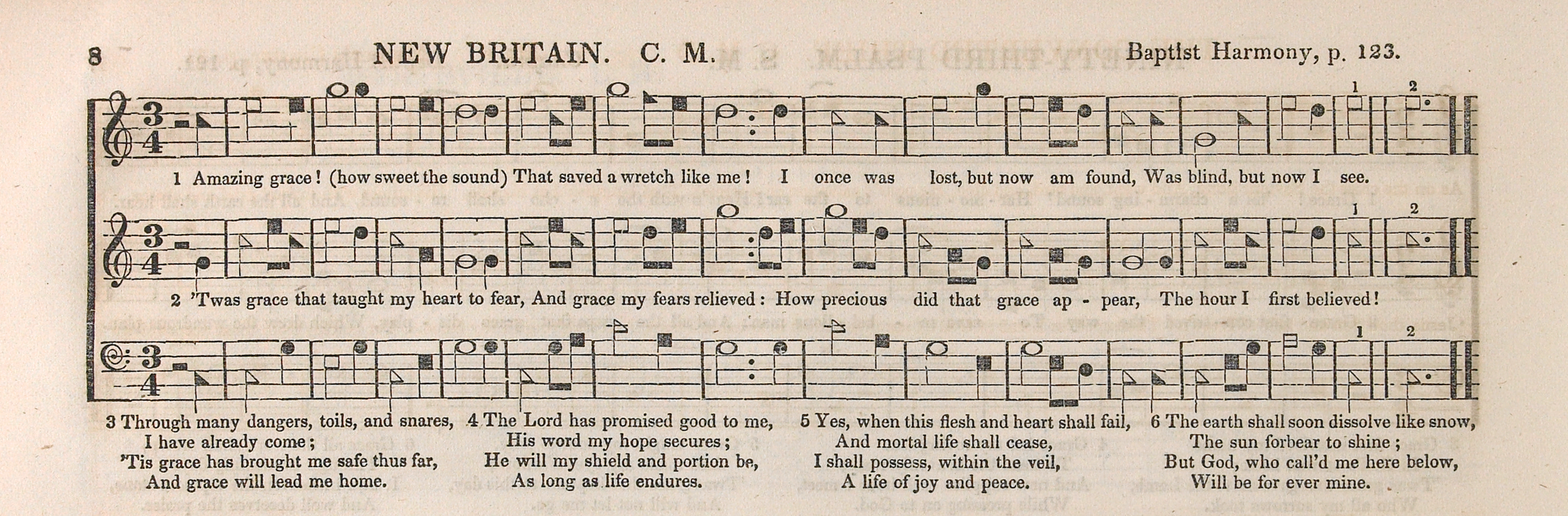
Yet if folk hymns were out of step with the North’s prevailing religious mood, they were welcomed in the hinterlands to the south and west. One of the most familiar and best loved today is New Britain, known now by the opening words of the text it sets: John Newton’s 1779 hymn “Amazing Grace.” As it first appears in the Columbian Harmony (Cincinnati, 1829), New Britain is scored for three voices, omitting the counter (alto). Like Idumea, the tune is pentatonic (though here in the major mode), and its simple beauty, combined with a rugged harmonization and a text that stresses divine grace—God’s love embraced through contrition—makes “Amazing Grace” a quintessential expression of southern praise singing.
The southern shape-note tradition bore the stamp of revivalism as embodied in the Second Awakening—not only because it encouraged the kind of worshipful singing that qualifies as praise but also because it indicates a leveling of class consciousness. Revivalism opened the medium of print to any American who had a message to deliver.
The idea of author and book buyer (i.e., singer) as social peers is reflected in the two tunebooks that brought shape-note hymnody to the Deep South: William Walker’s The Southern Harmony (1835; compiled in South Carolina), and Benjamin Franklin White and Elisha J. King’s The Sacred Harp (1844; compiled in Georgia). The Southern Harmony sold 600,000 copies by 1866. The Sacred Harp has been one of the great successes in American publishing history. King died before the book appeared in print; it went through three revisions and several editions under White’s supervision, was revised further after his death, and is still in print today, used at singings around the country. The stories that circulated about the authors reveal The Sacred Harp as an icon of Upland Southern culture, a book “of, for, and by the people.”
Elisha J. King, a Georgia native and Baptist singing-school master, was a talented musician who has lived in memory through his association with the book. Benjamin Franklin White, the senior partner, was a native South Carolinian who moved to Harris Country, Georgia, around 1840. The youngest of fourteen children, White received only three months of formal schooling, yet managed to become editor of the local newspaper and a prominent singing master and civic leader. He was said to have departed from this world, at age seventy-nine, only after singing the melody of Sounding Joy, which he had composed to words by Isaac Watts.
White seems to have achieved eminence in the Upland South as a typical figure, not an extraordinary one. A 1904 account of The Sacred Harp’s history indicates that he and King relied on their friends’ and neighbors’ taste in singing: the collection was shaped by gatherings in and around White’s house, where people would “sing the songs long before they were published in book form.”
The Sacred Harp emphasizes old favorites over new pieces. Familiar numbers in the third edition (1859) include Old Hundred, Daniel Read’s Sherburne, and folk hymns such as New Britain and Wondrous Love, the latter taking its tune from a song about the pirate Captain Kidd.
Southern shape-note hymnody, or Sacred Harp singing, as it has also come to be known, has proved to be remarkably long-lived—displaced but never obliterated by later musical fashions. Even as George Pullen Jackson was “discovering” Sacred Harp singing in the 1930s, the composition of new tunes in this rugged folk style was very much alive. Indeed, one of the finest tunes in later editions of The Sacred Harp is Soar Away, an inspired blend of folk hymn and fuging tune written in 1935 by A. Marcus Cagle of Villa Rica, Georgia.
New Britain, better known today as “Amazing Grace,” as it was reprinted in William Walker, The Southern Harmony (1835); the melody is in the middle staff.
The second half of the twentieth century saw a resurgence of interest in shape-note hymnody, with local and regional groups springing up throughout the United States and beyond, meeting, often monthly, to sing from The Sacred Harp. Annual singing conventions today regularly draw hundreds of enthusiastic singers, not only in the South but even in New England, where many features of the music originated but long ago fell out of favor. The energy behind this new return to the past has less to do, generally speaking, with Christian religious expression than with the discovery in recent decades of so-called “roots music” and its attendant cultural and social values (see chapter 24).
Yet while its subject matter is religious, the activity of Sacred Harp singing has always been nonliturgical. Even when singing meetings are held in a church, they are events distinct from worship services. Although southern shape-note hymnody is a direct descendant of the Regular Singing movement that began in the 1720s with the aim of improving congregational singing, liturgical use has never been its intent. It is quite different from the type of music sung by most American Protestant congregations today, which follows a different line of descent. That line may be traced from the reform movement of early nineteenth-century New England and the work of Lowell Mason.
A scale of five pitches; most frequently, a five-pitch scale that corresponds to five of seven notes of a diatonic scale and avoids half steps (and thus can be produced by the black keys of the piano).