As we have noted, the separation of powers enables several different federal institutions to influence the nation’s agenda, to affect decisions, and to prevent the other institutions from taking action. The Constitution’s framers saw this arrangement, although cumbersome, as an essential means of protecting liberty.
the policy principle
THE PATCHWORK OF STATE MEDICAID PROGRAMS
Medicaid beneficiaries have very different experiences depending on where they live.
Medicaid is one of the largest government programs in the country and is a distinct product of American federalism. It is administered through the joint authority of the federal and state governments. Medicaid provides health insurance to around 86 million low-income individuals and their families, including millions of children, pregnant women, people with disabilities, and the elderly. Today, spending on Medicaid makes up between 7 and 9 percent of federal outlays and is one of the largest budget items in all of the 50 state governments. Because of its sheer size and importance, Medicaid is a prime example of how federalism shapes public policy—and of the strengths and weaknesses of policy authority divided between state and federal government.
When Congress first enacted Medicaid in 1965, state participation in the program was optional. In the years that followed, all 50 states eventually got on board. The federal and state governments share responsibility for both the program design and financing. While the federal government established certain minimum standards that all states must meet, beyond those requirements, the states have considerable flexibility in determining who is eligible for coverage, what services are included, and specific policies on matters such as provider reimbursements, how much money doctors receive for visits and treatments, and copayments. As a result, citizens’ experiences with Medicaid can vary dramatically depending on where they live.
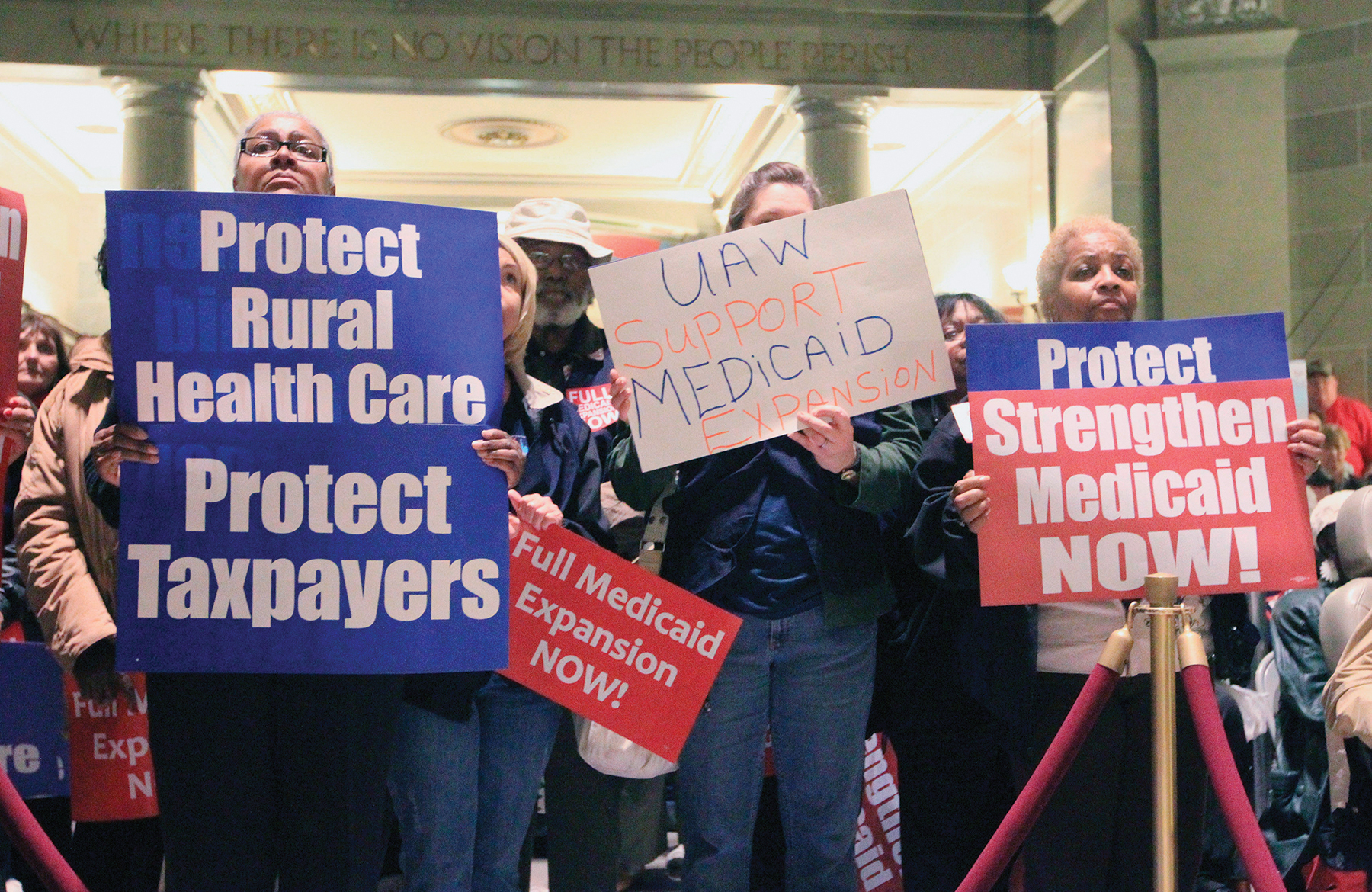
For example, coverage for dental, vision, and hearing varies significantly from state to state. In Virginia and Texas, Medicaid does not cover dental care at all. In other states, dental care is covered but is limited to emergency services or specific treatments. Some states put a limit on the amount providers can be reimbursed for dental services. The same differences can be seen in vision coverage. Medicaid in states such as California and North Carolina does not cover eyeglasses or other visual aids. Other states limit vision benefits in various ways. Oregon, for example, covers routine eye exams only for pregnant women. States also differ in whether and how their Medicaid programs cover other medical conditions, from hearing aids to end-of-life care. These cross-state differences have only deepened since the passage of the Affordable Care Act (ACA) in 2010, when most states expanded eligibility for Medicaid (with the federal government paying for most of the cost of expansion), but several did not.
One positive aspect of federalism is that for major national programs like Medicaid, state policy makers have flexibility to tailor the program to the particular needs and preferences of their own constituents. Medicaid claims a large share of the revenue states generate—about 17 percent on average—so seemingly technical changes to Medicaid benefits, eligibility, and reimbursement rates can significantly affect states’ ability to finance their other priorities. It makes sense, then, that states have some control over the program’s design.
On the other hand, the disadvantage of federalism can be seen in Medicaid’s patchwork of different state programs—beneficiaries have very different experiences with the program and the health care system depending on where they live. Moreover, the needs and preferences of constituents are but one consideration among many that state policy makers might weigh in making decisions about Medicaid. As the debates over the ACA’s Medicaid expansion have shown, national political party strategy and the advocacy of interest groups also play an important role.
think it through
Research the Medicaid benefits available in your state. How do these benefits compare to those of the other states mentioned in this discussion? What political factors in your state do you think contribute to these differences?
In what other state policies do you see federalism in action?
In his discussion of the separation of powers, James Madison quoted the originator of the idea, the French political thinker Baron de Montesquieu: “There can be no liberty where the legislative and executive powers are united in the same person . . . [or] if the power of judging be not separated from the legislative and executive powers.”32 Using the same reasoning, many of Madison’s contemporaries argued that there was not enough separation among the three branches, and Madison had to backtrack to insist that complete separation was not required:
Unless these departments [branches] be so far connected and blended as to give to each a constitutional control over the others, the degree of separation which the maxim requires, as essential to a free government, can never in practice be duly maintained.33
This is the secret of how Americans have made the separation of powers effective: they have made it self-enforcing by giving each branch of government the means to participate in, and partially or temporarily obstruct, the workings of the other branches.
Checks and Balances
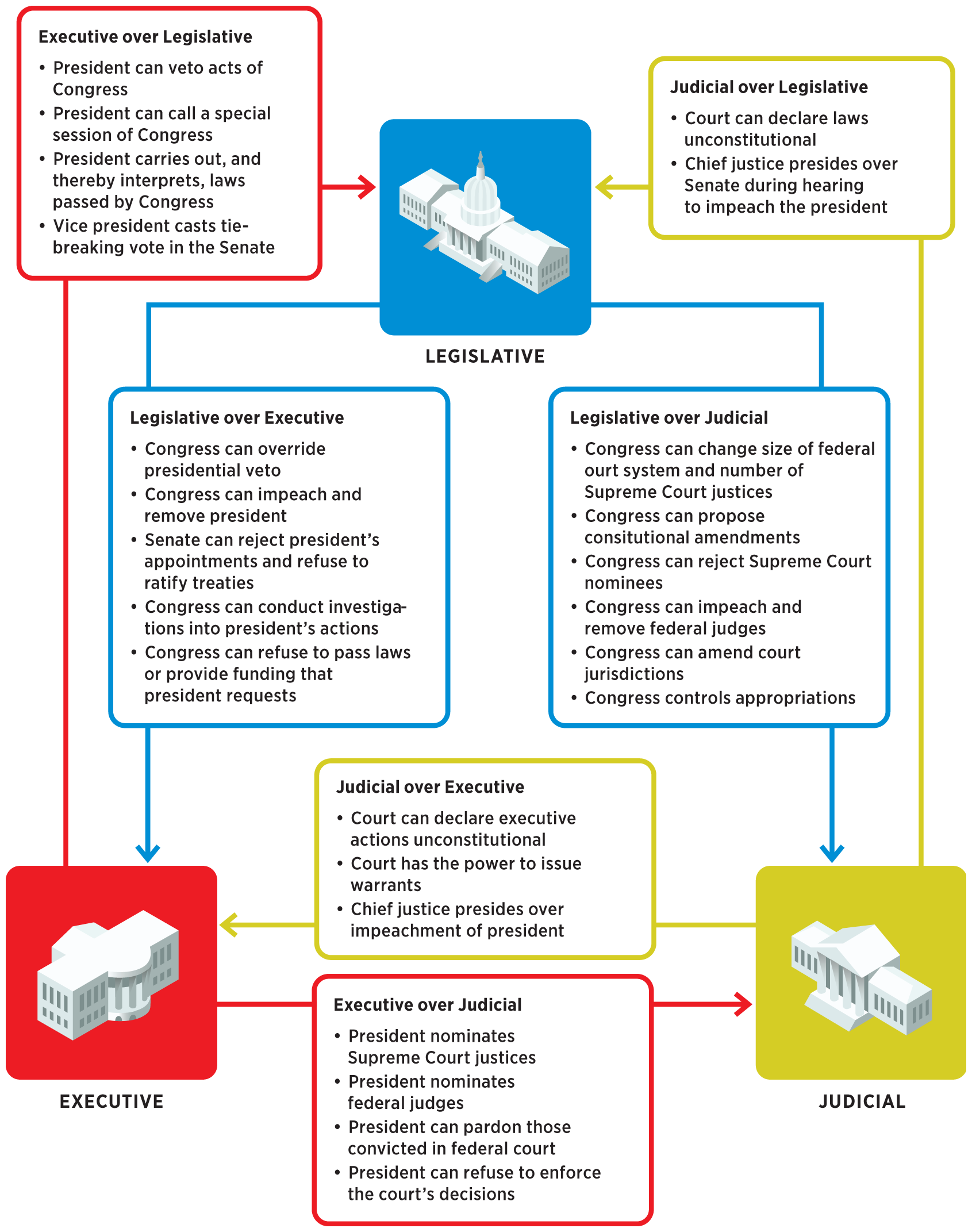
The means by which each branch of government interacts with every other branch is known informally as checks and balances. The best-known examples are shown in Figure 3.4. The framers tried to guarantee that the three branches would in fact use these checks and balances as weapons against one another by giving each branch a different political constituency—a different group of voters or individuals by which its members are chosen and therefore a different perspective on what the government ought to do. For example, the framers adopted direct, popular election for the members of the House, indirect election of senators through state legislatures (until the Seventeenth Amendment, adopted in 1913), indirect election of the president through the Electoral College, and appointment of federal judges for life. All things considered, the best characterization of the separation-of-powers principle in action is, as we said in Chapter 2, “separated institutions sharing power.”34
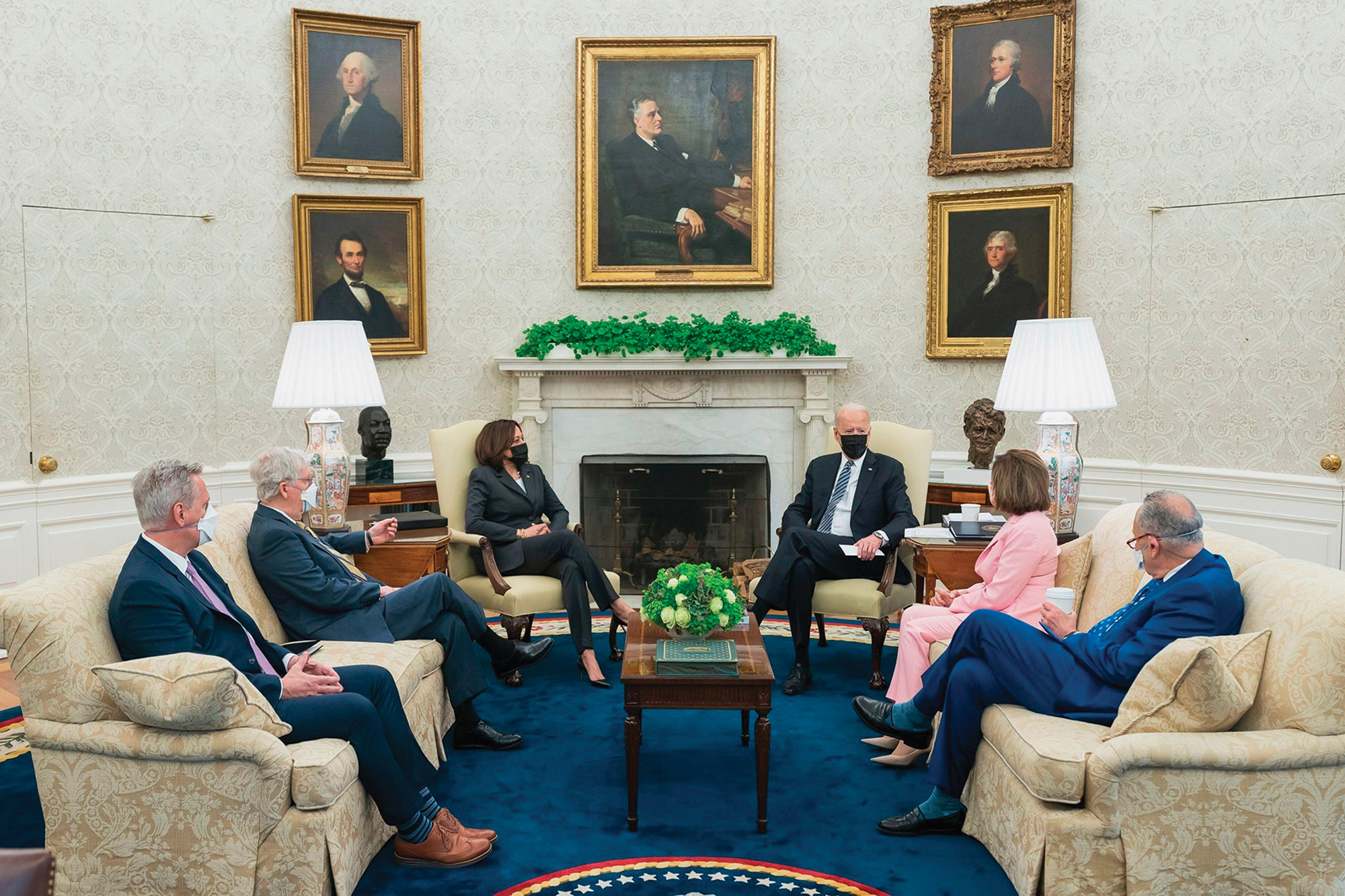
The system of checks and balances ensures that political power is shared by the separate institutions. Here, President Biden meets with the 117th Congress leadership, including Senate Minority Leader Mitch McConnell, Senate Majority Leader Chuck Schumer, and House Speaker Nancy Pelosi.
FIGURE 3.4
Checks and Balances
Legislative Supremacy
Although each branch was given adequate means to compete with the other branches, the framers provided for legislative supremacy by making Congress the preeminent branch. Legislative supremacy made the provision of checks and balances in the other two branches all the more important.
The most important indication of the intentions of the framers was the provisions in Article I to treat the powers of the national government as powers of Congress. The Founders also provided for legislative supremacy in their decision to give Congress the sole power over appropriations.
Although “presidential government” gradually took the place of legislative supremacy after 1937, the relative power of the executive and legislative branches since that time has varied. The power play between the president and Congress is especially intense during periods of divided government, when one party controls the White House and another controls all or part of Capitol Hill.
A recent example of the power play during periods of divided government occurred in 2018 when President Trump declared a national emergency along America’s southern border and then issued executive orders diverting funds from the Pentagon’s budget to start work on a border wall. Congress reacted sharply. The House of Representatives voted to block the president’s emergency declaration and even some GOP lawmakers sharply criticized the president’s actions. After the Democrats won control of the House of Representatives later that year, they launched a number of investigations into the activities of President Trump and his aides. Trump responded by ordering White House staffers and other officials to refuse to testify before Congress and by asserting executive privilege to deny Congress access to information. This tactic touched off a series of legal battles between the president and Congress, and some members of Congress declared that the president should be impeached. House Speaker Nancy Pelosi initially resisted calls for Trump’s impeachment, saying that Democrats should focus their energies on defeating Trump in the 2020 national election. After evidence emerged that Trump had withheld congressionally approved defense funding for Ukraine in an attempt to obtain information on a political opponent, he was eventually impeached in the House but ultimately acquitted in the Senate.
The Role of the Supreme Court
The role of the judicial branch in the separation of powers has depended on the power of judicial review, a power not provided for in the Constitution but asserted by Chief Justice Marshall in 1803:
If a law be in opposition to the Constitution; if both the law and the Constitution apply to a particular case, so that the Court must either decide that case conformable to the law, disregarding the Constitution, or conformable to the Constitution, disregarding the law; the Court must determine which of these conflicting rules governs the case: This is of the very essence of judicial duty.35
Review of the constitutionality of acts of the president or Congress is relatively rare. For example, there were no Supreme Court reviews of congressional acts in the 50-plus years between Marbury v. Madison (1803) and Dred Scott v. Sandford (1857). In the century or so between the Civil War and 1970, 84 acts of Congress were held unconstitutional (in whole or in part), but there were long periods of complete Court deference to Congress, punctuated by flurries of judicial review during periods of social upheaval. The most significant of these periods was 1935–36, when 12 acts of Congress were invalidated, blocking virtually the entire New Deal program.36
Then, after 1937, when the Court made its great reversals in upholding New Deal legislation, no significant acts were struck down until 1983, when the Court declared unconstitutional the legislative veto, a practice in which Congress authorized the president to take certain actions but reserved the right to veto those with which it disagreed.37 The Supreme Court became much more activist (that is, less deferential to Congress) after the elevation of William H. Rehnquist to chief justice (1986–2005), and “a new program of judicial activism”38 seemed to be in place. Between 1995 and 2002, at least 26 congressional acts or parts of acts were struck down on constitutional grounds.39
The Court has been far more deferential toward the president since the New Deal period, with only five significant confrontations. One was the so-called steel seizure case of 1952, in which the Court refused to permit President Truman to use “emergency powers” to force workers back into the steel mills during the Korean War.40
The second confrontation occurred in 1974 when the Court declared unconstitutional President Nixon’s refusal to respond to a subpoena to make available his tapes of White House conversations as evidence in a criminal prosecution. The Court argued that although the claim of executive privilege protected confidentiality of communications between the president and close advisers, this privilege did not extend to data in presidential files or tapes bearing on criminal prosecutions.41
The third and fourth confrontations occurred during the Trump administration. A number of federal district and circuit courts ruled against the president, particularly on immigration issues. The Supreme Court, however, generally refrained from directly confronting the president. The closest it came involved the matter of whether a citizenship question could be added to the 2020 census. The administration had sought to ask respondents whether or not they were citizens. Critics charged that the question was designed to reduce legislative representation and federal funding to states with large numbers of undocumented immigrants. Lower federal courts had ruled that the question should be removed and the Supreme Court refused to make a final determination. The Supreme Court ruled that the Commerce Department had not provided adequate justification for including the question in 2020 but might reinstate it in the future.42
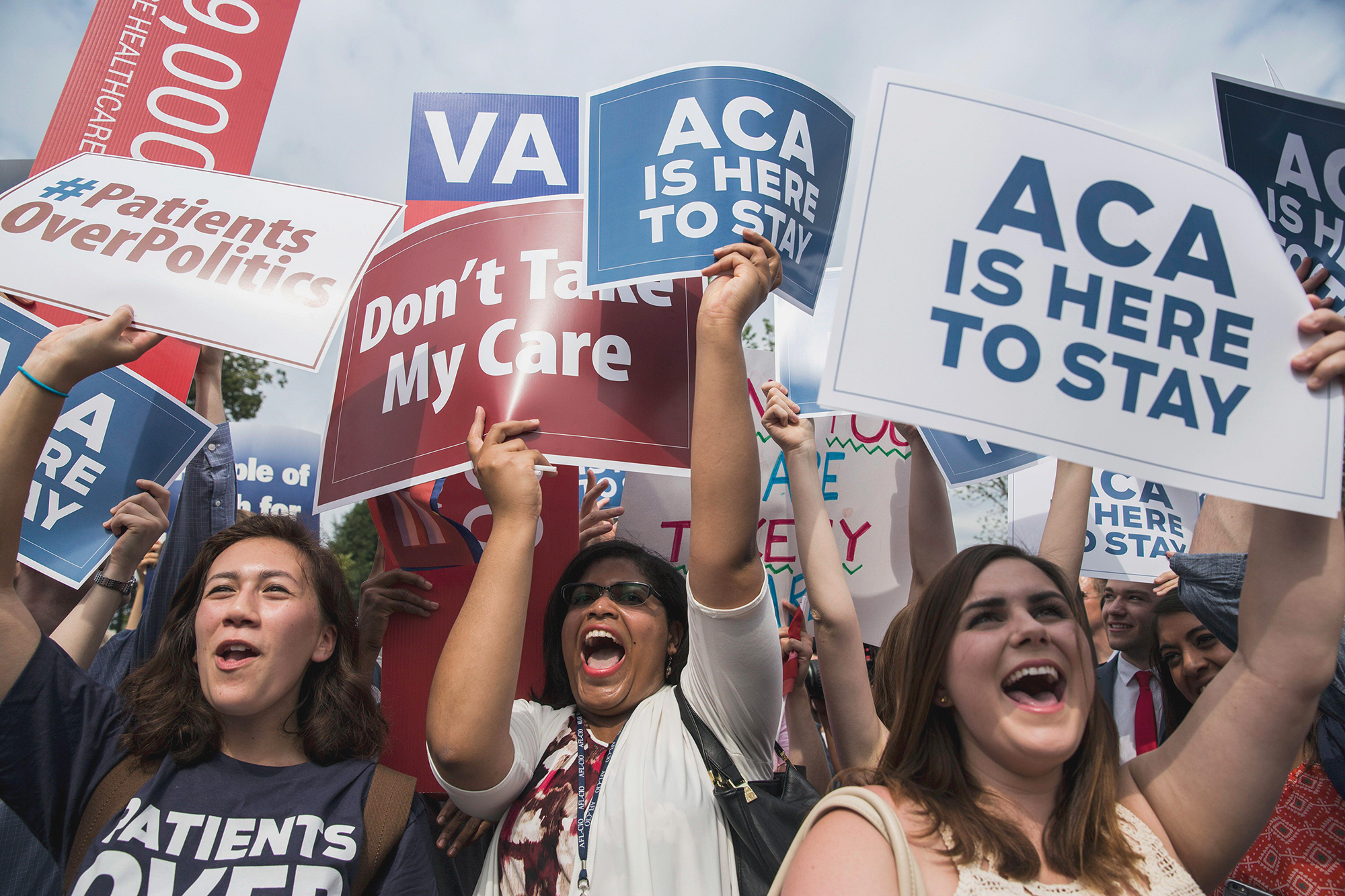
The ACA expanded Americans’ coverage options. While the federal government provides most of the financing for subsidized coverage and establishes insurance market regulations, states have flexibility to implement the law.
The fifth confrontation came during an important case decided in the early months of the Biden administration. In this instance, the Court again avoided a confrontation with the president by refraining from ruling on the constitutionality of the Affordable Care Act.43 An adverse decision would have touched off a firestorm and renewed demands from Democratic progressives that the Court be enlarged to add more Democratic justices. This issue will be more fully discussed in Chapter 8.
The claim that confidential communications between a president and close advisers should not be revealed without the president’s consent.
Endnotes
Clinton L. Rossiter, ed., The Federalist Papers; Alexander Hamilton, James Madison, and John Jay (New York: New American Library, 1961), no. 47 (James Madison), p. 302.Return to reference 32
 think it through