CHANGING THE INSTITUTIONAL FRAMEWORK: CONSTITUTIONAL AMENDMENT
The Constitution has endured for more than two centuries as the framework of government. But it has not endured without change. Without change, the Constitution might have become merely a sacred relic, stored under glass.
Amendments: Many Are Called, Few Are Chosen
The framers of the Constitution recognized the need for change, and they incorporated provisions for amending the document into Article V. Since 1791, when the first 10 amendments (the Bill of Rights) were added, only 17 amendments have been adopted. Two of them—Prohibition and its repeal—cancel each other out. Overall, therefore, only 15 amendments have been added since 1791, despite vast changes in American society and its economy.
Article V provides for four methods of amendment:
Passage in the House and Senate, each by two-thirds vote; then ratification by majority vote in the legislatures of three-fourths (now 38) of the states.
Passage in the House and Senate, each by two-thirds vote; then ratification by conventions called for that purpose in three-fourths of the states.
Passage in a national convention called by Congress in response to petitions by two-thirds (now 34) of the states; ratification by majority vote in the legislatures of three-fourths of the states.
Passage in a national convention, as in method 3; then ratification by conventions called for that purpose in three-fourths of the states.
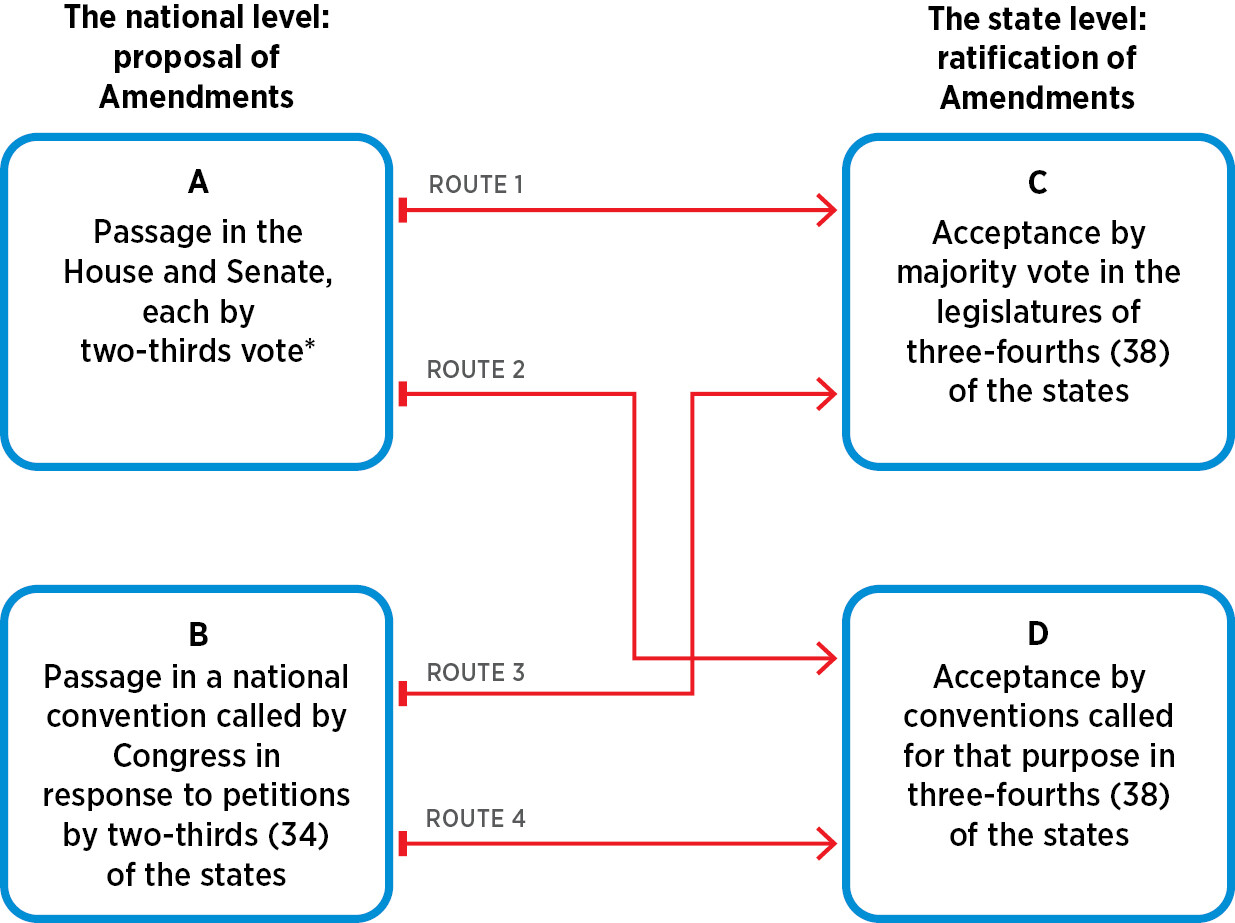
Figure 2.2 illustrates each of these methods. Because no amendment has ever been proposed by national convention, however, routes 3 and 4 have never been employed. And route 2 has been used only once (for the Twenty-First Amendment, which repealed the Eighteenth Amendment, or Prohibition). Thus, route 1 has been used for all the others.
figure 2.2
ROUTES OF AMENDMENT
More information
Figure 2.2 titled Routes of Amendment is a flowchart to describe the four methods of amendment for the U.S. constitution. There are two columns on each side and four routes. The left side columns are labeled the National Level: Proposal of Amendments. These include box A, Passage in House and Senate, each by two-thirds vote. In each amendment proposal, Congress has the power to choose the method of ratification, the time limit for consideration by the states, and other conditions of ratification. The second part of the first column is box B, Passage in a national convention called by Congress in response to petitions by two-thirds (34) of the states. The right column is labeled The State Level: Ratification of Amendments. These include box C, Acceptance by majority vote in the legislatures of three-fourths (38) of the states and box D, Acceptance by conventions called for that purpose in three-fourths (38) of the states. Route one goes from A to C. Route two goes from A to D. Route three goes from B to C. Route four goes from B to D.
*In each amendment proposal, Congress has the power to choose the method of ratification, the time limit for consideration by the states, and other conditions of ratification.
The Twenty-Seven Amendments
The Constitution and its 27 amendments are reproduced at the end of this book. All but two are concerned with the structure or composition of government. This is consistent with the definition of constitution in another sense, as the “makeup or composition of a thing.” It is also consistent with the concept of a constitution as higher law, that is, a framework within which government and the process of making ordinary laws can take place. There is great wisdom in this principle. A constitution ought to enable the passage of legislation and implementation of public policies, but it should not determine what that legislation or those policies ought to be. (Analyzing the Evidence on pp. 72–73 discusses the desire for legislation to restrict gun violence.)
The purpose of the 10 amendments in the Bill of Rights was to give each of the three branches clearer and more restricted boundaries. The First Amendment restricts the power of Congress to enact laws regulating religion, speech, the press, and assembly. Indeed, the First Amendment makes this limitation quite explicit by opening with the phrase “Congress shall make no law . . .” The Second, Third, and Fourth Amendments spell out limits that apply to both the executive branch and Congress. Though controversial today, against the backdrop of colonial history the Second Amendment—the right to bear arms—was seen as essential.
The Fifth, Sixth, Seventh, and Eighth Amendments contain some of the most important safeguards for individual citizens against the exercise of governmental power. These amendments regulate judicial proceedings and outlaw various forms of arbitrary action by agents of the executive branch. The Ninth and Tenth Amendments reinforce the idea that the Constitution creates a government of limited powers. The Ninth declares that the Constitution’s failure to mention a right does not mean it is not possessed by the people, while the Tenth states that powers not granted to the federal government are reserved to the states and the people. Table 2.3 analyzes the 10 amendments included in the Bill of Rights.
table 2.3
THE BILL OF RIGHTS: ANALYSIS OF ITS PROVISIONS
AMENDMENT
PURPOSE
I
Congress may not make any law establishing a religion or abridging the freedom of speech, press, or assembly or the right to petition the government.
II, III, IV
No branch of government may infringe on the right of people to keep arms (II), force people arbitrarily to let soldiers live in their houses (III), or engage in the search or seizure of evidence or arrest people without a court warrant (IV).
V, VI, VII, VIII
The courts may not hold trials for serious offenses without provision for a grand jury (V), a petit (trial) jury (VII), a speedy trial (VI), the presentation of charges, and the confrontation of hostile witnesses (VI). Individuals may not be compelled to testify against themselves (V) and are immune from trial more than once for the same offense (V). Neither bail nor punishment can be excessive (VIII), and no property can be taken without just compensation (V).
IX, X
All powers not enumerated are reserved to the states or to the people.
Six of the 17 amendments adopted since 1791 expand the electorate (Table 2.4). The framers could not agree on uniform qualifications defining the boundaries of the national electorate. Instead, in Article I, Section 2, they indicated that eligibility to vote in a national election would be the same as “the Qualifications requisite for Electors of the most numerous Branch of the State Legislature.” Article I, Section 4, added that Congress could alter state regulations as to the “Times, Places and Manner of holding Elections for Senators and Representatives,” but said nothing about voting qualifications. This meant that any important expansion of the American electorate would almost certainly require a constitutional amendment.
table 2.4
AMENDING THE CONSTITUTION TO EXPAND THE ELECTORATE
AMENDMENT
PURPOSE
YEAR PROPOSED
YEAR ADOPTED
XIV
Prohibited states from denying voting rights to any male citizen over the age of 21. Provided penalties for states that do so.
1866
1868
XV
Extended voting rights to men of all races
1869
1870
XIX
Extended voting rights to women
1919
1920
XXIII
Extended voting rights to residents of the District of Columbia
1960
1961
XXIV
Extended voting rights to all classes through the abolition of poll taxes
1962
1964
XXVI
Extended voting rights to citizens ages 18–21
1971
1971
analyzing the evidence
Who Do Young People Think Can Prevent Mass Shootings?
Contributed by Alexandra T. Middlewood,Wichita State UniversityAbigail Vegter,William Jewell College
Significant evidence suggests that a majority of citizens support government policies that restrict access to firearms. Among young people—those under the age of 35—there is strong support for the idea that government policies can prevent mass shootings. This group is much more likely than earlier generations to attribute mass shootings to a lack of government action, and to believe such tragedies could be prevented if only the government would intervene.
Young Americans have lived with the consistent threat of mass violence and do not remember a time before that threat seemed constant. Accordingly, many refer to this group as the “massacre generation.” Their shared experiences with gun violence shape who this group blames for mass shootings and who they think can create real change.
To identify who this generation blames for mass shootings, we analyzed data from eight national public-opinion polls conducted over nearly 20 years, from 1999 to 2018.
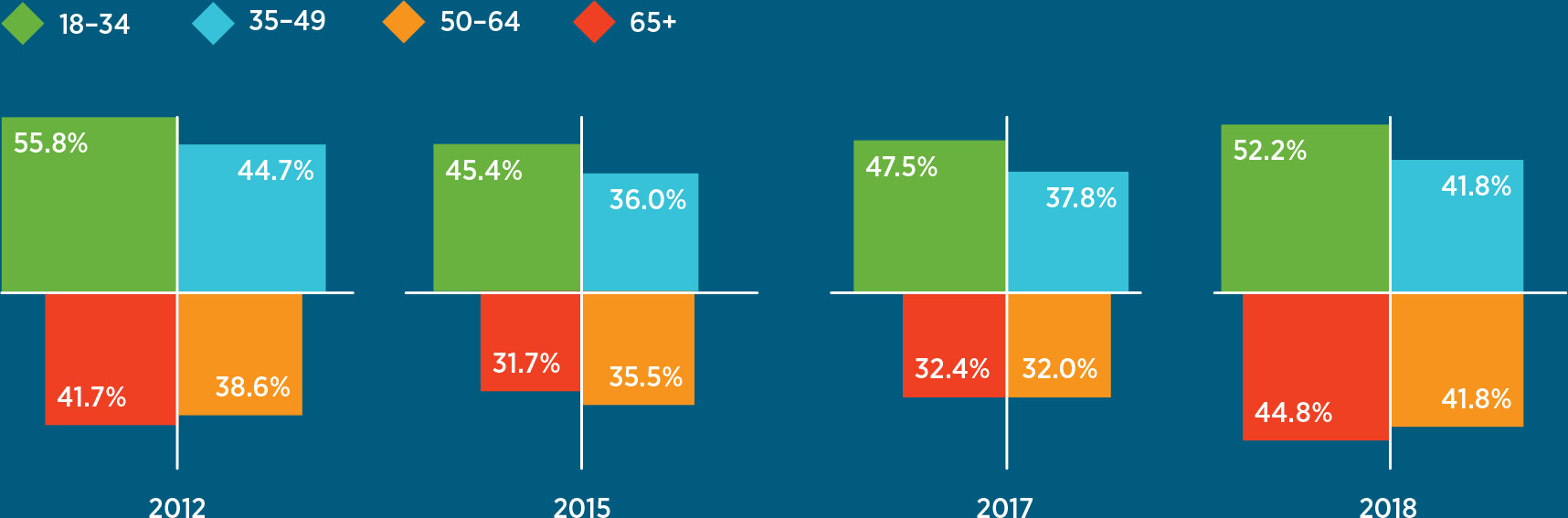
From 2012 and beyond, younger people have been increasingly likely to believe that government action can prevent mass shootings. We find that for every one year decrease in age, the likelihood of believing that government can prevent mass shootings goes up between 1 and 1.8 percent. After 2012, we find that members of the massacre generation—those who were under 18 when the Columbine school shooting took place—are significantly more likely to believe that government action could prevent mass shootings than every other generational cohort, as shown in Figure A.
figure A Percentage of the Population That Believes Government Can Take Action to Prevent Mass Shootings
More information
Four bar graphs titled, Percentage of the Population That Believes Government Can Take Action to Prevent Mass Shootings. Each graph shows the data for certain age groups for four different years, 2012, 2015, 2017, and 2018. Values follow in format year, age group, percent. 2012: 18 to 34, 55.8 percent; 35 to 49, 44.7 percent; 50 to 64, 38.6 percent; and 65 plus, 41.7 percent. 2015: 18 to 34, 45.4 percent; 35 to 49, 36 percent; 50 to 64, 35.5 percent; and 65 plus, 31.7 percent. 2017: 18 to 34, 47.5 percent; 35 to 49, 37.8 percent; 50 to 64, 32 percent; and 65 plus, 32.4 percent. 2018: 18 to 34, 52.2 percent; 35 to 49, 41.8 percent; 50 to 64, 41.8 percent; and 65 plus, 44.8 percent.
We don’t find this result for earlier years, and thus conclude that the belief that government can take action to prevent mass shootings results not just from being young but from coming of age during a period with a large number of high-profile mass shootings.
Anyone entering adulthood during the decade after Columbine participated in “active shooter” drills that earlier generations did not. By 2012, some 18-year-olds may have endured up to five active shooting drills a year for over a decade. Essentially, this generation has learned to expect this type of mass violence.
We believe that this steady stream of mass shootings and active shooter drills has triggered young people’s anxiety and put shootings at the forefront oftheir minds, shaping their tendency to blame the government for inaction.
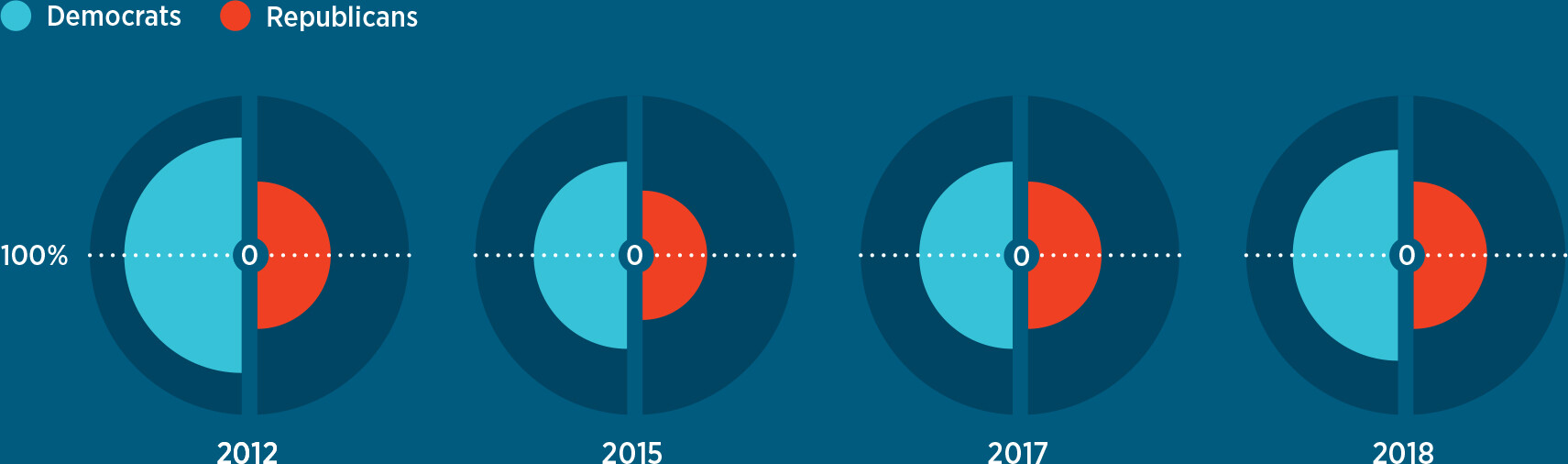
This does not mean that young people are united on what type of government action can prevent mass shootings. Polling by ABC News/Washington Post in 2021 revealed an ideological divide on certain gun regulation policies, especially those that may be implemented through presidential action. In recent years, however, we find that more than 40 percent of Republicans who belong to the massacre generation still believe that some government action can prevent mass shootings, as seen in Figure B.1
figure B Percentage of the Massacre Generation by Party Believing That Government Can Take Action to Prevent Mass Shootings
More information
4 circular bar graphs titled, percentage of the massacre generation by party believing that the government can take action to prevent mass shootings. Each graph shows the percentage of Democrats and Republicans for four different years: 2012, 2015, 2017, 2018. Values follow. 2012 data: Democrats, 70 percent; Republicans, 40 percent. 2015 data: Democrats, 55 percent; Republicans, 30 percent. 2017 data: Democrats, 55 percent; Republicans, 40 percent. 2018 data: Democrats, 65 percent; Republicans, 40 percent.
Will this generation prompt action? In a 1989 article, political scientist Deborah Stone wrote, “Difficult conditions become problems only when people come to see them as amenable to human action.”2 If today’s young people perceive gun violence as something the government can fix, they may increasingly mobilize to influence gun policies. We’ve already seen some suggestions that they will.
After the Parkland, Florida, high school shooting in 2018, its survivors organized national marches and other activities demanding more gun regulation. While that wave of activism may have receded, the experiences that gave rise to it remain. Should a majority of this cohort come to agree on what policies are needed, the massacre generation could shape the gun regulation debate and come to dominate the U.S. electorate.
Six more amendments are also electoral in nature, though not concerned directly with voting rights (Table 2.5). These amendments deal with the elective offices themselves (the Twentieth, Twenty-Second, and Twenty-Fifth) or with the relationships between elective offices and the electorate (the Twelfth, Fourteenth, and Seventeenth).
table 2.5
AMENDING THE CONSTITUTION TO CHANGE THE RELATIONSHIP BETWEEN THE ELECTED OFFICES AND THE ELECTORATE
AMENDMENT
PURPOSE
YEAR PROPOSED
YEAR ADOPTED
XII
Provided a separate ballot for the vice president in the Electoral College
1803
1804
XIV
Asserted the principle of national citizenship and prohibited the states from infringing on the rights of citizens of the nation
1866
1868
XVII
Provided for the direct election of senators. This diminished the power of the state legislatures and reinforced the idea of a direct relationship between Americans and the government of the United States.
1912
1913
XX
Shortened the time between elections and the inauguration of the new president and Congress
1932
1933
XXII
Limited the presidential term
1947
1951
XXV
Provided for presidential succession in case of disability
1965
1967
Another five amendments have expanded or limited the powers of the national and state governments (Table 2.6).34 The Eleventh Amendment protects the states from suits by private individuals and denies the federal courts any power to hear suits by private individuals of one state (or a foreign country) against another state. Three other amendments presented in Table 2.6 reduce state power (the Thirteenth), reduce state power and expand national power (the Fourteenth), and expand national power (the Sixteenth). The Twenty-Seventh limits Congress’s ability to raise its members’ salary. The Thirteenth, which abolished slavery, restricted the states’ power by forever forbidding them to treat any human being as property. The Sixteenth Amendment expanded the federal government’s power by granting it the ability to levy an income tax.
table 2.6
AMENDING THE CONSTITUTION TO EXPAND OR LIMIT THE POWER OF GOVERNMENT
AMENDMENT
PURPOSE
YEAR PROPOSED
YEAR ADOPTED
XI
Limited the jurisdiction of federal courts over suits involving the states
1794
1795
XIII
Eliminated slavery and the rights of states to allow property in the form of persons
Established due process of law in state courts for all persons; was later used to apply the entire Bill of Rights to the states
1866
1868
XVI
Established the national power to tax income
1909
1913
XXVII
Limited Congress’s power to raise its own salary
1789
1992
Two peculiar amendments had very narrow and specific purposes: the Eighteenth Amendment, prohibiting the manufacture, transport, and sale of alcoholic beverages, and the Twenty-First Amendment, which repealed that prohibition. The Eighteenth Amendment was an unsuccessful attempt to address a substantive social problem and became the only amendment ever to have been repealed.
For those whose hopes for change center on the Constitution, it must be emphasized that the amendment route to social change is, and always will be, extremely limited. This is “path dependency,” as captured in the history principle, with a vengeance. The status quo—the original Constitution—and the arduousness of its amendment process provide durability, on the one hand, and constrain the prospects for change, on the other. Through a constitution it is possible to establish a working structure of government, and through a constitution it is possible to establish basic rights of citizens by placing limitations and obligations on that government’s powers.
No written constitution can or should prevent political change. We see change every year: at the ballot box, in congressional rules, in the form of new legislation, and so forth. The purpose of a constitution is to maintain boundaries, to protect the rule of law, to ensure the stability without which no economy can function, and to assure citizens that change will not take away their rights and liberties.
Endnotes
Fearnow, Benjamin. “Americans Under 30 Have Rapidly Turned Against Gun Control Laws, Poll Finds,” NewsWeek, April 28, 2021, https://www.newsweek.com/americans-under-30-have-rapidly-turned-against-gun-control-laws-poll-finds-1587154 (accessed 3/20/24). Return to reference 1
Stone, Deborah A. “Causal Stories and the Formation of Policy Agendas.” Political Science Quarterly 104, no. 2 (1989): 281–300. https://doi.org/10.2307/2151585 (accessed 3/20/24). Return to reference 2
The Fourteenth Amendment is included in Table 2.6 as well as Table 2.4 because it not only defines citizenship but also seems to intend that this definition include, along with the right to vote, all rights conferred by the Bill of Rights, regardless of the states in which citizens reside. A great deal more will be said about this in Chapter 4. Return to reference 34
The Thirteenth Amendment was proposed on January 31, 1865, and adopted less than a year later, on December 6, 1865. Return to reference *