1.2 Science Is a Way of Viewing the Universe

To view the universe through the eyes of an astronomer, you need to understand how science itself works. Throughout this book, we emphasize not only scientific discoveries but also the process of science. This section outlines the scientific method.

The Scientific Method

The scientific method is a systematic way of exploring the world by developing and then testing new ideas or explanations. You might begin a scientific study with a fact—an observation or a measurement. For example, you might observe that the weather changes predictably each year and wonder why that happens. You then create a hypothesis, a testable explanation of the observation: “I think that it is cold in the winter and warm in the summer because Earth is closer to the Sun in the summer.” You come up with a test: if your hypothesis is correct, then the whole planet will be cold in the winter—Australia should have winter at the same time of year as the United States. This is a prediction that you can use to check your hypothesis! In January, you travel from the United States to Australia and find that it is summer in Australia. Your hypothesis has just been proved incorrect; it has been falsified. (Notice that this usage of “falsified” is different from the word’s meaning in common usage. In common usage, “falsified” evidence has been manipulated to misrepresent the truth. Here, it just means the hypothesis has been shown to be incorrect.) Your test has two important elements that all scientific tests share. Your observation is reproducible: anyone who goes to Australia will find the same result. And your result is repeatable: if you conducted a similar test next year or the year after, you would get the same result. Because you have falsified your hypothesis, you must revise or replace it to be consistent with the new data.

Any idea that is not testable—that is, not falsifiable—must be accepted or rejected based on intuition alone, so it is not a scientific idea. A scientific idea does not have to be testable using current technology, but we must be able to imagine an experiment or observation that could prove the idea wrong. These tests must be repeatable over time and reproducible by everyone. As continuing tests support a hypothesis by failing to disprove it, scientists come to accept the hypothesis as a theory.

A theory is a well-developed idea that agrees with known physical laws and makes testable predictions. As with “falsified,” the scientific meaning of “theory” is different from the meaning in common usage. In everyday language, theory may mean a guess: “Do you have a theory about who did it?” In everyday language, a theory can be something we don’t take very seriously. “After all,” people say, “it’s only a theory.” In stark contrast, scientists use the word theory to mean a carefully constructed proposition that accounts for every piece of relevant data as well as our entire understanding of how the world works. A theory has been used to make testable predictions, and all those predictions have come true. Sometimes, competing theories exist to explain a phenomenon. The success or failure of the predictions is the deciding factor between competing theories.

Einstein’s theory of general relativity, which underlies the modern understanding of gravity, is an example of a scientific theory. For more than a century, scientists have tested the predictions of Einstein’s theory of general relativity and have not been able to falsify it. As Einstein himself noted, a theory that fails only one test is proved false. Even after 100 years of verification, if a prediction of the theory of general relativity failed tomorrow, the theory would require revision or replacement. In that sense, all scientific knowledge is subject to challenge. This openness to challenge is one of the greatest strengths of science.

Let’s pause to summarize this science-specific vocabulary. An idea is a notion about how something might be. A fact is an observation or measurement—for example, the measured value of Earth’s radius is a fact. A hypothesis is an idea that leads to testable predictions. A hypothesis may lead to a scientific theory, may be based on an existing theory, or both. A theory is an idea that has been examined carefully, is consistent with all existing theoretical and observational knowledge, and makes testable predictions. Scientists also often use the term “law.” A scientific law is a series of observations that can be used to predict a phenomenon but has no underlying explanation of why the phenomenon occurs. A law of daytime might say that the Sun rises and sets once each day, whereas a theory of daytime might say that the Sun rises and sets once each day because Earth spins on its axis. A model describes the properties of a particular object or system in terms of known physical laws or theories. These models are often computational, and use computers to predict the behavior of a complex system, like a system of multiple stars or planets. Scientists themselves can be sloppy about how they use these words, so you may sometimes see them used differently from how we have defined them here.

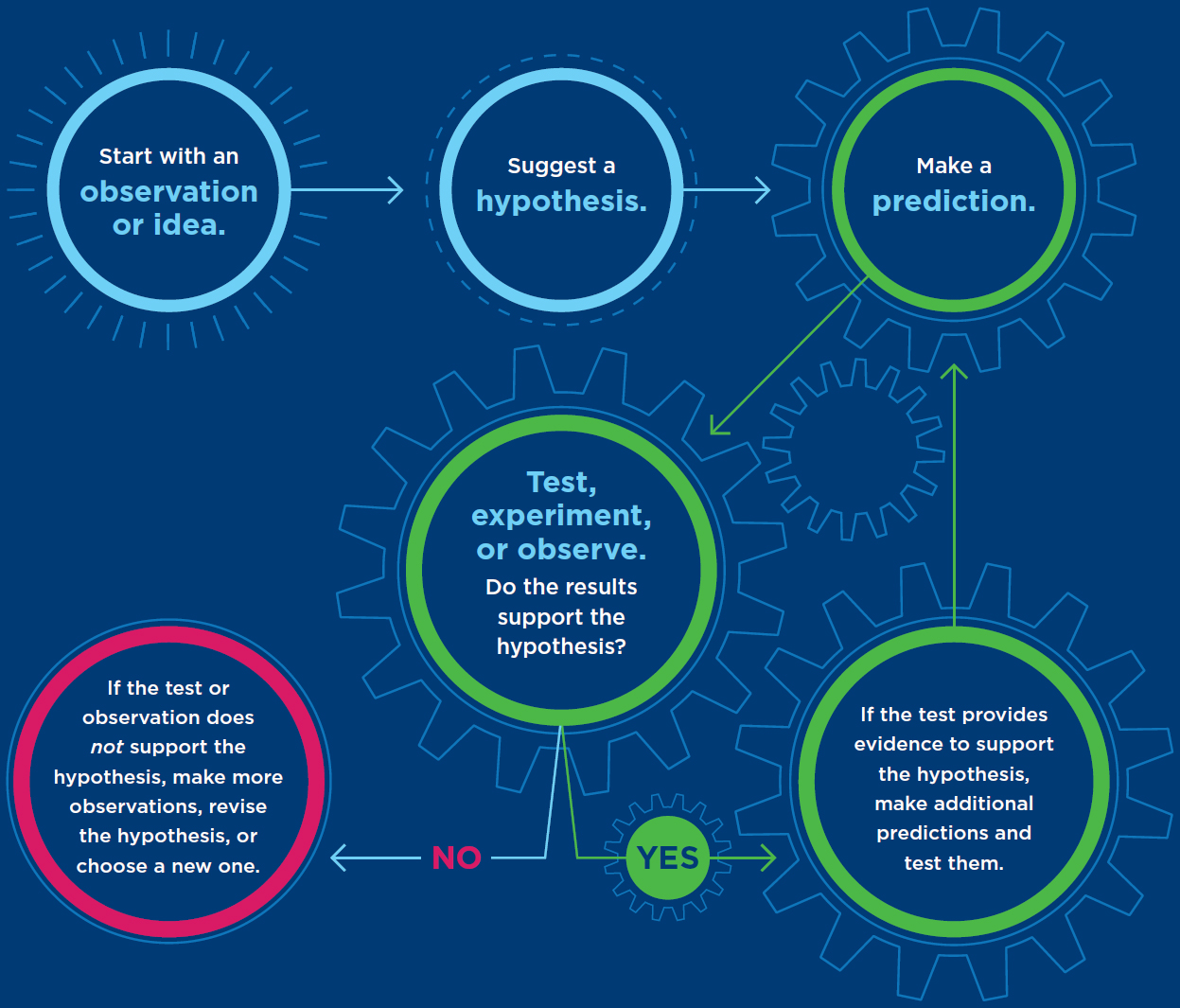
As the Process of Science Figure shows, the steps of the scientific method are interrelated. Scientists often begin with an observation or idea, followed by analysis, followed by a hypothesis, followed by a prediction, followed by further observations or experiments to test the prediction. Typically, the process of testing a theory is never completely finished; there is always another test to be performed under another set of conditions.

PROCESS of SCIENCE The Scientific Method

The scientific method is a formal procedure used to test the validity of scientific hypotheses and theories.

An idea or observation leads to a falsifiable hypothesis. This hypothesis is tested by observation or experiment, and is either accepted as a tested theory or rejected based on the results. The green loop repeats indefinitely as scientists continue to test the theory.

Scientific Principles

Scientific principles are general rules about the universe that provide guidelines for the formulation of scientific theories. Two important principles used in astronomy are the cosmological principle and Occam’s razor.

The cosmological principle assumes that matter and energy behave throughout space and time as they do today on Earth. This means that the same physical laws and theories that we observe and apply in laboratories on Earth can be used to understand what goes on in the centers of stars or in distant galaxies. The principle also implies that the universe has no special locations or directions. In a sense, the cosmological principle is tested each time we apply our theories to new observations of astronomical objects. Thus far, observations of the universe around us have only added to scientists’ confidence in the validity of the cosmological principle. If reasonable experimental evidence ever challenges the validity of the cosmological principle, scientists will construct a new description of the universe that takes those new data into account.

what if . . .

What if we discovered a region in the universe where the laws of physics are different from the ones on Earth (that is, the cosmological principle is wrong): How should we then think about the laws of physics in yet other parts of the universe?

How should you choose between two hypotheses if both explain all of the observations equally well? According to Occam’s razor, you should choose to adopt the hypothesis that requires the fewest assumptions until there is evidence to the contrary. For example, the nucleus of an atom is known to be positively charged, here in the Milky Way. Suppose you have two competing hypotheses about the charge of the nucleus of an atom in the Andromeda Galaxy: one hypothesis is that the nucleus is positively charged, like nuclei in the Milky Way; the second hypothesis is that the nucleus is negatively charged, opposite to nuclei in the Milky Way. The negative-nucleus hypothesis would require you to make additional assumptions about the location of the boundary between Andromeda-like matter and Milky Way–like matter and about why atoms on the boundary between the two regions did not destroy each other. You also would need an assumption about how the atoms in the two regions came to be constructed so differently. You also would need an assumption about why the Andromeda Galaxy is “special,” which violates the cosmological principle. It is far simpler, and requires fewer assumptions, to hypothesize that atoms in the Andromeda Galaxy are the same as atoms in the Milky Way Galaxy.

In many sciences, researchers can conduct controlled experiments to test hypotheses. That experimental method is typically unavailable to astronomers. Astronomers cannot change the tilt of Earth or the temperature of a star to see what happens. Instead, astronomy is an observational science: astronomers apply physical theories based on Earth-bound experiments to observations of astronomical objects. Astronomers typically make multiple observations using as many methods as possible, and then create mathematical and physical models based on established science to explain the observations.

One example of observation leading to new theories comes from the study of planets orbiting stars other than the Sun. Planets orbiting other stars are called exoplanets. The first exoplanets to be discovered were giant planets (similar to Jupiter) orbiting very close to their star. However, planets like these are not found in our own Solar System, where the giant planets are all far from the Sun. Those discoveries challenged existing ideas about how our Solar System formed. As different observers using multiple telescopes found more and more of these unexpected planets, astronomers realized they needed new ideas of planet formation to explain how such large planets could wind up so close to their star. Astronomers could not actually build different systems of stars and planets to run a controlled experiment, but they could use the known laws of physics to create computer simulations of planetary systems. When researchers did that, they discovered that the orbits of planets can migrate, becoming closer or farther from the central star. Planetary scientists are searching for evidence that planets migrated early in the history of our own Solar System. The new theory of star and planet formation, which includes planetary migration, has successfully explained thousands of planetary systems, and is at present the best theory available to explain all of the known facts.

Sometimes, science proceeds from theory to observation, instead of from observation to theory. One example is the discovery of black holes. In the late 18th century, John Mitchell (1724–1793) and Pierre-Simon Laplace (1749–1827) independently hypothesized the existence of “dark stars”: massive objects having such strong gravity that light could not escape. At that time, there was no way to test that hypothesis. More than 100 years later, in the early 20th century, Karl Schwarzschild (1873–1916) studied Einstein’s relativity equations and calculated that, despite their mass, those dark stars would be very small, with a radius of only a few kilometers. Fifty years after that, those objects were named black holes. No evidence of their existence was available until the 1970s and 1980s, when the new technology of space-based X-ray telescopes made possible the observations needed to test the hypothesis. In this case, the theory preceded the observation by nearly 200 years.

The scientific method provides a mechanism for testing new scientific ideas, but it offers no insight into where the idea came from in the first place or how an experiment was designed. Scientists discussing the creation of new ideas and experiments use words such as insight, intuition, and creativity. Scientists speak of a beautiful theory in the same way that an artist speaks of a beautiful painting or a musician speaks of a beautiful song. Science has an aesthetic that is as human and as profound as any found in the arts.

Reading Astronomy News

Astronomers Find Massive Black Hole in the Early Universe

Brooks Hays

Even though you may not yet know much about black holes, you can begin to make sense of some of the numbers astronomers use to talk about them.

June 25 (UPI)—With the help of a trio of Hawai’ian telescopes, astronomers have imaged the 13-billion-year-old light of a distant quasar—the second-most distant quasar ever found.

Scientists gave the new quasar an indigenous Hawaiian name, Pōniuā‘ena, which means “unseen spinning source of creation, surrounded with brilliance.” Researchers described the brilliant object in a new paper, which is available in preprint format online and will soon be published in the Astrophysical Journal Letters.

Quasars are like lighthouses, their beams hailing from far away in the ancient universe. Powered by supermassive black holes at the center of galaxies, quasars are some of the brightest objects in the universe.

As astronomers peer deeper into the cosmos, they’re able to see what the universe was like during its earliest days. In this instance, the Pōniuā‘ena’s lighthouse-like beacon hails from a period when the universe was still in its infancy—just 700 million years after the Big Bang.

The light of J1342+0928, a quasar spotted in 2018, is older and more distant, but the power and size of Pōniuā‘ena is unmatched in the early universe. Spectroscopic observations of Pōniuā‘ena, recorded by the Keck and Gemini observatories, revealed a supermassive black hole with a mass 1.5 billion times that of the sun.

“Pōniuā‘ena is the most distant object known in the universe hosting a black hole exceeding one billion solar masses,” lead study author Jinyi Yang, postdoctoral research associate at the University of Arizona’s Steward Observatory, said in a news release.

According to Yang and colleagues, for a black hole to grow to such a tremendous size so early in the history of the universe, it would have needed to start out as a 10,000-solar-mass “seed” black hole, born no later than 100 million years after the Big Bang.

“How can the universe produce such a massive black hole so early in its history?” said Xiaohui Fan, associate head of the astronomy department at the University of Arizona. “This discovery presents the biggest challenge yet for the theory of black hole formation and growth in the early universe.”

The light of distant objects, including quasars and massive galaxies in the early universe, can help scientists pinpoint the reionization of the universe. Astrophysicists estimate reionization occurred between 300 million years and one billion years after the Big Bang, but astronomers haven’t been able to determine exactly when and how quickly it happened.

The phenomenon describes the ionization of hydrogen gas as the first stars, quasars, galaxies, and black holes came into existence. Prior to the reionization, the universe was without distinct light sources. Diffuse light dominated, and most radiation was absorbed by neutral hydrogen gas.

“Pōniuā‘ena acts like a cosmic lighthouse,” said study coauthor Joseph Hennawi, a cosmologist and an associate professor in the department of physics at the University of California, Santa Barbara. “As its light travels the long journey towards Earth, its spectrum is altered by diffuse gas in the intergalactic medium which allowed us to pinpoint when the Epoch of Reionization occurred.”

Pōniuā‘ena was initially spotted by a deep universe survey using the observations of the University of Hawai’i Institute for Astronomy’s Pan-STARRS1 telescope on the Island of Maui. Later, scientists used the Gemini Observatory’s GNIRS instrument, as well as the Keck Observatory’s Near Infrared Echellette Spectrograph, to confirm the identify of Pōniuā‘ena.

“The preliminary data from Gemini suggested this was likely to be an important discovery,” said study coauthor Aaron Barth, a professor in the physics and astronomy department at the University of California, Irvine. “Our team had observing time scheduled at Keck just a few weeks later, perfectly timed to observe the new quasar using Keck’s NIRES spectrograph in order to confirm its extremely high redshift and measure the mass of its black hole.”

QUESTIONS

  1. The article describes the light from this object as being 13 billion years old. Is this object inside or outside of the Milky Way Galaxy?
  2. Which panel of Figure 1.3 would be most useful for showing someone else how far away this object is?
  3. This supermassive black hole has a mass of 1.5 billion times that of the Sun. Write this number in scientific notation.
  4. This black hole must have been born from a “seed” that formed no later than 100 million years after the Big Bang. In an astronomical context, is that “soon” after the Big Bang, or a “long time” after the Big Bang? How do you know?
  5. What is the new question that Xiaohui Fan is asking, now that this observation has been made? Where do questions like this fit into the scientific method shown in the Process of Science Figure and discussed in Section 1.2?

Source: https://www.upi.com/Science_News/2020/06/25/Astronomers-find-massive-black-hole-in-the-early-universe/7781593108062/.

Scientific Revolutions

Scientific inquiry is necessarily dynamic. Scientists must constantly refine their ideas in response to new data and new insights. This vulnerability of scientific knowledge may seem like a weakness. “Gee, you really don’t know anything,” the cynical person might say. But that apparent vulnerability is actually a great strength, because it means that science self-corrects. New information eventually overturns incorrect ideas. In science, even our most cherished ideas about the nature of the physical world remain subject to challenge by new evidence. Many of history’s best scientists earned their status by falsifying a universally accepted idea. That is a powerful motivation for scientists to challenge old ideas constantly—to formulate and test new explanations for their observations.

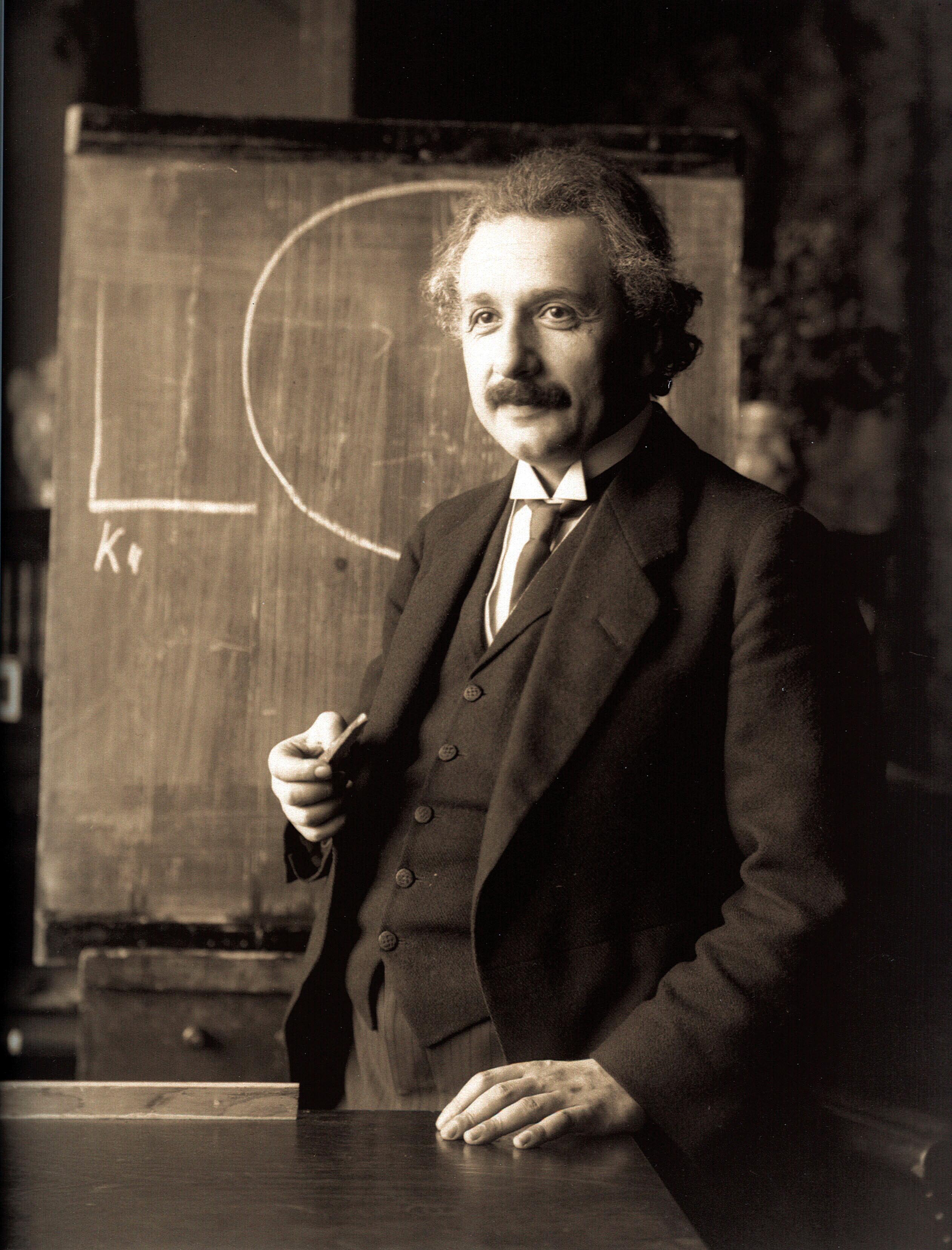
For example, the classical physics that Sir Isaac Newton developed in the 17th century to explain motion, forces, and gravity withstood the scrutiny of scientists for more than 200 years. During the late 19th and early 20th centuries, however, a series of scientific revolutions completely changed our understanding of the nature of reality. The work of Albert Einstein (Figure 1.5) is representative of those scientific revolutions. Einstein’s special and general theories of relativity replaced Newton’s mechanics. Einstein showed that Newton’s theories were a special case of a far more general and powerful set of physical theories. Einstein’s revolutionary new ideas unified the concepts of mass and energy and destroyed the conventional notion of space and time.

Figure 1.5 Albert Einstein is perhaps the most famous scientist of the 20th century, and he was Time magazine’s selection for Person of the Century. Einstein helped usher in two scientific revolutions.

Throughout this text, you will encounter many other discoveries that forced scientists to abandon accepted theories. Einstein himself never embraced the view of the world offered by quantum mechanics—a second revolution he helped start. Yet quantum mechanics, a statistical description of the behavior of particles smaller than atoms, has held up for more than 100 years. In science, all authorities are subject to challenge, even Einstein.

Science is a way of thinking about the world. It is a search for the relationships that make our world what it is. A scientist assumes that order exists in the universe and that the human mind can grasp the essence of the rules underlying that order. Scientists build on those assumptions to make and then test predictions, finding the underlying rules that allow humanity to solve problems, invent new technologies, or find a new appreciation for the natural world. Scientific knowledge is an accumulated collection of ideas about how the universe works, yet scientists are always aware that what is known today may be superseded tomorrow. Science has found such a central place in our civilization because science makes the most accurate predictions about how natural systems will behave.

working it out 1.1

Mathematical Tools

Scientists use mathematics to understand the patterns they observe and to communicate that understanding to others. The following mathematical tools will be useful in our study of astronomy:

Units. Scientists use the metric system of units because most metric units are related to each other by multiplying or dividing by 10. Thus, converting from one unit to another means simply moving the decimal point to the right or to the left. Metric measurements also have prefixes that identify the relationship of the units. There are 100 centimeters (cm) in a meter, 1000 meters in a kilometer (km), and 1000 grams in a kilogram (kg). (A more complete listing of metric prefixes is located inside the front cover of this book.) One way to check your own work is to think about whether the answer should be larger or smaller than the original number. The number of centimeters, for example, should always be larger than the number of meters because there is more than 1 cm in a meter. Often, a quick estimate can also help. For example, 1 ft is about an “order of magnitude” (a power of 10) larger than a centimeter; in other words, there are a few tens—not hundreds—of centimeters in a foot. If you have converted 1.2 ft to centimeters and calculated an answer of 3200 cm, you should try again. You can also include the units in every step of the calculation, and at each step, strike out the ones that cancel. For example, if you are multiplying 10 minutes by 60 seconds per minute, the unit minutes appears in the numerator and the denominator and divides out.

This can help you remember if you should multiply or divide by the conversion factor; you want the answer in the correct units.

Scientific notation. Scientific notation is how we handle numbers of vastly different sizes. Writing out 7,540,000,000,000,000,000,000 in standard notation is inefficient. Scientific notation uses the first few digits (the significant ones) and counts the number of decimal places to create the condensed form 7.54 × 10²¹. Similarly, instead of writing out 0.000000000005, we write 5 × 10–12. The exponent on the 10 is positive or negative depending on whether the decimal point moves left or right, respectively. For example, the average distance to the Sun is 149,600,000 km, but astronomers usually express that value as 1.496 × 10⁸ km.

Ratios. Ratios are a useful way to compare objects. A star may be “10 times as massive as the Sun” or “10,000 times as luminous as the Sun.” Those expressions are ratios.

Proportionality. Often, understanding a concept amounts to understanding the sense of the relationships that it predicts or describes. “If you have twice as far to go, getting there will take you twice as long.” “If you have half as much money, you will be able to buy only half as much gas.” Those are examples of proportionalities.

Appendix 1 further explains the mathematical tools used in this book.

CHECK YOUR UNDERSTANDING 1.2

The scientific method is a process by which scientists: (a) prove theories to be known facts; (b) gain confidence in theories by failing to prove them wrong; (c) turn theories into laws; (d) survey what most scientists think about a theory.

AnswerAnswer

b

Glossary

scientific method
The formal procedure—including hypothesis, prediction, and experiment or observation—used to test (that is, to attempt to falsify) the validity of scientific hypotheses and theories.
hypothesis
A well-considered idea, based on scientific principles and knowledge, that leads to testable predictions. Compare theory.
falsified
A hypothesis shown to be false.
theory
A well-developed idea or group of ideas that are tied solidly to known physical laws and make testable predictions about the world. A very well-tested theory may be called a physical law, or simply a fact. Compare hypothesis.
model
A simplified mathematical or conceptual representation of a physical system used to carry out calculations or predictions.
principles
A general idea or sense about the universe that guides us in constructing new scientific theories. Principles can be testable theories.
cosmological principle
The (testable) assumption that the same physical laws that apply here and now also apply everywhere and at all times and that the universe has no special locations or directions.
Occam’s razor
The principle that the simplest hypothesis is the most likely, named after William of Occam (circa 1285–1349), the medieval English cleric to whom the idea is attributed.