Name:
Course:
Section:
Date:
EXERCISE 1 CREATING PUNNETT SQUARES
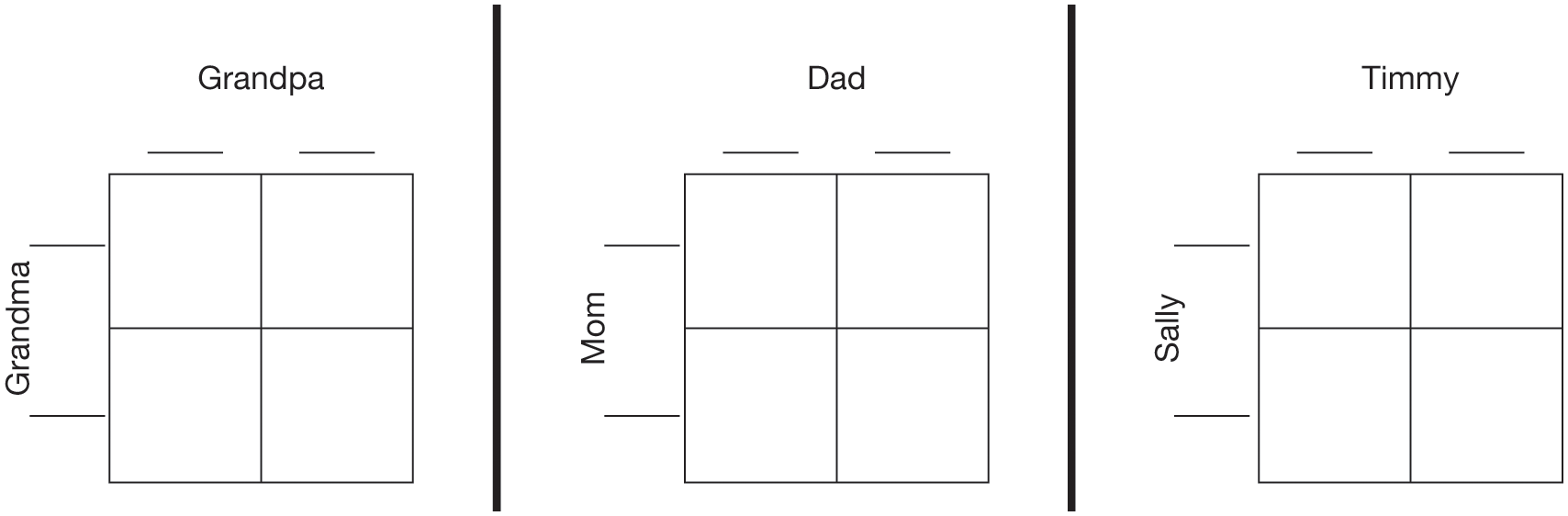
Work in a small group or alone to complete this exercise. Trait F is the Mendelian trait for freckles. The allele for freckles (F) is dominant over the allele for no freckles (f).
- Timmy is homozygous dominant for freckles.
- Timmy mates with Sally, who is heterozygous for freckles.
- Timmy’s father and Timmy’s mother are both heterozygous for freckles.
- Timmy’s maternal grandmother (mother’s mother) is homozygous recessive for freckles.
- Timmy’s maternal grandfather (mother’s father) is homozygous dominant for freckles.
Use the information provided to complete the three separate Punnett squares below.
EXERCISE 2 CREATING PEDIGREE DIAGRAMS
Working in a small group or alone, review the information about Timmy’s family from Exercise 1. Use this information to create a pedigree diagram for the freckles trait in his family. Be sure to include all three generations and all six people described. Use the space below.
EXERCISE 3 INTERPRETING PUNNETT SQUARES
Work in a small group or alone to complete this exercise. The Punnett square below shows the genotypes of two parents for trait R. Trait R is the Mendelian trait in humans for tongue rolling. The allele for the ability to roll the tongue (R) is dominant over the allele for the inability to roll the tongue (r).
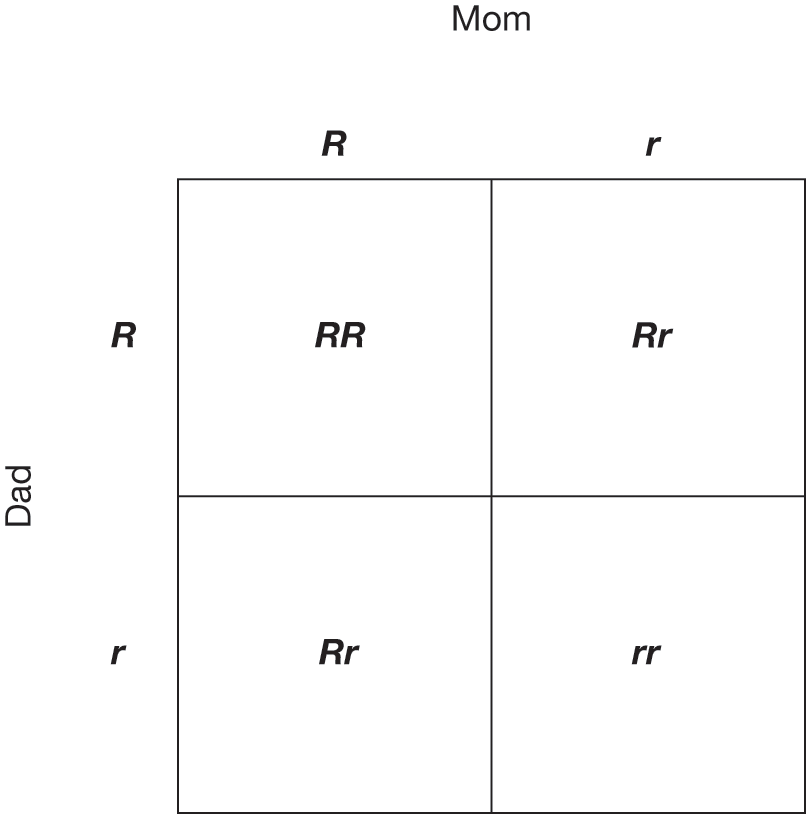
- According to the Punnett square above, what is the mother’s genotype? __________________________
- What is the mother’s phenotype? __________________________
- What is the father’s genotype? __________________________
- What is the father’s phenotype? __________________________
- What is the likelihood of their daughter Maria having each of the possible genotypes and phenotypes?
RR: __________________________
Rr: __________________________
rr: __________________________
Dominant phenotype (can roll tongue): __________________________
Recessive phenotype (cannot roll tongue): __________________________
- Are you 100% sure of Maria’s genotype? Why or why not?
- Are you 100% sure of Maria’s phenotype? Why or why not?
EXERCISE 4 INTERPRETING PEDIGREE DIAGRAMS
Work in a small group or alone to complete this exercise using the pedigree diagram below for trait R in a family. Trait R is the Mendelian trait in humans for tongue rolling. The allele for the ability to roll the tongue (R) is dominant over the allele for the inability to roll the tongue (r).
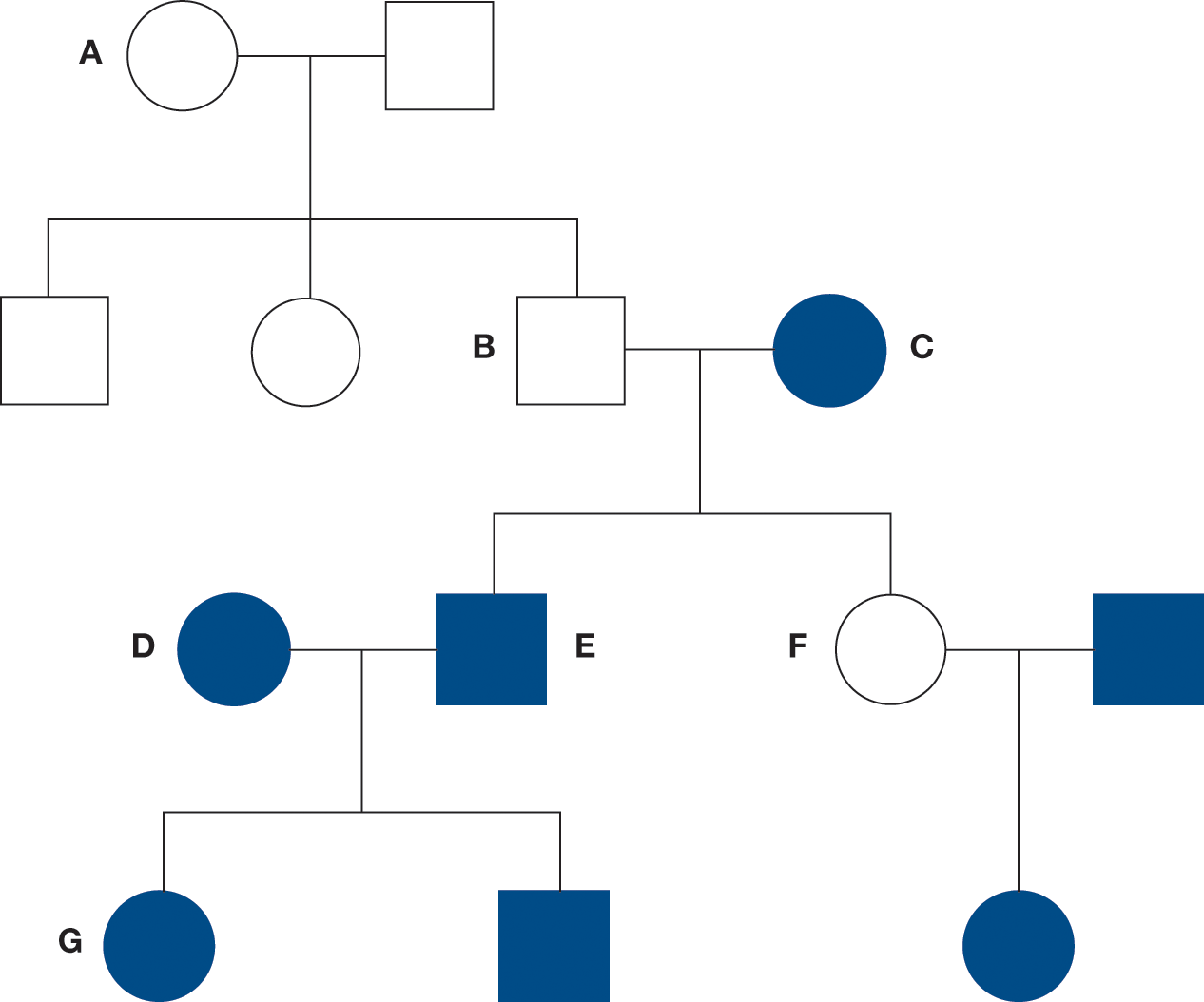
Complete the following chart using the pedigree diagram.
|
Person |
Genotype |
Phenotype |
|
A |
||
|
B |
||
|
C |
||
|
D |
||
|
E |
||
|
F |
||
|
G |
- Are you 100% sure of each person’s phenotype? If not, which ones are problematic? Why?
- Are you 100% sure of each person’s genotype? If not, which ones are problematic? Why?
EXERCISE 5 MENDELIAN TRAITS IN HUMANS 1
While most human traits are polygenic, the traits in the chart below have traditionally been considered Mendelian traits. More recent research has disputed the single-gene nature of some of these traits, but for the purpose of this exercise, assume that the following traits are Mendelian.
Work with a partner to help each other determine your own phenotypes and possible genotypes for these traits. Write your answers in the chart. (Note: Refer to the table on p. 62 for information about these traits.)
|
Mendelian Trait |
Your Phenotype |
Your Possible Genotype(s) |
|
Cleft Chin (Dominant) |
||
|
Freckles (Dominant) |
||
|
Attached Earlobes (Recessive) |
||
|
Hitchhiker’s Thumb (Recessive) |
||
|
Widow’s Peak (Dominant) |
EXERCISE 6 MENDELIAN TRAITS IN HUMANS 2
Some people can taste phenylthiocarbamide (PTC) and similar substances, but some people cannot. PTC tasting is a simple Mendelian trait in humans, where tasting (T) is dominant over nontasting (t).
Your instructor has distributed two taste strips: a control strip and a PTC strip.
STEP 1 Make sure to dispose of any candy, gum, or cough drops you may have in your mouth.
STEP 2 Differentiate the two taste strips by labeling them C (for control) and P (for PTC).
STEP 3 Touch the control strip to your tongue. Do not eat the strip. What do you taste? This is the taste of the paper, without any added substances.
STEP 4 Touch the PTC strip to your tongue. Do not eat the strip. What do you taste?
STEP 5 Discuss your results with several of your classmates. Based on your experience, answer the following questions.
- Are you a PTC taster? Do you have the dominant phenotype or the recessive phenotype?
- What is your possible genotype(s)?
- How do you compare with your classmates?
EXERCISE 7 USING THE SCIENTIFIC METHOD TO INVESTIGATE MENDELIAN TRAITS IN HUMANS
In this lab, we considered several Mendelian traits in humans, including the hitchhiker’s thumb trait. We assumed that this trait follows typical Mendelian patterns and has two distinct phenotypic expressions. In this exercise, you will work alone or with a small group to apply the scientific method and test this assumption.
Existing hypothesis: If the hitchhikers’ thumb is a Mendelian trait, then there will be two distinct phenotypic expressions (hitchhiker’s thumb and non-hitchhiker’s thumb).
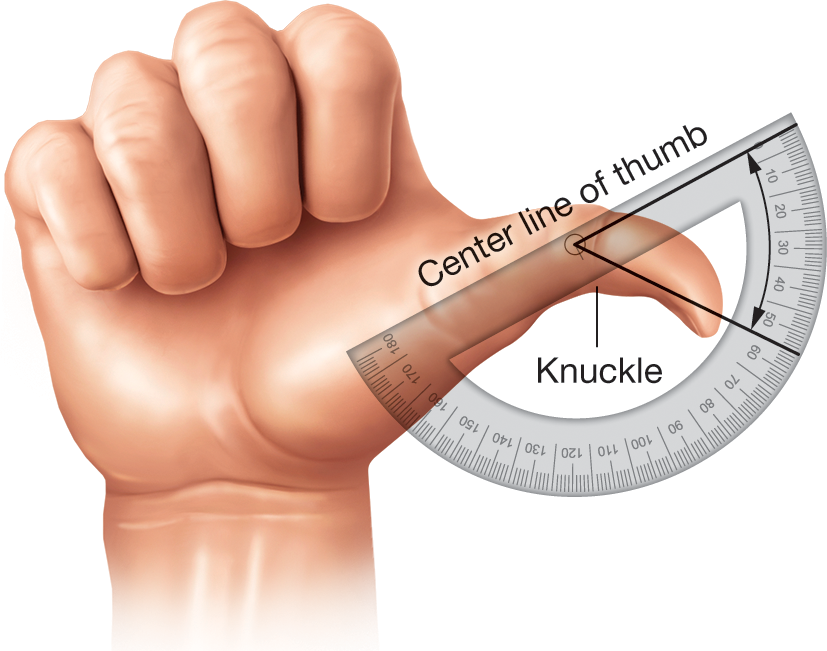
STEP 1 Collect thumb angle data. Use a protractor to measure the angle of at least 10 different people’s thumbs. Align the base of the protractor with the center line of the thumb (extending from the wrist through the base and second knuckle of the thumb) as shown in the diagram below. Make sure only one person does all the measuring so you avoid interobserver error.
STEP 2 Tabulate the data. Enter your measurements (by individual) in the chart below. The first row has been completed as a demonstration. (If you measure more than 10 people’s thumbs, use separate paper to compile the additional data.)
|
Individual’s Name |
Thumb Angle |
|
Sasha |
75° |
|
|
|
|
|
|
|
|
|
|
|
|
|
|
|
|
|
|
|
|
|
|
|
|
|
|
|
|
|
|
STEP 3 Interpretation
- Look for patterns in the data. Describe any patterns you find.
- Based on the data you collected, is the hypothesis supported or rejected? Why?
STEP 4 Reflection
- After investigating this trait more closely, what have you learned about variation in Mendelian traits?
- Why might this variation exist?
EXERCISE 8 SEX-LINKED TRAITS
Work in a small group or alone to solve this “mating mystery.” Then answer the questions that follow.
Mister Poppleton, a cat enthusiast who breeds cats and competes on the Cat Fancier’s Association competitive show circuit, has just received quite a shock! His award-winning cat, Emeline, has given birth to some surprising kittens. Of her five kittens, four have black fur, and one has an unexpected coat of fur that is a patchwork of black and orange, known as a tortoiseshell pattern.
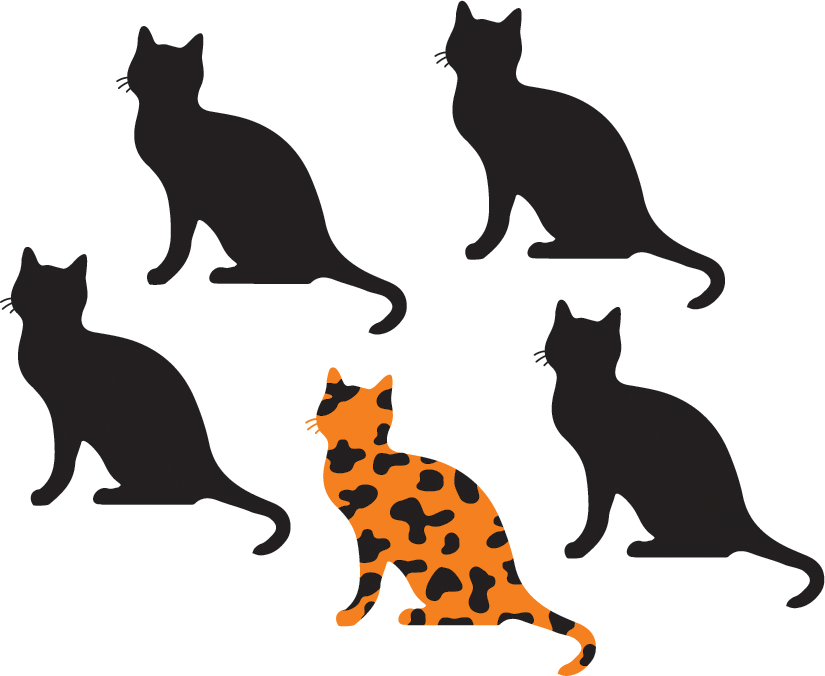
Mister Poppleton was breeding Emeline with an award-winning male cat, named Barnaby, but he is now worried that Emeline may have been having secret sexual relations with a neighborhood stray cat, named Hugo. Mister Poppleton consults with his veterinarian, Dr. Doolittle, for some expert advice.
Dr. Doolittle explains: In cats, there are several genes that determine fur color. One of those genes is found on the X chromosome and codes for whether a cat has orange fur or black fur. Because it is a sex-linked gene, it is expressed a bit differently in males than in females.
In males:
- If a male cat has the orange allele on his X chromosome, he will have orange fur.
- If a male cat has the black allele on his X chromosome, he will have black fur.
In females:
- If a female cat has the orange allele on both of her X chromosomes, she will have orange fur.
- If a female cat has the black allele on both of her X chromosomes, she will have black fur.
- If a female cat has the orange allele on one of her X chromosomes and the black allele on the other X chromosome, she will have a tortoiseshell coat.
With this information in mind, Mister Poppleton takes a closer look at Emeline and the possible fathers (Barnaby and Hugo) of her kittens. Emeline is a female cat with all-black fur. Barnaby is a male cat with all-black fur. Hugo is a male cat with all-orange fur.
- Who is the father of these kittens? (Note: All of the kittens have the same father.) __________________________
- How do you know this? Be sure to provide evidence from the scenario and from what you know about patterns of inheritance.
- Why does only one kitten have the unusual tortoiseshell coat? Be sure to provide evidence from the scenario and what you know about patterns of inheritance.
EXERCISE 9 THE ABO BLOOD SYSTEM
Work with a small group or alone to answer the following questions about the ABO blood group system and blood type compatibility.
- Can a person with blood type A successfully receive a transfusion from a person who has type O? Why or why not?
- Can a person with blood type A successfully receive a transfusion from a person who has type B? Why or why not?
- Can a person with blood type O successfully donate blood to a person who has type AB? Why or why not?
- Can a person with blood type B successfully donate blood to a person who has type O? Why or why not?
- Can a person with blood type AB successfully donate blood to a person who has type A? Why or why not?
EXERCISE 10 DIHYBRID CROSS
So far, you have worked on Punnett squares that show monohybrid crosses—likelihoods for an offspring from two parents involving a single trait, such as tongue rolling. When conducting his research, Mendel devised a method known as a dihybrid cross, which allowed him to consider two different traits. Mendel’s work on dihybrid crosses in pea plants helped him realize that traits are inherited separately (the law of independent assortment).
SCENARIO A
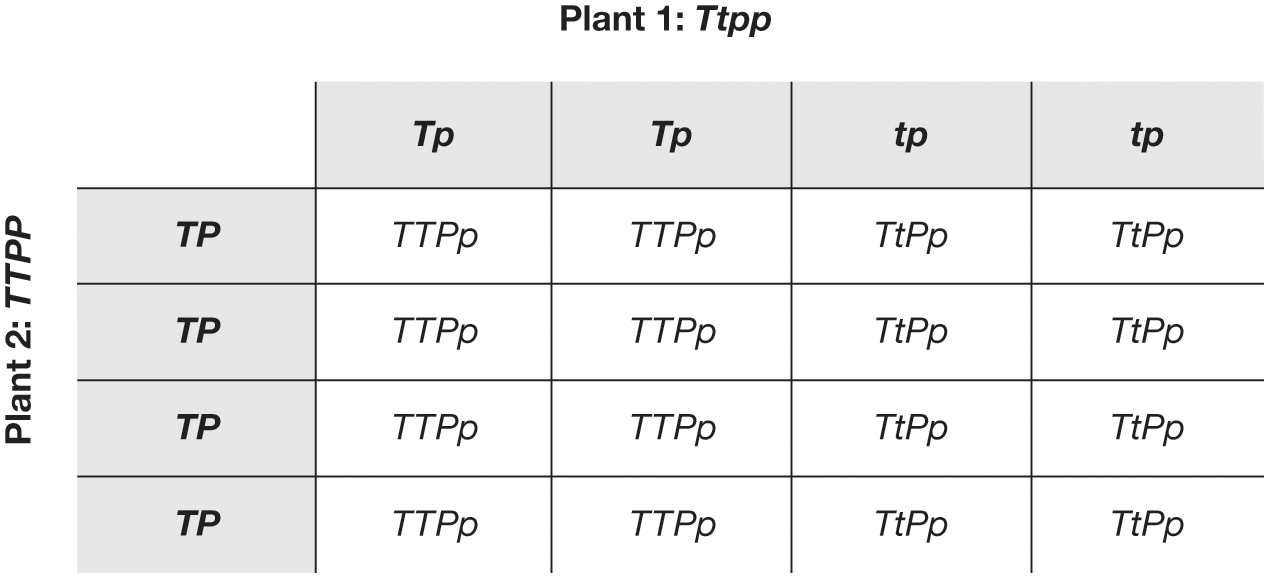
Here is an example of a dihybrid cross with Mendel’s pea plants. Consider two traits in pea plants: plant height (T) and flower color (P). Tallness (T) is dominant over shortness (t), and purple flowers (P) are dominant over white flowers (p). If a plant that is heterozygous for plant height (Tt) and homozygous recessive for flower color (pp) is mated with a plant that is homozygous dominant for plant height (TT) and for flower color (PP), what are the likelihoods for the offspring’s genotypes?
STEP 1 The first step is to determine the parents’ genotypes. Here, one plant is Ttpp and the other is TTPP.
STEP 2 Next, we have to determine all the possible gametes each plant might contribute. To do this, we write down the T and P combinations that may be present in each plant’s gametes.
- In plant 1, the possible gametes are Tp, Tp, tp, and tp.
- In plant 2, the possible gametes are TP, TP, TP, and TP.
STEP 3 Finally, we mate these possible gametes in a large Punnett square. In this example, the results are as follows:
- There is a 50% chance of an offspring that is TTPp.
- There is a 50% chance of an offspring that is TtPp.
- On the phenotypic level, there is a 100% chance that the offspring will be tall and have purple flowers.
SCENARIO B
For this exercise, work alone or in a small group to complete the dihybrid cross and answer the questions that follow. Consider two traits in humans: freckles (F) and widow’s peak (W). Having freckles (F) is dominant over not having freckles (f), and having a widow’s peak (W) is dominant over not having a widow’s peak (w).
- Suzy is heterozygous for freckles and widow’s peak.
- José is homozygous recessive for freckles and widow’s peak.
- Suzy and José are about to have a baby, and they are curious about the likelihood that their child will inherit these traits.
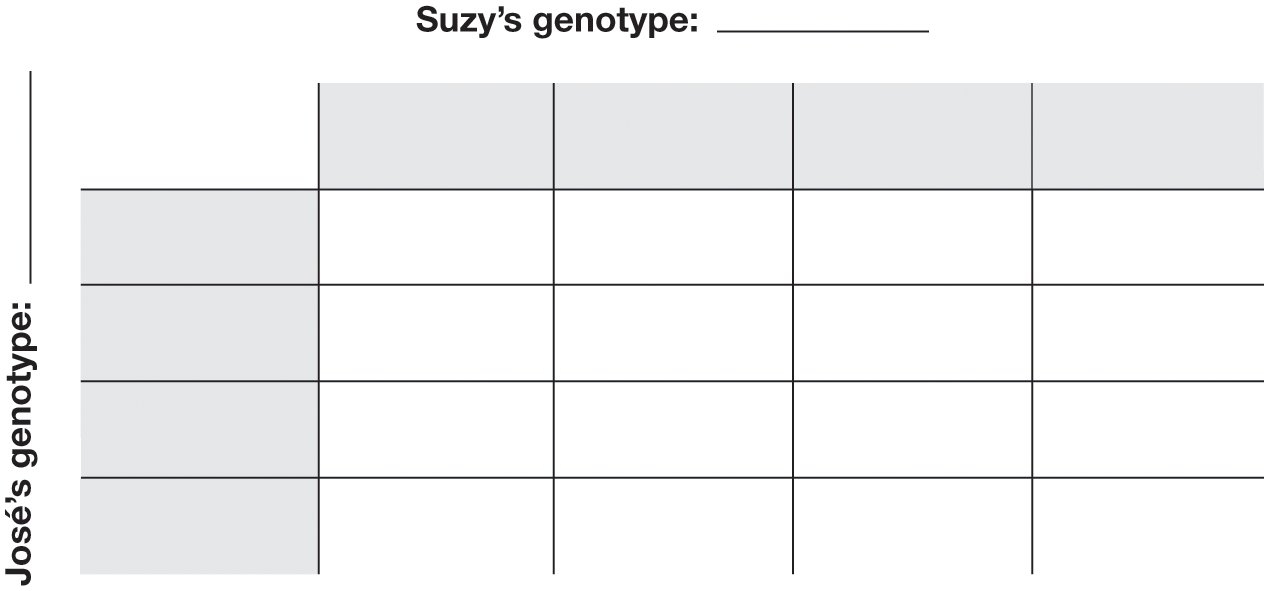
STEP 1 Enter Suzy’s and José’s genotypes in the Punnett square.
STEP 2 Enter Suzy’s and José’s possible gametes in the shaded rows and columns.
STEP 3 Complete the Punnett square and answer the following questions.
- What is the likelihood that Suzy and José’s child will have freckles but will not have a widow’s peak?
- What is the likelihood that Suzy and José’s child will not have freckles but will have a widow’s peak?
- What is the likelihood that Suzy and José’s child will have freckles and a widow’s peak?
- What is the likelihood that Suzy and José’s child will not have freckles or a widow’s peak?