Although China surpassed the United States in 2014 as the world’s largest national economy, the United States remains the most prosperous and technologically powerful country in the world. With just over 4 percent of the world’s population, the United States produces nearly as much of the world’s economic output as China, which has nearly 20 percent of the world’s population.31 In the past decade, while many of the world’s economies have struggled, the United States enjoyed the longest period of sustained economic growth in its history, breaking its own record set during the 1990s. For most of the decades since the 1970s, inflation and unemployment also remained relatively low. However, the global financial crisis and subsequent economic recession that originated with a banking crisis in the United States in 2008 had long-term negative consequences for the American economy and profoundly influenced its politics as well.
In general, the U.S. state plays a smaller role in the market than do the governments of most other industrialized democracies. The proportion of GDP spent by the U.S. state has hovered around 35 percent, less than in most European countries (for example, Sweden’s state consumes over 50 percent of GDP), a figure that has not varied much over time.32 Studies of global economic freedom rank the U.S. economy 25th globally in 2022, behind the United Kingdom, Canada, and Germany.33 The United States also has some of the lowest tax rates among the industrialized democracies (see “In Comparison: Taxes as a Percentage of GDP,” p. 148). However, what the United States does not provide by way of direct state expenditures is often less visible or “submerged,” such as various tax breaks for home ownership, children, or student loans and subsidies for employer-provided health care, to name a few. As a result, some observe that the notion of a weak U.S. welfare system is misleading; rather, benefits are often supplied through the private sector and supported by a complicated system of tax breaks targeting specific groups of Americans. Such a system, however, tends to benefit the middle class much more than the poor, who lack the resources to take advantage of tax exemptions and might more easily benefit from public goods, such as nationalized health care.34
Although private enterprise is the main engine of the U.S. economy, the state does play a significant role. At the country’s founding, Alexander Hamilton proposed ambitious plans for active state involvement in the marketplace, including providing infrastructure, creating a national bank, and channeling capital to strategic sectors of the economy. Such policies were controversial at the time but were largely implemented over the course of the nineteenth century.
Starting with the New Deal reforms of the 1930s, the state’s role in the economy increased significantly to prevent a market collapse, promote equity, and shield the American political-economic system from fascism on the right and communism on the left. Since the 1980s, governments have implemented neoliberal policies at times to scale back the role of the state in the economy. The Reagan administration, for example, deregulated many sectors of the economy (including telecommunications and the airlines) to make them more competitive; under the Clinton administration in the 1990s, reforms also devolved many welfare responsibilities to the states. The 2008 financial crisis once again brought the state into the marketplace on a dramatic scale in the form of fiscal stimuli, corporate bailouts, direct government ownership, and tougher government financial regulations. Over the course of the 2000s, an enormous boom took place in the U.S. housing market, facilitated by low interest rates backed by the Federal Reserve and large inflows of foreign funds seeking to profit from the boom. This easy money made cheap loans available to American consumers and fueled a housing construction frenzy and, ultimately, a housing bubble. Unrestrained by government regulators, financial institutions issued risky loans to increasingly indebted consumers and then bundled these mortgages together into complex securities and sold them to investors at great profit.
For a season, this bubble kept everyone aloft and happy. Americans were living the American dream of home ownership, jobs were plentiful, and banks were extremely profitable. But when the inflated housing bubble popped and housing prices declined, so too did the value of these mortgage-backed securities. The Wall Street financial institutions that had invested heavily in these securities began to suffer huge losses, prompting investors to flee. As interest rates climbed and property values plummeted, more and more Americans found themselves unable to make mortgage payments and were forced into foreclosure. The federal government stepped in to bail out banks, shore up key businesses, calm troubled financial markets, and jump-start the economy. These steps were designed to increase employment, stimulate investment, lift the economy out of recession, and prevent the kinds of market failures that had led to the crisis in the first place. During the presidencies of Donald Trump and Joseph Biden the federal government once again spent massively to cushion the damage caused by the Covid-19 pandemic.
In addition, the U.S. state’s intervention in the economy has been aimed at improving the business climate. Over the past 40 years, the tax burden has shifted from corporations to individuals, and the state has granted huge subsidies to agribusiness and given generous tax breaks to corporations. In 2018, President Trump and the Republican-led Congress implemented tax reforms that substantially lowered tax rates for both corporations and individuals. At the same time, in contrast to many European countries, the state has done little to support trade unions. Even during a Republican administration, under George W. Bush, the size of the state grew faster than at any time since the 1970s, though this growth largely involved military and national security spending.35 Declining state revenues, high military expenditures (direct costs of the wars in Iraq and Afghanistan tallied over $2 trillion through 2020), and emergency spending in the wake of the Covid-19 pandemic have raised government debt to dangerous levels, complicating efforts to fund government programs and sharpening political debate. In 2011, credit rating agency Standard & Poor’s downgraded the U.S. credit rating for the first time in the country’s history, citing concern about both the growing debt and the protracted political struggle over raising the debt ceiling.
Despite its wealth and generally impressive record of economic growth, the United States faces numerous political and economic challenges in the twenty-first century. Perhaps the most serious of these challenges has been that of persistent and growing income inequality. By the end of 2021, U.S. wealth concentration was at its highest since World War II.36 The globalization of trade and rapid technological transformation have led to a “two-tiered” labor market in the United States (and among all advanced industrial economies). Medical and pension costs have soared, while wages for lower-income families have remained stagnant even as higher-income households have reaped substantial increases in wealth. Since the Social Security Act of 1935, the U.S. state has provided a safety net of welfare measures, but the provisions have been less extensive than those of other advanced democracies. Legislation in the 1960s expanded welfare measures to include some health care coverage for the poor and the elderly, but it stopped short of providing universal health care for all citizens. During the Reagan administration, welfare spending per recipient fell by one-fifth. Under President Clinton, there was bipartisan support for measures aimed at cutting welfare expenditures, and with some notable exceptions (such as prescription drug benefits for the elderly), social expenditures remained flat or declined. The economic downturn in 2008 caused a spike in welfare expenditures, which rose to nearly 5 percent of GDP by 2010, nearly double the proportion of just three years previous. But once the economy regained its footing, welfare expenditures returned to less than 3 percent of GDP in subsequent years.
IN COMPARISON
Taxes as a Percentage of GDP
COUNTRY
PERCENTAGE
France
45.4
Germany
38.8
Brazil
33.1
United Kingdom
32.7
Japan
32.0
South Africa
29.1
United States
24.5
Mexico
16.5
China
15.2
Russia
11.0
Iran
8.4
India
6.8
Nigeria
6.3
Source: 2022 Heritage Foundation Index of Economic Freedom, https://www.heritage.org/index/explore?view=by-variables&u=637828685588291267. Most recent data available for each country (accessed 3/14/22).
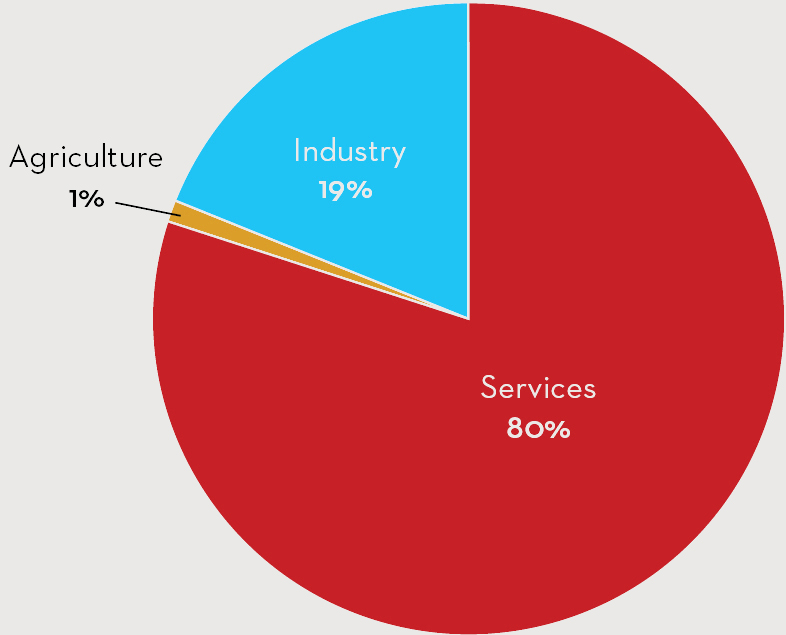
LABOR FORCE BY OCCUPATION
More information
A pie chart that displays labor force by occupation in the United States. Services make up 80 percent, Industry 19 percent, and Agriculture 1 percent.
As a result, income inequality in the United States has become a serious and growing problem. While the main measure of inequality, the Gini index, has remained relatively flat in many countries around the world, the United States has seen a dramatic increase over the past two decades. In 1980, the U.S. Gini index stood at 34, where it had been since the late 1960s. This figure is comparable to the European Union’s Gini index in 2007. Since the 1980s, the U.S. Gini number has risen to 41, similar to that of China and many countries in Africa.37 The United States has the largest number of millionaires in the world, but it also has a disproportionately large number of poor people for a country of its wealth (hence the high degree of inequality). About 12 percent of the country’s citizens live below the poverty line, including approximately 18 percent of its children (the highest percentage among the advanced democracies). This poverty is particularly concentrated among African Americans and Latinos, indicating how immigration and racism can compound the likelihood of poverty in the United States. Persistent racial divisions in the United States remain one of the greatest challenges to reducing inequality.
Some scholars believe that growing inequality has a corrosive effect on American society. A recent book by political scientist Robert Putnam illustrates the growing social consequences of economic inequality, which he argues threatens the American dream of social mobility.38 Other scholars have argued that the United States’ political system is increasingly dominated by large economic interests at the expense of the majority of the population.39 These concerns dovetail with alarm over the role of money in politics and the weakness of U.S. campaign finance laws. Concern over growing inequality, not usually central to U.S. politics, became a central theme in both the 2016 and 2020 presidential campaigns. In the 2016 Democratic Party primary campaign, Senator Bernie Sanders, declaring himself a “socialist,” mounted a serious challenge to the former senator and secretary of state Hillary Clinton, focused almost entirely on the need to stem the growing economic divide. In the Republican Party primary campaign, real estate mogul Donald Trump defeated his more mainstream competition by embracing economic nationalism and attacking free-trade deals that he claimed led to the impoverishment of the U.S. working class. Four years later, Senator Sanders and Senator Elizabeth Warren both sought the Democratic nomination, calling for significant social-democratic reforms, including tax increases for corporations and the wealthy, state-provided universal health care, and state-funded university education.
Related to the problems of inequality and poverty is the growing national debt over the past two decades. While U.S. social expenditures are small compared with those of other advanced democracies, the low and declining levels of taxation (see “In Comparison: Taxes as a Percentage of GDP,” p. 148), growing numbers of elderly citizens, expanding entitlement programs, an inability to control health care expenses, and costs of defense and waging wars in Iraq and Afghanistan have translated into far greater expenses than state revenues can support. This budget deficit has been funded by borrowing. As a result, the United States has an enormous national debt of over $30 trillion; the figure now far exceeds the country’s annual GDP and has reached a level not seen since World War II. If at some point the United States is no longer able to sustain this debt through borrowing (often from foreign sources such as China), the result could be economic decline and the inability to sustain military commitments and other obligations abroad. Rising trade tensions and protectionism have threatened American and global economic growth, compounding the problem. Predictably, Democrats and Republicans have quite effectively “checked” each other in efforts to resolve this dilemma, finding little common policy ground.
Finally, the U.S. economy also faces the challenges of globalization common to the other cases in this book. While both Democrats and Republicans have historically pushed for freer world trade, growing sentiments of economic nationalism in recent years have increased calls for neomercantilist protections from some of the costs associated with earlier neoliberal policies. President Clinton signed the North American Free Trade Agreement (NAFTA), which has further integrated the U.S. economy with the economies of its largest trading partners, Canada and Mexico. President Obama worked closely with countries in the Asia-Pacific region (excluding China) and North and Latin American countries to implement the Trans-Pacific Partnership, designed to lower tariff and nontariff barriers among the dozen signatories. The trade deal was signed in 2016 but was never ratified by the U.S. Congress, and the Trump administration withdrew from the treaty in 2017 (though the other 11 signatories have subsequently enacted the treaty). President Trump also renegotiated NAFTA and imposed tariffs worth hundreds of billions of dollars on Chinese imports, triggering a trade war with China that promises to have long-ranging impacts on both of these heavily interdependent economies, global economic growth, and broader U.S.-China relations. Domestic economic challenges have combined with rising trade tensions to prompt growing calls for economic nationalism both within the United States and in many other countries. How will this affect personal and government debt, growth, inequality, and poverty in the United States? How will it affect economic relations between the United States and the rest of the world? We will get a better sense of this as events unfold in the near future.
Democratic president elected in 2020 who formerly served as President Barack Obama’s vice president
Notes
See CIA, World Factbook, 2019, www.cia.gov/the-world-factbook/ (accessed 1/5/23). Return to reference 31
Graham K. Wilson, Only in America? The Politics of the United States in Comparative Perspective (Chatham, NJ: Chatham House, 1998), p. 61. Return to reference 32
Heritage Foundation, “2022 Index of Economic Freedom: Country Rankings,” www.heritage.org/index/ranking (accessed 1/6/23). Return to reference 33
See Steinmo, The Evolution of Modern States. For the “submerged state,” see Suzanne Mettler, The Submerged State: How Invisible Government Policies Undermine American Democracy (Chicago: University of Chicago Press, 2011). Return to reference 34
Richard Kogan, “Federal Spending, 2001–2008: Defense Is a Rapidly Growing Share of the Budget, While Domestic Appropriations Have Shrunk,” Center on Budget and Policy Priorities, May 5, 2008, www.cbpp.org/research/federal-spending-2001-2008-defense-is-a-rapidly-growing-share-of-the-budget-while-domestic (accessed 1/5/23). Return to reference 35
Peter Coy, “Wealth Inequality Is the Highest Since World War II,” New York Times, February 2, 2022, www.nytimes.com/2022/02/02/opinion/inequality-wealth-pandemic.html?referringSource=articleShare (accessed 1/5/23). Return to reference 36
For details, see the World Bank, https://data.worldbank.org/indicator/SI.POV.GINI (accessed 3/14/22). Return to reference 37
Robert D. Putnam, Our Kids: The American Dream in Crisis (New York: Simon & Schuster, 2015). Return to reference 38
See Martin Gilens and Benjamin I. Page, “Testing Theories of American Politics: Elites, Interest Groups, and Average Citizens,” Perspectives on Politics 12, no. 3 (September 2014): 564–81. Return to reference 39