We have spent some time discussing ways that people’s identities are shaped by their membership in larger ethnic or national groups. But such groups do not completely define our political identity. We also hold individual views regarding the ideal relation between freedom and equality. In the rest of this chapter, we will divide these views into two categories: political attitudes and political ideology. Political attitudes are concerned with the speed of political change and the methods used to achieve it. Political ideology comprises the basic values an individual holds about the fundamental goals of politics with respect to freedom and equality. Political attitudes are particularistic: they focus on the specific context of political change in a given country. By contrast, political ideologies are more universal, since they assume there is one ideal way to balance freedom and equality.
Where do political attitudes and ideologies come from? These views are not defined by birth or by the state, although they may be influenced by either. Nor are the boundaries between such views as clear or evident as are those that define ethnicity, national identity, or citizenship. At the same time, these views do not simply materialize out of thin air. Ideologies are built over time out of a set of ideas, and attitudes are articulated in response to the institutional conditions around us. More fundamentally, it may be that attitudes and ideologies—our individual or group preferences regarding freedom, equality, and the degree of change needed to achieve them—stem from basic human traits that balance our need to establish order and our need to embrace change. While our own political views may not be inherited, having such views in the first place is central to what makes us human.
POLITICAL ATTITUDES
Political attitudes describe views regarding the necessary pace and scope of change in the balance between freedom and equality. Attitudes are typically broken up into the categories of radical, liberal, conservative, and reactionary and are often arrayed on a spectrum from left to right.
Radicals are placed on the extreme left. Radicals believe in dramatic, often revolutionary change of the existing political, social, or economic order. Radicals believe that the current system is broken and cannot simply be improved or repaired; it must be scrapped in favor of a new order. As a result, most radicals do not believe in slow, evolutionary change. Politics will be improved, they believe, only when the entire political structure has been fundamentally transformed, remaking the political institutions of government, regime, and state. As a result, some radicals may be more inclined to favor violence as a necessary or unavoidable part of politics. The institutions of the old order, in some radicals’ view, will not change willingly; they will have to be destroyed. Not all or even most radicals hold these views, however. Many argue that radical change can be achieved through peaceful means, by raising public consciousness and mobilizing mass support for wide-ranging change.
INFOCUSPolitical Attitudes Are . . .
Concerned with the speed and methods of political change.
Generally classified as radical, liberal, conservative, or reactionary.
Particularistic: relative to the specific context of a given country. “Radical” in one country may be “conservative” in another.
Distinct from political ideologies.
Liberals, like radicals, believe that much can be improved in the current political, social, and economic institutions, and liberals, too, support widespread change. However, instead of revolutionary transformation, liberals favor evolutionary change. In the liberal view, progressive change can happen through changes within the system; it does not require an overthrow of the system itself. Moreover, liberals part from radicals in their belief that existing institutions can be instruments of positive change. Liberals also believe that change can and sometimes must occur over a long period of time. They are skeptical that institutions can be replaced or transformed quickly and believe that only constant effort can create fundamental change.
Conservatives break with both radicals and liberals in their view of the necessity for change. Whereas radicals and liberals both advocate change, though disagree on the degree of change and the tactics needed to achieve it, conservatives question whether any significant or profound change in existing institutions is necessary. Conservatives are skeptical of the view that change is good in itself and instead view it as disruptive and leading to unforeseen outcomes. They see existing institutions as key to providing basic order and continuity; should too much change take place, conservatives argue, it might undermine the very legitimacy of the system. Conservatives also question whether the problems that radicals and liberals point to can ever really be solved. At best, they believe, change will simply replace one set of problems with another, and, at worst, it will create more problems than it solves.
Reactionaries are similar to conservatives in their opposition to further evolutionary or revolutionary change. Yet, unlike conservatives and like radicals, they view the current order as fundamentally unacceptable. Rather than transforming the system into something new, however, reactionaries seek to restore political, social, and economic institutions. Reactionaries advocate restoring values, reverting to a previous regime or state that they believe was superior to the current order. Some reactionaries do not even look back to a specific period in history but instead seek to return to an envisioned past ideal that may never have existed. Reactionaries, like radicals, may in some cases be willing to use violence to advance their cause, because of what they see as the entrenched nature of the status quo.
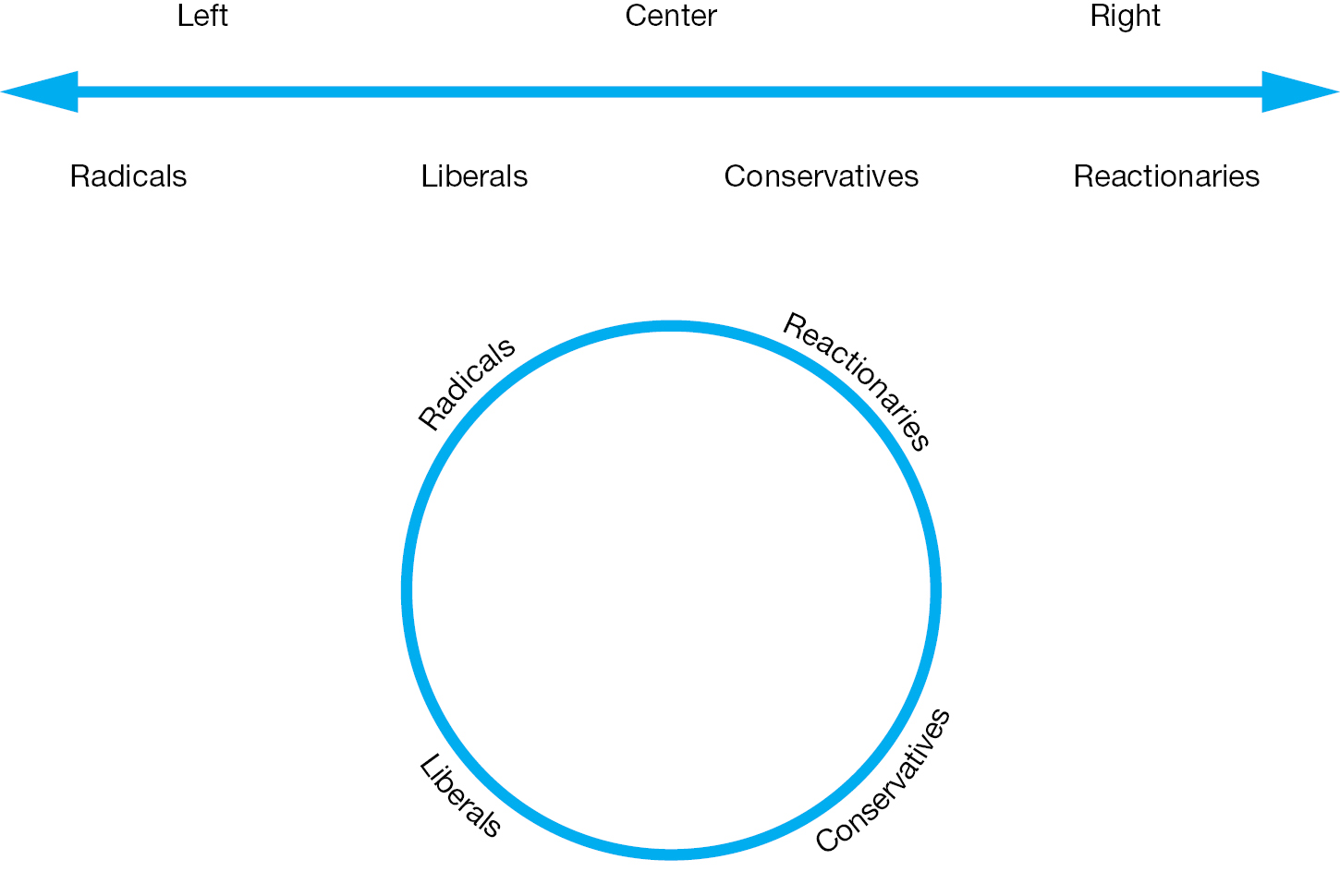
This left–right continuum of political attitudes gives the impression that the farther one travels from the center, the more polarized politics becomes. By this logic, then, radicals and reactionaries are miles apart from one another and have nothing in common (Figure 3.2, top). But our preceding discussion indicates that in many ways this impression is incorrect. Viewing left and right as extending along a single continuum is misleading, for the closer one moves toward the extremes, the closer the attitudes become. In other words, the continuum of left and right is more aptly portrayed as a circle, bringing the two ends, radical and reactionary, close together (Figure 3.2, bottom). And in fact, radicals and reactionaries have much in common. Both believe in dramatic change, though in different directions, and both contemplate the use of violence to achieve this change. Although their ends may be quite different, the means of both groups can often be similar. Just as liberals sometimes become conservatives and vice versa, radicals and reactionaries often cross over into each other’s camps. For example, many reactionary fascists in Europe became supporters of radical communism after World War II. More recently, in some of the same countries we have seen voters who once supported parties on the far left switch their vote to the far right. This is not as surprising as we might think. Studies indicate that individuals with radical and reactionary political attitudes share in common a strong resistance to recognizing and updating their personal views when they are shown to be wrong.8 This may explain why those resistant to updating their viewpoints would be more likely to jump from one extreme to another, given the similarities between the two.
More information
A diagram demonstrates two views of political attitudes. The first view is a double-sided arrow labeled left, center, and right on the top. Below the arrow are groups labeled from left to right: Radicals, Liberals, Conservatives, and Reactionaries. The second view is a circle with the following words equally spaced and wrapped around it: Radicals, Reactionaries, Conservatives, and Liberals.
FIGURE 3.2 Two Views of Political Attitudes
You may have noticed that our discussion of the spectrum of political attitudes has not provided any specific examples of political issues, such as welfare, civil liberties, immigration, or national defense—common sources of political division that separate right from left in most industrialized democracies. But these policy areas are the concern of political ideology, the basic beliefs that people hold about how politics should be constructed. It is important to emphasize again that ideology and political attitudes are not interchangeable. The attitudes of radicals, liberals, conservatives, and reactionaries often take on different ideological content in different societies, depending on the context. What might be considered radical in one country could be conservative in another.
Consider some examples. In the United States, Canada, and western Europe, radicals are viewed as those who seek to fundamentally transform or overthrow the current capitalist democratic order, replacing it with a system of greater economic and social equality. Liberals in these countries are sympathetic to some of these ideas but believe in pursuing gradual changes within the current system, engaging democratic institutions. Conservatives believe that the current economic and social structures are as good as they are likely to be and that change is unlikely to improve the state of humanity and might make it worse. Reactionaries, meanwhile, would reject the status quo in favor a restoration of greater inequality or hierarchy between people. The foregoing is a simplified but accurate description of how political attitudes are manifested in North America and much of the West.
These same political attitudes would manifest themselves quite differently in a country such as China, however. Despite dramatic economic reforms, China still has a nondemocratic regime dominated by a communist party. A Chinese radical, defined as someone who seeks the destruction of the current system, would advocate the overthrow of communist rule, perhaps replaced by a democracy like those found in the West. Students who were active in the Tiananmen Square protests for democracy in 1989, as well as student protesters in Hong Kong in recent years, were frequently described or condemned by observers and the Chinese government as “radicals” because of their demands for political change. Chinese liberals are also likely to support increased democracy, although they would favor a process of gradual change within the existing political system. Chinese conservatives, skeptical of institutional change, resist calls for liberalization. They may support market reforms, but they do not view these steps as leading down an inevitable path to democracy. This might best describe those currently in power. Finally, Chinese reactionaries strongly oppose any reforms that might jeopardize communist rule. These neo-Maoists, as they are sometimes called, favor a return to earlier, “purer” communist values and policies, rolling back changes and restoring their communist ideal.
Clearly, American or western European radicals would have little to say to Chinese radicals; they are united by their attitudes toward the scope and speed of political change, but their political values and goals—their ideologies—are dramatically different. Indeed, Chinese radicals might have more in common with American or European conservatives in terms of their ideological values, which we will discuss next. Chinese reactionaries, on the other hand, might have more in common with American or western European radicals. Context matters.
POLITICAL IDEOLOGY
The importance of context in understanding political attitudes might lead to the conclusion that comparing political attitudes across countries is impossible: what is radical in one country might be conservative in another. To move past these particularistic differences between countries, political scientists also speak about political ideologies.
Like much of modern politics, the concept of ideology is relatively recent: the term was first used during the French Revolution to speak of a “science of ideas.”9 This meaning reflects the fact that ideologies emerged with the construction of modern secular states as a means to guide politics. Ideologies were thus viewed as alternatives to traditional sets of values such as religion; they were seen as based on rational thought rather than spiritual notions of good and evil. For our purposes, political ideologies are defined as sets of political values held by individuals regarding the fundamental goals of politics. Instead of being concerned with the pace and scope of change in a given context, as political attitudes are, ideologies are concerned with the ideal relation between freedom and equality for all individuals and the proper role of political institutions in achieving or maintaining this relation. Supporters of each ideology work to ensure that their values become institutionalized as the basic regime. In the modern world, there are five primary ideologies.
INFOCUSPolitical Ideologies Are . . .
Sets of political values regarding the fundamental goals of politics.
Exemplified by five dominant modern ideologies: liberalism, communism, social democracy, fascism, and anarchism.
Universalistic: not specific to one country or time.
Distinct from political attitudes.
Liberalism as an ideology (rather than as a political attitude) places a high priority on individual political and economic freedom. Adherents of a liberal ideology believe that politics should seek to create the maximum degree of liberty for all people, including free speech, the right of association, and other basic political rights. This goal requires a state with a limited degree of autonomy so that the state can be easily controlled or checked by the public should it begin encroaching on individual rights. For liberals, the lower the ability of the state to intervene in the public’s affairs, the greater are the scope and promise of human activity and prosperity. As Thomas Jefferson said, “The legitimate powers of government extend to such acts only as are injurious to others. But it does me no injury for my neighbour to say there are twenty gods, or no god. It neither picks my pocket nor breaks my leg.”10
From these ideas of liberalism, we take our current definition of democracy, which is often called liberal democracy—a system of political, social, and economic liberties, supported by competition, participation, and contestation (such as voting). To be sure, liberals do recognize that if everyone is left to their own devices not all individuals will succeed, and great economic inequality inevitably will exist between the wealthiest and the poorest. Liberals argue that despite this shortcoming, a high degree of freedom will produce the greatest amount of general prosperity for the majority. As a final point, we should note that liberalism as an ideology and liberalism as a political attitude are very different things and not necessarily connected.
INFOCUSDifferent Meanings of the Term Liberalism
As a political attitude: favoring slow, evolutionary change.
As a political ideology outside North America: favoring free markets and individualism, accepting greater inequality.
As a political ideology in North America: favoring a greater state role in limiting inequality; many outside the region would call this ideology “social democracy.”
As a political-economic system: favoring a limited state role in the economy.
Communism differs greatly from liberalism in its view of freedom and equality. Whereas liberalism enshrines individual freedom over equality, communism rejects the idea that personal freedom will ensure prosperity for the majority. Rather, it holds that in the inevitable struggle over economic resources in a liberal society, a small group will eventually come to dominate both the market and the state, using its wealth to control and exploit society as a whole. Prosperity will not be spread throughout society but will be monopolized by a few for their own benefit. The gap between rich and poor will widen, and poverty will increase. For communists, liberal democracy is “bourgeois democracy”—of the rich, by the rich, and for the rich. Such institutions as free speech and voting are meaningless when a few control the wealth of society.
To eliminate exploitation, communism advocates that the state control all economic resources and thus produce true economic equality for the community as a whole. This goal requires a powerful state in terms of both autonomy, capacity and scope—a state able to restrict those individual rights (such as the freedom to own property or oppose the current regime) that would hinder the pursuit of economic equality. Individual liberties must give way to the needs of society as a whole, creating what communists would see as a true democracy. In the Soviet Union, from 1917 to 1991, this communist ideology was the political regime, as it has been in China since 1949 (though with significant modifications that call into question whether it remains communist).
Social democracy (sometimes called socialism, though that term often has a distinct and separate meaning) draws from ideas connected to both communism and liberalism to form its own distinct ideology. Social democracy accepts a strong role for private ownership and market forces while maintaining an emphasis on economic equality. A state with strong capacity and autonomy is considered important to social democrats to ensure greater economic equality through specific policies like job protection or social benefits like medical care, retirement, and higher education. This commitment to equality means that social democracy may limit freedom more than liberalism does, through such mechanisms as regulation or taxation. However, social democracy recognizes the importance of individual liberty as complementary to equality. In many countries, social democracy, rather than liberalism, is the guiding political regime. Many environmental parties, which seek to balance human and environmental needs, also have social-democratic influences.
Fascism is hostile to the idea of individual freedom and also rejects the notion of equality. Instead, fascism rests on the idea that people and groups can be classified in terms of inferiority and superiority, justifying a hierarchy among them. Whereas liberals, social democrats, and communists all see inherent potential in every person (although they disagree on the best means to unleash this potential), fascists do not. Fascism conceives of society as an organic whole, a single living body, and the state as a vital instrument to express national will. State autonomy and capacity must therefore be high, and democracy, no matter how it is defined, is rejected as anathema, just as freedom and equality are rejected. Fascism is well remembered from the Nazi regime that ruled Germany from 1933 to 1945. More recently, parties and movements with a fascist orientation have resurfaced in various countries. This includes some strains of a philosophy tellingly known as neo-reaction, which expresses a hostility to liberal democracy and a belief in a hierarchy of racial differences.11
Anarchism departs from these other ideologies quite drastically. If liberalism, communism, and fascism differ over how powerful the state should be, anarchism rejects the notion of the state altogether. Anarchists share with communists the belief that private property leads to inequality, but they are opposed to the idea that the state can solve this problem. As the Russian anarchist Mikhail Bakunin (1814–76) once stated, “I am not a communist, because communism unites all the forces of society in the state and becomes absorbed in it . . . while I seek the complete elimination of the principles of authority and governmental guardianship, which under the pretense of making men moral and civilizing them, has up to now always enslaved, oppressed, exploited, and ruined them.”12
Thus, like liberals, anarchists view the state as a threat to freedom and equality rather than as their champion, but they believe that both individual freedom and equality can be achieved only by eliminating the state entirely. Without a state to reinforce inequality or limit personal freedom, argue anarchists, people would be able to cooperate freely as true equals. Given that we live in a world of states, anarchism is the only one of the five primary ideologies that has never been realized. However, anarchist ideas played a role in the Russian Revolution (1917) and in the Spanish Civil War (1936–39). In North America, some versions of libertarianism come close to an anarchist view in their hostility to the state, though libertarians differ from anarchists in their emphasis on private property. Digital currencies are a good example of where libertarian and anarchist views overlap.
INFOCUSIdeology and Political Attitudes
IDEOLOGY
TENETS
CORRESPONDING POLITICAL ATTITUDE IN NORTH AMERICA
LIBERALISM
Favors a limited state role in society and economic activity; emphasizes a high degree of personal freedom over social equality.
Conservative
COMMUNISM
Emphasizes limited personal freedom and a strong state in order to achieve social equality; property is wholly owned by the state and market forces are eliminated; state takes on task of production and other economic decisions.
Radical
SOCIAL DEMOCRACY
Supports private property and markets but believes the state has a strong role to play in regulating the economy and providing benefits to the public; seeks to balance freedom and equality.
Liberal
FASCISM
Stresses a low degree of both personal freedom and equality in order to achieve a powerful state.
Reactionary
ANARCHISM
Stresses the elimination of the state and private property as the only way to achieve both a high degree of personal freedom and social equality for all.
Radical
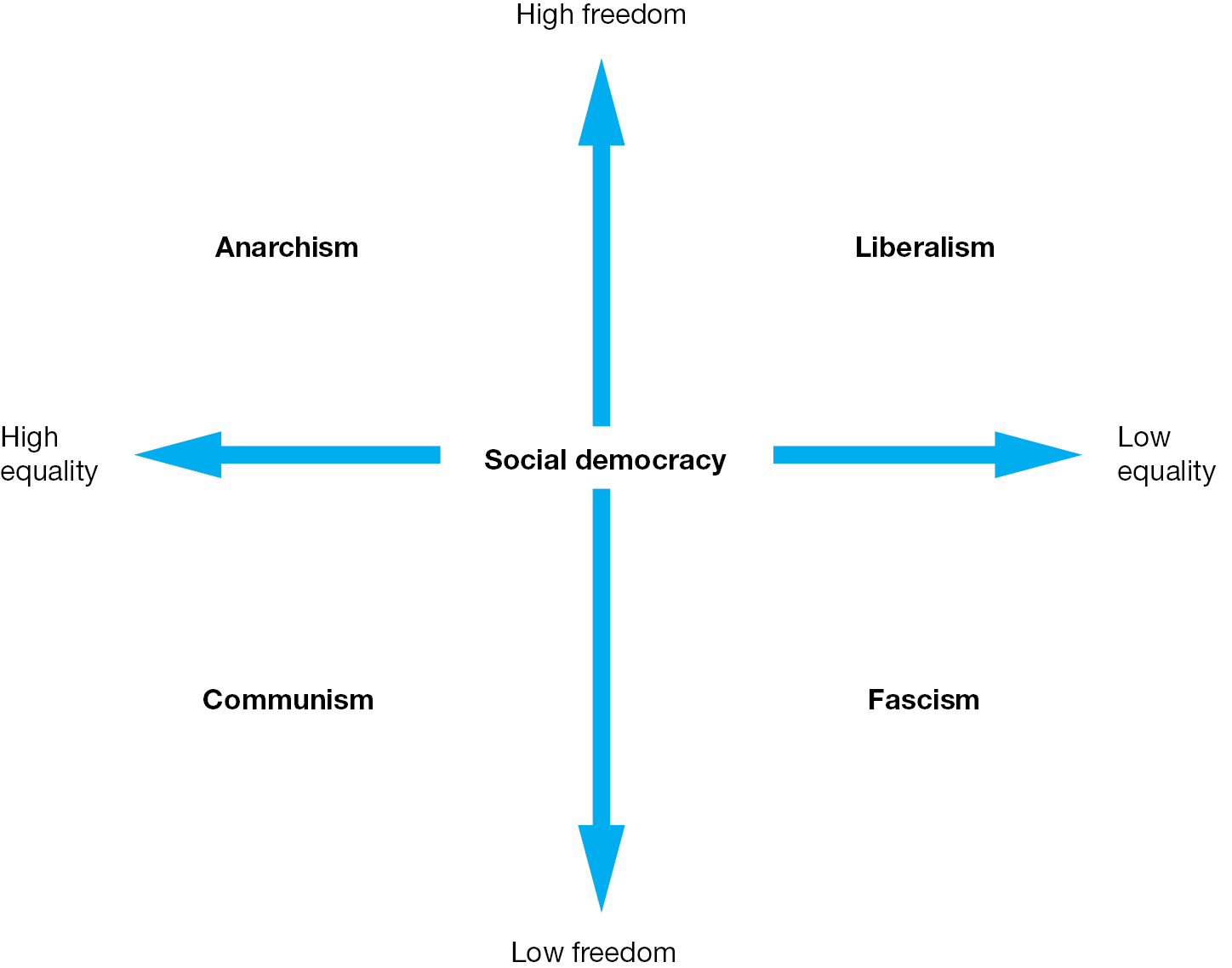
Political ideologies differ according to what they consider the proper balance between freedom and equality to be as well as what role they believe the state should have in achieving that balance. Building on the preceding chapters’ discussion of freedom and equality and state strength, Figure 3.3 shows how liberalism, social democracy, communism, fascism, and anarchism try to reconcile freedom and equality with state power. These ideologies are not particularistic, like political attitudes, but are universal in their outlook. And although ethnic and national identities and citizenship may draw the lines of conflict between groups, ideologies and attitudes shape the arena of political conflict within groups. How much change should there be? How fast should it occur? Should it be achieved through peaceful or violent means? What end should it serve? This is the essence of political life, as ideologies rise and fall in prominence, compete peacefully or violently, and pass from the scene as new ones take their place. In 200 years, such ideologies as liberalism and social democracy may make no more sense than monarchism does for most today.
More information
A matrix displays the differences in political ideologies. The diagram is set up like a graph with equality on the x-axis and freedom on the y-axis spanning from negative to positive. On the x-axis the left side points to high equality and on the right side it points to low equality. On the y-axis the arrow points up to high freedom and down to low freedom. At the center of the graph is social democracy. Anarchism is on the top left representing high equality and high freedom. Liberalism is on the right representing low equality and high freedom. Communism is on the bottom left representing high equality and low freedom. Fascism is on the bottom right representing low equality and low freedom.
FIGURE 3.3 Political Ideologies: Balancing Freedom and Equality
Liberals and anarchists favor decentralized power and weaker (or nonexistent) states as well as high levels of individual freedom; communists and fascists favor the concentration of state power at the expense of individual freedom; social democrats prefer a balance between state power and individual freedom.
USA
WHY HAS THE UNITED STATES RESISTED SOCIAL DEMOCRACY?
In our earlier discussion, we noted that while political attitudes are particularistic—a function of their specific context—ideologies are universal. This means that ideologies are roughly comparable across time and space. A communist in one country, for example, should rely on essentially the same assumptions about freedom and equality as in a communist regime elsewhere. But this may incorrectly suggest that all ideologies are present everywhere. As we know, communism has had a tremendous impact on states and regimes in the Soviet Union/Russia and China, but it has had much less impact in Africa. Similarly, while liberalism is the dominant ideology across the former colonies of the British Empire, it has found much less traction in most of Europe. This makes for an interesting puzzle: why do some ideologies have greater power in some countries or regions as opposed to others?
In fact, there is one case where this is particularly puzzling: the United States. While the United States is typically cited as a case where liberal ideology is enshrined in the regime, social-democratic values historically have had a much harder time influencing politics. Some might respond by saying that in fact there is a clear ideological distinction in the United States, with the Democratic Party favoring such things as universal state-provided health care and strong unemployment benefits. Although true, even Democrats fall far short of standard social-democratic values found across Europe, like extensive maternity benefits and low-cost higher education. A simple explanation that the strength of liberalism has “crowded out” social democracy is unsatisfying. The United Kingdom, the birthplace of liberalism, has both strong liberal and social-democratic parties.
What then explains the United States’ peculiar ideological profile? For a century, political scientists and social democrats have struggled with this question, and there may be no single answer. One common argument focuses on the concept of political culture, which we will turn to shortly. In this view, the particular founding values of the American regime, emphasizing individual liberty over state power, generate skepticism toward social democracy’s emphasis on state-supported equality. Another related argument is that the emphasis on individualism has weakened the kind of working-class solidarity needed to build a strong, labor-oriented, social-democratic party. The fact that most Americans view themselves as “middle class” and upwardly mobile limits support for an ideology ostensibly focused on lower classes. However, it is not necessarily the case that the weakness of social democracy was somehow predetermined. During the Great Depression, social democracy made significant inroads into politics, but American social-democratic leaders failed to build bridges to labor unions that could have institutionalized their ideology. Accordingly, there is no reason why social democracy could not reemerge in the United States as a more powerful force. In the 2016 and 2020 U.S. presidential campaigns, candidate Bernie Sanders promoted a social-democratic agenda that attracted considerable support, especially among younger voters. The ongoing rise of inequality could in fact pave the way in the future for a social-democratic America. We’ll speak more about economic inequality and its political implications in Chapter 4.
(1) A political attitude that favors evolutionary transformation; (2) an ideology and political system that favors a limited state role in society and the economy and places a high priority on individual political and economic freedom
(1) A political-economic system in which all wealth and property are shared so as to eliminate exploitation, oppression, and, ultimately, the need for political institutions such as the state; (2) a political ideology that advocates such a system
(1) A political-economic system in which freedom and equality are balanced through the state’s management of the economy and the provision of social expenditures; (2) a political ideology that advocates such a system
(1) A political-economic system in which freedom and equality are balanced through the state’s management of the economy and the provision of social expenditures; (2) a political ideology that advocates such a system
A political ideology that asserts the superiority and inferiority of different groups of people and stresses a low degree of both freedom and equality in order to achieve a powerful state
A political ideology that stresses the elimination of the state and private property as a way to achieve both freedom and equality for all
Endnotes
Max Rollwage, Raymond J. Dolan, and Stephen M. Fleming, “Metacognitive Failure as a Feature of Those Holding Radical Beliefs,” Current Biology 28, no. 24 (December 2018): 4014–21. Return to reference 8
Antoine Louis Claude Destutt de Tracy, A Treatise on Political Economy (1817; New York: Augustus M. Kelley, 1970). Return to reference 9
Thomas Jefferson, “Notes on the State of Virginia: Query XVII: Religion,” https://teachingamericanhistory.org/library/document/notes-on-the-state-of-virginia-query-xvii-religion (accessed 05/23/22). Return to reference 10
Roger Burrows, “Urban Futures and The Dark Enlightenment,” in Keith Jacobs and Jeff Malpas, eds., Philosophy and the City: Interdisciplinary and Transcultural Perspectives (New York: Rowman & Littlefield, 2019), 245–58. Return to reference 11
Quoted in George Plechanoff, Anarchism and Socialism (Chicago: Kerr, 1909), 80. Return to reference 12