As the Roman Empire declined, however, the Christian Church gained influence, becoming the main — and, often, the only — unifying force and channel of culture in Europe until the tenth century. With the help of the Church Fathers, highly influential Christian writers and scholars who interpreted the Bible and set down some guiding principles, the Church took over Rome’s mission of civilizing and unifying the peoples under its sway. Writing in Greek (Clement of Alexandria, Origen, Saint Basil, and Saint John Chrysostom in the third and fourth centuries) or in Latin (Saint Ambrose, Saint Augustine, and Saint Jerome in the fourth and early fifth centuries), they saw in music the power to inspire divine thoughts and to influence, for good or evil, the character of its listeners (a version of the Greek concept of ethos). When the last Roman emperor finally left the throne in 476 CE after a terrible century of wars and invasions, the power of the papacy was already well established.
Philosophers and church leaders of the early Middle Ages disdained the idea that music might be enjoyed solely for its play of sounds, something we now take for granted. Without denying that the sound of music could be pleasurable, they held to the Platonic principle that beautiful things exist to remind us of divine and perfect beauty, not to inspire self-centered enjoyment or seduce our senses. This view forms the basis for many of the pronouncements against music made by some Church Fathers (and, later, by some theologians of the Protestant Reformation; see Chapter 9). Others, however, not only defended pagan art, literature, and music, but found themselves so deeply affected by these arts that they actually worried about taking pleasure in listening to music, even in church. Saint Augustine (354–430 CE) expresses this concern in a well-known passage from his Confessions (see Vignette, below).
The music theory and philosophy of the ancient world — or whatever could still be found after the collapse of the Roman Empire and the invasions from the north — were gathered, summarized, modified, and transmitted to the West during the early Christian era, most notably by the writers Martianus Capella and Boethius.
In his widely read treatise, The Marriage of Mercury and Philology (early fifth century), Martianus described the seven liberal arts: grammar, dialectic (logic), rhetoric, geometry, arithmetic, astronomy, and harmonics (music). The first three, the verbal arts, came to be called the trivium (three paths), while the last four, the mathematical disciplines, were called the quadrivium (four paths) by Boethius. Music was part of the quadrivium because its precise numeric relationships seemed to furnish the key to explaining the universe, the harmony of the entire cosmos.
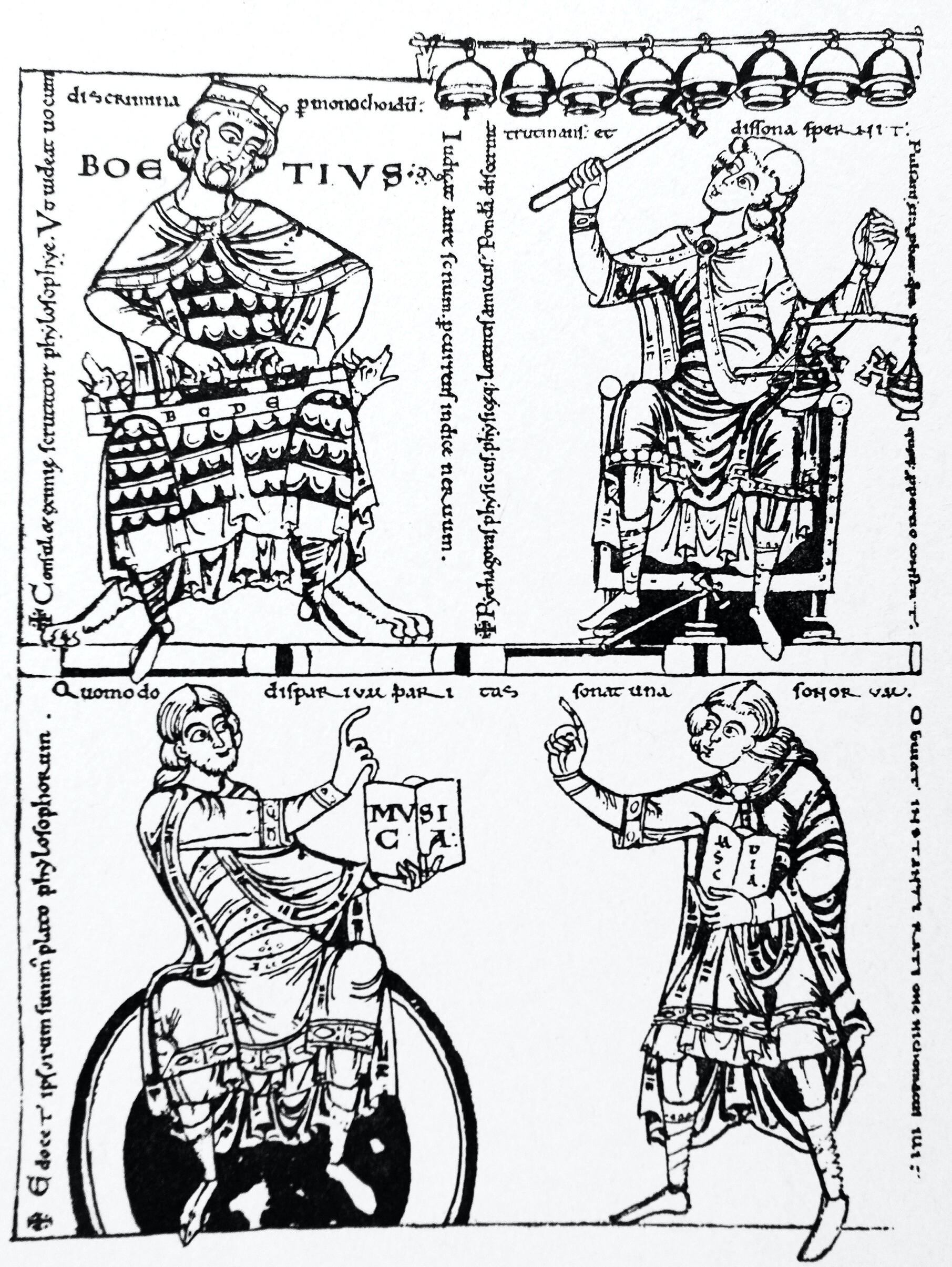
Boethius (ca. 480–ca. 524), depicted in Figure 1.4, was the most revered authority on music in the Middle Ages: his De institutione musica (The Fundamentals of Music; see A Closer Look, p. 22), widely copied and cited for the next thousand years, treats sounding music as a science of numbers because numerical relationships and proportions determine intervals, consonances, scales, and tuning. Boethius compiled the book from Greek sources, mainly a long treatise by Nicomachus and the first book of Ptolemy’s Harmonics. Although medieval readers may not have realized how much Boethius borrowed from other authors (a standard practice at the time), they understood that his statements were based on Greek mathematics and music theory.
VIGNETTE Saint Augustine on the Benefits and Dangers of Music
Augustine is one of the most significant thinkers in the history of Christianity and Western philosophy. His Confessions are often considered the first modern autobiography. In the following passage, he expresses the tension between music’s abilities to heighten devotion and to seduce with pleasure.
When I recall the tears that I shed at the song of the Church in the first days of my recovered faith, and even now as I am moved not by the song but by the things which are sung — when chanted with fluent voice and completely appropriate melody–I acknowledge the great benefit of this practice. Thus I waver between the peril of pleasure and the benefit of my experience; but I am inclined, while not maintaining an irrevocable position, to endorse the custom of singing in church so that weaker souls might rise to a state of devotion by indulging their ears. Yet when it happens that I am moved more by the song than by what is sung, I confess sinning grievously, and I would prefer not to hear the singer at such times. See now my condition!
Saint Augustine, Confessions 10:33, trans. James W. McKinnon, in Oliver Strunk, ed., Source Readings in Music History, rev. ed. by Leo Treitler (New York: W. W. Norton, 1998), vol. 2, p. 22.
A Closer Look Boethius’s Fundamentals
More information
In the drawing, Boethius and Pythagoras appear in panels at the top, playing an instrument each. Plato and Nicomachus, portrayed in a panel at the bottom, lecture while holding a book each.Figure 1.4An early twelfth-century drawing with fanciful portrayals of Boethius and Pythagoras, above, and Plato and Nicomachus, below. Boethius measures out notes on a monochord, a string stretched over a long wooden box with a movable bridge to vary the sounding length of the string. Pythagoras strikes bells with hammers. The others were also revered as authorities on music.
(World History Archive/Alamy Stock Photo.)
In the opening chapters of De institutione musica, the most original part of the treatise, Boethius divides music into three types. The first is the inaudible musica mundana (cosmic music), the numerical relations controlling the movement of the planets, the changing of the seasons, and the combination of elements. The second is musica humana, which harmonizes and unifies the body and soul and their parts. Last is musica instrumentalis, audible music produced by instruments and voices, which exemplifies the same principles of order as the other types of music, especially in the numerical ratios of its musical intervals.
Because music could influence character and morals, Boethius assigned it an important place in the education of the young, both in its own right and as an introduction to more advanced philosophical studies. In placing musica instrumentalis — the art of music as we commonly understand it now — in the third and presumably lowest category, Boethius indicated that, like his predecessors, he saw music primarily as a science, the discipline of examining the diversity of high and low sounds by means of reason and the senses, and only secondarily as a practice. Therefore, the true musician is not the singer or someone who makes up songs by instinct without understanding the nature of the medium, but rather the theorist and critic, who can use reason to make discoveries and judgments about the essence and the art of music.

 A Closer Look Boethius’s Fundamentals