What Is Globalization, and Why Is It Important for Anthropology?
Describe globalization and its four key dynamics.
The term globalization refers to the worldwide intensification of interactions and increased movement of money, people, goods, and ideas within and across national borders. Growing integration of the global economy has driven the rapid globalization of the past fifty years. Corporations have relocated factories halfway around the world. People are crossing borders legally and illegally in search of work. Goods, services, ideas, and viruses—both biological and digital—are flowing along high-speed transportation and communication networks. People, organizations, and nations are being drawn into closer connection.
Globalization is not an entirely new phenomenon. Intensification of global interaction occurred in earlier eras as communication and transportation breakthroughs brought the world’s people into closer contact. The present period of globalization, however, has ushered in a level of interaction previously unknown.
Globalization has not resulted in the broad improvements to local communities that its proponents originally imagined. As we will see in Chapter 11, the economic expansion and growth associated with globalization has also created significant global economic inequalities as billions of people are left out of these advances. At the same time, as we will see in Chapter 14, key characteristics of globalization, particularly innovations in communication and transportation, have enabled grassroots social and nongovernmental movements to build networks and coalitions across national boundaries to address problems created by economic globalization.
Globalization and Anthropology
Globalization and anthropology have always been intricately intertwined. As we have noted, the field of anthropology emerged in the mid-nineteenth century during an earlier era of globalization. At that time, technological innovations in transportation and communication enabled a period of colonial encounter, the slave trade, and the emerging capitalist economic system while facilitating deeper interactions of people across cultures. Early anthropologists sought to organize the vast quantity of information being accumulated about people across the globe. Unlike most contemporary anthropologists who conduct research in the field, however, they did so primarily from the comfort of their own homes and meeting halls.
Today, another era of even more dynamic globalization is transforming the lives of the people whom anthropologists study in every part of the world. And, as we will see throughout this book, globalization is also transforming how anthropologists conduct research and communicate their findings. To understand these sweeping changes, we must understand the key dynamics of globalization at play in the world today (Inda and Rosaldo 2002; Kearney 1995; Lewellen 2002; Trouillot 2003).
Globalization: Key Dynamics
Globalization today is characterized by several key dynamics: time-space compression, flexible accumulation, increasing migration, and uneven development, all of which are happening at an accelerating pace. These dynamics are reshaping how humans adapt to the natural world and how the natural world is adapting to us.
Time-Space Compression According to the theory of time-space compression, the rapid innovation of communication and transportation technologies has transformed the way we think about space (distances) and time. Jet travel, supertankers, superhighways, high-speed railways, telephones, computers, the Internet, digital cameras, and cell phones have condensed time and space, changing our sense of how long it takes to do something and how far away someplace or someone is. The world no longer seems as big as it used to.
Consider these examples of a changing sense of time. Today, we can fly from New York to Paris in eight hours or from Los Angeles to Hong Kong in twelve. A letter that once took ten days to mail from Texas to Kenya can now be attached as a PDF and emailed instantaneously with a few clicks of a mouse. We instant message, text, Zoom, Snapchat, and FaceTime. These kinds of changes have transformed not only how long it takes us to do something but also how quickly we expect other people to do things. For example, how much time do you have to respond to an email or a text message before someone thinks you are rude or irresponsible?
Flexible Accumulation A second characteristic of today’s globalization, flexible accumulation, reflects the fact that advances in transportation and communication have enabled companies to move their production facilities and activities around the world in search of cheaper labor, lower taxes, and fewer environmental regulations—in other words, to be increasingly flexible about the way they accumulate profits (see Chapter 11). Companies in developed countries move their factories to export-processing zones in the developing world, a process called offshoring. An iPhone is made from parts built by 200 companies in over two dozen countries that are then shipped to China for assembly. Once the phones are assembled, they are sold around the world.
Other corporations shift aspects of their work to employees in disparate parts of the world, a process called outsourcing. Phone and computer companies hire English-speaking operators and technicians in Manila to answer customers’ questions called in on 800 numbers. X-rays, CT scans, and MRIs taken in Colorado may be read and interpreted by doctors in Bangalore, India. Clearly, flexible accumulation allows corporations to maximize profits, while time-space compression enables the efficient management of global networks and distribution systems (Harvey 1990).
More information
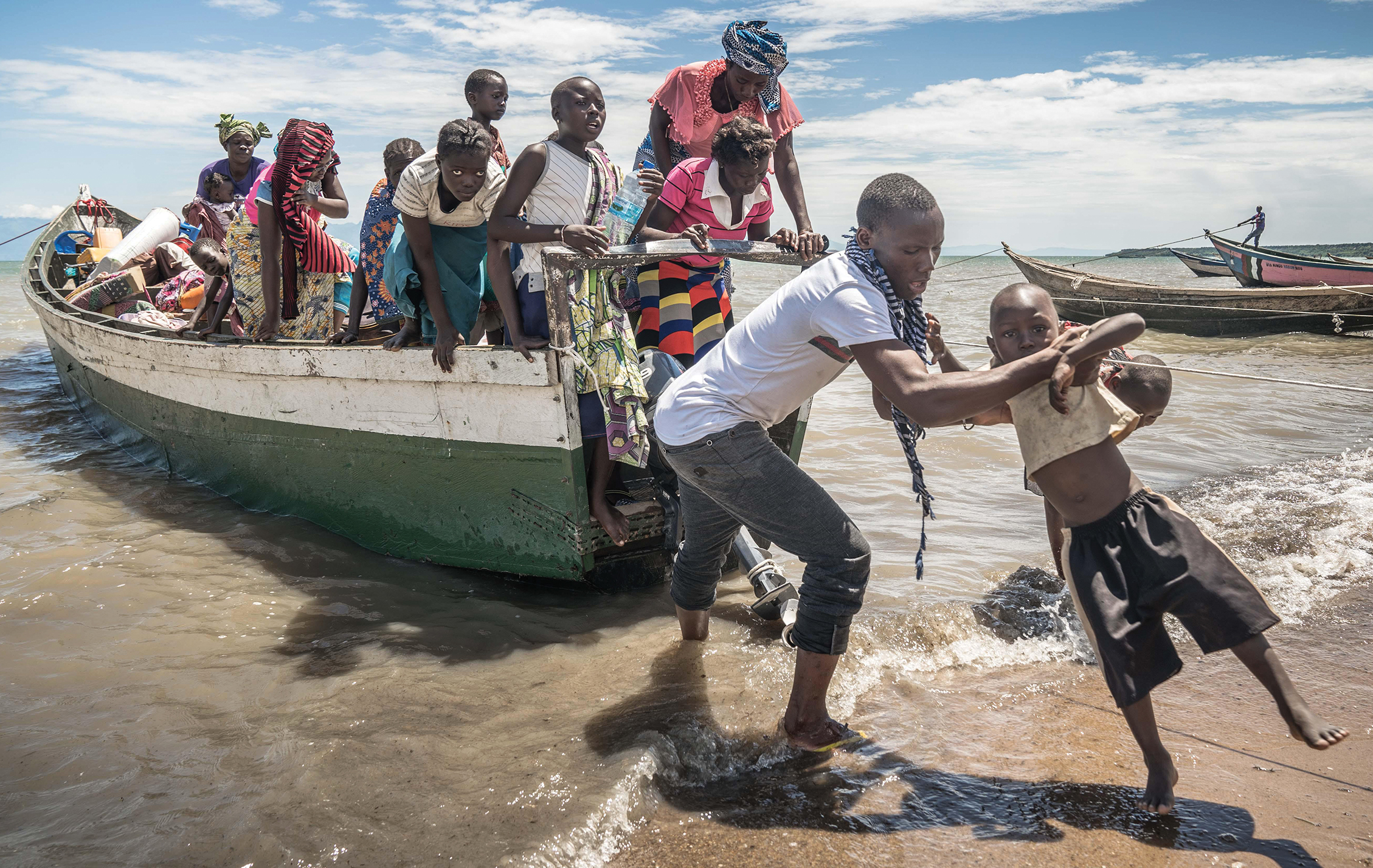
A small boat filled with Congolese refugees are waiting to get off the boat. A man standing on the shore is lifting a child off the boat and onto the beach.
Globalization has accelerated the movement of people within and between countries. Here, Congolese refugees arrive on the coast of Lake Albert in Uganda in 2018.
Increasing Migration A third characteristic of globalization is increasing migration, the accelerated movement of people both within and between countries. In fact, recent globalization has spurred the international migration of more than 258 million people, 51 million of them to the United States alone (see Chapter 13; United Nations Department of Economic and Social Affairs, Population Division 2020). An estimated 740 million more are internal migrants within their own countries, usually moving from rural to urban areas in search of work (International Organization for Migration 2022). The Chinese government counts 245 million internal migrants floating in China’s cities, drawn by construction projects, service jobs, and export-oriented factories (Chang 2017; Liang, Li, and Ma 2014).
In countries from Pakistan to Kenya to Peru, rural workers migrate to urban areas seeking to improve their lives and the lives of their families back home. This movement of people within and across national borders is stretching human relationships and interactions across space and time. Immigrants send money home, call and email friends and family, and sometimes even travel back and forth. Migration is building connections between distant parts of the world, replacing face-to-face interactions with more remote encounters and potentially reducing the hold of the local environment over people’s lives and imaginations.
Uneven Development Globalization is also characterized by uneven development. Although many people associate globalization with rapid economic development and progress, globalization has not brought equal benefits to the world’s people. Some travel the globe for business or pleasure; others are limited to more local forms of transportation. Although 3.9 billion people now have Internet access, the distribution is uneven. In developing countries, 3.5 billion people remain offline, representing more than half of their population. And only 19.5 percent of the 1 billion people living in the least-developed countries have Internet access. Europe, North America, and Asia account for the vast majority of high-tech consumption, while areas of Africa are marginalized and excluded from the globalization process (International Telecommunication Union 2018). Such uneven development and uneven access to the benefits of globalization reflect the negative side of changes in the world today.
More information
More information
THE SOCIAL LIFE OF THINGSThe Vanilla Bean
Our lives are entangled with things, what anthropologists refer to as “material culture.” Yet the stuff of our daily lives can become almost invisible—so common that we take it for granted. If we pay attention, however, stuff talks. Things have a biography and tell a story that often reveals a great deal about who we are as humans, what we value, how our cultures work, and, in a time of increasing globalization, how the world works. Let’s consider, for instance, what a vanilla bean can tell us about a local community in Madagascar through the work of anthropologist Sarah Osterhoudt (2017).
More information
A bowl of vanilla ice cream with vanilla beans next to the bowl.
1 Perhaps you associate vanilla with a bowl of ice cream or icing on a celebratory cake. Much of the world’s vanilla is produced by small-scale farmers in Madagascar. They associate vanilla with income, family, the land, and a connection to global markets.
More information
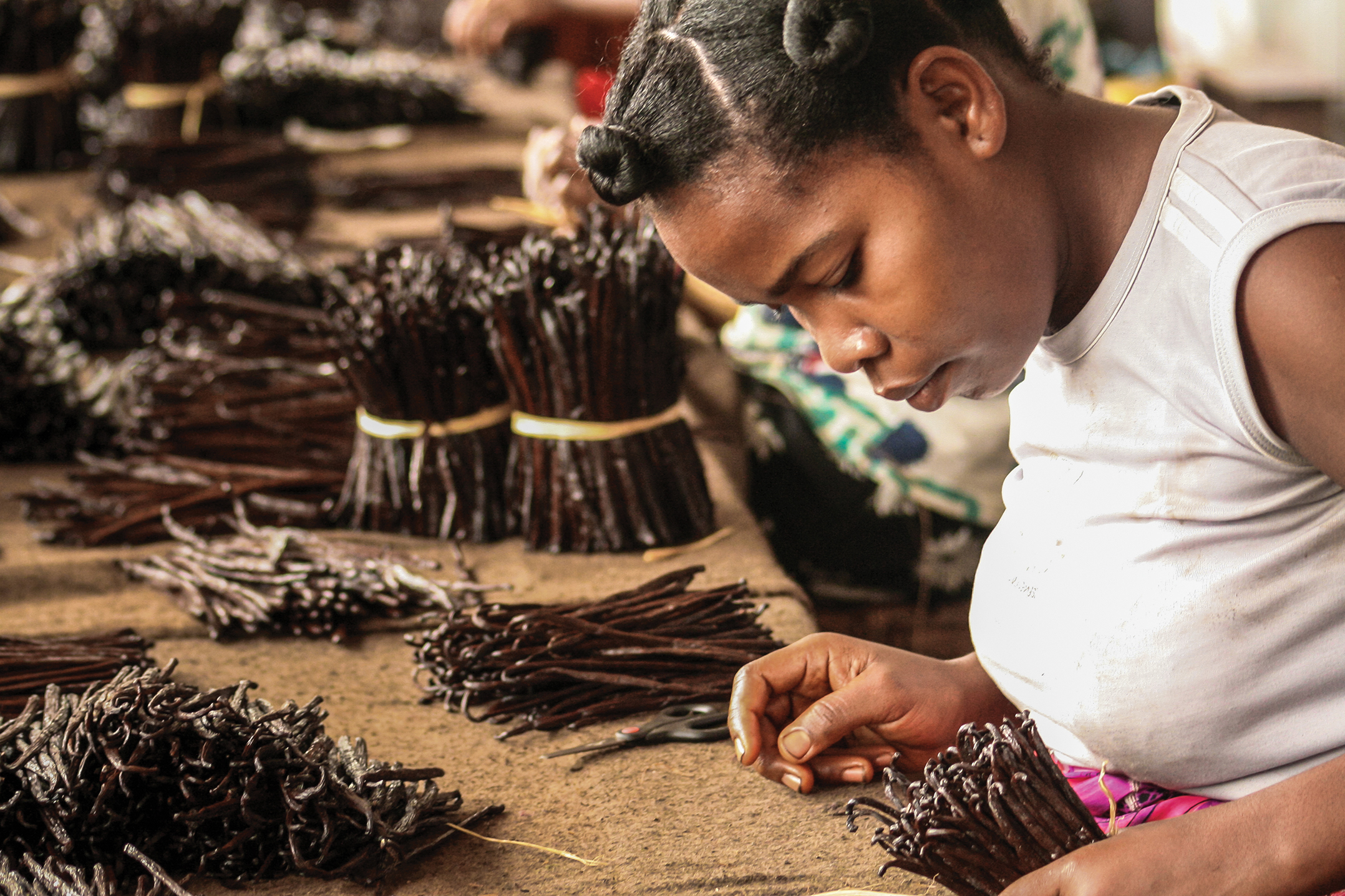
A woman leans over a table trimming and sorting vanilla beans.
2 Vanilla originated in Mexico and was transported to Madagascar by French colonialists. It grows as a vine, climbing up a tree or pole for support. Each of its flowers produces a pod, inside of which are thousands of black seeds. Farmers in Madagascar’s remote northeast coastal region, Imorona, engage in the labor-intensive work of cultivating, pollinating, and harvesting the vanilla, which ends up in the global marketplace.
More information
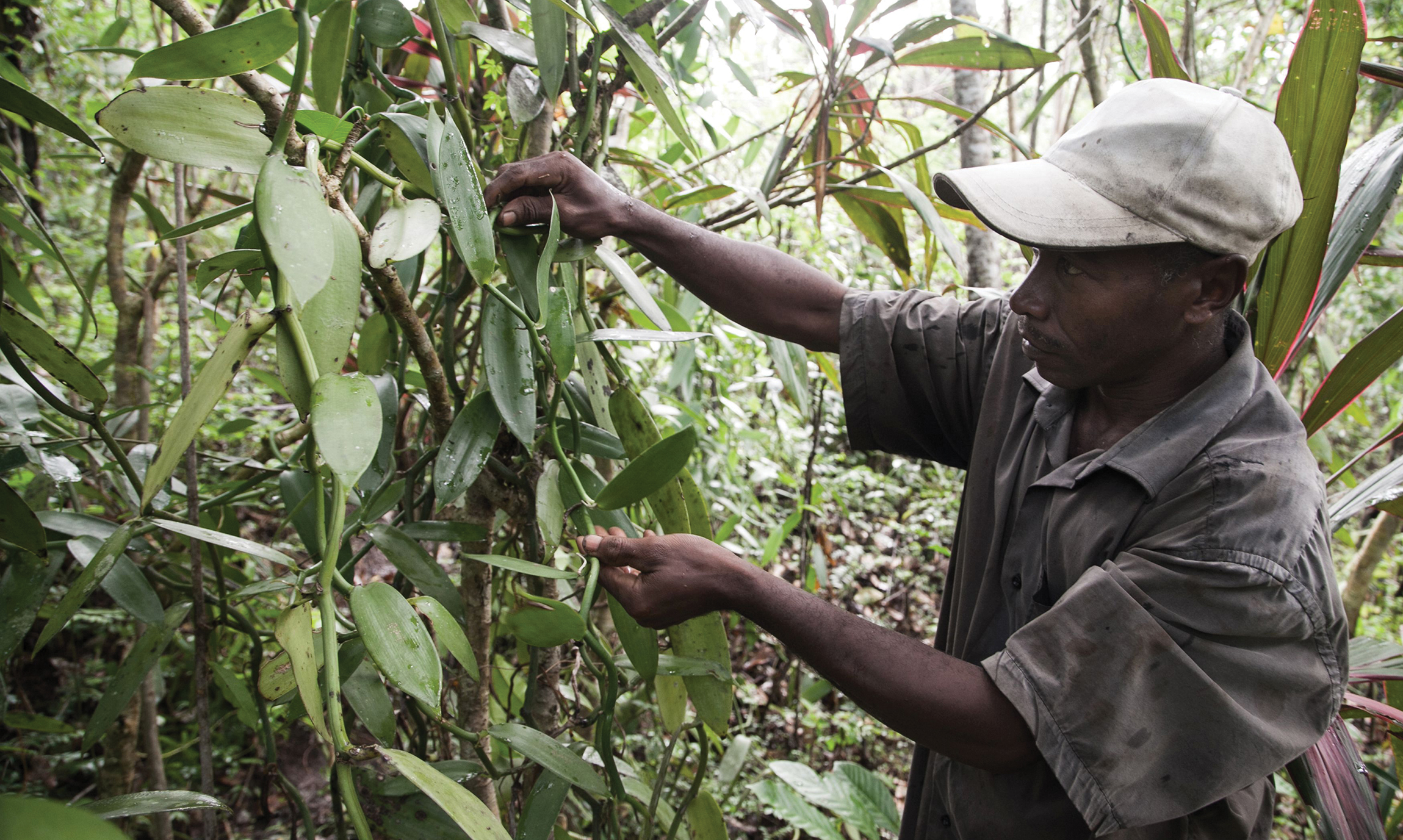
A man in a forest touches a vanilla plant.
3 Vanilla is more than a cash crop. Through their long-term, family-oriented agricultural practices, the farmers of Imorona have woven vanilla into a complex story of trees, vines, landscapes, family, and memory central to their culture. Trees are planted in memory of particular people. Family stories are linked to particular places. Landscapes become sources of happiness, connection, and meaning.
More information
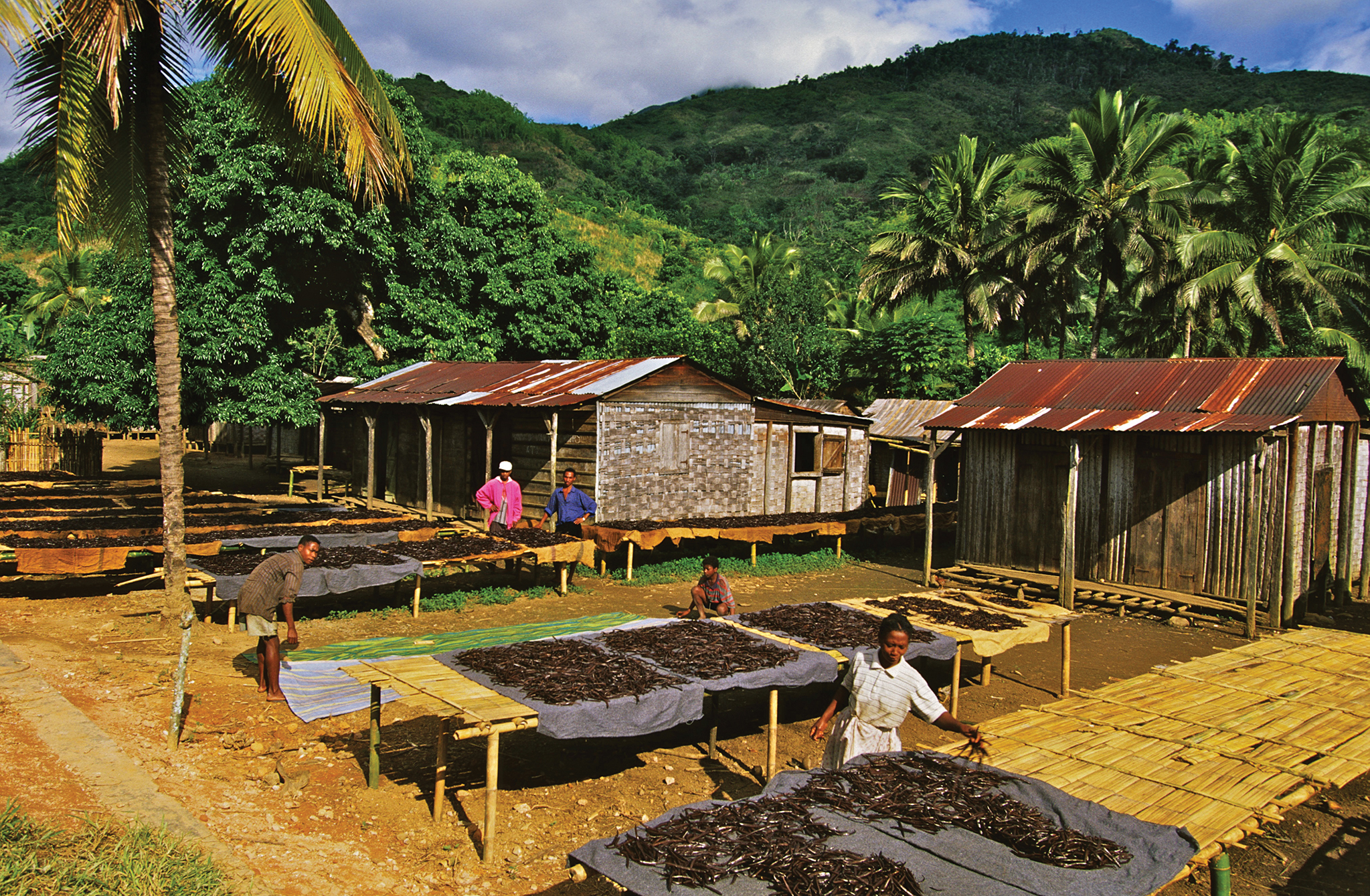
Vanilla beans are drying on towels and raised tables in front of small buildings with tin roofs.
4 Madagascar has suffered widespread deforestation and loss of biodiversity as global corporations systematically extract the country’s natural resources. Yet Imorona’s vanilla farmers have achieved remarkable success by using their existing local land management practices to maintain the area’s trees and biodiversity. They attribute their success to the power of culture, memories, and stories to create meaningful and sustainable relationships with the land. Still, development workers and environmental activists pressure Imorona’s farmers to adopt imported “sustainable solutions.”
More information
Bottles of pure vanillla extract in cardboard boxes in a store.
5 Increasing global demand has created a boom of vanilla cultivation in Madagascar. This has had significant effects on the culture, economy, and physical environment of the region’s small-scale vanilla farmers. Working with farmer cooperatives in Madagascar, anthropologist Sarah Osterhoudt is currently expanding her local research to explore strategies for establishing fairer and more equitable relations between vanilla farmers, global corporations, and vanilla consumers like us.
In recent years, anthropologists have developed an anthropology of stuff—or what we call “material culture.” After reviewing this feature, can you begin to see how exploring the social life of the vanilla bean can help you better understand not only the local life of vanilla farmers but also their connection to the global marketplace and even your daily life?
Can you apply this idea to another object with which you are familiar? Try the Your Turn exercise on p. 32 to see what tracing the social life of a cup of coffee might tell you about globalization.
Although the global economy is creating extreme wealth, it is also creating extreme poverty. Fully half of the world’s population continues to live in poverty. And nearly 700 million people live in extreme poverty, surviving on less than $1.90 each day (World Bank 2019). Even in the United States, the wealthiest country in the world, 38.3 million people, including 11.7 million children, experience food insecurity, a number that increased dramatically during the COVID-19 pandemic (United States Department of Agriculture 2020). In Chapter 11, we will explore the possibility that the rapid growth seen in globalization actually depends on uneven development—extracting the resources of some to fuel the success of others.
The rapid innovation of communication and transportation technologies associated with globalization that transforms the way people think about space (distances) and time.
The flexible strategies that corporations use to accumulate profits in an era of globalization, enabled by innovative communication and transportation technologies.