How Do Anthropologists Get Started Conducting Fieldwork?
Summarize the key fieldwork strategies, skills, and perspectives.
Today, cultural anthropologists call on a set of techniques designed to assess the complexity of human interactions and social organizations. You probably use some variation of these techniques as you go about daily life and make decisions for yourself and others. For a moment, imagine yourself doing fieldwork with Nancy Scheper-Hughes in the Brazilian shantytown of Alto do Cruzeiro. How would you prepare yourself? What strategies would you use? How would you analyze your data? What equipment would you need to conduct your research?
Preparation
Prior to beginning fieldwork, anthropologists go through an intense process of preparation, carefully assembling an anthropologist’s toolkit: all the information, perspectives, strategies, and even equipment that may be needed. We start by reading everything we can find about our research site and the particular issues we will be examining. This literature review provides a crucial background for the experiences to come. Following Malinowski’s recommendation, anthropologists also learn the language of their field site. The ability to speak the local language eliminates the need to work through interpreters and allows us to participate in the community’s everyday activities and conversations, which richly reflect local culture.
Before going to the field, anthropologists search out possible contacts: other scholars who have worked in the community, community leaders, government officials, perhaps even a host family. A specific research question or problem is defined and a research design created. Grant applications are submitted to seek financial support for the research. Permission to conduct the study is sought ahead of time from the local community and, where necessary, from appropriate government agencies. Protocols are developed to protect those who will be the focus of the research. Anthropologists attend to many of these logistical matters following a preliminary visit to the intended field site before fully engaging in the fieldwork process.
Finally, we assemble all the equipment needed to conduct our research. Today this aspect of your anthropologist’s toolkit—most likely a backpack—might include a notebook, pens, camera, voice recorder, maps, cell phone, batteries and chargers, dictionary, watch, and identification.
If you look back at the excerpt from Scheper-Hughes’s work on pp. 75–80, you can see evidence of some of these preparation strategies. Here’s how she developed her research question:
The questions I addressed first crystallized during a veritable “die-off” of Alto babies during a severe drought in 1965. . . . But that wasn’t what surprised me. . . . What puzzled me was the seeming indifference of Alto women to the death of their infants and their willingness to attribute to their own tiny offspring an aversion to life that made their death seem wholly natural.
Here she refers to work done in terms of a literature review:
Mothers stepped back and allowed nature to take its course. This pattern, which I call mortal selective neglect, is called passive infanticide by anthropologist Marvin Harris. The Alto situation . . . is not unique to Third World shantytown communities and may have its correlates in our own impoverished urban communities in some cases of “failure to thrive” infants.
ANTHROPOLOGISTS ENGAGE THE WORLD
More information
More information
Shannon SpeedExploring an Engaged, Activist Anthropology
Shannon Speed is a professor of anthropology and director of Native American and Indigenous Studies at the University of Texas at Austin who has conducted fieldwork in southern Mexico and the United States. Reflecting on her journey into anthropology, she credits the importance of fieldwork—and particularly an engaged, activist fieldwork—for helping her link her personal and political commitments to her scholarship and her work abroad to her work at home in the United States.
“I grew up as a Native American in the U.S. so I had an acute sense of the deeply egregious history of government behavior toward the native inhabitants of this land and then more broadly of the behavior of the state toward the Indigenous populations of other countries—questions of imperialism and human rights.
“I was drawn to cultural anthropology because it gave me the ability to look at what was happening to real people in the real world. I was drawn to ethnographic field methods as a way of approaching a topic by going out and living with and learning from the perspectives of the people I would be writing about, rather than seeking archival data. So field methods were important for me, as were the kinds of analytical approaches and understanding the not-always-obvious cultural and social dynamics that were shaping the forces of power and oppression.”
During graduate school, Speed, a Chickasaw tribal citizen, set out to study the role of mixed-heritage identity among Native Americans and what that meant for the Chickasaw Nation in particular. But a different opportunity quickly presented itself. In January 1994, a group of Indigenous people in the southern Mexican state of Chiapas occupied several cities in a dramatic uprising to demand that the Mexican government return their ancestral lands and protect their human rights. Moved by the creative and courageous struggles of Indigenous people in those areas for Indigenous rights, Indigenous identity, social justice, and women’s rights, Speed soon shifted her research to this Zapatista movement in Chiapas.
There, Speed conducted what she calls engaged, activist anthropology—a commitment to working with the local people in their struggles—as part of the fieldwork process. During her more than five years of fieldwork, Speed worked for two human rights organizations and engaged directly in human rights monitoring and advocacy in collaboration with the communities affected. “There are lots of reasons to engage in activist research,” Speed says. “In Chiapas the conflict was so intense that there was a clear sense from people that you are with us or against us. Who are you? Why should we trust you? You couldn’t just walk in there and start doing fieldwork. If you did, you wouldn’t get very far. You really needed to live there, be involved and be engaged in the issues in order to develop the relationships to understand anything. Otherwise nobody would trust you.”
More information
A portrait of Shannon Speed, a white woman with brown shoulder-length hair and bangs, wearing earrings and a teal top.
Anthropologist Shannon Speed
“Most anthropologists do participant observation, living there and engaging in their day-to-day activities. But an activist engagement takes on an additional level of intensity because you have shared political goals. And you develop a dual accountability. As anthropologists we certainly have a level of accountability to our field. But with an activist anthropology you’re making a commitment to be accountable also to the local people about your representations and interpretations. I think that ultimately makes for a better anthropology on an ethical basis. And it can also provide and produce new wisdom and knowledge. That kind of long-term approach in anthropology was very helpful to my work in Chiapas.”
Establishing rapport with people during fieldwork can be a complex process under any circumstance, but building relationships of trust in Chiapas proved particularly challenging, as many Indigenous people were wary of anthropology’s reputation, both in Mexico and globally, of working in tandem with European colonialism. “Anthropology can be a bad word for Indigenous people. And that was definitely the case in Chiapas. There is this history of anthropologists creating representations of Indigenous people that are not good for them. Because of the current conflict, people were distrustful of everyone generally. But they were particularly distrustful of anthropologists.”
“
”
With an activist anthropology you’re making a commitment to be accountable also to the local people about your representations and interpretations. I think that ultimately makes for a better anthropology.
Long-term fieldwork can be a mutually transformative experience, shaping the lives of both the anthropologist and those being studied. Speed notes the many ways in which her work with Indigenous people in Chiapas reshaped her teaching, research, and activism back home. Since her return, she has helped develop a Native American and Indigenous Studies Program at the University of Texas at Austin and has become increasingly active in helping to shape the work of a number of Native American councils and conferences.
Recently, she has become deeply involved in monitoring the human rights of Mexican and Central American immigrants held in U.S. detention centers in Austin, visiting Indigenous women and advocating for them.
Speed’s advocacy on behalf of detained immigrant women has included writing extensively about their stories, including numerous newspaper editorials questioning both the living conditions of the family detention centers and the morality of imprisoning women and children who are fleeing violence at home.
In reflecting on how anthropology can be transformative for undergraduates, Speed says, “Cultural anthropology, more than any other course, is going to allow you to stand outside of your cultural blinders and see the world in a different way. Potentially to understand yourself for the first time as part of the human family, instead of just as a member of one of the many subsets that sees itself in opposition to all of the other subsets. Once you take off your cultural blinders, you can begin to see that your way of thinking isn’t the only way to think about the world. That has the potential to transform everything in the way you view yourself in relation to the world around you.”
Strategies
Once in the field, anthropologists apply a variety of research strategies for gathering quantitative and qualitative data. Quantitative data include statistical information about a community—data that can be measured and compared, including details of population demographics and economic activity. Qualitative data include information that cannot be counted but may be even more significant for understanding the dynamics of a community. Qualitative data consist of personal stories and interviews, life histories, and general observations about daily life drawn from participant observation. Qualitative data enable the ethnographer to connect the dots and answer the questions of why people behave in certain ways or organize their lives in particular patterns.
Central to a cultural anthropologist’s research is participant observation. By participating in our subjects’ daily activities, we experience their lives from the perspective of an insider. Through participant observation over time, we establish rapport—relationships of trust and familiarity with members of the community we study. The deepening of that rapport through intense engagement enables the anthropologist to move from being an outsider toward being an insider. Over time in a community, anthropologists seek out people who will be our advisors, teachers, and guides—sometimes called key informants or cultural consultants. Key informants may suggest issues to explore, introduce community members to interview, provide feedback on research insights, and warn against cultural miscues. (Again, quoting from Scheper-Hughes: “Ze Antonio advised me to ignore Nailza’s odd behavior, which he understood as a kind of madness that, like the birth and death of children, came and went.”)
Another key research method is the interview. Anthropologists are constantly conducting interviews while in the field. Some interviews are very informal, essentially gathering data through everyday conversation. Other interviews are highly structured, closely following a set of questions. Semi-structured interviews use those questions as a framework but leave room for the interviewee to guide the conversation. One particular form of interview, a life history, traces the biography of a person over time, examining changes in the person’s life and illuminating the interlocking network of relationships in the community. Life histories provide insight into the frameworks of meaning that individuals build around their life experiences. Surveys can also be developed and administered to gather quantitative data on key issues and to reach a broader sample of participants, but rarely do they supersede participant observation and face-to-face interviews as the anthropologist’s primary strategy for data collection.
Anthropologists also map human relations. Kinship analysis enables us to explore the interlocking relationships of power built on family and marriage (see Chapter 9). In more urban areas where family networks are diffuse, a social network analysis may prove illuminating. One of the simplest ways to analyze a social network is to identify whom people turn to in times of need.
YOUR TURN: FIELDWORK
More information
More information
Mapping a Block
Develop your ethnographic skills of observation and description by drawing a map of a block or public space in your community and writing a narrative description of what you find.
Select an interesting location for your mapping project. You may choose to map a block defined as an area bounded on four sides by streets, as both sides of a single street (include the corners), or as the four corners of an intersection. Alternatively, you may choose to map an outdoor public space, such as a park or campus quadrangle, or an indoor space, such as a shopping mall or your college’s student center. In these cases, focus on what is inside the space or inside the building’s four walls.
Bring your anthropologist’s toolkit, and spend time in your chosen location. Take careful notes. Pay attention to details. Draw a map of what you see. For an outdoor space, note streets, buildings, businesses, residences, schools, hospitals, and infrastructure such as streetlights, sewers, telephone and electric lines, and satellite dishes, as well as transportation and pedestrian traffic. For an indoor space, note rooms, offices, businesses, hallways, entry and exit locations, public and private areas, lighting, sounds, and smells. Also note the people—their activities, movements, characteristics, gender, age, and race. Notice who or what is absent that you might have expected to find. Not all information presents itself immediately, so be patient. Consider taking photos or shooting video of your location as part of your data gathering and to supplement your hand-drawn map. Consider asking people to tell you about the space you are mapping from their perspective. To observe changes in your location, visit more than once. Vary the time of day or the day of the week. Write a description of the block, comparing the findings of your multiple visits.
If time permits, continue your mapping project by examining census data for your location. You can access U.S. census data by zip code at data.census.gov. Also consider searching local archives and databases to collect historical information about how your chosen location has changed over time. If appropriate, you might also ask local residents to share an anecdote about how the block has changed through the years.
When presenting your mapping project, consider supplementing your hand-drawn map and narrative description with photos, Google Earth images, film clips, and statistical data. Compare and analyze your maps with classmates. If you are working in a team, consider posting your research online to promote collaboration, integrate multiple media sources, and enhance your presentation.
Central to our data-gathering strategy, anthropologists write detailed field notes of our observations and reflections. These field notes take various forms. Some are elaborate descriptions of people, places, events, sounds, and smells. Others are reflections on patterns and themes that emerge, questions to be asked, and issues to be pursued. Some field notes are personal reflections on the experience of doing fieldwork—how it feels physically and emotionally to be engaged in the process. Although the rigorous recording of field notes may sometimes seem tedious, the collection of data over time allows the anthropologist to revisit details of earlier experiences, to compare information and impressions over time, and to analyze changes, trends, patterns, and themes.
More information
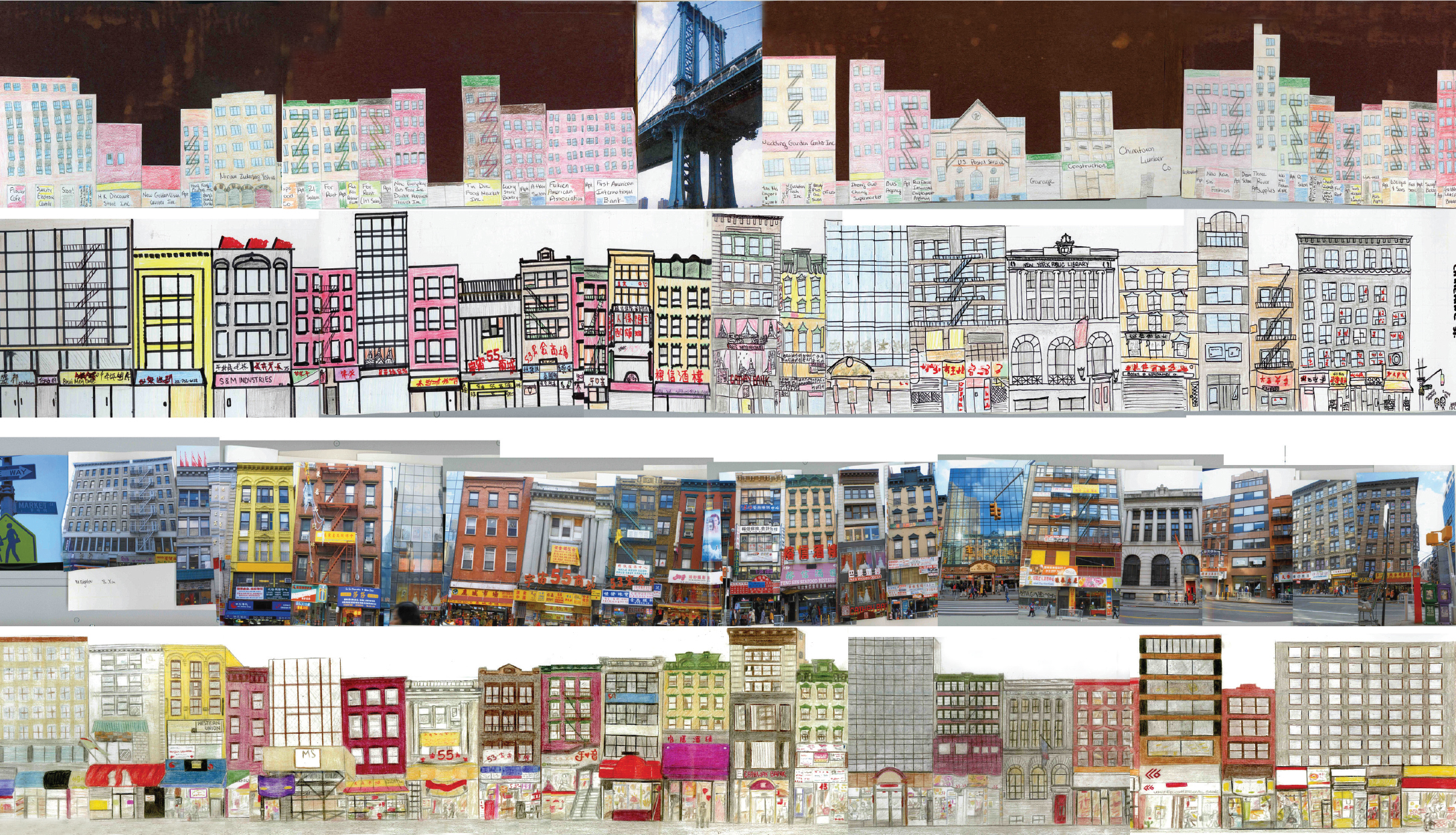
Four rows of artwork of building facades of a New York City street. In the top row, the buildings are colored with crayon, labeled in English, and cut out, and there’s a photo of the Manhattan Bridge in the middle. In the second row, the buildings are colored with pencil and most of them are labeled with Chinese characters. The third row includes photos of each individual building placed next to each other. The bottom row is colored with details of the contents of the ground floors of the businesses.
Student-made maps of blocks along East Broadway, a street on Manhattan’s Lower East Side that serves as both a gateway into the country and the economic hub for Chinese immigrants seeking a foothold in the United States today.
Sophisticated computer programs can assist in the organization and categorization of data about people, places, and institutions. But in the final analysis, the instincts and insights of the ethnographer are key to recognizing significant themes and patterns. Dedication to rigorous recording of field notes supports the process of thick description as defined by Clifford Geertz (see Chapter 2), in which detailed description affords deeper insights into the underlying meaning of words and actions.
Mapping
Often, one of the first steps an anthropologist takes upon entering a new community is to map the surroundings. Mapping takes many forms and produces many different products. While walking the streets of the field site, the ethnographer develops a spatial awareness of where people live, work, worship, play, and eat and of the space through which they move. After all, human culture exists in real physical space. And culture shapes how space is constructed and used. Likewise, physical surroundings influence human culture, shaping the boundaries of behavior and imagination. Careful observation and description, recorded in maps, field notes, audio and video recordings, and photographs, provide the material for deeper analysis of these community dynamics.
Urban ethnographers describe the power of the built environment to shape human life. Most humans live in a built environment, not one made up solely or primarily of nature. By focusing on the built environment—what we have built around us—scholars can analyze the intentional development of human settlements, neighborhoods, towns, and cities. Growth of the built environment is rarely random. Rather, it is guided by political and economic choices that determine funding for roads, public transportation, parks, schools, lighting, sewers, water systems, electrical grids, hospitals, police and fire stations, and other public services and infrastructure. Local governments establish and enforce tax and zoning regulations to control the construction of buildings and approved uses. Mapping the components of this built environment may shed light on key dynamics of power and influence in a community.
Anthropologists turn to quantitative data to map who is present in a community, including characteristics such as age, gender, family type, and employment status. This demographic data may be available through the local or national census, or, if the sample size is manageable, the anthropologist may choose to gather the data directly by surveying the community. To map historical change over time in an area and to discern its causes, anthropologists also turn to archives, newspaper databases, minutes and records of local organizations, historical photos, and personal descriptions, in addition to census data.
Mapping today may be aided by online tools such as satellite imagery, geographic information system devices and data, online archives, and electronic databases. All can be extremely helpful in establishing location, orientation, and, in the case of photo archives, changes over time. On their own, however, these tools do not provide the deep immersion sought by anthropologists conducting fieldwork. Instead, anthropologists place primary emphasis on careful, firsthand observation and documentation of physical space as a valuable strategy for understanding the day-to-day dynamics of cultural life.
Mapping may produce a tremendous variety of products. Hand-drawn maps reveal the intricate character of the built environment and force the ethnographer to be more conscious of details. Photos present a visual map as seen through the camera’s lens, a map that may be extremely valuable when writing up an ethnographic report and in creating a visual record of a particular place viewed at a particular time. Film captures moving images and sounds that may make the fieldwork site come alive for those who are unable to experience it firsthand. Blogs and wikis present opportunities to work collaboratively and publicly in the mapping process, creating open-source documents that can be regularly updated, enhanced, and engaged with by members of a research team or by members of the community under study.
Skills and Perspectives
Successful fieldwork requires a unique set of skills and perspectives that are hard to teach in the classroom. Ethnographers must begin with open-mindedness about the people and places they study. We must be wary of any prejudices we might have formed before our arrival, and we must be reluctant to judge once we are in the field. Boas’s notion of cultural relativism is an essential place to begin: Can we see the world through the eyes of the people we are studying? Can we understand their systems of meaning and internal logic? The tradition of anthropology suggests that cultural relativism must be the starting point if we are to accurately hear and retell the stories of others.
A successful ethnographer must also be a skilled listener. We spend a lot of time in conversation, but much of that time involves listening, not talking. The ability to ask good questions and to listen carefully to the responses is essential. A skilled listener hears both what is said and what is not said. Zeros are the elements of a story or a picture that are not told or seen—key details omitted from the conversation or key people absent from the room. Zeros offer insights into issues and topics that may be too sensitive to discuss or display publicly.
A good ethnographer must be patient, flexible, and open to the unexpected. Sometimes sitting still in one place is the best research strategy because it offers opportunities to observe and experience unplanned events and unexpected people. The overscheduled fieldworker can easily miss the mundane imponderabilia that constitute the richness of everyday life. For instance, I have a favorite tea shop in one Chinese village where I like to sit and wait to see what happens.
At times, the most important, illuminating conversations and interviews are not planned ahead of time. On a research trip to China, for example, I had hoped to better understand the Catholic Church in the area where I was doing fieldwork. I visited a number of parishes but realized that I really needed an interview with the bishop—the head of all Catholic churches in the region. Unable to arrange one through official channels, I decided to make one last visit to a large rural church before leaving China. As I climbed the hill from the town to the church, I met an old man sitting on the steps reading a book. I greeted him, and as we began to talk, his outer cloak fell back to reveal a large cross hanging around his neck. “Are you by any chance the bishop?” I asked. “Yes, my son,” he answered. “How may I help you?”
Patience and a commitment to conducting research over an extended period allow the ethnographic experience to come to us on its own terms, not on the schedule we assign to it. This is one of the significant differences between anthropology and journalism. It is also a hard lesson to learn and a hard skill to develop.
A final perspective essential for a successful ethnographer is openness to the possibility of mutual transformation in the fieldwork process. This is risky business because it exposes the personal component of anthropological research. It is clear that by participating in fieldwork, anthropologists alter—in ways large and small—the character of the community being studied. But if you ask them about their fieldwork experience, they will acknowledge that in the process they themselves become transformed on a very personal level—their self-understanding, their empathy for others, their worldviews. The practice of participant observation over time entails building deep relationships with people from another culture and directly engages the ethnographer in the life of the community.
Nancy Scheper-Hughes could not have returned unchanged by her research experience. The people of Alto do Cruzeiro would not let her simply observe their lives; they made her work with them to organize a neighborhood organization to address community problems. Indeed, the potential for the fieldworker to affect the local community is very great. So is the potential for the people being studied to transform the fieldworker.
Analysis
As the fieldwork experience proceeds, anthropologists regularly reflect on and analyze the trends, issues, themes, and patterns that emerge from their carefully collected data. One framework for analysis that we will examine in this book is power: Who has it? How do they get it and keep it? Who uses it, and why? Where is the money, and who controls it? The anthropologist Eric Wolf thought of culture as a mechanism for facilitating relationships of power—among families, genders, religions, classes, and political entities (1999). Good ethnographers constantly assess the relations of power in the communities they study.
Ethnographers also submit their local data and analysis to cross-cultural comparisons. We endeavor to begin from an emic perspective—that is, to understand the local community on its own terms. But the anthropological commitment to understanding human diversity and the complexity of human cultures also requires taking an etic perspective—viewing the local community from the anthropologist’s perspective as an outsider. This provides a foundation for comparison with other relevant case studies. The overarching process of comparison and assessment, called ethnology, uses the wealth of anthropological studies to compare the activities, trends, and patterns of power across cultures. The process enables us to better see what is unique in a particular context and how it contributes to identifying larger patterns of cultural beliefs and practices. Perhaps the largest effort to facilitate worldwide comparative studies is the Human Relations Area Files at Yale University (http://hraf.yale.edu/), which has been building a database of ethnographic material since 1949 to encourage cross-cultural analysis.
A community member who advises the anthropologist on community issues, provides feedback, and warns against cultural miscues. Also called cultural consultant.
A form of interview that traces the biography of a person over time, examining changes in the person’s life and illuminating the interlocking network of relationships in the community.
Elements of a story or a picture that are not told or seen and yet offer key insights into issues that might be too sensitive to discuss or display publicly.