A young mother holding her toddler in her arms. They are standing in a dimly lit shack made from old wooden boards.
Anthropologist Nancy Scheper-Hughes researched survival strategies of mothers and children in a Brazilian shantytown.
Learning Objectives
I have seen death without weeping,
The destiny of the Northeast is death,
Cattle they kill,
To the people they do
Something worse
—Anonymous Brazilian singer (1965)
Over many years, anthropologist Nancy Scheper-Hughes invested herself in trying to understand the lives of the women and children of one particular shantytown in Brazil. Her research resulted in numerous articles and an award-winning ethnography, Death Without Weeping: The Violence of Everyday Life in Brazil (1992). Scheper-Hughes’s efforts reflect the deep commitment of anthropologists to ethnographic fieldwork—a research strategy for understanding the world through intense interaction with a local community of people over an extended period. Here is a particularly moving excerpt from her fieldwork experience:
“Why do the church bells ring so often?” I asked Nailza de Arruda soon after I moved into a corner of her tiny mud-walled hut near the top of the shantytown called the Alto do Cruzeiro (Crucifix Hill). I was then a Peace Corps volunteer and community development/health worker. It was the dry and blazing hot summer of 1965, the months following the military coup in Brazil, and save for the rusty, clanging bells of N. S. das Dores church, an eerie quiet had settled over the market town that I call Bom Jesus da Mata. Beneath the quiet, however, there was chaos and panic. “It’s nothing,” replied Nailza, “just another little angel gone to heaven.”
Nailza had sent more than her share of little angels to heaven, and sometimes at night I could hear her engaged in a muffled but passionate discourse with one of them, two-year-old Joana. Joana’s photograph, taken as she lay propped up in her tiny cardboard coffin, her eyes open, hung on a wall next to one of Nailza and Ze Antonio taken on the day they eloped.
More information
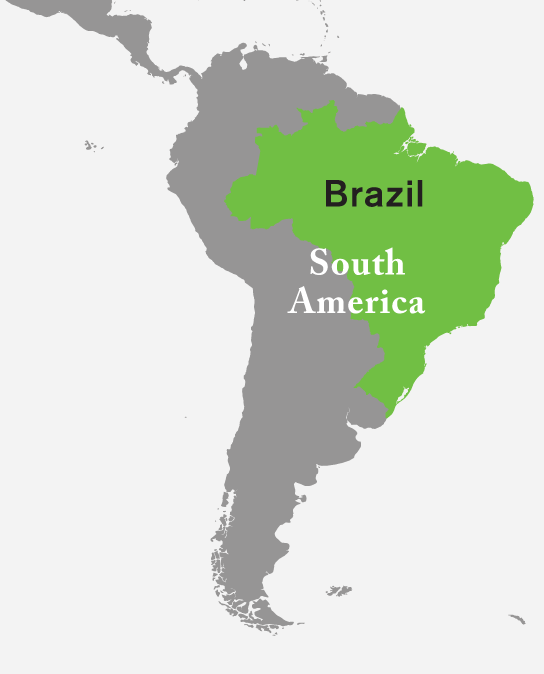
South America is labeled. Brazil is highlighted and labeled.
MAP 3.1
Brazil
Nailza could barely remember the other infants and babies who came and went in close succession. Most had died unnamed and were hastily baptized in their coffins. Few lived more than a month or two. Only Joana, properly baptized in church at the close of her first year and placed under the protection of a powerful saint, Joan of Arc, had been expected to live. And Nailza had dangerously allowed herself to love the little girl.
In addressing the dead child, Nailza’s voice would range from tearful imploring to angry recrimination: “Why did you leave me? Was your patron saint so greedy that she could not allow me one child on this earth?” Ze Antonio advised me to ignore Nailza’s odd behavior which he understood as a kind of madness that, like the birth and death of children, came and went. Indeed the premature birth of a stillborn son some months later “cured” Nailza of her “inappropriate” grief, and the day came when she removed Joana’s photo and carefully packed it away.
More than fifteen years elapsed before I returned to the Alto do Cruzeiro, and it was anthropology that provided the vehicle of my return. Since 1982 I have returned several times in order to pursue a problem that first attracted my attention in the 1960s. My involvement with the people of the Alto do Cruzeiro now spans a quarter of a century and three generations of parenting in a community where mothers and daughters are often simultaneously pregnant.
More information
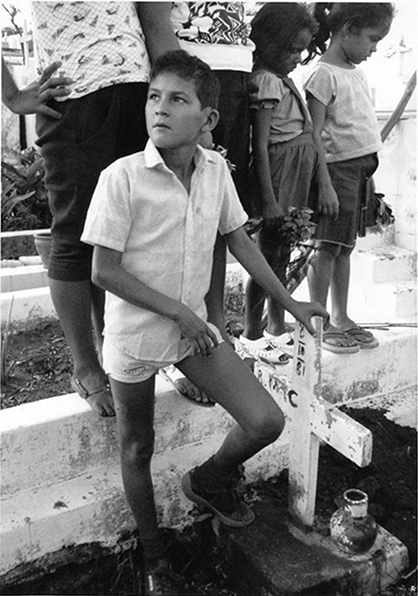
A black and white image of a young boy standing with his hands placed on a wooden cross marking a grave. There are two other people and two little girls standing behind him.
Burial of an infant in the Alto do Cruzeiro favela in northeast Brazil. How did anthropologist Nancy Scheper-Hughes make sense of the “death without weeping” that she found in this poor community?
The Alto do Cruzeiro is one of three shantytowns surrounding the large market town of Bom Jesus in the sugar plantation zone of Pernambuco in Northeast Brazil, one of the many zones of neglect that have emerged in the shadow of the now tarnished economic miracle of Brazil. For the women and children of the Alto do Cruzeiro the only miracle is that some of them have managed to stay alive at all. . . .
My research agenda never wavered. The questions I addressed first crystallized during a veritable “die-off” of Alto babies during a severe drought in 1965. The food and water shortages and the political and economic chaos occasioned by the military coup were reflected in the handwritten entries of births and deaths in the dusty, yellowed pages of the ledger books kept at the public registry office in Bom Jesus. More than 350 babies died in the Alto during 1965 alone—this from a shantytown population of little more than 5,000. But that wasn’t what surprised me. There were reasons enough for the deaths in the miserable conditions of shantytown life. What puzzled me was the seeming indifference of Alto women to the death of their infants and their willingness to attribute to their own tiny offspring an aversion to life that made their death seem wholly natural, indeed all but anticipated.
Although I found that it was possible, and hardly difficult, to rescue infants and toddlers from death by diarrhea and dehydration with a simple sugar, salt, and water solution (even bottled Coca-Cola worked fine), it was more difficult to enlist a mother herself in the rescue of a child she perceived as ill-fated for life or better off dead, or to convince her to take back into her threatened and besieged home a baby she had already come to think of as an angel rather than as a son or daughter.
I learned that the high expectancy of death, and the ability to face child death with stoicism and equanimity, produced patterns of nurturing that differentiated between those infants thought of as thrivers and survivors and those thought of as born already “wanting to die.” The survivors were nurtured, while stigmatized, doomed infants were left to die, as mothers say, a mingua, “of neglect.” Mothers stepped back and allowed nature to take its course. This pattern, which I call mortal selective neglect, is called passive infanticide by anthropologist Marvin Harris. The Alto situation, although culturally specific in the form that it takes, is not unique to Third World shantytown communities and may have its correlates in our own impoverished urban communities in some cases of “failure to thrive” infants. . . .
Part of learning how to mother in the Alto do Cruzeiro is learning when to let go of a child who shows that it “wants” to die or that it has no “knack” or no “taste” for life. Another part is learning when it is safe to let oneself love a child. Frequent child death remains a powerful shaper of maternal thinking and practice. In the absence of firm expectation that a child will survive, mother love as we conceptualize it (whether in popular terms or in the psychobiological notion of maternal bonding) is attenuated and delayed with consequences for infant survival. In an environment already precarious to young life, the emotional detachment of mothers toward some of their babies contributes even further to the spiral of high mortality–high fertility in a kind of macabre lock-step dance of death. . . .
What, then, can be said of these women? What emotions, what sentiments motivate them? How are they able to do what, in fact, must be done? What does mother love mean in this inhospitable context? Are grief, mourning, and melancholia present, although deeply repressed? If so, where shall we look for them? And if not, how are we to understand the moral visions and moral sensibilities that guide their actions?
I have been criticized more than once for presenting an unflattering portrait of poor Brazilian women, women who are, after all, themselves the victims of severe social and institutional neglect. I have described these women as allowing some of their children to die, as if this were an unnatural and inhuman action rather than, as I would assert, the way any one of us might act, reasonably and rationally, under similarly desperate conditions. Perhaps I have not emphasized enough the real pathogens in this environment of high risk: poverty, deprivation, sexism, chronic hunger, and economic exploitation. If mother love is, as many psychologists and some feminists believe, a seemingly natural and universal maternal script, what does it mean to women for whom scarcity, loss, sickness, and deprivation have made that love frantic and robbed them of their grief, seeming to turn hearts to stone? . . .
Life in the Alto do Cruzeiro resembles nothing so much as a battlefield or an emergency room in an overcrowded inner-city public hospital. Consequently, mortality is guided by a kind of “life-boat ethics,” the morality of triage. The seemingly studied indifference toward the suffering of some of their infants, conveyed in such sayings as “little critters have no feelings,” is understandable in light of these women’s obligation to carry on with their reproductive and nurturing lives.
In their slowness to anthropomorphize and personalize their infants, everything is mobilized so as to prevent maternal overattachment and, therefore, grief at death. The bereaved mother is told not to cry, that her tears will dampen the wings of her little angel so that she cannot fly up to her heavenly home. Grief at the death of an angel is not only inappropriate, it is a symptom of madness and of a profound lack of faith. (Scheper-Hughes 1989, 8ff)
What did you learn about fieldwork by reading this story? Scheper-Hughes, a middle-class woman from the United States, traveled to one of the poorest places in the world, learned the language, lived in the community, built relationships of trust, accompanied local people through the births and deaths of their children, and searched for meaning amid the pain. As you might imagine from the reading, the fieldwork experience can become more than a strategy for understanding human culture. Fieldwork has the potential to radically transform the anthropologist. Can you imagine making the same commitment Scheper-Hughes did?
The term fieldwork implies going out to “the field” to do extensive research. Although in the history of anthropology this has often meant going a long way from home, as Scheper-Hughes did, contemporary anthropologists also study human culture and activities in their own countries and local contexts. By exploring the practice of fieldwork, you will gain a deeper understanding of how anthropologists go about their work. In particular, in this chapter we will consider:
By the end of the chapter, you will see both how professional anthropologists employ fieldwork strategies and how fieldwork can provide a valuable toolkit for gathering information to make decisions in your own life. Fieldwork skills and strategies can help you navigate the many unfamiliar or cross-cultural experiences you will encounter at work or school, in your neighborhood, or in your family. And hopefully you will see how key fieldwork strategies can help you become a more engaged and responsible citizen of the world.