Biologists estimate that there may be as many as 100 million distinct species of living things on our planet—organisms as different as a dolphin and a rose or a bacterium and a butterfly. Cells, too, differ vastly in form and function. Animal cells differ from those in a plant, and even cells within a single multicellular organism can differ wildly in appearance and activity. Yet despite these differences, all cells share a fundamental chemistry and other common features.
In this section, we take stock of some of the similarities and differences among cells, and we discuss how all present-day cells appear to have evolved from a common ancestral cell.
Cells Vary Enormously in Appearance and Function
When comparing one cell and another, one of the most obvious places to start is with size. A bacterial cell—say a Lactobacillus in a piece of cheese—is a few micrometers, or μm, in length. That’s about 25 times smaller than the width of a human hair. A frog egg, on the other hand, has a diameter of about 1 millimeter (mm). If we scaled them up to make the Lactobacillus the size of a person, the frog egg would be half a mile long. In fact, the eggs of most animals are giant, single cells that contain a stockpile of nutrients that can support the growth of the embryo until it hatches. A chicken egg is measured in centimeters—and the egg of an ostrich is more than 20 times that size.
Cells vary just as widely in their shape (Figure 1–1). A typical nerve cell in your brain, for example, is enormously extended: it sends out its electrical signals along a single, fine protrusion (an axon) that is 10,000 times longer than it is thick, and the cell receives signals from other nerve cells through a collection of shorter extensions that sprout from its body like the branches of a tree (Figure 1–1A). A pond-dwelling Paramecium, on the other hand, is shaped like a submarine and is covered with thousands of cilia—hairlike projections whose sinuous, coordinated beating sweeps the cell forward, rotating as it goes (Figure 1–1B). A cell in the surface layer of a plant is squat and immobile, surrounded by a rigid box of cellulose with an outer waterproof coating of wax (Figure 1–1C). A macrophage in the body of an animal, by contrast, crawls through tissues, constantly pouring itself into new shapes, as it searches for and engulfs debris, foreign microorganisms, and dead or dying cells (Figure 1–1D). A fission yeast is shaped like a rod (Figure 1–1E), whereas a budding yeast is delightfully spherical (see Figure 1–16). And so on.
More information
Five micrographs labeled A to E show cells of differing shapes and sizes.
Micrograph A: A nerve cell from a mammalian brain. The image shows a slender extension with branched projections at the bottom. The scale reads 100 micrometers.
Micrograph B: A protozoan named Paramecium. The structure is ovoid in shape with the body surface covered with cilia. The scale reads 25 micrometers.
Micrograph C: The surface of a flower petal from a snapdragon. The array of cells is closely packed. The cells have striations. The scale reads 25 micrometers.
Micrograph D: A macrophage. The image shows a thickened central mass that spreads out into a thin layer. The scale reads 5 micrometers.
Micrograph E: A Fission yeast. The image shows a cylindrical rod-shaped cell that is divided into two sections, with a circular middle septum. Each part has a highly pigmented region in the center. The scale reads 3 micrometers.
Figure 1–1Cells come in a variety of shapes and sizes. (A) Drawing of a single nerve cell from a mammalian brain. This cell has a single, unbranched extension (axon), projecting toward the top of the image, through which it sends electrical signals to other nerve cells, and it possesses a huge branching tree of projections (dendrites) through which it receives signals from as many as 100,000 other nerve cells. (B) Paramecium. This protozoan—a single giant cell—swims by means of the beating cilia that cover its surface. (C) The surface of a snapdragon flower petal displays an orderly array of tightly packed cells. (D) A macrophage spreads itself out as it patrols animal tissues in search of invading microorganisms. (E) A fission yeast is caught in the act of dividing in two. The medial septum (stained red with a fluorescent dye) is forming a wall between the two nuclei (also stained red ) that have been separated into the two daughter cells; in this image, the cells’ membranes are stained in patches with a green fluorescent dye. Note that the micrographs have different scales: the nerve cell, with its sprawling extensions, is 100 times wider than the fission yeast. (A, courtesy of Herederos de Santiago Ramón y Cajal, 1899; B, courtesy of Anne Fleury, Michel Laurent, and André Adoutte; C, courtesy of Kim Findlay; D, from P.J. Hanley et al., Proc. Natl. Acad. Sci. USA 107:12145–12150, 2010. With permission from the National Academy of Sciences; E, courtesy of Janos Demeter and Shelley Sazer.)
Cells are also enormously diverse in their chemical requirements. Some require oxygen to live; for others the gas is deadly. Some cells consume little more than carbon dioxide (CO2), sunlight, and water as their raw materials; others need a complex mixture of molecules produced by other cells.
In multicellular organisms, these differences in size, shape, and chemical requirements almost always reflect differences in cell function. Some cells operate as factories optimized for the production of particular substances, such as hormones, starch, fat, latex, or pigments. Others, like muscle cells, are engines that burn fuel to do mechanical work. Some cells can even generate an electric current, like the stunningly specialized “electrocytes” of the electric eel.
QUESTION 1–1
“Life” is easy to recognize but difficult to define. According to one popular biology text, living things:
Are highly organized compared to natural inanimate objects.
Display homeostasis, maintaining a relatively constant internal environment.
Reproduce themselves.
Grow and develop from simple beginnings.
Take energy and matter from the environment and transform it.
Respond to stimuli.
Show adaptation to their environment.
Score a person, a smartphone, and a potato with respect to these characteristics.
Some cells become so specialized that they cease to proliferate, thus producing no descendants. Such a fate would be senseless for cells that live a solitary life. In a multicellular organism, however, there is a division of labor among cells, allowing some cells to become specialized to an extreme degree for particular tasks and leaving them dependent on their fellow cells for many basic requirements. Even the most basic need of all, that of passing on the genetic instructions of the organism to the next generation, is delegated to specialists: the egg and the sperm.
Living Cells All Have a Similar Basic Chemistry
Despite the extraordinary diversity of plants and animals, people have recognized from time immemorial that these organisms have something in common, something that entitles them all to be called living things. But while it seemed easy enough to recognize life, it was remarkably difficult to say in what sense all living things were alike. Textbooks had to settle for defining life in abstract general terms related to growth, reproduction, and an ability to actively alter behavior in response to the environment.
More information
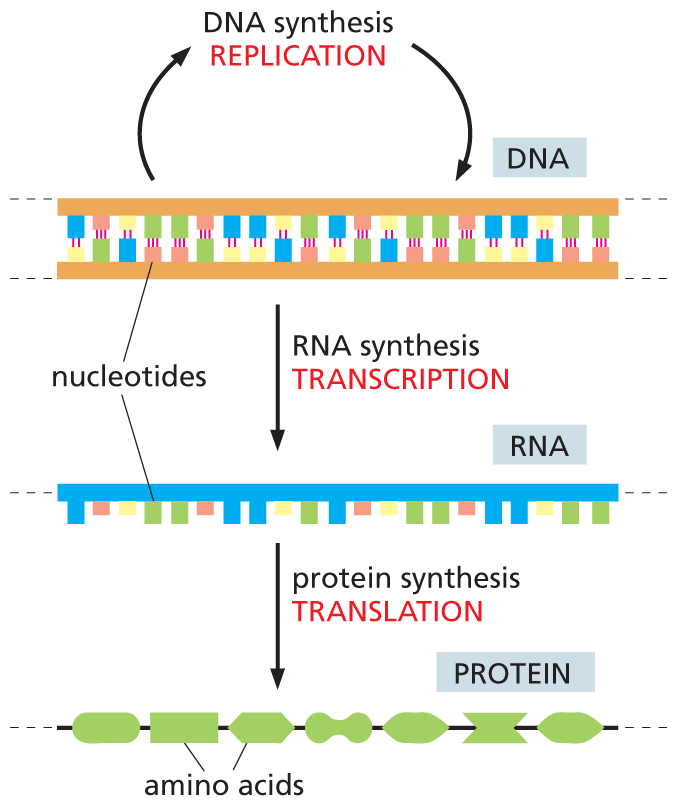
An illustration shows D N A synthesis, R N A synthesis, and protein synthesis. A schematic shows a D N A double strand with pairs of nucleotides arranged between the two strands. Two circular arrows indicate D N A synthesis also called Replication. D N A synthesis is followed by R N A synthesis also called transcription. A schematic shows a R N A strand. R N A synthesis is followed by protein synthesis also called translation. The leads to a protein chain, with amino acids labeled.
Figure 1–2In all living cells, genetic information flows from DNA to RNA (transcription) and from RNA to protein (translation)—a hierarchy known as the central dogma. The sequence of nucleotides in a particular segment of DNA (a gene) is transcribed into an RNA molecule, which can then be translated into the linear sequence of amino acids of a protein. Only a small part of the gene, RNA, and protein is shown.
A profound yet elegant solution to this awkward situation has been provided by discoveries in the fields of biochemistry and molecular biology. Although the cells of all living things are enormously varied when viewed from the outside, they are fundamentally similar inside. We now know that cells resemble one another to an astonishing degree in the details of their chemistry. They are composed of the same sorts of molecules, which participate in the same types of chemical reactions (discussed in Chapter 2). In all organisms, genetic information—in the form of genes—is carried in DNA molecules. This information is written in the same chemical code, constructed out of the same chemical building blocks, interpreted by essentially the same chemical machinery, and replicated in the same way when a cell or organism reproduces. Thus, in every cell, long polymer chains of DNA are made from the same set of four monomers, called nucleotides, strung together in different sequences like the letters of an alphabet. The information encoded in these DNA molecules is read out, or transcribed, into a related set of polynucleotides called RNA. Although some of these RNA molecules have their own regulatory, structural, or chemical activities, most are translated into a different type of polymer called a protein. This flow of information—from DNA to RNA to protein—is so fundamental to life that it is referred to as the central dogma (Figure 1–2).
At the same time, the appearance and behavior of a cell are dictated largely by its protein molecules, which serve as structural supports, chemical catalysts, molecular motors, and much more. Proteins are built from amino acids, and all organisms use the same set of 20 amino acids to make their proteins. But the amino acids are linked in different sequences, giving each type of protein molecule a different three-dimensional shape, or conformation, just as different sequences of letters spell different words. In this way, the same basic biochemical machinery supports and serves the full gamut of life on Earth (Figure 1–3).
More information
A micrograph of rod shaped bacteria clustered together. The dimensions of each bacteria are approximately 1 micrometer by 2 micrometers.
More information
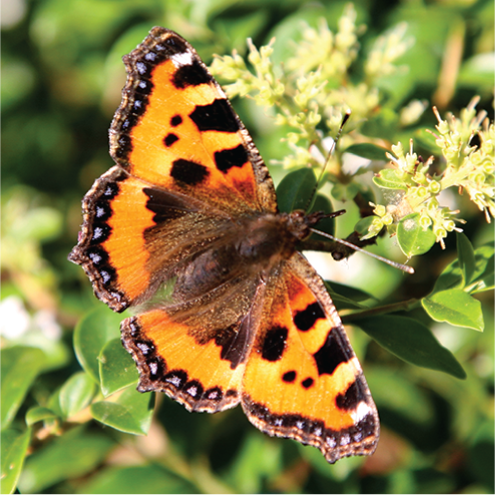
A photo of an orange and black butterfly resting on a plant.
(B)More information
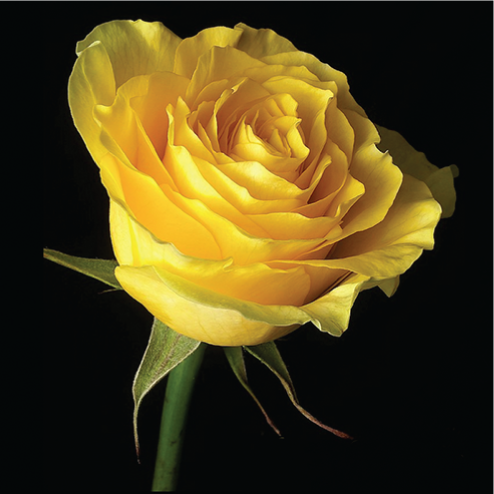
A photo of a yellow rose with the blossom partially open.
(C)More information
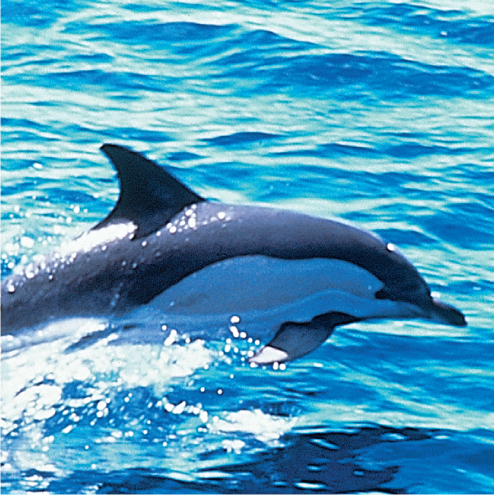
A photo of a dolphin jumping out of the ocean as it swims.
(D)Figure 1–3All living organisms are constructed from cells. (A) A colony of bacteria, (B) a butterfly, (C) a rose, and (D) a dolphin are all made of cells that have a fundamentally similar chemistry and operate according to the same basic principles. (A, courtesy of Janice Carr; D, courtesy of Jonathan Gordon, IFAW.)
Living Cells Are Self-replicating Collections of Catalysts
One of the most commonly cited properties of living things is their ability to reproduce. For cells, the process involves duplicating their genetic material and other components and then dividing in two—producing a pair of daughter cells that are themselves capable of undergoing the same cycle of replication.
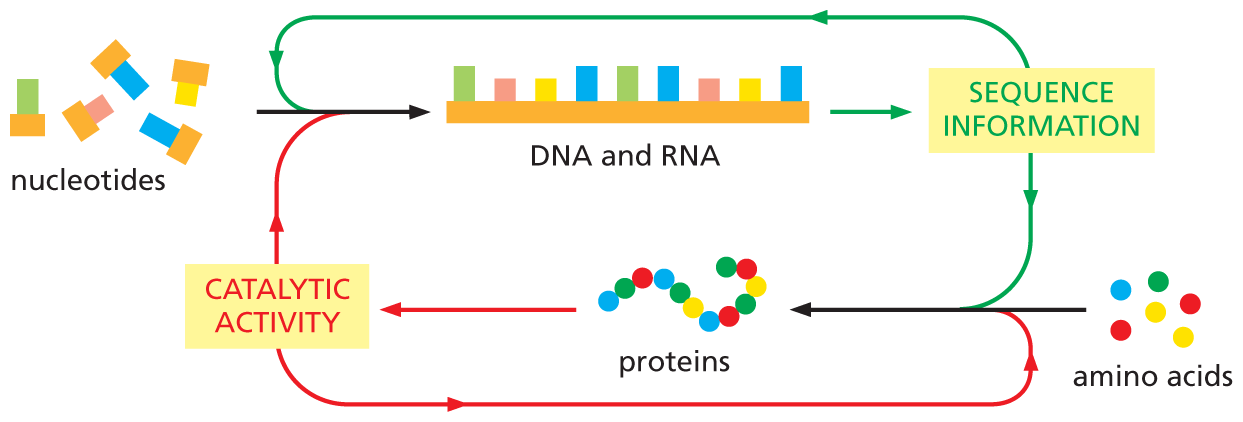
It is the special relationship between DNA, RNA, and proteins—reflected in the central dogma (see Figure 1–2)—that makes this self-replication possible. DNA encodes information that ultimately directs the assembly of proteins: the sequence of nucleotides in a molecule of DNA dictates the sequence of amino acids in a protein. Proteins, in turn, catalyze the replication of DNA and its transcription into RNA, and they participate in the translation of RNA into proteins. This feedback loop between proteins and polynucleotides underlies the self-reproducing behavior of living things (Figure 1–4). We discuss this complex interdependence between DNA, RNA, and proteins in detail in Chapters 5 through 8.
More information
A feedback loop explains the inter-relationship between D N A and R N A versus proteins. D N A and R N A provide sequence information that converts amino acids into proteins and binds the nucleotides to the D N A and R N A strands. Proteins in turn trigger the catalytic activity that enables R N A and D N A synthesis from nucleotides.
Figure 1–4Life is an autocatalytic process. DNA and RNA provide the sequence information (green arrows) that is used to produce proteins and to copy themselves. Proteins, in turn, provide the catalytic activity (red arrows) needed to synthesize DNA, RNA, and themselves. Black arrows represent the biochemical processes by which new DNA, RNA, and proteins are manufactured in cells. Together, these feedback loops create the self-replicating system that endows living cells with their ability to reproduce.
In addition to their roles in polynucleotide and protein synthesis, proteins also catalyze the many other chemical reactions that keep the self-replicating system shown in Figure 1–4 running. A living cell can break down nutrients and use the products both to make the building blocks needed to produce polynucleotides, proteins, and other cell constituents and to generate the energy needed to power these biosynthetic processes. We discuss these vital metabolic reactions in detail in Chapters 3 and 13.
Only living cells can perform these astonishing feats of self-replication. Viruses, which are little more than DNA or RNA wrapped in a protective coat, do not have the ability to reproduce by their own efforts. Instead, they parasitize the reproductive machinery of the cells that they invade to make copies of themselves. Without a host cell to aid them, viruses are inert and, therefore, are not generally considered to be living. Unfortunately for us, these genetic zombies are not entirely harmless: once viruses gain entry, they can exert a malign influence over a cell—or an organism, as demonstrated by the coronavirus responsible for the COVID-19 pandemic (discussed later in this chapter and in Chapter 9).
All Living Cells Have Apparently Evolved from the Same Ancestral Cell
When a cell replicates its DNA in preparation for cell division, the copying is not always perfect. On occasion, the instructions are misread or become damaged by mutations that change the sequence of nucleotides in the DNA. For this reason, daughter cells are not necessarily exact replicas of their parent.
Mutations can create offspring that are changed for the worse (in that they are less able to survive and reproduce), changed for the better (in that they are better able to survive and reproduce), or changed in a neutral way (in that they are genetically different but equally viable). The struggle for survival eliminates the first, favors the second, and tolerates the third. The genes of the next generation will be the genes of the survivors.
QUESTION 1–2
Mutations are mistakes in the DNA that change the genetic plan from that of the previous generation. Imagine a shoe factory. Would you expect mistakes (i.e., unintentional changes) in copying the shoe design to lead to improvements in the shoes produced? Explain your answer.
For many organisms, the pattern of heredity is further complicated by sexual reproduction, in which two cells of the same species fuse, pooling their DNA. In the process, the genes from each parent are combined and then distributed in new combinations to the next generation, to be tested again for their ability to promote survival and reproduction. We discuss the mechanism of this genetic shuffling in Chapter 19.
These simple principles of genetic change and selection, applied repeatedly over billions of cell generations, are the basis of evolution—the process by which living species become gradually modified and adapted to their environment in more and more sophisticated ways. Evolution offers a startling but compelling explanation of why present-day cells are so similar in their fundamentals: they have all inherited their genetic instructions from the same common ancestral cell. It is estimated that this cell existed between 3.5 and 3.8 billion years ago, and we must suppose that it contained a prototype of the molecular machinery used by all life on Earth today. Through a very long process of mutation and natural selection, the descendants of this ancestral cell have gradually diverged to fill every habitat on Earth with organisms that exploit the potential of this universal machinery in a seemingly endless variety of ways.
Genes Provide Instructions for the Form, Function, and Behavior of Cells and Organisms
A cell’s genome—that is, the entire sequence of nucleotides in an organism’s DNA—provides a genetic program that instructs a cell how to function. For the cells of plant and animal embryos, the genome directs the growth and development of an adult organism with hundreds of different cell types. Within an individual plant or animal, these cells can be extraordinarily varied, as we discuss in detail in Chapter 20. Fat cells, skin cells, bone cells, and nerve cells seem as dissimilar as any cells could be. Yet all these differentiated cell types are generated during embryonic development from a single fertilized egg, and they contain identical copies of the DNA of that individual. Their varied characters stem from the way that individual cells use their genetic instructions (see Movie 1.1). Different cells express different genes: that is, they use their genes to produce some RNAs and proteins and not others, depending on their identity, their current state, and on cues that they and their progenitors have received from their surroundings—mainly in the form of signals from other cells in the organism.
The DNA, therefore, is not just a shopping list specifying the molecules that every cell must make, and a cell is not just an assembly of all the items on the list. Each cell is capable of carrying out a variety of biological tasks, depending on its environment and its history, and it selectively uses the information encoded in its DNA to guide its activities. Later in this book, we will see in detail how DNA defines both the parts list of the cell and the rules that decide which cells receive which parts.
Double-stranded polynucleotide formed from two separate chains of covalently linked deoxyribonucleotides. It serves as the cell’s store of genetic information that is transmitted from generation to generation.
Molecule produced by the transcription of DNA; usually single-stranded, it is a polynucleotide composed of covalently linked ribonucleotide subunits. Serves a variety of informational, structural, catalytic, and regulatory functions in cells.
The total genetic information carried by all the chromosomes of a cell or organism; in humans, the total number of nucleotide pairs in the 22 autosomes plus the X and Y chromosomes.