We have learned to express the more delicate nuances of feeling by penetrating more deeply into the mysteries of harmony.”
—Robert Schumann
To the linear movement of the melody, harmony adds another dimension: depth. Harmony is the simultaneous combination of sounds. It can be compared to the concept of perspective in artworks (see p. 13). Not all musics of the world rely on harmony, but it is central to most Western styles.
Harmony determines the relationships of intervals and chords. Intervals, the distance between any two notes, can occur successively or simultaneously. When three or more notes are sounded together, a chord is produced. Harmony describes a piece’s chords and the progression from one chord to the next. It is the progression of harmony in a musical work that creates a feeling of order and unity.
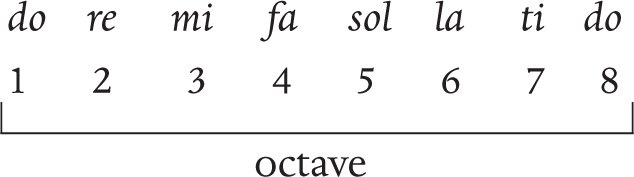
The intervals from which chords and melodies are built are chosen from a particular collection of pitches arranged in ascending or descending order known as a scale. To the notes of the scale we assign syllables, do–re–mi–fa–sol–la–ti–do, or numbers, 1–2–3–4–5–6–7–8. An interval spanning eight notes is called an octave.
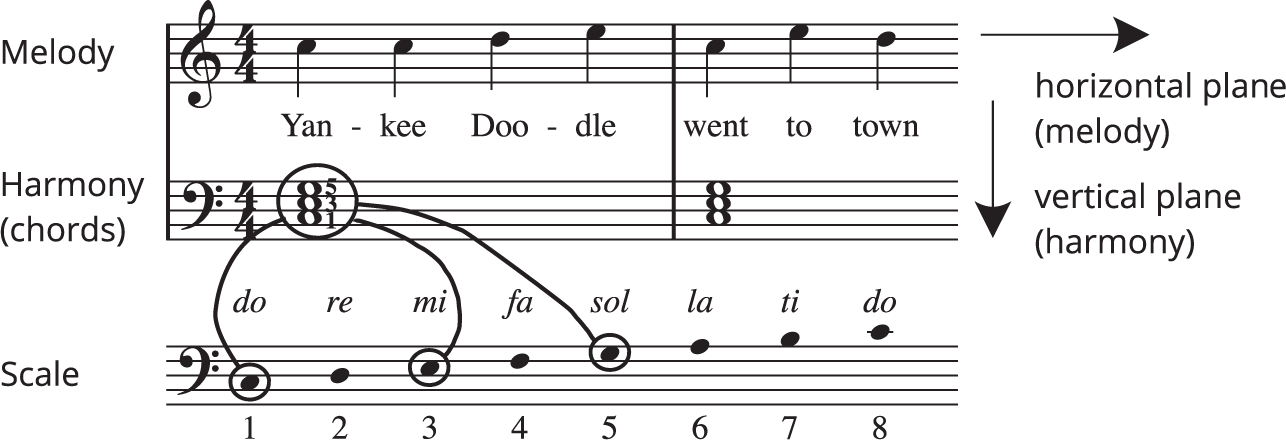
The most common chord in Western music is known as a triad. This particular combination of three pitches may be built on any note of the scale by combining every other note. For example, a triad built on the first pitch of a scale consists of the first, third, and fifth pitches of that scale (do–mi–sol); on the second pitch, steps 2–4–6 (re–fa–la); and so on. The triad is a basic formation in most music we know. In the example across, the melody of Yankee Doodle is harmonized with triads. You can see at a glance how melody is the horizontal aspect of music, while harmony, comprising blocks of notes (the chords), constitutes the vertical. Melody and harmony do not function independently of one another. On the contrary, the melody suggests the harmony that goes with it, and each constantly influences the other.
Examples of Harmony
Yankee Doodle (Revolutionary War song)
More information
An illustration shows two staves in 4 over 4 times in the key of C major. The first staff is the melody and the second staff is the harmony or chords. A C-major scale below the staves shows the first chord in the music that consists of 1 or do, 3 or mi, and 5 or sol degrees. The notation is provided for the lyric, Yankee Doodle Went to Town, a revolutionary war song.
KEY POINTS
Harmony describes the vertical aspects of music: how notes (pitches) sound together.
A chord is the simultaneous sounding of three or more pitches; chords are built from a particular scale, or sequence of pitches.
The most common chord in Western music is a triad, three alternate pitches of a scale.
Most Western music is based on major or minor scales, from which melody and harmony are derived.
The tonic is the central pitch around which a melody and its harmonies are built; this principle of organization is called tonality.
Dissonance is created by an unstable, or discordant, combination of pitches. Consonance occurs with a resolution of dissonance, producing a stable or restful sound.
Scale consisting of seven different pitches that comprise a specific pattern of whole and half steps (W-H-W-W-H-W-W). Differs from the major scale primarily in that its third degree is lowered half a step.
Scale consisting of seven different pitches that comprise a specific pattern of whole and half steps (W-W-H-W-W-W-H). Differs from the minor scale primarily in that its third degree is raised half a step.
 We have learned to express the more delicate nuances of feeling by penetrating more deeply into the mysteries of harmony.”