How Is Race Constructed around the World?
Racial categories are human constructs; they are not found in nature. Yet they have become so deeply internalized that they feel natural and provide one of the most powerful frameworks through which we experience the world (Mukhopadhyay, Henze, and Moses 2007). Anthropologists examine race and racism on a global scale and thus from different angles, identifying their similarities and variations and, in the process, revealing the ways those concepts have evolved and might be changed through individual and collective action.
RACE AND THE LEGACY OF COLONIALISM
Contemporary global expressions of race and racism are deeply rooted in the systems of classification that western Europeans created as they expanded their colonial empires into Africa, Asia, the Pacific, and the Americas beginning in the 1400s. Colonialism became the centerpiece of European global economic activity, combining economic, military, and political control of people and places to fuel Europe’s economic expansion and enhance the European position in the emerging global economy (see Chapter 10). The classification of people based on phenotype, particularly skin color, became the key framework for creating a hierarchy of races—with Europeans at the top—that linked people’s looks with assumptions about their intelligence, physical abilities, capacity for culture, and basic worth. Eventually this framework served to justify colonial conquests, the transatlantic slave trade, and the eradication of much of the indigenous population of the Americas (Gregory and Sanjek 1994).
Taking a global perspective, anthropologists often refer to “racisms” in the plural, reflecting the varieties of ways race has been constructed among people in different places. Locally and nationally, racisms and systems of racial classification are complex frameworks built out of the encounter of colonialism with local cultural patterns, global migration, and specific movements of resistance. While racializing systems around the world may all have their roots in European colonialism, they manifest themselves differently in different places and at different times.
Racial frameworks and systems of racism have changed significantly over the last century. After World War II, colonial-era racist political and legal structures shifted as national liberation movements struggled to end occupations by foreign powers. In addition, in this postcolonial period, anti-racist liberation movements challenged long-term patterns of race and racial discrimination. Notably, the anti-apartheid movement in South Africa resisted dominant white rule, eventually reversing decades of legal structural discrimination and violence. The civil rights movement challenged more than 300 years of race-based inequality in the United States. Today globalization has brought about new experiences of race and racism.
Indeed, in today’s global world, flexible accumulation produces new relationships between corporations and workers; the migration of workers within countries and across national borders yields new racial formations; and time-space compression enhances communication tools that can be employed to resist old hierarchies while also perpetuating old racial frameworks on a global scale. Racisms today, though rooted in similar historic realities, are shifting as they intersect with other systems of power, whether those are ethnicity, gender, sexuality, kinship, or class (Mullings 2005a). The exact expression of these constructs varies from culture to culture and place to place, depending on why races were originally invented and how they have been used to establish and maintain hierarchies of power.
More information
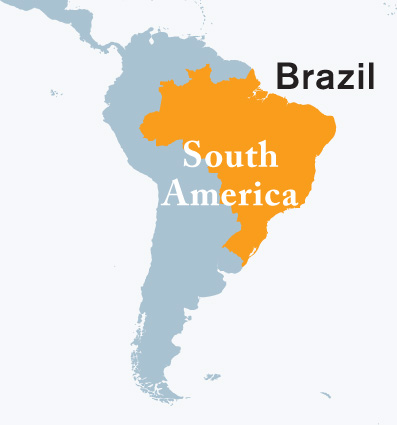
MAP 5.1
Brazil
Class, Gender, and Hundreds of Races in Brazil. Brazil provides a good location to explore the cultural construction of race and the application of ideas of race to the creation of stratification. The United States and Brazil are today the two largest multiracial countries in the Western Hemisphere, although they have traveled two very different paths in framing racial identities and hierarchies. By the time Brazil outlawed slavery in 1888, the country had the largest African population in the New World. This situation reflected the grim fact that during and after Brazil’s time as a colony of Portugal (1500–1815), 40 percent of all Africans in the Atlantic slave trade were taken to Brazil to work on Portuguese plantations and mines. Brazil was the last country in the Americas to outlaw slavery—a full generation after the U.S. Emancipation Proclamation in 1863.
Today, Brazilians describe the human physical diversity called “race” in great detail. Although Brazil’s system of racial classification is color-coded, its color terminology is far more expansive, encompassing hundreds of categories (Freyre 1933; Harris 1964, 1970). Terms include alva (pure white), alva-escuro (off-white), alva-rosada (pinkish white), branca (white), clara (light), branca morena (darkish white), branca suja (dirty white), café (coffee colored), café com leite (coffee with milk), canela (cinnamon), preta (black), and pretinha (lighter black) (Fluehr-Lobban 2006). Race categories follow along a nuanced continuum of appearance rather than a few rigid categories such as those used in the United States.
Brazil’s population of Europeans, Africans, and indigenous people has had a long history of interracial mixing. The Portuguese colonial government promoted assimilation and did not bar miscegenation—that is, interracial marriage. As a result, many single Portuguese men who settled in Brazil chose to intermarry. Nor has Brazil applied the rule of hypodescent—the “one drop of blood” rule—that in the United States meant that having even one black ancestor out of many could mark an individual as black (see “The Rule of Hypodescent” later in this chapter). As a result, a Brazilian family may include children who are categorized as various shades of white, brown, and black.
Race in Brazil is not solely a function of skin color. In fact, race intersects closely with class—including land ownership, wealth, and education—in determining social status. Because of the power of class, a Brazilian’s racial position can be modified by his or her level of affluence. Affluence can shift a Brazilian’s racial identity in spite of skin color and other supposedly “racial” markers (Walker 2002).
Some scholars refer to Brazil as a “racial democracy” and extol the nation as an exceptional example of racial harmony (Freyre 1933; Harris 1964; Kottak 2006). Brazil’s government abolished the use of racial categories in the 1930s and constitutionally banned racism in 1951. The complex and fluid color classifications—and the absence of political and legal mechanisms to establish and enforce a clear color line between black and white—are seen as a sign of tolerance.
In addition, the incorporation of key African cultural practices (including carnival, samba, Candomblé religious practices, capoeira, and specific cuisine) as symbols of the Brazilian nation is often cited as supporting evidence for the racial democracy thesis (Downey 2005).
Other scholars have noted that despite the appearance of racial democracy, inequality exists in almost every area of Brazilian life and is directly linked to color. Darker-skinned Brazilians face higher levels of exclusion and injustice, including a systemic correlation between color and economics. Most of the poor are Afro-Brazilians. Most of the rich are white. Racial democracy may instead be simply a myth that serves as a cornerstone of Brazil’s national denial of the existence of racism (Harrison 2002b; Roth-Gordon 2016; Smith 2016).
In Laughter Out of Place (2003), anthropologist Donna Goldstein writes about poor working women from the bleak favela (shantytown), ironically named Felicidade Eterna (“eternal happiness”), who support their families as domestic workers in the homes of middle-class Brazilian families in the affluent sections of Rio de Janeiro. Gloria, poor and dark skinned, raising fourteen children, including nine of her own, works as a domestic servant, shopping, cooking, and cleaning. She earns five dollars a day—just enough to feed herself and her family. The pay is off the books, so she has no legal labor protections, no insurance, and no pension. Goldstein links the contemporary culture of domestic work, particularly the employer–domestic servant relationships, to the historic institution of slavery in Brazil. Middle-class families enjoy a kind of learned helplessness similar to that of the slave owner—allowing their workers to do the dirty, manual chores. The employer–domestic servant relationship, like the owner–slave relationship, is characterized by domination, strict rules, and social separation.
How do Brazil’s marginalized and oppressed people make sense of their lives—lives overburdened with poverty, violence, and work at the bottom of a global hierarchy of race, class, and gender, yet lives that also display dignity and resilience? Goldstein explores the role of laughter and humor as means to cope with persistent brutality. She particularly notes a humor that recognizes life’s absurdities and ironies and provides perspective to a sense of injustice. She recalls, for instance, the awkwardness of “laughter out of place,” as domestic workers and employers laugh at different times and for different reasons when they watch the local soap operas that dramatize middle-class Brazilian life. The distinctive life experiences of worker and employer create vastly different viewing experiences, casting the televised dramas and traumas of the Brazilian middle class in sharp contrast to the survival needs of the domestic workers living in the favela—a contrast so absurd as to evoke laughter out of place.
Glossary
- colonialism
- The practice by which a nation-state extends political, economic, and military power beyond its own borders over an extended period of time to secure access to raw materials, cheap labor, and markets in other countries or regions.
- miscegenation
- A demeaning historical term for interracial marriage.