The end of World War I saw critical changes in international relations. First, three European empires were strained and finally broke up during or near the end of World War I. With those empires went the conservative social order of Europe. In its place emerged a proliferation of nationalisms. Russia exited the war in 1917, as revolution raged within its territory. The tsar was overthrown and eventually replaced by not only a new leader, Vladimir Ilyich Lenin, but also a new ideology—communism. The Austro-Hungarian and Ottoman Empires disintegrated. Austria-Hungary was replaced by Austria, Hungary, Czechoslovakia, part of Yugoslavia, and part of Romania. The Ottoman Empire was also reconfigured. Having gradually weakened throughout the nineteenth century, its defeat resulted in the final overthrow of the Ottomans. Arabia rose against Ottoman rule, and British forces occupied Palestine (including Jerusalem) and Baghdad. Turkey became the largest of the successor states that emerged from the disintegration of the Ottoman Empire.
The end of the empires accelerated and intensified nationalisms. In fact, one of President Woodrow Wilson’s Fourteen Points in the treaty ending World War I called for self-determination, the right of national groups to self-rule. Technological innovations in the printing industry and a mass literate audience stimulated the nationalism of these various groups. Now it was easy and cheap to publish material in the multitude of different European languages and so offer differing interpretations of history and national life.
A second critical change was that Germany emerged from World War I an even more dissatisfied power. Germany had been defeated on the battlefield but its leaders had not been honest with the German people. Many German newspapers had been predicting a major breakthrough and victory right up until the armistice of November 11, 1918, so the myth grew that the German military had been “stabbed in the back” by “liberals” (and later Jews) in Berlin. Even more devastating was the fact that the Treaty of Versailles, which formally ended the war, made the subsequent generation of Germans pay the entire economic cost of the war through reparations—$32 billion for wartime damages. As Germany printed more money to pay its reparations, Germans suffered from hyperinflation, causing widespread impoverishment of the middle and working classes. Finally, Germany was no longer allowed to have a standing military, and French and British troops occupied its most productive industrialized region, the Ruhr Valley. Bitterness over these harsh penalties provided the climate for the emergence of conservative groups such as the National Socialist Worker’s Party, or Nazis, led by Adolf Hitler. Hitler publicly dedicated himself to righting the “wrongs” imposed on the German people after World War I.
Third, enforcement of the Treaty of Versailles was given to the League of Nations, the intergovernmental organization designed to prevent future interstate wars. But the organization itself did not have the political weight, the legal instruments, or the legitimacy to carry out the task. The political weight of the League was weakened by the fact that the United States—whose president Woodrow Wilson had been the League’s principal architect—itself refused to join, retreating instead to an isolationist foreign policy. Nor did Russia join, nor were any of the vanquished states of the war permitted to participate. The League’s legal authority was weak, and the instruments it had for enforcing the peace, namely sanctions, proved ineffective.
Fourth, the blueprint for a peaceful international order enshrined in Wilson’s Fourteen Points failed. Wilson had called for open diplomacy—“open covenants of peace, openly arrived at.”7 Point three was a reaffirmation of economic liberalism, the removal of economic barriers among all the nations consenting to the peace. The League, a “general association of nations” that would ensure war never occurred again, would maintain order. But these principles were not adopted. In the words of historian E. H. Carr, “The characteristic feature of the twenty years between 1919 and 1939 was the abrupt descent from the visionary hopes of the first decade to the grim despair of the second, from a utopia which took little account of reality to a reality from which every element of utopia was rigorously excluded.”8 Liberalism and its utopian and idealist elements were replaced by realism as the dominant international relations theory—a fundamentally divergent theoretical perspective (see Chapter 3).
IN FOCUS
Key Developments in the Interwar Years
Three empires collapse: Russia by revolution, the Austro-Hungarian Empire by dismemberment, and the Ottoman Empire by external wars and internal turmoil. These collapses lead to a resurgence of nationalisms.
German dissatisfaction with the World War I settlement (Treaty of Versailles) leads to the rise of fascism in Germany. Germany finds allies in Italy and Japan.
A weak League of Nations is unable to respond to Japanese, Italian, and German aggression. Nor can it prevent or reverse widespread economic depression.
World War II
In the view of most Europeans and many in the United States, Germany, and in particular Adolf Hitler, started World War II. But Italy and Japan also played major roles in the breakdown of interstate order in the 1930s.
In 1935, Italy invaded Ethiopia (Abyssinia) and occupied it the following year. The League of Nations responded to this act of aggression with sanctions, but member states refused to enforce them, dealing a blow to the League’s very foundation.
In 1931, Japan staged the Mukden incident as a pretext for assaulting China and annexing Manchuria. The Japanese invasion of China was marked by horrifying barbarity against the Chinese people, including the rape, murder, and torture of Chinese civilians, and by the increasing inability of Japan’s civilian government to restrain its generals in China. Japan’s record in Korea was equally brutal. Japan’s reputation for savagery against noncombatants in China reached its peak in the Rape of Nanking in 1937, when an estimated 300,000 were murdered. When news of the massacres and rapes reached the United States—itself already embroiled in a dispute with Japan over Japan’s prior conduct in China—a diplomatic crisis ensued, the result of which was war, when Japanese forces attacked the U.S. Seventh Fleet at Pearl Harbor in December 1941.
But Nazi Germany, the Third Reich, proved to be the greatest challenge to the nascent interstate order that followed World War I. Adolf Hitler had come to power with a promise to restore Germany’s economy and national pride. To that end, he accelerated armaments production, but unable to pay for both foodstuffs and arms, he bullied the weaker new states to the east—Bulgaria, Hungary, and Romania—into ruinous trade deals. As one economic historian put it: “Germany was in a position where she was arming in order to expand, and then had to expand in order to continue to arm.”9 But once the other European powers realized how far behind they were, they used every diplomatic opportunity to delay confronting Germany.
The Third Reich represented more than an economic juggernaut. Fascism as practiced by Hitler effectively mobilized the masses in support of the state, exalting the nation and race above the individual. It capitalized on the idea that war and conflict were noble activities from which ultimately superior civilizations would be formed. It drew strength from the belief that the Caucasian race was superior and other groups, namely Jews, were inferior, and it mobilized the disenchanted and the economically weak on behalf of its cause. In autumn 1938, Britain agreed to let Germany occupy the westernmost region of Czechoslovakia, in the hope of averting a general war, or at least delaying war until Britain’s defense preparations could be sufficiently strengthened. But this was a false hope. In spring 1939, the Third Reich annexed the remainder of Czechoslovakia, and in September 1939, after having signed a peace treaty with the Soviet Union that divided Poland between them, German forces stormed into Poland from the west while Soviet forces assaulted from the east. Hitler’s real intent was to secure his eastern flank against a Soviet threat while he assaulted Norway, Denmark, the Netherlands, and, ultimately, France. His grand plan then called for Germany to turn east and conquer the Soviet Union. Poland was quickly overcome, but because Britain and France had guaranteed Polish security, the invasion prompted a declaration of war: World War II had begun.
In 1940, Hitler set his plans into motion and succeeded in a series of rapid conquests, culminating in the defeat of France in May. In the late summer and fall, after being repeatedly rebuffed in its efforts to coerce Britain into neutrality, the Third Reich prepared to invade and the Battle of Britain ensued. Fought almost entirely in the air, the battle was eventually won by Britain through a combination of extreme courage, resourcefulness, and luck; and Hitler was forced to turn east with a hostile Britain at his back. In June 1941, the Third Reich undertook the most ambitious land invasion in history: Operation Barbarossa—its long-planned yet ill-fated invasion of the Soviet Union. This surprise attack led the Soviet Union to join sides with Britain and France.
The power of fascism—in German, Italian, and Japanese versions—led to an uneasy alliance between the communist Soviet Union and the liberal United States, Great Britain, and France, among others (the Allies). That alliance sought to check the Axis powers (Germany, Italy, and Japan), by force if necessary. Thus, during World War II, those fighting against the Axis powers acted in unison, regardless of their ideological disagreements.
At the end of the war in 1945, the Allies prevailed. Italy had already surrendered in September 1943, and the Third Reich and imperial Japan lay in ruins. In Europe, the Soviet Union paid the highest price for the Third Reich’s aggression, and, with some justification, considered itself the victor in Europe, with help from the United States and Britain. In the Pacific, the United States, China, and Korea paid the highest price for Japan’s aggression. With some justification, the United States considered itself the victor in the Pacific.
Two other features of World War II demand attention as well. First, the Third Reich’s military invasion of Poland, the Baltic states, and the Soviet Union was followed by organized killing teams whose sole aim was the mass murder of human beings, regardless of their support for, or resistance to, the German state. Jews in particular were singled out, but Nazi policy extended to Roma (formerly referred to as gypsies), communists, LGBTQ individuals, and Germans born with genetic defects. In Germany, Poland, the Baltic states, Yugoslavia, and the Soviet Union, persons on target lists were forced to abandon their homes. Nazi captors forced these people to work in labor camps and then either slowly or rapidly murdered them. In East Asia, Japanese forces acted with similar cruelty against Chinese, Vietnamese, and Korean noncombatants. The Japanese often tortured victims or forced them to become subjects in gruesome experiments before murdering them. In many places, women were forced into brothels, or “comfort stations,” as Japanese rhetoric of the day described them. The nearly unprecedented brutality of the Axis powers against noncombatants in areas of occupation during the war led to war crimes tribunals and, ultimately, to a major new feature of international politics following the war: the Geneva Conventions of 1948 and 1949. The conventions are collectively known as international humanitarian law (IHL), which is discussed in Chapter 10.
More information
A map shows alliances in Europe in 1939. Axis aligned: Finland, East Prussia, Germany, Slovakia, Hungary, Romania, Bulgaria, Italy, Albania, Sardinia, and Sicily. Allies aligned: Iceland, Denmark, United Kingdom, Norway, Estonia, Latvia, Lithuania, Netherlands, Belgium, Luxembourg, Corsica, France, Poland, Yugoslavia, Greece, Morocco, Algeria, Tunisia, Iran, Syria, and Iraq. Neutral: Sweden, Ireland, Portugal, Spain, Union of Soviet Switzerland, Socialist Republics, and Turkey. The caption reads, �Europe, showing alliances as of 1939.�
Europe, showing alliances as of 1939
The Germans and Japanese were not the only forces for whom race was a factor in World War II. As documented by John Dower in his book War without Mercy, U.S., British, and Australian forces fighting in the Pacific tended to view the Japanese as “apes” or “monkey men.” As a result, they rarely took prisoners and were more comfortable in undertaking massive strategic air assaults on Japanese cities. In the United States in 1942, American citizens of Japanese descent were summarily deprived of their constitutional rights and interned for the duration of the war. In the Pacific theater, racism affected the conduct and strategies of armed forces on both sides.10
Second, Germany surrendered unconditionally in May 1945 and the Allies would accept no less from Japan. But Japan refused, seeking to shield Emperor Hirohito from prosecution. In response, on August 6, the United States dropped an atomic bomb on Hiroshima, and three days later, a second bomb on Nagasaki. The new weapon, combined with a Soviet declaration of war on Japan the same day as the Nagasaki bombing, led to Japan’s unconditional surrender on August 15, 1945.
The end of World War II resulted in a major redistribution of power. The victorious United States and Soviet Union emerged as the new world powers, though the USSR had been severely hurt by the war and remained economically crippled as compared to the United States. Yet what the USSR lacked in economic power, it gained from geopolitical proximity to the two places where the future of the international system would be decided: Western Europe and East Asia. The war also changed political boundaries. The Soviet Union virtually annexed the Baltic states (Latvia, Lithuania, and Estonia) and portions of Austria, Finland, Czechoslovakia, Poland, and Romania; Germany and Korea were divided; and Japan was ousted from much of Asia. Each of these changes contributed to the new international conflict: the Cold War.
the era in international relations between the end of World War II and 1990, distinguished by ideological, economic, political, and military rivalry between the Soviet Union and the United States
Endnotes
Quoted in A. C. Walworth, Woodrow Wilson (Baltimore, MD: Penguin, 1969), p. 148. Return to reference 7
E. H. Carr, The Twenty Years’ Crisis, 1919–1939: An Introduction to the Study of International Relations (New York: Harper Torchbooks, 1939, rep. 1964), p. 224. Return to reference 8
P. M. H. Bell, The Origins of the Second World War in Europe (New York: Longman, 1986), pp. 151–52. Return to reference 9
John W. Dower, War without Mercy: Race and Power in the Pacific War (New York: Pantheon Books, 1986). Return to reference 10
 IN FOCUS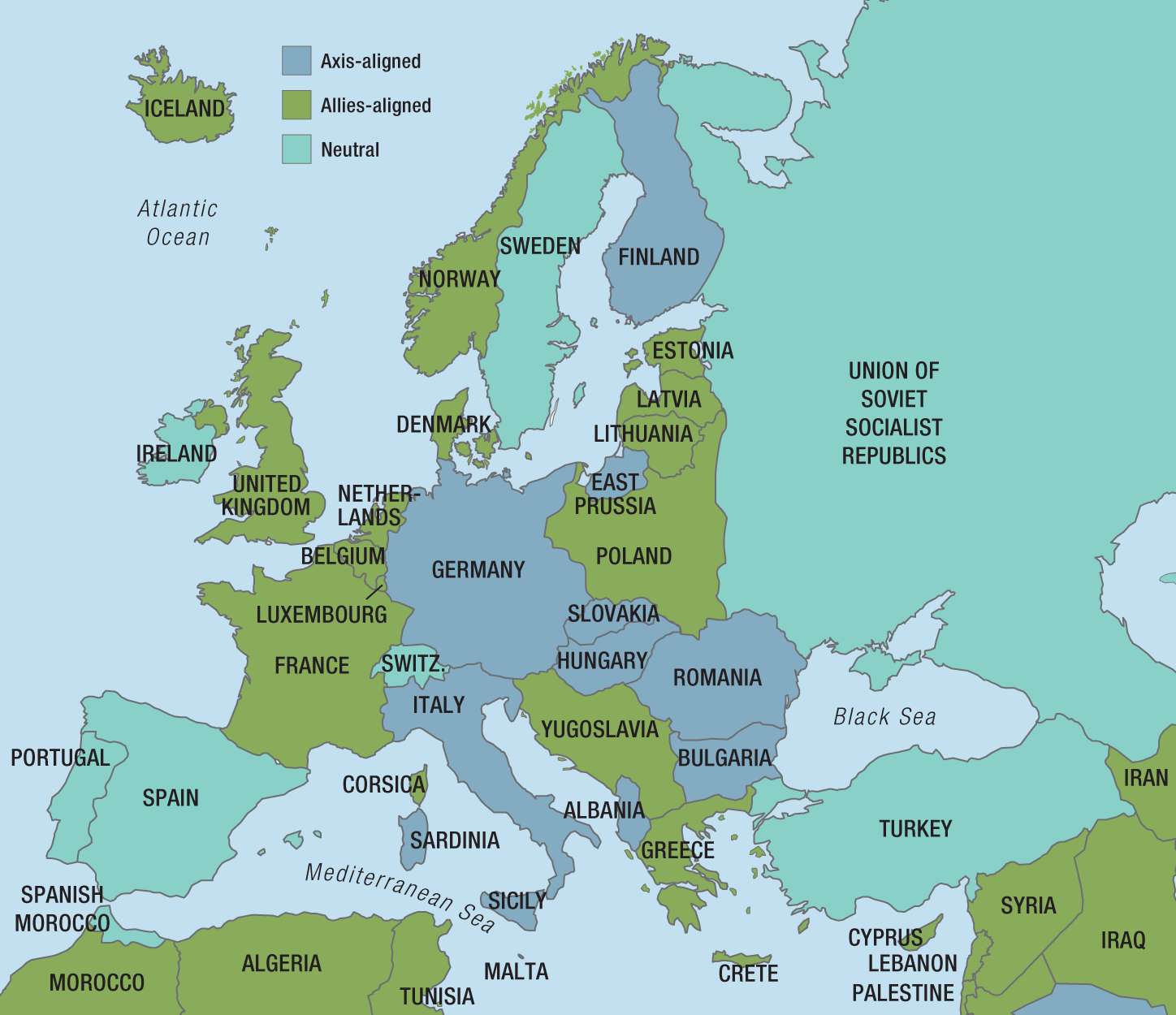

 Answer
 Answer: c