3.3Natural Selection in the Field
Natural selection acts on the entire spectrum of traits present in an organism, including molecular, morphological, behavioral, and physiological traits. The manner in which natural selection acts can be tracked in wild populations. In this section, we will examine two field studies on natural selection: one a long-term study on a behavioral/physiological trait (life history strategy) and another a study of adaptation to “urban heat islands” created in cities.
Predation and Natural Selection in Guppies
A life history strategy refers to the schedule and manner of investment in survivorship and reproduction over the lifetime of an individual. Life history traits include the timing of sexual maturity, the timing of aging or senescence (Chapter 20), the number and size of offspring, and whether an organism reproduces repeatedly over the course of its lifetime or just once during its lifetime. A beautifully documented example of studying life history and natural selection in the field comes from decades of work on life history strategies in the guppy Poecilia reticulata (Houde 1997; Magurran 2005).
In many of the streams of the northern mountains of Trinidad and Tobago, guppy populations are found both upstream and downstream of a series of waterfalls (Seghers 1973; Houde 1997; Magurran 2005). Upstream and downstream sites are often only separated by a very small geographical distance—a few hundred feet in some instances—but the waterfalls act as a physical barrier to guppies and their aquatic predators alike. Upstream of such waterfalls, guppies typically face only mild predation pressure from one small species of fish, Rivulus hartii. Downstream of the waterfalls, however, populations of guppies are often under severe predation pressure from voracious predators such as the pike cichlid (Crenicichla alta).
Because upstream and downstream populations face different predation pressures, evolutionary biologists have hypothesized that natural selection should favor different suites of traits across these populations. Indeed, this turns out to be the case. Between-population comparisons in guppies have found differences in color, antipredator behavior, and numerous life history traits, including the number of offspring born in each clutch, the size of offspring at birth, the age at reproduction, and the timing of senescence (Endler 1995; Reznick 1996; Houde 1997; Magurran 2005). Let us examine some of these in more detail.
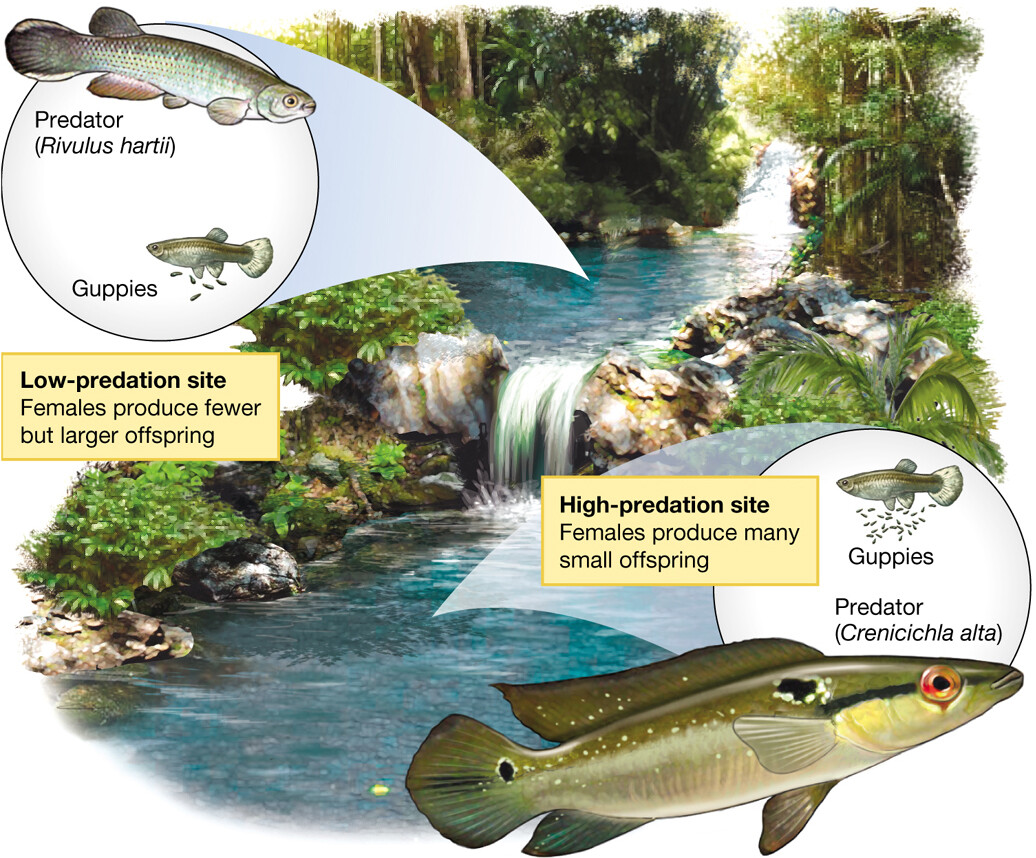
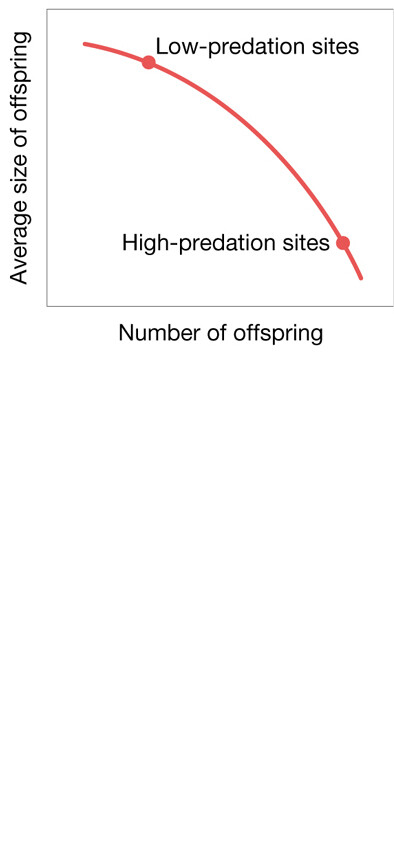
David Reznick and his colleagues found that guppies from downstream sites produce more broods (clutches of offspring) than their counterparts in upstream sites, and broods from downstream females contain many small fry (newborn fish), whereas broods from upstream females tend to contain larger but fewer fry (Reznick 1996) (Figure 3.11). Why? That is, why should differences in predation lead to such differences across our guppy populations?
More information
A diagram showing a river stream with illustrations of guppies and their predators and a graph showing the tradeoff between the number of guppy offspring compared to the size at birth. The river has two areas which are labeled low-predation site and high-predation site. In the low-predation site, the predator Rivulus hartii is present, and female guppies will produce fewer but larger offspring here. In the high-predation site, the predator Crenicichla alta is present, and female guppies will produce many small offspring.
More information
A line graph that has an x axis labeled with number of offspring and the y axis is labeled with average size of offspring. In low-predation sites, the average size is larger, but the number of offspring is fewer. In high-predation sites, the average size of offspring is smaller but the number of offspring is higher.

To understand why these guppy populations have diverged, let us examine the different selective conditions at downstream and upstream sites. At upstream sites, the small fish Rivulus hartii is the only aquatic predator that feeds on guppies. If female guppies at upstream sites produce offspring that start off relatively large and can quickly grow past a certain size threshold, such offspring will, relatively quickly, be safe from predation by R. hartii. So, females face a trade-off. On the one hand, larger offspring may survive with higher probabilities. On the other, because guppies give birth to live offspring rather than lay eggs, fewer (but larger) offspring can be produced (see Figure 3.11). The number and size of offspring produced by females is the result of this trade-off.
At high-predation sites, guppy predators are much larger and more dangerous, and again there is a trade-off with respect to the number and size of offspring. At high-predation sites, natural selection should favor producing many smaller fry. This is because predators at high-predation sites can eat guppy fry no matter how big they get, and so guppy mothers have less to gain from investing in large offspring. Natural selection should favor females that produce as many fry as possible, because by “flooding the market” with young, mothers increase the chances that at least some of their fry survive. This pattern is precisely what we see when we study reproduction in downstream females (Reznick 1996).
In the guppy system, evolutionary biologists can do more than infer adaptation by observing life history differences. In the mountain streams of Trinidad and Tobago, biologists can experimentally manipulate natural selection on guppy populations, make specific predictions about the changes that should occur, and test these predictions.
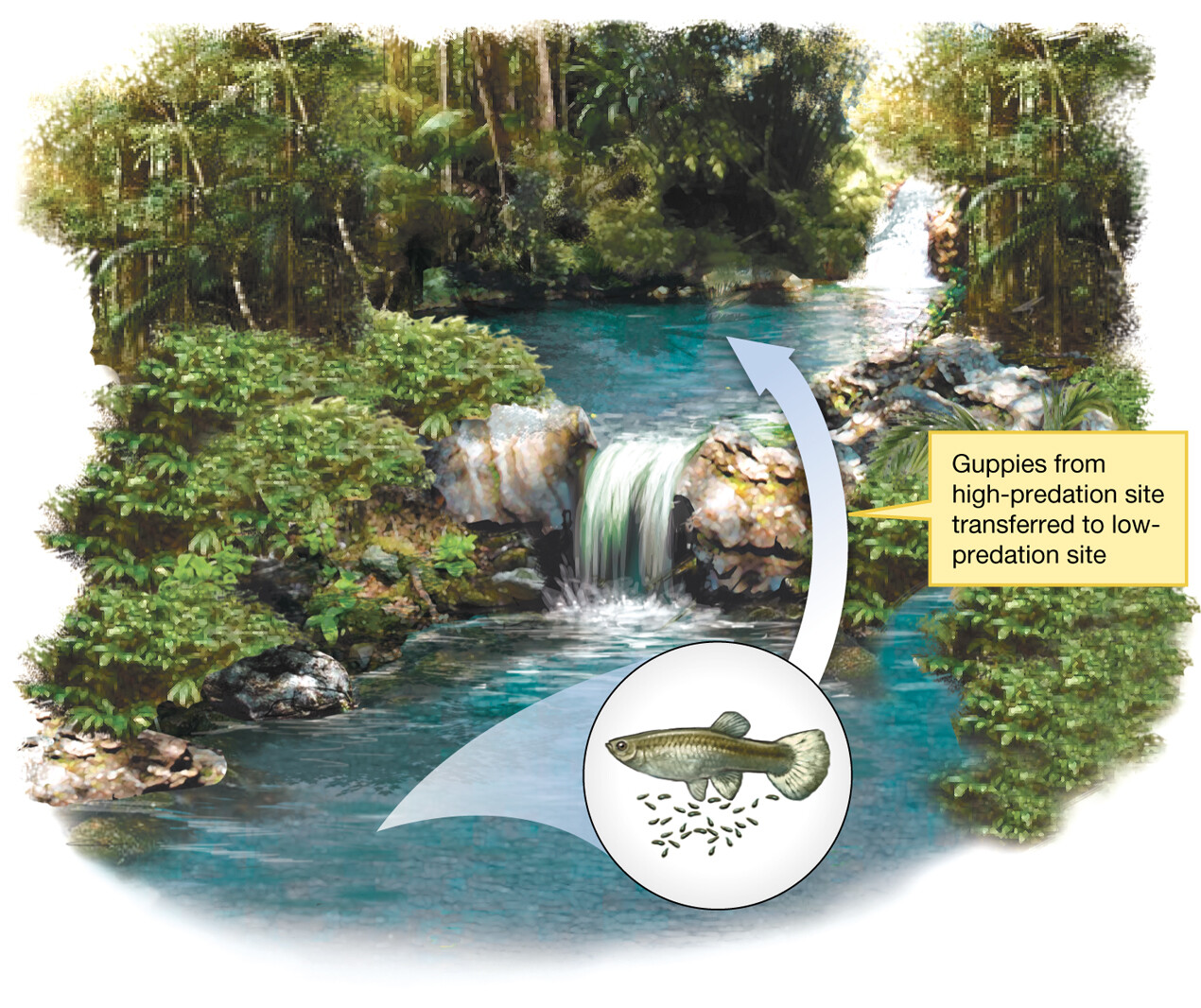
David Reznick, John Endler, and their colleagues experimentally manipulated predation pressure in wild guppy populations by transplanting a group of 100 male and 100 female guppies from a high-predation, downstream site into a low-predation, upstream site, and they cordoned off the transplanted guppies so they could track the populations over time (Figure 3.12). If it is correct that producing larger but fewer offspring at upstream sites is an adaptation to predation pressure there, then given sufficient genetic variation for offspring size, we would expect that over the course of many generations, natural selection will favor the descendants of those fish transplanted from high-predation sites who produce larger but fewer offspring than their recent ancestors (Reznick et al. 1990).
More information
A river stream that has a high-predation site and a low-predation site along with an illustration of a guppy laying eggs in the lower section of the river. An arrow indicates that guppies from the high-predation site were transferred to the low-predation site.
For 12 years, Reznick and his team periodically sampled the descendants of the transplanted populations after the original transplant and found that the descendant population had evolved in the predicted direction, with females producing larger but fewer offspring than their ancestors from a high-predation site (Reznick et al. 1990). The researchers then brought guppies from the area of the transplant into the laboratory and found that the new life history strategy was inherited. Guppies from the descendant population born and raised in the laboratory displayed the same life history strategies in the lab as in the field, suggesting that (1) the differences in life history were not solely caused by environmental differences above and beyond differences in predation level in the field and (2) differences seen in the field arose from natural selection rather than a norm of reaction being expressed.
In addition to nicely illustrating how we study the evolution of behavior and life history, the guppy example reveals the rapidity with which natural selection can operate. We know from geological evidence that upstream and downstream guppy populations have been separated from one another for less than 10,000 years, yet largely as a result of differences in predation pressure, natural selection has produced significant differences in behavior and life history in guppy populations over this fairly brief evolutionary time period (Endler 1995).
Natural Selection on Lizards in Urban Heat Islands
In Chapter 1 we discussed the growing impact of anthropogenic factors on the process of evolution. Cities are often warmer than their surroundings. For example, a study of 57 cities across Scandinavia found that cities had temperatures up to 5°C higher than immediate nonurban areas (Miles and Esau 2020). These urban heat islands are created by a number of factors including dark-colored asphalt and brick and steel construction, both of which affect how heat is absorbed. Evolutionary biologists are beginning to piece together how urban heat islands create new selective forces on species that live in urban environments; this research makes up one part of the new subdiscipline of urban evolution (Johnson and Munshi-South 2017; Santangelo et al. 2018).
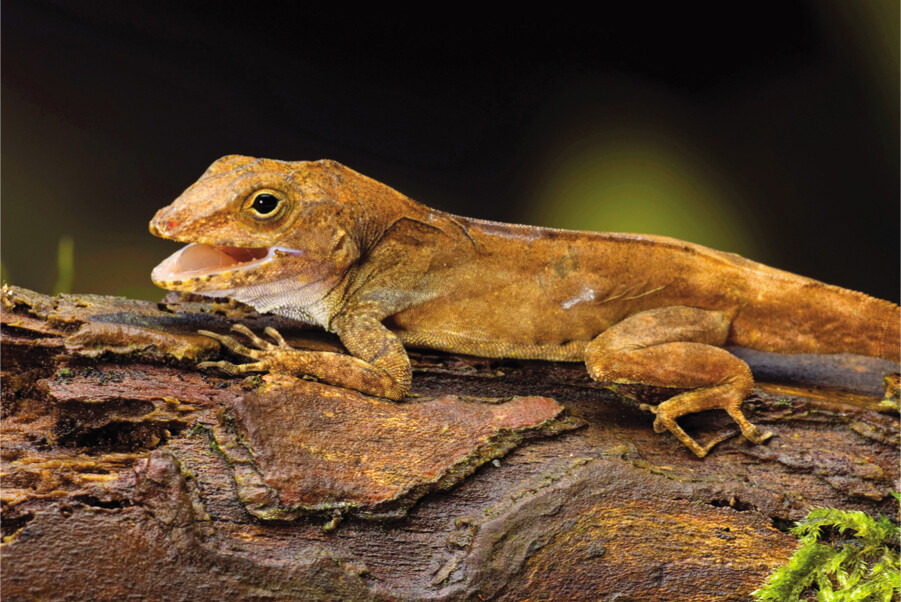
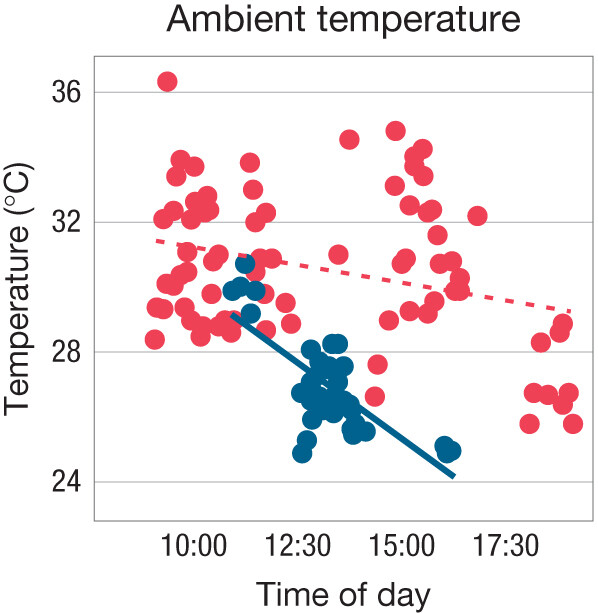
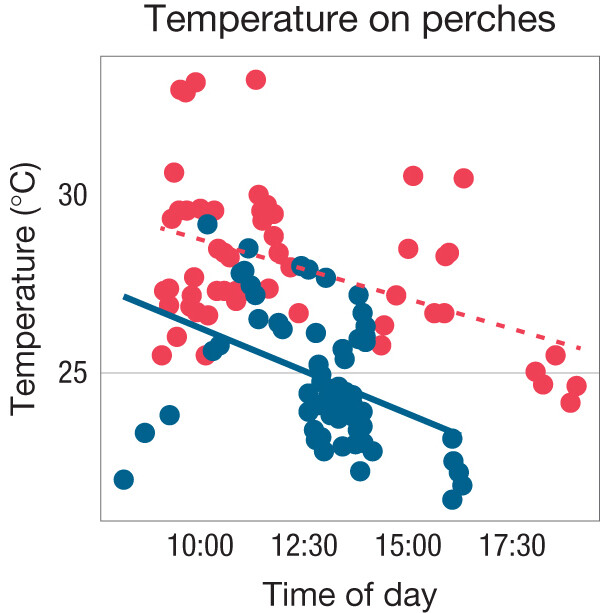
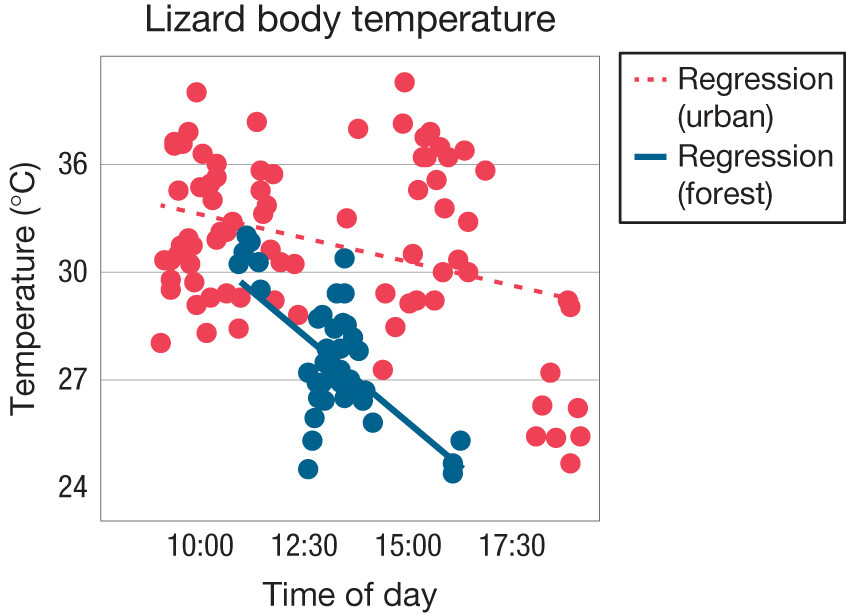
Shane Campbell-Staton and his colleagues examined the impact of urban heat islands on crested anole lizards (Anolis cristatellus) at four sites in Puerto Rico (Campbell-Staton et al. 2020). Each site contained an urban area and a nearby forest area. Average temperatures, as well as the temperatures at the perches where the lizards spend much of the day, were significantly higher in urban settings. The body temperatures of city lizards were also higher (Figure 3.13).
More information
An orange lizard with a white patch under its chin perches on a rotten log.
More information
A scatterplot of Ambient Temperature against time of day in urban and forest environments. The temperature is lower in the forest and drops more steeply over time than in urban settings.
More information
A scatterplot of Perch Temperature against time of day in urban and forest environments. The temperature is lower in the forest, the lines are roughly parallel.
More information
A scatterplot of Lizard Body Temperature against time of day in urban and forest environments. The temperature is lower in the forest and drops more steeply over time than in urban settings.
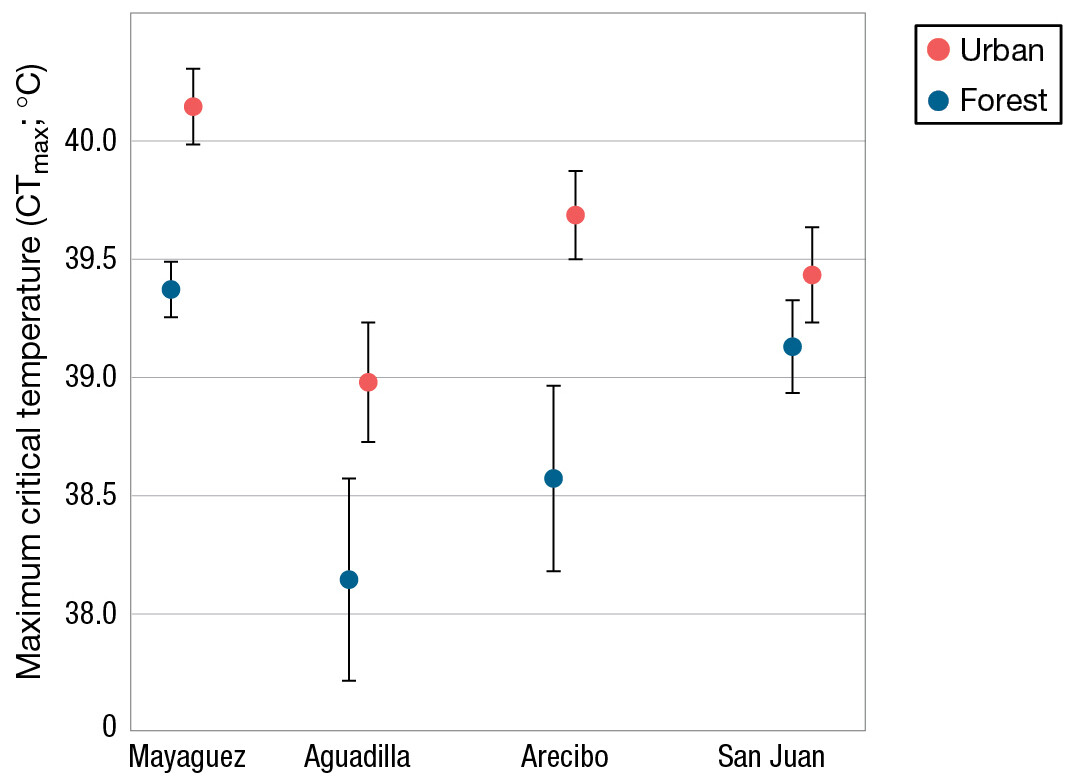
Campbell-Staton hypothesized that taken together, these factors would produce different selection pressures for thermal tolerance in forest versus urban populations. To test this, they brought anoles in from the field and measured, among other things, their response to increasing temperature by placing animals under heating lamps and increasing the temperature 1°C each minute. Anoles were periodically placed on their backs and touched with forceps to see if they would flip themselves back over. Maximal critical temperature (CTmax) was defined as that at which a lizard did not right itself after 30 seconds. CTmax was significantly higher in urban anoles than in forest anoles (Figure 3.14A).
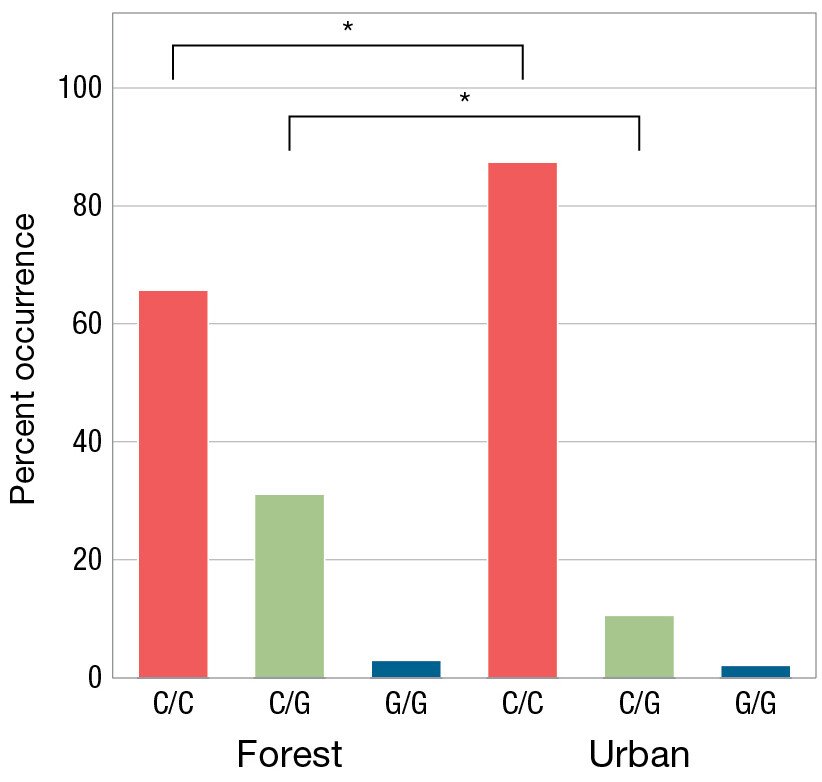
Campbell-Staton next examined whether there were any underlying genetic differences that might help explain the CTmax differences they found among the anoles. They ran a genomic comparison of individuals from urban and forest environments and found that there were differences at a single locus at three of the four sampling sites. One particular genotype at this locus (C/C) was at higher frequencies in anoles from urban settings. Alleles at this locus, called the arginyl-transfer RNA synthetase (RARS) locus, have been shown to be important in controlling the misfolding of proteins that sometimes occurs under environmental stress (such as high temperature) and causes cell damage. Based on this and other evidence, Campbell-Staton argues that the relatively high frequency of the C/C genotype in individuals that inhabit cities is the result of natural selection operating in urban heat islands (Figure 3.14B).
More information
Maximum critical temperature for lizards in urban and forest settings in four different sites in Puerto Rico: Mayaguez, Aguadilla, Arecibo, and San Juan. The critical temperature was consistently higher in urban settings, by anywhere from 0.3 to 1.1 degrees Celsius.
More information
A bar graph showing incidence of the C C, C G, and G G genotypes in forest and urban environments. In urban environments, the C C genotype was more common and the C G genotype less common than in forest environments, to a statistically significant degree.
Glossary
- life history strategy
- The way that an organism invests time and resources into survivorship and reproduction over its lifetime.
- trade-off
- A situation in which constraints prevent simultaneously optimizing two different characters or two different aspects of a character.