For the other Weems Gateway boxes, see p. 329, p. 551, and p. 687
Gateway to Art: Weems, Kitchen Table Series
The Principle of Contrast and Dramatic Effect
For the other Weems Gateway boxes, see p. 329, p. 551, and p. 687
The African American artist Carrie Mae Weems (b. 1953) concentrates on personal, cultural, and racial identity in her work. In her photograph series Kitchen Table, she poses an invented family in real-life situations that highlight interpersonal relationships.
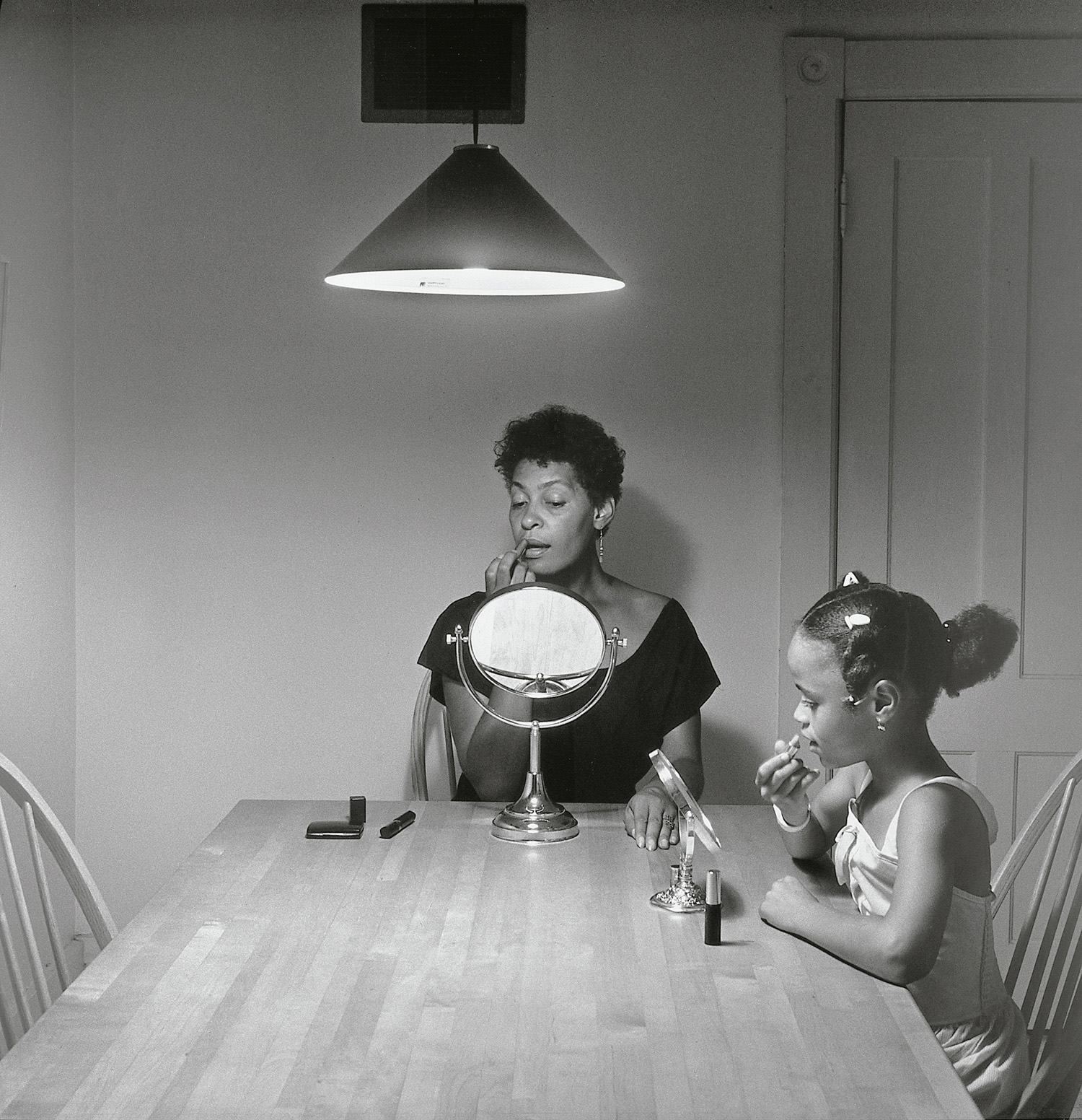
As she focuses on these subjects, Weems uses the principle of contrast as an important device in her photography. Weems exploits contrast in the image “Untitled (Woman and Daughter with Makeup)” (1.1.24) by balancing opposite shapes and values. Black and white are opposite values, and the monochromatic palette, along with the spotlight above the table, adds a level of drama to the seemingly everyday scene of a normal domestic routine. Weems arranges the organic shapes of the two figures to contrast against the geometry of the rectangular table and door, circular mirrors, and triangular light fixture. Strong differences in dark and light values are evident in the bright overhead light and the shadows. The dark clothing of the woman also contrasts with the girl’s white dress. These contrasts bring clarity to the intimate scene, which may imply that life can sometimes be tough but it contains both positive and negative experiences.
1.1.24 Carrie Mae Weems, “Untitled (Woman and Daughter with Makeup),” 1990, from Kitchen Table series, 1989–90. Inkjet print, 41¼ × 41¼ × 2¼" (framed)
1.1.24 Carrie Mae Weems, “Untitled (Woman and Daughter with Makeup),” 1990, from Kitchen Table series, 1989–90. Inkjet print, 41¼ × 41¼ × 2¼" (framed)