For the other Weems Gateway boxes, see p. 56, p. 329, and p. 687
Gateway to Art: Weems, Kitchen Table Series
Personal and Cultural Narrative
For the other Weems Gateway boxes, see p. 56, p. 329, and p. 687
The American artist Carrie Mae Weems (b. 1953) has always been fascinated by stories. Her Kitchen Table series (3.10.8), centers around a common piece of household furniture, the kitchen table. It recalls old sayings about everyone congregating in the kitchen and the kitchen table being the site of the most important discoveries, memories, and decisions.
Twenty photographs and seventeen text panels in the series tell a story about a fictional character and the relationships that develop in her home. The photos and text can each function on their own or, when considered together, they form a third thing. Overall, the texts serve to highlight the struggles the woman faces as she tries to balance personal aspirations with domestic and interpersonal obligations. The last photographs of the series show the woman by herself, as her journey of self-discovery ends with empowerment and inner peace.
T&H Video: Photography |
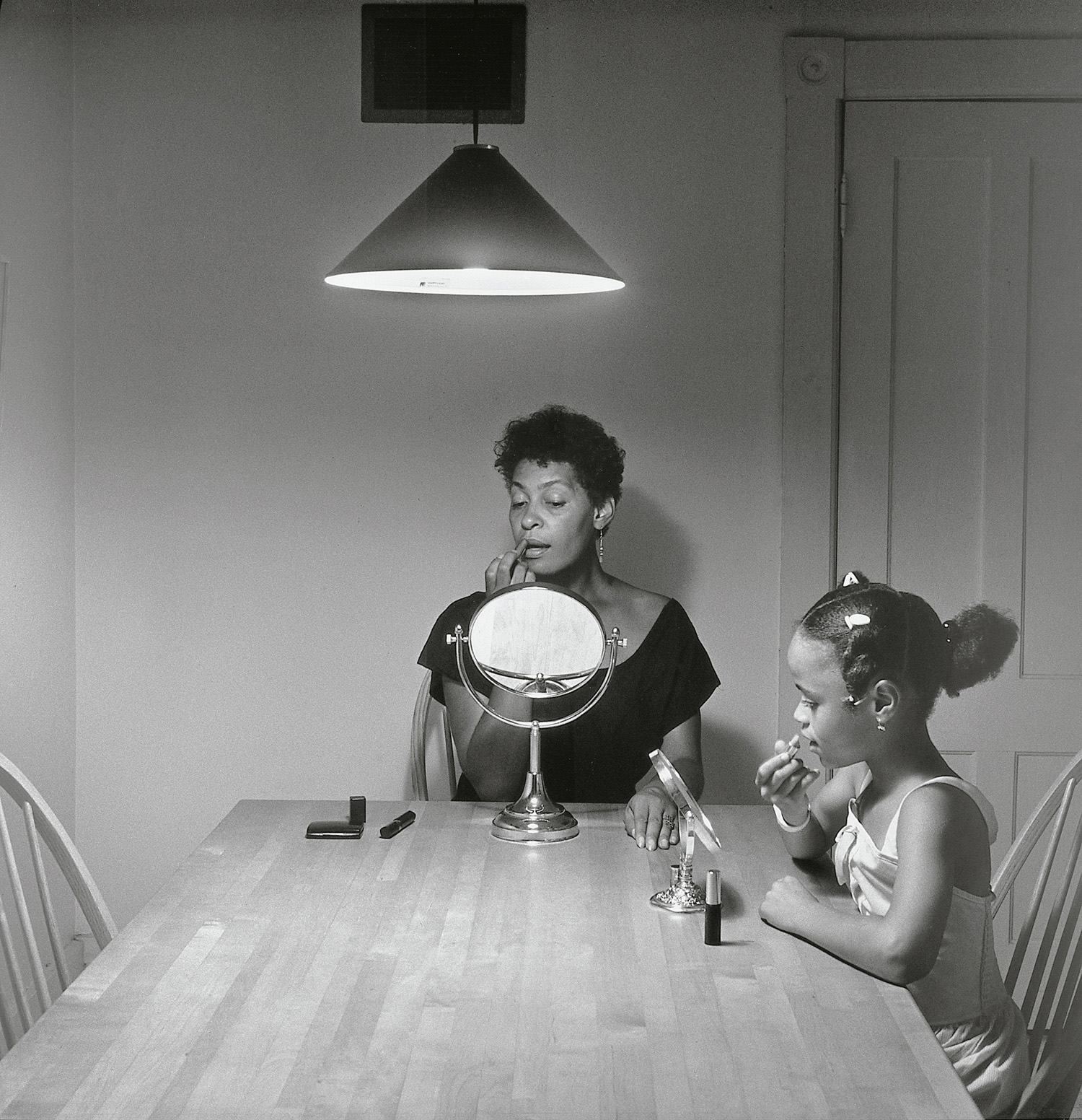
The photograph featured in 3.10.8 shows the woman seated at the table with a young girl, both of them applying lipstick with a few extra tubes on the table. The girl’s age is enhanced by her youthful hairstyle and smaller mirror. We do not see her seeking guidance, though, as they both focus independently on the task at hand, perhaps suggesting a parallel development with a hint of growing up too fast. This moment of generational bonding is also a moment of transition, like a rite of passage into womanhood.
3.10.8 Carrie Mae Weems, “Untitled (Woman and Daughter with Makeup),” 1990, from Kitchen Table series, 1989–90. Inkjet print, 41¼ × 41¼ × 2¼" (framed)
3.10.8 Carrie Mae Weems, “Untitled (Woman and Daughter with Makeup),” 1990, from Kitchen Table series, 1989–90. Inkjet print, 41¼ × 41¼ × 2¼" (framed)
Elements of this fictional story invoke historical events. Because the character is not given a name (and because Weems herself plays the main character), the self-portraits are sometimes interpreted as autobiographical. They do not document moments in the artist’s own life, however. Her daughter, for example, was around twenty years old at the time the Kitchen Table series was made.
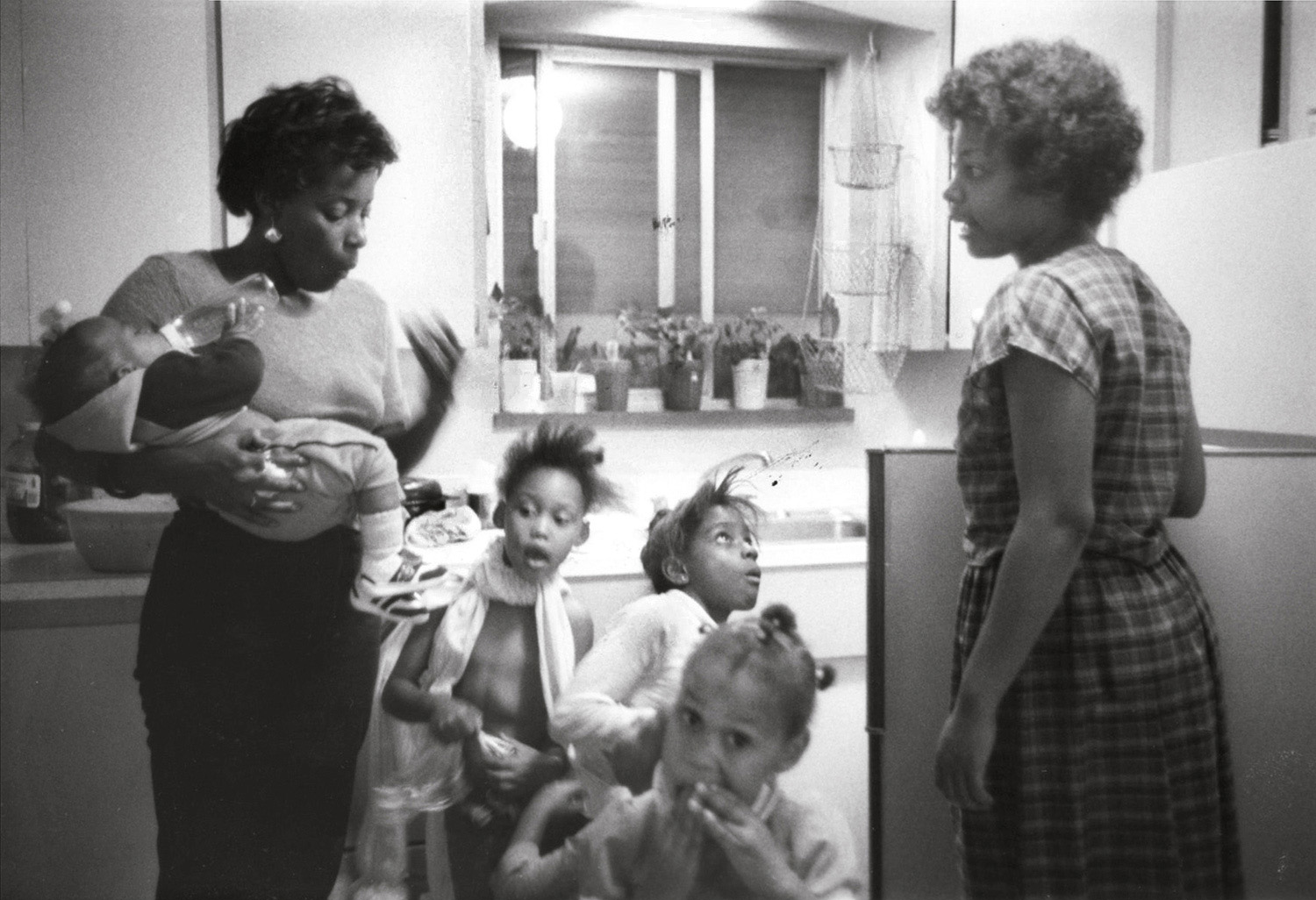
A few years before, though, Weems created Family Pictures and Stories (3.10.9) with snapshots of her actual family and an accompanying oral-history recording. She was responding to the controversial Moynihan Report of 1965, which attributes crumbling socio-economic conditions for poor blacks and, by extension race-relation challenges, to the single-parent African American family led by mothers. Weems’s response was to simultaneously move away from and engage the generalizations. The stories she tells are,often unidealized presentations of complex realities. While the Family Pictures series is more documentary and the Kitchen Table series is constructed, both of them present love and support triumphing alongside dysfunction, and determination generated by, yet overcoming, struggle.