 The Populist Movement
THE POPULIST CHALLENGE
The Farmers’ Revolt
Even as labor unrest crested, a different kind of uprising was ripening in the South and the trans-Mississippi West, a response to falling agricultural prices and growing economic dependency in rural areas. Like industrial workers, small farmers faced increasing economic insecurity. In the South, the sharecropping system, discussed in Chapter 15, locked millions of tenant farmers, white and Black, into perpetual poverty. The interruption of cotton exports during the Civil War had led to the rapid expansion of production in India, Egypt, and Brazil. The glut of cotton on the world market when southern production resumed led to declining prices (from 11 cents a pound in 1881 to 4.6 cents in 1894), throwing millions of small farmers deep into debt and threatening them with the loss of their land. In the West, farmers who had mortgaged their property to purchase seed, fertilizer, and equipment faced the prospect of losing their farms when unable to repay their bank loans. Farmers increasingly believed that their plight derived from the high freight rates charged by railroad companies, excessive interest rates for loans from merchants and bankers, and the fiscal policies of the federal government (discussed in the previous chapter) that reduced the supply of money and helped to push down farm prices.
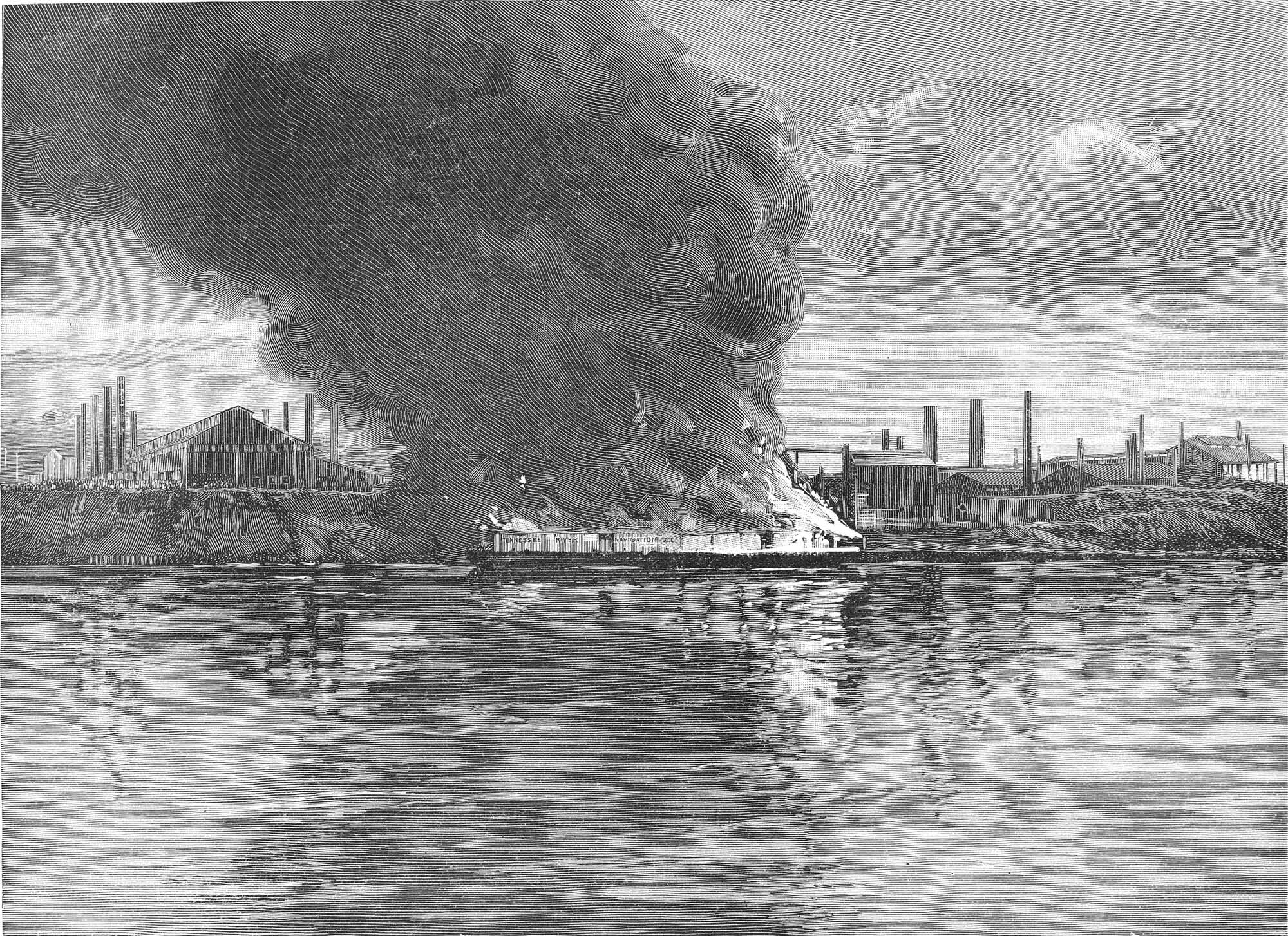
In the most violent encounter of the Homestead strike of 1892, strikers took part in a day-long battle with 300 private policemen from the Pinkerton Agency, eventually setting fire to the agents’ barge. The Pinkertons surrendered, but Andrew Carnegie succeeded in crushing the strikers and their union, the Amalgamated Association.
Through the Farmers’ Alliance, the largest citizens’ movement of the nineteenth century, farmers sought to remedy their condition. Founded in Texas in the late 1870s, the Alliance spread to forty-three states by 1890. At first, the Alliance remained aloof from politics, attempting to improve rural conditions by the cooperative financing and marketing of crops. Alliance “exchanges” would loan money to farmers and sell their produce. But it soon became clear that farmers on their own could not finance this plan, and banks refused to extend loans to the exchanges. The Alliance therefore proposed that the federal government establish warehouses where farmers could store their crops until they were sold. Using the crops as collateral, the government would then issue loans to farmers at low interest rates, thereby ending their dependence on bankers and merchants. Since it would have to be enacted by Congress, the “subtreasury plan,” as this proposal was called, led the Alliance into politics.
The People’s Party
In the early 1890s, the Alliance evolved into the People’s Party (or Populists), the era’s greatest political insurgency. The party did not just appeal to farmers. It sought to speak for all the “producing classes” and achieved some of its greatest successes in states like Colorado and Idaho, where it won the support of miners and industrial workers. But its major base lay in the cotton and wheat belts of the South and West.
The Populists embarked on a remarkable effort of community organization and education. To spread their message they published numerous pamphlets on political and economic questions, established more than 1,000 local newspapers, and sent traveling speakers throughout rural America. Wearing “a huge Black sombrero and a Black Prince Albert coat,” Texas Populist orator “Cyclone” Davis traveled the Great Plains accompanied by the writings of Thomas Jefferson, which he quoted to demonstrate the evils of banks and large corporations. At great gatherings on the western plains, similar in some ways to religious revival meetings, and in small-town southern country stores, one observer wrote, “people talked who had seldom spoken. . . . Little by little they commenced to theorize upon their condition.”
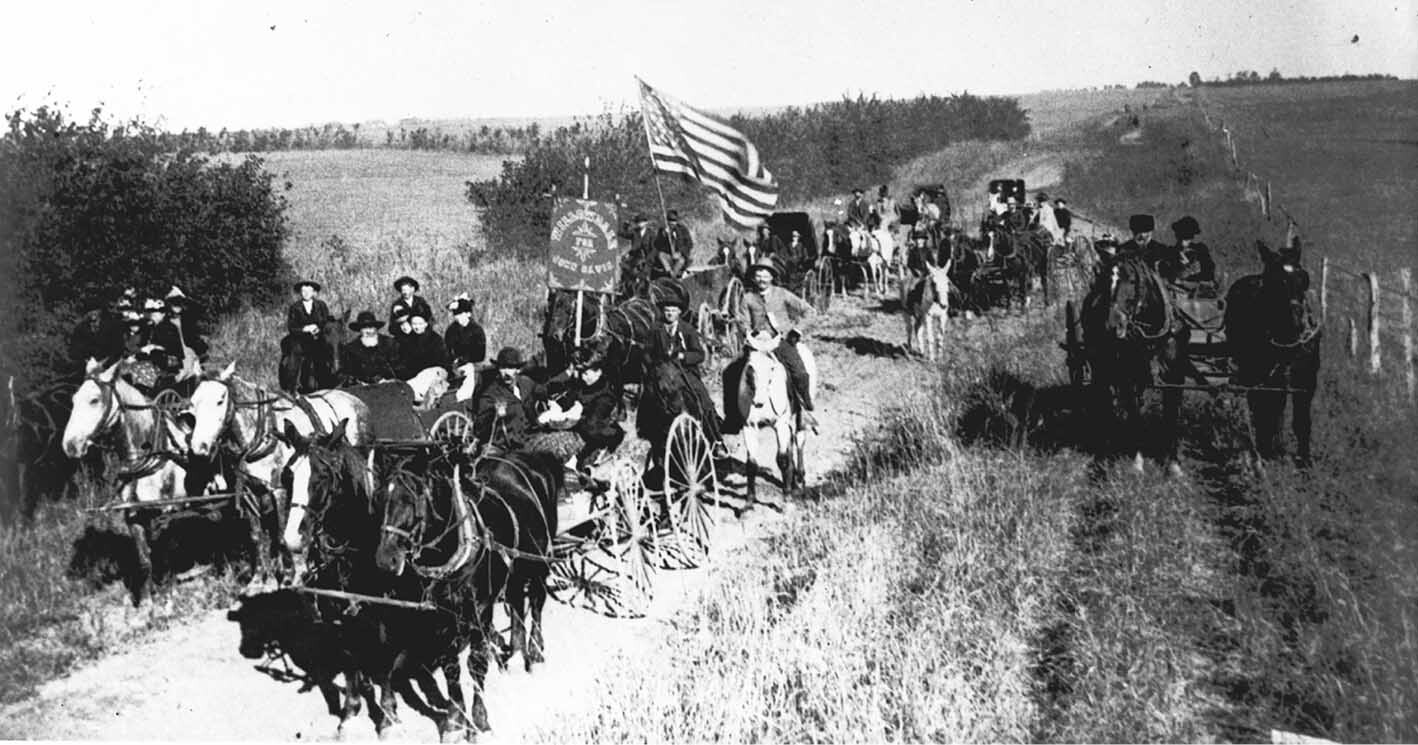
A group of Kansas Populists, perhaps on their way to a political gathering, in a photograph from the 1890s.
Here was the last great political expression of the nineteenth-century vision of America as a commonwealth of small producers whose freedom rested on the ownership of productive property and respect for the dignity of labor. “Day by day,” declared the People’s Party Paper of Georgia in 1893, “the power of the individual sinks. Day by day the power of the classes, or the corporations, rises. . . . In all essential respects, the republic of our fathers is dead.”
But although the Populists used the familiar language of nineteenth-century radicalism, they were hardly a backward-looking movement. They embraced the modern technologies that made large-scale cooperative enterprise possible—the railroad, the telegraph, and the national market—while looking to the federal government to regulate them in the public interest. They promoted agricultural education and believed farmers should adopt modern scientific methods of cultivation. They believed the federal government could move beyond partisan conflict to operate in a businesslike manner to promote the public good—a vision soon to be associated with the Progressive movement and, many years later, presidents Jimmy Carter and Barack Obama.
The Populist Platform
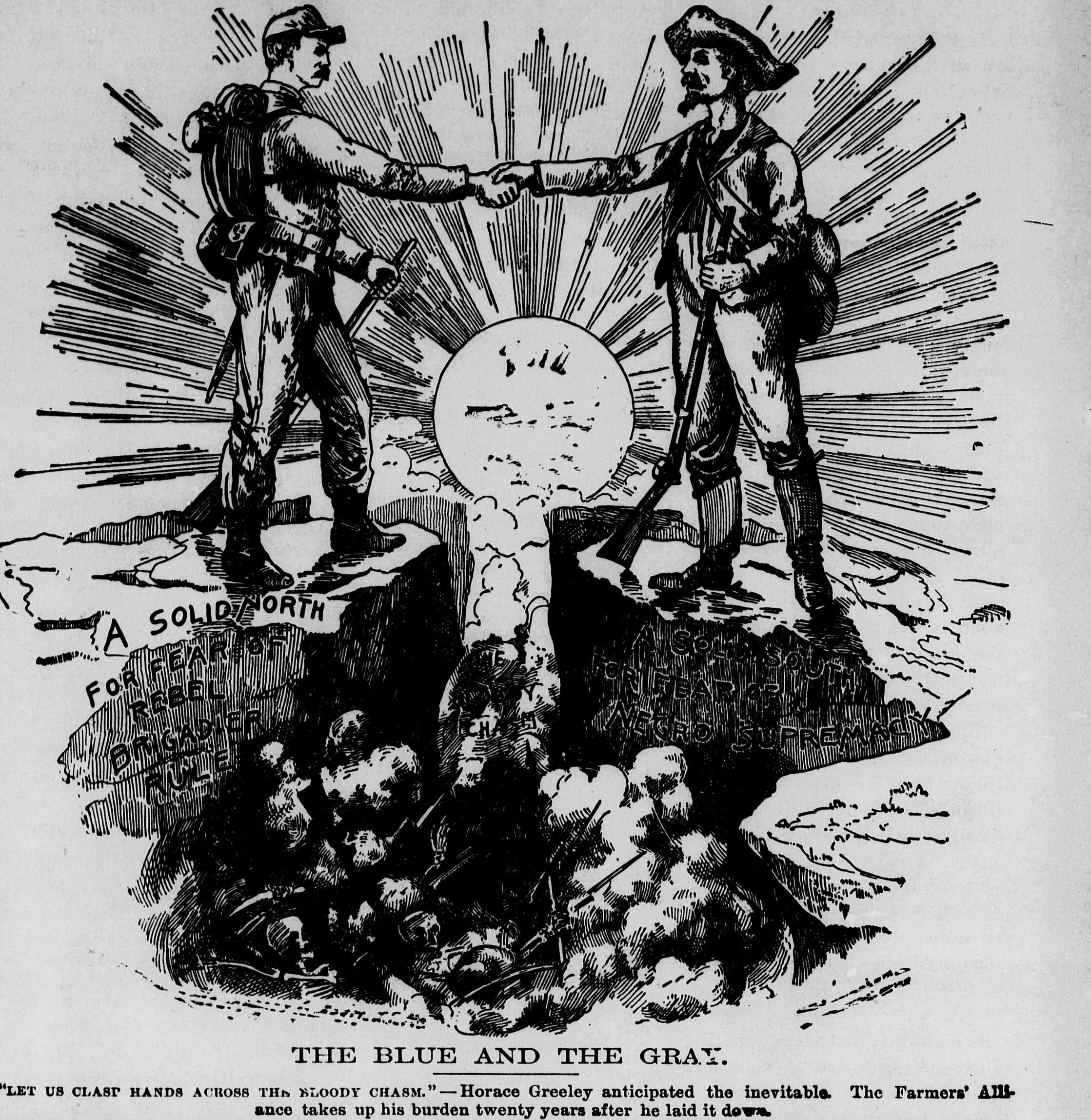
In an 1891 cartoon from a Texas Populist newspaper, northern and southern Civil War veterans clasp hands across the “bloody chasm” (a phrase first used by the New York editor Horace Greeley during his campaign for president in 1872). Beneath each figure is an explanation of why voting alignments have previously been based on sectionalism—the North fears “rebel” rule, the white South “Negro supremacy.”
The Populist platform of 1892, adopted at the party’s Omaha convention, remains a classic document of American reform (see the Appendix for the full text). Written by Ignatius Donnelly, a Minnesota editor and former Radical Republican congressman during Reconstruction, it spoke of a nation “brought to the verge of moral, political, and material ruin” by political corruption and economic inequality. “The fruits of the toil of millions,” the platform declared, “are boldly stolen to build up colossal fortunes . . . while their possessors despise the republic and endanger liberty.” The platform put forth a long list of proposals to restore democracy and economic opportunity, many of which would be adopted during the next half-century: the direct election of U.S. senators, government control of the currency, a graduated income tax, a system of low-cost public financing to enable farmers to market their crops, and recognition of the right of workers to form labor unions. In addition, Populists called for public ownership of the railroads to guarantee farmers inexpensive access to markets for their crops. A generation would pass before a major party offered so sweeping a plan for political action to create the social conditions of freedom.
The Populist Coalition
In some southern states, the Populists made remarkable efforts to unite Black and white small farmers on a common political and economic program. The obstacles to such an alliance were immense—not merely the heritage of racism and the political legacy of the Civil War, but the fact that many white Populists were landowning farmers while most Blacks were tenants and agricultural laborers. Unwelcome in the southern branches of the Farmers’ Alliance, Black farmers formed their own organization, the Colored Farmers’ Alliance.
In general, southern white Populists’ racial attitudes did not differ significantly from those of their non-Populist neighbors. Nonetheless, recognizing the need for allies to break the Democratic Party’s stranglehold on power in the South, some white Populists insisted that Black and white farmers shared common grievances and could unite for common goals. Tom Watson, Georgia’s leading Populist, worked the hardest to forge a Black-white alliance. “You are kept apart,” he told interracial audiences, “that you may be separately fleeced of your earnings. . . . This race antagonism perpetuates a monetary system which beggars both.” While many Blacks refused to abandon the party of Lincoln, others were attracted by the Populist appeal. In 1894, a coalition of white Populists and Black Republicans won control of North Carolina, bringing to the state a “second Reconstruction” complete with increased spending on public education and a revival of Black officeholding. In most of the South, however, Democrats fended off the Populist challenge by resorting to the tactics they had used to retain power since the 1870s—mobilizing whites with warnings about “Negro supremacy,” intimidating Black voters, and stuffing ballot boxes on election day.
POPULIST STRENGTH, 1892
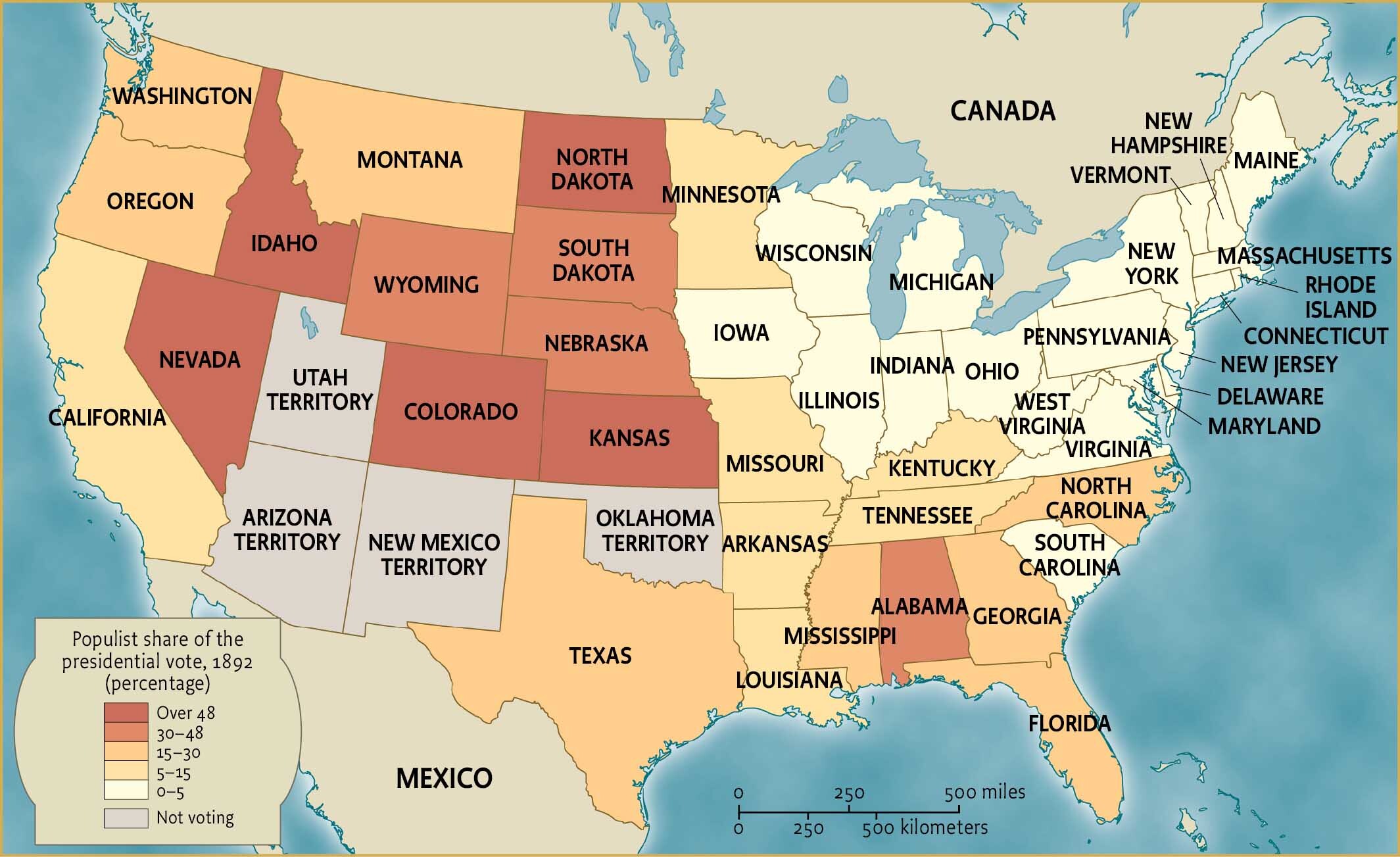
More information
Color-coded map of the United States illustrating sectional divisions during the 19th century, likely related to slavery or political alignment. States and territories are shaded in different colors to represent categories such as free states, slave states, and disputed or newly acquired territories. The map includes labeled regions across the West, Midwest, South, and Northeast, with clear boundaries and state names. A legend explains the color scheme, indicating how each region aligns politically or economically.
The Populist movement also engaged the energies of thousands of reform-minded women from farm and labor backgrounds. Some, like Mary Elizabeth Lease, a former homesteader and one of the first female lawyers in Kansas, became prominent organizers, campaigners, and strategists. Lease was famous for her speeches urging farmers to “raise less corn and more hell” (although she apparently never uttered those exact words, which would have been considered inappropriate for a woman in public). “We fought England for our liberty,” Lease declared, “and put chains on four million Blacks. We wiped out slavery and . . . began a system of white wage slavery worse than the first.” During the 1890s, referendums in Colorado and Idaho approved extending the vote to women, while in Kansas and California the proposal went down in defeat. Populists in all these states endorsed women’s suffrage.
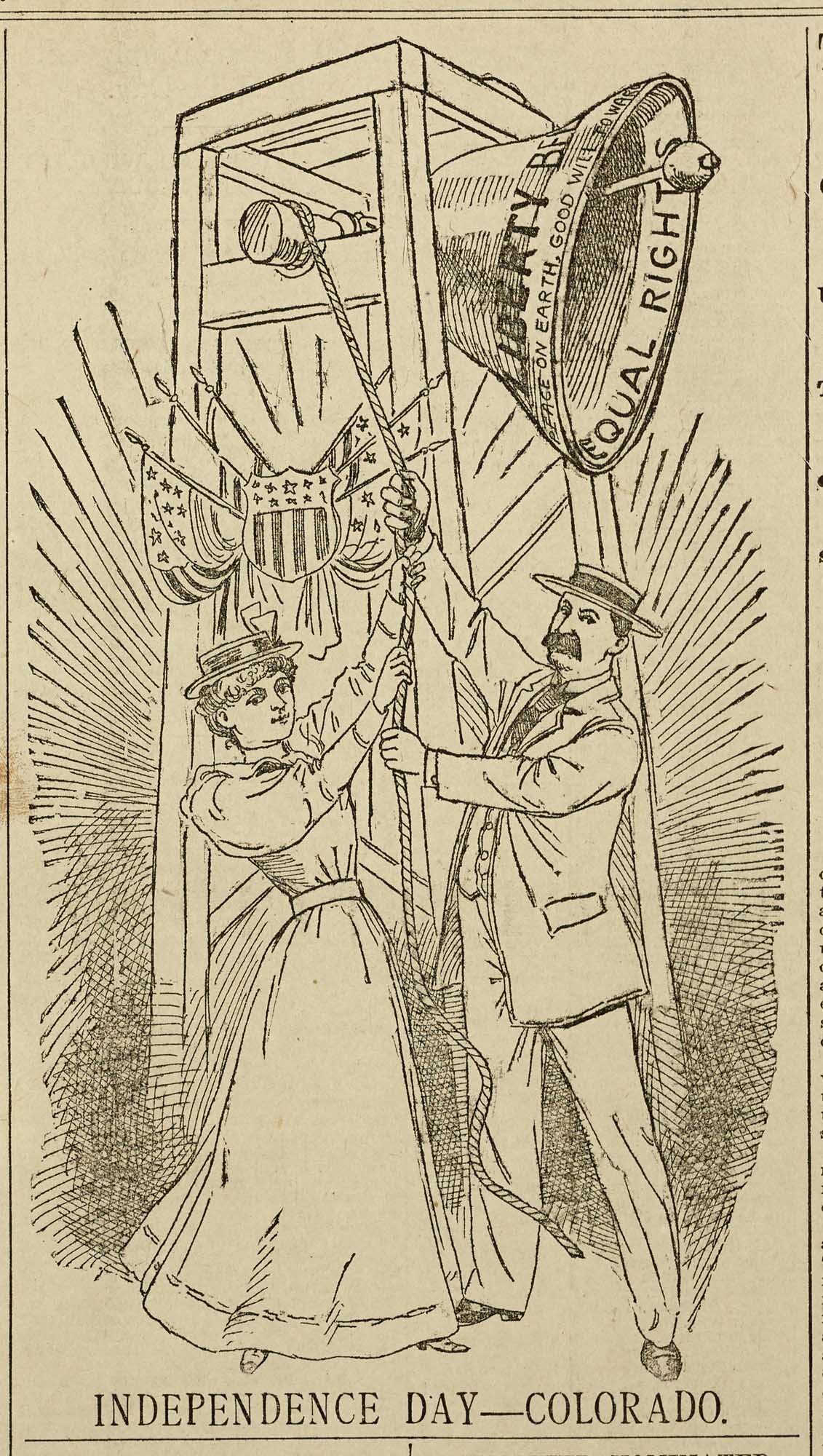
Most Populists in the West supported woman suffrage. In this cartoon published in a Colorado Populist newspaper on July 4, 1894, a man and a woman celebrate the passage of a referendum giving women the right to vote in that state.
Populist presidential candidate James Weaver received more than 1 million votes in 1892. The party carried five western states, with twenty-two electoral votes, and elected three governors and fifteen members of Congress. In his inaugural address in 1893, Lorenzo Lewelling, the new Populist governor of Kansas, anticipated a phrase made famous seventy years later by Martin Luther King Jr.: “I have a dream. . . . In the beautiful vision of a coming time I behold the abolition of poverty. A time is foreshadowed when . . . liberty, equality, and justice shall have permanent abiding places in the republic.”
The Government and Labor
Were the Populists on the verge of replacing one of the two major parties? The severe depression that began in 1893 led to increased conflict between capital and labor and seemed to create an opportunity for expanding the Populist vote. Time and again, employers brought state or federal authority to bear to protect their own economic power or put down threats to public order. Even before the economic downturn, in 1892, the governor of Idaho declared martial law and sent militia units and federal troops into the mining region of Coeur d’Alene to break a strike. In May 1894, the federal government deployed soldiers to disperse Coxey’s Army—a band of several hundred unemployed men led by Ohio businessman Jacob Coxey, who marched to Washington demanding economic relief.
Also in 1894, workers in the company-owned town of Pullman, Illinois, where railroad sleeping cars were manufactured, called a strike to protest a reduction in wages. The American Railway Union, whose 150,000 members included both skilled and unskilled railroad laborers, announced that its members would refuse to handle trains with Pullman cars. When the boycott crippled national rail service, President Grover Cleveland’s attorney general, Richard Olney (himself on the board of several railroad companies), obtained a federal court injunction ordering the strikers back to work. Federal troops and U.S. marshals soon occupied railroad centers like Chicago and Sacramento.
The strike collapsed when the union’s leaders, including its charismatic president, Eugene V. Debs, were jailed for contempt of court for violating the judicial order. In the case of In re Debs, the Supreme Court unanimously confirmed the sentences and approved the use of injunctions against striking labor unions. On his release from prison in November 1895, more than 100,000 persons greeted Debs at a Chicago railroad depot.
The Rise of the AFL
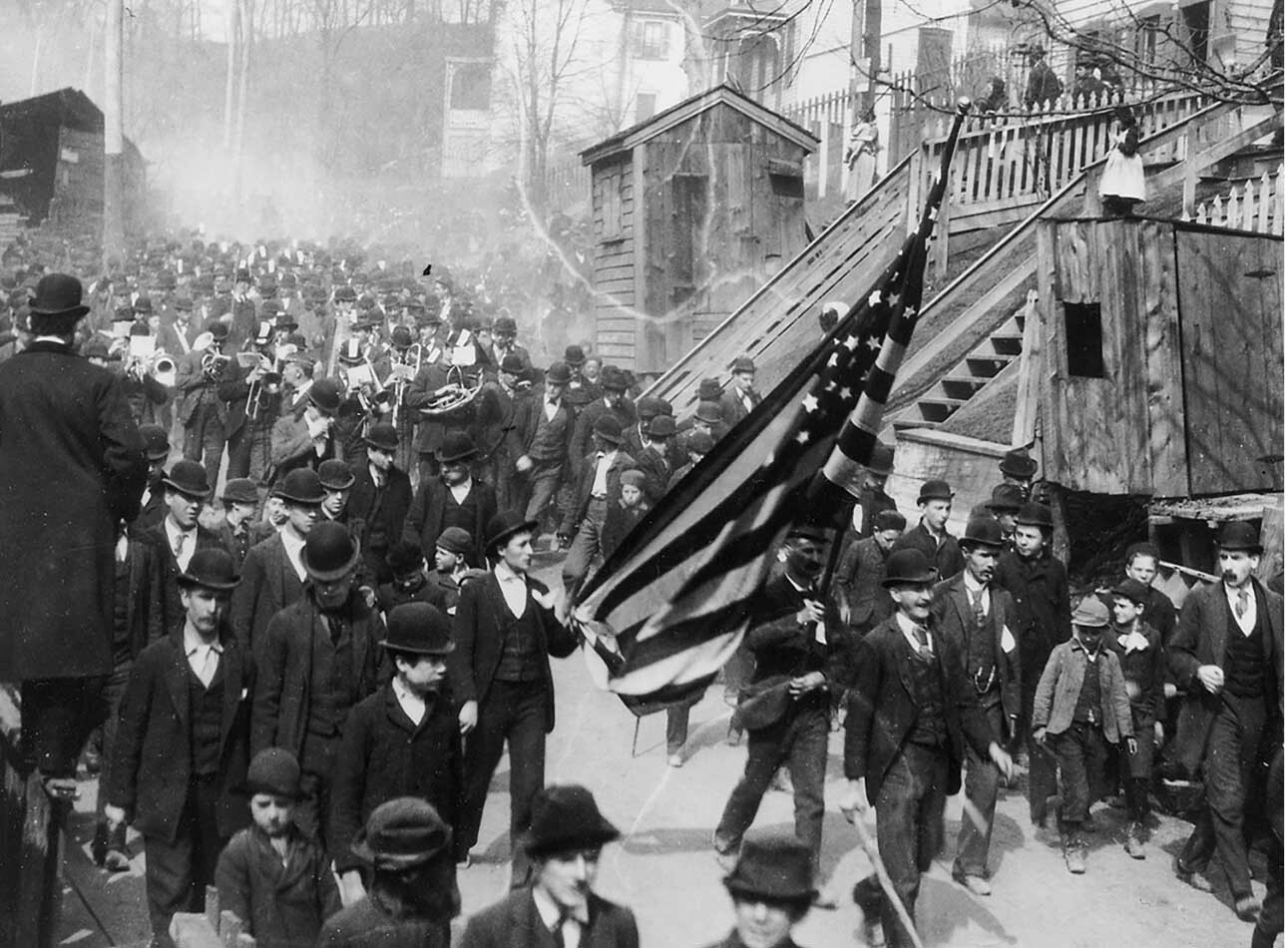
Coxey’s Army on the march in 1894.
Within the labor movement, the demise of the Knights of Labor and the ascendancy of the American Federation of Labor (AFL) during the 1890s reflected the shift away from a broadly reformist past to more limited goals. As the Homestead and Pullman strikes demonstrated, direct confrontations with large corporations were likely to prove suicidal. AFL founder and longtime president Samuel Gompers declared that unions should not seek economic independence, pursue the Knights’ utopian dream of creating a “cooperative commonwealth,” or form independent parties with the aim of achieving power in government. Rather, the labor movement should devote itself to negotiating with employers for higher wages and better working conditions for its members. Like Booker T. Washington, Gompers spoke the language of the era’s business culture. Indeed, the AFL policies he pioneered were known as “business unionism.” Gompers embraced the idea of “freedom of contract,” shrewdly turning it into an argument against interference by judges with workers’ right to organize unions.
During the 1890s, union membership rebounded from its decline in the late 1880s. But at the same time, the labor movement became less and less inclusive. Abandoning the Knights’ ideal of labor solidarity, the AFL restricted membership to skilled workers—a small minority of the labor force—effectively excluding the vast majority of unskilled workers and, therefore, nearly all Blacks, women, and new European immigrants. AFL membership centered on sectors of the economy like printing and building construction that were dominated by small competitive businesses. AFL unions had little presence in basic industries like steel and rubber or in the large-scale factories that now dominated the economy.
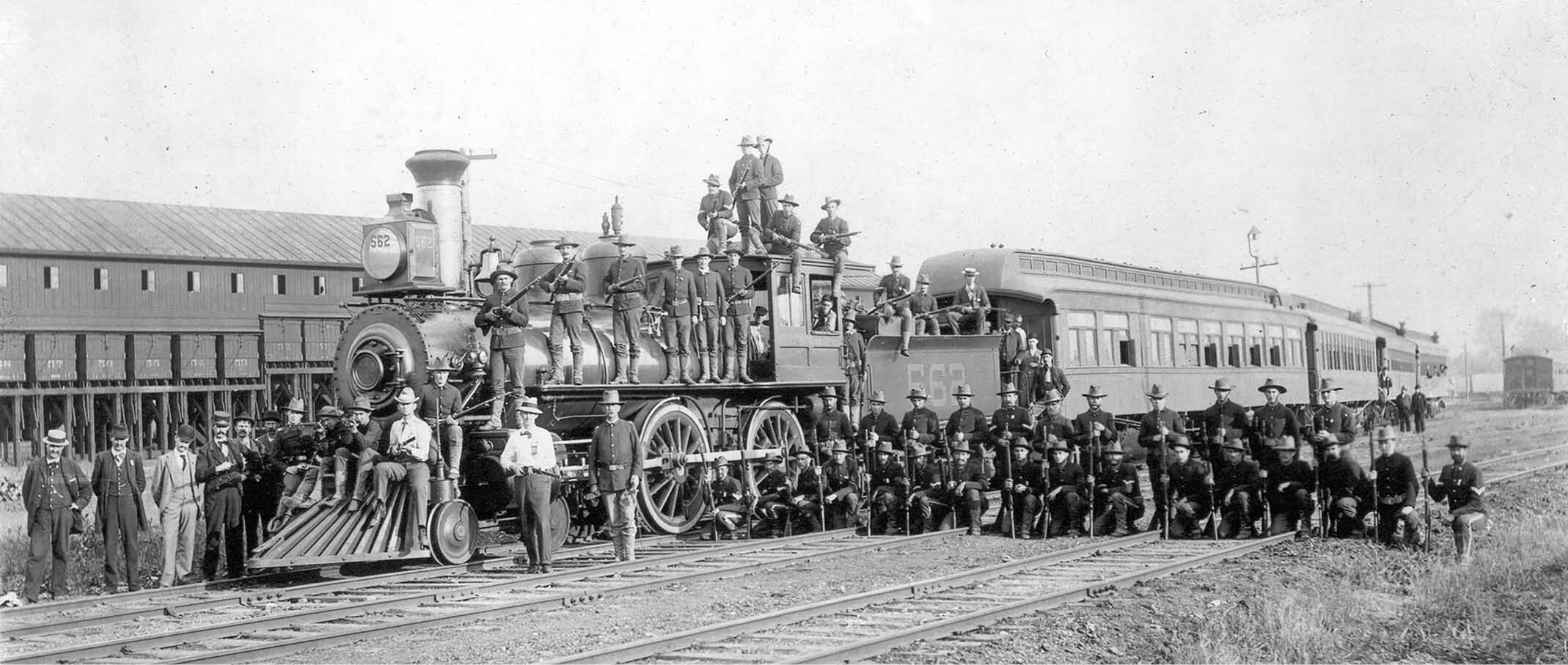
Federal troops pose atop a railroad engine after being sent to Chicago to help suppress the Pullman Strike of 1894.
Populism and Labor
In 1894, Populists made determined efforts to appeal to industrial workers. Populist senators supported the demand of Coxey’s Army for federal unemployment relief, and Governor Davis Waite of Colorado, who had edited a labor newspaper before his election, sent the militia to protect striking miners against company police. In the state and congressional elections of that year, as the economic depression deepened, voters by the millions abandoned the Democratic Party of President Cleveland.
In rural areas, the Populist vote increased in 1894. But urban workers did not rally to the Populists, whose demand for higher prices for farm goods would raise the cost of food and reduce the value of workers’ wages. Moreover, the revivalist atmosphere of many Populist gatherings and the biblical cadences of Populist speeches were alien to the largely immigrant and Catholic industrial working class. Urban working-class voters in 1894 instead shifted en masse to the Republicans, who claimed that raising tariff rates (which Democrats had recently reduced) would restore prosperity by protecting manufacturers and industrial workers from the competition of imported goods and cheap foreign labor. In one of the most decisive shifts in congressional power in American history, the Republicans gained 117 seats in the House of Representatives.
Bryan and Free Silver
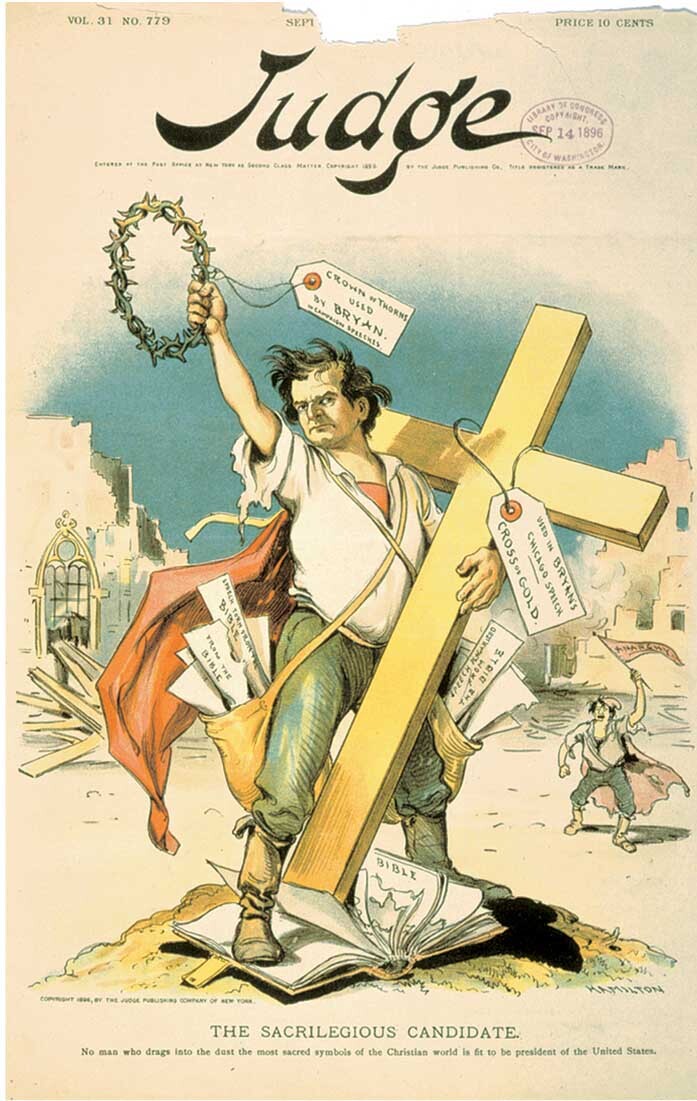
A cartoon from the magazine Judge, September 14, 1896, condemns William Jennings Bryan and his “cross of gold” speech for defiling the symbols of Christianity. Bryan tramples on the Bible while holding his golden cross; a vandalized church is visible in the background.
In 1896, Democrats and Populists joined to support William Jennings Bryan for the presidency. A thirty-six-year-old congressman from Nebraska, Bryan won the Democratic nomination after delivering to the national convention an electrifying speech that crystallized the farmers’ pride and grievances. “Burn down your cities and leave our farms,” Bryan proclaimed, “and your cities will spring up again as if by magic; but destroy our farms and grass will grow in the streets of every city in the country.” Bryan called for the “free coinage” of silver—the unrestricted minting of silver money. In language ringing with biblical imagery, Bryan condemned the gold standard: “You shall not press down upon the brow of labor this crown of thorns. You shall not crucify mankind upon a cross of gold.”
At various points in the nineteenth century, from debates over “hard” versus “soft” money in the Jacksonian era to the greenback movement after the Civil War, the “money question” played a central role in American politics. Bryan’s demand for “free silver” was the latest expression of the view that increasing the amount of currency in circulation would raise the prices farmers received for their crops and make it easier to pay off their debts.
There was more to Bryan’s appeal, however, than simply free silver. A devoutly religious man, he was strongly influenced by the Social Gospel movement (discussed in the previous chapter) and tried to apply the teachings of Jesus Christ to uplifting the “little people” of the United States.
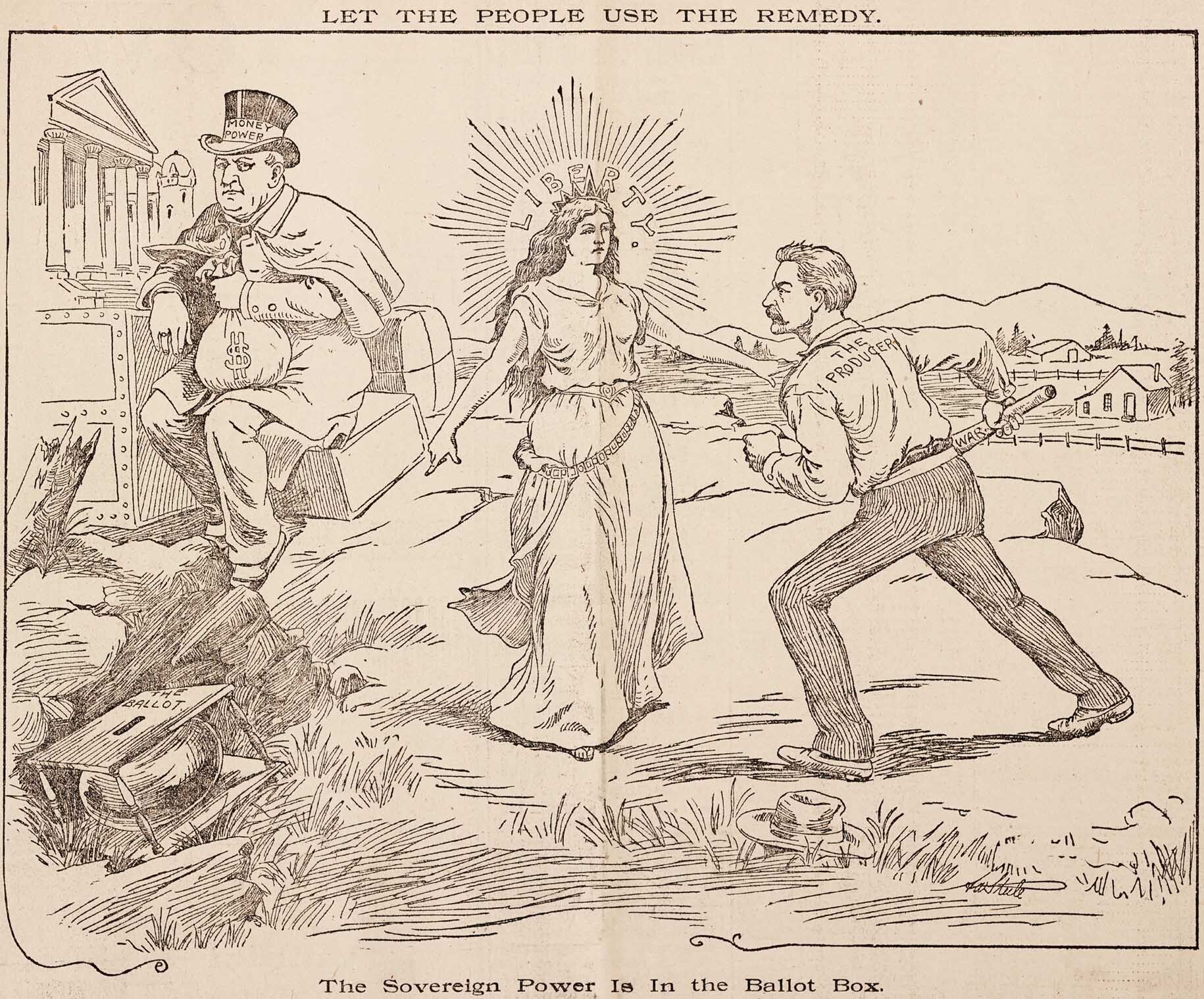
In another Populist cartoon from a Colorado newspaper, the figure of Liberty directs a member of the producing classes to use the ballot box to combat the “money power.”
Many Populists were initially cool to Bryan’s campaign. Their party had been defrauded time and again by Democrats in the South. But realizing that they could not secure victory alone, the party’s leaders endorsed Bryan’s candidacy. Bryan broke with tradition and embarked on a nationwide speaking tour, seeking to rally farmers and workers to his cause.
The Campaign of 1896
Republicans met the silverite challenge head on, insisting that gold was the only “honest” currency. Abandoning the gold standard, they insisted, would destroy business confidence and prevent recovery from the depression by making creditors unwilling to extend loans, since they could not be certain of the value of the money in which they would be repaid. The party nominated for president Ohio governor William McKinley, who as a congressman in 1890 had shepherded to passage the strongly protectionist McKinley Tariff.
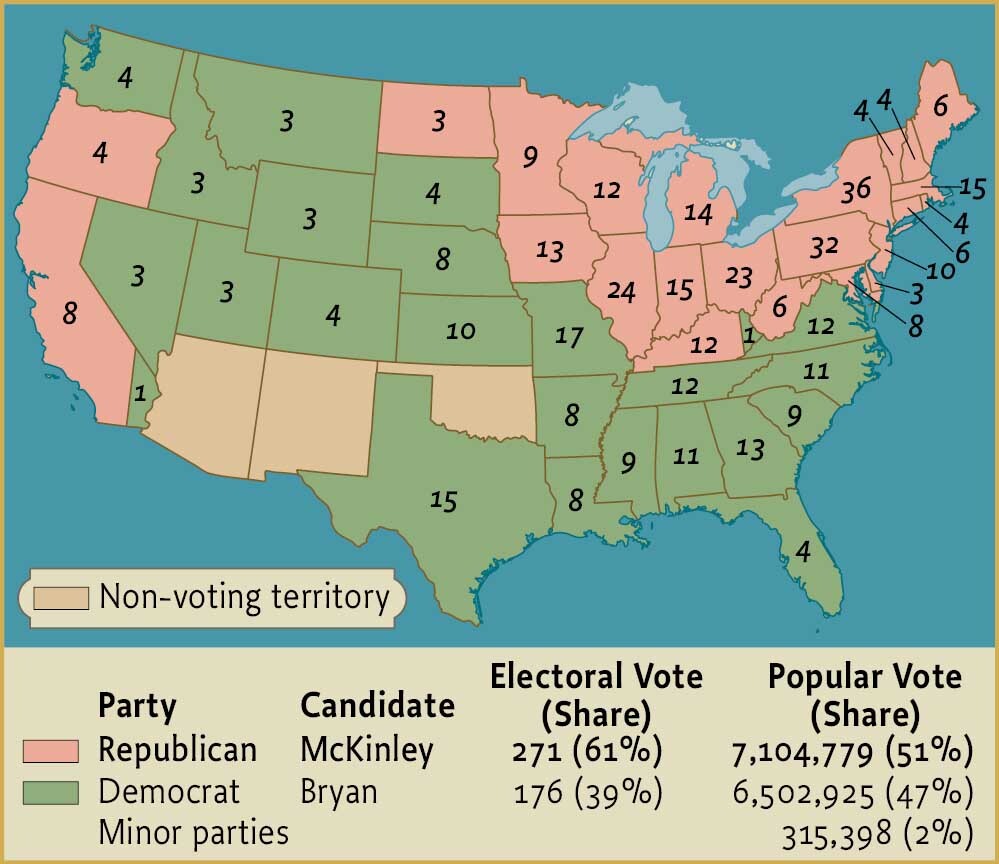
THE PRESIDENTIAL ELECTION OF 1896
More information
Color-coded map of the United States displaying the results of a 19th-century presidential election. States are shaded by political party, including Republican (green), Democratic (tan), and Constitutional Union (pink). Small numerical markers within each state indicate electoral vote counts. A legend at the bottom lists party names, candidates, and popular vote totals. The map highlights strong regional divisions, with Republicans dominating the North, Democrats concentrated in the South, and Constitutional Union support in border states.
The election of 1896 is sometimes called the first modern presidential campaign because of the amount of money spent by the Republicans and the efficiency of their national organization. Eastern bankers and industrialists, thoroughly alarmed by Bryan’s call for monetary inflation and his fiery speeches denouncing corporate arrogance, poured millions of dollars into Republican coffers. (McKinley’s campaign raised some $10 million; Bryan’s around $300,000.) While McKinley remained at his Ohio home, where he addressed crowds of supporters from his front porch, his political manager Mark Hanna created a powerful national machine that flooded the country with pamphlets, posters, and campaign buttons.
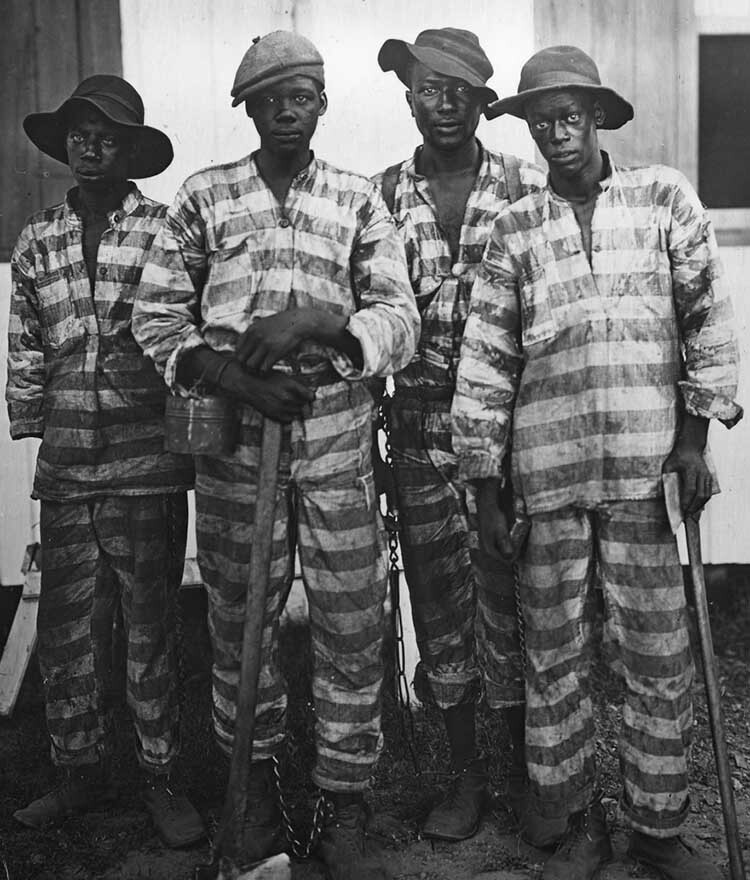
A group of Florida convict laborers. Southern states notoriously used convicts for public labor or leased them out to work in dire conditions for private employers.
The results revealed a nation as divided along regional lines as in 1860. Bryan carried the South and West and received 6.5 million votes. McKinley swept the more populous industrial states of the Northeast and Midwest, attracting 7.1 million. The era’s bitter labor strife did not carry over into the electoral arena; indeed, party politics seemed to mute class conflict rather than to reinforce it. Industrial America, from financiers and managers to workers, now voted solidly Republican, a loyalty reinforced when prosperity returned after 1897.
McKinley’s victory shattered the political stalemate that had persisted since 1876 and created one of the most enduring political majorities in American history. During McKinley’s presidency, Republicans placed their stamp on economic policy by passing the Dingley Tariff of 1897, raising rates to the highest level in history, and passing the Gold Standard Act of 1900. Not until 1932, in the midst of another economic depression, would the Democrats become the nation’s majority party. The election of 1896 also proved to be the last presidential election with extremely high voter turnout (in some states, over 90 percent of those eligible). From then on, voter participation began a downhill trend, although it rose again from the mid-1930s through the 1960s. Today, only around half the electorate casts ballots.
Glossary
- Populists
- Founded in 1892, a group that advocated a variety of reform issues, including free coinage of silver, income tax, postal savings, regulation of railroads, and direct election of U.S. senators.
- Coxey’s Army
- A march on Washington organized by Jacob Coxey, an Ohio member of the People’s Party. Coxey believed in abandoning the gold standard and printing enough legal tender to reinvigorate the economy. The marchers demanded that Congress create jobs and pay workers in paper currency not backed by gold.
- American Federation of Labor
- A federation of trade unions founded in 1881 composed mostly of skilled, white, native-born workers; its long-term president was Samuel Gompers.