Willendorf
Figurines: Human, Animal, and Hybrid
In addition to painting and engraving caves and stones, ancient artists also made figurines out of soft clay or carved stone, ivory, and bone—the same materials that they used to create the tools for cutting, shaping, polishing, and incising the sculptures. Figurines may also have been carved from wood and other perishable materials, but no such works are known to have survived. The earliest known portable figurines were found in Europe and West Asia.
While depictions of humans are extremely rare in cave imagery, figurine art seems to be a medium in which humans are more frequently depicted. In many places, female figurines are far more common than male ones, suggesting that artists and communities wanted to capture some idea of womanhood in objects that could travel with them and be handed down across generations.
Several sculpted figurines represent animals or human–animal hybrid figures. The creation of hybrid figures—images of creatures that did not exist in observable nature—indicates that the simple division between “human” and “animal” that we take for granted today may not have applied to these ancient communities. The artists may have exaggerated specific characteristics of the figures or used hybrids to express ideas beyond what they saw.
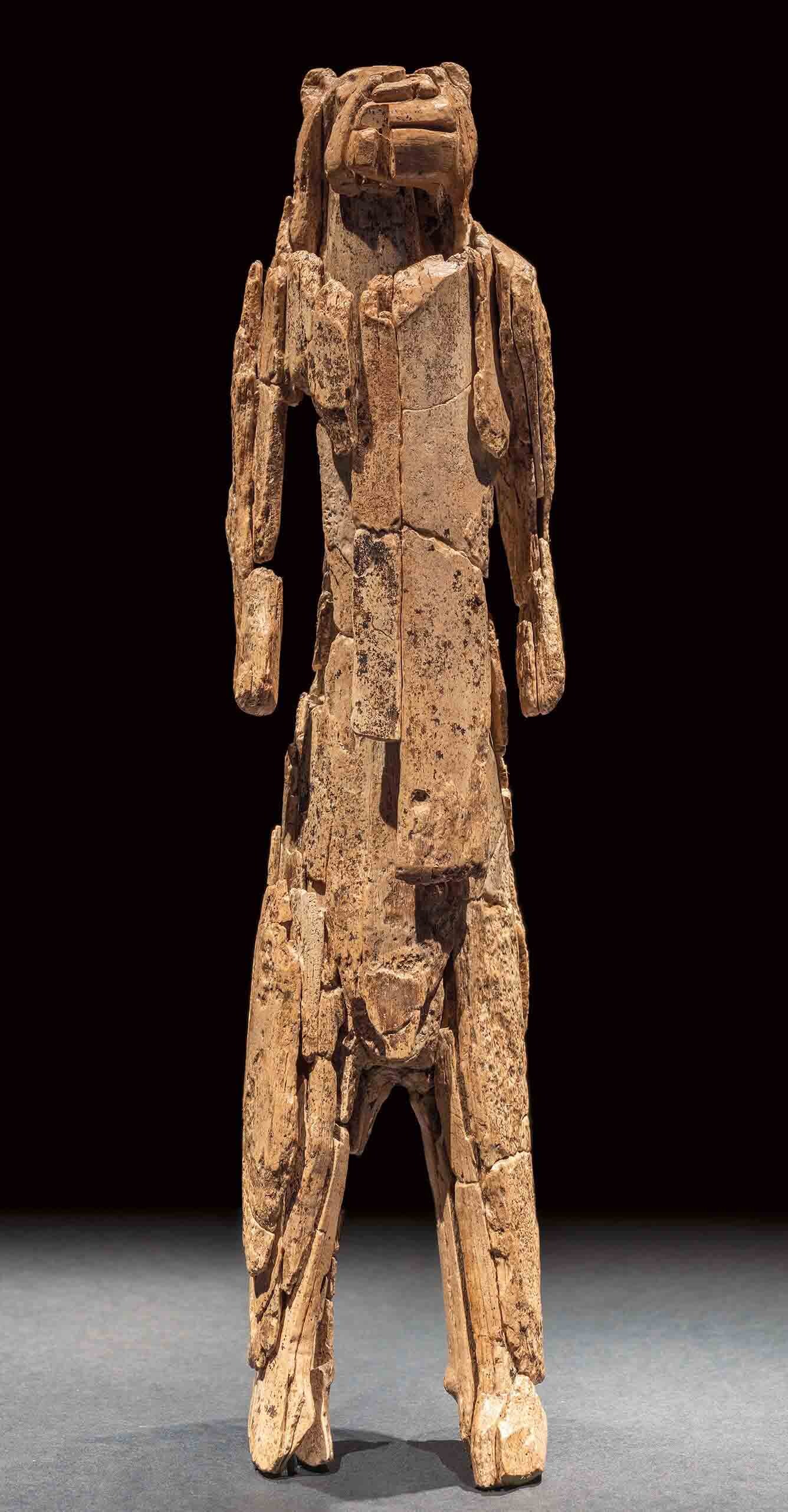
LION–HUMAN FIGURINE A very early example of a hybrid figurine is the lion–human figurine (Fig. 1.9) found in a cave in Hohlenstein-Stadel in southwest Germany, along with beads, jewelry, and worked-bone tools. This 12-inch-tall figurine was carved, using stone tools, from the ivory tusk of a mammoth. The hybrid creature has a carefully carved head of a lion but borrows the bodily posture of a human being with elaborately articulated arms and legs. Lines on the arms, as well as features such as the mouth and eyes, have been incised into the ivory. Commonly dated to approximately 40,000–35,000 BCE, this may be one of the oldest known sculptures in human history.
More information
The figure has a long, catlike torso and ears and mane like a lion, but it stands fully upright like a human being, with its chin held high.
Most of the early human figurines discovered in Europe and West Asia are naked, although humans at this time are believed to have worn clothing of some kind. While some of these small figurines do not indicate the figure’s biological sex, others have bodies with distinct or exaggerated sexual characteristics. Some are abstracted rather than naturalistic, with features missing, minimized, or suggested. It is possible that the figurines represented women and men in general, rather than specific individuals, and therefore they may reveal how early humans conceived of gender.
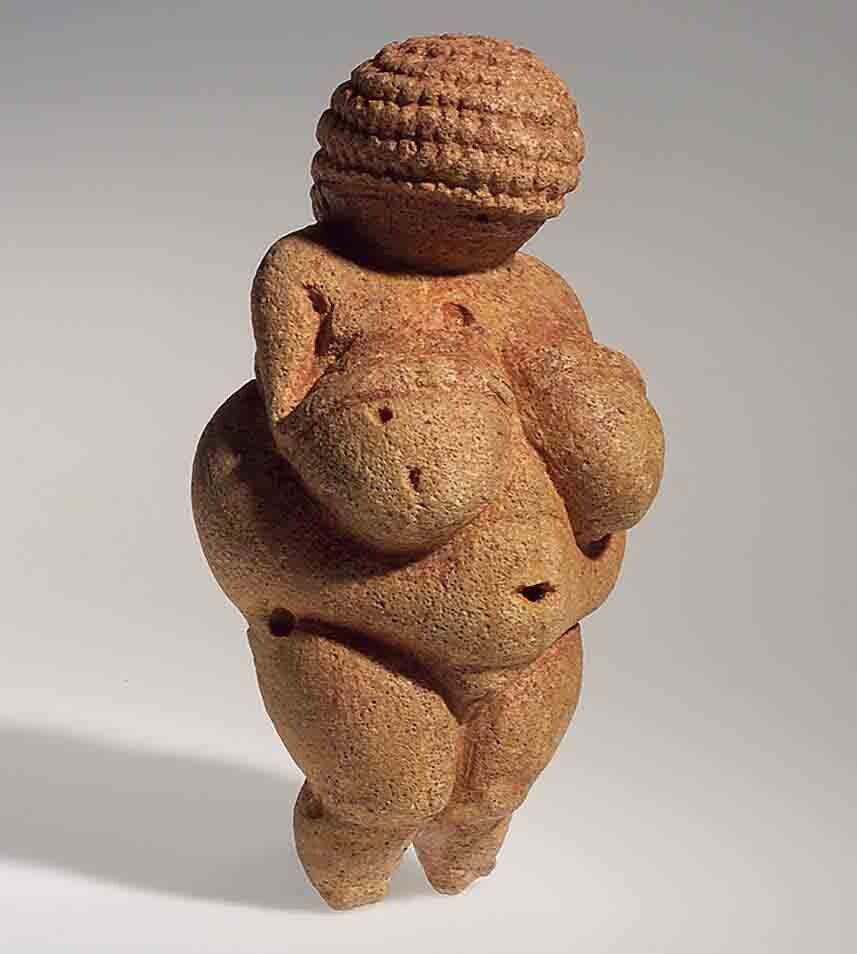
WOMAN OF WILLENDORF The artist focused considerable attention on certain aspects of female anatomy in this figurine (Fig. 1.10) when it was created around 24,000 BCE. Found in 1908 near the village of Willendorf, Austria, it is now called the Woman of Willendorf. Less than 5 inches high, the figurine has a substantial belly and a deep and pronounced navel. The thighs are solid, the hips are wide, and the vulva is clearly defined. The arms, slender compared to the rest of the body, wrap around full breasts. The slightly forward-leaning head has no facial features, but it is decorated with a highly textured pattern that is sometimes interpreted as a textile—perhaps a knitted cap—or braided hair. Given its posture and tiny feet, the figurine, like many others from this period, was probably meant to be handled or carried rather than to stand upright. The limestone from which the Woman of Willendorf was carved is not native to the region, meaning that either the raw stone or the finished figure was transported from one place to another. Originally, it was colored red with ocher pigment.
More information
The figure has large breasts and hips. The small forearms rest atop the breasts. The genitals are carefully defined. The head is bowed, with no facial features apparent. The hair or headdress appears as a tidy pattern of braids or rows of knitted material.
More information
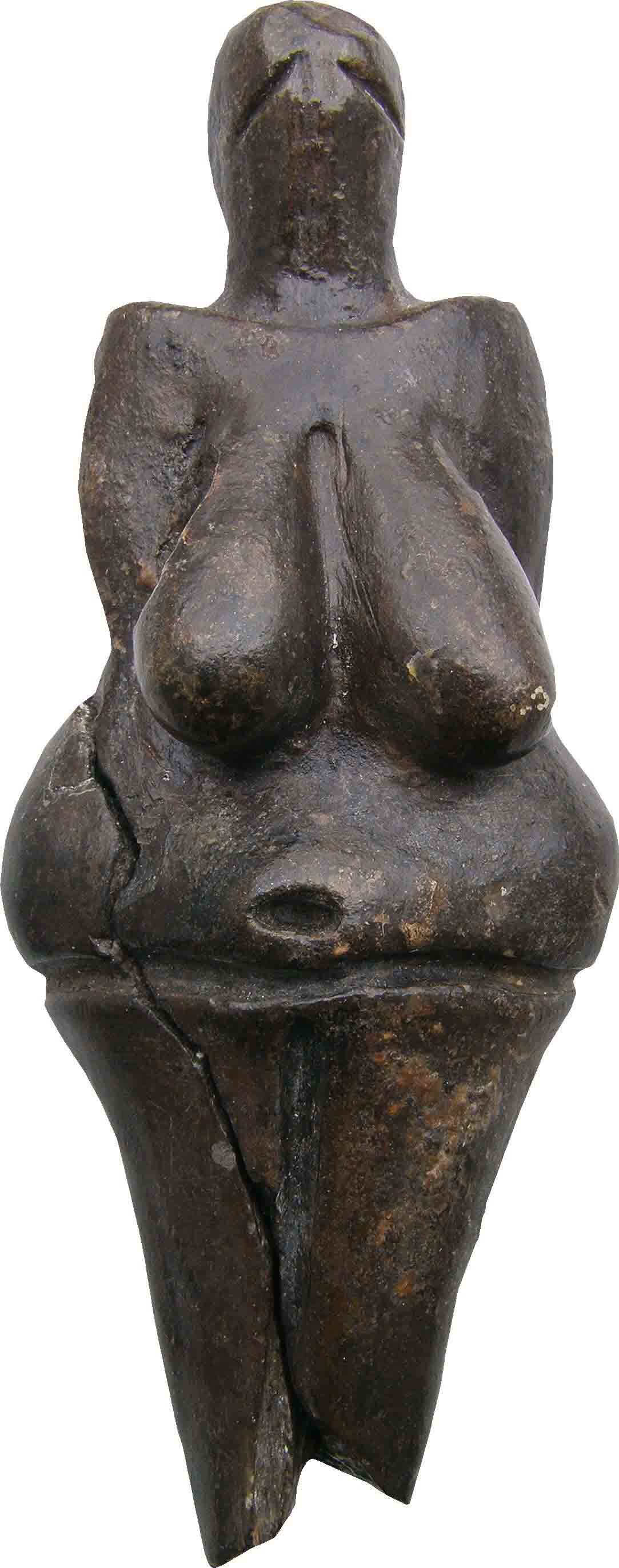
The prominent features on the torso are large, pendulous breasts, a deep navel, and wide hips. The only detailing on the head is two long, downward slanting slits, possibly intended for eyes. A crack runs through the right hip and leg.
Dolní Věstonice
CERAMIC FEMALE FIGURINE Other figurines from roughly the same period were made of clay rather than carved from rock. In 1925, archaeologists found more than 2,300 human and animal clay figurines, many with abstract or abbreviated bodily forms, at the site of Dolní Vestonice in the Czech Republic. This temporary settlement, under a shelter constructed of mammoth bones and tusks around 25,000 BCE, included a kiln for firing clay objects. Archaeological evidence points to the unusual technique of intentionally firing wet clay at high temperatures, which would have caused many figurines to explode during the firing process. It seems, then, that these were intended as short-lived spectacles rather than lasting sculptures. A well-preserved and rare example of a nearly intact, well-fired female figurine (Fig. 1.11) was found in a layer of ash, broken into just two pieces. It shares numerous features with the Willendorf figurine, such as its height (4¼ inches), small feet, absence of facial features, and wide hips, sizable breasts, and deeply incised navel. The sculpture’s small size allowed individuals to carry it—along with its associated meanings—wherever they might move.
Some art historians have suggested that the Dolní Vestonice figurines, and others like them, are not naturalistic representations of ancient human bodies, but rather attempts to portray bodily ideals in a specific culture. Recent art-historical scholarship refutes earlier interpretations of the voluptuous female figurines as erotic objects. Indeed, many of the female figurines from this period have slimmer shapes, lacking the exaggerated features that led to earlier interpretations of the full-figured sculptures as mother goddesses or as evidence for matriarchal or woman-led societies. Instead, recent archaeological research suggests that such amply proportioned female figurines denoted accumulated knowledge, experience, and continuity across generations, given the fact that the objects represent older rather than younger women, as suggested by their drooping skin (see also Fig. 1.20, p. 47).
Glossary
- incised
- cut or engraved.