auroch
The Highlands of the Sahara, c. 8000–c. 2000 BCE
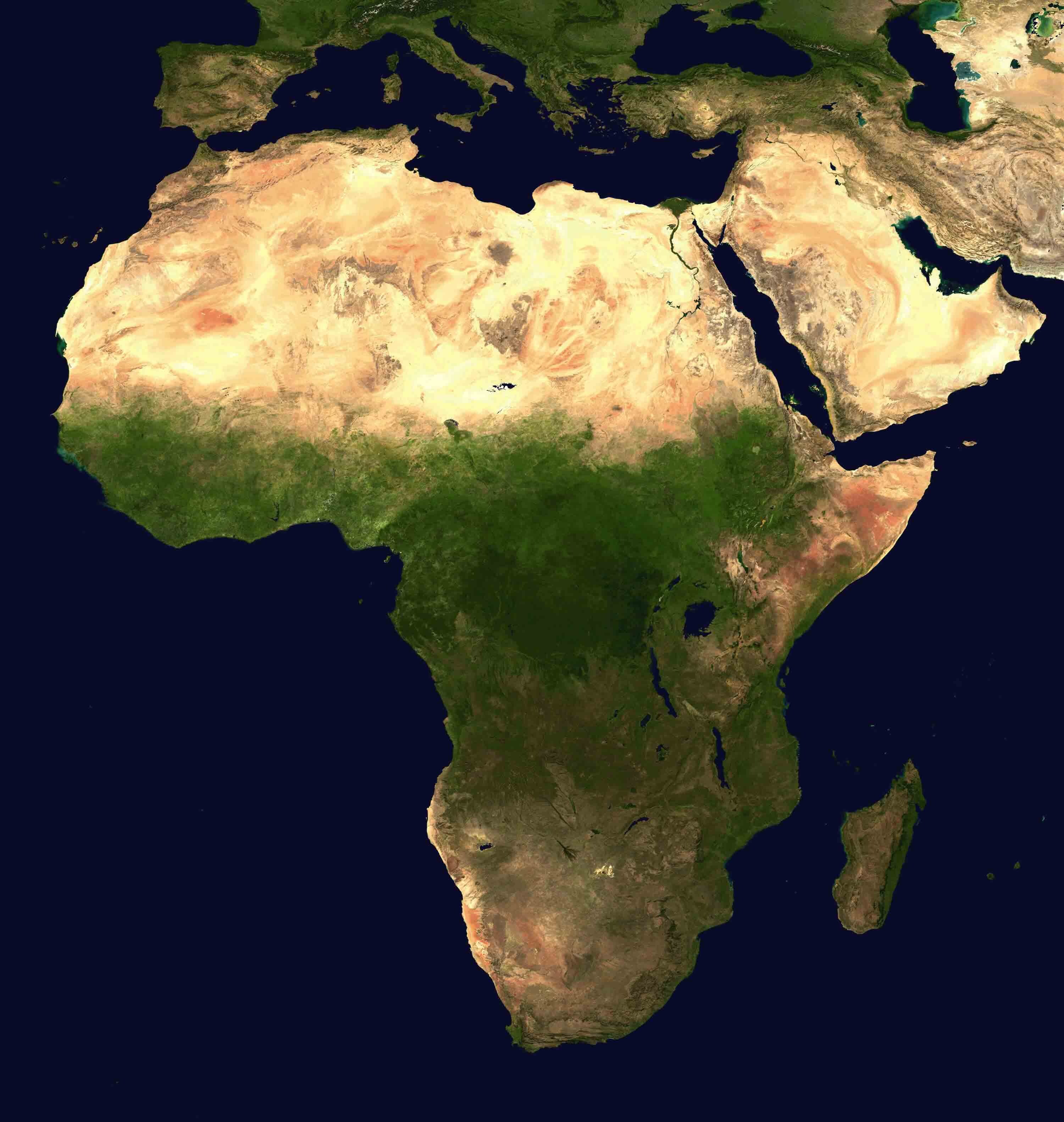
While the last Ice Age covered the Northern Hemisphere with glaciers, the northern half of the African continent was quite arid. As that period came to an end, beginning about 12,000 years ago, rains came to north Africa, transforming the arid landscape into a grassland with rivers and trees. Small animals—foxes, anteaters, antelopes, jackals, and donkeys—gradually moved into the newly green area, followed by crocodiles, hippopotamuses, lions, giraffes, and elephants. The region’s buffalo, with their huge curved horns, were dwarfed by aurochs, a species of enormous wild cattle that is now extinct. Humans followed the migrating animals into the green Sahara. From about 8000 BCE, varied populations lived in the mountainous regions that now are encircled by desert sands, and their artists left images of animals, humans, and supernatural beings on the walls of rock shelters, canyons, and cliffs. About 4,000 years ago, the climate changed again, and most of these early populations left the region. As the rains disappeared, the Sahara became, once again, the world’s largest desert (Fig. 2.1).
More information
Northern Africa appears sandy brown and mostly lacking in vegetation, as do, to a lesser extent, the eastern Horn and southern tip of the continent. Central Africa appears green and heavily forested.
LARGE WILD FAUNA STYLE RELIEFS Early hunters carved, scraped, and polished thousands of petroglyphs into rock surfaces across the Sahara. Unlike European cave paintings of the Paleolithic period (Figs. 1.1–1.6), which are deep in underground caves, the rock art found in North Africa and elsewhere on the continent appears in shallow rock shelters and on stone outcrops above ground. The ancient rock art of the Sahara that depicts in low relief the large animals then roaming the landscape is described as the Large Wild Fauna Style, or as the Bubalus Style after a now-extinct species that lived in the region.
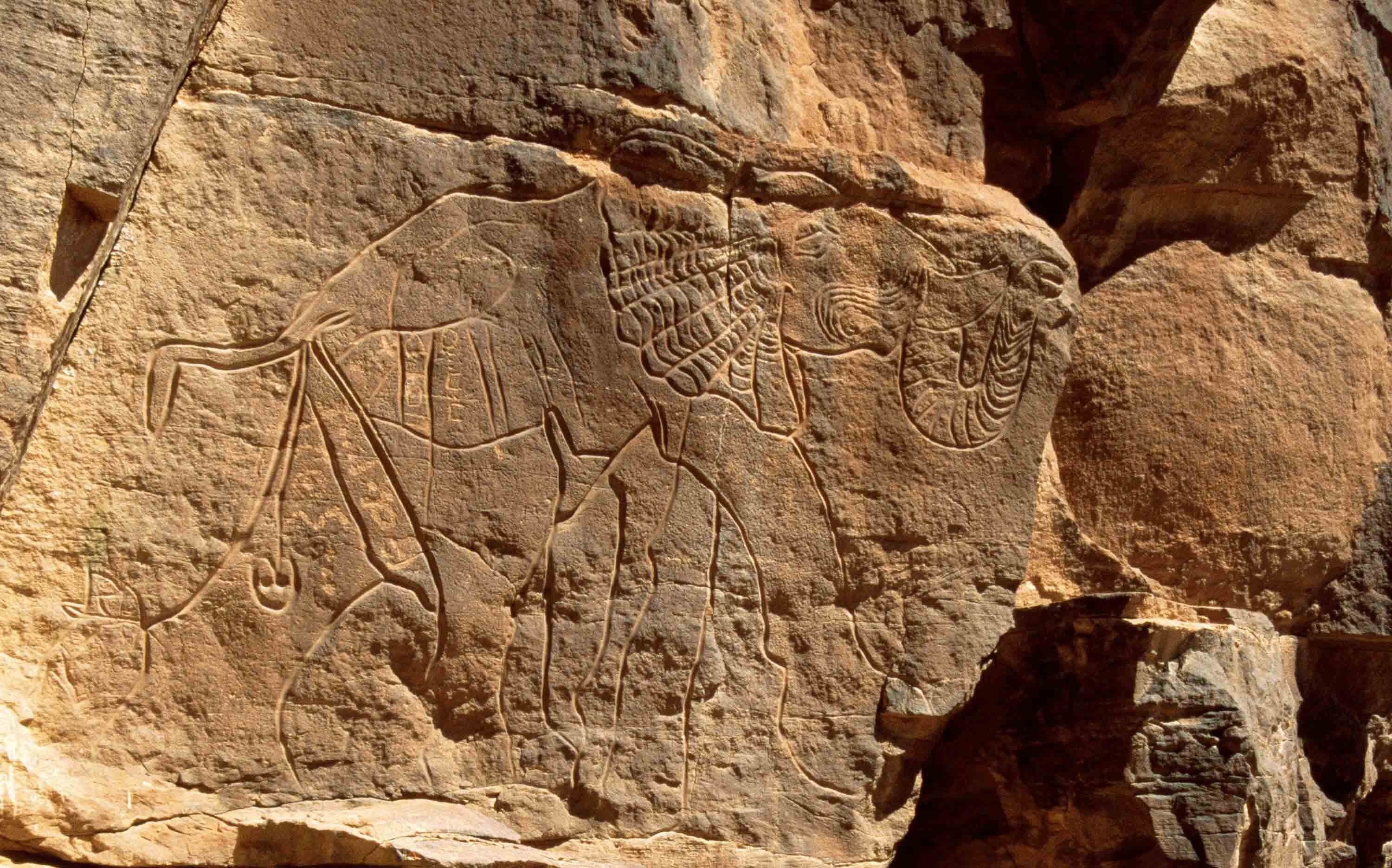
Images in the Large Wild Fauna Style were incised during the long period of time beginning with the human resettlement of the Sahara, and ending when these animals became scarce in the region, roughly 9000–4000 BCE. Most scholars date them between 7500 and 5000 BCE, but some specialists assign them to a shorter time span, or give them later dates. The artists rubbed deep grooves into the rock surface with abrasives or stone tools to define the contours of the animals. The technique is well illustrated in one relief of an elephant, which is almost half the size of the actual animal (Fig. 2.2); additional lines provide textures for the elephant’s ears, trunk, and eyes. Cutting into and sanding down the surfaces of the rock to create these long, continuous grooves must have been an arduous, time-consuming process, suggesting that these animals were profoundly important to the artists.
More information
The elephant faces right, with head raised and trunk curled upward. The head is finely detailed, with wrinkles shown on the ears and trunk and around the mouth. The tusks are relatively short. A pitted object appears to hang, or be falling, from the elephant’s anus.
Many of the wild animals shown in the Large Wild Fauna Style rock art are naturalistic, and closely resemble the actual appearance of an elephant, buffalo, or giraffe. However, some of their features have yet to be sufficiently explained. For example, a round, pitted object appears to hang suspended from the elephant’s anus. Some observers have suggested that the object indicates that the elephant is defecating, because elephant dung helped hunters to track the animals. They believe that such images were created to master the animal’s spirit before a hunt or to celebrate a successful kill. However, most rock art specialists believe that the round object is a symbol of some kind, rather than a depiction of a physical object.
More information
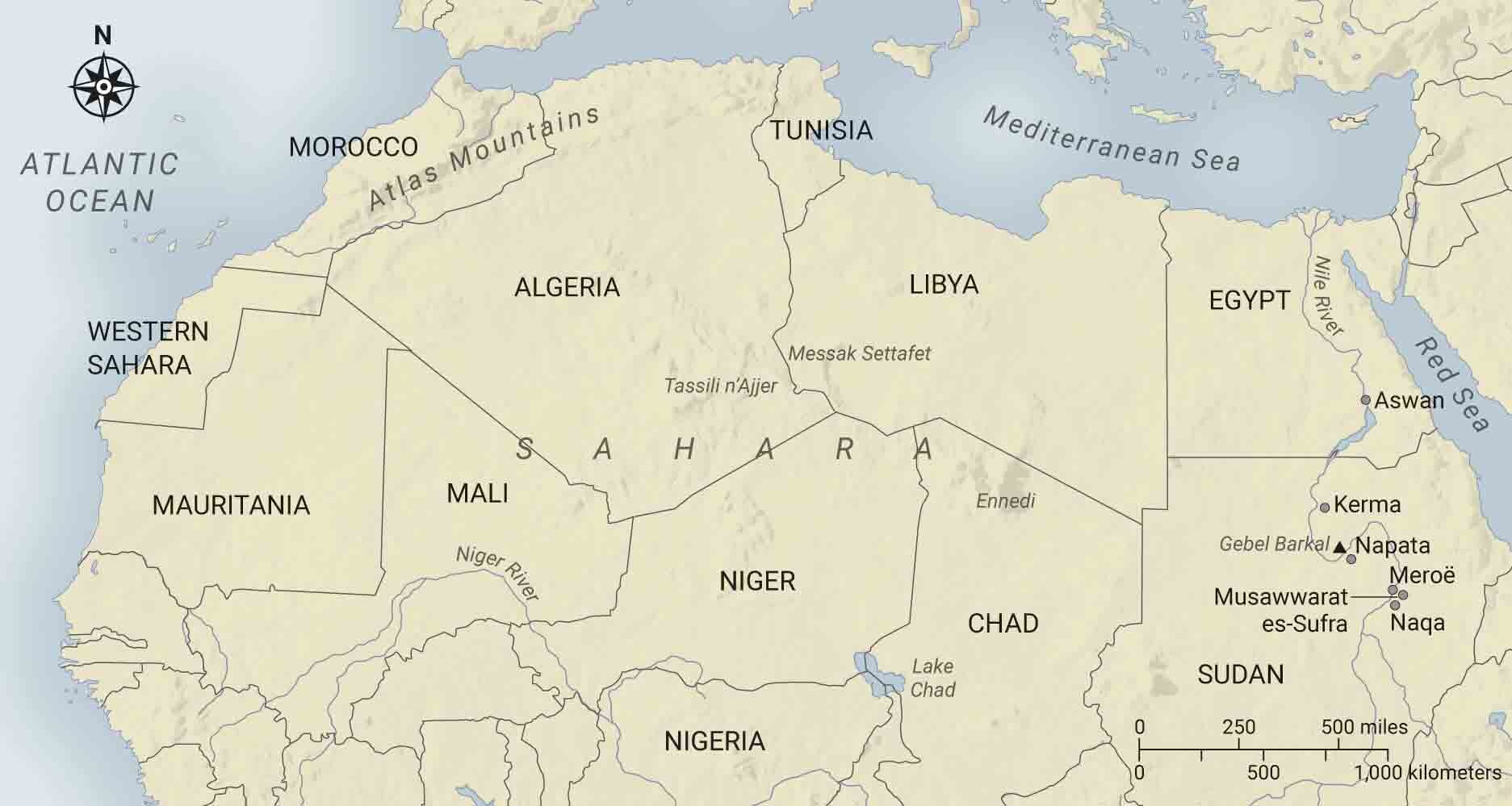
The map shows Tassili n’Ajjer in southeastern Algeria, Messak Settafet in southwestern Libya, Ennedi in northern Chad, and numerous sites along the Nile, including Aswan in Egypt, and Kerma, Gebel Barkal, Napata, Meroë, Musawwarat es-Sufra and Naqa in Sudan.
More information
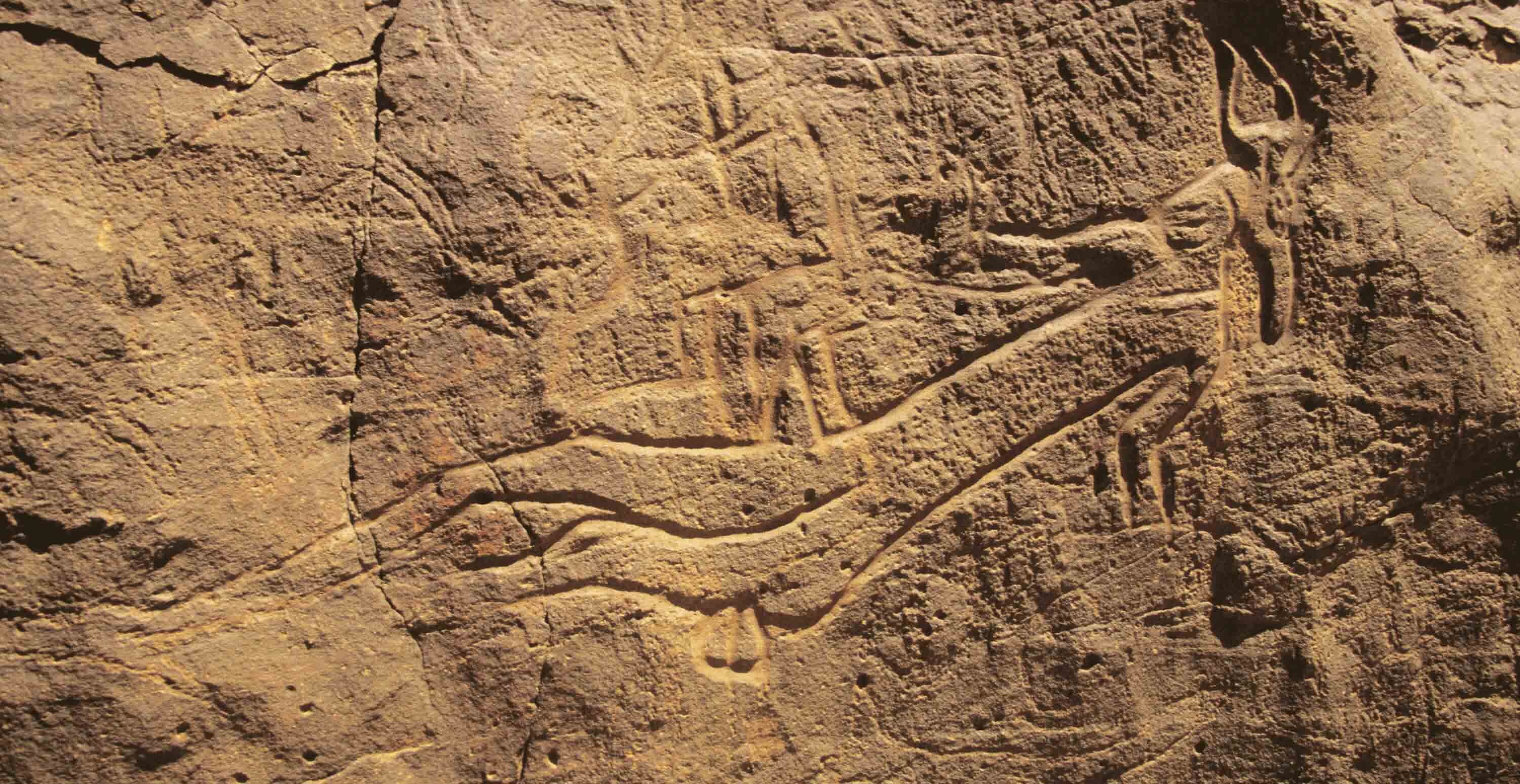
The humanlike figure is almost but not fully prone and has arms outstretched, as if falling rightward. The head, which is turned away from the body, appears as the head of an animal with a long nose and large ears or horns.
Messak Settafet
Rock carvings, especially those found in the canyons of a huge rocky plateau in southern Libya named the Messak Settafet (see Map 2.1), combine animal and human features. On one rock wall an elongated, reclining man appears to be falling, and has turned to catch himself (Fig. 2.3). He has an animal head that might be that of a wild African donkey or an anteater or an antelope, but with features that are stretched to the point that its identity remains a mystery. There are a few Large Wild Fauna Style images where shallow lines at the base of an animal head hint at a human face beneath the animal features, suggesting that the artist wished to show a human wearing a mask. However, these are rare, and composite animal-headed figures such as this hybrid being are much more typical of the Large Wild Fauna Style.
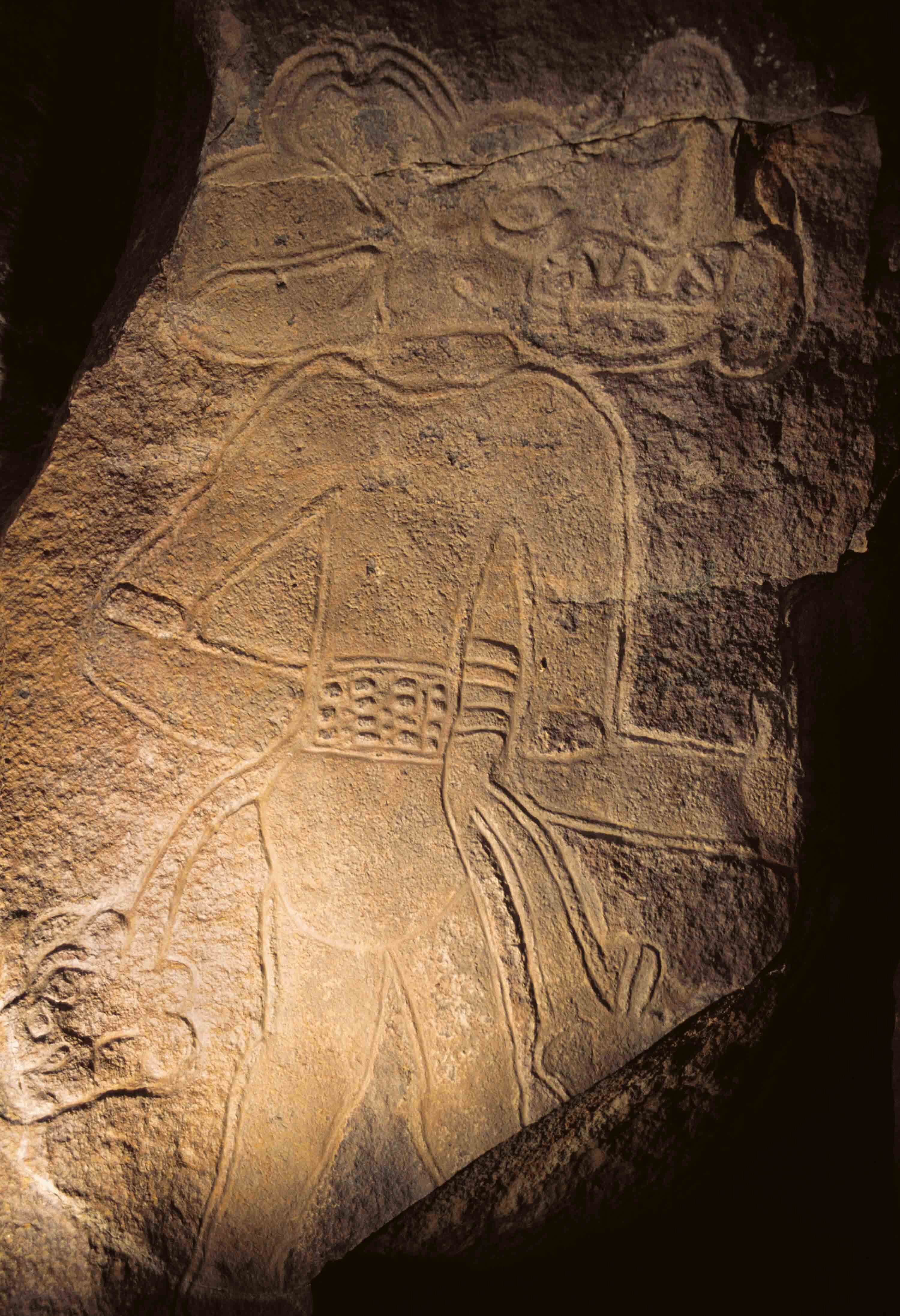
More information
The humanlike figure stands facing rightward with hands raised waist high. The head appears as the head of a dog or jackal with sharp, bared teeth. The figure wears a wide belt with one or more tail-like extensions.
Other Large Wild Fauna Style figures have the heads of felines, or even giraffes or elephants. The most numerous hybrids in the Messak Settafet, however, merge human figures with canids (wild dogs or jackals). Hundreds of them hunt, run, dance, fight, and tumble across the canyon walls. One of the most detailed depictions uses an unusual technique, outlining the shapes with a double contour and polishing the interior surfaces. This jackal–man hybrid wears a broad belt and a tail-like extension at the back (Fig. 2.4). The sharp teeth in the open jaws give the figure a threatening aspect missing from many other examples, which have closed mouths or even a dog-like grin.
Although most hybrid figures are found in the central Sahara, incised images of animals in the Large Wild Fauna Style are scattered across the entire desert, from the foothills of the Atlas Mountains in Algeria to the Ennedi highlands of Chad (see Map 2.1). An elephant in a modified Large Wild Fauna Style was even found on a rock that rolled into the Nile River near Aswan, at the southern border of ancient Egypt. Such similarities of style and subject matter in art that was spread across enormous distances, over thousands of years, suggest that early African populations were linked through migration patterns, and that they may have shared religious practices.
Tassili n’Ajjer
ARCHAIC STYLE ROCK ART IN TASSILI N’AJJER While the Messak Settafet of Libya was a particularly important site for Large Wild Fauna Style images, the mountain range to its southwest, known as Tassili n’Ajjer, is the home of Africa’s most diverse rock art. Rock shelters in this region of southern Algeria are protected by overhangs, and display huge paintings that are not seen elsewhere. Their figures have circular heads with no discernible facial features, and they have thus been described as the Round Head Style or the Archaic Style. In the 1980s, archaeological research in a cave near Tassili n’Ajjer dated small versions of these faceless figures to approximately 6000 BCE. The Archaic Style thus appears to overlap in time with some Large Wild Fauna Style images.
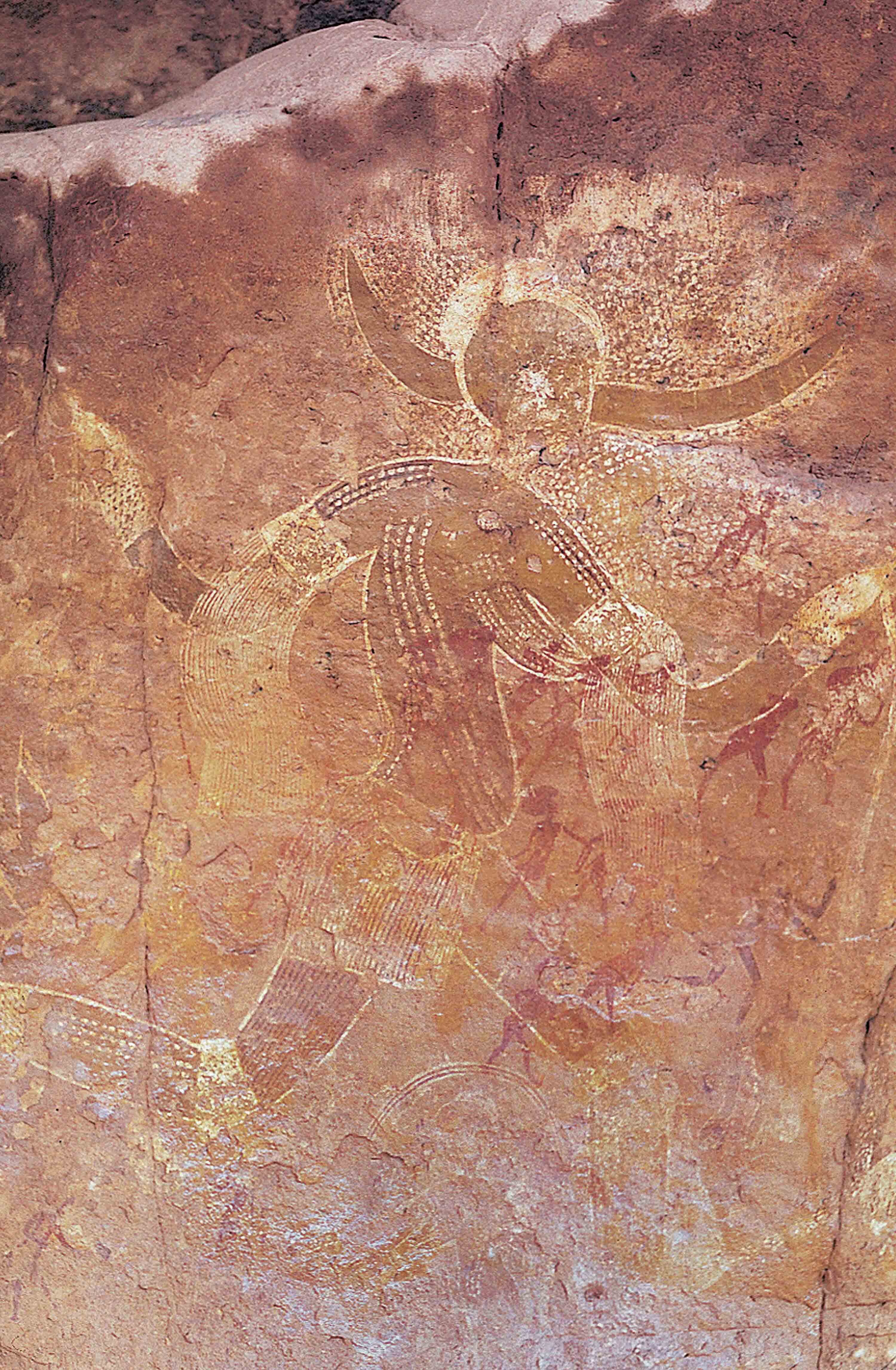
More information
The figure is outlined in white, on a dark red rock background. The outlines are faint in places, particularly at the lower right. The figure faces to the right and runs or dances with arms raised to shoulder height.
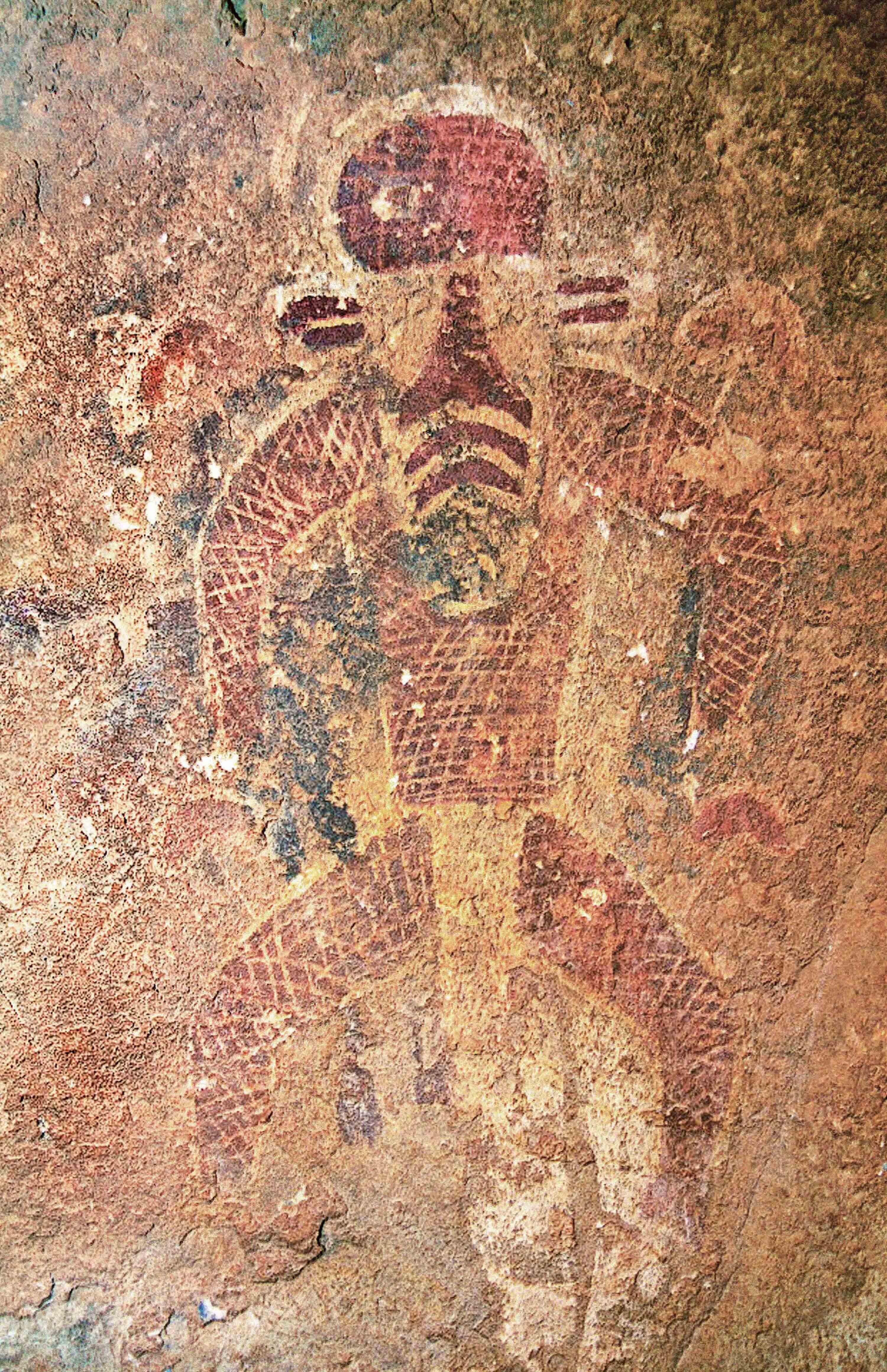
More information
The figure, wearing a loincloth and a large, abstract mask, faces the viewer. The arms point downward but the shoulders are hunched upward. The legs are bent into a half-squat. Cross-hatched lines cover the surface of the body.
An intriguing Archaic Style painting shows an apparently female figure with a curved breast, rounded stomach, upraised arms, and long bovine horns, similar to the horns on the wild cattle in Large Wild Fauna Style engravings (Fig. 2.5). White dots cascade over her body, and rows of white lines hang from her waist and from bands on her upper arms, suggestive of strands of fiber. The position of the figure’s upraised arms and bent legs implies that she is dancing or running. It was painted over the top of several smaller, darker figures, some in similar poses. As is the case for almost any rock art in unprotected, remote locations, these ancient paintings have been vulnerable to damage and even destruction during the modern era. The first French visitors to publish reproductions of this painting moistened it to bring out its delicate colors before photographing it, and some later travelers followed this destructive practice. Repeated wetting has also damaged other Archaic Style images and made them difficult to see.
The head and hands of another polychrome figure from Tassili n’Ajjer are composed of abstract shapes that recall human features but distort them, as if the drawing represents a person wearing a mask (Fig. 2.6). Assuming that this image depicts a masquerade, art historians have searched for West African and even Central African masks that resemble its face. Although they have located modern masks and fiber costumes that seem similar to the Archaic image, no masquerade recorded in recent years is likely to have endured in unchanging form for over eight thousand years. The painting may also represent a supernatural being, rather than a masked person.
ocher
PASTORALIST STYLE ROCK ART Tassili n’Ajjer is also the site where the greatest number of paintings in the strikingly naturalistic Pastoralist Style (also called the Cattle Style) have been found. Archaeologists have tied these paintings to the population that began to fire ceramic vessels and to domesticate wild grains and cattle in the central Sahara from 5000 to 2000 BCE. Most of their living sites have been dated to about 3500 BCE, and were abandoned about 2000 BCE. In fact, the Pastoralist Style is named for the practice of cattle herding, which they had recently developed. The paintings show not only domesticated cattle, with the specific patterns of their hides and the shapes of horns, but also humans interacting in relaxed poses and using natural gestures in what appear to be scenes of daily life. People are depicted with considerable variation, but most are shown with dark skin tones. The different sizes and proportions of the people in this detail from a much larger painting from Tassili n’Ajjer indicate that they are women, men, and children (Fig. 2.7). While children appear in the art of some later Egyptian tombs and Mesopotamian monuments, lifelike images of children were relatively rare in art around the world until about 2000 years ago. Pastoralist Style rock art, therefore, includes some of the world’s earliest depictions of children interacting with their families and friends. Analysis of the paints has revealed that they contain the same ochers, chalks, and charcoal as the much earlier Archaic Style paintings. In Pastoralist Style paintings, however, the pigments are bound with cow’s milk so that the food the animals produce—along with their portraits—fill the compositions. The use of cow’s milk emphasizes cattle’s importance to these communities.
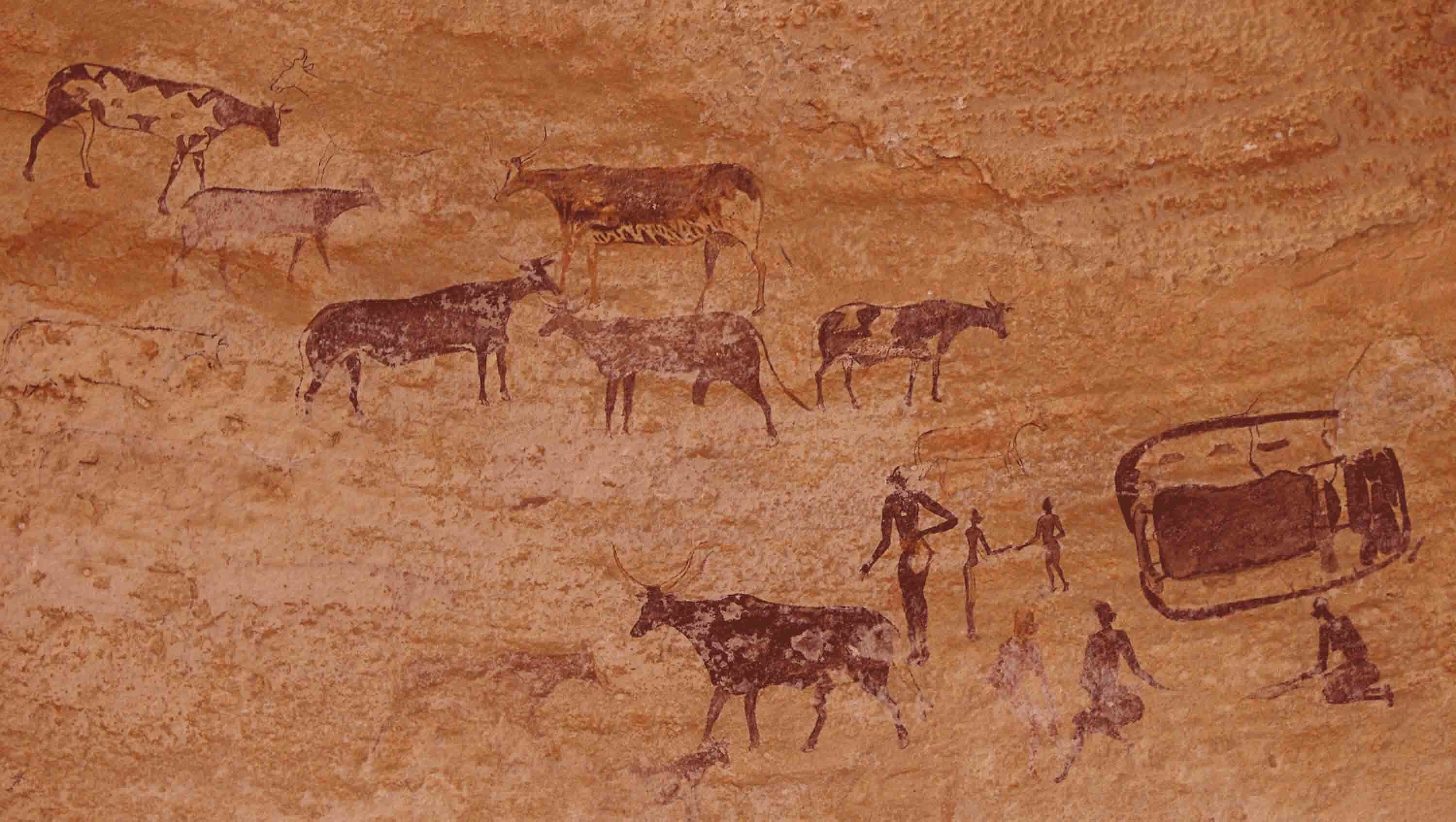
More information
A lifelike depiction of horned cattle standing about, while a human figure stands and gestures towards one animal. Other human figures of varying sizes stand and sit near by.
Later painted and engraved images found across the Sahara are even more varied in style as well as in subject matter. Generally, as the Sahara became more arid after 2000 BCE, naturalistic paintings were replaced by figures that were more abstract. Over time, the scenes began to include men riding horses and wheeled chariots, and, later on, camels and camel-riding nomads.
Glossary
- petroglyph
- an image created on a rock surface through incision, picking, carving, or abrading.
- low relief
- (also called bas-relief) raised forms that project only slightly from a flat background.
- incised
- cut or engraved.
- polychrome
- displaying several different colors.
- masquerade
- the masks, choreography, music, costumes, lyrics, and staging of performances involving transformations of the human body.
- ocher
- a naturally occurring clay pigment that ranges in color from yellow to red, brown or white.
- bound
- (of a dry pigment) mixed with a wet substance (a binder) that helps the pigment adhere to a surface.