1 The Beginnings of Art
65,000–3200 BCE
CHAPTER OUTLINE
65,000–3200 BCE
CHAPTER OUTLINE
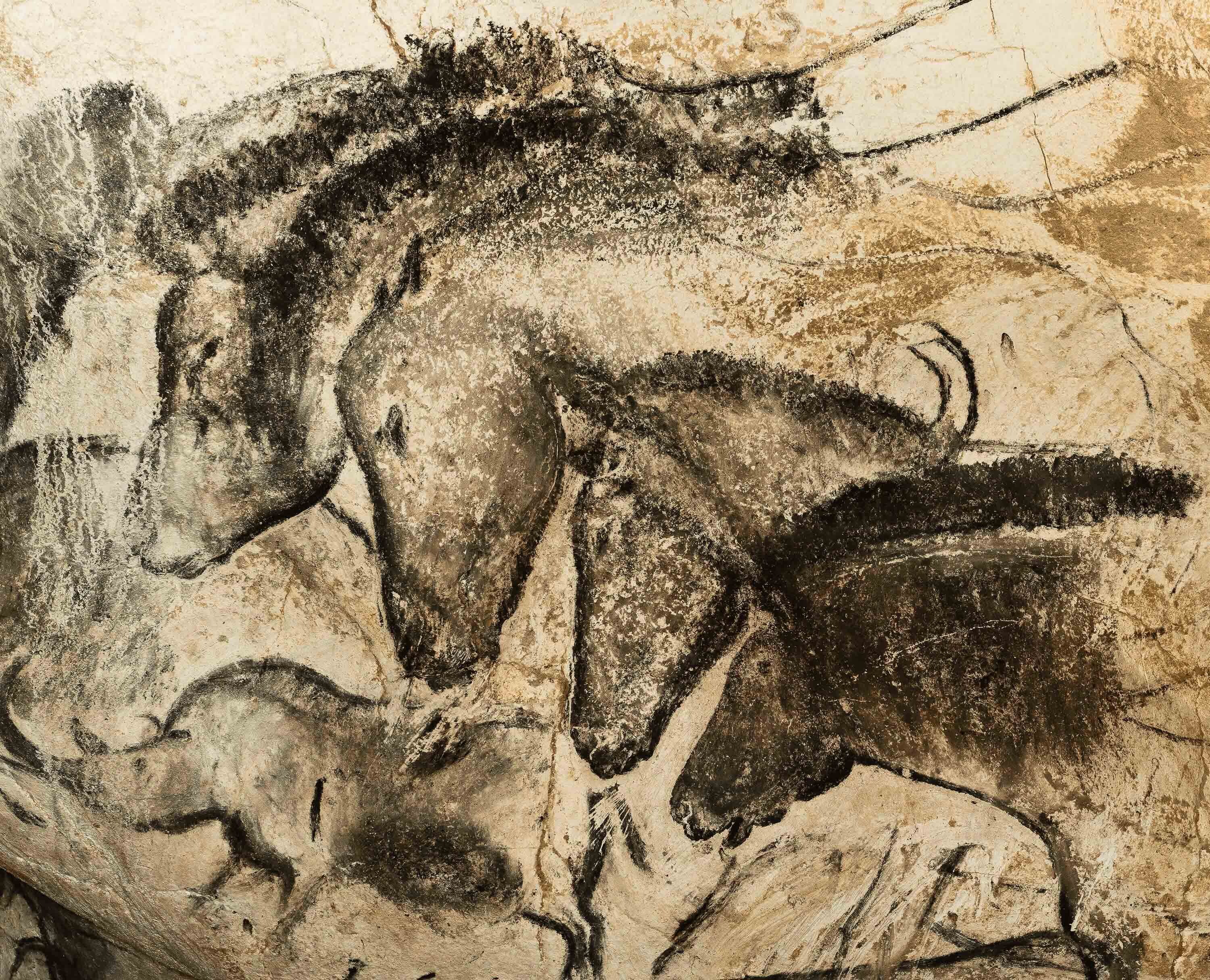
The horses stand shoulder to shoulder with all four heads visible. Below them is a two-horned rhinoceros with a very long front horn.
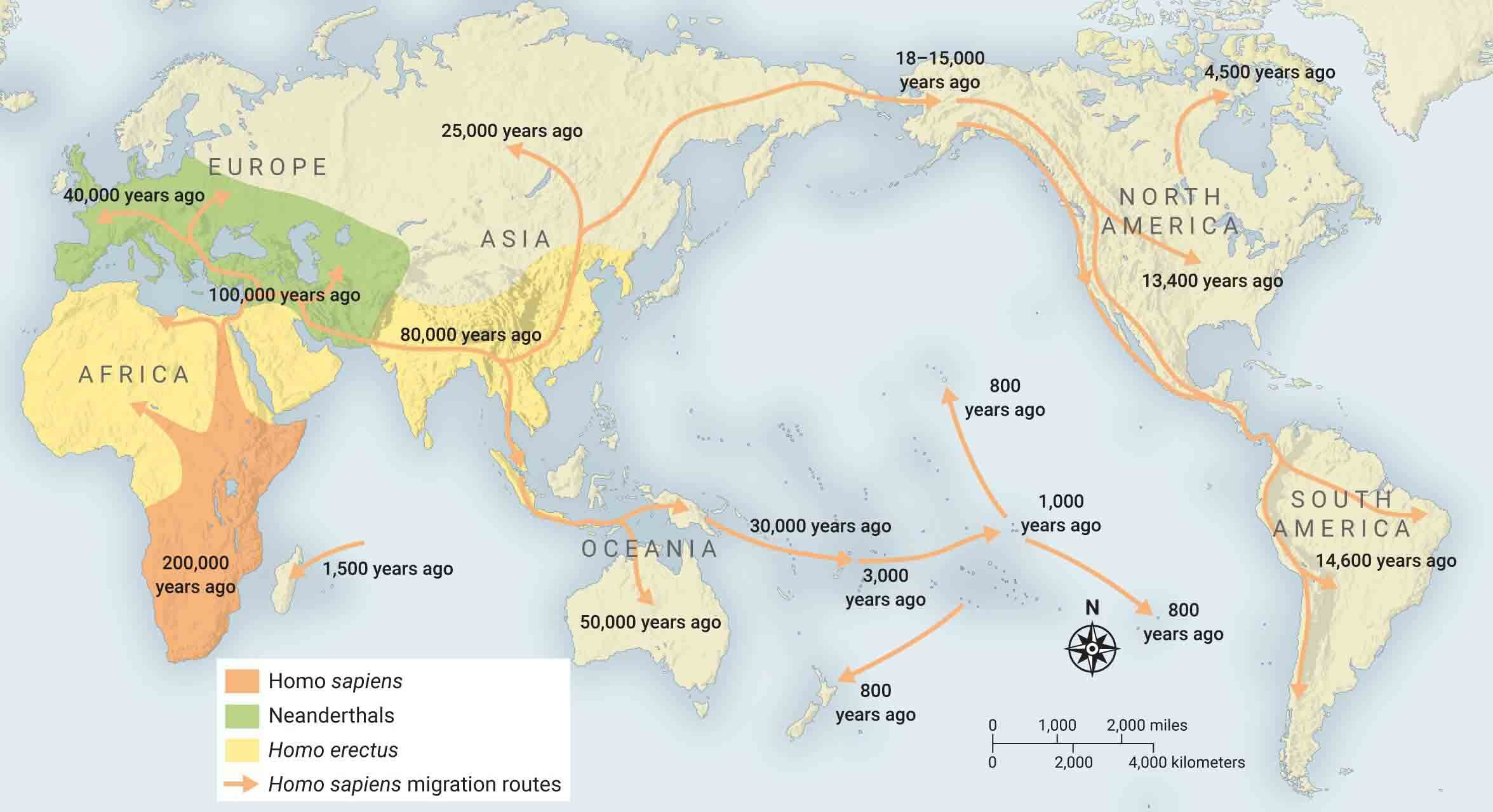
About two hundred thousand years ago, communities of modern homo sapiens began migrating northward from southern Africa, into the parts of Africa occupied by homo erectus. Migration into western Asia and Europe, at the time also occupied by Neanderthals, began about one hundred thousand years ago. About eighty thousand years ago, homo sapiens migrated across southern Asia, into territory occupied by homo erectus. From there, humans migrated to Oceania and later to northern Asia. Migration across the Bering Strait to North and South America occurred within the last twenty thousand years. Migration to certain Pacific islands, including the islands of present-day New Zealand, occurred within the last thousand years.
Homo Sapiens
Neanderthal
The earliest human evidence for activity that would develop into what we now perceive as tool-making dates back to more than two million years ago, with the creation of stone tools such as hand axes. The ancestors of the modern human species, Homo sapiens, originated in Africa, where these early stone tools were found. Such artifacts, and what they reveal about changes in tool manufacture, have long been used by archaeologists to trace the evolution of early humans. By 500,000 years ago, human communities had begun to develop a technological process known as flint-knapping, in which humans chose a specific kind of stone, such as flint or obsidian, and used it to shape durable rocks into stone tools of gradually increasing sophistication, such as symmetrically made hand axes. The tools that these communities left behind, and the places they were found, also provide evidence of how early humans moved across the land, and researchers now believe that the original communities from Africa migrated throughout the world beginning about 200,000 years ago (Map 1.1). When they arrived in Europe, they coexisted for some time with Neanderthals (the human species Homo sapiens neandertalensis), who then disappeared about 40,000 years ago. Early humans were hunter-gatherers who lived during the last Ice Age, when large parts of northern Europe, Asia, and North America were covered with glaciers. During this last Ice Age, human communities began to give shape to materials, making stone tools, and, in some areas, building structures out of mammoth bones or tusks.
Early examples such as these challenge our definition of what art is, and whether it is a useful term outside a modern context. Some people prefer to focus instead on the images humans made. An image is a representation of a physical reality encountered in life, or simply an abstract visual expression that can take the form of a drawing, a painting, a statue or even a built structure. Art historians have pointed out the difficulty in differentiating what is a work of art and what is a functional tool among ancient peoples, because that distinction is a modern concept. Recent research has also shown that what we now consider to be prehistoric art (such as cave paintings and figurines) most probably had vital functional roles in the lives of early humans. Such items were made to accomplish particular goals. However, these works suggest that their creators made deliberate aesthetic choices, and were aware of the visual power of images.
Current evidence for image-making on cave walls and rock shelters shows that it began about 65,000 years ago, and includes abstract shapes, patterns, and depictions of animals and humans. Beyond representing exactly what was visible around them, these images may have had vital functions for the human community. Images painted and carved onto the walls of caves and exposed rock surfaces might have been created not because they were simply decorative or representational, but because they were believed to accomplish something. So why did ancient artists choose to make images in deep, dark caves? Contrary to the common assumption, hunter-gatherer groups of the Ice Age rarely lived deep inside caves; they mostly lived in rock shelters, the mouths of caves, or open-air sites. However, caves preserve archaeological evidence particularly well, so that is where we are most likely to discover the traces of early art these groups left behind. Humans probably visited deep caves only for special occasions, possibly for rituals, to make new images, or to view older images, and caves often seem to have constituted sacred spaces.
After the Ice Age ended around 9,600 BCE and the global climate began to warm substantially, humans in West Asia (a region including present-day Turkey, Israel, Jordan, Syria, Iran, Iraq, and the countries on the Arabian peninsula) began living in settled communities, thanks to the domestication of cereals and animals. Many art historians have proposed that the beginning of settled life was revolutionary in terms of the creative abilities of early humans and their art, which can be seen as the most powerful expression of those abilities.