The Akkadian Empire, 2334–2193 BCE
Mesopotamia saw a number of dramatic transformations in the last few centuries of the third millennium BCE (roughly from 2350 BCE onward). Around 2350 BCE, the kings of Agade, a territorially ambitious state also known as the Akkadian Kingdom, attempted to unify politically the vast cultural and physical landscape of northern and southern Mesopotamia. Starting with the long transformational reign of Sargon (ruled 2334–2279 BCE), the first ruler of the empire, kings of the dynasty governed from the capital city of Agade, the site of which has yet to be discovered. While temples were the dominant economic institutions in urban centers earlier in the third millennium BCE, with the Akkadian rule, another competing institution began to play a vital role: the palace. As the king became a more powerful, idealized, and charismatic ruler in a very centralized political administration, representations of the king were altered to reflect this new ideology. Toward the end of the Akkadian period, the king even achieved a divine character.
Naram-Sin
Nineveh
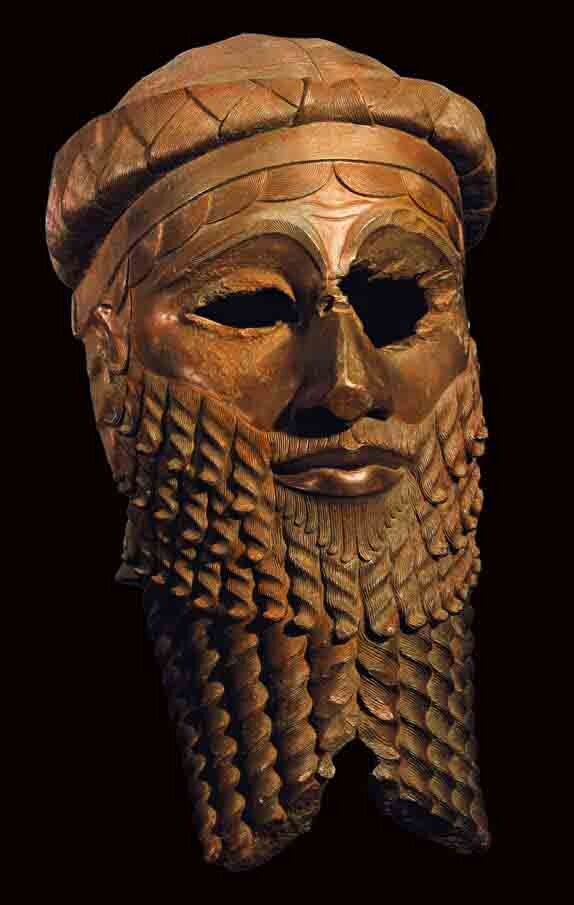
HEAD OF AKKADIAN RULER This copper alloy head of an Akkadian ruler (Fig. 3.15) illustrates the new perception of Mesopotamian rulers in art. Found in the Temple of Ishtar in the ancient city of Nineveh in present-day Iraq, the oversized head depicts a ruler (possibly Naram-Sin, Sargon’s grandson) with balanced, serene, powerful, and confident features. His long hair is braided and wrapped around his head, as in earlier images of kings (see Fig. 3.9), and the curls of his long, full beard flow down from his face. His eyes would have been made from precious stones, but they were gouged out (along with his ears) at a later date, perhaps in protest against the Akkadians. The naturalism of the nose and texture of the face are blended with the abstraction used for other features, such as the arched eyebrows and heavily textured beard. This head is the earliest example of the lost-wax technique for casting bronze and other alloys (see box: Making It Real: Lost-Wax Casting Techniques for Copper Alloys, p. 62). The production of this Akkadian statue marks an important turning point in metallurgical arts, and its highly detailed portraiture points to the increased interest of Mesopotamian craftsmen of the late third millennium BCE in representing the human body accurately.
More information
The curled beard and braided hair are rendered in fine detail. A simple headband runs across the forehead. Both eyes are missing, and the left eyehole has been badly damaged by gouging.
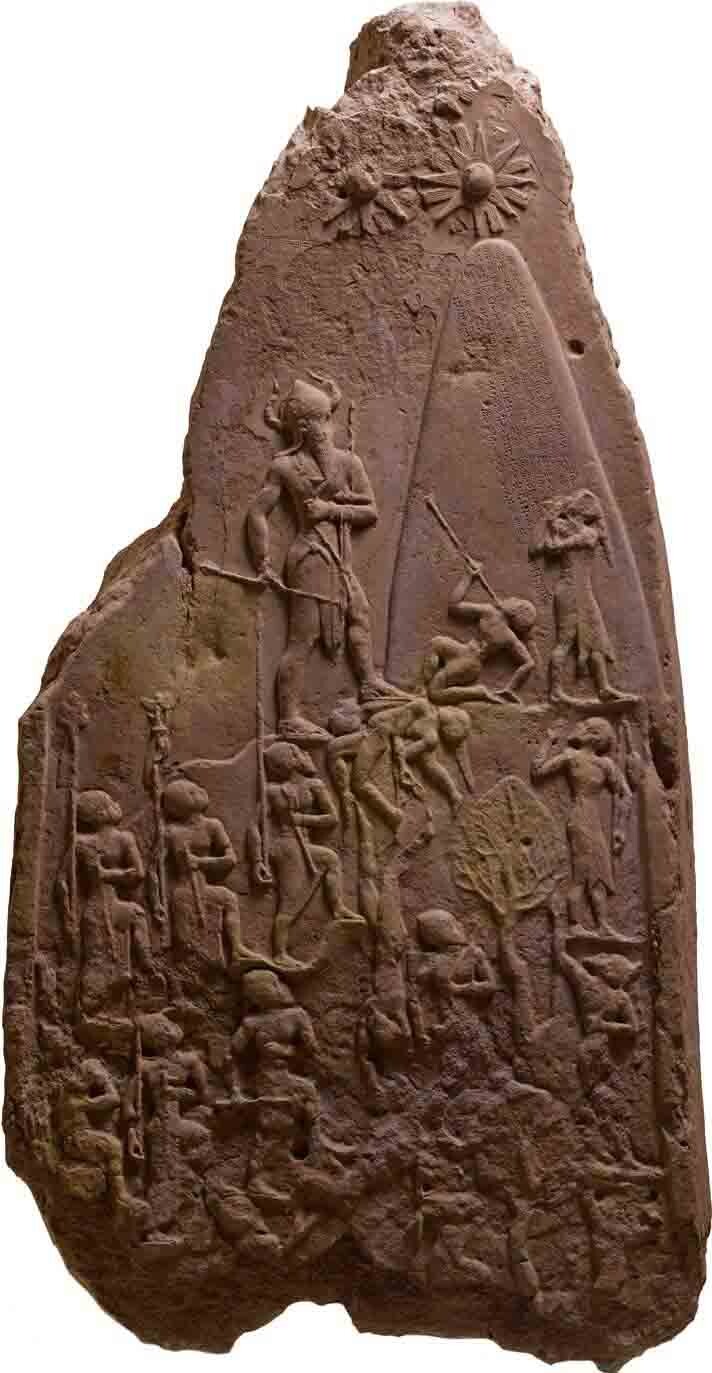
STELE OF NARAM-SIN This same type of confident and powerful king is seen striding up the mountain in the Stele of Naram-Sin (Fig. 3.16), originally displayed in a public space in the city of Sippar. Sargon and other Akkadian kings continued the much earlier practice of carving public monuments on stone steles (see Figs. 3.9 and 3.13), but these newer monuments depicted fewer divine actors and acts of devotion. Instead, they focused on military conflict and victories at the frontiers of the Akkadian kingdom. The primary figures are no longer gods and goddesses in human form, but the fully empowered Akkadian rulers themselves. This large (6 ft. 6 in.) monument commemorates the military victory of the Akkadian ruler Naram-Sin (ruled 2254–2218 BCE) over the Lullubi, who occupied the eastern Zagros Mountains (in the present-day Kurdish regions of Iraq and Iran).
The stele represents a stunning break from the visual conventions of previous Mesopotamian stele monuments, as it eliminates the horizontal registers that were known from earlier monuments. The entire victory narrative is unified into a single scene, framed in the form of the mountain landscape itself, mimicking the great mountain represented on it. In this landscape scene, the figure of Naram-Sin immediately commands attention. He is semi-nude, muscular, bearded, and larger than all the other figures. He stands victorious, holding a bow and arrow and facing the mountain. On the left he is flanked by ordered rows of Akkadian soldiers, in contrast to the disarray of the Lullubi, who beg for mercy on the right. His broad, frontally depicted torso and his upward step emphasize his power. The deities of earlier Mesopotamian monuments, who played a major role in the visual storytelling, are now relegated to the sky at the top of the stele where they dwell above the mountain, and they are reduced to geometric symbols: two stars. Naram-Sin wears the double-horned crown that is usually associated with divine figures, announcing the ruler’s claim to divine status. The narrative is unified in a single scene carved in low relief, framed in the shape of the mountainous landscape and resembling the mountain that it represents. The plants depicted on the stele correspond to very specific and identifiable species of trees. This and other details on the stele reinforce the idea that it depicts an actual event.
More information
Many armed figures look upward to where a larger male figure in a horned headdress or helmet stands, with his foot on a contorted figure lying just below him. A figure kneeling nearby plays a long trumpet. A mountain-like shape rising in the background has several lines of writing on it.
Enheduanna
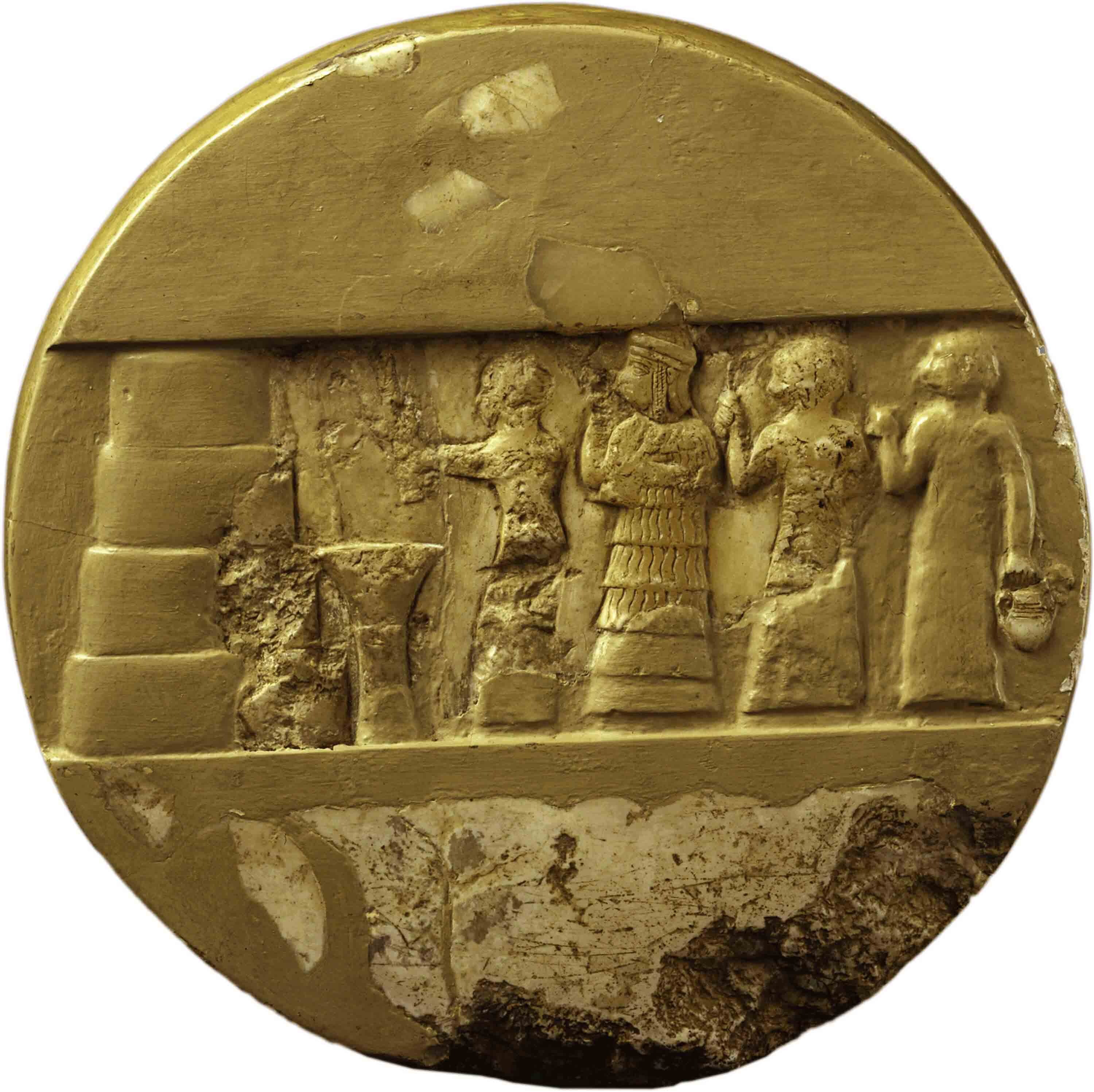
DISK OF ENHEDUANNA Women of the Akkadian royal and elite families held important positions across the empire, as attested by the women’s seals and seal impressions found in the cities. Enheduanna, daughter of Sargon, is the first known author in human history with a recorded name. The high priestess of the moon god Nanna in Ur, she was also the author of a series of temple hymns and devotions to the goddess Inanna.
More information
A row of four variously attired human figures faces leftward, toward a tiered structure and a pedestal. The first figure has an arm extended over the pedestal. The second figure is more elaborately dressed than the others and is carved in finer detail.
A cuneiform inscription on the back of an alabaster disk (Fig. 3.17) found in Ur identifies the main figure as Enheduanna, “wife” of Nanna and daughter of Sargon. The procession, carved in low relief, shows four people approaching a ziggurat or series of temple platforms, before which stands an altar. A naked man, perhaps a priest, pours a libation to dedicate the altar. Enheduanna is carved slightly larger than the other figures. She wears the ceremonial headdress of a high priestess and a flounced woolen garment. Together with the two female attendants behind her, Enheduanna raises her hand in a ritual greeting to the god.
Glossary
- low relief
- (also called bas-relief) raised forms that project only slightly from a flat background.
- lost-wax casting
- a method of creating metal sculpture in which a clay mold surrounds a wax model and is then fired. When the wax melts away, molten metal is poured in to fill the space.