Oba
Ewuare the Great
manilla
Oba
Ewuare the Great
manilla
Like Mbanza Kongo, Benin was the capital of a thriving kingdom at the end of the fifteenth century. The kingdom of Benin is noteworthy in African art history because it retained its dominance in the region for almost five centuries, and because its royal treasury assembled a rich collection of objects that document the stylistic development of Benin art over that broad stretch of time. The Oba, or king, named Ewuare the Great (ruled 1440–73) was apparently the first of Benin’s rulers to have direct contact with the Portuguese, and according to oral traditions, Ewuare was responsible for providing his people with three particularly valuable imported commodities. The first were thick rings called manillas, made of European brass. The royal brasscasters in Benin could recast these manillas into new objects. Thus they no longer needed to smelt their own metal from local ores, as the metalworkers of Igbo-Ukwu had done (see Chapter 25). The second was red coral, which is found off the coast of southern Portugal. The third was cotton cloth that had been woven in Europe and dyed red to match the coral. All three of these imported materials—brass, coral, and cloth—are still seen today in artworks made for the royal court of Benin, such as those displayed during the coronation of the Oba Eware II in 2016.
Esigie
Iyoba
Idia
PENDANT PORTRAIT OF THE IYOBA Oba Esigie (ruled 1504–47), the grandson of Ewuare the Great, invited the Portuguese to come to Benin as tutors, advisors, mercenaries, and weapons specialists. These foreigners are depicted on a pair of ivory pendants commissioned by Esigie about 1525. One of the pendants is now in the British Museum in London, while the other is owned by the Metropolitan Museum of Art in New York (Fig. 49.7). Both represent an Iyoba (mother of the Oba), in this case the extraordinary Queen Idia, the mother of Esigie. Known for her knowledge, courage, and tenacity, Queen Idia helped her son overcome his rivals, organized an army to resist an attack on the kingdom, and enlisted the aid of Portuguese visitors. She was said to be a magician whose interactions with the spirit world allowed her to manage the unpredictable foreign soldiers and their mysterious weapons.
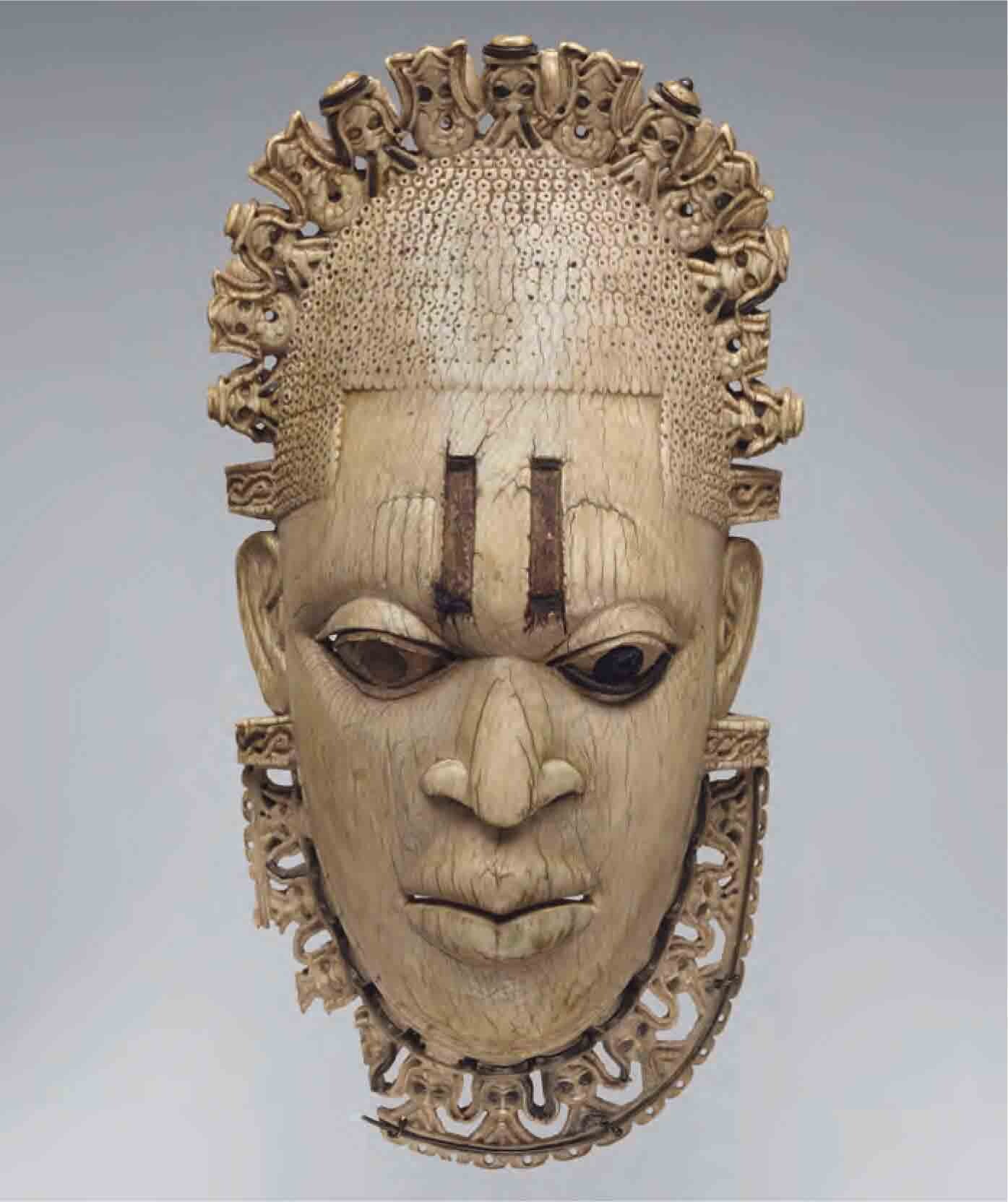
The hairstyle incorporates a crown-like crest of tiny figures running from ear to ear, and a similar row of figures below the chin, like a necklace. Above each eye is a pattern of shallow vertical incisions, and above the bridge of the nose are two rectangular vertical grooves.
Olokun
During this period, the people of Benin believed that the Portuguese sailors were spirits who came from the land of the dead, for they were as pale as corpses. They also believed that the marvelous goods that the Portuguese brought with them came from the court of Olokun, the deified equivalent of the king whose homeland was under the ocean. Thus the heads of Portuguese soldiers appear on both pendants, forming a crown-like crest along the top of the queen’s head. The artist focuses our attention on their long, stringy hair and beards, and their flat hats. On this particular pendant, the heads also encircle the notched lower half of the sculpture, which represents the queen’s beaded necklace, while the heads on the crest are interspersed with stylized representations of coiled fish that live in African rivers and ponds. Because some species can lie dormant in mud, reviving when rain fills the streams, they are known as mudfish. Most are quite tasty, and the coiled fish are thus a reference to food and prosperity. However, some species of mudfish can unleash an electric shock strong enough to stun a person, and so the mudfish may also be interpreted as a reference to the ruler’s divine right to lash out at rebels, criminals, and other enemies. Finally, both the Portuguese heads and the mudfish link the pendants to the power of the deity Olokun, who rules the ocean just as the Oba rules the land. Thin vertical lines above the queen’s eyes represent the delicate scars that identified her as a female citizen of Benin, but the two central grooves that once held iron bars were references to her inner strength. Her stylized face, with its harmonious proportions and wide eyes, is an idealized portrait, though it shares a fairly naturalistic style with other early works from the kingdom of Benin. It is almost large enough to cover a face, but the pendant was not intended to be worn as a mask. Instead, it was an amulet attached to the robes worn by the Oba. For almost four hundred years, the successors of Oba Esigie wore the pair of ivories during sacred ceremonies, perhaps on the chest and the back, or on the hips. Each was a protective device, an invocation of the Iyoba’s spirit that shielded the king from dangers comparable to those faced by Oba Esigie in the distant past.
FIGURE OF A PORTUGUESE SOLDIER Representations of Portuguese soldiers were also made in copper alloy using the lost-wax casting method. Several of these statues were probably created by the brasscasting guild of Benin between around 1520 and 1640. The military men depicted in these statues, who aim crossbows or guns at the enemy (Fig. 49.8), are identifiable by the helmets, codpieces, and other items of clothing worn by Europeans in the early sixteenth century. The dress of Portuguese military men in this period was carefully replicated in artworks made in Benin over a period of two centuries, even after rival European traders had driven the Portuguese from this part of the West African coastal region.
The richness of the figure’s embroidered garments indicates his status as a representative of Olokun’s court. Just as men carried tribute to the Oba by walking on land, the Portuguese sailors brought Olokun’s wealth to the Oba by gliding over the water in their sailing ships. However, even though Olokun was the deified equivalent of the king, the two are also portrayed as opposites. For example, the active pose of this soldier is consistent with the unpredictable, dangerous character of water spirits; it contrasts with the frontal, static pose of the earthly Oba and his courtiers in other artforms (such as the carved tusk, Fig. 49.10).
These statues of brass or a related copper alloy were protective, valued for their ability to ward off natural and supernatural dangers. Such figures (or larger metal versions of them) were placed on the high central ridge of the palace roof, but they were also appropriate for altars dedicated to Olokun or to a different deity, one connected to thunder, lightning, and sudden death. It is also possible that they were placed on altars dedicated to the king’s hand, because the Oba and other successful men of the kingdom believed that the source of a man’s strength and skill resided in his right hand. Most probably, this brass figure guarded one of the altars that honored the royal ancestors, the predecessors of the Oba who commissioned it.
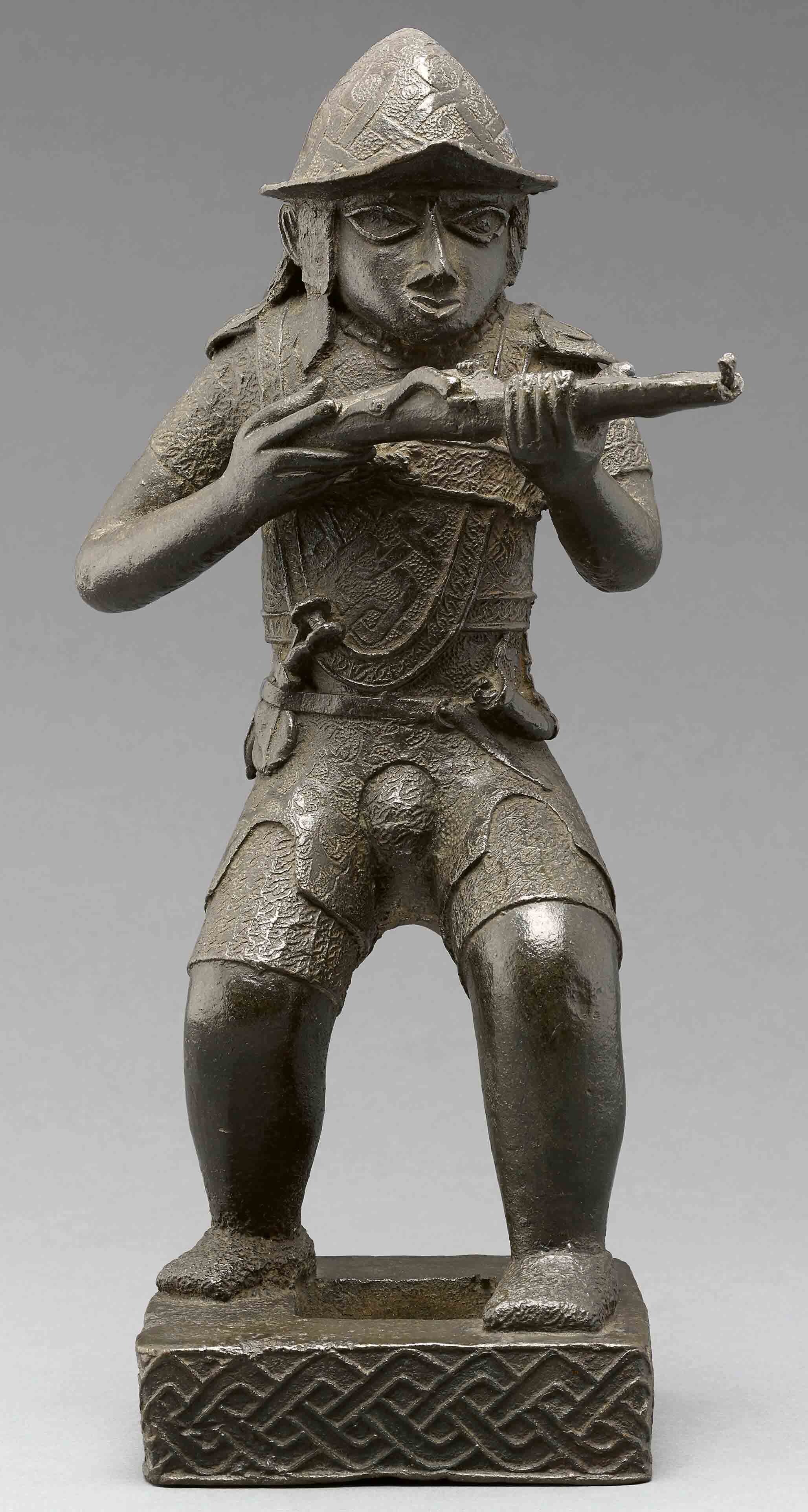
The soldier wears a helmet and other protective gear, including a codpiece. He has a weapon at his right shoulder, either a rifle or a crossbow, and is aiming it.
PLAQUE DEPICTING A PALACE SHRINE An altar to a royal ancestor appears to be featured on a rectangular plate, or plaque, cast of copper or brass (Fig. 49.9). This plaque and the figure of a Portuguese soldier are examples of an early phase of Benin art that ended around 1640, but they are still slightly less naturalistic (and thus slightly more abstract) than the portrait of Queen Idia. This plaque’s figures are shown in very high relief against a patterned background (p. 794). The plaque reproduces either the entrance to a shrine or the interior of a shrine, as an altar is visible at the lower center of the scene. The objects resting on the altar’s tiered platform include two tiny round spheres that probably represent ancient stone tools. They are flanked by two very small leopards, perhaps representing the hollow brass figures of leopards that were filled with water and used to cleanse the altar. They serve as a metaphor: just as the leopard is the most powerful animal of the forest, the Oba is the most powerful person in the kingdom. The altar is guarded by two court officials who wear rings of coral beads around their necks and who carry staffs and shields. Beside each court official is one of the adolescent boys who once served the Oba in the nude as a sign of their dedication and purity.
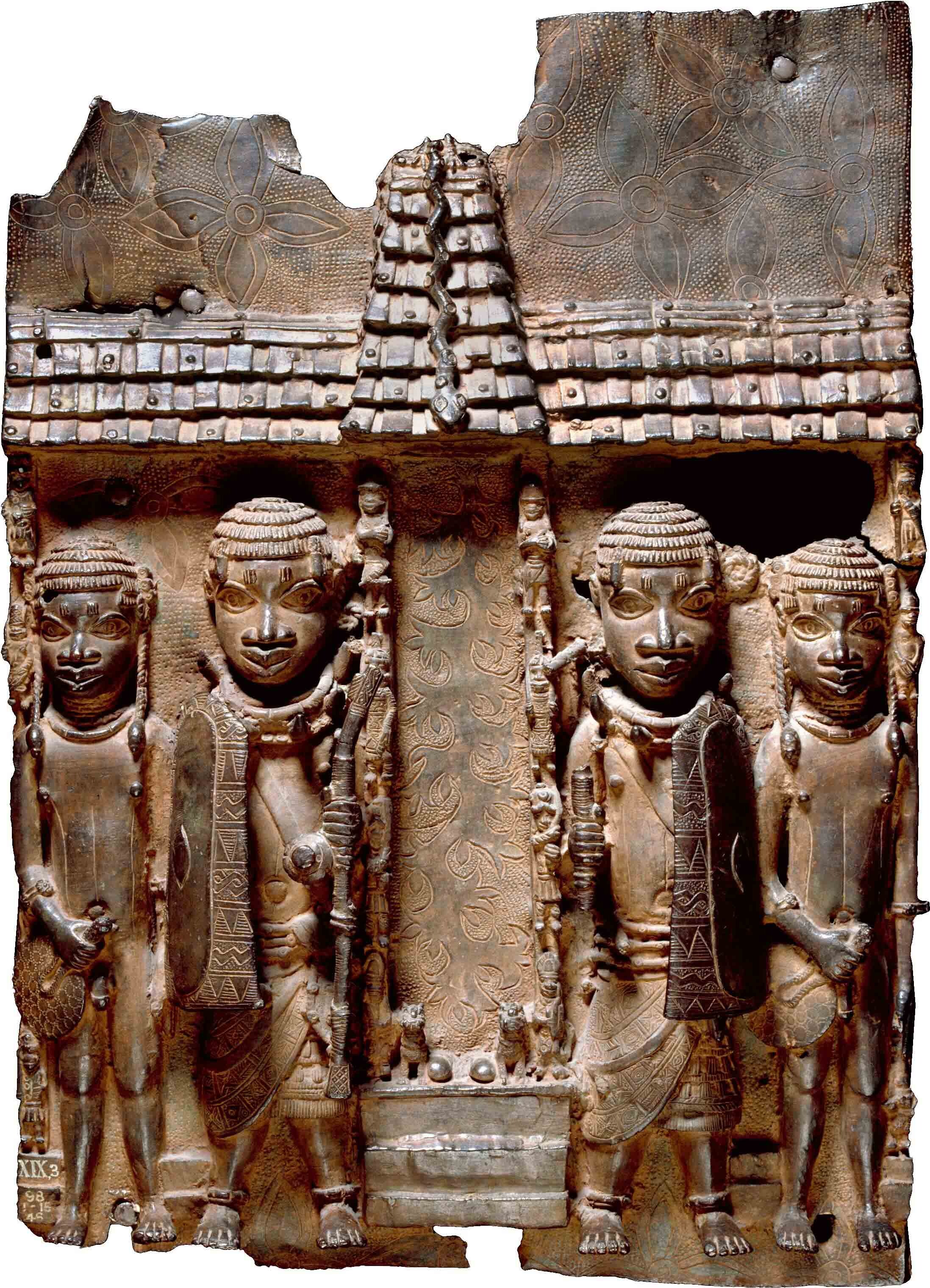
Four figures stand guard, two on either side of a set of steps. A roof runs left to right above the figures’ heads. Above the space the figures are guarding, the roof has a raised portion with a serpent figure on it.
Altars were placed in enclosed shrines in the city of Benin, but in the palace some altars were also sheltered in verandas roofed with wooden shingles, as seen in this plaque. Each of the two veranda posts shown at the center of the relief sculpture is covered with small figures, indicating that their surfaces were covered with brass reliefs similar to the plaque itself. The relief also shows one of the narrow towers of the palace and the copper serpent, said to be more than 30 feet long, that once slithered down its roof. The top of the relief has been damaged, but at the very top of the central tower are grooves representing the tips of the talons of the huge copper bird with outstretched wings that was placed on its summit.
This copper relief is one of about nine hundred that survive. During the seventeenth century, visiting traders reported that the reliefs were highly polished, covering the wooden posts that supported the palace ceiling and creating a glittering setting for audiences with the Oba. By the eighteenth century, though, no Europeans mentioned the copper plaques, which leads art historians to believe that they were ripped down during a period of instability in the last decade of the seventeenth century, when the plaques were stored in a room of the palace.
Ile-Ife
Akenzua
Osemwende
TUSK FOR AN ANCESTRAL ALTAR Although this particular plaque does not show animal heads or human heads on the altar, by this period altars for royal ancestors displayed copper-alloy sculptures in the form of human heads. A person’s head was considered the source of destiny and character, and honoring the heads of the king’s ancestors also nourished the head of the living leader. The first royal portrait heads in copper alloy are said to have been imported from the ancient Yoruba kingdom of Ile-Ife in the fourteenth century (see Chapter 25). By the seventeenth century, a circular opening on top of the heads allowed a small elephant tusk to be inserted, holding it upright and drawing on the strength of that powerful animal. Oba Akenzua (reigned 1713–40) asked the ivory-carving guild to cover the tusks with images in relief. The carvers seem to have consulted the earlier brass plaques when they created on the tusks their representations of Benin’s long history.
Ohen
Later rulers continued to commission carved ivories, including this one (Fig. 49.10a), which is believed to have been made for Oba Osemwende (ruled 1816–48) soon after his father’s death in 1816. As on other tusks carved during the middle and late stylistic periods of Benin art, Portuguese warriors, who are archetypes of what was believed to be superhuman power, appear in several of the registers. Depictions of crowns, other beaded regalia, and weapons indicate that particular figures represent an Oba, an Iyoba, or a royal official. Almost at midpoint, one motif revolves around a leopard (Fig. 49.10b). The leopard lies under the feet of a crowned figure flanked by two crowned supporters, who are in turn flanked by two figures in pointed crowns similar to those of queen mothers. The presence of the leopard identifies the central crowned figure as Oba Ewuare the Great. Although all kings of Benin were seen metaphorically as leopards, Ewuare chose the leopard as his personal avatar. Directly below the five figures and the leopard are two images of Oba Ohen, the fourteenth-century king who was Ewuare’s father. Oba Ohen was paralyzed, and his legs are shown as curled mudfish. Pythons and multiple crocodiles also spring from Ohen’s body, and the crocodiles that emerge from between the mudfish seize antelopes in their jaws. The primary message of this complex motif relates to the king’s perceived mystical ability to stun and kill his enemies.
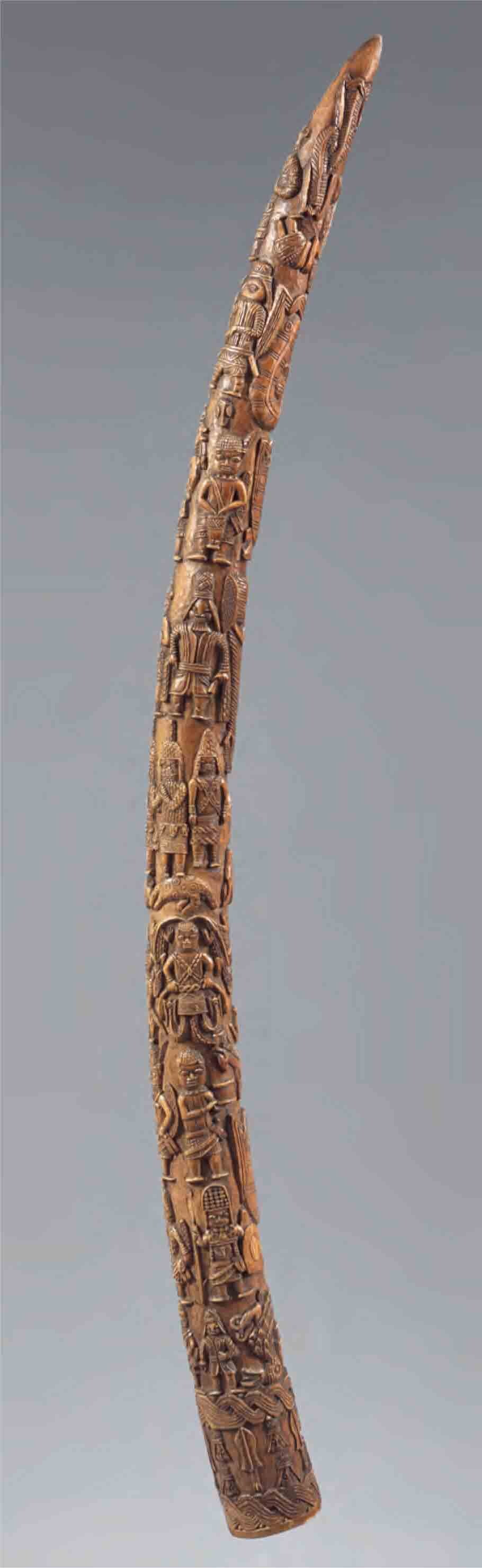
The tusk has many carved figures on it, mostly human or human-like.
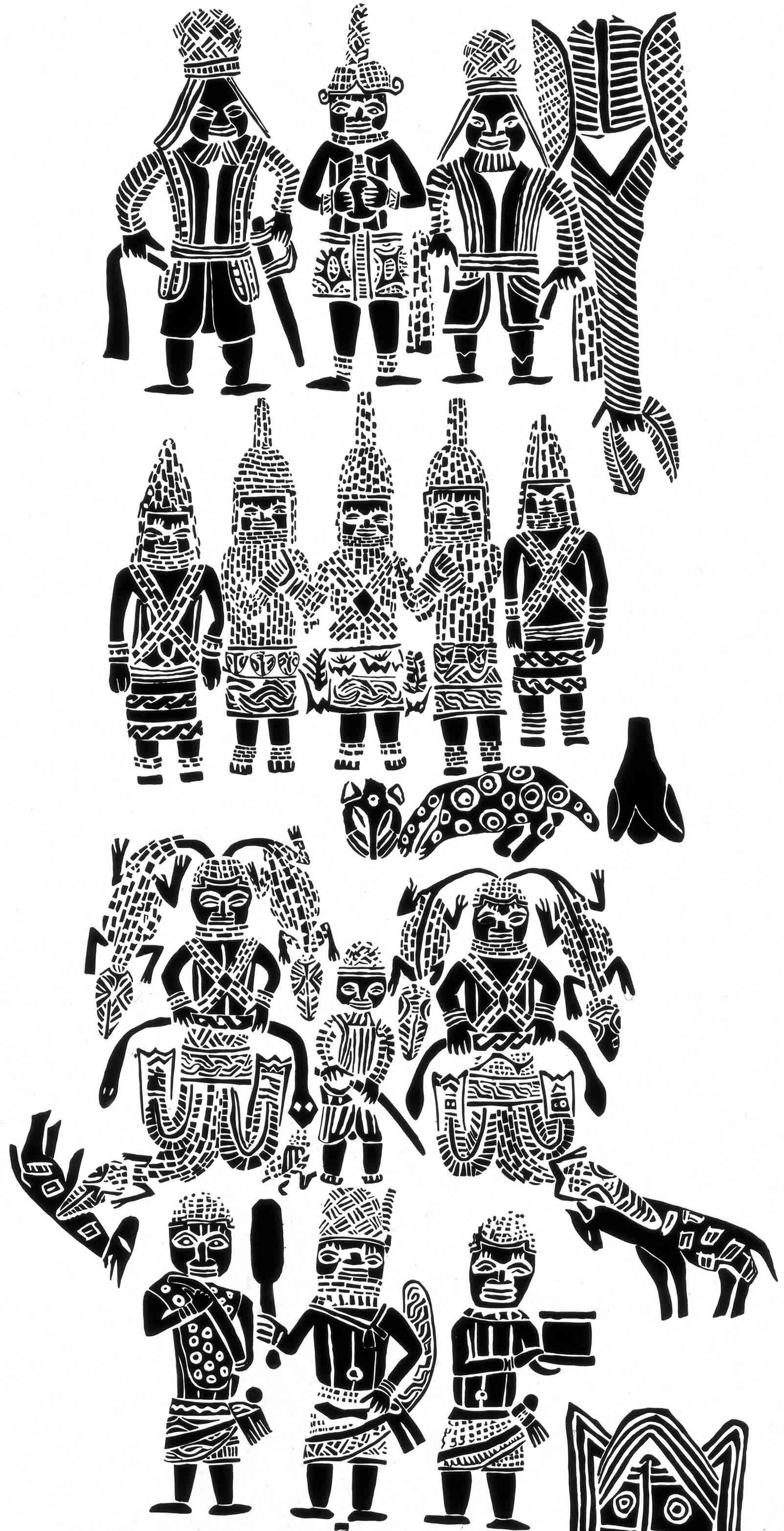
Some of the human figures wear crowns and other beaded regalia. In one register, a leopard lies at the feet of the middle figure in a group of five. In the register immediately below are two images of a person with legs curled in fishlike shapes and also producing creatures that eat other creatures.
HEAD FOR AN ANCESTRAL ALTAR One of the surviving copper-alloy heads (Fig. 49.11) that might have supported this carved tusk is attributed to brasscasters during the reign of Osemwende. Like the copper heads made in Ile-Ife for fourteenth-century Yoruba royalty (see Chapter 25), it is a generic portrait of a king, an image of ideal royal power. Its base is encircled by a flat ring (called a flange) that helped it support a heavy tusk, and the images on the flange refer to royal authority and supernatural power. For example, they include two small representations of the ancient stone hand axes that were sometimes unearthed by the floods that followed violent thunderstorms, and were thus seen as symbols of the king’s ability to smite his rivals unexpectedly. Here, these wedge-shaped items look a bit like teeth. Multiple rows of coral beads are shown covering the neck and chin of the royal head, but the crown does not include the projecting elements on the sides of the Oba's coral headdress that were introduced around 1820. The facial features are flat against the surface, but the cheeks are gently rounded. All of these formal qualities place the head within a stylistic sequence that spans at least four hundred years of royal portraiture in Benin.
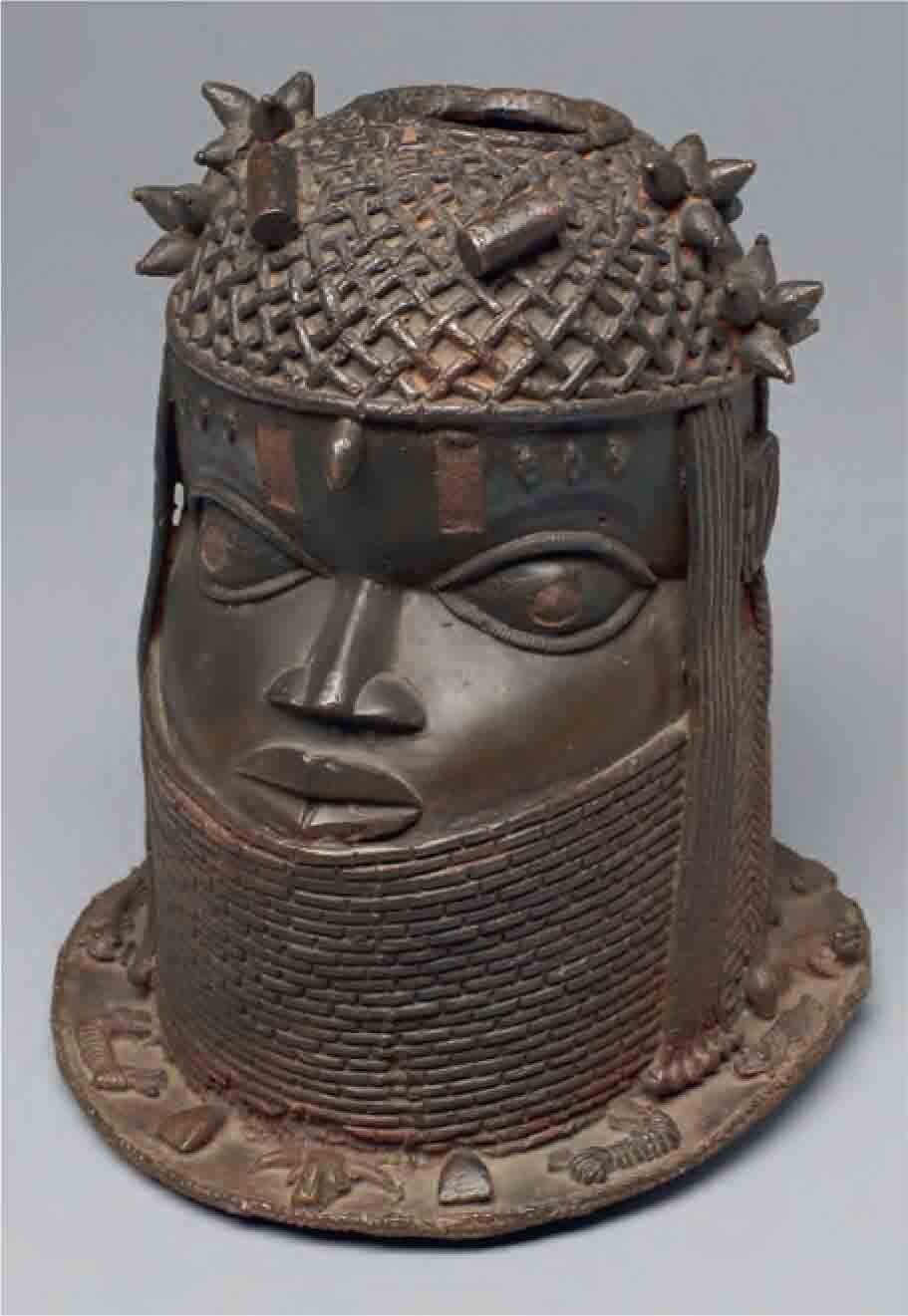
The head has a large hole in the top, into which an ivory tusk could be inserted. A flange encircles the neck to form a broad base. Animal shapes decorate the flange, along with two objects that look like human teeth. A necklace made to look like coral beads covers not just the neck but the entire lower jaw. The cap or helmet on top of head is a mesh of beadwork, with flower-like ornaments.